Task 2
Sample WT1
1. Task achievement
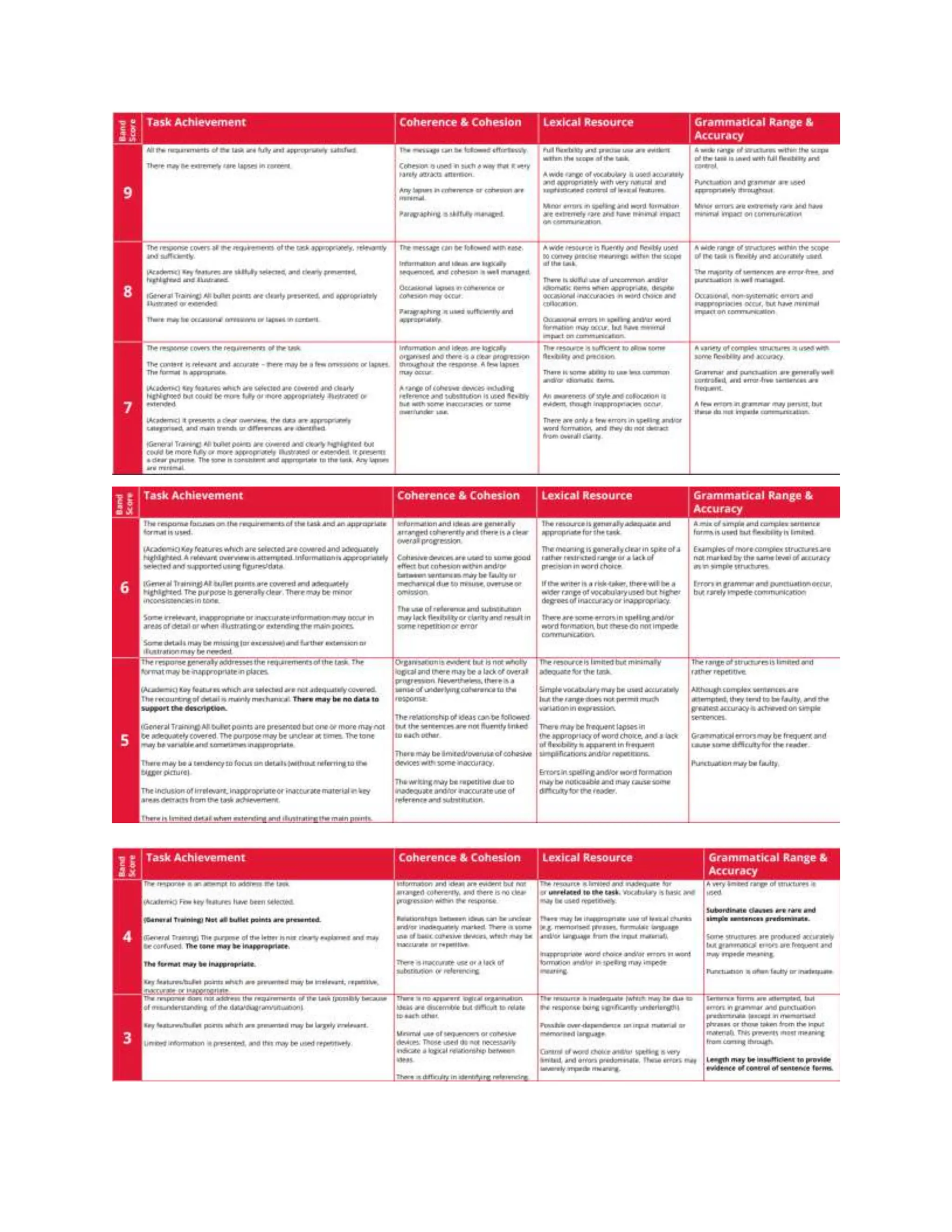
9 – All the requirements of the tasks are fully and appropriately satisfied
8 – The response covers all the requirements of the task appropriately, relevantly and
sufficiently. Key features are skilfully selected, and clearly presented, highlighted and
illustrated.
7 - The response covers the requirements of the task. The content is relevant and accurate –
there may be a few omissions or lapses. The format is appropriate. Key features which are
selected are covered and clearly highlighted but could be more fully or more appropriately
illustrated or extended. It presents a clear overview, the data are appropriately categorised,
and main trends or differences are identified.
6 - The response focuses on the requirements of the task and an appropriate format is used.
Key features which are selected are covered and adequately highlighted. A relevant overview
is attempted. Information is appropriately selected and supported using figures/data. Some
irrelevant, inappropriate or inaccurate information may occur in areas of detail or when
illustrating or extending the main points. Some details may be missing (or excessive) and
further extension or illustration may be needed.
5 - The response generally addresses the requirements of the task. The format may be
inappropriate in places. Key features which are selected are not adequately covered. The
recounting of detail is mainly mechanical. There may be no data to support the description.
There may be a tendency to focus on details (without referring to the bigger picture). The
inclusion of irrelevant, inappropriate or inaccurate material in key areas detracts from the
task achievement. There is limited detail when extending and illustrating the main points.
4 - The response is an attempt to address the task. Few key features have been selected. The
format may be inappropriate. Key features/bullet points which are presented may be
irrelevant, repetitive, inaccurate or inappropriate.
2. Coherence & Cohesion
9 - The message can be followed effortlessly. Cohesion is used in such a way that it very
rarely attracts attention. Any lapses in coherence or cohesion are minimal. Paragraphing is
skilfully managed.
8 - The message can be followed with ease. Information and ideas are logically sequenced,
and cohesion is well managed. Occasional lapses in coherence or cohesion may occur.
Paragraphing is used sufficiently and appropriately.
7 - Information and ideas are logically organised and there is a clear progression throughout
the response. A few lapses may occur. A range of cohesive devices including reference and
substitution is used flexibly but with some inaccuracies or some over/under use.
6 - Information and ideas are generally arranged coherently and there is a clear overall
progression. Cohesive devices are used to some good effect but cohesion within and/or
between sentences may be faulty or mechanical due to misuse, overuse or omission. The use
of reference and substitution may lack flexibility or clarity and result in some repetition or
error
5 - Organisation is evident but is not wholly logical and there may be a lack of overall
progression. Nevertheless, there is a sense of underlying coherence to the response. The
relationship of ideas can be followed but the sentences are not fluently linked to each other.
There may be limited/overuse of cohesive devices with some inaccuracy. The writing may be
repetitive due to inadequate and/or inaccurate use of reference and substitution.
4 - Information and ideas are evident but not arranged coherently, and there is no clear
progression within the response. Relationships between ideas can be unclear and/or
inadequately marked. There is some use of basic cohesive devices, which may be inaccurate
or repetitive. There is inaccurate use or a lack of substitution or referencing.
3. Lexical resource
9 – Full flexibility and precise use are evident within the scope of the task. A wide range of
vocabulary is used accurately and appropriately with very natural and sophisticated control of
lexical features. Minor errors in spelling and word formation are extremely rare and have
minimal impact on communication.
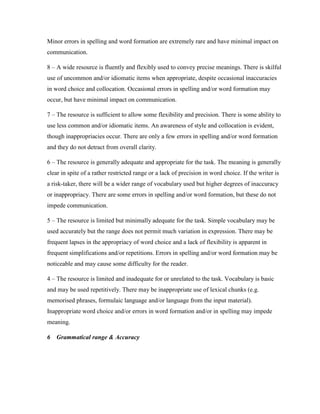
8 – A wide resource is fluently and flexibly used to convey precise meanings within the
scope of the task. There is skilful use of uncommon and/or idiomatic items when appropriate,
despite occasional inaccuracies in word choice and collocation. Occasional errors in spelling
and/or word formation may occur, but have minimal impact on communication.
7 – The resource is sufficient to allow some flexibility and precision. There is some ability to
use less common and/or idiomatic items. An awareness of style and collocation is evident,
though inappropriacies occur. There are only a few errors in spelling and/or word formation,
and they do not detract from overall clarity.
6 – The resource is generally adequate and appropriate for the task. The meaning is generally
clear in spite of a rather restricted range or a lack of precision in word choice. If the writer is
a risk-taker, there will be a wider range of vocabulary used but higher degrees of inaccuracy
or inappropriacy. There are some errors in spelling and/or word formation, but these do not
impede communication.
5 – The resource is limited but minimally adequate for the task. Simple vocabulary may be
used accurately but the range does not permit much variation in expression. There may be
frequent lapses in the appropriacy of word choice, and a lack of flexibility is apparent in
frequent simplifications and/or repetitions. Errors in spelling and/or word formation may be
noticeable and may cause some difficulty for the reader.
4 – The resource is limited and inadequate for or unrelated to the task. Vocabulary is basic
and may be used repetitively. There may be inappropriate use of lexical chunks (e.g.
memorised phrases, formulaic language and/or language from the input material).
Inappropriate word choice and/or errors in word formation and/or in spelling may impede
meaning.
4. Grammatical range & Accuracy
9 – A wide range of structures within the scope of the task is used with full flexibility and
control. Punctuation and grammar are used appropriately throughout. Minor errors are
extremely rare and have minimal impact on communication
8 – A wide range of structures within the scope of the task is flexibly and accurately used.
The majority of sentences are error-free, and punctuation is well managed. Occasional, non-
systematic errors and inappropriacies occur, but have minimal impact on communication.
7 – A variety of complex structures is used with some flexibility and accuracy. Grammar and
punctuation are generally well controlled, and error-free sentences are frequent. A few errors
in grammar may persist, but these do not impede communication.
6 – A mix of simple and complex sentence forms is used but flexibility is limited. Examples
of more complex structures are not marked by the same level of accuracy as in simple
structures. Errors in grammar and punctuation occur, but rarely impede communication
5 – The range of structures is limited and rather repetitive. Although complex sentences are
attempted, they tend to be faulty, and the greatest accuracy is achieved on simple sentences.
Grammatical errors may be frequent and cause some difficulty for the reader. Punctuation
may be faulty.
4 – A very limited range of structures is used. Subordinate clauses are rare and simple
sentences predominate. Some structures are produced accurately but grammatical errors are
frequent and may impede meaning. Punctuation is often faulty or inadequate.
Sample WT2
1. Task response
9 – The prompt is appropriately addressed and explored in depth. A clear and fully developed
position is presented which directly answers the question/s. Ideas are relevant, fully extended
and well supported.
8 – The prompt is appropriately and sufficiently addressed. A clear and well-developed
position is presented in response to the question/s. Ideas are relevant, well extended and
supported.
7 – The main parts of the prompt are appropriately addressed. A clear and developed position
is presented. Main ideas are extended and supported but there may be a tendency to over-
generalise or there may be a lack of focus and precision in supporting ideas/material.
6 – The main parts of the prompt are addressed (though some may be more fully covered
than others). An appropriate format is used. A position is presented that is directly relevant to
the prompt, although the conclusions drawn may be unclear, unjustified or repetitive. Main
ideas are relevant, but some may be insufficiently developed or may lack clarity, while some
supporting arguments and evidence may be less relevant or inadequate.
5 – The main parts of the prompt are incompletely addressed. The format may be
inappropriate in places. The writer expresses a position, but the development is not always
clear. Some main ideas are put forward, but they are limited and are not sufficiently
developed and/or there may be irrelevant detail. There may be some repetition.
4 – The prompt is tackled in a minimal way, or the answer is tangential, possibly due to some
misunderstanding of the prompt. The format may be inappropriate. A position is discernible,
but the reader has to read carefully to find it. Main ideas are difficult to identify and such
ideas that are identifiable may lack relevance, clarity and/or support. Large parts of the
response may be repetitive.
2. Coherence & Cohesion
9 – The message can be followed effortlessly. Cohesion is used in such a way that it very
rarely attracts attention. Any lapses in coherence or cohesion are minimal. Paragraphing is
skilfully managed.
8 – The message can be followed with ease. Information and ideas are logically sequenced,
and cohesion is well managed. Occasional lapses in coherence and cohesion may occur.
Paragraphing is used sufficiently and appropriately.
7 – Information and ideas are logically organised, and there is a clear progression throughout
the response. (A few lapses may occur, but these are minor.) A range of cohesive devices
including reference and substitution is used flexibly but with some inaccuracies or some
over/under use. Paragraphing is generally used effectively to support overall coherence, and
the sequencing of ideas within a paragraph is generally logical.
6 – Information and ideas are generally arranged coherently and there is a clear overall
progression. Cohesive devices are used to some good effect but cohesion within and/or
between sentences may be faulty or mechanical due to misuse, overuse or omission. The use
of reference and substitution may lack flexibility or clarity and result in some repetition or
error. Paragraphing may not always be logical and/or the central topic may not always be
clear.
5 – Organisation is evident but is not wholly logical and there may be a lack of overall
progression. Nevertheless, there is a sense of underlying coherence to the response. The
relationship of ideas can be followed but the sentences are not fluently linked to each other.
There may be limited/overuse of cohesive devices with some inaccuracy. The writing may be
repetitive due to inadequate and/or inaccurate use of reference and substitution. Paragraphing
may be inadequate or missing
4 – Information and ideas are evident but not arranged coherently and there is no clear
progression within the response. Relationships between ideas can be unclear and/or
inadequately marked. There is some use of basic cohesive devices, which may be inaccurate
or repetitive. There is inaccurate use or a lack of substitution or referencing. There may be no
paragraphing and/or no clear main topic within paragraphs.
5 Lexical resource
9 – Full flexibility and precise use are widely evident. A wide range of vocabulary is used
accurately and appropriately with very natural and sophisticated control of lexical features.
Minor errors in spelling and word formation are extremely rare and have minimal impact on
communication.
8 – A wide resource is fluently and flexibly used to convey precise meanings. There is skilful
use of uncommon and/or idiomatic items when appropriate, despite occasional inaccuracies
in word choice and collocation. Occasional errors in spelling and/or word formation may
occur, but have minimal impact on communication.
7 – The resource is sufficient to allow some flexibility and precision. There is some ability to
use less common and/or idiomatic items. An awareness of style and collocation is evident,
though inappropriacies occur. There are only a few errors in spelling and/or word formation
and they do not detract from overall clarity.
6 – The resource is generally adequate and appropriate for the task. The meaning is generally
clear in spite of a rather restricted range or a lack of precision in word choice. If the writer is
a risk-taker, there will be a wider range of vocabulary used but higher degrees of inaccuracy
or inappropriacy. There are some errors in spelling and/or word formation, but these do not
impede communication.
5 – The resource is limited but minimally adequate for the task. Simple vocabulary may be
used accurately but the range does not permit much variation in expression. There may be
frequent lapses in the appropriacy of word choice and a lack of flexibility is apparent in
frequent simplifications and/or repetitions. Errors in spelling and/or word formation may be
noticeable and may cause some difficulty for the reader.
4 – The resource is limited and inadequate for or unrelated to the task. Vocabulary is basic
and may be used repetitively. There may be inappropriate use of lexical chunks (e.g.
memorised phrases, formulaic language and/or language from the input material).
Inappropriate word choice and/or errors in word formation and/or in spelling may impede
meaning.
6 Grammatical range & Accuracy
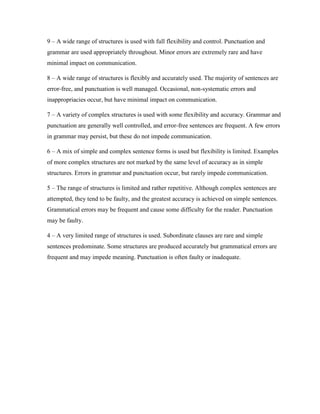
9 – A wide range of structures is used with full flexibility and control. Punctuation and
grammar are used appropriately throughout. Minor errors are extremely rare and have
minimal impact on communication.
8 – A wide range of structures is flexibly and accurately used. The majority of sentences are
error-free, and punctuation is well managed. Occasional, non-systematic errors and
inappropriacies occur, but have minimal impact on communication.
7 – A variety of complex structures is used with some flexibility and accuracy. Grammar and
punctuation are generally well controlled, and error-free sentences are frequent. A few errors
in grammar may persist, but these do not impede communication.
6 – A mix of simple and complex sentence forms is used but flexibility is limited. Examples
of more complex structures are not marked by the same level of accuracy as in simple
structures. Errors in grammar and punctuation occur, but rarely impede communication.
5 – The range of structures is limited and rather repetitive. Although complex sentences are
attempted, they tend to be faulty, and the greatest accuracy is achieved on simple sentences.
Grammatical errors may be frequent and cause some difficulty for the reader. Punctuation
may be faulty.
4 – A very limited range of structures is used. Subordinate clauses are rare and simple
sentences predominate. Some structures are produced accurately but grammatical errors are
frequent and may impede meaning. Punctuation is often faulty or inadequate.

ielts Writing descriptorsSSSSSSSSSS.docx

  • 2.
  • 3.
    Sample WT1 1. Taskachievement 9 – All the requirements of the tasks are fully and appropriately satisfied 8 – The response covers all the requirements of the task appropriately, relevantly and sufficiently. Key features are skilfully selected, and clearly presented, highlighted and illustrated. 7 - The response covers the requirements of the task. The content is relevant and accurate – there may be a few omissions or lapses. The format is appropriate. Key features which are selected are covered and clearly highlighted but could be more fully or more appropriately illustrated or extended. It presents a clear overview, the data are appropriately categorised, and main trends or differences are identified. 6 - The response focuses on the requirements of the task and an appropriate format is used. Key features which are selected are covered and adequately highlighted. A relevant overview is attempted. Information is appropriately selected and supported using figures/data. Some irrelevant, inappropriate or inaccurate information may occur in areas of detail or when illustrating or extending the main points. Some details may be missing (or excessive) and further extension or illustration may be needed. 5 - The response generally addresses the requirements of the task. The format may be inappropriate in places. Key features which are selected are not adequately covered. The
  • 4.
    recounting of detailis mainly mechanical. There may be no data to support the description. There may be a tendency to focus on details (without referring to the bigger picture). The inclusion of irrelevant, inappropriate or inaccurate material in key areas detracts from the task achievement. There is limited detail when extending and illustrating the main points. 4 - The response is an attempt to address the task. Few key features have been selected. The format may be inappropriate. Key features/bullet points which are presented may be irrelevant, repetitive, inaccurate or inappropriate. 2. Coherence & Cohesion 9 - The message can be followed effortlessly. Cohesion is used in such a way that it very rarely attracts attention. Any lapses in coherence or cohesion are minimal. Paragraphing is skilfully managed. 8 - The message can be followed with ease. Information and ideas are logically sequenced, and cohesion is well managed. Occasional lapses in coherence or cohesion may occur. Paragraphing is used sufficiently and appropriately. 7 - Information and ideas are logically organised and there is a clear progression throughout the response. A few lapses may occur. A range of cohesive devices including reference and substitution is used flexibly but with some inaccuracies or some over/under use. 6 - Information and ideas are generally arranged coherently and there is a clear overall progression. Cohesive devices are used to some good effect but cohesion within and/or between sentences may be faulty or mechanical due to misuse, overuse or omission. The use of reference and substitution may lack flexibility or clarity and result in some repetition or error 5 - Organisation is evident but is not wholly logical and there may be a lack of overall progression. Nevertheless, there is a sense of underlying coherence to the response. The relationship of ideas can be followed but the sentences are not fluently linked to each other. There may be limited/overuse of cohesive devices with some inaccuracy. The writing may be repetitive due to inadequate and/or inaccurate use of reference and substitution.
  • 5.
    4 - Informationand ideas are evident but not arranged coherently, and there is no clear progression within the response. Relationships between ideas can be unclear and/or inadequately marked. There is some use of basic cohesive devices, which may be inaccurate or repetitive. There is inaccurate use or a lack of substitution or referencing. 3. Lexical resource 9 – Full flexibility and precise use are evident within the scope of the task. A wide range of vocabulary is used accurately and appropriately with very natural and sophisticated control of lexical features. Minor errors in spelling and word formation are extremely rare and have minimal impact on communication. 8 – A wide resource is fluently and flexibly used to convey precise meanings within the scope of the task. There is skilful use of uncommon and/or idiomatic items when appropriate, despite occasional inaccuracies in word choice and collocation. Occasional errors in spelling and/or word formation may occur, but have minimal impact on communication. 7 – The resource is sufficient to allow some flexibility and precision. There is some ability to use less common and/or idiomatic items. An awareness of style and collocation is evident, though inappropriacies occur. There are only a few errors in spelling and/or word formation, and they do not detract from overall clarity. 6 – The resource is generally adequate and appropriate for the task. The meaning is generally clear in spite of a rather restricted range or a lack of precision in word choice. If the writer is a risk-taker, there will be a wider range of vocabulary used but higher degrees of inaccuracy or inappropriacy. There are some errors in spelling and/or word formation, but these do not impede communication. 5 – The resource is limited but minimally adequate for the task. Simple vocabulary may be used accurately but the range does not permit much variation in expression. There may be frequent lapses in the appropriacy of word choice, and a lack of flexibility is apparent in frequent simplifications and/or repetitions. Errors in spelling and/or word formation may be noticeable and may cause some difficulty for the reader.
  • 6.
    4 – Theresource is limited and inadequate for or unrelated to the task. Vocabulary is basic and may be used repetitively. There may be inappropriate use of lexical chunks (e.g. memorised phrases, formulaic language and/or language from the input material). Inappropriate word choice and/or errors in word formation and/or in spelling may impede meaning. 4. Grammatical range & Accuracy 9 – A wide range of structures within the scope of the task is used with full flexibility and control. Punctuation and grammar are used appropriately throughout. Minor errors are extremely rare and have minimal impact on communication 8 – A wide range of structures within the scope of the task is flexibly and accurately used. The majority of sentences are error-free, and punctuation is well managed. Occasional, non- systematic errors and inappropriacies occur, but have minimal impact on communication. 7 – A variety of complex structures is used with some flexibility and accuracy. Grammar and punctuation are generally well controlled, and error-free sentences are frequent. A few errors in grammar may persist, but these do not impede communication. 6 – A mix of simple and complex sentence forms is used but flexibility is limited. Examples of more complex structures are not marked by the same level of accuracy as in simple structures. Errors in grammar and punctuation occur, but rarely impede communication 5 – The range of structures is limited and rather repetitive. Although complex sentences are attempted, they tend to be faulty, and the greatest accuracy is achieved on simple sentences. Grammatical errors may be frequent and cause some difficulty for the reader. Punctuation may be faulty. 4 – A very limited range of structures is used. Subordinate clauses are rare and simple sentences predominate. Some structures are produced accurately but grammatical errors are frequent and may impede meaning. Punctuation is often faulty or inadequate. Sample WT2
  • 7.
    1. Task response 9– The prompt is appropriately addressed and explored in depth. A clear and fully developed position is presented which directly answers the question/s. Ideas are relevant, fully extended and well supported. 8 – The prompt is appropriately and sufficiently addressed. A clear and well-developed position is presented in response to the question/s. Ideas are relevant, well extended and supported. 7 – The main parts of the prompt are appropriately addressed. A clear and developed position is presented. Main ideas are extended and supported but there may be a tendency to over- generalise or there may be a lack of focus and precision in supporting ideas/material. 6 – The main parts of the prompt are addressed (though some may be more fully covered than others). An appropriate format is used. A position is presented that is directly relevant to the prompt, although the conclusions drawn may be unclear, unjustified or repetitive. Main ideas are relevant, but some may be insufficiently developed or may lack clarity, while some supporting arguments and evidence may be less relevant or inadequate. 5 – The main parts of the prompt are incompletely addressed. The format may be inappropriate in places. The writer expresses a position, but the development is not always clear. Some main ideas are put forward, but they are limited and are not sufficiently developed and/or there may be irrelevant detail. There may be some repetition. 4 – The prompt is tackled in a minimal way, or the answer is tangential, possibly due to some misunderstanding of the prompt. The format may be inappropriate. A position is discernible, but the reader has to read carefully to find it. Main ideas are difficult to identify and such ideas that are identifiable may lack relevance, clarity and/or support. Large parts of the response may be repetitive. 2. Coherence & Cohesion 9 – The message can be followed effortlessly. Cohesion is used in such a way that it very rarely attracts attention. Any lapses in coherence or cohesion are minimal. Paragraphing is skilfully managed.
  • 8.
    8 – Themessage can be followed with ease. Information and ideas are logically sequenced, and cohesion is well managed. Occasional lapses in coherence and cohesion may occur. Paragraphing is used sufficiently and appropriately. 7 – Information and ideas are logically organised, and there is a clear progression throughout the response. (A few lapses may occur, but these are minor.) A range of cohesive devices including reference and substitution is used flexibly but with some inaccuracies or some over/under use. Paragraphing is generally used effectively to support overall coherence, and the sequencing of ideas within a paragraph is generally logical. 6 – Information and ideas are generally arranged coherently and there is a clear overall progression. Cohesive devices are used to some good effect but cohesion within and/or between sentences may be faulty or mechanical due to misuse, overuse or omission. The use of reference and substitution may lack flexibility or clarity and result in some repetition or error. Paragraphing may not always be logical and/or the central topic may not always be clear. 5 – Organisation is evident but is not wholly logical and there may be a lack of overall progression. Nevertheless, there is a sense of underlying coherence to the response. The relationship of ideas can be followed but the sentences are not fluently linked to each other. There may be limited/overuse of cohesive devices with some inaccuracy. The writing may be repetitive due to inadequate and/or inaccurate use of reference and substitution. Paragraphing may be inadequate or missing 4 – Information and ideas are evident but not arranged coherently and there is no clear progression within the response. Relationships between ideas can be unclear and/or inadequately marked. There is some use of basic cohesive devices, which may be inaccurate or repetitive. There is inaccurate use or a lack of substitution or referencing. There may be no paragraphing and/or no clear main topic within paragraphs. 5 Lexical resource 9 – Full flexibility and precise use are widely evident. A wide range of vocabulary is used accurately and appropriately with very natural and sophisticated control of lexical features.
  • 9.
    Minor errors inspelling and word formation are extremely rare and have minimal impact on communication. 8 – A wide resource is fluently and flexibly used to convey precise meanings. There is skilful use of uncommon and/or idiomatic items when appropriate, despite occasional inaccuracies in word choice and collocation. Occasional errors in spelling and/or word formation may occur, but have minimal impact on communication. 7 – The resource is sufficient to allow some flexibility and precision. There is some ability to use less common and/or idiomatic items. An awareness of style and collocation is evident, though inappropriacies occur. There are only a few errors in spelling and/or word formation and they do not detract from overall clarity. 6 – The resource is generally adequate and appropriate for the task. The meaning is generally clear in spite of a rather restricted range or a lack of precision in word choice. If the writer is a risk-taker, there will be a wider range of vocabulary used but higher degrees of inaccuracy or inappropriacy. There are some errors in spelling and/or word formation, but these do not impede communication. 5 – The resource is limited but minimally adequate for the task. Simple vocabulary may be used accurately but the range does not permit much variation in expression. There may be frequent lapses in the appropriacy of word choice and a lack of flexibility is apparent in frequent simplifications and/or repetitions. Errors in spelling and/or word formation may be noticeable and may cause some difficulty for the reader. 4 – The resource is limited and inadequate for or unrelated to the task. Vocabulary is basic and may be used repetitively. There may be inappropriate use of lexical chunks (e.g. memorised phrases, formulaic language and/or language from the input material). Inappropriate word choice and/or errors in word formation and/or in spelling may impede meaning. 6 Grammatical range & Accuracy
  • 10.
    9 – Awide range of structures is used with full flexibility and control. Punctuation and grammar are used appropriately throughout. Minor errors are extremely rare and have minimal impact on communication. 8 – A wide range of structures is flexibly and accurately used. The majority of sentences are error-free, and punctuation is well managed. Occasional, non-systematic errors and inappropriacies occur, but have minimal impact on communication. 7 – A variety of complex structures is used with some flexibility and accuracy. Grammar and punctuation are generally well controlled, and error-free sentences are frequent. A few errors in grammar may persist, but these do not impede communication. 6 – A mix of simple and complex sentence forms is used but flexibility is limited. Examples of more complex structures are not marked by the same level of accuracy as in simple structures. Errors in grammar and punctuation occur, but rarely impede communication. 5 – The range of structures is limited and rather repetitive. Although complex sentences are attempted, they tend to be faulty, and the greatest accuracy is achieved on simple sentences. Grammatical errors may be frequent and cause some difficulty for the reader. Punctuation may be faulty. 4 – A very limited range of structures is used. Subordinate clauses are rare and simple sentences predominate. Some structures are produced accurately but grammatical errors are frequent and may impede meaning. Punctuation is often faulty or inadequate.