JISC BCE - Dissemination

Editor's Notes

  • #2 <number>Knowledge transfer and exchange, innovation and employer engagement are all themes high on the government’s agenda, reflected by high profile reports such as Innovation Nation, the Science and Innovation Investment Framework 2004-14 and several key reviews including those by Sainsbury, Leitch and Foster. These are all drivers of national policy striving to position the UK effectively in a knowledge based economy, and shape the role of Universities and Colleges in both the economy and society.
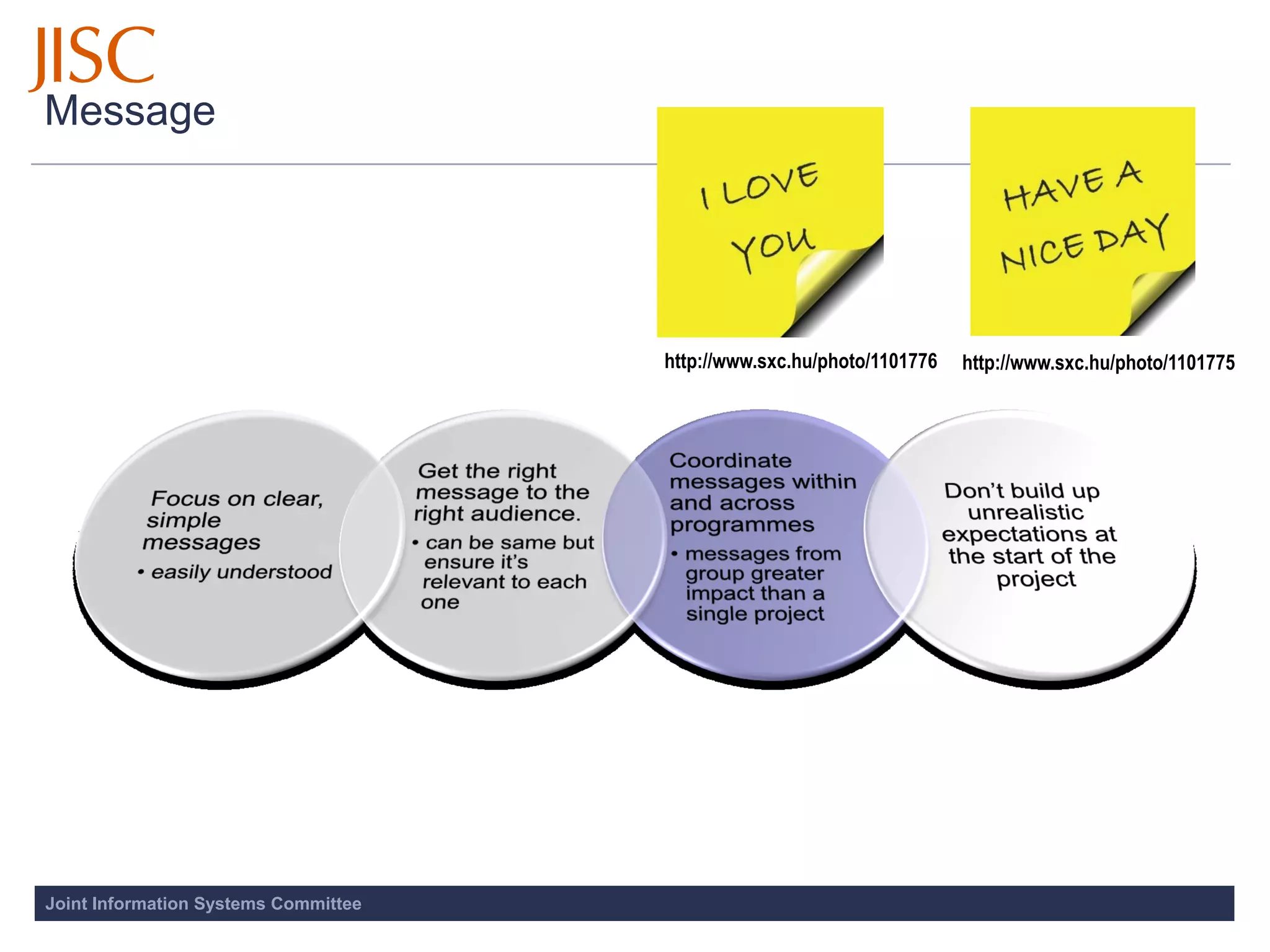
  • #4 Focus on clear, simple messages that are easily understood Get the right message to the right audience. You can send the same message to different audiences, but make sure it’s relevant to each one Coordinate messages within and across programmes.
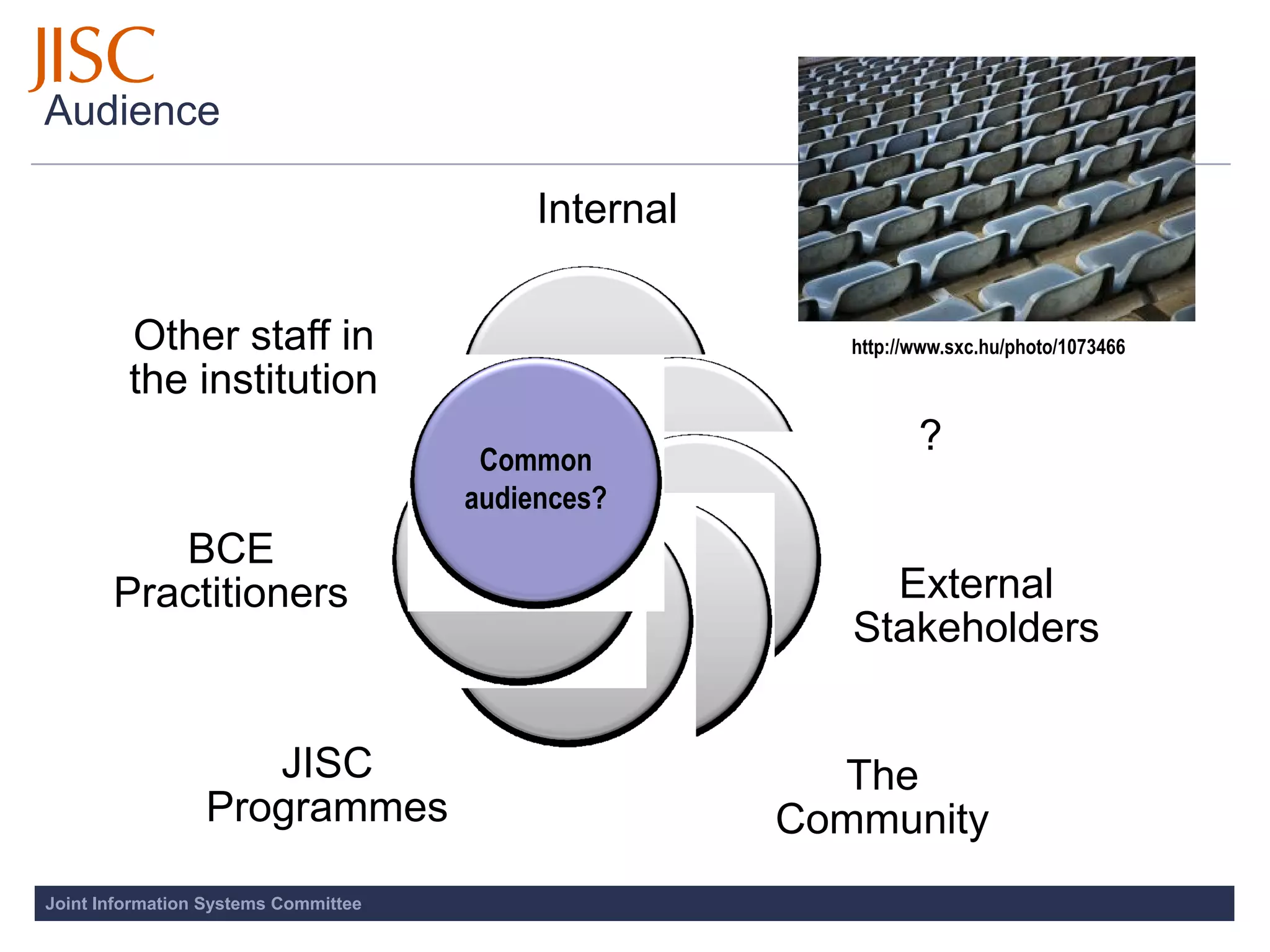
  • #5 Audience Think about who you want to reach and what they can do for your project. Identify the different individuals, groups, and organisations that will be interested in what you’re developing, particularly with respect to take-up at the end of the project. The stakeholder analysis2 identified people who will be affected by your project and whose support you need. Use dissemination to inform and engage stakeholders, and get them to buy into your work.  Consider the following audiences: Internal (e.g. your institution and/or the project consortium) – They supported the project bid, so keep them informed about what you’re doing. Use dissemination to make sure the project has a high profile and they buy into what you are developing. JISC development programmes – Share your results with other projects, within the programme and across programmes.  rogramme meetings (and cluster meetings) are an excellent opportunity to share what you’ve done and get feedback from projects doing similar work or facing similar problems and issues. External stakeholders – Think about who might take up your outputs and the stakeholders that can help you to ‘make it happen’. These might be teachers, researchers, librarians, publishers, online hosts, etc. Think of opportunities to engage with them like conferences. The community – There may be much to share with the wider education and research communities. For example, guidelines, methods, evaluation criteria, questionnaires, and what you learned generally. Think about who could learn from your knowledge and experience and share it in case studies, journal articles, etc. <number>
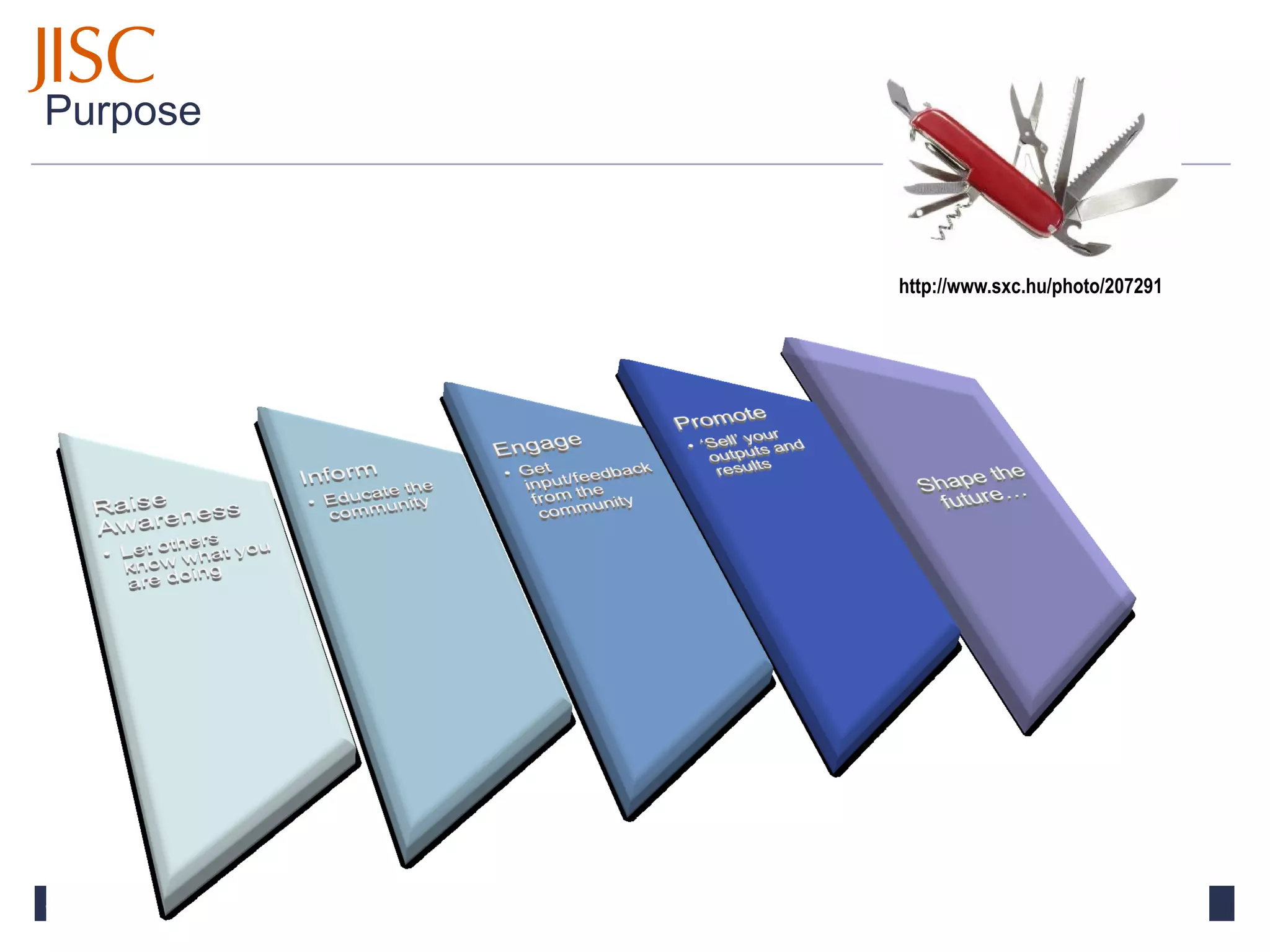
  • #6 Raise awareness – let others know what you are doingInform – educate the communityEngage – get input/feedback from the communityPromote – ‘sell’ your outputs and results<number>
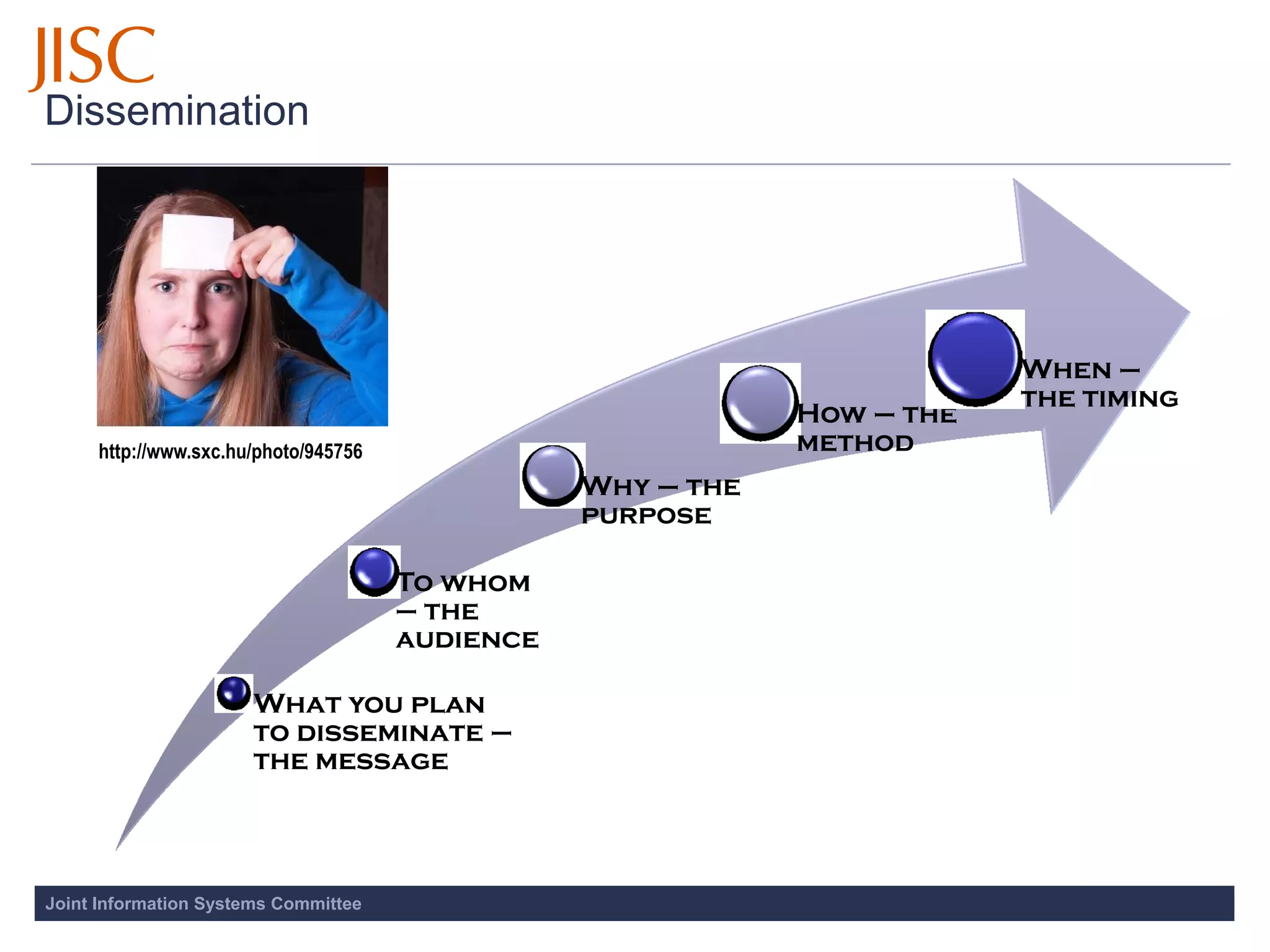
  • #7 Methods There are a wide variety of dissemination methods3.
  • #8 Collaboration The dissemination strategy will ensure that the programme has a high profile, the community learns from its achievements, and outputs are embedded and taken up.  The programme manager will share the strategy with you early in the project and invite you to contribute ideas. Where the programme is structured by clusters, the clusters will be asked to brainstorm about ways to collaborate on dissemination. Thinking early in the programme about the ‘big picture’ will maximise the impact of dissemination and the sustainability of its outputs You will be asked to participate in programme and cluster dissemination activities. There are very selfish reasons for doing so. Firstly, initiatives at programme and cluster-level often have more impact than those at project-level. Colleagues in the field are more likely to attend a cluster workshop with six demos than a project workshop with one. A MLE InfoKit has more impact than a single case study. Secondly, it’s cost effective. Contribute your ideas on collaboration and participate in the activities that are planned<number>
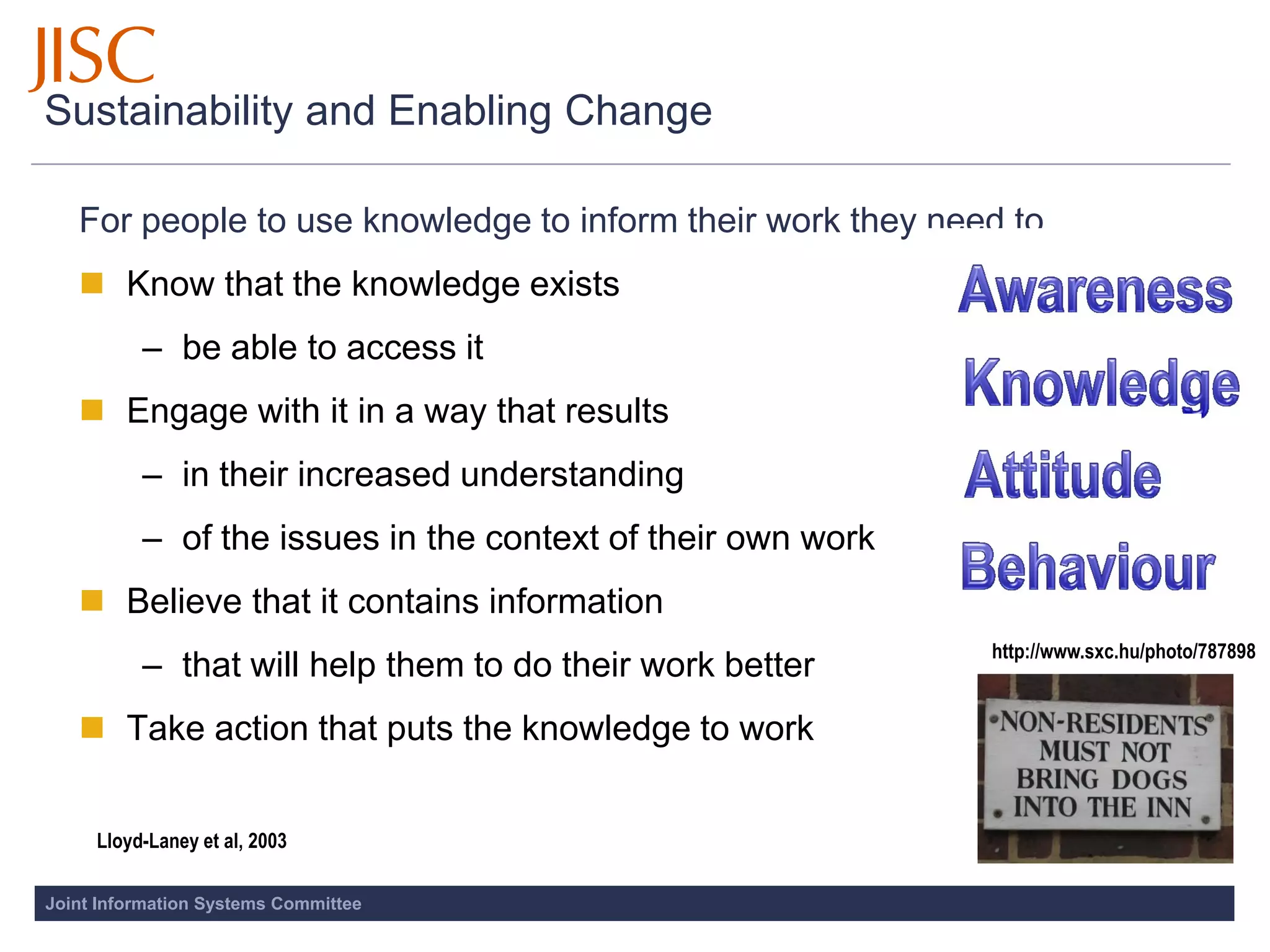
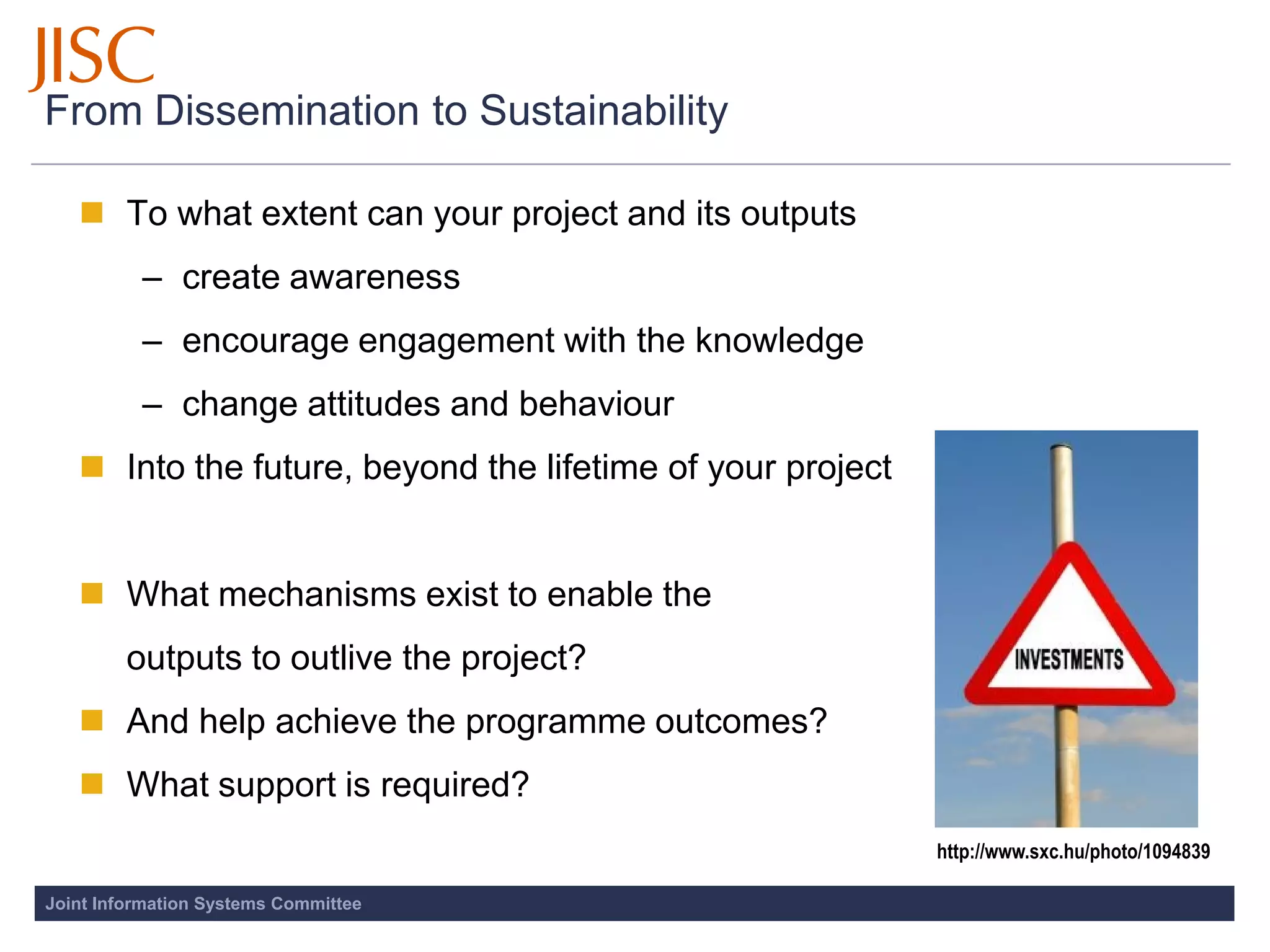
  • #9 For people to use knowledge to inform their work, they need to know that the knowledge exists and they need to be able to access it (Awareness). Once they have hold of it, they need to engage with ti in a way that results in their increased understanding of the issues in the context of their own work (Knowledge). They need to believe that it contains information that will help them to do their work better (Attitude). And finally, they need to take action that puts the knowledge to work (Behavior)<number>
  • #10 For people to use knowledge to inform their work, they need to know that the knowledge exists and they need to be able to access it (Awareness). Once they have hold of it, they need to engage with ti in a way that results in their increased understanding of the issues in the context of their own work (Knowledge). They need to believe that it contains information that will help them to do their work better (Attitude). And finally, they need to take action that puts the knowledge to work (Behavior)<number>