IEEE Standard 1588
  Precision Timing Protocol - PTP


                                    許勝倉@NCU 2008/March/08
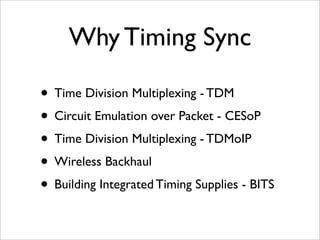
Why Timing Sync

• Time Division Multiplexing - TDM
• Circuit Emulation over Packet - CESoP
• Time Division Multiplexing - TDMoIP
• Wireless Backhaul
• Building Integrated Timing Supplies - BITS
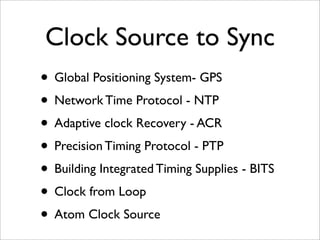
Clock Source to Sync
• Global Positioning System- GPS
• Network Time Protocol - NTP
• Adaptive clock Recovery - ACR
• Precision Timing Protocol - PTP
• Building Integrated Timing Supplies - BITS
• Clock from Loop
• Atom Clock Source
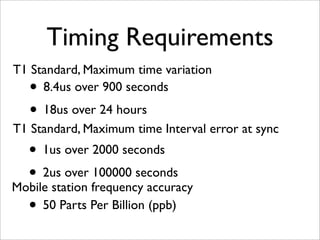
Timing Requirements
T1 Standard, Maximum time variation
   • 8.4us over 900 seconds
   • 18us over 24 hours
T1 Standard, Maximum time Interval error at sync
  • 1us over 2000 seconds
  • 2us over 100000 seconds
Mobile station frequency accuracy
  • 50 Parts Per Billion (ppb)
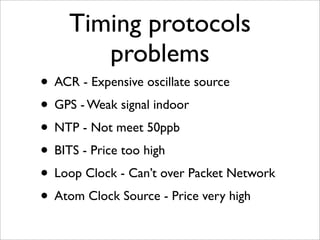
Timing protocols
       problems
• ACR - Expensive oscillate source
• GPS - Weak signal indoor
• NTP - Not meet 50ppb
• BITS - Price too high
• Loop Clock - Can’t over Packet Network
• Atom Clock Source - Price very high
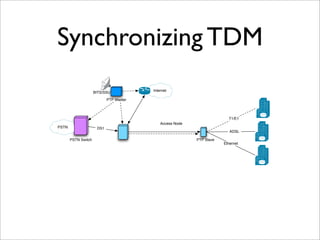
Synchronizing TDM
                                         Internet
                     BITS/SSU
                            PTP Master


                                                                         T1/E1
                                             Access Node
PSTN                  DS1
                                                                          ADSL

       PSTN Switch                                         PTP Slave
                                                                       Ethernet
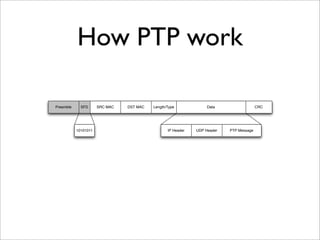
How PTP work

Preamble     SFD      SRC MAC   DST MAC   Length/Type             Data                  CRC


           10101011                              IP Header   UDP Header   PTP Message
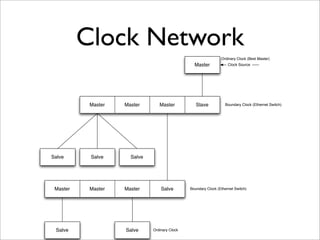
Clock Network
                                                                Ordinary Clock (Best Master)
                                                 Master             Clock Source


           Master   Master       Master           Slave           Boundary Clock (Ethernet Switch)


Salve      Salve      Salve


 Master    Master   Master        Salve        Boundary Clock (Ethernet Switch)


 Salve              Salve     Ordinary Clock
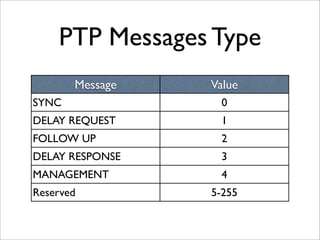
PTP Messages Type
       Message   Value
SYNC              0
DELAY REQUEST     1
FOLLOW UP         2
DELAY RESPONSE    3
MANAGEMENT        4
Reserved         5-255
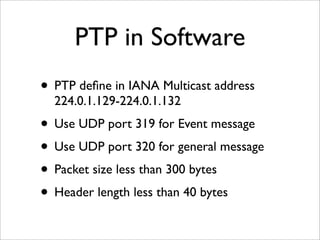
PTP in Software
• PTP define in IANA Multicast address
  224.0.1.129-224.0.1.132
• Use UDP port 319 for Event message
• Use UDP port 320 for general message
• Packet size less than 300 bytes
• Header length less than 40 bytes
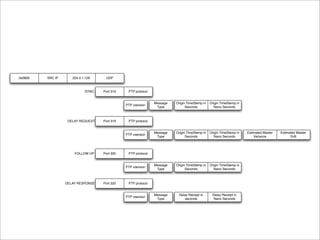
0x0800   SRC IP      224.0.1.129    UDP


                            SYNC   Port 319    PTP protocol


                                                              Message   Origin TimeStemp in   Origin TimeStemp in
                                              PTP vsersion
                                                               Type           Seconds            Nano Seconds


                   DELAY REQUEST   Port 319    PTP protocol


                                                              Message   Origin TimeStemp in   Origin TimeStemp in   Estimated Master   Estimated Master
                                              PTP vsersion
                                                               Type           Seconds            Nano Seconds           Variance             Drift


                      FOLLOW UP    Port 320    PTP protocol


                                                              Message   Origin TimeStemp in   Origin TimeStemp in
                                              PTP vsersion
                                                               Type           Seconds            Nano Seconds


                  DELAY RESPONSE   Port 320    PTP protocol


                                                              Message    Delay Receipt in      Delay Receipt in
                                              PTP vsersion
                                                               Type          seconds           Nano Seconds
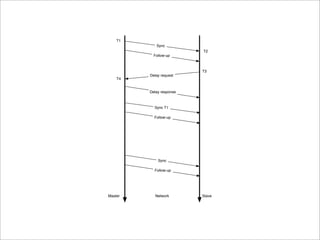
T1
            Sync
                          T2
           Follow-up


                          T3
         Delay request
    T4


         Delay response


           Sync T1

           Follow-up


             Sync

           Follow-up


Master      Network       Slave
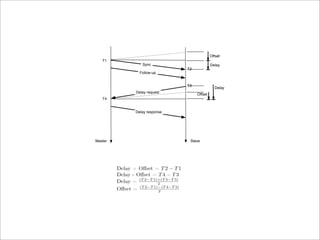
Offset
   T1
            Sync                        Delay
                          T2
           Follow-up


                          T3
                                          Delay
         Delay request
                               Offset
   T4


         Delay response


Master                     Slave
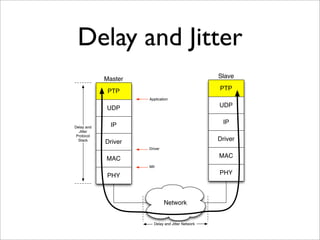
Delay and Jitter
            Master                                Slave

             PTP                                  PTP
                     Application

            UDP                                   UDP


              IP                                   IP
Delay and
  Jitter
 Protocol
  Stack
            Driver                                Driver
                     Driver

            MAC                                   MAC
                     MII

            PHY                                   PHY


                              Network


                       Delay and Jitter Network
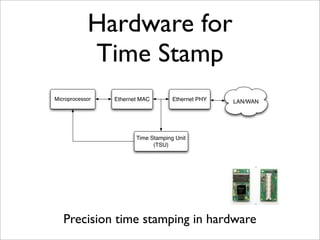
Hardware for
            Time Stamp
Microprocessor   Ethernet MAC        Ethernet PHY   LAN/WAN


                        Time Stamping Unit
                              (TSU)


   Precision time stamping in hardware
Open Source PTPD
             http://ptpd.sf.net
Conclusion
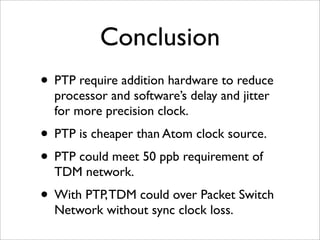
• PTP require addition hardware to reduce
  processor and software’s delay and jitter
  for more precision clock.
• PTP is cheaper than Atom clock source.
• PTP could meet 50 ppb requirement of
  TDM network.
• With PTP, TDM could over Packet Switch
  Network without sync clock loss.
Reference

•   IEEE Standard 1588-2002 Version 2

•   IEEE 1588 Precision Timing Protocol, Jeremy Bennington, Symmetricom

•   High Precision clock Synchronization according to IEEE 1588 Implementation
    and Performance Issue, Hans Weibel, Zurich Univ.

•   PTPD for Linux http://ptpd.sf.net

•   IEEE Standard 802.1AS Draft

Ieee 1588 ptp

  • 1.
    IEEE Standard 1588 Precision Timing Protocol - PTP 許勝倉@NCU 2008/March/08
  • 2.
    Why Timing Sync •Time Division Multiplexing - TDM • Circuit Emulation over Packet - CESoP • Time Division Multiplexing - TDMoIP • Wireless Backhaul • Building Integrated Timing Supplies - BITS
  • 3.
    Clock Source toSync • Global Positioning System- GPS • Network Time Protocol - NTP • Adaptive clock Recovery - ACR • Precision Timing Protocol - PTP • Building Integrated Timing Supplies - BITS • Clock from Loop • Atom Clock Source
  • 4.
    Timing Requirements T1 Standard,Maximum time variation • 8.4us over 900 seconds • 18us over 24 hours T1 Standard, Maximum time Interval error at sync • 1us over 2000 seconds • 2us over 100000 seconds Mobile station frequency accuracy • 50 Parts Per Billion (ppb)
  • 5.
    Timing protocols problems • ACR - Expensive oscillate source • GPS - Weak signal indoor • NTP - Not meet 50ppb • BITS - Price too high • Loop Clock - Can’t over Packet Network • Atom Clock Source - Price very high
  • 6.
    Synchronizing TDM Internet BITS/SSU PTP Master T1/E1 Access Node PSTN DS1 ADSL PSTN Switch PTP Slave Ethernet
  • 7.
    How PTP work Preamble SFD SRC MAC DST MAC Length/Type Data CRC 10101011 IP Header UDP Header PTP Message
  • 8.
    Clock Network Ordinary Clock (Best Master) Master Clock Source Master Master Master Slave Boundary Clock (Ethernet Switch) Salve Salve Salve Master Master Master Salve Boundary Clock (Ethernet Switch) Salve Salve Ordinary Clock
  • 9.
    PTP Messages Type Message Value SYNC 0 DELAY REQUEST 1 FOLLOW UP 2 DELAY RESPONSE 3 MANAGEMENT 4 Reserved 5-255
  • 10.
    PTP in Software •PTP define in IANA Multicast address 224.0.1.129-224.0.1.132 • Use UDP port 319 for Event message • Use UDP port 320 for general message • Packet size less than 300 bytes • Header length less than 40 bytes
  • 11.
    0x0800 SRC IP 224.0.1.129 UDP SYNC Port 319 PTP protocol Message Origin TimeStemp in Origin TimeStemp in PTP vsersion Type Seconds Nano Seconds DELAY REQUEST Port 319 PTP protocol Message Origin TimeStemp in Origin TimeStemp in Estimated Master Estimated Master PTP vsersion Type Seconds Nano Seconds Variance Drift FOLLOW UP Port 320 PTP protocol Message Origin TimeStemp in Origin TimeStemp in PTP vsersion Type Seconds Nano Seconds DELAY RESPONSE Port 320 PTP protocol Message Delay Receipt in Delay Receipt in PTP vsersion Type seconds Nano Seconds
  • 12.
    T1 Sync T2 Follow-up T3 Delay request T4 Delay response Sync T1 Follow-up Sync Follow-up Master Network Slave
  • 13.
    Offset T1 Sync Delay T2 Follow-up T3 Delay Delay request Offset T4 Delay response Master Slave
  • 14.
    Delay and Jitter Master Slave PTP PTP Application UDP UDP IP IP Delay and Jitter Protocol Stack Driver Driver Driver MAC MAC MII PHY PHY Network Delay and Jitter Network
  • 15.
    Hardware for Time Stamp Microprocessor Ethernet MAC Ethernet PHY LAN/WAN Time Stamping Unit (TSU) Precision time stamping in hardware
  • 16.
    Open Source PTPD http://ptpd.sf.net
  • 17.
    Conclusion • PTP requireaddition hardware to reduce processor and software’s delay and jitter for more precision clock. • PTP is cheaper than Atom clock source. • PTP could meet 50 ppb requirement of TDM network. • With PTP, TDM could over Packet Switch Network without sync clock loss.
  • 18.
    Reference • IEEE Standard 1588-2002 Version 2 • IEEE 1588 Precision Timing Protocol, Jeremy Bennington, Symmetricom • High Precision clock Synchronization according to IEEE 1588 Implementation and Performance Issue, Hans Weibel, Zurich Univ. • PTPD for Linux http://ptpd.sf.net • IEEE Standard 802.1AS Draft