1 
Once upon a time in an eco- home far, far away
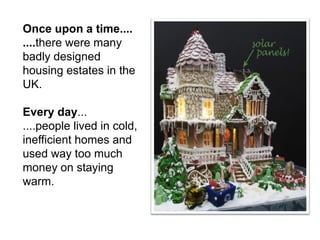
Once upon a time.... ....there were many badly designed housing estates in the UK. Every day... ....people lived in cold, inefficient homes and used way too much money on staying warm.
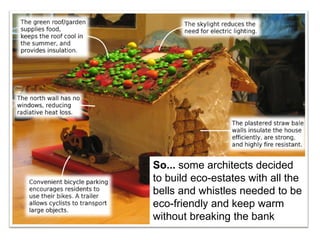
So... some architects decided to build eco-estates with all the bells and whistles needed to be eco-friendly and keep warm without breaking the bank
Then, one day... 
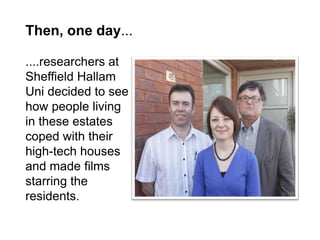
....researchers at Sheffield Hallam Uni decided to see how people living in these estates coped with their high-tech houses and made films starring the residents.
But then... the researchers found that people living in eco-homes had different understandings of its features and technologies to those designing them. 
They often didn’t care or know they were eco homes but liked the look of them. They also complained that no one had explained to them all the eco features and how to use them properly.
Until, finally... The films were all put online to bring together everyone involved in building, selling and living in eco housing. 
And, ever since then...architects, builders and policy makers that have watched the films have gotten a bit wiser about what is important to the users of their products.
7
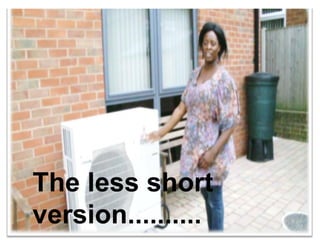
The less short version..........
Key facts....... 
•one year UK ESRC funded project (2011- 2012) 
•four case study low energy housing developments in England 
•uses film making and social media to give residents a VOICE 
•residents filmed talking about their homes, in their homes 
•3 films featuring total of 14 households
4 reasons to research eco-homes now research eco-homes now? 
1.If eco-schemes are to have desired outcomes, architects, developers and housing providers should think from the users' point of view Lynch (1989, 67-106) and Marshall (2008) 
2.Zero carbon footprints by 2050* mean that radical changes in the way our homes look and function are unavoidable. 
3.Escalating energy costs also mean we must ensure that the energy saving potential of properties are maximised 
4.The complexity of domestic energy systems will increase 
*UK national carbon delivery plan (DECC 2011, 30)
3 aims.... 
1.to understand and show how ‘ordinary’ people use and respond to innovative eco-homes 
2.to give occupants a voice in the debate around low energy homes 
3.to enable architects and developers to think from the users' point of view
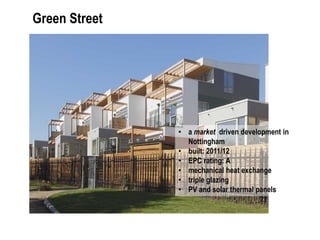
Green Street 
•a market driven development in Nottingham 
•built: 2011/12 
•EPC rating: A 
•mechanical heat exchange 
•triple glazing 
•PV and solar thermal panels
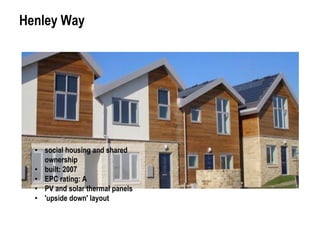
Henley Way 
•social housing and shared ownership 
•built: 2007 
•EPC rating: A 
•PV and solar thermal panels 
•'upside down' layout
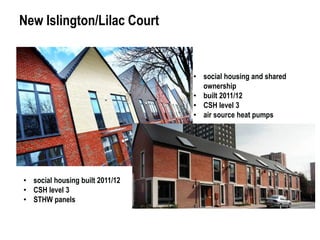
New Islington/Lilac Court 
•social housing and shared ownership 
•built 2011/12 
•CSH level 3 
•air source heat pumps 
•social housing built 2011/12 
•CSH level 3 
•STHW panels
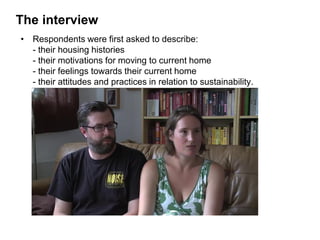
The interview 
•Respondents were first asked to describe: - their housing histories - their motivations for moving to current home - their feelings towards their current home - their attitudes and practices in relation to sustainability.
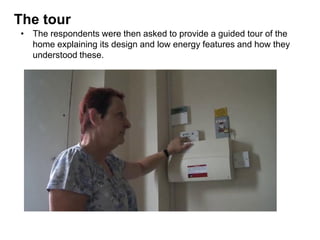
The tour 
•The respondents were then asked to provide a guided tour of the home explaining its design and low energy features and how they understood these.
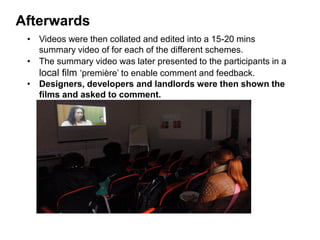
Afterwards 
•Videos were then collated and edited into a 15-20 mins summary video of for each of the different schemes. 
•The summary video was later presented to the participants in a local film ‘première’ to enable comment and feedback. 
•Designers, developers and landlords were then shown the films and asked to comment.
4 things we learntabout living in low energy housing? 
1.Many residents struggled with the complexity of the unconventional technology, did not find it intuitive and were unsure how to get the best out of it 
2.Some were experiencing adverse effects: e.g. higher bills and hot/cold homes 
3.Little support / guidance available aside from manuals and some erroneous information passed on. 
4.Some social housing tenants felt they had not 'opted in' to low carbon living
What we learnt about eco as home... 
•Appearance, location and the community and performance as 'home' are as important as eco-features (a bonus) 
•Previous studies have used practice theory to interpret occupants responses. Works well BUT.... 
•...does not take account of identity: the home is a means of both forming and projecting social identity. 
•Neither identity nor practice are independent. 
•As a result, both identity theory AND practice theory is relevant, when analysing the results and designing houses.
4 lessons for policy types... 
1.If the home is not used correctly, low energy designs will not realise their potential 
2.Social landlords must take account of tenants' preferences when trying to meet obligations to reduce carbon emissions and protect tenants from FP 
3.More training of 'frontline staff' required to support occupants to access benefits of a low energy home 
4.Homes have to be socially acceptable as well as functional
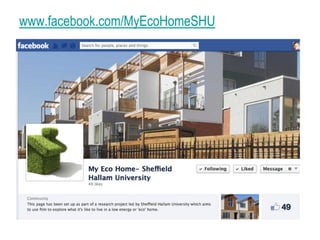
www.facebook.com/MyEcoHomeSHU

Inside the UK's EcoHome - a Pecha Kucha story

  • 1.
    1 Once upona time in an eco- home far, far away
  • 2.
    Once upon atime.... ....there were many badly designed housing estates in the UK. Every day... ....people lived in cold, inefficient homes and used way too much money on staying warm.
  • 3.
    So... some architectsdecided to build eco-estates with all the bells and whistles needed to be eco-friendly and keep warm without breaking the bank
  • 4.
    Then, one day... ....researchers at Sheffield Hallam Uni decided to see how people living in these estates coped with their high-tech houses and made films starring the residents.
  • 5.
    But then... theresearchers found that people living in eco-homes had different understandings of its features and technologies to those designing them. They often didn’t care or know they were eco homes but liked the look of them. They also complained that no one had explained to them all the eco features and how to use them properly.
  • 6.
    Until, finally... Thefilms were all put online to bring together everyone involved in building, selling and living in eco housing. And, ever since then...architects, builders and policy makers that have watched the films have gotten a bit wiser about what is important to the users of their products.
  • 7.
  • 8.
    The less shortversion..........
  • 9.
    Key facts....... •oneyear UK ESRC funded project (2011- 2012) •four case study low energy housing developments in England •uses film making and social media to give residents a VOICE •residents filmed talking about their homes, in their homes •3 films featuring total of 14 households
  • 10.
    4 reasons toresearch eco-homes now research eco-homes now? 1.If eco-schemes are to have desired outcomes, architects, developers and housing providers should think from the users' point of view Lynch (1989, 67-106) and Marshall (2008) 2.Zero carbon footprints by 2050* mean that radical changes in the way our homes look and function are unavoidable. 3.Escalating energy costs also mean we must ensure that the energy saving potential of properties are maximised 4.The complexity of domestic energy systems will increase *UK national carbon delivery plan (DECC 2011, 30)
  • 11.
    3 aims.... 1.tounderstand and show how ‘ordinary’ people use and respond to innovative eco-homes 2.to give occupants a voice in the debate around low energy homes 3.to enable architects and developers to think from the users' point of view
  • 12.
    Green Street •amarket driven development in Nottingham •built: 2011/12 •EPC rating: A •mechanical heat exchange •triple glazing •PV and solar thermal panels
  • 13.
    Henley Way •socialhousing and shared ownership •built: 2007 •EPC rating: A •PV and solar thermal panels •'upside down' layout
  • 14.
    New Islington/Lilac Court •social housing and shared ownership •built 2011/12 •CSH level 3 •air source heat pumps •social housing built 2011/12 •CSH level 3 •STHW panels
  • 15.
    The interview •Respondentswere first asked to describe: - their housing histories - their motivations for moving to current home - their feelings towards their current home - their attitudes and practices in relation to sustainability.
  • 16.
    The tour •Therespondents were then asked to provide a guided tour of the home explaining its design and low energy features and how they understood these.
  • 17.
    Afterwards •Videos werethen collated and edited into a 15-20 mins summary video of for each of the different schemes. •The summary video was later presented to the participants in a local film ‘première’ to enable comment and feedback. •Designers, developers and landlords were then shown the films and asked to comment.
  • 18.
    4 things welearntabout living in low energy housing? 1.Many residents struggled with the complexity of the unconventional technology, did not find it intuitive and were unsure how to get the best out of it 2.Some were experiencing adverse effects: e.g. higher bills and hot/cold homes 3.Little support / guidance available aside from manuals and some erroneous information passed on. 4.Some social housing tenants felt they had not 'opted in' to low carbon living
  • 19.
    What we learntabout eco as home... •Appearance, location and the community and performance as 'home' are as important as eco-features (a bonus) •Previous studies have used practice theory to interpret occupants responses. Works well BUT.... •...does not take account of identity: the home is a means of both forming and projecting social identity. •Neither identity nor practice are independent. •As a result, both identity theory AND practice theory is relevant, when analysing the results and designing houses.
  • 20.
    4 lessons forpolicy types... 1.If the home is not used correctly, low energy designs will not realise their potential 2.Social landlords must take account of tenants' preferences when trying to meet obligations to reduce carbon emissions and protect tenants from FP 3.More training of 'frontline staff' required to support occupants to access benefits of a low energy home 4.Homes have to be socially acceptable as well as functional
  • 21.