Sustainable	
  Development	
  in	
  Madrid	
  
Beatriz	
  Fernández	
  de	
  Córdoba	
  
Beatriz	
  Fernández	
  de	
  Córdoba	
  
“Do	
  you	
  think	
  that	
  the	
  lifestyle	
  of	
  the	
  inhabitants	
  of	
  
your	
  town	
  reflects	
  behaviour	
  that	
  is	
  in	
  line	
  with	
  the	
  
concept	
  of	
  sustainable	
  development?	
  In	
  your	
  
opinion	
  what	
  should	
  be	
  improved?”	
  
InternaEonal	
  InsEtute	
  for	
  Sustainable	
  Development	
  (IISD).	
  
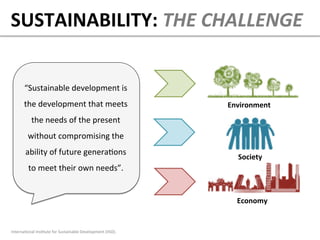
Environment	
  
Society	
  
Economy	
  
SUSTAINABILITY:	
  THE	
  CHALLENGE
“Sustainable	
  development	
  is	
  
the	
  development	
  that	
  meets	
  
the	
  needs	
  of	
  the	
  present	
  
without	
  compromising	
  the	
  
ability	
  of	
  future	
  generaEons	
  
to	
  meet	
  their	
  own	
  needs”.	
  
Madrid	
  Barajas	
  Airport	
  is	
  
commiLed	
  to	
  a	
  sustainable	
  
development	
  policy	
  which	
  has	
  
achieved	
  a	
  80%	
  increase	
  in	
  the	
  
recovery	
  of	
  hazardous	
  waste	
  in	
  
2012	
  
100%	
  
recycling	
  of	
  
waters	
  
2012	
  industry	
  
expenditure	
  on	
  
environmental	
  
protecEon	
  was	
  
€2,348million	
  	
  
M-­‐30	
  underground	
  
has	
  achieved	
  the	
  
reducEon	
  of	
  35.000	
  
tons	
  of	
  CO2	
  
Industry	
  environmental	
  
expenditure	
  has	
  
decreased	
  following	
  the	
  
2008	
  recession	
  
The	
  use	
  of	
  wind	
  
power	
  in	
  Spain	
  has	
  
significantly	
  increased	
  
in	
  past	
  years	
  as	
  a	
  
percentage	
  of	
  total	
  
energy	
  use	
   91.7%	
  of	
  
households	
  in	
  
Madrid	
  recycle	
  
hLp://www.aena.es/csee/ccurl/844/557/Madrid-­‐GEST%20AMBIENTAL%202012_ingles_V4_OK.pdf	
  	
  
InsEtuto	
  Nacional	
  de	
  EstadísEca	
  Report	
  on	
  Sustainable	
  Development	
  2008.	
  
hLp://www.connectedurbandevelopment.org/ciEes/madrid	
  	
  
hLp://elpais.com/elpais/2014/09/10/inenglish/1410347495_437248.html	
  	
  
ENVIRONMENT	
  -­‐	
  FACTS
hLp://www.dw.de/madrid-­‐air-­‐polluEon-­‐reaches-­‐alarming-­‐levels/a-­‐16739363	
  
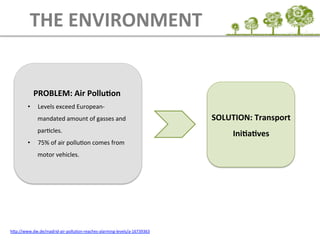
PROBLEM:	
  Air	
  PolluAon	
  
•  Levels	
  exceed	
  European-­‐
mandated	
  amount	
  of	
  gasses	
  and	
  
parEcles.	
  
•  75%	
  of	
  air	
  polluEon	
  comes	
  from	
  
motor	
  vehicles.	
  
SOLUTION:	
  Transport	
  
IniAaAves	
  
THE	
  ENVIRONMENT
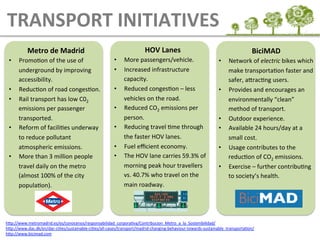
Metro	
  de	
  Madrid	
  
•  PromoEon	
  of	
  the	
  use	
  of	
  
underground	
  by	
  improving	
  
accessibility.	
  
•  ReducEon	
  of	
  road	
  congesEon.	
  
•  Rail	
  transport	
  has	
  low	
  C02	
  
emissions	
  per	
  passenger	
  
transported.	
  
•  Reform	
  of	
  faciliEes	
  underway	
  
to	
  reduce	
  pollutant	
  
atmospheric	
  emissions.	
  
•  More	
  than	
  3	
  million	
  people	
  
travel	
  daily	
  on	
  the	
  metro	
  
(almost	
  100%	
  of	
  the	
  city	
  
populaEon).	
  
HOV	
  Lanes	
  
•  More	
  passengers/vehicle.	
  
•  Increased	
  infrastructure	
  
capacity.	
  
•  Reduced	
  congesEon	
  –	
  less	
  
vehicles	
  on	
  the	
  road.	
  
•  Reduced	
  CO2	
  emissions	
  per	
  
person.	
  
•  Reducing	
  travel	
  Eme	
  through	
  
the	
  faster	
  HOV	
  lanes.	
  
•  Fuel	
  efficient	
  economy.	
  
•  The	
  HOV	
  lane	
  carries	
  59.3%	
  of	
  
morning	
  peak	
  hour	
  travellers	
  
vs.	
  40.7%	
  who	
  travel	
  on	
  the	
  
main	
  roadway.
BiciMAD	
  
•  Network	
  of	
  electric	
  bikes	
  which	
  
make	
  transportaEon	
  faster	
  and	
  
safer,	
  aLracEng	
  users.	
  
•  Provides	
  and	
  encourages	
  an	
  
environmentally	
  “clean”	
  
method	
  of	
  transport.	
  
•  Outdoor	
  experience.	
  
•  Available	
  24	
  hours/day	
  at	
  a	
  
small	
  cost.	
  
•  Usage	
  contributes	
  to	
  the	
  
reducEon	
  of	
  CO2	
  emissions.	
  
•  Exercise	
  –	
  further	
  contribuEng	
  
to	
  society’s	
  health.	
  	
  
hLp://www.metromadrid.es/es/conocenos/responsabilidad_corporaEva/Contribucion_Metro_a_la_Sostenibilidad/	
  
hLp://www.dac.dk/en/dac-­‐ciEes/sustainable-­‐ciEes/all-­‐cases/transport/madrid-­‐changing-­‐behaviour-­‐towards-­‐sustainable	
  -­‐transportaEon/	
  	
  
hLp://www.bicimad.com	
  	
  
TRANSPORT	
  INITIATIVES
hLp://elpais.com/elpais/2014/09/10/inenglish/1410347495_437248.html	
  
THE	
  ENVIRONMENT
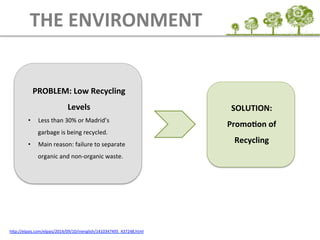
PROBLEM:	
  Low	
  Recycling	
  
Levels	
  
•  Less	
  than	
  30%	
  or	
  Madrid’s	
  
garbage	
  is	
  being	
  recycled.	
  
•  Main	
  reason:	
  failure	
  to	
  separate	
  
organic	
  and	
  non-­‐organic	
  waste.	
  
SOLUTION:	
  
PromoAon	
  of	
  
Recycling	
  
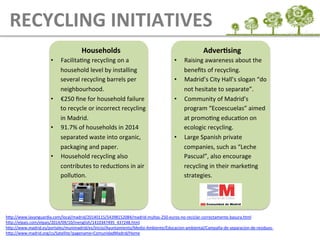
Households	
  
•  FacilitaEng	
  recycling	
  on	
  a	
  
household	
  level	
  by	
  installing	
  
several	
  recycling	
  barrels	
  per	
  
neighbourhood.	
  
•  €250	
  fine	
  for	
  household	
  failure	
  
to	
  recycle	
  or	
  incorrect	
  recycling	
  
in	
  Madrid.	
  
•  91.7%	
  of	
  households	
  in	
  2014	
  
separated	
  waste	
  into	
  organic,	
  
packaging	
  and	
  paper.	
  
•  Household	
  recycling	
  also	
  
contributes	
  to	
  reducEons	
  in	
  air	
  
polluEon.	
  
AdverAsing	
  
•  Raising	
  awareness	
  about	
  the	
  
benefits	
  of	
  recycling.	
  
•  Madrid’s	
  City	
  Hall’s	
  slogan	
  “do	
  
not	
  hesitate	
  to	
  separate”.	
  
•  Community	
  of	
  Madrid’s	
  
program	
  “Ecoescuelas”	
  aimed	
  
at	
  promoEng	
  educaEon	
  on	
  
ecologic	
  recycling.	
  
•  Large	
  Spanish	
  private	
  
companies,	
  such	
  as	
  “Leche	
  
Pascual”,	
  also	
  encourage	
  
recycling	
  in	
  their	
  markeEng	
  
strategies.	
  
RECYCLING	
  INITIATIVES
hLp://www.lavanguardia.com/local/madrid/20140115/54398152084/madrid-­‐multas-­‐250-­‐euros-­‐no-­‐reciclar-­‐correctamente-­‐basura.html	
  	
  
hLp://elpais.com/elpais/2014/09/10/inenglish/1410347495_437248.html	
  	
  
hLp://www.madrid.es/portales/munimadrid/es/Inicio/Ayuntamiento/Medio-­‐Ambiente/Educacion-­‐ambiental/Campaña-­‐de-­‐separacion-­‐de-­‐residuos-­‐	
  
hLp://www.madrid.org/cs/Satellite?pagename=ComunidadMadrid/Home	


What	
  can	
  be	
  improved?	
  
THE	
  ENVIRONMENT
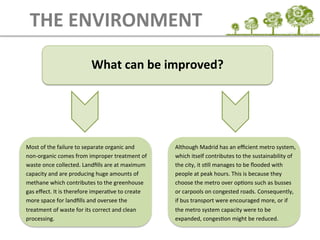
Most	
  of	
  the	
  failure	
  to	
  separate	
  organic	
  and	
  
non-­‐organic	
  comes	
  from	
  improper	
  treatment	
  of	
  
waste	
  once	
  collected.	
  Landfills	
  are	
  at	
  maximum	
  
capacity	
  and	
  are	
  producing	
  huge	
  amounts	
  of	
  
methane	
  which	
  contributes	
  to	
  the	
  greenhouse	
  
gas	
  effect.	
  It	
  is	
  therefore	
  imperaEve	
  to	
  create	
  
more	
  space	
  for	
  landfills	
  and	
  oversee	
  the	
  
treatment	
  of	
  waste	
  for	
  its	
  correct	
  and	
  clean	
  
processing.	
  
Although	
  Madrid	
  has	
  an	
  efficient	
  metro	
  system,	
  
which	
  itself	
  contributes	
  to	
  the	
  sustainability	
  of	
  
the	
  city,	
  it	
  sEll	
  manages	
  to	
  be	
  flooded	
  with	
  
people	
  at	
  peak	
  hours.	
  This	
  is	
  because	
  they	
  
choose	
  the	
  metro	
  over	
  opEons	
  such	
  as	
  busses	
  
or	
  carpools	
  on	
  congested	
  roads.	
  Consequently,	
  
if	
  bus	
  transport	
  were	
  encouraged	
  more,	
  or	
  if	
  
the	
  metro	
  system	
  capacity	
  were	
  to	
  be	
  
expanded,	
  congesEon	
  might	
  be	
  reduced.	
  
ECONOMY	
  -­‐	
  FACTS
Tourism	
  plays	
  an	
  important	
  
role	
  in	
  the	
  capital’s	
  
economy.	
  In	
  fact,	
  the	
  World	
  
Tourism	
  OrganisaEon’s	
  
headquarters	
  are	
  located	
  in	
  
Madrid	
  
The	
  unemployment	
  rate	
  
in	
  Madrid	
  is	
  around	
  20%	
  
and	
  youth	
  
unemployment	
  is	
  sEll	
  
approximately	
  at	
  a	
  
staggering	
  50%	
  
hLp://www.tradingeconomics.com/spain/unemployment-­‐rate	
  	
  
hLp://www.madrid.org/iestadis/	


hLp://www.datosmacro.com/deuda/espana-­‐comunidades-­‐autonomas/madrid	
  	
  
hLp://www.muycomputerpro.com/2015/02/09/madrid-­‐id	
  	
  
hLp://www.elconfidencial.com/empresas/2015-­‐01-­‐30/el-­‐gobierno-­‐da-­‐hoy-­‐luz-­‐verde-­‐a-­‐la-­‐operacion-­‐chamarEn-­‐que-­‐creara-­‐120-­‐000-­‐empleos_652176/	
  
Debt	
  as	
  a	
  percentage	
  of	
  
Madrid’s	
  GDP	
  reached	
  its	
  
peak	
  in	
  June	
  2014	
  as	
  has	
  
been	
  decreasing	
  since	
  
€6	
  million	
  are	
  being	
  
invested	
  in	
  the	
  largest-­‐
scale	
  urban	
  development	
  
project	
  in	
  Europe,	
  
“OperaEon	
  Chamarvn”	
  in	
  
Madrid.	
  
The	
  rate	
  of	
  people	
  
entering	
  the	
  workforce	
  
in	
  2008	
  in	
  Madrid	
  was	
  
0.8%	
  	
  
The	
  amount	
  of	
  investment	
  
in	
  Research	
  and	
  
Development	
  in	
  Madrid	
  
has	
  increased	
  in	
  2015	
  to	
  
over	
  €3	
  million,	
  which	
  will	
  
bring	
  long-­‐term	
  
sustainable	
  benefits	
  to	
  the	
  
city	
  
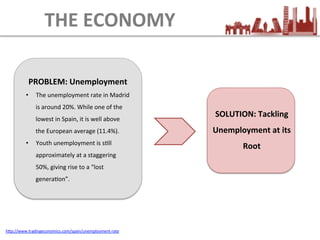
PROBLEM:	
  Unemployment	
  
•  The	
  unemployment	
  rate	
  in	
  Madrid	
  
is	
  around	
  20%.	
  While	
  one	
  of	
  the	
  
lowest	
  in	
  Spain,	
  it	
  is	
  well	
  above	
  
the	
  European	
  average	
  (11.4%).	
  
•  Youth	
  unemployment	
  is	
  sEll	
  
approximately	
  at	
  a	
  staggering	
  
50%,	
  giving	
  rise	
  to	
  a	
  “lost	
  
generaEon”.	
  
SOLUTION:	
  Tackling	
  
Unemployment	
  at	
  its	
  
Root	
  
THE	
  ECONOMY
hLp://www.tradingeconomics.com/spain/unemployment-­‐rate	


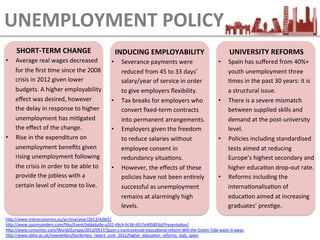
SHORT-­‐TERM	
  CHANGE	
  
•  Average	
  real	
  wages	
  decreased	
  
for	
  the	
  first	
  Eme	
  since	
  the	
  2008	
  
crisis	
  in	
  2012	
  given	
  lower	
  
budgets.	
  A	
  higher	
  employability	
  
effect	
  was	
  desired,	
  however	
  
the	
  delay	
  in	
  response	
  to	
  higher	
  
unemployment	
  has	
  miEgated	
  
the	
  effect	
  of	
  the	
  change.	
  
•  Rise	
  in	
  the	
  expenditure	
  on	
  
unemployment	
  benefits	
  given	
  
rising	
  unemployment	
  following	
  
the	
  crisis	
  in	
  order	
  to	
  be	
  able	
  to	
  
provide	
  the	
  jobless	
  with	
  a	
  
certain	
  level	
  of	
  income	
  to	
  live.	
  
UNEMPLOYMENT	
  POLICY
UNIVERSITY	
  REFORMS	
  
•  Spain	
  has	
  suffered	
  from	
  40%+	
  
youth	
  unemployment	
  three	
  
Emes	
  in	
  the	
  past	
  30	
  years:	
  it	
  is	
  
a	
  structural	
  issue.	
  
•  There	
  is	
  a	
  severe	
  mismatch	
  
between	
  supplied	
  skills	
  and	
  
demand	
  at	
  the	
  post-­‐university	
  
level.	
  
•  Policies	
  including	
  standardised	
  
tests	
  aimed	
  at	
  reducing	
  
Europe’s	
  highest	
  secondary	
  and	
  
higher	
  educaEon	
  drop-­‐out	
  rate.	
  
•  Reforms	
  including	
  the	
  
internaEonalisaEon	
  of	
  
educaEon	
  aimed	
  at	
  increasing	
  
graduates’	
  presEge.	
  
INDUCING	
  EMPLOYABILITY	
  
•  Severance	
  payments	
  were	
  
reduced	
  from	
  45	
  to	
  33	
  days’	
  
salary/year	
  of	
  service	
  in	
  order	
  
to	
  give	
  employers	
  flexibility.	
  
•  Tax	
  breaks	
  for	
  employers	
  who	
  
convert	
  fixed-­‐term	
  contracts	
  
into	
  permanent	
  arrangements.	
  
•  Employers	
  given	
  the	
  freedom	
  
to	
  reduce	
  salaries	
  without	
  
employee	
  consent	
  in	
  
redundancy	
  situaEons.	
  
•  However,	
  the	
  effects	
  of	
  these	
  
policies	
  have	
  not	
  been	
  enErely	
  
successful	
  as	
  unemployment	
  
remains	
  at	
  alarmingly	
  high	
  
levels.	
  
hLp://www.intereconomics.eu/archive/year/2013/4/865/	


hLp://www.squiresanders.com/files/Event/bddeba0e-­‐a202-­‐49c4-­‐9c58-­‐d557e905893d/PresentaEon/	
  
hLp://www.csmonitor.com/World/Europe/2013/0517/Spain-­‐s-­‐controversial-­‐educaEonal-­‐reform-­‐Will-­‐the-­‐Green-­‐Tide-­‐wash-­‐it-­‐away	
  	
  
hLp://www.obhe.ac.uk/newsleLers/borderless_report_june_2012/higher_educaEon_reforms_italy_spain	
  	
  
THE	
  ECONOMY
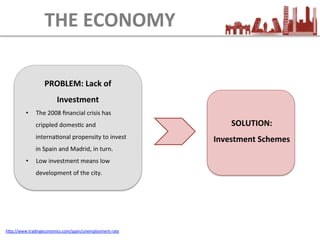
PROBLEM:	
  Lack	
  of	
  
Investment	
  
•  The	
  2008	
  financial	
  crisis	
  has	
  
crippled	
  domesEc	
  and	
  
internaEonal	
  propensity	
  to	
  invest	
  
in	
  Spain	
  and	
  Madrid,	
  in	
  turn.	
  
•  Low	
  investment	
  means	
  low	
  
development	
  of	
  the	
  city.	
  
SOLUTION:	
  
Investment	
  Schemes	
  
hLp://www.tradingeconomics.com/spain/unemployment-­‐rate	


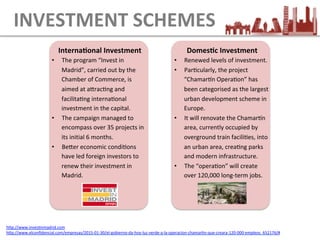
INVESTMENT	
  SCHEMES
InternaAonal	
  Investment	
  
•  The	
  program	
  “Invest	
  in	
  
Madrid”,	
  carried	
  out	
  by	
  the	
  
Chamber	
  of	
  Commerce,	
  is	
  
aimed	
  at	
  aLracEng	
  and	
  
facilitaEng	
  internaEonal	
  
investment	
  in	
  the	
  capital.	
  
•  The	
  campaign	
  managed	
  to	
  
encompass	
  over	
  35	
  projects	
  in	
  
its	
  initial	
  6	
  months.	
  
•  BeLer	
  economic	
  condiEons	
  
have	
  led	
  foreign	
  investors	
  to	
  
renew	
  their	
  investment	
  in	
  
Madrid.	
  
DomesAc	
  Investment	
  
•  Renewed	
  levels	
  of	
  investment.	
  
•  ParEcularly,	
  the	
  project	
  
“Chamarvn	
  OperaEon”	
  has	
  
been	
  categorised	
  as	
  the	
  largest	
  
urban	
  development	
  scheme	
  in	
  
Europe.	
  	
  
•  It	
  will	
  renovate	
  the	
  Chamarvn	
  
area,	
  currently	
  occupied	
  by	
  
overground	
  train	
  faciliEes,	
  into	
  
an	
  urban	
  area,	
  creaEng	
  parks	
  
and	
  modern	
  infrastructure.	
  
•  The	
  “operaEon”	
  will	
  create	
  
over	
  120,000	
  long-­‐term	
  jobs.	
  
hLp://www.invesEnmadrid.com	
  	
  
hLp://www.elconfidencial.com/empresas/2015-­‐01-­‐30/el-­‐gobierno-­‐da-­‐hoy-­‐luz-­‐verde-­‐a-­‐la-­‐operacion-­‐chamarEn-­‐que-­‐creara-­‐120-­‐000-­‐empleos_652176/#	
  	
  
What	
  can	
  be	
  improved?	
  
THE	
  ECONOMY
Even	
  though	
  a	
  variety	
  of	
  measures	
  against	
  
unemployment	
  have	
  been	
  carried	
  out,	
  the	
  
amount	
  of	
  jobless	
  people	
  has	
  not	
  significantly	
  
diminished.	
  Since	
  the	
  naturally	
  high	
  level	
  of	
  
employment	
  in	
  Madrid,	
  and	
  in	
  Spain	
  as	
  a	
  
whole,	
  is	
  a	
  structural	
  issue,	
  more	
  long-­‐term	
  
changes	
  need	
  to	
  be	
  made.	
  In	
  parEcular	
  it	
  is	
  
fundamental	
  that	
  labour	
  flexibility	
  is	
  further	
  
introduced,	
  for	
  example	
  by	
  reducing	
  severance	
  
payments	
  further.	
  By	
  looking	
  at	
  labour	
  market	
  	
  
models,	
  such	
  as	
  the	
  American,	
  it	
  is	
  clear	
  that	
  
more	
  dynamic	
  labour	
  law	
  leads	
  to	
  greater	
  
employment	
  levels,	
  and,	
  ironically,	
  greater	
  
sustainability	
  on	
  an	
  economic	
  level.	
  Another	
  
criEcal	
  change	
  to	
  be	
  made	
  is	
  the	
  complete	
  
reform	
  of	
  the	
  Spanish	
  educaEon	
  system.	
  A	
  
wider	
  variety	
  of	
  subjects	
  to	
  study	
  at	
  university	
  
need	
  to	
  be	
  introduced	
  in	
  order	
  to	
  reduce	
  
supply-­‐demand	
  mismatch.	
  Policies	
  to	
  reduce	
  
dropouts	
  from	
  studies	
  are	
  also	
  necessary.	
  
SOCIETAL	
  SUSTAINABILITY
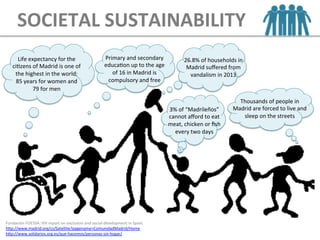
Thousands	
  of	
  people	
  in	
  
Madrid	
  are	
  forced	
  to	
  live	
  and	
  
sleep	
  on	
  the	
  streets	
  
Life	
  expectancy	
  for	
  the	
  
ciEzens	
  of	
  Madrid	
  is	
  one	
  of	
  
the	
  highest	
  in	
  the	
  world:	
  
85	
  years	
  for	
  women	
  and	
  
79	
  for	
  men	
  
Primary	
  and	
  secondary	
  
educaEon	
  up	
  to	
  the	
  age	
  
of	
  16	
  in	
  Madrid	
  is	
  
compulsory	
  and	
  free	
  
3%	
  of	
  “Madrileños”	
  
cannot	
  afford	
  to	
  eat	
  
meat,	
  chicken	
  or	
  fish	
  
every	
  two	
  days	
  
26.8%	
  of	
  households	
  in	
  
Madrid	
  suffered	
  from	
  
vandalism	
  in	
  2013	
  
Fundación	
  FOESSA:	
  VIII	
  report	
  on	
  exclusion	
  and	
  social	
  development	
  in	
  Spain.	
  
hLp://www.madrid.org/cs/Satellite?pagename=ComunidadMadrid/Home	
  
hLp://www.solidarios.org.es/que-­‐hacemos/personas-­‐sin-­‐hogar/	
  	
  
PROBLEM:	
  Social	
  Exclusion	
  
•  0.7%	
  of	
  the	
  Spanish	
  populaEon	
  is	
  
homeless	
  or	
  lives	
  in	
  sub-­‐standard	
  
housing.	
  
•  For	
  a	
  growing	
  number	
  of	
  people,	
  the	
  
food	
  in	
  garbage	
  bins	
  helps	
  make	
  
ends	
  meet.	
  
•  Unequal	
  employment	
  and	
  
educaEonal	
  opportuniEes	
  divided	
  by	
  
neighbourhoods.	
  
SOLUTION:	
  IniAaAves	
  
pro-­‐EducaAon,	
  and	
  
Against	
  Homelessness	
  
and	
  Hunger	
  
SOCIETAL	
  SUSTAINABILITY
hLp://www.share-­‐internaEonal.org/archives/homelessness/hl-­‐cfSpain.htm	
  	
  
hLp://www.nyEmes.com/2012/09/25/world/europe/hunger-­‐on-­‐the-­‐rise-­‐in-­‐spain.html?pagewanted=all&_r=0	


EDUCATION	
  
•  Making	
  educaEon	
  more	
  
accessible	
  for	
  opportunity	
  
equality.	
  
•  Community	
  of	
  Madrid	
  
iniEaEves:	
  by	
  taking	
  a	
  basic	
  
course	
  in	
  “Formación	
  
Profesional”,	
  ciEzens	
  of	
  all	
  
backgrounds	
  can	
  be	
  re-­‐
educated	
  for	
  employment	
  
purposes.	
  
•  Primary	
  and	
  secondary	
  
educaEon	
  is	
  mandatory	
  and	
  
free	
  in	
  municipal	
  schools	
  
across	
  the	
  capital.	
  
HOMELESSNESS	
  
•  The	
  Community	
  of	
  Madrid	
  
provides	
  shelter	
  homes	
  for	
  
the	
  homeless.	
  
•  The	
  Community	
  of	
  Madrid	
  
also	
  provides	
  shelter	
  for	
  
those	
  in	
  a	
  situaEon	
  of	
  
household	
  “urgency”	
  
including	
  abuse.	
  
•  Volunteering	
  schemes	
  such	
  
as	
  the	
  ONG	
  “Solidarios”	
  offer	
  
the	
  homeless	
  company	
  and	
  
someone	
  with	
  who	
  they	
  can	
  
interact.	
  
SOUP/FOOD	
  KITCHENS	
  
•  Abundant	
  free	
  food	
  services	
  
are	
  available	
  in	
  Madrid,	
  both	
  
provided	
  my	
  the	
  council	
  of	
  
Madrid	
  and	
  by	
  non-­‐for	
  profit	
  
organisaEons.	
  
•  Some	
  organisaEons,	
  such	
  as	
  
Caritas,	
  now	
  aLend	
  2.5	
  million	
  
people	
  on	
  an	
  annual	
  basis.	
  
•  OrganisaEons	
  such	
  as	
  the	
  
Order	
  of	
  Malta	
  serve	
  500	
  
meals	
  daily	
  in	
  the	
  capital	
  
alone.	
  
•  Numerous	
  voluntary	
  work	
  
takes	
  place	
  in	
  these	
  kitchens.	
  
hLp://www.madrid.org/cs/Satellite	
  
hLp://www.solidarios.org.es/que-­‐hacemos/personas-­‐sin-­‐hogar/	
  
hLp://sociedad.elpais.com/sociedad/2014/09/29/actualidad/1411989045_795090.html	
  	
  
hLp://www.orderofmalta.int/latest-­‐intervenEons/21323/the-­‐order-­‐of-­‐malta-­‐soup-­‐kitchens-­‐in-­‐madrid-­‐serve-­‐500-­‐meals-­‐daily/?lang=en	
  	
  
SOCIAL	
  INCLUSION
SOCIETAL	
  SUSTAINABILITY
What	
  can	
  be	
  improved?	
  
I	
  believe	
  that	
  in	
  respect	
  to	
  the	
  policies	
  in	
  place,	
  Madrid	
  works	
  hard	
  
to	
  sustain	
  social	
  inclusion	
  and	
  enable	
  equity	
  between	
  its	
  peoples.	
  
Apart	
  from	
  the	
  aforemenEoned	
  iniEaEves,	
  public	
  healthcare	
  is	
  
provided	
  to	
  all	
  via	
  Social	
  Security.	
  However,	
  a	
  deeper	
  change	
  needs	
  
to	
  occur	
  for	
  the	
  sustainability	
  and	
  PEACE	
  of	
  Madrid’s	
  society.	
  More	
  
openness	
  must	
  be	
  achieved	
  for	
  there	
  to	
  be	
  greater	
  tolerance.	
  With	
  
regards	
  to	
  innovaEon	
  and	
  change,	
  	
  having	
  an	
  open	
  mind	
  will	
  enable	
  
our	
  society	
  to	
  embrace	
  new	
  opportuniEes.	
  
Sources	
  
InternaEonal	
  InsEtute	
  for	
  Sustainable	
  Development	
  (IISD).	
  
hLp://www.aena.es/csee/ccurl/844/557/Madrid-­‐GEST%20AMBIENTAL%202012_ingles_V4_OK.pdf	
  	
  
InsEtuto	
  Nacional	
  de	
  EstadísEca	
  Report	
  on	
  Sustainable	
  Development	
  2008.	
  
hLp://www.connectedurbandevelopment.org/ciEes/madrid	
  	
  
hLp://elpais.com/elpais/2014/09/10/inenglish/1410347495_437248.html	
  	
  
hLp://www.dw.de/madrid-­‐air-­‐polluEon-­‐reaches-­‐alarming-­‐levels/a-­‐16739363	
  
hLp://www.metromadrid.es/es/conocenos/responsabilidad_corporaEva/Contribucion_Metro_a_la_Sostenibilidad/	
  
hLp://www.dac.dk/en/dac-­‐ciEes/sustainable-­‐ciEes/all-­‐cases/transport/madrid-­‐changing-­‐behaviour-­‐towards-­‐sustainable	
  -­‐transportaEon/	
  	
  
hLp://www.bicimad.com	
  	
  
hLp://www.lavanguardia.com/local/madrid/20140115/54398152084/madrid-­‐multas-­‐250-­‐euros-­‐no-­‐reciclar-­‐correctamente-­‐basura.html	
  	
  
hLp://www.madrid.org/cs/Satellite?pagename=ComunidadMadrid/Home	
  	
  
hLp://www.madrid.es/portales/munimadrid/es/Inicio/Ayuntamiento/Medio-­‐Ambiente/Educacion-­‐ambiental/Campaña-­‐de-­‐separacion-­‐de-­‐residuos	
  
hLp://www.tradingeconomics.com/spain/unemployment-­‐rate	
  	
  
hLp://www.datosmacro.com/deuda/espana-­‐comunidades-­‐autonomas/madrid	
  	
  
hLp://www.muycomputerpro.com/2015/02/09/madrid-­‐id	
  	
  
hLp://www.elconfidencial.com/empresas/2015-­‐01-­‐30/el-­‐gobierno-­‐da-­‐hoy-­‐luz-­‐verde-­‐a-­‐la-­‐operacion-­‐chamarEn-­‐que-­‐creara-­‐120-­‐000-­‐empleos_652176/	
  
hLp://www.intereconomics.eu/archive/year/2013/4/865/	


hLp://www.squiresanders.com/files/Event/bddeba0e-­‐a202-­‐49c4-­‐9c58-­‐d557e905893d/PresentaEon/	
  
hLp://www.csmonitor.com/World/Europe/2013/0517/Spain-­‐s-­‐controversial-­‐educaEonal-­‐reform-­‐Will-­‐the-­‐Green-­‐Tide-­‐wash-­‐it-­‐away	
  	
  
hLp://www.obhe.ac.uk/newsleLers/borderless_report_june_2012/higher_educaEon_reforms_italy_spain	
  	
  
hLp://www.invesEnmadrid.com	
  	
  
Fundación	
  FOESSA:	
  VIII	
  report	
  on	
  exclusion	
  and	
  social	
  development	
  in	
  Spain.	
  
hLp://www.solidarios.org.es/que-­‐hacemos/personas-­‐sin-­‐hogar/	
  	
  
hLp://www.share-­‐internaEonal.org/archives/homelessness/hl-­‐cfSpain.htm	
  	
  
hLp://www.nyEmes.com/2012/09/25/world/europe/hunger-­‐on-­‐the-­‐rise-­‐in-­‐spain.html?pagewanted=all&_r=0	
  	
  
hLp://sociedad.elpais.com/sociedad/2014/09/29/actualidad/1411989045_795090.html	
  	
  
hLp://www.orderofmalta.int/latest-­‐intervenEons/21323/the-­‐order-­‐of-­‐malta-­‐soup-­‐kitchens-­‐in-­‐madrid-­‐serve-­‐500-­‐meals-­‐daily/?lang=en	


IE Application - Sustainable development in Madrid

  • 1.
    Sustainable  Development  in  Madrid   Beatriz  Fernández  de  Córdoba   Beatriz  Fernández  de  Córdoba  
  • 2.
    “Do  you  think  that  the  lifestyle  of  the  inhabitants  of   your  town  reflects  behaviour  that  is  in  line  with  the   concept  of  sustainable  development?  In  your   opinion  what  should  be  improved?”  
  • 3.
    InternaEonal  InsEtute  for  Sustainable  Development  (IISD).   Environment   Society   Economy   SUSTAINABILITY:  THE  CHALLENGE “Sustainable  development  is   the  development  that  meets   the  needs  of  the  present   without  compromising  the   ability  of  future  generaEons   to  meet  their  own  needs”.  
  • 4.
    Madrid  Barajas  Airport  is   commiLed  to  a  sustainable   development  policy  which  has   achieved  a  80%  increase  in  the   recovery  of  hazardous  waste  in   2012   100%   recycling  of   waters   2012  industry   expenditure  on   environmental   protecEon  was   €2,348million     M-­‐30  underground   has  achieved  the   reducEon  of  35.000   tons  of  CO2   Industry  environmental   expenditure  has   decreased  following  the   2008  recession   The  use  of  wind   power  in  Spain  has   significantly  increased   in  past  years  as  a   percentage  of  total   energy  use   91.7%  of   households  in   Madrid  recycle   hLp://www.aena.es/csee/ccurl/844/557/Madrid-­‐GEST%20AMBIENTAL%202012_ingles_V4_OK.pdf     InsEtuto  Nacional  de  EstadísEca  Report  on  Sustainable  Development  2008.   hLp://www.connectedurbandevelopment.org/ciEes/madrid     hLp://elpais.com/elpais/2014/09/10/inenglish/1410347495_437248.html     ENVIRONMENT  -­‐  FACTS
  • 5.
    hLp://www.dw.de/madrid-­‐air-­‐polluEon-­‐reaches-­‐alarming-­‐levels/a-­‐16739363   PROBLEM:  Air  PolluAon   •  Levels  exceed  European-­‐ mandated  amount  of  gasses  and   parEcles.   •  75%  of  air  polluEon  comes  from   motor  vehicles.   SOLUTION:  Transport   IniAaAves   THE  ENVIRONMENT
  • 6.
    Metro  de  Madrid   •  PromoEon  of  the  use  of   underground  by  improving   accessibility.   •  ReducEon  of  road  congesEon.   •  Rail  transport  has  low  C02   emissions  per  passenger   transported.   •  Reform  of  faciliEes  underway   to  reduce  pollutant   atmospheric  emissions.   •  More  than  3  million  people   travel  daily  on  the  metro   (almost  100%  of  the  city   populaEon).   HOV  Lanes   •  More  passengers/vehicle.   •  Increased  infrastructure   capacity.   •  Reduced  congesEon  –  less   vehicles  on  the  road.   •  Reduced  CO2  emissions  per   person.   •  Reducing  travel  Eme  through   the  faster  HOV  lanes.   •  Fuel  efficient  economy.   •  The  HOV  lane  carries  59.3%  of   morning  peak  hour  travellers   vs.  40.7%  who  travel  on  the   main  roadway. BiciMAD   •  Network  of  electric  bikes  which   make  transportaEon  faster  and   safer,  aLracEng  users.   •  Provides  and  encourages  an   environmentally  “clean”   method  of  transport.   •  Outdoor  experience.   •  Available  24  hours/day  at  a   small  cost.   •  Usage  contributes  to  the   reducEon  of  CO2  emissions.   •  Exercise  –  further  contribuEng   to  society’s  health.     hLp://www.metromadrid.es/es/conocenos/responsabilidad_corporaEva/Contribucion_Metro_a_la_Sostenibilidad/   hLp://www.dac.dk/en/dac-­‐ciEes/sustainable-­‐ciEes/all-­‐cases/transport/madrid-­‐changing-­‐behaviour-­‐towards-­‐sustainable  -­‐transportaEon/     hLp://www.bicimad.com     TRANSPORT  INITIATIVES
  • 7.
    hLp://elpais.com/elpais/2014/09/10/inenglish/1410347495_437248.html   THE  ENVIRONMENT PROBLEM:  Low  Recycling   Levels   •  Less  than  30%  or  Madrid’s   garbage  is  being  recycled.   •  Main  reason:  failure  to  separate   organic  and  non-­‐organic  waste.   SOLUTION:   PromoAon  of   Recycling  
  • 8.
    Households   •  FacilitaEng  recycling  on  a   household  level  by  installing   several  recycling  barrels  per   neighbourhood.   •  €250  fine  for  household  failure   to  recycle  or  incorrect  recycling   in  Madrid.   •  91.7%  of  households  in  2014   separated  waste  into  organic,   packaging  and  paper.   •  Household  recycling  also   contributes  to  reducEons  in  air   polluEon.   AdverAsing   •  Raising  awareness  about  the   benefits  of  recycling.   •  Madrid’s  City  Hall’s  slogan  “do   not  hesitate  to  separate”.   •  Community  of  Madrid’s   program  “Ecoescuelas”  aimed   at  promoEng  educaEon  on   ecologic  recycling.   •  Large  Spanish  private   companies,  such  as  “Leche   Pascual”,  also  encourage   recycling  in  their  markeEng   strategies.   RECYCLING  INITIATIVES hLp://www.lavanguardia.com/local/madrid/20140115/54398152084/madrid-­‐multas-­‐250-­‐euros-­‐no-­‐reciclar-­‐correctamente-­‐basura.html     hLp://elpais.com/elpais/2014/09/10/inenglish/1410347495_437248.html     hLp://www.madrid.es/portales/munimadrid/es/Inicio/Ayuntamiento/Medio-­‐Ambiente/Educacion-­‐ambiental/Campaña-­‐de-­‐separacion-­‐de-­‐residuos-­‐   hLp://www.madrid.org/cs/Satellite?pagename=ComunidadMadrid/Home      
  • 9.
    What  can  be  improved?   THE  ENVIRONMENT Most  of  the  failure  to  separate  organic  and   non-­‐organic  comes  from  improper  treatment  of   waste  once  collected.  Landfills  are  at  maximum   capacity  and  are  producing  huge  amounts  of   methane  which  contributes  to  the  greenhouse   gas  effect.  It  is  therefore  imperaEve  to  create   more  space  for  landfills  and  oversee  the   treatment  of  waste  for  its  correct  and  clean   processing.   Although  Madrid  has  an  efficient  metro  system,   which  itself  contributes  to  the  sustainability  of   the  city,  it  sEll  manages  to  be  flooded  with   people  at  peak  hours.  This  is  because  they   choose  the  metro  over  opEons  such  as  busses   or  carpools  on  congested  roads.  Consequently,   if  bus  transport  were  encouraged  more,  or  if   the  metro  system  capacity  were  to  be   expanded,  congesEon  might  be  reduced.  
  • 10.
    ECONOMY  -­‐  FACTS Tourism  plays  an  important   role  in  the  capital’s   economy.  In  fact,  the  World   Tourism  OrganisaEon’s   headquarters  are  located  in   Madrid   The  unemployment  rate   in  Madrid  is  around  20%   and  youth   unemployment  is  sEll   approximately  at  a   staggering  50%   hLp://www.tradingeconomics.com/spain/unemployment-­‐rate     hLp://www.madrid.org/iestadis/       hLp://www.datosmacro.com/deuda/espana-­‐comunidades-­‐autonomas/madrid     hLp://www.muycomputerpro.com/2015/02/09/madrid-­‐id     hLp://www.elconfidencial.com/empresas/2015-­‐01-­‐30/el-­‐gobierno-­‐da-­‐hoy-­‐luz-­‐verde-­‐a-­‐la-­‐operacion-­‐chamarEn-­‐que-­‐creara-­‐120-­‐000-­‐empleos_652176/   Debt  as  a  percentage  of   Madrid’s  GDP  reached  its   peak  in  June  2014  as  has   been  decreasing  since   €6  million  are  being   invested  in  the  largest-­‐ scale  urban  development   project  in  Europe,   “OperaEon  Chamarvn”  in   Madrid.   The  rate  of  people   entering  the  workforce   in  2008  in  Madrid  was   0.8%     The  amount  of  investment   in  Research  and   Development  in  Madrid   has  increased  in  2015  to   over  €3  million,  which  will   bring  long-­‐term   sustainable  benefits  to  the   city  
  • 11.
    PROBLEM:  Unemployment   • The  unemployment  rate  in  Madrid   is  around  20%.  While  one  of  the   lowest  in  Spain,  it  is  well  above   the  European  average  (11.4%).   •  Youth  unemployment  is  sEll   approximately  at  a  staggering   50%,  giving  rise  to  a  “lost   generaEon”.   SOLUTION:  Tackling   Unemployment  at  its   Root   THE  ECONOMY hLp://www.tradingeconomics.com/spain/unemployment-­‐rate        
  • 12.
    SHORT-­‐TERM  CHANGE   • Average  real  wages  decreased   for  the  first  Eme  since  the  2008   crisis  in  2012  given  lower   budgets.  A  higher  employability   effect  was  desired,  however   the  delay  in  response  to  higher   unemployment  has  miEgated   the  effect  of  the  change.   •  Rise  in  the  expenditure  on   unemployment  benefits  given   rising  unemployment  following   the  crisis  in  order  to  be  able  to   provide  the  jobless  with  a   certain  level  of  income  to  live.   UNEMPLOYMENT  POLICY UNIVERSITY  REFORMS   •  Spain  has  suffered  from  40%+   youth  unemployment  three   Emes  in  the  past  30  years:  it  is   a  structural  issue.   •  There  is  a  severe  mismatch   between  supplied  skills  and   demand  at  the  post-­‐university   level.   •  Policies  including  standardised   tests  aimed  at  reducing   Europe’s  highest  secondary  and   higher  educaEon  drop-­‐out  rate.   •  Reforms  including  the   internaEonalisaEon  of   educaEon  aimed  at  increasing   graduates’  presEge.   INDUCING  EMPLOYABILITY   •  Severance  payments  were   reduced  from  45  to  33  days’   salary/year  of  service  in  order   to  give  employers  flexibility.   •  Tax  breaks  for  employers  who   convert  fixed-­‐term  contracts   into  permanent  arrangements.   •  Employers  given  the  freedom   to  reduce  salaries  without   employee  consent  in   redundancy  situaEons.   •  However,  the  effects  of  these   policies  have  not  been  enErely   successful  as  unemployment   remains  at  alarmingly  high   levels.   hLp://www.intereconomics.eu/archive/year/2013/4/865/       hLp://www.squiresanders.com/files/Event/bddeba0e-­‐a202-­‐49c4-­‐9c58-­‐d557e905893d/PresentaEon/   hLp://www.csmonitor.com/World/Europe/2013/0517/Spain-­‐s-­‐controversial-­‐educaEonal-­‐reform-­‐Will-­‐the-­‐Green-­‐Tide-­‐wash-­‐it-­‐away     hLp://www.obhe.ac.uk/newsleLers/borderless_report_june_2012/higher_educaEon_reforms_italy_spain    
  • 13.
    THE  ECONOMY PROBLEM:  Lack  of   Investment   •  The  2008  financial  crisis  has   crippled  domesEc  and   internaEonal  propensity  to  invest   in  Spain  and  Madrid,  in  turn.   •  Low  investment  means  low   development  of  the  city.   SOLUTION:   Investment  Schemes   hLp://www.tradingeconomics.com/spain/unemployment-­‐rate        
  • 14.
    INVESTMENT  SCHEMES InternaAonal  Investment   •  The  program  “Invest  in   Madrid”,  carried  out  by  the   Chamber  of  Commerce,  is   aimed  at  aLracEng  and   facilitaEng  internaEonal   investment  in  the  capital.   •  The  campaign  managed  to   encompass  over  35  projects  in   its  initial  6  months.   •  BeLer  economic  condiEons   have  led  foreign  investors  to   renew  their  investment  in   Madrid.   DomesAc  Investment   •  Renewed  levels  of  investment.   •  ParEcularly,  the  project   “Chamarvn  OperaEon”  has   been  categorised  as  the  largest   urban  development  scheme  in   Europe.     •  It  will  renovate  the  Chamarvn   area,  currently  occupied  by   overground  train  faciliEes,  into   an  urban  area,  creaEng  parks   and  modern  infrastructure.   •  The  “operaEon”  will  create   over  120,000  long-­‐term  jobs.   hLp://www.invesEnmadrid.com     hLp://www.elconfidencial.com/empresas/2015-­‐01-­‐30/el-­‐gobierno-­‐da-­‐hoy-­‐luz-­‐verde-­‐a-­‐la-­‐operacion-­‐chamarEn-­‐que-­‐creara-­‐120-­‐000-­‐empleos_652176/#    
  • 15.
    What  can  be  improved?   THE  ECONOMY Even  though  a  variety  of  measures  against   unemployment  have  been  carried  out,  the   amount  of  jobless  people  has  not  significantly   diminished.  Since  the  naturally  high  level  of   employment  in  Madrid,  and  in  Spain  as  a   whole,  is  a  structural  issue,  more  long-­‐term   changes  need  to  be  made.  In  parEcular  it  is   fundamental  that  labour  flexibility  is  further   introduced,  for  example  by  reducing  severance   payments  further.  By  looking  at  labour  market     models,  such  as  the  American,  it  is  clear  that   more  dynamic  labour  law  leads  to  greater   employment  levels,  and,  ironically,  greater   sustainability  on  an  economic  level.  Another   criEcal  change  to  be  made  is  the  complete   reform  of  the  Spanish  educaEon  system.  A   wider  variety  of  subjects  to  study  at  university   need  to  be  introduced  in  order  to  reduce   supply-­‐demand  mismatch.  Policies  to  reduce   dropouts  from  studies  are  also  necessary.  
  • 16.
    SOCIETAL  SUSTAINABILITY Thousands  of  people  in   Madrid  are  forced  to  live  and   sleep  on  the  streets   Life  expectancy  for  the   ciEzens  of  Madrid  is  one  of   the  highest  in  the  world:   85  years  for  women  and   79  for  men   Primary  and  secondary   educaEon  up  to  the  age   of  16  in  Madrid  is   compulsory  and  free   3%  of  “Madrileños”   cannot  afford  to  eat   meat,  chicken  or  fish   every  two  days   26.8%  of  households  in   Madrid  suffered  from   vandalism  in  2013   Fundación  FOESSA:  VIII  report  on  exclusion  and  social  development  in  Spain.   hLp://www.madrid.org/cs/Satellite?pagename=ComunidadMadrid/Home   hLp://www.solidarios.org.es/que-­‐hacemos/personas-­‐sin-­‐hogar/    
  • 17.
    PROBLEM:  Social  Exclusion   •  0.7%  of  the  Spanish  populaEon  is   homeless  or  lives  in  sub-­‐standard   housing.   •  For  a  growing  number  of  people,  the   food  in  garbage  bins  helps  make   ends  meet.   •  Unequal  employment  and   educaEonal  opportuniEes  divided  by   neighbourhoods.   SOLUTION:  IniAaAves   pro-­‐EducaAon,  and   Against  Homelessness   and  Hunger   SOCIETAL  SUSTAINABILITY hLp://www.share-­‐internaEonal.org/archives/homelessness/hl-­‐cfSpain.htm     hLp://www.nyEmes.com/2012/09/25/world/europe/hunger-­‐on-­‐the-­‐rise-­‐in-­‐spain.html?pagewanted=all&_r=0      
  • 18.
    EDUCATION   •  Making  educaEon  more   accessible  for  opportunity   equality.   •  Community  of  Madrid   iniEaEves:  by  taking  a  basic   course  in  “Formación   Profesional”,  ciEzens  of  all   backgrounds  can  be  re-­‐ educated  for  employment   purposes.   •  Primary  and  secondary   educaEon  is  mandatory  and   free  in  municipal  schools   across  the  capital.   HOMELESSNESS   •  The  Community  of  Madrid   provides  shelter  homes  for   the  homeless.   •  The  Community  of  Madrid   also  provides  shelter  for   those  in  a  situaEon  of   household  “urgency”   including  abuse.   •  Volunteering  schemes  such   as  the  ONG  “Solidarios”  offer   the  homeless  company  and   someone  with  who  they  can   interact.   SOUP/FOOD  KITCHENS   •  Abundant  free  food  services   are  available  in  Madrid,  both   provided  my  the  council  of   Madrid  and  by  non-­‐for  profit   organisaEons.   •  Some  organisaEons,  such  as   Caritas,  now  aLend  2.5  million   people  on  an  annual  basis.   •  OrganisaEons  such  as  the   Order  of  Malta  serve  500   meals  daily  in  the  capital   alone.   •  Numerous  voluntary  work   takes  place  in  these  kitchens.   hLp://www.madrid.org/cs/Satellite   hLp://www.solidarios.org.es/que-­‐hacemos/personas-­‐sin-­‐hogar/   hLp://sociedad.elpais.com/sociedad/2014/09/29/actualidad/1411989045_795090.html     hLp://www.orderofmalta.int/latest-­‐intervenEons/21323/the-­‐order-­‐of-­‐malta-­‐soup-­‐kitchens-­‐in-­‐madrid-­‐serve-­‐500-­‐meals-­‐daily/?lang=en     SOCIAL  INCLUSION
  • 19.
    SOCIETAL  SUSTAINABILITY What  can  be  improved?   I  believe  that  in  respect  to  the  policies  in  place,  Madrid  works  hard   to  sustain  social  inclusion  and  enable  equity  between  its  peoples.   Apart  from  the  aforemenEoned  iniEaEves,  public  healthcare  is   provided  to  all  via  Social  Security.  However,  a  deeper  change  needs   to  occur  for  the  sustainability  and  PEACE  of  Madrid’s  society.  More   openness  must  be  achieved  for  there  to  be  greater  tolerance.  With   regards  to  innovaEon  and  change,    having  an  open  mind  will  enable   our  society  to  embrace  new  opportuniEes.  
  • 20.
    Sources   InternaEonal  InsEtute  for  Sustainable  Development  (IISD).   hLp://www.aena.es/csee/ccurl/844/557/Madrid-­‐GEST%20AMBIENTAL%202012_ingles_V4_OK.pdf     InsEtuto  Nacional  de  EstadísEca  Report  on  Sustainable  Development  2008.   hLp://www.connectedurbandevelopment.org/ciEes/madrid     hLp://elpais.com/elpais/2014/09/10/inenglish/1410347495_437248.html     hLp://www.dw.de/madrid-­‐air-­‐polluEon-­‐reaches-­‐alarming-­‐levels/a-­‐16739363   hLp://www.metromadrid.es/es/conocenos/responsabilidad_corporaEva/Contribucion_Metro_a_la_Sostenibilidad/   hLp://www.dac.dk/en/dac-­‐ciEes/sustainable-­‐ciEes/all-­‐cases/transport/madrid-­‐changing-­‐behaviour-­‐towards-­‐sustainable  -­‐transportaEon/     hLp://www.bicimad.com     hLp://www.lavanguardia.com/local/madrid/20140115/54398152084/madrid-­‐multas-­‐250-­‐euros-­‐no-­‐reciclar-­‐correctamente-­‐basura.html     hLp://www.madrid.org/cs/Satellite?pagename=ComunidadMadrid/Home     hLp://www.madrid.es/portales/munimadrid/es/Inicio/Ayuntamiento/Medio-­‐Ambiente/Educacion-­‐ambiental/Campaña-­‐de-­‐separacion-­‐de-­‐residuos   hLp://www.tradingeconomics.com/spain/unemployment-­‐rate     hLp://www.datosmacro.com/deuda/espana-­‐comunidades-­‐autonomas/madrid     hLp://www.muycomputerpro.com/2015/02/09/madrid-­‐id     hLp://www.elconfidencial.com/empresas/2015-­‐01-­‐30/el-­‐gobierno-­‐da-­‐hoy-­‐luz-­‐verde-­‐a-­‐la-­‐operacion-­‐chamarEn-­‐que-­‐creara-­‐120-­‐000-­‐empleos_652176/   hLp://www.intereconomics.eu/archive/year/2013/4/865/       hLp://www.squiresanders.com/files/Event/bddeba0e-­‐a202-­‐49c4-­‐9c58-­‐d557e905893d/PresentaEon/   hLp://www.csmonitor.com/World/Europe/2013/0517/Spain-­‐s-­‐controversial-­‐educaEonal-­‐reform-­‐Will-­‐the-­‐Green-­‐Tide-­‐wash-­‐it-­‐away     hLp://www.obhe.ac.uk/newsleLers/borderless_report_june_2012/higher_educaEon_reforms_italy_spain     hLp://www.invesEnmadrid.com     Fundación  FOESSA:  VIII  report  on  exclusion  and  social  development  in  Spain.   hLp://www.solidarios.org.es/que-­‐hacemos/personas-­‐sin-­‐hogar/     hLp://www.share-­‐internaEonal.org/archives/homelessness/hl-­‐cfSpain.htm     hLp://www.nyEmes.com/2012/09/25/world/europe/hunger-­‐on-­‐the-­‐rise-­‐in-­‐spain.html?pagewanted=all&_r=0     hLp://sociedad.elpais.com/sociedad/2014/09/29/actualidad/1411989045_795090.html     hLp://www.orderofmalta.int/latest-­‐intervenEons/21323/the-­‐order-­‐of-­‐malta-­‐soup-­‐kitchens-­‐in-­‐madrid-­‐serve-­‐500-­‐meals-­‐daily/?lang=en