IDENTITY THEFT   “ The fastest growing white-collar crime in America” According to the FBI
Identity Theft Privacy & Security Training Randall Chesnutt , CITRMS Avoid ID Theft USA Houston, Texas  The Institute of Fraud Risk Management is the nation’s only professional certification program ( CITRMS ) specifically developed to train and equip professionals to understand and address Identity Theft and related fraud issues. This is the same organization that trains F.B.I
WHAT IS IDENTITY THEFT? It occurs when someone steals your personal information –    e.g., credit card or Social Security number – and uses it fraudulently It can cost you time and money It can destroy your credit and ruin your good name
Identity Theft is in the News
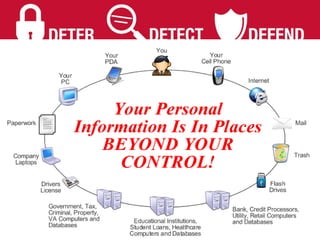
Over 340 million  American’s Identities have been reported lost or stolen since Jan. 2005 . –  PrivacyRights.org  The revenue from trafficking financial data has  surpassed that of drug trafficking .  –  Secret Service March 2007 Identity Theft is Spiraling out of Control !
 
Indifference   – Lack of Feeling Ignorance  –  Lack of Knowledge Inability  –  Lack of Training or Education Inaction  –  Lack of Respect FOUR  AREAS OF NEGLECT
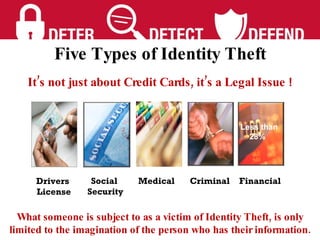
Drivers  License Medical Financial What someone is subject to as a victim of Identity Theft, is only limited to the imagination of the person who has their information. Social  Security Five Types of Identity Theft It’s not just about Credit Cards, it’s a Legal Issue  ! Less than 28% Criminal
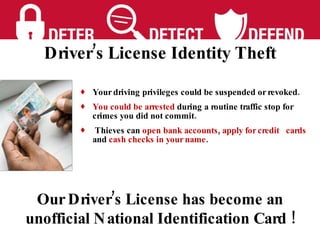
Driver’s License Identity Theft Your driving privileges could be suspended or revoked. You could be arrested  during a routine traffic stop for crimes you did not commit. Thieves can  open bank accounts ,  apply for credit  cards  and  cash checks in your name .  Our Driver’s License has become an unofficial National Identification Card !
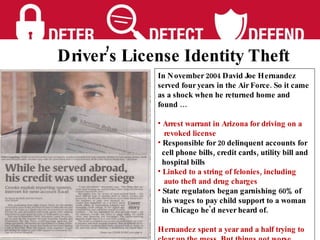
In November 2004 David Joe Hernandez served four years in the Air Force. So it came as a shock when he returned home and found … Arrest warrant in Arizona for driving on a  revoked license Responsible for 20 delinquent accounts for cell phone bills, credit cards, utility bill and  hospital bills Linked to a string of felonies, including  auto theft and drug charges  State regulators began garnishing 60% of his wages to pay child support to a woman  in Chicago he'd never heard of. Hernandez spent a year and a half trying to clear up the mess  But things got worse.  Driver’s License Identity Theft
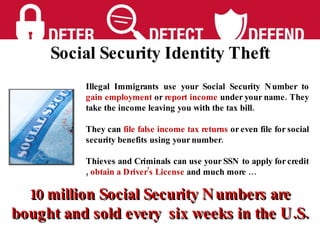
Illegal Immigrants use your Social Security Number to  gain employment  or  report income  under your name. They take the income leaving you with the tax bill. They can  file false income tax returns  or even file for social security benefits using your number. Thieves and Criminals can use your SSN to apply for credit ,  obtain a Driver’s License  and much more … 10 million Social Security Numbers are bought and sold every  six weeks in the U.S. Social Security Identity Theft
Why you are at Risk
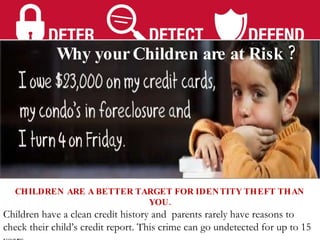
CHILDREN ARE A BETTER TARGET FOR IDENTITY THEFT THAN YOU. Children have a clean credit history and  parents rarely have reasons to check their child’s credit report. This crime can go undetected for up to 15 years.    Why your Children are at Risk ?
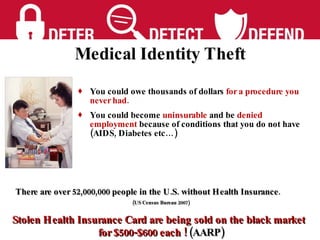
You could owe thousands of dollars  for a procedure you never had. You could become  uninsurable  and be  denied   employment  because of conditions that you do not have (AIDS, Diabetes etc…) There are over 52,000,000 people in the U.S. without Health Insurance .     (US Census Bureau 2007) Stolen Health Insurance Card are being sold on the black market    for $500-$600 each !  (AARP) Medical Identity Theft
Why you are at Risk
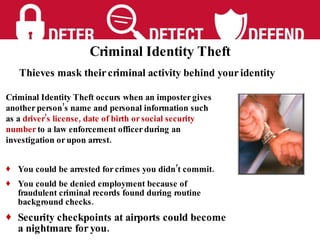
You could be arrested for crimes you didn’t commit. You could be denied employment because of fraudulent criminal records found during routine background checks. Security checkpoints at airports could become a nightmare for you. Thieves mask their criminal activity behind your identity Criminal Identity Theft occurs when an imposter gives another person’s name and personal information such as a  driver’s license, date of birth or social security number  to a law enforcement officer during an investigation or upon arrest.  Criminal Identity Theft
Why you are at Risk
Victims of Financial Identity Theft are people who have had  bank accounts  wiped out,  credit  histories  ruined  and  jobs  and valuable possessions  taken away .  Thieves use your  social security number  to   open new accounts and can  change the billing address  leaving you with the debt. Financial Institutions advertise zero liability for fraudulent activity on accounts if notified within 48 hours.  What happens after 48 hours ?  You could be responsible for debts you didn’t create ! Financial Identity Theft
Federal Trade Commission free report: 877.IDTHEFT consumer.gov/idtheft Financial Identity Theft Financial Identity Theft
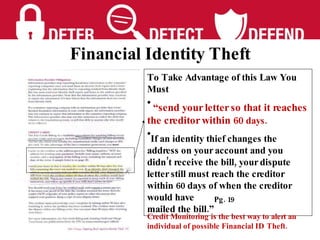
Pg. 19 To Take Advantage of this Law You Must  “ send your letter so that it reaches the creditor within 60  days.  If an identity thief changes the  address on your account and you didn’t receive the bill, your dispute letter still must reach the creditor within 60 days of when the creditor would have  mailed the bill.”  Credit Monitoring is the best way to alert an individual of possible Financial ID Theft. Financial Identity Theft Financial Identity Theft Financial Identity Theft
February 2004 ID Theft Victims Face Tough Bank Fights In 2003 ,  The Korinke family was sued by Homecoming Financial Network INC. , a division of GMAC, for $75,000, plus attorney fees. In 2001, an imposter got hold of a line of credit,  switched the address , and the Korinkes never received the outstanding bills. Homecomings … claimed the Korinkes had been negligent.  “The Korinkes were  slow to  discover and  report the identity theft  … as such,  Korinke is liable  for any and all sums attributed to his negligence.” Korinke’s attorney said “victims who don’t have the means to find a good lawyer, may be losing out in battles with financial institutions.” Financial Identity Theft
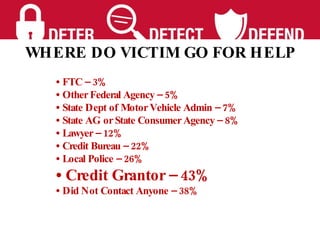
•  FTC – 3% •  Other Federal Agency – 5% •  State Dept of Motor Vehicle Admin – 7% •  State AG or State Consumer Agency – 8% •  Lawyer – 12% •  Credit Bureau – 22% •  Local Police – 26% •  Credit Grantor – 43% •  Did Not Contact Anyone – 38% WHERE DO VICTIM GO FOR HELP
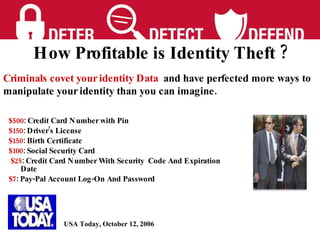
$500 : Credit Card Number with Pin  $150 : Driver’s License $150 : Birth Certificate $100 : Social Security Card $25 : Credit Card Number With Security  Code And Expiration Date $7 : Pay-Pal Account Log-On And Password USA Today, October 12, 2006 Criminals covet your identity Data  and have perfected more ways to manipulate your identity than you can imagine.  How Profitable is Identity Theft ?
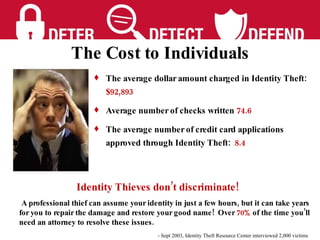
The average dollar amount charged in Identity Theft:  $92,893 Average number of checks written  74.6 The average number of credit card applications approved through Identity Theft:  8.4 - Sept 2003, Identity Theft Resource Center interviewed 2,000 victims The Cost to Individuals Identity Thieves don’t discriminate!   A professional thief can assume your identity in just a few hours, but it can take years for you to repair the damage and restore your good name!  Over  70%  of the time you’ll need an attorney to resolve these issues.
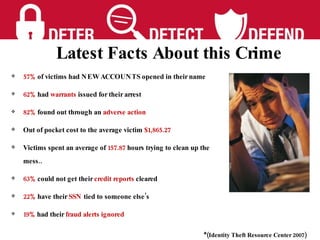
57%  of victims had NEW ACCOUNTS opened in their name 62%   had  warrants  issued for their arrest 82%  found out through an  adverse action Out of pocket cost   to   the average victim   $1,865.27  Victims spent an average of  157.87  hours trying to clean up the mess.. 63%  could not get their  credit reports  cleared 22%  have their  SSN  tied to someone else’s 19%  had their  fraud alerts ignored *(Identity Theft Resource Center 2007) Latest Facts About this Crime
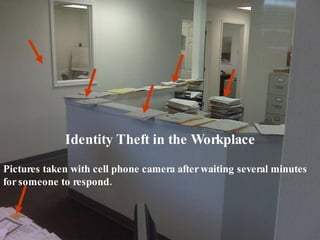
Pictures taken with cell phone camera after waiting several minutes for someone to respond. Identity Theft in the Workplace
Access to the computer, mail and other documents possible.
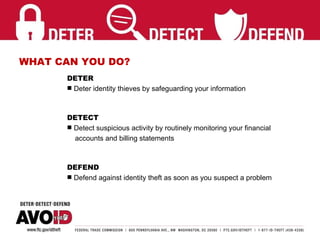
WHAT CAN YOU DO? DETER  Deter identity thieves by safeguarding your information DETECT   Detect suspicious activity by routinely monitoring your financial  accounts and billing statements DEFEND Defend against identity theft as soon as you suspect a problem
DETER  identity thieves by safeguarding your information . Shred financial documents before discarding them Protect your Social Security number Don’t give out personal information unless you’re sure who  you’re dealing with  Don’t use obvious passwords Keep your information secure
DETECT  suspicious activity by routinely monitoring your financial  accounts and billing statements. Be alert  Mail or bills that don’t arrive Denials of credit for no reason Inspect your credit report Law entitles you to one free report a year from each nationwide credit reporting agencies if you ask for it Online:  www.AnnualCreditReport.com ; by phone: 1-877-322-8228;  or by mail: Annual Credit Report Request Service, P.O. Box 105281,  Atlanta, GA 30348-5281.   WE RECOMMEND WWW.MYCREDITKEEPER.COM Inspect your financial statements Look for charges you didn’t make
DEFEND  against identity theft as soon as you suspect  a problem. Place a “Fraud Alert” on your credit reports by calling any one of the three nationwide credit reporting companies:  Equifax: 1-800-525-6285 Experian: 1-888-397-3742 TransUnion: 1-800-680-7289 Review reports carefully, looking for fraudulent activity Close accounts that have been tampered with or opened fraudulently  File a police report Contact the Federal Trade Commission
 
QUESTIONS! Joe Orsak Randall Chesnutt Ron Hargrove

Identity Theft Presentation

  • 1.
    IDENTITY THEFT “ The fastest growing white-collar crime in America” According to the FBI
  • 2.
    Identity Theft Privacy& Security Training Randall Chesnutt , CITRMS Avoid ID Theft USA Houston, Texas The Institute of Fraud Risk Management is the nation’s only professional certification program ( CITRMS ) specifically developed to train and equip professionals to understand and address Identity Theft and related fraud issues. This is the same organization that trains F.B.I
  • 3.
    WHAT IS IDENTITYTHEFT? It occurs when someone steals your personal information – e.g., credit card or Social Security number – and uses it fraudulently It can cost you time and money It can destroy your credit and ruin your good name
  • 4.
    Identity Theft isin the News
  • 5.
    Over 340 million American’s Identities have been reported lost or stolen since Jan. 2005 . – PrivacyRights.org The revenue from trafficking financial data has surpassed that of drug trafficking . – Secret Service March 2007 Identity Theft is Spiraling out of Control !
  • 6.
  • 7.
    Indifference – Lack of Feeling Ignorance – Lack of Knowledge Inability – Lack of Training or Education Inaction – Lack of Respect FOUR AREAS OF NEGLECT
  • 8.
    Drivers LicenseMedical Financial What someone is subject to as a victim of Identity Theft, is only limited to the imagination of the person who has their information. Social Security Five Types of Identity Theft It’s not just about Credit Cards, it’s a Legal Issue ! Less than 28% Criminal
  • 9.
    Driver’s License IdentityTheft Your driving privileges could be suspended or revoked. You could be arrested during a routine traffic stop for crimes you did not commit. Thieves can open bank accounts , apply for credit cards and cash checks in your name . Our Driver’s License has become an unofficial National Identification Card !
  • 10.
    In November 2004David Joe Hernandez served four years in the Air Force. So it came as a shock when he returned home and found … Arrest warrant in Arizona for driving on a revoked license Responsible for 20 delinquent accounts for cell phone bills, credit cards, utility bill and hospital bills Linked to a string of felonies, including auto theft and drug charges State regulators began garnishing 60% of his wages to pay child support to a woman in Chicago he'd never heard of. Hernandez spent a year and a half trying to clear up the mess But things got worse. Driver’s License Identity Theft
  • 11.
    Illegal Immigrants useyour Social Security Number to gain employment or report income under your name. They take the income leaving you with the tax bill. They can file false income tax returns or even file for social security benefits using your number. Thieves and Criminals can use your SSN to apply for credit , obtain a Driver’s License and much more … 10 million Social Security Numbers are bought and sold every six weeks in the U.S. Social Security Identity Theft
  • 12.
    Why you areat Risk
  • 13.
    CHILDREN ARE ABETTER TARGET FOR IDENTITY THEFT THAN YOU. Children have a clean credit history and parents rarely have reasons to check their child’s credit report. This crime can go undetected for up to 15 years.   Why your Children are at Risk ?
  • 14.
    You could owethousands of dollars for a procedure you never had. You could become uninsurable and be denied employment because of conditions that you do not have (AIDS, Diabetes etc…) There are over 52,000,000 people in the U.S. without Health Insurance . (US Census Bureau 2007) Stolen Health Insurance Card are being sold on the black market for $500-$600 each ! (AARP) Medical Identity Theft
  • 15.
    Why you areat Risk
  • 16.
    You could bearrested for crimes you didn’t commit. You could be denied employment because of fraudulent criminal records found during routine background checks. Security checkpoints at airports could become a nightmare for you. Thieves mask their criminal activity behind your identity Criminal Identity Theft occurs when an imposter gives another person’s name and personal information such as a driver’s license, date of birth or social security number to a law enforcement officer during an investigation or upon arrest. Criminal Identity Theft
  • 17.
    Why you areat Risk
  • 18.
    Victims of FinancialIdentity Theft are people who have had bank accounts wiped out, credit histories ruined and jobs and valuable possessions taken away . Thieves use your social security number to open new accounts and can change the billing address leaving you with the debt. Financial Institutions advertise zero liability for fraudulent activity on accounts if notified within 48 hours. What happens after 48 hours ? You could be responsible for debts you didn’t create ! Financial Identity Theft
  • 19.
    Federal Trade Commissionfree report: 877.IDTHEFT consumer.gov/idtheft Financial Identity Theft Financial Identity Theft
  • 20.
    Pg. 19 ToTake Advantage of this Law You Must “ send your letter so that it reaches the creditor within 60 days. If an identity thief changes the address on your account and you didn’t receive the bill, your dispute letter still must reach the creditor within 60 days of when the creditor would have mailed the bill.” Credit Monitoring is the best way to alert an individual of possible Financial ID Theft. Financial Identity Theft Financial Identity Theft Financial Identity Theft
  • 21.
    February 2004 IDTheft Victims Face Tough Bank Fights In 2003 , The Korinke family was sued by Homecoming Financial Network INC. , a division of GMAC, for $75,000, plus attorney fees. In 2001, an imposter got hold of a line of credit, switched the address , and the Korinkes never received the outstanding bills. Homecomings … claimed the Korinkes had been negligent. “The Korinkes were slow to discover and report the identity theft … as such, Korinke is liable for any and all sums attributed to his negligence.” Korinke’s attorney said “victims who don’t have the means to find a good lawyer, may be losing out in battles with financial institutions.” Financial Identity Theft
  • 22.
    • FTC– 3% • Other Federal Agency – 5% • State Dept of Motor Vehicle Admin – 7% • State AG or State Consumer Agency – 8% • Lawyer – 12% • Credit Bureau – 22% • Local Police – 26% • Credit Grantor – 43% • Did Not Contact Anyone – 38% WHERE DO VICTIM GO FOR HELP
  • 23.
    $500 : CreditCard Number with Pin $150 : Driver’s License $150 : Birth Certificate $100 : Social Security Card $25 : Credit Card Number With Security Code And Expiration Date $7 : Pay-Pal Account Log-On And Password USA Today, October 12, 2006 Criminals covet your identity Data and have perfected more ways to manipulate your identity than you can imagine. How Profitable is Identity Theft ?
  • 24.
    The average dollaramount charged in Identity Theft: $92,893 Average number of checks written 74.6 The average number of credit card applications approved through Identity Theft: 8.4 - Sept 2003, Identity Theft Resource Center interviewed 2,000 victims The Cost to Individuals Identity Thieves don’t discriminate! A professional thief can assume your identity in just a few hours, but it can take years for you to repair the damage and restore your good name! Over 70% of the time you’ll need an attorney to resolve these issues.
  • 25.
    57% ofvictims had NEW ACCOUNTS opened in their name 62% had warrants issued for their arrest 82% found out through an adverse action Out of pocket cost to the average victim $1,865.27 Victims spent an average of 157.87 hours trying to clean up the mess.. 63% could not get their credit reports cleared 22% have their SSN tied to someone else’s 19% had their fraud alerts ignored *(Identity Theft Resource Center 2007) Latest Facts About this Crime
  • 26.
    Pictures taken withcell phone camera after waiting several minutes for someone to respond. Identity Theft in the Workplace
  • 27.
    Access to thecomputer, mail and other documents possible.
  • 28.
    WHAT CAN YOUDO? DETER Deter identity thieves by safeguarding your information DETECT Detect suspicious activity by routinely monitoring your financial accounts and billing statements DEFEND Defend against identity theft as soon as you suspect a problem
  • 29.
    DETER identitythieves by safeguarding your information . Shred financial documents before discarding them Protect your Social Security number Don’t give out personal information unless you’re sure who you’re dealing with Don’t use obvious passwords Keep your information secure
  • 30.
    DETECT suspiciousactivity by routinely monitoring your financial accounts and billing statements. Be alert Mail or bills that don’t arrive Denials of credit for no reason Inspect your credit report Law entitles you to one free report a year from each nationwide credit reporting agencies if you ask for it Online: www.AnnualCreditReport.com ; by phone: 1-877-322-8228; or by mail: Annual Credit Report Request Service, P.O. Box 105281, Atlanta, GA 30348-5281. WE RECOMMEND WWW.MYCREDITKEEPER.COM Inspect your financial statements Look for charges you didn’t make
  • 31.
    DEFEND againstidentity theft as soon as you suspect a problem. Place a “Fraud Alert” on your credit reports by calling any one of the three nationwide credit reporting companies: Equifax: 1-800-525-6285 Experian: 1-888-397-3742 TransUnion: 1-800-680-7289 Review reports carefully, looking for fraudulent activity Close accounts that have been tampered with or opened fraudulently File a police report Contact the Federal Trade Commission
  • 32.
  • 33.
    QUESTIONS! Joe OrsakRandall Chesnutt Ron Hargrove

Editor's Notes

  • #2 How many of you have been victims or know someone who has been a victim of Identity Theft
  • #3 I am a Certified Identity theft Risk Management Speacilist
  • #4 So, identity thieves can do a lot of damage… They can go on spending sprees using your credit card Using your name and Social Security number, they can open new credit card accounts They could give your name to the police if they get arrested
  • #6 Mention 340 million doesn’t mean they are victims it just means there information has been breached.
  • #7 Some people say take my credit, or that I am good at protecting my information, BUT WHAT ABOUT EVERYONE ELSE are they protecting your information. Unlike the drug trade one transaction one product, with your information it can be sold over and over again Pill bottle
  • #11 The Average time it takes before you find out you are a victim is 12.3 months
  • #21 The Average time it takes before you find out you are a victim is 12.3 months
  • #29 While there are no ways to absolutely guarantee you’ll never be a victim of identity theft, there are ways to minimize your risk. By following the “3 D’s” of identity protection, we can all make it more difficult for thieves to walk away with our identities. The “3 D’s” are Deter, Detect, and Defend; let me tell you about some specific steps you can take to minimize your risk. Don’t worry about taking notes, I have handouts for you from the Federal Trade Commission.
  • #30 Shred paperwork with personal information and financial documents before you discard them. Don’t carry your Social Security card in your wallet or write your Social Security number on a check. Give it out only if absolutely necessary; you can always ask to use another identifier. Don’t give out personal information on the phone, through the mail, or over the Internet unless you are sure who you are dealing with. Never click on links sent in unsolicited emails; instead, type in a web address you know.  Don’t use obvious passwords. Your mother’s maiden name, or the last four digits of your Social Security number – all are obvious passwords. Keep your personal information in a secure place at home, especially if you have roommates, employ outside help, or are having work done in your house.
  • #31 Credit reports contain information about you, including what accounts you have and your bill paying history. There are three major nationwide consumer reporting companies – Equifax, Experian, and TransUnion – the law requires them to give you a free copy of your credit report each year if you ask for it. www.AnnualCreditReport.com is a service created by these three companies: It is the only authorized site where you can order the free credit report you’re entitled to each year. When asking for your credit report, you may need to provide certain personal information, including your Social Security number and information about your monthly bills.
  • #32 Placing a fraud alert on your credit reports tells creditors to follow certain procedures before they open new accounts in your name or make certain changes to your existing accounts. The 3 consumer reporting companies have toll-free numbers for placing an initial 90-day fraud alert; a call to one company is sufficient. It entitles you to free copies of your credit reports. Look for inquiries from companies you haven’t contacted, accounts you didn’t open, and debts on your accounts that you can’t explain. To close your accounts, call the security or fraud departments of each company where an account was opened or changed without your okay. Follow up in writing, with copies of supporting documents. Use the ID Theft Affidavit at ftc.gov/idtheft to support your written statement. Ask for written verification that the disputed account has been closed and the fraudulent debts discharged. The FTC is the federal consumer protection agency that helps law enforcement officials in their investigations.