IDENTITY THEFT
What is Identity Theft
• Identity theft occurs when someone steals key pieces of
personal information to impersonate
• a person. This information may include such data as
name, address, date of birth, Social
• Security number, passport number, driver’s license
number, and mother’s maiden name.
• Using this information, an identity thief may apply for
new credit or financial accounts, rent
• an apartment, set up utility or phone service, and register
for college courses—all in someone
• else’s name.
Impact Of Identity Theft
• Damaged Credit: Thieves run up bills or open new accounts in your
name. When they don’t pay your credit rating plummets while your
interest rates skyrocket. When you apply for a loan or new credit
card, you are turned down.
• Lost Medical Benefits: When someone seeks medical treatment with
your health insurance benefit, the implications go beyond financial.
You could end up with a medical history that isn’t entirely yours,
resulting in potentially incorrect diagnosis and treatment when you
do need help.
• Financial Loss: With bank account numbers and basic personal
information, identity thieves can drain your bank accounts.
• Repair Time: The average identity theft victim spends more than 500
hours and more than $3,000 to restore his or her credit and good
name. That time lost from work, from family, from life.
TYPES OF ID THEFT
• Criminal identity theft (posing as another person when
apprehended for a crime)
• Financial identity theft (using another's identity to obtain
credit, goods and services)
• Identity cloning (using another's information to assume
his or her identity in daily life)
• Medical identity theft (using another's identity to obtain
medical care or drugs)
• Child identity theft
HOW IT IS CARRIED OUT
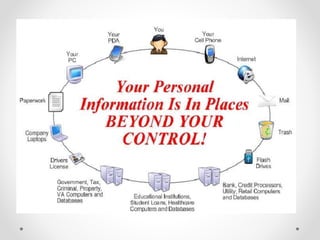
Identity thieves have a variety of ways to steal your information—both
high and low tech. With the constant evolution of technology, there is a
constant evolution of ways identity thieves can steal data. These are
the most common:
• Dumpster diving
It’s exactly as it sounds. Thieves will go through your trash looking for
bills, receipts and other documents containing your personal
information.
• Phishing, Vishing & Smishing
Identity thieves will email (phishing), call (vishing) or text (smishing) you
pretending to be someone else—likely a bank or other institution your
trust— and request that you provide more information. They’ve even
been known to replicate a popular website hoping to trick you into filling
out an online form.
• Hacking
Your computer, smartphone and mobile devices could all be at
risk. Hackers can install malware, keystroke-logging software
and other malicious technology that grabs your information
without you ever noticing.
• Data breach
When an organization like a bank, retailer or doctor’s office gets
hacked, the damage is often widespread impacting hundreds or
thousands of customers. Hackers may use stolen information for
identity fraud, or they may simply sell it on black market websites
for other criminals to purchase and use. Many people affected by
data breaches don’t even know they’re victims until several
years after the event occurred.
How to protect yourself from identity
theft
• Shred
Buy a cross-cut shredder and make sure you shred any documents
containing personal information before you toss them in the dumpster.
• Lock
Be sure to password protect all of your devices, and use unique,
complicated passwords for your online accounts.
• Secure
Never log in to financial accounts or shop online while using public Wi-
Fi, and make sure to encrypt and password protect your Wi-Fi at home.
• Monitor
Review your credit reports and bank accounts periodically looking for
suspicious activity and errors that could signify identity theft
• Detect
Consider purchasing an identity theft detection product that
includes identity theft restoration. If you do become a victim of
identity theft, you’ll be notified quickly and be able to lean on
certified specialists to help restore your identity.
• Educate
People must be educated as to the value of information.They
must be trained to protect information (even if the information
they have access to appears to be of relatively low value).
People must be made aware of what social engineering is and
how social engineers operate.
5 Steps to Take Immediately If You’ve Been a
Victim of Identity Theft
1. Contact Any Institution Directly Affected
2. Put a Fraud Alert on Your Credit Reports
3. Contact the Federal Trade Commission (FTC)
4. File a Police Report
5. Protect Your Social Security Number
IT Acts to prevent identity
theft:
Identity Theft and Assumption Deterrence Act, 1998
United States of America has enacted Identity Theft and
Assumption Deterrence Act of 1998 in order to make
identity theft a crime.
This act makes identity theft a Federal crime with penalties
up to 15 years imprisonment and a maximum fine of
$250,000.
2. ITA,2000
• The Information Technology Act 2000 (also known as ITA-
2000, or the IT Act) is an Act of the Indian Parliament notified
on October 17, 2000.
• It extends to whole of India and also applies to any offence
committed outside India by any person .
• Punishment for identity theft according to section 66c of ITA-
“ Whoever, fraudulently or dishonestly make use of the
electronic signature, password or any other unique identification
feature of any other person, shall be punished with imprisonment
of either description for a term which may extend to three years
and shall also be liable to fine which may extend to rupees one
lakh.”
To counter identity theft and fraud in India, the
government must focus on three areas:—
• Legislating specific provisions to counter identity theft.
• Enabling flow of information from credit bureaus to
consumers.
• Implementing an identity fraud alert registry.
•
Thank you
Group no.4
A001 JASON AMANNA
A012 UMANG GUPTA
A045 VARNIKA TALWAR
A058 HARSH GUPTA

Identity Theft.pptx

  • 1.
  • 2.
    What is IdentityTheft • Identity theft occurs when someone steals key pieces of personal information to impersonate • a person. This information may include such data as name, address, date of birth, Social • Security number, passport number, driver’s license number, and mother’s maiden name. • Using this information, an identity thief may apply for new credit or financial accounts, rent • an apartment, set up utility or phone service, and register for college courses—all in someone • else’s name.
  • 3.
    Impact Of IdentityTheft • Damaged Credit: Thieves run up bills or open new accounts in your name. When they don’t pay your credit rating plummets while your interest rates skyrocket. When you apply for a loan or new credit card, you are turned down. • Lost Medical Benefits: When someone seeks medical treatment with your health insurance benefit, the implications go beyond financial. You could end up with a medical history that isn’t entirely yours, resulting in potentially incorrect diagnosis and treatment when you do need help. • Financial Loss: With bank account numbers and basic personal information, identity thieves can drain your bank accounts. • Repair Time: The average identity theft victim spends more than 500 hours and more than $3,000 to restore his or her credit and good name. That time lost from work, from family, from life.
  • 5.
    TYPES OF IDTHEFT • Criminal identity theft (posing as another person when apprehended for a crime) • Financial identity theft (using another's identity to obtain credit, goods and services) • Identity cloning (using another's information to assume his or her identity in daily life) • Medical identity theft (using another's identity to obtain medical care or drugs) • Child identity theft
  • 6.
    HOW IT ISCARRIED OUT Identity thieves have a variety of ways to steal your information—both high and low tech. With the constant evolution of technology, there is a constant evolution of ways identity thieves can steal data. These are the most common: • Dumpster diving It’s exactly as it sounds. Thieves will go through your trash looking for bills, receipts and other documents containing your personal information. • Phishing, Vishing & Smishing Identity thieves will email (phishing), call (vishing) or text (smishing) you pretending to be someone else—likely a bank or other institution your trust— and request that you provide more information. They’ve even been known to replicate a popular website hoping to trick you into filling out an online form.
  • 7.
    • Hacking Your computer,smartphone and mobile devices could all be at risk. Hackers can install malware, keystroke-logging software and other malicious technology that grabs your information without you ever noticing. • Data breach When an organization like a bank, retailer or doctor’s office gets hacked, the damage is often widespread impacting hundreds or thousands of customers. Hackers may use stolen information for identity fraud, or they may simply sell it on black market websites for other criminals to purchase and use. Many people affected by data breaches don’t even know they’re victims until several years after the event occurred.
  • 8.
    How to protectyourself from identity theft • Shred Buy a cross-cut shredder and make sure you shred any documents containing personal information before you toss them in the dumpster. • Lock Be sure to password protect all of your devices, and use unique, complicated passwords for your online accounts. • Secure Never log in to financial accounts or shop online while using public Wi- Fi, and make sure to encrypt and password protect your Wi-Fi at home. • Monitor Review your credit reports and bank accounts periodically looking for suspicious activity and errors that could signify identity theft
  • 9.
    • Detect Consider purchasingan identity theft detection product that includes identity theft restoration. If you do become a victim of identity theft, you’ll be notified quickly and be able to lean on certified specialists to help restore your identity. • Educate People must be educated as to the value of information.They must be trained to protect information (even if the information they have access to appears to be of relatively low value). People must be made aware of what social engineering is and how social engineers operate.
  • 10.
    5 Steps toTake Immediately If You’ve Been a Victim of Identity Theft 1. Contact Any Institution Directly Affected 2. Put a Fraud Alert on Your Credit Reports 3. Contact the Federal Trade Commission (FTC) 4. File a Police Report 5. Protect Your Social Security Number
  • 11.
    IT Acts toprevent identity theft: Identity Theft and Assumption Deterrence Act, 1998 United States of America has enacted Identity Theft and Assumption Deterrence Act of 1998 in order to make identity theft a crime. This act makes identity theft a Federal crime with penalties up to 15 years imprisonment and a maximum fine of $250,000.
  • 12.
    2. ITA,2000 • TheInformation Technology Act 2000 (also known as ITA- 2000, or the IT Act) is an Act of the Indian Parliament notified on October 17, 2000. • It extends to whole of India and also applies to any offence committed outside India by any person . • Punishment for identity theft according to section 66c of ITA- “ Whoever, fraudulently or dishonestly make use of the electronic signature, password or any other unique identification feature of any other person, shall be punished with imprisonment of either description for a term which may extend to three years and shall also be liable to fine which may extend to rupees one lakh.”
  • 13.
    To counter identitytheft and fraud in India, the government must focus on three areas:— • Legislating specific provisions to counter identity theft. • Enabling flow of information from credit bureaus to consumers. • Implementing an identity fraud alert registry. •
  • 14.
    Thank you Group no.4 A001JASON AMANNA A012 UMANG GUPTA A045 VARNIKA TALWAR A058 HARSH GUPTA