Identifying
vs.
Enumerating
Objects
John L. Dennis & Vidal Annan
Visual Attention Lab
Rutgers University Center
for Cognitive Science
Theoretical Motivation
• The FINST mechanism has been
described as a limited-capacity parallel
mechanism for object individuation of
about 4-5 objects, (Pylyshyn & Storm,
1988).
• This mechanism has been used to
describe some preconceptual processes,
i.e., MOT and subitizing.
General Question
What “types” of information
about objects are accessible
when they are processed in
parallel, i.e., shape, orientation,
color, position or quantity?
Research Question
In this study we examined two
types of information –
Enumeration of Objects
and
Identifying of Objects
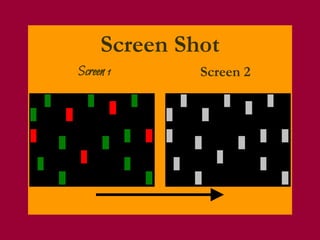
Screen Shot
Screen 1 Screen 2
Design
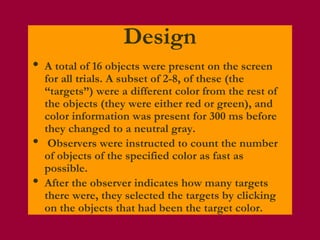
• A total of 16 objects were present on the screen
for all trials. A subset of 2-8, of these (the
“targets”) were a different color from the rest of
the objects (they were either red or green), and
color information was present for 300 ms before
they changed to a neutral gray.
• Observers were instructed to count the number
of objects of the specified color as fast as
possible.
• After the observer indicates how many targets
there were, they selected the targets by clicking
on the objects that had been the target color.
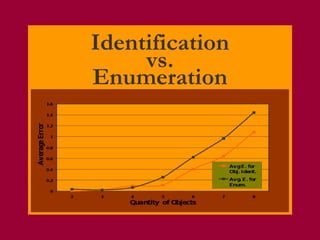
Identification
vs.
Enumeration
Results
There is an overall significant
difference between enumeration
and object identification
[F(1, 11) = 27.437, p < .001]
But when does the performance
on the two tasks diverge?
Point of Divergence
This divergence between identifying
and enumerating fails to occur for the
quantities 2, 3, 4
[F(1, 11) = .047, p = .832]
and does occur when we include the
quantity 5, (i.e., when we compare the
effect for 2, 3, 4 and 2, 3, 4, 5)
[F(1,11) = 6.61, p = .026]
Possible Confound
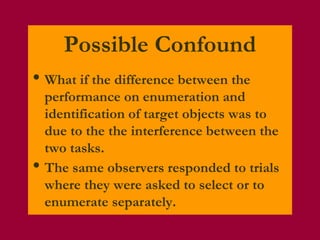
• What if the difference between the
performance on enumeration and
identification of target objects was to
due to the the interference between the
two tasks.
• The same observers responded to trials
where they were asked to select or to
enumerate separately.
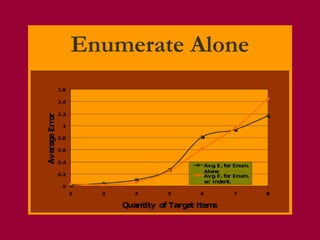
Enumerate Alone
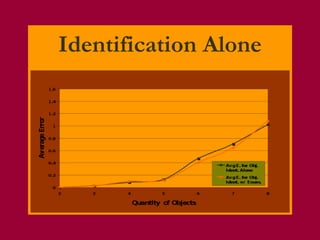
Identification Alone
Together
vs.
Separately
• There is no significant difference identifying
[F(1, 11) = .012, p = .914]
and enumerating
[F(1, 11) = .527, p = .483]
when done together as compared to when
they are done separately
Summary
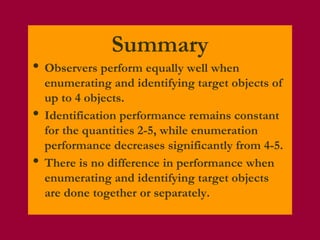
• Observers perform equally well when
enumerating and identifying target objects of
up to 4 objects.
• Identification performance remains constant
for the quantities 2-5, while enumeration
performance decreases significantly from 4-5.
• There is no difference in performance when
enumerating and identifying target objects
are done together or separately.
Conclusions
• These results suggest that a Visual Index
allows an observer to identify and
enumerate without significant error 2-4
target objects.
• The performance for enumeration and
identification diverge at the quantity 4-5,
with identification performance
significantly exceeding enumeration
performance.
References
• Pylyshyn, Z. W. (1989). The role of location indexes in
spatial perception: A sketch of the FINST spatial-
index model. Cognition, 32, 65-97.
• Pylyshyn, Z. W. & Storm, R. W. (1988). Tracking
multiple independent targets: evidence for a parallel
tracking mechanism. Spatial Vision, 3(3), 1-19.
• Trick, L. M. & Pylyshyn, Z. W. (1994). Why are small
and large numbers enumerated differently? A limited-
capacity preattentive stage in vision.

Identifying vs. Enumerating Objects

  • 1.
    Identifying vs. Enumerating Objects John L. Dennis& Vidal Annan Visual Attention Lab Rutgers University Center for Cognitive Science
  • 2.
    Theoretical Motivation • TheFINST mechanism has been described as a limited-capacity parallel mechanism for object individuation of about 4-5 objects, (Pylyshyn & Storm, 1988). • This mechanism has been used to describe some preconceptual processes, i.e., MOT and subitizing.
  • 3.
    General Question What “types”of information about objects are accessible when they are processed in parallel, i.e., shape, orientation, color, position or quantity?
  • 4.
    Research Question In thisstudy we examined two types of information – Enumeration of Objects and Identifying of Objects
  • 5.
  • 6.
    Design • A totalof 16 objects were present on the screen for all trials. A subset of 2-8, of these (the “targets”) were a different color from the rest of the objects (they were either red or green), and color information was present for 300 ms before they changed to a neutral gray. • Observers were instructed to count the number of objects of the specified color as fast as possible. • After the observer indicates how many targets there were, they selected the targets by clicking on the objects that had been the target color.
  • 7.
  • 8.
    Results There is anoverall significant difference between enumeration and object identification [F(1, 11) = 27.437, p < .001]
  • 9.
    But when doesthe performance on the two tasks diverge?
  • 10.
    Point of Divergence Thisdivergence between identifying and enumerating fails to occur for the quantities 2, 3, 4 [F(1, 11) = .047, p = .832] and does occur when we include the quantity 5, (i.e., when we compare the effect for 2, 3, 4 and 2, 3, 4, 5) [F(1,11) = 6.61, p = .026]
  • 11.
    Possible Confound • Whatif the difference between the performance on enumeration and identification of target objects was to due to the the interference between the two tasks. • The same observers responded to trials where they were asked to select or to enumerate separately.
  • 12.
  • 13.
  • 14.
    Together vs. Separately • There isno significant difference identifying [F(1, 11) = .012, p = .914] and enumerating [F(1, 11) = .527, p = .483] when done together as compared to when they are done separately
  • 15.
    Summary • Observers performequally well when enumerating and identifying target objects of up to 4 objects. • Identification performance remains constant for the quantities 2-5, while enumeration performance decreases significantly from 4-5. • There is no difference in performance when enumerating and identifying target objects are done together or separately.
  • 16.
    Conclusions • These resultssuggest that a Visual Index allows an observer to identify and enumerate without significant error 2-4 target objects. • The performance for enumeration and identification diverge at the quantity 4-5, with identification performance significantly exceeding enumeration performance.
  • 17.
    References • Pylyshyn, Z.W. (1989). The role of location indexes in spatial perception: A sketch of the FINST spatial- index model. Cognition, 32, 65-97. • Pylyshyn, Z. W. & Storm, R. W. (1988). Tracking multiple independent targets: evidence for a parallel tracking mechanism. Spatial Vision, 3(3), 1-19. • Trick, L. M. & Pylyshyn, Z. W. (1994). Why are small and large numbers enumerated differently? A limited- capacity preattentive stage in vision.