Narratives & Time
Can current models predict
differential duration estimates for
“fantasy” and “reality” narratives?
The Short Answer
• No
– Just kidding.
» Kinda.
Event-Indexing Model
aka Situation Model (Zwaan & Radvansky)
• Three types of situation models
– Current, integrated and complete model
• Four types of processing
– Construction, updating, retrieval of
situation models & foregrounding of
specific situation model elements
How does it work?
• Info from sentences construct the
current model
• This info is integrated into a single
model - integrated model via updating
• Readers focus on different types of
information via foregrounding
• Integrated model is stored in LTM as a
complete model - may be retrieved
Five Dimension of Event-
Indexing Model
• Temporal
• Spatial
• Causal
• Motivational
• Person/Object
Focus on Time:
Situation Model
• Temporal info allows comprehender to
locate in time situations referred to in
discourse.
• But how do people get the temporal
information from the current situation
model?
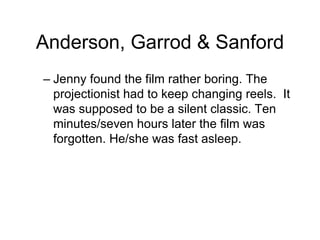
Anderson, Garrod & Sanford
– Jenny found the film rather boring. The
projectionist had to keep changing reels. It
was supposed to be a silent classic. Ten
minutes/seven hours later the film was
forgotten. He/she was fast asleep.
Results
• Time shifts “outside the norm” took longer to
read and memory for character described
was less accessable.
• Anderson et al, argue that readers use world
knowledge about typical temporal length of
scenarios to judge perceived duration of
events described in scenario.
There is a problem
• First problem-
– What if one has not experienced a
scenario?
• Like a trip from Denver to San Fransisco by
AMTRAK
• Second problem
– What about fictional events that nobody
has experienced?
• Like a trip to the center of the Earth
Situation Model vs. Plot
Rapp & Gerrig
• Subjects given M time shift selected
minute-consistent outcome 89.5%
• But critically, given H time shift they
selected the minute-consistent outcome
56.2%
Plot Wins
Situation Model Looses
• Results demonstrated that readers
showed propensity to accept preferred
outcome despite reality-driven
constraints
• Providing evidence for plot-driven
analysis of narrative comprehension
Mechanisms for Differences
in Perceived Duration
• Perhaps for fantasy and reality narratives the
– Encoding or retrieval of the situation model
involves a qualitatively different process
– Unable to connect fantasy narrative to reality
– The plots are qualitatively different thereby
imparting differences in reader’s wishes or desires
Time: Narratives & Time

Time: Narratives & Time

  • 1.
    Narratives & Time Cancurrent models predict differential duration estimates for “fantasy” and “reality” narratives?
  • 2.
    The Short Answer •No – Just kidding. » Kinda.
  • 3.
    Event-Indexing Model aka SituationModel (Zwaan & Radvansky) • Three types of situation models – Current, integrated and complete model • Four types of processing – Construction, updating, retrieval of situation models & foregrounding of specific situation model elements
  • 4.
    How does itwork? • Info from sentences construct the current model • This info is integrated into a single model - integrated model via updating • Readers focus on different types of information via foregrounding • Integrated model is stored in LTM as a complete model - may be retrieved
  • 5.
    Five Dimension ofEvent- Indexing Model • Temporal • Spatial • Causal • Motivational • Person/Object
  • 6.
    Focus on Time: SituationModel • Temporal info allows comprehender to locate in time situations referred to in discourse. • But how do people get the temporal information from the current situation model?
  • 7.
    Anderson, Garrod &Sanford – Jenny found the film rather boring. The projectionist had to keep changing reels. It was supposed to be a silent classic. Ten minutes/seven hours later the film was forgotten. He/she was fast asleep.
  • 8.
    Results • Time shifts“outside the norm” took longer to read and memory for character described was less accessable. • Anderson et al, argue that readers use world knowledge about typical temporal length of scenarios to judge perceived duration of events described in scenario.
  • 9.
    There is aproblem • First problem- – What if one has not experienced a scenario? • Like a trip from Denver to San Fransisco by AMTRAK • Second problem – What about fictional events that nobody has experienced? • Like a trip to the center of the Earth
  • 10.
    Situation Model vs.Plot Rapp & Gerrig • Subjects given M time shift selected minute-consistent outcome 89.5% • But critically, given H time shift they selected the minute-consistent outcome 56.2%
  • 11.
    Plot Wins Situation ModelLooses • Results demonstrated that readers showed propensity to accept preferred outcome despite reality-driven constraints • Providing evidence for plot-driven analysis of narrative comprehension
  • 12.
    Mechanisms for Differences inPerceived Duration • Perhaps for fantasy and reality narratives the – Encoding or retrieval of the situation model involves a qualitatively different process – Unable to connect fantasy narrative to reality – The plots are qualitatively different thereby imparting differences in reader’s wishes or desires

Editor's Notes

  • #5 For example, we can use tense to express a location in time. The tense of the verbs can indicate if the event occurred before, after or at the same time with the current time that we are speaking about.
  • #10 Distribute handout