Entrepreneurship
Senior High School Applied - Academic
Unit 1: Understanding the Concept of Entrepreneurship
Lesson 1
Entrepreneurship: Overview and
Concepts
ENGAGE EXPLORE EXPLAIN EXTEND
EVALUAT
What is
Entrepreneurship?
Do you want to be an
entrepreneur?
2
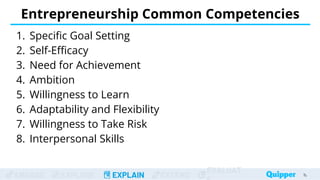
Learning
Objective
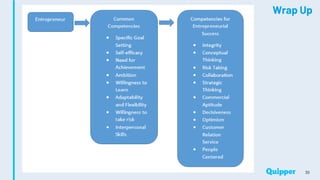
ENGAGE EXPLORE EXPLAIN EXTEND
EVALUAT
At the end of the
lesson, you should
be able to do the
following:
Explain the key concepts of
common competencies in
entrepreneurship.
3
3
ENGAGE EXPLORE EXPLAIN EXTEND
EVALUAT
Who are the
entrepreneurs around
you?
4
ENGAGE EXPLORE EXPLAIN EXTEND
EVALUAT
Can you name
some of the
most
successful
entrepreneurs
in the country?
5
ENGAGE EXPLORE EXPLAIN EXTEND
EVALUAT
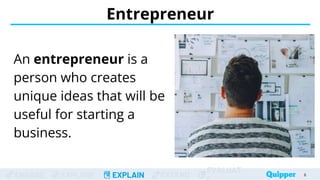
Entrepreneur
An entrepreneur is a
person who creates
unique ideas that will be
useful for starting a
business.
6
ENGAGE EXPLORE EXPLAIN EXTEND
EVALUAT
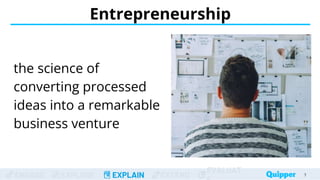
Entrepreneurship
the science of
converting processed
ideas into a remarkable
business venture
7
ENGAGE EXPLORE EXPLAIN EXTEND
EVALUAT
Why study
Entrepreneurship?
8
ENGAGE EXPLORE EXPLAIN EXTEND
EVALUAT
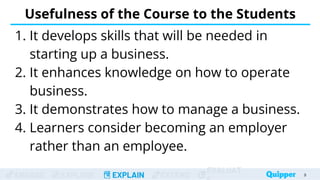
Usefulness of the Course to the Students
1. It develops skills that will be needed in
starting up a business.
2. It enhances knowledge on how to operate
business.
3. It demonstrates how to manage a business.
4. Learners consider becoming an employer
rather than an employee.
9
ENGAGE EXPLORE EXPLAIN EXTEND
EVALUAT
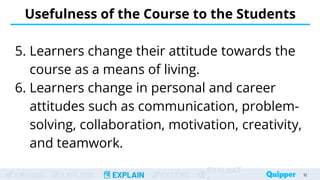
Usefulness of the Course to the Students
5. Learners change their attitude towards the
course as a means of living.
6. Learners change in personal and career
attitudes such as communication, problem-
solving, collaboration, motivation, creativity,
and teamwork.
10
ENGAGE EXPLORE EXPLAIN EXTEND
EVALUAT
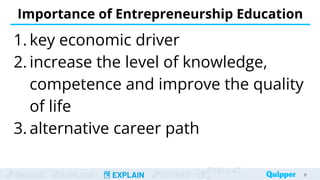
Importance of Entrepreneurship Education
11
1. key economic driver
2. increase the level of knowledge,
competence and improve the quality
of life
3. alternative career path
12
Can you think of other
importance of Entrepreneurship
Education aside from those
already mentioned?
ENGAGE EXPLORE EXPLAIN EXTEND
EVALUAT
Competencies are
considered as the capability,
capacity and ability of the
learner in handling
situations in various areas in
business operations such as
in marketing, management,
production, and finance.
Entrepreneurship Common Competencies
13
ENGAGE EXPLORE EXPLAIN EXTEND
EVALUAT
What are the common
entrepreneurial
competencies?
14
ENGAGE EXPLORE EXPLAIN EXTEND
EVALUAT
1. Specific Goal Setting
2. Self-Efficacy
3. Need for Achievement
4. Ambition
5. Willingness to Learn
6. Adaptability and Flexibility
7. Willingness to Take Risk
8. Interpersonal Skills
Entrepreneurship Common Competencies
15
15
ENGAGE EXPLORE EXPLAIN EXTEND
EVALUAT
Integrity
Competencies For Entrepreneurial Success
16
16
Competency
An entrepreneur
knows what is good
and right. Do what is
best for everyone and
do not act without
thinking.
Example
ENGAGE EXPLORE EXPLAIN EXTEND
EVALUAT
Conceptual
Thinking
Competencies For Entrepreneurial Success
17
17
Competency
Review outcome projects
in order to understand
where problems occurred.
Check the impact of the
proposed solution to both
customers and employees.
Example
ENGAGE EXPLORE EXPLAIN EXTEND
EVALUAT
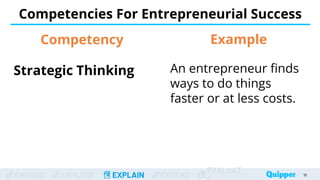
Strategic Thinking
Competencies For Entrepreneurial Success
18
18
Competency
An entrepreneur finds
ways to do things
faster or at less costs.
Example
ENGAGE EXPLORE EXPLAIN EXTEND
EVALUAT
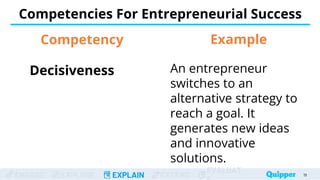
Decisiveness
Competencies For Entrepreneurial Success
19
19
Competency
An entrepreneur
switches to an
alternative strategy to
reach a goal. It
generates new ideas
and innovative
solutions.
Example
ENGAGE EXPLORE EXPLAIN EXTEND
EVALUAT
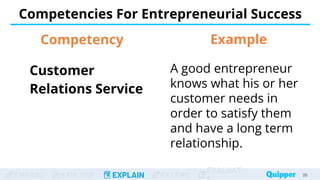
Customer
Relations Service
Competencies For Entrepreneurial Success
20
20
Competency
A good entrepreneur
knows what his or her
customer needs in
order to satisfy them
and have a long term
relationship.
Example
ENGAGE EXPLORE EXPLAIN EXTEND
EVALUAT
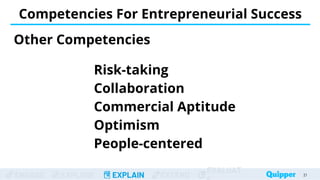
Risk-taking
Collaboration
Commercial Aptitude
Optimism
People-centered
Competencies For Entrepreneurial Success
21
21
Other Competencies
Tip
22
The common competencies are
the skills you need in starting a
business. On the other hand, the
10 competencies discussed are
the skills that you need to be a
successful entrepreneur.
ENGAGE EXPLORE EXPLAIN EXTEND
EVALUAT
Individual Activity
Do you have what it takes to be an
entrepreneur?
Answer the questionnaire in the Extend part of
the study guide.
23
ENGAGE EXPLORE EXPLAIN EXTEND
EVALUAT
ENGAGE EXPLORE EXPLAIN EXTEND
EVALUAT
Questions
Part A.
1. What are the qualities that you possess as an
entrepreneurship student? Give at least 5 qualities
and explain each.
2. Among those qualities, rank them with 1 as the
highest and 5 as the weakest quality.
3. What are the benefits of studying entrepreneurship
to students?
24
ENGAGE EXPLORE EXPLAIN EXTEND
EVALUAT
ENGAGE EXPLORE EXPLAIN EXTEND
EVALUAT
Questions
4. What entrepreneurial competencies do you
need to have to become a successful
entrepreneur?
5. What is the difference between a
businessman and an entrepreneur?
25
ENGAGE EXPLORE EXPLAIN EXTEND
EVALUAT
ENGAGE EXPLORE EXPLAIN EXTEND
EVALUAT
Questions
Part B.
1. You saw your classmate who was inside the faculty room
alone using your teacher’s computer. Your teacher never
allows anyone to be in the faculty room unattended. Your
classmate looked up, saw you and knew you saw him. A
few days later, it was found out that confidential files have
been lost and everyone is being questioned. Should you
reveal what you saw? Which is a better example of
integrity: being honest or being loyal to a friend?
26
ENGAGE EXPLORE EXPLAIN EXTEND
EVALUAT
ENGAGE EXPLORE EXPLAIN EXTEND
EVALUAT
Questions
2. A sales staff is having difficulty assisting a foreign
customer because he cannot speak English fluently. It was
seen by the manager. What should the manager do?
3. All finance staff have a meeting with suppliers at 9:00 in
the morning. Because of an accident on the road, it
causes traffic and it is the reason why you came late. If
you were the staff, what competency of entrepreneur you
should have in order to conquer the scenario?
27
Wrap Up
28
An entrepreneur is a person who creates unique
ideas that will be useful for starting a business.
Entrepreneurship is the science of converting
processed ideas into a remarkable business
venture.
Wrap Up
29
A businessman starts the business with an
existing idea or concept, while an entrepreneur
starts the business from his own idea or concept.
Wrap Up
30
Bibliography
Amit_selp. “Entrepreneurial Competencies.” Docuri. Accessed March 3,
2020. https://docuri.com/download/entrepreneurial-
competencies_59ae47b2f581710a6200ff25_pdf#modals.
Dollingner, Marc. Entrepreneurship: Strategies and Resources 3rd Edition.
New Jersey: Prentice Hall, 2003.
Kotler, Philip & Gordon McDougall. Marketing Essentials. Prentice-Hall
Canada Inc., 1985.
Peters, Michael & Robert Hisrich. Entrepreneurship 4th Edition. McGraw-Hill
Book Co., 1999.
Seth, Shobhit. “ 5 Characteristics of Successful Entrepreneurs.”
Investopedia. Accessed March 3, 2020.
https://www.investopedia.com/articles/personal-finance/101014/10-
characteristics-successful-entrepreneurs.asp.
31

Entrepreneurship Subject - Unit1_Lesson1_Final

  • 1.
    Entrepreneurship Senior High SchoolApplied - Academic Unit 1: Understanding the Concept of Entrepreneurship Lesson 1 Entrepreneurship: Overview and Concepts
  • 2.
    ENGAGE EXPLORE EXPLAINEXTEND EVALUAT What is Entrepreneurship? Do you want to be an entrepreneur? 2
  • 3.
    Learning Objective ENGAGE EXPLORE EXPLAINEXTEND EVALUAT At the end of the lesson, you should be able to do the following: Explain the key concepts of common competencies in entrepreneurship. 3 3
  • 4.
    ENGAGE EXPLORE EXPLAINEXTEND EVALUAT Who are the entrepreneurs around you? 4
  • 5.
    ENGAGE EXPLORE EXPLAINEXTEND EVALUAT Can you name some of the most successful entrepreneurs in the country? 5
  • 6.
    ENGAGE EXPLORE EXPLAINEXTEND EVALUAT Entrepreneur An entrepreneur is a person who creates unique ideas that will be useful for starting a business. 6
  • 7.
    ENGAGE EXPLORE EXPLAINEXTEND EVALUAT Entrepreneurship the science of converting processed ideas into a remarkable business venture 7
  • 8.
    ENGAGE EXPLORE EXPLAINEXTEND EVALUAT Why study Entrepreneurship? 8
  • 9.
    ENGAGE EXPLORE EXPLAINEXTEND EVALUAT Usefulness of the Course to the Students 1. It develops skills that will be needed in starting up a business. 2. It enhances knowledge on how to operate business. 3. It demonstrates how to manage a business. 4. Learners consider becoming an employer rather than an employee. 9
  • 10.
    ENGAGE EXPLORE EXPLAINEXTEND EVALUAT Usefulness of the Course to the Students 5. Learners change their attitude towards the course as a means of living. 6. Learners change in personal and career attitudes such as communication, problem- solving, collaboration, motivation, creativity, and teamwork. 10
  • 11.
    ENGAGE EXPLORE EXPLAINEXTEND EVALUAT Importance of Entrepreneurship Education 11 1. key economic driver 2. increase the level of knowledge, competence and improve the quality of life 3. alternative career path
  • 12.
    12 Can you thinkof other importance of Entrepreneurship Education aside from those already mentioned?
  • 13.
    ENGAGE EXPLORE EXPLAINEXTEND EVALUAT Competencies are considered as the capability, capacity and ability of the learner in handling situations in various areas in business operations such as in marketing, management, production, and finance. Entrepreneurship Common Competencies 13
  • 14.
    ENGAGE EXPLORE EXPLAINEXTEND EVALUAT What are the common entrepreneurial competencies? 14
  • 15.
    ENGAGE EXPLORE EXPLAINEXTEND EVALUAT 1. Specific Goal Setting 2. Self-Efficacy 3. Need for Achievement 4. Ambition 5. Willingness to Learn 6. Adaptability and Flexibility 7. Willingness to Take Risk 8. Interpersonal Skills Entrepreneurship Common Competencies 15 15
  • 16.
    ENGAGE EXPLORE EXPLAINEXTEND EVALUAT Integrity Competencies For Entrepreneurial Success 16 16 Competency An entrepreneur knows what is good and right. Do what is best for everyone and do not act without thinking. Example
  • 17.
    ENGAGE EXPLORE EXPLAINEXTEND EVALUAT Conceptual Thinking Competencies For Entrepreneurial Success 17 17 Competency Review outcome projects in order to understand where problems occurred. Check the impact of the proposed solution to both customers and employees. Example
  • 18.
    ENGAGE EXPLORE EXPLAINEXTEND EVALUAT Strategic Thinking Competencies For Entrepreneurial Success 18 18 Competency An entrepreneur finds ways to do things faster or at less costs. Example
  • 19.
    ENGAGE EXPLORE EXPLAINEXTEND EVALUAT Decisiveness Competencies For Entrepreneurial Success 19 19 Competency An entrepreneur switches to an alternative strategy to reach a goal. It generates new ideas and innovative solutions. Example
  • 20.
    ENGAGE EXPLORE EXPLAINEXTEND EVALUAT Customer Relations Service Competencies For Entrepreneurial Success 20 20 Competency A good entrepreneur knows what his or her customer needs in order to satisfy them and have a long term relationship. Example
  • 21.
    ENGAGE EXPLORE EXPLAINEXTEND EVALUAT Risk-taking Collaboration Commercial Aptitude Optimism People-centered Competencies For Entrepreneurial Success 21 21 Other Competencies
  • 22.
    Tip 22 The common competenciesare the skills you need in starting a business. On the other hand, the 10 competencies discussed are the skills that you need to be a successful entrepreneur.
  • 23.
    ENGAGE EXPLORE EXPLAINEXTEND EVALUAT Individual Activity Do you have what it takes to be an entrepreneur? Answer the questionnaire in the Extend part of the study guide. 23
  • 24.
    ENGAGE EXPLORE EXPLAINEXTEND EVALUAT ENGAGE EXPLORE EXPLAIN EXTEND EVALUAT Questions Part A. 1. What are the qualities that you possess as an entrepreneurship student? Give at least 5 qualities and explain each. 2. Among those qualities, rank them with 1 as the highest and 5 as the weakest quality. 3. What are the benefits of studying entrepreneurship to students? 24
  • 25.
    ENGAGE EXPLORE EXPLAINEXTEND EVALUAT ENGAGE EXPLORE EXPLAIN EXTEND EVALUAT Questions 4. What entrepreneurial competencies do you need to have to become a successful entrepreneur? 5. What is the difference between a businessman and an entrepreneur? 25
  • 26.
    ENGAGE EXPLORE EXPLAINEXTEND EVALUAT ENGAGE EXPLORE EXPLAIN EXTEND EVALUAT Questions Part B. 1. You saw your classmate who was inside the faculty room alone using your teacher’s computer. Your teacher never allows anyone to be in the faculty room unattended. Your classmate looked up, saw you and knew you saw him. A few days later, it was found out that confidential files have been lost and everyone is being questioned. Should you reveal what you saw? Which is a better example of integrity: being honest or being loyal to a friend? 26
  • 27.
    ENGAGE EXPLORE EXPLAINEXTEND EVALUAT ENGAGE EXPLORE EXPLAIN EXTEND EVALUAT Questions 2. A sales staff is having difficulty assisting a foreign customer because he cannot speak English fluently. It was seen by the manager. What should the manager do? 3. All finance staff have a meeting with suppliers at 9:00 in the morning. Because of an accident on the road, it causes traffic and it is the reason why you came late. If you were the staff, what competency of entrepreneur you should have in order to conquer the scenario? 27
  • 28.
    Wrap Up 28 An entrepreneuris a person who creates unique ideas that will be useful for starting a business. Entrepreneurship is the science of converting processed ideas into a remarkable business venture.
  • 29.
    Wrap Up 29 A businessmanstarts the business with an existing idea or concept, while an entrepreneur starts the business from his own idea or concept.
  • 30.
  • 31.
    Bibliography Amit_selp. “Entrepreneurial Competencies.”Docuri. Accessed March 3, 2020. https://docuri.com/download/entrepreneurial- competencies_59ae47b2f581710a6200ff25_pdf#modals. Dollingner, Marc. Entrepreneurship: Strategies and Resources 3rd Edition. New Jersey: Prentice Hall, 2003. Kotler, Philip & Gordon McDougall. Marketing Essentials. Prentice-Hall Canada Inc., 1985. Peters, Michael & Robert Hisrich. Entrepreneurship 4th Edition. McGraw-Hill Book Co., 1999. Seth, Shobhit. “ 5 Characteristics of Successful Entrepreneurs.” Investopedia. Accessed March 3, 2020. https://www.investopedia.com/articles/personal-finance/101014/10- characteristics-successful-entrepreneurs.asp. 31

Editor's Notes

  • #2 GENERAL PARTS of this presentation: Engage- this is meant to capture the students’ attention, link their prior knowledge to the new topic, and set their expectations about the lesson. Explore- this is meant to elicit discussion, and encourage students to explore and derive ideas from questions, scenarios, activities, or discussion. Explain- this is meant for the teacher to use to synthesize students’ ideas from EXPLORE, and to emphasize on the key understandings needed for this lesson. Extend- this is an optional activity meant for guided practice. Evaluate- this is a quick check of students’ understanding of the lesson. Wrap Up- this is a reiteration of the key concepts of the lesson.
  • #5 Note to teacher: You may discuss this in class to check prior knowledge and ideas of students about Entrepreneurship and entrepreneurs. You may show this slide and the next before discussing both questions.
  • #6 Note to teacher: You may discuss this in class to check prior knowledge and ideas of students about Entrepreneurship and entrepreneurs.
  • #24 Note to teacher: Tell the class that if they got at least 7 YES answers to the questionnaire, they have what it takes to be an entrepreneur.
  • #25 Model Answer: The learner may answer common competencies an entrepreneur has when starting a business such as specific goal setter, self-efficacy, need for achievement, ambition, willingness to learn, willingness to take risk, adaptability and flexibility and good interpersonal skills. The answer depends on the learner’s rate on question number 1. The learner will assess qualities given as 5 being the highest and 1 being the lowest. The learner may answer that it adds knowledge on how to start up a business and gives them an alternative career path at any time. The learner may answer the 10 competencies discussed such as integrity, conceptual thinking, risk-taking, collaboration, strategic thinking, commercial aptitude, decisiveness, optimism, customer relation service, and people-centered. A businessman starts the business with an existing idea or concept, while an entrepreneur starts the business from his own idea or concept.
  • #26 Model Answer: The learner may answer common competencies an entrepreneur has when starting a business such as specific goal setter, self-efficacy, need for achievement, ambition, willingness to learn, willingness to take risk, adaptability and flexibility and good interpersonal skills. The answer depends on the learner’s rate on question number 1. The learner will assess qualities given as 5 being the highest and 1 being the lowest. The learner may answer that it adds knowledge on how to start up a business and gives them an alternative career path at any time. The learner may answer the 10 competencies discussed such as integrity, conceptual thinking, risk-taking, collaboration, strategic thinking, commercial aptitude, decisiveness, optimism, customer relation service, and people-centered. A businessman starts the business with an existing idea or concept, while an entrepreneur starts the business from his own idea or concept.
  • #27 Model Answer: The learner may answer being honest as an example of integrity. It is a better thing to do than to consider a friend with the wrongdoing.
  • #28 Model Answer: The learner may answer that the manager should help the sales staff in assisting the foreign customer in order to satisfy the needs and eliminate complaints. The learner may answer optimism and decisiveness. As an entrepreneur, you should find ways on how to solve problems and think in a positive way.