White
Paper
DataCore’s SANsymphony-V Storage
Virtualization Software
Music to the Ears of Server Virtualization Users Stalled by Storage
Challenges
By Mark Peters
January, 2011
This ESG White Paper was commissioned by DataCore
and is distributed under license from ESG.
© 2011, Enterprise Strategy Group, Inc. All Rights Reserved
White Paper: DataCore’s SANsymphony-V Storage Virtualization Software 2
© 2011, Enterprise Strategy Group, Inc. All Rights Reserved.
Contents
Why Virtualize Storage? ...............................................................................................................................3
DataCore................................................................................................................................................................... 3
Virtualized Storage .......................................................................................................................................4
How We Got Here..................................................................................................................................................... 5
Where to Next? ........................................................................................................................................................ 5
Market Applicability and Relevance.............................................................................................................6
The Bigger Truth ...........................................................................................................................................8
All trademark names are property of their respective companies. Information contained in this publication has been obtained by sources The
Enterprise Strategy Group (ESG) considers to be reliable but is not warranted by ESG. This publication may contain opinions of ESG, which are
subject to change from time to time. This publication is copyrighted by The Enterprise Strategy Group, Inc. Any reproduction or redistribution of
this publication, in whole or in part, whether in hard-copy format, electronically, or otherwise to persons not authorized to receive it, without the
express consent of the Enterprise Strategy Group, Inc., is in violation of U.S. copyright law and will be subject to an action for civil damages and, if
applicable, criminal prosecution. Should you have any questions, please contact ESG Client Relations at (508) 482-0188.
White Paper: DataCore’s SANsymphony-V Storage Virtualization Software 3
© 2011, Enterprise Strategy Group, Inc. All Rights Reserved.
Why Virtualize Storage?
Getting Storage “Out of the Way”
Winston Churchill may have preceded the IT Age, but he perfectly summed up the situation in which IT—and
especially its storage component—now finds itself: “We must take change by the hand or rest assuredly, change
will take us by the throat.” Decades of growth (of storage, applications, and expectations) and ever-increasing
complexity have brought IT to a crossroads. The best answer to address the economic, operational, and financial
flexibility required to meet the demands of today’s IT is virtualization not just at the margin, but in every facet of IT.
When broadly and well deployed, virtualization has the ability to ensure that management focus is where it should
be: on applications and organizational results rather than on hardware choices.
If there are any lingering doubts that the data center as we’ve known it is in the midst of a total “virtual” upheaval,
let us dispel them: it’s over. The data center of yesterday is gone (or is at least going); the data center of tomorrow
is virtualized. Server virtualization, albeit still nascent in its overall capabilities, is not a fad. It is here to stay. It is not
simply good marketing; it is logical and compelling, both operationally and financially, and makes business sense.
Gradually and ever-faster, the world of IT is beginning to virtualize its server infrastructure. The more advanced an
organization in terms of virtualization deployments, the greater the level of benefit and value that organization can
expect.
With server virtualization ubiquity as a foregone conclusion, the next logical areas to investigate are those which
hinder its progress. Storage, at least storage as it has been done for decades, is a significant obstacle that is slowing
or stalling the successful and optimal advance of IT. And yet we possess the tools to capably address the issue—
with the virtualization of storage being a crucial element.1
In essence, the virtualization of storage will enable IT organizations to “get storage out of the way” by replacing
systems based on proprietary hardware and firmware with a fundamental flexibility that puts the emphasis back on
applications, responsiveness, availability, and business value rather than on managing the Ponzi-scheme-like, ever-
escalating complexity of traditional storage approaches. This paper looks generically at the logic and justification for
the virtualization of storage, but will also specifically highlight the capabilities of DataCore in this space.
DataCore
DataCore is relatively unknown for a company that has been around for over a decade and boasts 6,000 customers
and over 20,000 licenses deployed. The explanation is largely because this software company was very avant-garde
when it began and (partly its own fault, partly market ignorance) was seen as simply a “different way to do
storage;” the reality is that it is not a storage company per se (inasmuch as its business model is not tied to storage
hardware sales) and that awareness for DataCore is set to skyrocket in the “perfect maelstrom” mandating new
ways to run IT. The inevitability of virtualization is assured and DataCore’s opportunity for success has been left
open due to both the limited competitive developments of recent years and also the dramatic improvement in the
(server) platforms upon which DataCore runs, which has enabled an equally dramatic improvement in the
capabilities of DataCore’s software, especially new functionality and performance acceleration.
SANsymphony-V
The capabilities DataCore delivers have recently been significantly uplifted and streamlined further for virtualized
server environments in its latest SANsymphony-V release. For brevity, it’s hard to beat DataCore’s press release
which points out that “SANsymphony offers a flexible, open software platform from which to provision, share,
reconfigure, migrate, replicate, expand and upgrade storage without slowdowns or downtime.” The product is
agnostic with regard to the underlying storage hardware and can essentially breathe life and operational value into
whatever is on a user’s floor. It is robust, flexible, and responsive and it can deliver value in terms of, for instance,
better economics, improved response times, high availability (HA), and easy management administration.
1
This paragraph (and other sections in the paper) is an adapted extract from the ESG Market Report, The Future of Storage in a Virtualized
Data Center, January 2011.
White Paper: DataCore’s SANsymphony-V Storage Virtualization Software 4
© 2011, Enterprise Strategy Group, Inc. All Rights Reserved.
Functionally, DataCore is also very rich: examples include snapshots, roll-back CDP, easy migration and upgrades,
replication with compression (for practical bi-directional remote site recovery), and thin provisioning (which of
course, like everything else DataCore does, can span heterogeneous storage because SANsymphony operates as a
“storage hypervisor”). In many ways, it is possible to view DataCore and others as doing for storage hardware
exactly what VMware, Citrix, and Microsoft have done (and are doing) for server hardware; by abstracting it and
making it flexible, fast, and scalable, users are freed to concentrate on their applications and business value rather
than on developing an army of white-coated twiddlers of storage knobs.
Virtualized Storage
If it’s not already abundantly clear, it’s worth stating explicitly that virtualizing storage is not some technical luxury.
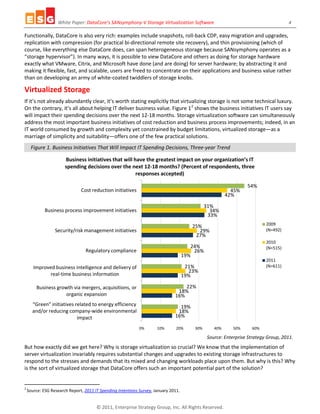
On the contrary, it’s all about helping IT deliver business value. Figure 12
Figure 1. Business Initiatives That Will Impact IT Spending Decisions, Three-year Trend
shows the business initiatives IT users say
will impact their spending decisions over the next 12-18 months. Storage virtualization software can simultaneously
address the most important business initiatives of cost reduction and business process improvements; indeed, in an
IT world consumed by growth and complexity yet constrained by budget limitations, virtualized storage—as a
marriage of simplicity and suitability—offers one of the few practical solutions.
Source: Enterprise Strategy Group, 2011.
But how exactly did we get here? Why is storage virtualization so crucial? We know that the implementation of
server virtualization invariably requires substantial changes and upgrades to existing storage infrastructures to
respond to the stresses and demands that its mixed and changing workloads place upon them. But why is this? Why
is the sort of virtualized storage that DataCore offers such an important potential part of the solution?
2
Source: ESG Research Report, 2011 IT Spending Intentions Survey, January 2011.
16%
16%
19%
19%
27%
33%
42%
18%
18%
23%
26%
29%
34%
45%
19%
22%
21%
24%
25%
31%
54%
0% 10% 20% 30% 40% 50% 60%
“Green” initiatives related to energy efficiency
and/or reducing company-wide environmental
impact
Business growth via mergers, acquisitions, or
organic expansion
Improved business intelligence and delivery of
real-time business information
Regulatory compliance
Security/risk management initiatives
Business process improvement initiatives
Cost reduction initiatives
Business initiatives that will have the greatest impact on your organization’s IT
spending decisions over the next 12-18 months? (Percent of respondents, three
responses accepted)
2009
(N=492)
2010
(N=515)
2011
(N=611)
White Paper: DataCore’s SANsymphony-V Storage Virtualization Software 5
© 2011, Enterprise Strategy Group, Inc. All Rights Reserved.
How We Got Here
Commercial computing took hold when one single infrastructure stack executed one specific application for one
specific purpose. The original mainframe was a glorified calculator. Centralized computing was predictable and
controllable, albeit expensive. But it could be managed: one processor system and one IO subsystem.
Decentralized (or distributed) computing was developed largely to try to solve the economic challenges of
centralized computing (essentially CAPEX) and yielded low-cost, commodity servers—which we promptly plugged
into proprietary, large, expensive, monolithic storage boxes. Servers became cheaper and more interoperable while
storage has remained proprietary and expensive. In the old days, the server was the thing that cost all the money.
You picked your server by your OS. You picked your OS by your application. Storage was a “peripheral.”
Today, storage is outlandishly expensive, complex, incompatible, and difficult; in many respects, it is the last bastion
of IT awkwardness: the peripheral tail wagging the purposeful dog!
Where to Next?
In order to create a data center built on virtualized assets (for all of the logic already touched upon3
• Self-optimizes and self-heals: systems that tune/reconfigure themselves for the workloads that are
presented—and change as those requirements change; infrastructure deals with fault-scenarios
autonomously, remapping/rebuilding itself so that applications are not affected.
) all of the
virtual “layers” must coexist and support the same functional capabilities. These layers (or assets) must then
“act/react” to changing conditions within their own infrastructural areas as well as to those around them. Against
this backdrop, we are then set up to drive the next (higher) level of value where we can aspire to provide [storage]
infrastructure that:
• Scales dynamically: up or down, in or out; infrastructure that extends—virtually—to whatever
requirements the workload(s) presents. Think of it this way: virtual servers can be thought of as scale-out
servers: a plethora of commodity machines with various capabilities that allow workloads to be almost
instantly brought up anywhere. But this wondrous capability is then all-too-often restricted by having to
serve the requisite data from a “monolithic storage box” originally architected in the IT Stone Age. Today,
you can buy any server you want from anyone, plug it into your environment, and use it almost instantly—
but if you’re running monolithic storage, you’re no better off than you were ten years ago. Virtualized
storage is a prerequisite to an optimized virtual server environment.
• Self-manages: adapts to changing scenarios based on policies and enforces those policies via automation.
We can no longer continue to rely upon proprietary monolithic storage “boxes” of functionality where complexity is
layered upon complexity to deal with the complexity that was put there last year in what might be described as
“Ponzi storage.” Clearly something has to change, as was eloquently stated in a recent Information Week article:4
Today, we can provision a virtual machine (server) for a business in minutes; yet we still provision storage in days,
weeks, and—often—many months. We can instantly move a virtual machine onto another server and give it more
CPU power than entire countries had ten years ago; but if data isn’t moved with it, it’s a useless exercise. These
competing forces cannot continue to proceed. ESG’s position is simple: storage will cease to be implemented as
we’ve known it for decades and will instead become a virtualized complement to the server and network layers of a
modern, flexible, effective, and efficient IT infrastructure. Clearly, there is considerable overlap and inter-
“It’s past time for an intervention. We’ve all grown comfortable with the server virtualization model, where you buy
intelligent software and run your choice of hardware. Why should storage be any different? … something between
the extremes of a Tier 1 SAN and a Google-like collection of 1U boxes is not only doable for most enterprises—it’s
the wave of the future.”
3
Key factors are to gain efficiencies in asset utilization, take advantage of the commoditization of hardware, leverage common
infrastructures, and to provide seamless mobility options.
4
“Storage Anonymous,” Information Week, 11/01/10.
White Paper: DataCore’s SANsymphony-V Storage Virtualization Software 6
© 2011, Enterprise Strategy Group, Inc. All Rights Reserved.
dependence of all these elements; consequently ESG’s research also investigated the storage-specific
developments that would enable the more widespread use of server virtualization.5
Figure 2. Storage Developments That Would Enable Wider Server Virtualization Usage
The responses are summarized
in Figure 2 and need no additional explanation other than to say that in a world that has elected to “go virtual,” we
clearly need storage to become simpler and more flexible as well—a set of needs that DataCore would applaud and
can address.
Source: Enterprise Strategy Group, 2011.
As these pragmatic elements reinforce, virtualized storage is an approach that aligns with today’s needs and
expected future realities. SANsymphony-V is not a “cool geek-fest,” but rather it represents a collection of
innovations to enable practical architectures that make it easier for IT practitioners to do more things, do them
more easily, and yet also save money not only now and with current devices but also across multiple brands,
vendors, and device types beyond any specific hardware lifetime.
Market Applicability and Relevance
Virtualized storage is an idea—and deliverable reality—whose time has come. The big promises of server and
overall IT virtualization are stalled without it. When vendors such as DataCore started evangelizing the concept a
decade ago, it was an uphill battle, partly because the IT world was generally simpler and partly because the
tsunami of virtualization had not hit computing broadly. Consequently, virtualized storage was regularly seen as
“just” a different approach to storage whereas now it can clearly be recognized as a prerequisite of flexible modern
IT. Whatever terms and models are favored—utility computing, cloud computing, or just plain old efficiency—
virtualized storage replaces hardware-centric thinking with an approach designed to make storage “anonymous” (at
least to users and applications). Traditional storage vendors are caught between the proverbial rock and a hard
place: on the one hand, they are compelled (by history and their own commercial needs) to continue making
storage into something massive that’s very sensitive to device nuances; on the other hand, they fully understand
that what’s needed is both hardware interchangeability (not to mention an ability to shop for best deal!) and
abstraction so as to serve changing and growing application and business needs seamlessly. Many are trying to
keep a foot in both camps and so, ironically, as the compute side of IT becomes increasingly virtualized, these
5
See: ESG Research Report, The Evolution of Server Virtualization, November 2010.
25%
25%
25%
28%
33%
0% 5% 10% 15% 20% 25% 30% 35%
Better storage migration tools
Increased use of storage virtualization
More scalable storage infrastructure to support rapid
virtual machine growth
Faster storage provisioning
Additional training for IT staff
From a storage infrastructure perspective, which of the following developments do
you believe need to take place in order to enable more widespread server
virtualization usage in your organization? (Percent of respondents, N=190, multiple
responses accep
White Paper: DataCore’s SANsymphony-V Storage Virtualization Software 7
© 2011, Enterprise Strategy Group, Inc. All Rights Reserved.
vendors can actually exacerbate the storage challenges of that newly virtualized server environment (see Figure 3)
rather than address them.
Figure 3. Storage Challenges Related to Server Virtualization Usage
Source: Enterprise Strategy Group, 2011.
Obviously virtualized storage does address the major challenges shown in Figure 3. While some of the ways it does
this have already been discussed (better utilization drives down both CAPEX and OPEX, for instance) a couple of the
other bullets are worth highlighting with examples:
• Scalability, for instance, is not just about “getting big;” it is about being able to start small and grow
without rip and replace tactics and with attractive economics and management simplicity. Such scalability is
definitely going to be required as virtual desktop infrastructures (VDI) become more prevalent over the
next few years. Like virtual machines for virtual data center computing, VDs require shared storage to do
migration, failovers, etc. The need for storage virtualization is clear in VDI. DataCore has recently modeled
and measured that it can start small (its reference model is just 220 VDs) and scale while delivering
advanced functions (dual node and full HA) and yet achieving a complete hardware price of under $35 per
VD.6
• Security is a broad challenge for everyone; like world peace, it’s easy to vote for but often much harder to
deliver. Desire is often countered by difficulty; conversely, ease will tend to generate implementation.
DataCore has around 95% of its users doing HA/replication as part of their security efforts. This percentage
far exceeds expected industry averages and is crucial when Data Protection so often features in the top two
or three IT importance lists. Not only is the DataCore implementation easy, but its hypervisor style means it
can deliver flexibility that single source manufacturers cannot—such as HA between the CX and DMX
ranges from EMC.
6
DataCore published the details: Benchmarking a Scalable and Highly Available Architecture for Virtual Desktops, DataCore, January 2011.
21%
21%
24%
24%
25%
36%
0% 5% 10% 15% 20% 25% 30% 35% 40%
Impact on overall volume of storage capacity
Performance problems
Security concerns
Operational cost of new storage infrastructure
Scalability problems
Capital cost of new storage infrastructure
From a storage infrastructure perspective, which of the following would you consider
to be significant challenges related to your organization’s server virtualization usage?
(Percent of respondents, N=190, multiple responses accepted)
White Paper: DataCore’s SANsymphony-V Storage Virtualization Software 8
© 2011, Enterprise Strategy Group, Inc. All Rights Reserved.
The Bigger Truth
There are two—parallel—summaries to this paper: the generic value of virtualized storage and the more specific
place of DataCore with its newly announced SANsymphony-V.
Storage virtualization has had a relatively long adolescence, but is now about to come of age. “Perfect storm” is a
popular phrase these days, but in this case it’s entirely appropriate. Virtualization is one of the few tools in the IT kit
with a genuine ability to significantly impact the challenge of unabated demand (for data capacity, application
growth, and of user expectations) tempered by limited supply (of the resources to deliver IT and the tools to
manage it). Virtualization is a logical tour-de-force that offers an escape valve and coping mechanism for the IT
industry; what was a “nice-to-have” and a huge leap of faith five or ten years ago is now poised to rapidly become a
“have-to-have” and a quick hop of necessity. There is no choice. Much as the experience and success of server
virtualization has transitioned from initially doing consolidation to it now being a software infrastructure for data
center architectures, so storage—virtualized—has to be a part of that virtual IT infrastructure.
From DataCore’s perspective, the market changes of recent years are really giving it a second bite at the apple.
SANsymphony-V is a brand new product based on a decade of experience, and the company has literally thousands
of users that will attest to its ability to deliver both quality and business value. Users ESG spoke to in preparing to
write this paper can only be described as “raving fans.” The company now finds itself with incredibly relevant
capabilities that truly matter to users. Ten years ago, the fact that it was out of synch with most all of the storage
industry was a challenge; today, with the changes to the macro IT environment, the fact that DataCore is not in line
with much of the [traditional] storage industry is probably the best compliment it can receive.
Of course, huge sections of the IT and storage community are renowned for their conservatism … these sections
have maintained a white-coated, knob-twiddling approach that is largely self-perpetuating and eagerly supported
by those vendors whose proprietary system sales benefit as a result. This new tide that DataCore represents—a tide
that advocates getting storage out of the way—will likely still have to overcome a wall of inertia in some places.
However, the range of realistic and affordable options to deal with the challenges outlined earlier is diminishing
rapidly. To compound the issue (or, more positively, to encourage users to fully investigate virtualizing their
storage) storage administrators are increasingly being retired and replaced or re-invented as network and
virtualization administrators; storage in a modern IT environment has to be simple and practical as well as
functional. The weight of all these factors means that, DataCore or otherwise, users will be compelled to virtualize
everything. The only variable will be timing; although it is somewhat ironic that something so smart, logical,
operationally valuable, and economically attractive could even be “left for later.” ESG’s advice? Whether you’re a
traditionalist or not, take a look now.
20 Asylum Street | Milford, MA 01757 | Tel:508.482.0188 Fax: 508.482.0218 | www.enterprisestrategygroup.com

ESG Datacore SANsymphony-V Whitepaper

  • 1.
    White Paper DataCore’s SANsymphony-V Storage VirtualizationSoftware Music to the Ears of Server Virtualization Users Stalled by Storage Challenges By Mark Peters January, 2011 This ESG White Paper was commissioned by DataCore and is distributed under license from ESG. © 2011, Enterprise Strategy Group, Inc. All Rights Reserved
  • 2.
    White Paper: DataCore’sSANsymphony-V Storage Virtualization Software 2 © 2011, Enterprise Strategy Group, Inc. All Rights Reserved. Contents Why Virtualize Storage? ...............................................................................................................................3 DataCore................................................................................................................................................................... 3 Virtualized Storage .......................................................................................................................................4 How We Got Here..................................................................................................................................................... 5 Where to Next? ........................................................................................................................................................ 5 Market Applicability and Relevance.............................................................................................................6 The Bigger Truth ...........................................................................................................................................8 All trademark names are property of their respective companies. Information contained in this publication has been obtained by sources The Enterprise Strategy Group (ESG) considers to be reliable but is not warranted by ESG. This publication may contain opinions of ESG, which are subject to change from time to time. This publication is copyrighted by The Enterprise Strategy Group, Inc. Any reproduction or redistribution of this publication, in whole or in part, whether in hard-copy format, electronically, or otherwise to persons not authorized to receive it, without the express consent of the Enterprise Strategy Group, Inc., is in violation of U.S. copyright law and will be subject to an action for civil damages and, if applicable, criminal prosecution. Should you have any questions, please contact ESG Client Relations at (508) 482-0188.
  • 3.
    White Paper: DataCore’sSANsymphony-V Storage Virtualization Software 3 © 2011, Enterprise Strategy Group, Inc. All Rights Reserved. Why Virtualize Storage? Getting Storage “Out of the Way” Winston Churchill may have preceded the IT Age, but he perfectly summed up the situation in which IT—and especially its storage component—now finds itself: “We must take change by the hand or rest assuredly, change will take us by the throat.” Decades of growth (of storage, applications, and expectations) and ever-increasing complexity have brought IT to a crossroads. The best answer to address the economic, operational, and financial flexibility required to meet the demands of today’s IT is virtualization not just at the margin, but in every facet of IT. When broadly and well deployed, virtualization has the ability to ensure that management focus is where it should be: on applications and organizational results rather than on hardware choices. If there are any lingering doubts that the data center as we’ve known it is in the midst of a total “virtual” upheaval, let us dispel them: it’s over. The data center of yesterday is gone (or is at least going); the data center of tomorrow is virtualized. Server virtualization, albeit still nascent in its overall capabilities, is not a fad. It is here to stay. It is not simply good marketing; it is logical and compelling, both operationally and financially, and makes business sense. Gradually and ever-faster, the world of IT is beginning to virtualize its server infrastructure. The more advanced an organization in terms of virtualization deployments, the greater the level of benefit and value that organization can expect. With server virtualization ubiquity as a foregone conclusion, the next logical areas to investigate are those which hinder its progress. Storage, at least storage as it has been done for decades, is a significant obstacle that is slowing or stalling the successful and optimal advance of IT. And yet we possess the tools to capably address the issue— with the virtualization of storage being a crucial element.1 In essence, the virtualization of storage will enable IT organizations to “get storage out of the way” by replacing systems based on proprietary hardware and firmware with a fundamental flexibility that puts the emphasis back on applications, responsiveness, availability, and business value rather than on managing the Ponzi-scheme-like, ever- escalating complexity of traditional storage approaches. This paper looks generically at the logic and justification for the virtualization of storage, but will also specifically highlight the capabilities of DataCore in this space. DataCore DataCore is relatively unknown for a company that has been around for over a decade and boasts 6,000 customers and over 20,000 licenses deployed. The explanation is largely because this software company was very avant-garde when it began and (partly its own fault, partly market ignorance) was seen as simply a “different way to do storage;” the reality is that it is not a storage company per se (inasmuch as its business model is not tied to storage hardware sales) and that awareness for DataCore is set to skyrocket in the “perfect maelstrom” mandating new ways to run IT. The inevitability of virtualization is assured and DataCore’s opportunity for success has been left open due to both the limited competitive developments of recent years and also the dramatic improvement in the (server) platforms upon which DataCore runs, which has enabled an equally dramatic improvement in the capabilities of DataCore’s software, especially new functionality and performance acceleration. SANsymphony-V The capabilities DataCore delivers have recently been significantly uplifted and streamlined further for virtualized server environments in its latest SANsymphony-V release. For brevity, it’s hard to beat DataCore’s press release which points out that “SANsymphony offers a flexible, open software platform from which to provision, share, reconfigure, migrate, replicate, expand and upgrade storage without slowdowns or downtime.” The product is agnostic with regard to the underlying storage hardware and can essentially breathe life and operational value into whatever is on a user’s floor. It is robust, flexible, and responsive and it can deliver value in terms of, for instance, better economics, improved response times, high availability (HA), and easy management administration. 1 This paragraph (and other sections in the paper) is an adapted extract from the ESG Market Report, The Future of Storage in a Virtualized Data Center, January 2011.
  • 4.
    White Paper: DataCore’sSANsymphony-V Storage Virtualization Software 4 © 2011, Enterprise Strategy Group, Inc. All Rights Reserved. Functionally, DataCore is also very rich: examples include snapshots, roll-back CDP, easy migration and upgrades, replication with compression (for practical bi-directional remote site recovery), and thin provisioning (which of course, like everything else DataCore does, can span heterogeneous storage because SANsymphony operates as a “storage hypervisor”). In many ways, it is possible to view DataCore and others as doing for storage hardware exactly what VMware, Citrix, and Microsoft have done (and are doing) for server hardware; by abstracting it and making it flexible, fast, and scalable, users are freed to concentrate on their applications and business value rather than on developing an army of white-coated twiddlers of storage knobs. Virtualized Storage If it’s not already abundantly clear, it’s worth stating explicitly that virtualizing storage is not some technical luxury. On the contrary, it’s all about helping IT deliver business value. Figure 12 Figure 1. Business Initiatives That Will Impact IT Spending Decisions, Three-year Trend shows the business initiatives IT users say will impact their spending decisions over the next 12-18 months. Storage virtualization software can simultaneously address the most important business initiatives of cost reduction and business process improvements; indeed, in an IT world consumed by growth and complexity yet constrained by budget limitations, virtualized storage—as a marriage of simplicity and suitability—offers one of the few practical solutions. Source: Enterprise Strategy Group, 2011. But how exactly did we get here? Why is storage virtualization so crucial? We know that the implementation of server virtualization invariably requires substantial changes and upgrades to existing storage infrastructures to respond to the stresses and demands that its mixed and changing workloads place upon them. But why is this? Why is the sort of virtualized storage that DataCore offers such an important potential part of the solution? 2 Source: ESG Research Report, 2011 IT Spending Intentions Survey, January 2011. 16% 16% 19% 19% 27% 33% 42% 18% 18% 23% 26% 29% 34% 45% 19% 22% 21% 24% 25% 31% 54% 0% 10% 20% 30% 40% 50% 60% “Green” initiatives related to energy efficiency and/or reducing company-wide environmental impact Business growth via mergers, acquisitions, or organic expansion Improved business intelligence and delivery of real-time business information Regulatory compliance Security/risk management initiatives Business process improvement initiatives Cost reduction initiatives Business initiatives that will have the greatest impact on your organization’s IT spending decisions over the next 12-18 months? (Percent of respondents, three responses accepted) 2009 (N=492) 2010 (N=515) 2011 (N=611)
  • 5.
    White Paper: DataCore’sSANsymphony-V Storage Virtualization Software 5 © 2011, Enterprise Strategy Group, Inc. All Rights Reserved. How We Got Here Commercial computing took hold when one single infrastructure stack executed one specific application for one specific purpose. The original mainframe was a glorified calculator. Centralized computing was predictable and controllable, albeit expensive. But it could be managed: one processor system and one IO subsystem. Decentralized (or distributed) computing was developed largely to try to solve the economic challenges of centralized computing (essentially CAPEX) and yielded low-cost, commodity servers—which we promptly plugged into proprietary, large, expensive, monolithic storage boxes. Servers became cheaper and more interoperable while storage has remained proprietary and expensive. In the old days, the server was the thing that cost all the money. You picked your server by your OS. You picked your OS by your application. Storage was a “peripheral.” Today, storage is outlandishly expensive, complex, incompatible, and difficult; in many respects, it is the last bastion of IT awkwardness: the peripheral tail wagging the purposeful dog! Where to Next? In order to create a data center built on virtualized assets (for all of the logic already touched upon3 • Self-optimizes and self-heals: systems that tune/reconfigure themselves for the workloads that are presented—and change as those requirements change; infrastructure deals with fault-scenarios autonomously, remapping/rebuilding itself so that applications are not affected. ) all of the virtual “layers” must coexist and support the same functional capabilities. These layers (or assets) must then “act/react” to changing conditions within their own infrastructural areas as well as to those around them. Against this backdrop, we are then set up to drive the next (higher) level of value where we can aspire to provide [storage] infrastructure that: • Scales dynamically: up or down, in or out; infrastructure that extends—virtually—to whatever requirements the workload(s) presents. Think of it this way: virtual servers can be thought of as scale-out servers: a plethora of commodity machines with various capabilities that allow workloads to be almost instantly brought up anywhere. But this wondrous capability is then all-too-often restricted by having to serve the requisite data from a “monolithic storage box” originally architected in the IT Stone Age. Today, you can buy any server you want from anyone, plug it into your environment, and use it almost instantly— but if you’re running monolithic storage, you’re no better off than you were ten years ago. Virtualized storage is a prerequisite to an optimized virtual server environment. • Self-manages: adapts to changing scenarios based on policies and enforces those policies via automation. We can no longer continue to rely upon proprietary monolithic storage “boxes” of functionality where complexity is layered upon complexity to deal with the complexity that was put there last year in what might be described as “Ponzi storage.” Clearly something has to change, as was eloquently stated in a recent Information Week article:4 Today, we can provision a virtual machine (server) for a business in minutes; yet we still provision storage in days, weeks, and—often—many months. We can instantly move a virtual machine onto another server and give it more CPU power than entire countries had ten years ago; but if data isn’t moved with it, it’s a useless exercise. These competing forces cannot continue to proceed. ESG’s position is simple: storage will cease to be implemented as we’ve known it for decades and will instead become a virtualized complement to the server and network layers of a modern, flexible, effective, and efficient IT infrastructure. Clearly, there is considerable overlap and inter- “It’s past time for an intervention. We’ve all grown comfortable with the server virtualization model, where you buy intelligent software and run your choice of hardware. Why should storage be any different? … something between the extremes of a Tier 1 SAN and a Google-like collection of 1U boxes is not only doable for most enterprises—it’s the wave of the future.” 3 Key factors are to gain efficiencies in asset utilization, take advantage of the commoditization of hardware, leverage common infrastructures, and to provide seamless mobility options. 4 “Storage Anonymous,” Information Week, 11/01/10.
  • 6.
    White Paper: DataCore’sSANsymphony-V Storage Virtualization Software 6 © 2011, Enterprise Strategy Group, Inc. All Rights Reserved. dependence of all these elements; consequently ESG’s research also investigated the storage-specific developments that would enable the more widespread use of server virtualization.5 Figure 2. Storage Developments That Would Enable Wider Server Virtualization Usage The responses are summarized in Figure 2 and need no additional explanation other than to say that in a world that has elected to “go virtual,” we clearly need storage to become simpler and more flexible as well—a set of needs that DataCore would applaud and can address. Source: Enterprise Strategy Group, 2011. As these pragmatic elements reinforce, virtualized storage is an approach that aligns with today’s needs and expected future realities. SANsymphony-V is not a “cool geek-fest,” but rather it represents a collection of innovations to enable practical architectures that make it easier for IT practitioners to do more things, do them more easily, and yet also save money not only now and with current devices but also across multiple brands, vendors, and device types beyond any specific hardware lifetime. Market Applicability and Relevance Virtualized storage is an idea—and deliverable reality—whose time has come. The big promises of server and overall IT virtualization are stalled without it. When vendors such as DataCore started evangelizing the concept a decade ago, it was an uphill battle, partly because the IT world was generally simpler and partly because the tsunami of virtualization had not hit computing broadly. Consequently, virtualized storage was regularly seen as “just” a different approach to storage whereas now it can clearly be recognized as a prerequisite of flexible modern IT. Whatever terms and models are favored—utility computing, cloud computing, or just plain old efficiency— virtualized storage replaces hardware-centric thinking with an approach designed to make storage “anonymous” (at least to users and applications). Traditional storage vendors are caught between the proverbial rock and a hard place: on the one hand, they are compelled (by history and their own commercial needs) to continue making storage into something massive that’s very sensitive to device nuances; on the other hand, they fully understand that what’s needed is both hardware interchangeability (not to mention an ability to shop for best deal!) and abstraction so as to serve changing and growing application and business needs seamlessly. Many are trying to keep a foot in both camps and so, ironically, as the compute side of IT becomes increasingly virtualized, these 5 See: ESG Research Report, The Evolution of Server Virtualization, November 2010. 25% 25% 25% 28% 33% 0% 5% 10% 15% 20% 25% 30% 35% Better storage migration tools Increased use of storage virtualization More scalable storage infrastructure to support rapid virtual machine growth Faster storage provisioning Additional training for IT staff From a storage infrastructure perspective, which of the following developments do you believe need to take place in order to enable more widespread server virtualization usage in your organization? (Percent of respondents, N=190, multiple responses accep
  • 7.
    White Paper: DataCore’sSANsymphony-V Storage Virtualization Software 7 © 2011, Enterprise Strategy Group, Inc. All Rights Reserved. vendors can actually exacerbate the storage challenges of that newly virtualized server environment (see Figure 3) rather than address them. Figure 3. Storage Challenges Related to Server Virtualization Usage Source: Enterprise Strategy Group, 2011. Obviously virtualized storage does address the major challenges shown in Figure 3. While some of the ways it does this have already been discussed (better utilization drives down both CAPEX and OPEX, for instance) a couple of the other bullets are worth highlighting with examples: • Scalability, for instance, is not just about “getting big;” it is about being able to start small and grow without rip and replace tactics and with attractive economics and management simplicity. Such scalability is definitely going to be required as virtual desktop infrastructures (VDI) become more prevalent over the next few years. Like virtual machines for virtual data center computing, VDs require shared storage to do migration, failovers, etc. The need for storage virtualization is clear in VDI. DataCore has recently modeled and measured that it can start small (its reference model is just 220 VDs) and scale while delivering advanced functions (dual node and full HA) and yet achieving a complete hardware price of under $35 per VD.6 • Security is a broad challenge for everyone; like world peace, it’s easy to vote for but often much harder to deliver. Desire is often countered by difficulty; conversely, ease will tend to generate implementation. DataCore has around 95% of its users doing HA/replication as part of their security efforts. This percentage far exceeds expected industry averages and is crucial when Data Protection so often features in the top two or three IT importance lists. Not only is the DataCore implementation easy, but its hypervisor style means it can deliver flexibility that single source manufacturers cannot—such as HA between the CX and DMX ranges from EMC. 6 DataCore published the details: Benchmarking a Scalable and Highly Available Architecture for Virtual Desktops, DataCore, January 2011. 21% 21% 24% 24% 25% 36% 0% 5% 10% 15% 20% 25% 30% 35% 40% Impact on overall volume of storage capacity Performance problems Security concerns Operational cost of new storage infrastructure Scalability problems Capital cost of new storage infrastructure From a storage infrastructure perspective, which of the following would you consider to be significant challenges related to your organization’s server virtualization usage? (Percent of respondents, N=190, multiple responses accepted)
  • 8.
    White Paper: DataCore’sSANsymphony-V Storage Virtualization Software 8 © 2011, Enterprise Strategy Group, Inc. All Rights Reserved. The Bigger Truth There are two—parallel—summaries to this paper: the generic value of virtualized storage and the more specific place of DataCore with its newly announced SANsymphony-V. Storage virtualization has had a relatively long adolescence, but is now about to come of age. “Perfect storm” is a popular phrase these days, but in this case it’s entirely appropriate. Virtualization is one of the few tools in the IT kit with a genuine ability to significantly impact the challenge of unabated demand (for data capacity, application growth, and of user expectations) tempered by limited supply (of the resources to deliver IT and the tools to manage it). Virtualization is a logical tour-de-force that offers an escape valve and coping mechanism for the IT industry; what was a “nice-to-have” and a huge leap of faith five or ten years ago is now poised to rapidly become a “have-to-have” and a quick hop of necessity. There is no choice. Much as the experience and success of server virtualization has transitioned from initially doing consolidation to it now being a software infrastructure for data center architectures, so storage—virtualized—has to be a part of that virtual IT infrastructure. From DataCore’s perspective, the market changes of recent years are really giving it a second bite at the apple. SANsymphony-V is a brand new product based on a decade of experience, and the company has literally thousands of users that will attest to its ability to deliver both quality and business value. Users ESG spoke to in preparing to write this paper can only be described as “raving fans.” The company now finds itself with incredibly relevant capabilities that truly matter to users. Ten years ago, the fact that it was out of synch with most all of the storage industry was a challenge; today, with the changes to the macro IT environment, the fact that DataCore is not in line with much of the [traditional] storage industry is probably the best compliment it can receive. Of course, huge sections of the IT and storage community are renowned for their conservatism … these sections have maintained a white-coated, knob-twiddling approach that is largely self-perpetuating and eagerly supported by those vendors whose proprietary system sales benefit as a result. This new tide that DataCore represents—a tide that advocates getting storage out of the way—will likely still have to overcome a wall of inertia in some places. However, the range of realistic and affordable options to deal with the challenges outlined earlier is diminishing rapidly. To compound the issue (or, more positively, to encourage users to fully investigate virtualizing their storage) storage administrators are increasingly being retired and replaced or re-invented as network and virtualization administrators; storage in a modern IT environment has to be simple and practical as well as functional. The weight of all these factors means that, DataCore or otherwise, users will be compelled to virtualize everything. The only variable will be timing; although it is somewhat ironic that something so smart, logical, operationally valuable, and economically attractive could even be “left for later.” ESG’s advice? Whether you’re a traditionalist or not, take a look now.
  • 9.
    20 Asylum Street| Milford, MA 01757 | Tel:508.482.0188 Fax: 508.482.0218 | www.enterprisestrategygroup.com