Data Structures-2
Prof. K. Adisesha
BE, M.Sc., M.Th., NET, (Ph.D.)
2
Learning objectives
Objective
• Linear data structures
• Type Linear data structures
 Stacks – PUSH, POP using a list (Single Data, Multiple Data)
 Queue- INSERT, DELETE using a list (Single Data, Multiple Data)
• Implementation in Python
3
Data Structure
What is Data Structure ?
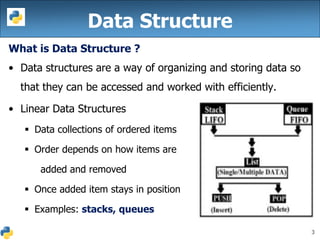
• Data structures are a way of organizing and storing data so
that they can be accessed and worked with efficiently.
• Linear Data Structures
 Data collections of ordered items
 Order depends on how items are
added and removed
 Once added item stays in position
 Examples: stacks, queues
4
Linear Data Structure
Characteristics Linear Data Structures:
• Two ends (left – right, front – rear)
• Linear structures distinguished by how items are added and
removed
• Additions of new items only allowed at the end
• Deletion of existing items only allowed at the end
• Appear in many algorithms
5
Linear Data Structure
Stack:
• Stacks are linear Data Structures which are based on the principle
of Last-In-First-Out (LIFO) where data which is entered last will
be the first to get accessed.
 Addition/removal of items always takes place at same end (top)
 Base represents bottom and contains item has been in stack the
longest
 Most recently added to be removed first (last in-first-out, LIFO)
 Top: newer items;
 bottom: lower items
6
Stack
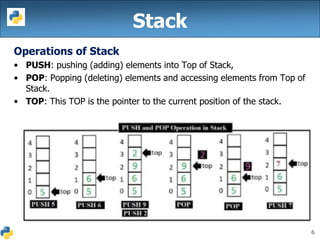
Operations of Stack
• PUSH: pushing (adding) elements into Top of Stack,
• POP: Popping (deleting) elements and accessing elements from Top of
Stack.
• TOP: This TOP is the pointer to the current position of the stack.
7
Stack
Applications Using Stacks
• Stacks are prominently used in applications such as:
 Recursive Programming
 Reversing words
 Expression Conversion
• In-fix to Post-fix
 Backtracking
 Undo mechanisms in word editors
 Check if delimiters are matched
• Matching of opening and closing symbols: {,},[,],(,)
• Check: {{a}[b]{[{c}](d(e)f)}((g))} and ({[a}b(c)])
8
Stack
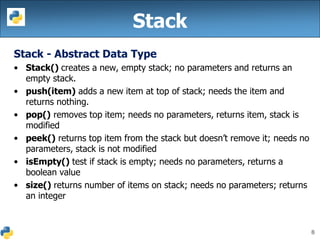
Stack - Abstract Data Type
• Stack() creates a new, empty stack; no parameters and returns an
empty stack.
• push(item) adds a new item at top of stack; needs the item and
returns nothing.
• pop() removes top item; needs no parameters, returns item, stack is
modified
• peek() returns top item from the stack but doesn’t remove it; needs no
parameters, stack is not modified
• isEmpty() test if stack is empty; needs no parameters, returns a
boolean value
• size() returns number of items on stack; needs no parameters; returns
an integer
9
Stack
Implementing Stack using List in Python
10
Stack
Implementing Stack using List in Python
• To use lists as stacks, that is a data structures (LIFO).
 An item can be added to a list by using the append() method.
 The last item can be removed from the list by using the pop()
method without passing any index to it.
• Example
>>> stack = ['a','b','c','d']
>>> stack.append('e')
>>> stack.append('f')
>>> stack
Output: ['a', 'b', 'c', 'd', 'e', 'f']
>>> stack.pop()
Output: 'f'
>>> stack
Output: ['a, 'b', 'c', 'd', 'e']
11
Stack
Implementing Stack using List in Python
#Program to implement Stack Operation on Single data
def push(stack,x): #function to add element at the end of list
stack.append(x)
def pop(stack): #function to remove last element from list
n = len(stack)
if(n<=0):
print("Stack empty....Pop not possible")
else:
stack.pop()
def display(stack): #function to display stack entry
if len(stack)<=0:
print("Stack empty...........Nothing to display")
for i in stack:
print(i,end=" ")
12
Stack
#main program starts from here
x=[]
choice=0
while (choice!=4):
print("********Stack Menu***********")
print("1. push(INSERT)")
print("2. pop(DELETE)")
print("3. Display ")
print("4. Exit")
choice = int(input("Enter your choice :"))
if(choice==1):
value = int(input("Enter value "))
push(x,value)
if(choice==2):
pop(x)
if(choice==3):
display(x)
if(choice==4):
print("You selected to close this program")
13
Queue
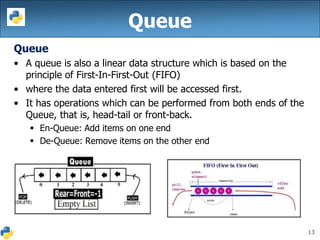
Queue
• A queue is also a linear data structure which is based on the
principle of First-In-First-Out (FIFO)
• where the data entered first will be accessed first.
• It has operations which can be performed from both ends of the
Queue, that is, head-tail or front-back.
 En-Queue: Add items on one end
 De-Queue: Remove items on the other end
14
Queue
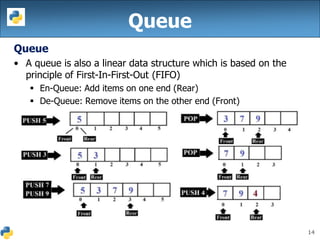
Queue
• A queue is also a linear data structure which is based on the
principle of First-In-First-Out (FIFO)
 En-Queue: Add items on one end (Rear)
 De-Queue: Remove items on the other end (Front)
15
Queue
Applications of Queues
• Queues are used in various applications:
 In network equipment like switches and routers
 Network Buffers for traffic congestion management
 Operating Systems for Job Scheduling
 Checkout line
 Printer queue
 Take-off at airport
16
Queue
Queue - Abstract Data Type
• Queue() creates a new, empty queue; no parameters and
returns an empty queue.
• enqueue(item) adds a new item to rear of queue; needs the
item and returns nothing.
• dequeue() removes front item; needs no parameters, returns
item, queue is modified
• isEmpty() test if queue is empty; needs no parameters, returns
a boolean value
• size() returns number of items in the queue; needs no
parameters; returns an integer
17
Queue
Implementing Queue in Python
18
Queue
Implementing Queue in Python
• Usage of list, again presented in Python documentation is to use lists as
queues, that is a first in - first out (FIFO).
• Example
>>> queue = ['a', 'b', 'c', 'd']
>>> queue.append('e')
>>> queue.append('f')
>>> queue
Output: ['a', 'b', 'c', 'd', 'e', 'f']
>>> queue.pop(0)
Output: 'a'
19
Queue
Implementing Queue using List in Python
def add_element(Queue,x): #function to add element at the end of list
Queue.append(x)
def delete_element(Queue): #function to remove last element from list
n = len(Queue)
if(n<=0):
print("Queue empty....Deletion not possible")
else:
del(Queue[0])
def display(Queue): #function to display Queue entry
if len(Queue)<=0:
print("Queue empty...........Nothing to display")
for i in Queue:
print(i,end=" ")
20
Queue
#main program starts from here
x=[]
choice=0
while (choice!=4):
print(" ********Queue menu***********")
print("1. Add Element ")
print("2. Delete Element")
print("3. Display ")
print("4. Exit")
choice = int(input("Enter your choice : "))
if(choice==1):
value = int(input("Enter value : "))
add_element(x,value)
if(choice==2):
delete_element(x)
if(choice==3):
display(x)
if(choice==4):
print("You selected to close this program")
21
• We learned about:
 Linear data structures
 Type Linear data structures
• Stacks – PUSH, POP using a list (Single Data, Multiple Data)
• Queue- INSERT, DELETE using a list (Single Data, Multiple Data)
 Implementation in Python
Thank you
Conclusion!

9 python data structure-2

  • 1.
    Data Structures-2 Prof. K.Adisesha BE, M.Sc., M.Th., NET, (Ph.D.)
  • 2.
    2 Learning objectives Objective • Lineardata structures • Type Linear data structures  Stacks – PUSH, POP using a list (Single Data, Multiple Data)  Queue- INSERT, DELETE using a list (Single Data, Multiple Data) • Implementation in Python
  • 3.
    3 Data Structure What isData Structure ? • Data structures are a way of organizing and storing data so that they can be accessed and worked with efficiently. • Linear Data Structures  Data collections of ordered items  Order depends on how items are added and removed  Once added item stays in position  Examples: stacks, queues
  • 4.
    4 Linear Data Structure CharacteristicsLinear Data Structures: • Two ends (left – right, front – rear) • Linear structures distinguished by how items are added and removed • Additions of new items only allowed at the end • Deletion of existing items only allowed at the end • Appear in many algorithms
  • 5.
    5 Linear Data Structure Stack: •Stacks are linear Data Structures which are based on the principle of Last-In-First-Out (LIFO) where data which is entered last will be the first to get accessed.  Addition/removal of items always takes place at same end (top)  Base represents bottom and contains item has been in stack the longest  Most recently added to be removed first (last in-first-out, LIFO)  Top: newer items;  bottom: lower items
  • 6.
    6 Stack Operations of Stack •PUSH: pushing (adding) elements into Top of Stack, • POP: Popping (deleting) elements and accessing elements from Top of Stack. • TOP: This TOP is the pointer to the current position of the stack.
  • 7.
    7 Stack Applications Using Stacks •Stacks are prominently used in applications such as:  Recursive Programming  Reversing words  Expression Conversion • In-fix to Post-fix  Backtracking  Undo mechanisms in word editors  Check if delimiters are matched • Matching of opening and closing symbols: {,},[,],(,) • Check: {{a}[b]{[{c}](d(e)f)}((g))} and ({[a}b(c)])
  • 8.
    8 Stack Stack - AbstractData Type • Stack() creates a new, empty stack; no parameters and returns an empty stack. • push(item) adds a new item at top of stack; needs the item and returns nothing. • pop() removes top item; needs no parameters, returns item, stack is modified • peek() returns top item from the stack but doesn’t remove it; needs no parameters, stack is not modified • isEmpty() test if stack is empty; needs no parameters, returns a boolean value • size() returns number of items on stack; needs no parameters; returns an integer
  • 9.
  • 10.
    10 Stack Implementing Stack usingList in Python • To use lists as stacks, that is a data structures (LIFO).  An item can be added to a list by using the append() method.  The last item can be removed from the list by using the pop() method without passing any index to it. • Example >>> stack = ['a','b','c','d'] >>> stack.append('e') >>> stack.append('f') >>> stack Output: ['a', 'b', 'c', 'd', 'e', 'f'] >>> stack.pop() Output: 'f' >>> stack Output: ['a, 'b', 'c', 'd', 'e']
  • 11.
    11 Stack Implementing Stack usingList in Python #Program to implement Stack Operation on Single data def push(stack,x): #function to add element at the end of list stack.append(x) def pop(stack): #function to remove last element from list n = len(stack) if(n<=0): print("Stack empty....Pop not possible") else: stack.pop() def display(stack): #function to display stack entry if len(stack)<=0: print("Stack empty...........Nothing to display") for i in stack: print(i,end=" ")
  • 12.
    12 Stack #main program startsfrom here x=[] choice=0 while (choice!=4): print("********Stack Menu***********") print("1. push(INSERT)") print("2. pop(DELETE)") print("3. Display ") print("4. Exit") choice = int(input("Enter your choice :")) if(choice==1): value = int(input("Enter value ")) push(x,value) if(choice==2): pop(x) if(choice==3): display(x) if(choice==4): print("You selected to close this program")
  • 13.
    13 Queue Queue • A queueis also a linear data structure which is based on the principle of First-In-First-Out (FIFO) • where the data entered first will be accessed first. • It has operations which can be performed from both ends of the Queue, that is, head-tail or front-back.  En-Queue: Add items on one end  De-Queue: Remove items on the other end
  • 14.
    14 Queue Queue • A queueis also a linear data structure which is based on the principle of First-In-First-Out (FIFO)  En-Queue: Add items on one end (Rear)  De-Queue: Remove items on the other end (Front)
  • 15.
    15 Queue Applications of Queues •Queues are used in various applications:  In network equipment like switches and routers  Network Buffers for traffic congestion management  Operating Systems for Job Scheduling  Checkout line  Printer queue  Take-off at airport
  • 16.
    16 Queue Queue - AbstractData Type • Queue() creates a new, empty queue; no parameters and returns an empty queue. • enqueue(item) adds a new item to rear of queue; needs the item and returns nothing. • dequeue() removes front item; needs no parameters, returns item, queue is modified • isEmpty() test if queue is empty; needs no parameters, returns a boolean value • size() returns number of items in the queue; needs no parameters; returns an integer
  • 17.
  • 18.
    18 Queue Implementing Queue inPython • Usage of list, again presented in Python documentation is to use lists as queues, that is a first in - first out (FIFO). • Example >>> queue = ['a', 'b', 'c', 'd'] >>> queue.append('e') >>> queue.append('f') >>> queue Output: ['a', 'b', 'c', 'd', 'e', 'f'] >>> queue.pop(0) Output: 'a'
  • 19.
    19 Queue Implementing Queue usingList in Python def add_element(Queue,x): #function to add element at the end of list Queue.append(x) def delete_element(Queue): #function to remove last element from list n = len(Queue) if(n<=0): print("Queue empty....Deletion not possible") else: del(Queue[0]) def display(Queue): #function to display Queue entry if len(Queue)<=0: print("Queue empty...........Nothing to display") for i in Queue: print(i,end=" ")
  • 20.
    20 Queue #main program startsfrom here x=[] choice=0 while (choice!=4): print(" ********Queue menu***********") print("1. Add Element ") print("2. Delete Element") print("3. Display ") print("4. Exit") choice = int(input("Enter your choice : ")) if(choice==1): value = int(input("Enter value : ")) add_element(x,value) if(choice==2): delete_element(x) if(choice==3): display(x) if(choice==4): print("You selected to close this program")
  • 21.
    21 • We learnedabout:  Linear data structures  Type Linear data structures • Stacks – PUSH, POP using a list (Single Data, Multiple Data) • Queue- INSERT, DELETE using a list (Single Data, Multiple Data)  Implementation in Python Thank you Conclusion!