CS364 Artificial Intelligence Machine Learning Matthew Casey
Learning Outcomes Describe methods for acquiring human knowledge Through experience Evaluate which of the acquisition methods would be most appropriate in a given situation Limited data available through example
Learning Outcomes Describe techniques for representing acquired knowledge in a way that facilitates automated reasoning over the knowledge Generalise experience to novel situations Categorise and evaluate AI techniques according to different criteria such as applicability and ease of use, and intelligently participate in the selection of the appropriate techniques and tools, to solve simple problems Strategies to overcome the ‘knowledge engineering bottleneck’
Key Concepts Machines learning from experience… Through examples, analogy or discovery Adapting… Changes in response to interaction Generalising… To use experience to form a response to novel situations
What is Learning? ‘ The action of receiving  instruction  or acquiring knowledge’ ‘ A process which leads to the  modification of behaviour  or the acquisition of  new abilities or responses , and which is additional to natural development by growth or maturation’ Oxford English Dictionary (1989).  Learning, vbl. n. 2 nd  Edition.  http://dictionary.oed.com/cgi/entry/50131042?single=1&query_type=word&queryword=learning&first=1&max_to_show=10 .  [Accessed 16-10-06].
Machine Learning Negnevitsky: ‘ In general, machine learning involves adaptive mechanisms that enable computers to learn from  experience , learn by  example  and learn by  analogy ’ (2005:165) Callan: ‘ A machine or software tool would not be viewed as intelligent if it could not  adapt  to changes in its environment’ (2003:225) Luger: ‘ Intelligent agents must be able to  change  through the course of their interactions with the world’ (2002:351)
Types of Learning Inductive learning Learning from  examples Supervised learning: training examples with a known classification from a teacher Unsupervised learning: no pre-classification of training examples Evolutionary/genetic learning Shaping a population of individual solutions through  survival of the fittest Emergent behaviour/interaction: game of life
Game of Life Wikipedia (2006). Image:Gospers glider gun.gif - Wikipedia, the free encyclopedia.  http://en.wikipedia.org/wiki/Image:Gospers_glider_gun.gif .  [Accessed 16-10-06].
Why? Knowledge Engineering Bottleneck ‘ Cost and difficulty of building expert systems using traditional […] techniques’ (Luger 2002:351) Complexity of task / amount of data Other techniques fail or are computationally expensive Problems that cannot be defined Discovery of patterns / data mining
Example: Ice-cream When should an ice-cream seller attempt to sell ice-cream (Callan 2003:241)? Could you write a set of rules? How would you acquire the knowledge? You might learn by experience: For example, experience of: ‘ Outlook’: Overcast or Sunny ‘ Temperature’: Hot, Mild or Cold ‘ Holiday Season’: Yes or No
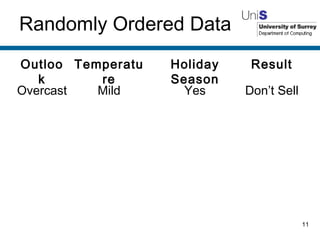
Randomly Ordered Data Don’t Sell Yes Cold Overcast Don’t Sell No Cold Sunny Don’t Sell No Hot Overcast Sell No Hot Sunny Sell Yes Mild Sunny Don’t Sell Yes Mild Overcast Result Holiday Season Temperature Outlook
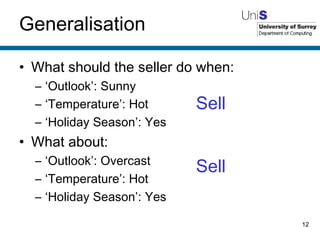
Generalisation What should the seller do when: ‘ Outlook’: Sunny ‘ Temperature’: Hot ‘ Holiday Season’: Yes What about: ‘ Outlook’: Overcast ‘ Temperature’: Hot ‘ Holiday Season’: Yes Sell Sell
Can A Machine Learn? From a limited set of examples, you should be able to  generalise How did you do this? How can we get a machine to do this? Machine learning is the branch of Artificial Intelligence concerned with building systems that generalise from examples
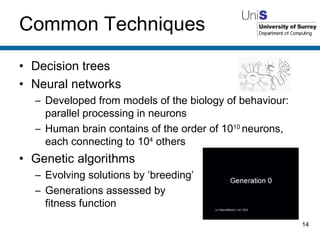
Common Techniques Decision trees Neural networks Developed from models of the biology of behaviour: parallel processing in neurons Human brain contains of the order of 10 10  neurons, each connecting to 10 4  others Genetic algorithms Evolving solutions by ‘breeding’ Generations assessed by fitness function
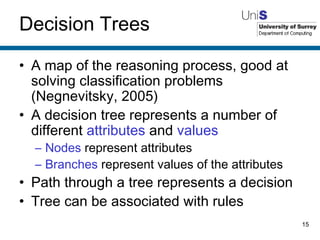
Decision Trees A map of the reasoning process, good at solving classification problems (Negnevitsky, 2005) A decision tree represents a number of different  attributes  and  values Nodes  represent attributes Branches  represent values of the attributes Path through a tree represents a decision Tree can be associated with rules
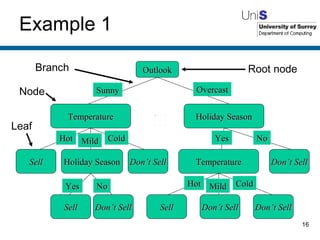
Example 1 Root node Branch Leaf Node Outlook Temperature Sunny Hot Sell Don’t Sell Sell Yes No Mild Holiday Season Cold Don’t Sell Holiday Season Overcast No Don’t Sell Yes Temperature Hot Cold Mild Don’t Sell Sell Don’t Sell
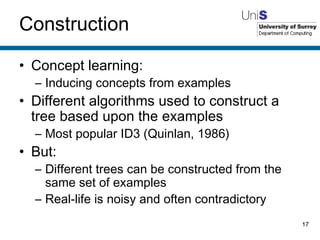
Construction Concept learning: Inducing concepts from examples Different algorithms used to construct a tree based upon the examples Most popular ID3 (Quinlan, 1986) But: Different trees can be constructed from the same set of examples Real-life is noisy and often contradictory
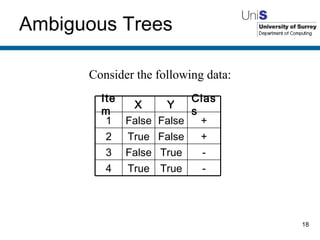
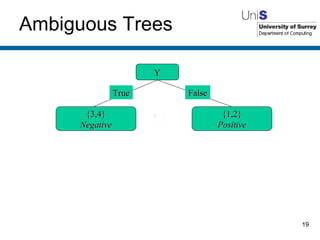
Ambiguous Trees Consider the following data: - True False 3 - True True 4 2 1 Item + False True + False False Class Y X
Ambiguous Trees Y {3,4} Negative {1,2} Positive True False
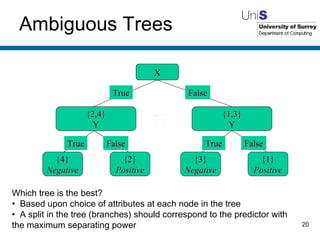
Ambiguous Trees X {2,4} Y {1,3} Y {2} Positive {4} Negative True False True False {1} Positive {3} Negative True False Which tree is the best? Based upon choice of attributes at each node in the tree A split in the tree (branches) should correspond to the predictor with the maximum separating power
Example Callan (2003:242-247) Locating a new bar
Information Theory We can use Information Theory to help us understand: Which attribute is the best to choose for a particular node of the tree This is the node that is the best at separating the required predictions, and hence which leads to the best (or at least a good) tree ‘ Information Theory address both the  limitations  and the  possibilities  of communication’ (MacKay, 2003:16) Measuring information content Probability and entropy: avoiding disorder MacKay, D.J.C. (2003).  Information Theory, Inference, and Learning Algorithms.  Cambridge, UK:  Cambridge University Press.
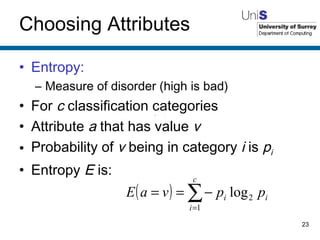
Choosing Attributes Entropy: Measure of disorder (high is bad) For  c  classification categories Attribute  a  that has value  v Probability of  v  being in category  i  is  p i Entropy  E  is:
Entropy Example Choice of attributes: City/Town, University, Housing Estate, Industrial Estate, Transport and Schools City/Town: is either Y or N For Y: 7  positive  examples, 3  negative For N: 4  positive  examples, 6  negative
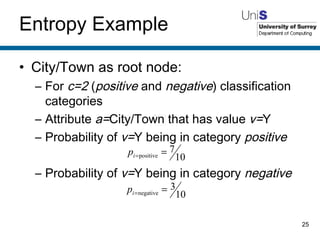
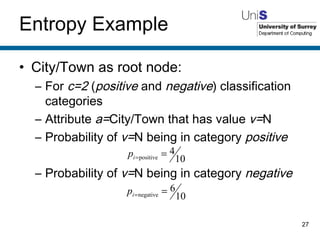
Entropy Example City/Town as root node: For  c=2  ( positive  and  negative ) classification categories Attribute  a= City/Town that has value  v= Y Probability of  v= Y being in category  positive Probability of  v= Y being in category  negative
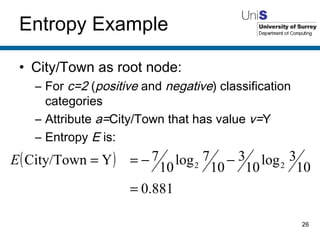
City/Town as root node: For  c=2  ( positive  and  negative ) classification categories Attribute  a= City/Town that has value  v= Y Entropy  E  is: Entropy Example
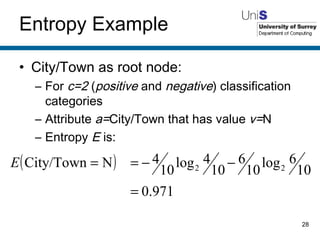
City/Town as root node: For  c=2  ( positive  and  negative ) classification categories Attribute  a= City/Town that has value  v= N Probability of  v= N being in category  positive Probability of  v= N being in category  negative Entropy Example
City/Town as root node: For  c=2  ( positive  and  negative ) classification categories Attribute  a= City/Town that has value  v= N Entropy  E  is: Entropy Example
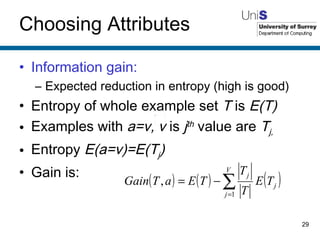
Choosing Attributes Information gain:   Expected reduction in entropy (high is good) Entropy of whole example set  T  is  E(T) Examples with  a=v, v  is  j th  value are  T j, Entropy  E(a=v)=E(T j ) Gain is:
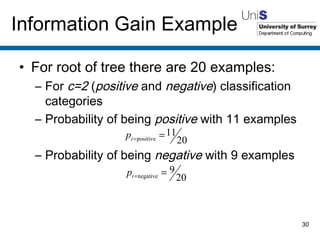
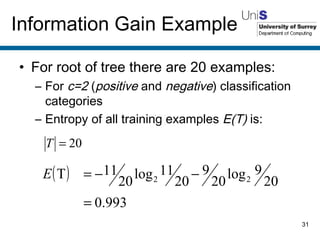
For root of tree there are 20 examples: For  c=2  ( positive  and  negative ) classification categories Probability of being  positive  with 11 examples Probability of being  negative  with 9 examples Information Gain Example
For root of tree there are 20 examples: For  c=2  ( positive  and  negative ) classification categories Entropy of all training examples  E(T)  is: Information Gain Example
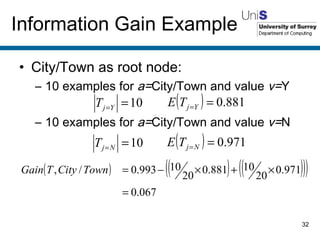
Information Gain Example City/Town as root node: 10 examples for  a= City/Town and value  v= Y 10 examples for  a= City/Town and value  v= N
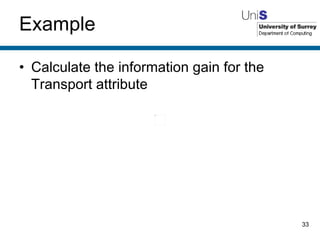
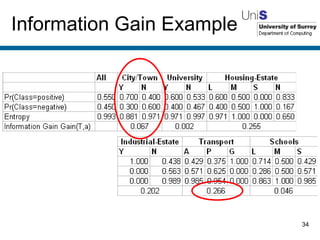
Example Calculate the information gain for the Transport attribute
Information Gain Example
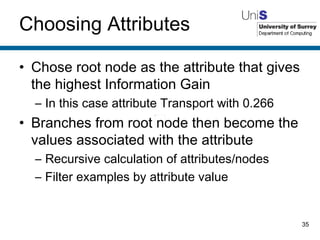
Choosing Attributes Chose root node as the attribute that gives the highest Information Gain In this case attribute Transport with 0.266 Branches from root node then become the values associated with the attribute Recursive calculation of attributes/nodes Filter examples by attribute value
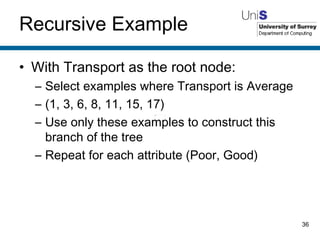
Recursive Example With Transport as the root node: Select examples where Transport is Average (1, 3, 6, 8, 11, 15, 17) Use only these examples to construct this branch of the tree Repeat for each attribute (Poor, Good)
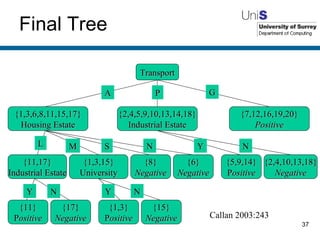
Final Tree Transport {7,12,16,19,20} Positive {8} Negative {6} Negative Callan 2003:243 {5,9,14} P ositive {2,4,10,13,18} Negative A P G {1,3,6,8,11,15,17} Housing Estate L M S N {11,17} Industrial Estate {17} Negative {11} P ositive Y N {1,3,15} University {15} Negative {1,3} P ositive Y N {2,4,5,9,10,13,14,18} Industrial Estate Y N
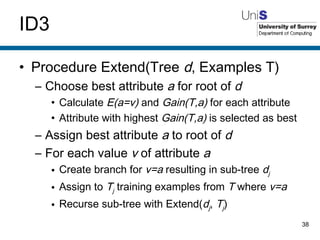
ID3 Procedure Extend(Tree  d , Examples T) Choose best attribute  a  for root of  d Calculate  E(a=v)  and  Gain(T,a)  for each attribute Attribute with highest  Gain(T,a)  is selected as best Assign best attribute  a  to root of  d For each value  v  of attribute  a Create branch for  v=a  resulting in sub-tree  d j Assign to  T j  training examples from  T  where  v=a Recurse sub-tree with Extend( d j ,  T j )
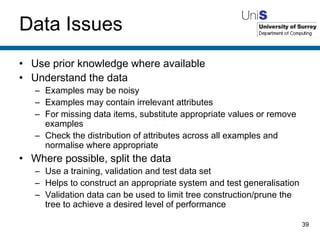
Data Issues Use prior knowledge where available Understand the data Examples may be noisy Examples may contain irrelevant attributes For missing data items, substitute appropriate values or remove examples Check the distribution of attributes across all examples and normalise where appropriate Where possible, split the data Use a training, validation and test data set Helps to construct an appropriate system and test generalisation Validation data can be used to limit tree construction/prune the tree to achieve a desired level of performance
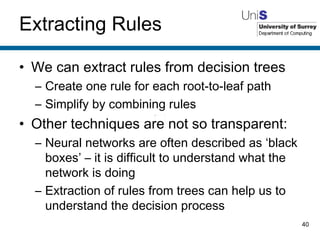
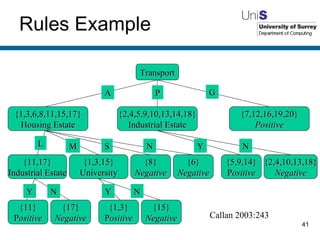
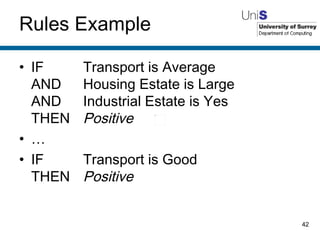
Extracting Rules We can extract rules from decision trees Create one rule for each root-to-leaf path Simplify by combining rules Other techniques are not so transparent: Neural networks are often described as ‘black boxes’ – it is difficult to understand what the network is doing Extraction of rules from trees can help us to understand the decision process
Rules Example Transport {1,3,6,8,11,15,17} Housing Estate {2,4,5,9,10,13,14,18} Industrial Estate {7,12,16,19,20} Positive {11,17} Industrial Estate {1,3,15} University {8} Negative {6} Negative {5,9,14} P ositive {2,4,10,13,18} Negative {17} Negative {11} P ositive {15} Negative {1,3} P ositive A P G L M S N Y N Y N Callan 2003:243 Y N
Rules Example IF Transport is Average AND Housing Estate is Large AND Industrial Estate is Yes THEN Positive … IF Transport is Good THEN Positive
Summary What are the benefits/drawbacks of machine learning? Are the techniques simple? Are they simple to implement? Are they computationally cheap? Do they learn from experience? Do they generalise well? Can we understand how knowledge is represented? Do they provide perfect solutions?
Key Concepts Machines learning from experience… Through examples, analogy or discovery But real life is imprecise – how do you know which data is valid and collect (enough of) it? Adapting… Changes in response to interaction But you only want to learn what’s ‘correct’ – how do you know this (you don’t know the solution)? Generalising… To use experience to form a response to novel situations How do you know the solution is accurate?
Source Texts Negnevitsky, M. (2005).  Artificial Intelligence: A Guide to Intelligent Systems .  2 nd  Edition.  Essex, UK: Pearson Education Limited. Chapter 6, pp. 165-168, chapter 9, pp. 349-360. Callan, R. (2003).  Artificial Intelligence , Basingstoke, UK: Palgrave MacMillan. Part 5, chapters 11-17, pp. 225-346. Luger, G.F. (2002).  Artificial Intelligence: Structures & Strategies for Complex Problem Solving.  4 th  Edition. London, UK: Addison-Wesley. Part IV, chapters 9-11, pp. 349-506.
Journals Artificial Intelligence http://www.elsevier.com/locate/issn/00043702 http://www.sciencedirect.com/science/journal/00043702
Articles Quinlan, J.R. (1986).  Induction of Decision Trees.  Machine Learning , vol. 1, pp.81-106. Quinlan, J.R. (1993).  C4.5: Programs for Machine Learning .  San Mateo, CA: Morgan Kaufmann Publishers.
Websites UCI Machine Learning Repository Example data sets for benchmarking http:// www.ics.uci.edu/~mlearn/MLRepository.html Wonders of Math: Game of Life Game of life applet and details http:// www.math.com/students/wonders/life/life.html

week9_Machine_Learning.ppt

  • 1.
    CS364 Artificial IntelligenceMachine Learning Matthew Casey
  • 2.
    Learning Outcomes Describemethods for acquiring human knowledge Through experience Evaluate which of the acquisition methods would be most appropriate in a given situation Limited data available through example
  • 3.
    Learning Outcomes Describetechniques for representing acquired knowledge in a way that facilitates automated reasoning over the knowledge Generalise experience to novel situations Categorise and evaluate AI techniques according to different criteria such as applicability and ease of use, and intelligently participate in the selection of the appropriate techniques and tools, to solve simple problems Strategies to overcome the ‘knowledge engineering bottleneck’
  • 4.
    Key Concepts Machineslearning from experience… Through examples, analogy or discovery Adapting… Changes in response to interaction Generalising… To use experience to form a response to novel situations
  • 5.
    What is Learning?‘ The action of receiving instruction or acquiring knowledge’ ‘ A process which leads to the modification of behaviour or the acquisition of new abilities or responses , and which is additional to natural development by growth or maturation’ Oxford English Dictionary (1989). Learning, vbl. n. 2 nd Edition. http://dictionary.oed.com/cgi/entry/50131042?single=1&query_type=word&queryword=learning&first=1&max_to_show=10 . [Accessed 16-10-06].
  • 6.
    Machine Learning Negnevitsky:‘ In general, machine learning involves adaptive mechanisms that enable computers to learn from experience , learn by example and learn by analogy ’ (2005:165) Callan: ‘ A machine or software tool would not be viewed as intelligent if it could not adapt to changes in its environment’ (2003:225) Luger: ‘ Intelligent agents must be able to change through the course of their interactions with the world’ (2002:351)
  • 7.
    Types of LearningInductive learning Learning from examples Supervised learning: training examples with a known classification from a teacher Unsupervised learning: no pre-classification of training examples Evolutionary/genetic learning Shaping a population of individual solutions through survival of the fittest Emergent behaviour/interaction: game of life
  • 8.
    Game of LifeWikipedia (2006). Image:Gospers glider gun.gif - Wikipedia, the free encyclopedia. http://en.wikipedia.org/wiki/Image:Gospers_glider_gun.gif . [Accessed 16-10-06].
  • 9.
    Why? Knowledge EngineeringBottleneck ‘ Cost and difficulty of building expert systems using traditional […] techniques’ (Luger 2002:351) Complexity of task / amount of data Other techniques fail or are computationally expensive Problems that cannot be defined Discovery of patterns / data mining
  • 10.
    Example: Ice-cream Whenshould an ice-cream seller attempt to sell ice-cream (Callan 2003:241)? Could you write a set of rules? How would you acquire the knowledge? You might learn by experience: For example, experience of: ‘ Outlook’: Overcast or Sunny ‘ Temperature’: Hot, Mild or Cold ‘ Holiday Season’: Yes or No
  • 11.
    Randomly Ordered DataDon’t Sell Yes Cold Overcast Don’t Sell No Cold Sunny Don’t Sell No Hot Overcast Sell No Hot Sunny Sell Yes Mild Sunny Don’t Sell Yes Mild Overcast Result Holiday Season Temperature Outlook
  • 12.
    Generalisation What shouldthe seller do when: ‘ Outlook’: Sunny ‘ Temperature’: Hot ‘ Holiday Season’: Yes What about: ‘ Outlook’: Overcast ‘ Temperature’: Hot ‘ Holiday Season’: Yes Sell Sell
  • 13.
    Can A MachineLearn? From a limited set of examples, you should be able to generalise How did you do this? How can we get a machine to do this? Machine learning is the branch of Artificial Intelligence concerned with building systems that generalise from examples
  • 14.
    Common Techniques Decisiontrees Neural networks Developed from models of the biology of behaviour: parallel processing in neurons Human brain contains of the order of 10 10 neurons, each connecting to 10 4 others Genetic algorithms Evolving solutions by ‘breeding’ Generations assessed by fitness function
  • 15.
    Decision Trees Amap of the reasoning process, good at solving classification problems (Negnevitsky, 2005) A decision tree represents a number of different attributes and values Nodes represent attributes Branches represent values of the attributes Path through a tree represents a decision Tree can be associated with rules
  • 16.
    Example 1 Rootnode Branch Leaf Node Outlook Temperature Sunny Hot Sell Don’t Sell Sell Yes No Mild Holiday Season Cold Don’t Sell Holiday Season Overcast No Don’t Sell Yes Temperature Hot Cold Mild Don’t Sell Sell Don’t Sell
  • 17.
    Construction Concept learning:Inducing concepts from examples Different algorithms used to construct a tree based upon the examples Most popular ID3 (Quinlan, 1986) But: Different trees can be constructed from the same set of examples Real-life is noisy and often contradictory
  • 18.
    Ambiguous Trees Considerthe following data: - True False 3 - True True 4 2 1 Item + False True + False False Class Y X
  • 19.
    Ambiguous Trees Y{3,4} Negative {1,2} Positive True False
  • 20.
    Ambiguous Trees X{2,4} Y {1,3} Y {2} Positive {4} Negative True False True False {1} Positive {3} Negative True False Which tree is the best? Based upon choice of attributes at each node in the tree A split in the tree (branches) should correspond to the predictor with the maximum separating power
  • 21.
  • 22.
    Information Theory Wecan use Information Theory to help us understand: Which attribute is the best to choose for a particular node of the tree This is the node that is the best at separating the required predictions, and hence which leads to the best (or at least a good) tree ‘ Information Theory address both the limitations and the possibilities of communication’ (MacKay, 2003:16) Measuring information content Probability and entropy: avoiding disorder MacKay, D.J.C. (2003). Information Theory, Inference, and Learning Algorithms. Cambridge, UK: Cambridge University Press.
  • 23.
    Choosing Attributes Entropy:Measure of disorder (high is bad) For c classification categories Attribute a that has value v Probability of v being in category i is p i Entropy E is:
  • 24.
    Entropy Example Choiceof attributes: City/Town, University, Housing Estate, Industrial Estate, Transport and Schools City/Town: is either Y or N For Y: 7 positive examples, 3 negative For N: 4 positive examples, 6 negative
  • 25.
    Entropy Example City/Townas root node: For c=2 ( positive and negative ) classification categories Attribute a= City/Town that has value v= Y Probability of v= Y being in category positive Probability of v= Y being in category negative
  • 26.
    City/Town as rootnode: For c=2 ( positive and negative ) classification categories Attribute a= City/Town that has value v= Y Entropy E is: Entropy Example
  • 27.
    City/Town as rootnode: For c=2 ( positive and negative ) classification categories Attribute a= City/Town that has value v= N Probability of v= N being in category positive Probability of v= N being in category negative Entropy Example
  • 28.
    City/Town as rootnode: For c=2 ( positive and negative ) classification categories Attribute a= City/Town that has value v= N Entropy E is: Entropy Example
  • 29.
    Choosing Attributes Informationgain: Expected reduction in entropy (high is good) Entropy of whole example set T is E(T) Examples with a=v, v is j th value are T j, Entropy E(a=v)=E(T j ) Gain is:
  • 30.
    For root oftree there are 20 examples: For c=2 ( positive and negative ) classification categories Probability of being positive with 11 examples Probability of being negative with 9 examples Information Gain Example
  • 31.
    For root oftree there are 20 examples: For c=2 ( positive and negative ) classification categories Entropy of all training examples E(T) is: Information Gain Example
  • 32.
    Information Gain ExampleCity/Town as root node: 10 examples for a= City/Town and value v= Y 10 examples for a= City/Town and value v= N
  • 33.
    Example Calculate theinformation gain for the Transport attribute
  • 34.
  • 35.
    Choosing Attributes Choseroot node as the attribute that gives the highest Information Gain In this case attribute Transport with 0.266 Branches from root node then become the values associated with the attribute Recursive calculation of attributes/nodes Filter examples by attribute value
  • 36.
    Recursive Example WithTransport as the root node: Select examples where Transport is Average (1, 3, 6, 8, 11, 15, 17) Use only these examples to construct this branch of the tree Repeat for each attribute (Poor, Good)
  • 37.
    Final Tree Transport{7,12,16,19,20} Positive {8} Negative {6} Negative Callan 2003:243 {5,9,14} P ositive {2,4,10,13,18} Negative A P G {1,3,6,8,11,15,17} Housing Estate L M S N {11,17} Industrial Estate {17} Negative {11} P ositive Y N {1,3,15} University {15} Negative {1,3} P ositive Y N {2,4,5,9,10,13,14,18} Industrial Estate Y N
  • 38.
    ID3 Procedure Extend(Tree d , Examples T) Choose best attribute a for root of d Calculate E(a=v) and Gain(T,a) for each attribute Attribute with highest Gain(T,a) is selected as best Assign best attribute a to root of d For each value v of attribute a Create branch for v=a resulting in sub-tree d j Assign to T j training examples from T where v=a Recurse sub-tree with Extend( d j , T j )
  • 39.
    Data Issues Useprior knowledge where available Understand the data Examples may be noisy Examples may contain irrelevant attributes For missing data items, substitute appropriate values or remove examples Check the distribution of attributes across all examples and normalise where appropriate Where possible, split the data Use a training, validation and test data set Helps to construct an appropriate system and test generalisation Validation data can be used to limit tree construction/prune the tree to achieve a desired level of performance
  • 40.
    Extracting Rules Wecan extract rules from decision trees Create one rule for each root-to-leaf path Simplify by combining rules Other techniques are not so transparent: Neural networks are often described as ‘black boxes’ – it is difficult to understand what the network is doing Extraction of rules from trees can help us to understand the decision process
  • 41.
    Rules Example Transport{1,3,6,8,11,15,17} Housing Estate {2,4,5,9,10,13,14,18} Industrial Estate {7,12,16,19,20} Positive {11,17} Industrial Estate {1,3,15} University {8} Negative {6} Negative {5,9,14} P ositive {2,4,10,13,18} Negative {17} Negative {11} P ositive {15} Negative {1,3} P ositive A P G L M S N Y N Y N Callan 2003:243 Y N
  • 42.
    Rules Example IFTransport is Average AND Housing Estate is Large AND Industrial Estate is Yes THEN Positive … IF Transport is Good THEN Positive
  • 43.
    Summary What arethe benefits/drawbacks of machine learning? Are the techniques simple? Are they simple to implement? Are they computationally cheap? Do they learn from experience? Do they generalise well? Can we understand how knowledge is represented? Do they provide perfect solutions?
  • 44.
    Key Concepts Machineslearning from experience… Through examples, analogy or discovery But real life is imprecise – how do you know which data is valid and collect (enough of) it? Adapting… Changes in response to interaction But you only want to learn what’s ‘correct’ – how do you know this (you don’t know the solution)? Generalising… To use experience to form a response to novel situations How do you know the solution is accurate?
  • 45.
    Source Texts Negnevitsky,M. (2005). Artificial Intelligence: A Guide to Intelligent Systems . 2 nd Edition. Essex, UK: Pearson Education Limited. Chapter 6, pp. 165-168, chapter 9, pp. 349-360. Callan, R. (2003). Artificial Intelligence , Basingstoke, UK: Palgrave MacMillan. Part 5, chapters 11-17, pp. 225-346. Luger, G.F. (2002). Artificial Intelligence: Structures & Strategies for Complex Problem Solving. 4 th Edition. London, UK: Addison-Wesley. Part IV, chapters 9-11, pp. 349-506.
  • 46.
    Journals Artificial Intelligencehttp://www.elsevier.com/locate/issn/00043702 http://www.sciencedirect.com/science/journal/00043702
  • 47.
    Articles Quinlan, J.R.(1986). Induction of Decision Trees. Machine Learning , vol. 1, pp.81-106. Quinlan, J.R. (1993). C4.5: Programs for Machine Learning . San Mateo, CA: Morgan Kaufmann Publishers.
  • 48.
    Websites UCI MachineLearning Repository Example data sets for benchmarking http:// www.ics.uci.edu/~mlearn/MLRepository.html Wonders of Math: Game of Life Game of life applet and details http:// www.math.com/students/wonders/life/life.html

Editor's Notes

  • #15 See also Hastie, T., Tibshirani, R. & Friedman, J.H. (2001). The Elements of Statistical Learning: Data Mining, Inference, and Prediction . New York: Springer-Verlag: Least squares: linear model, given a set of points, attempt to fit a line/boundary by minimising the residual sum of squares. Decision trees: our focus. Support vector machines: non-linear boundaries represented as linear boundaries in transformed (high-dimensional) space. Boosting: combine weak classifiers and tune the training data. Neural networks: biologically inspired supervised and unsupervised techniques. K-means: given a set of points, attempt to fit k-nearest neighbours to the points. Genetic algorithms: evolutionary techniques to evolve solutions using a fitness function/breeding/mutation. Neuron image: http://cwabacon.pearsoned.com/bookbind/pubbooks/pinel_ab/chapter3/deluxe.html. Genetic video: http://www.naturalmotion.com/files/simplewalkevolution.mpg.