Interdisciplinary Inpatient
Teams ICU
PROJECT
GROUP 10
MEMBERS
1-Hussien Mohammed Hussein
2-Sherif abd elbade
3-Abdullah atteya
4-Mahmoud sallam
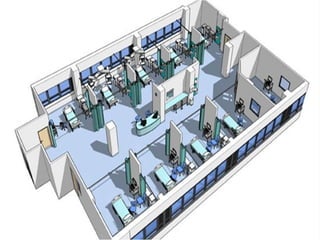
WHAT IS ICU ?
Specific unit in hospital designed to have the highest
medical services and also highest nurse care to
provide intensive treatment medicine.
For saving life of severe illnesses and injuries which
require continuous monitoring the case and supported
with special equipments to ensure about the normal
body function.
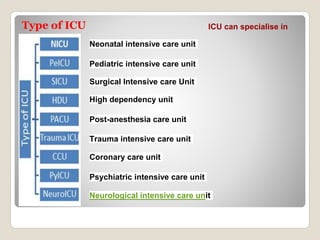
Type of ICU
Neonatal intensive care unit
Pediatric intensive care unit
Surgical Intensive care Unit
High dependency unit
Post-anesthesia care unit
Trauma intensive care unit
Coronary care unit
Psychiatric intensive care unit
Neurological intensive care unit
ICU can specialise in
CASE:-
75 years old patient present to ICU with dyspnea, cough, chest
tightness and wheezing. Severity of asthma assessed by
the following
1-Unable to speak full sentences.
2-Increased Respiratory rate.
3-Use of accessory muscle.
4-Increased Pulse rate.
5-Pulsus paradoxus ( Inspiratory decrease in systolic blood pressure)
6-Decrease in sensorium, fatigue.
Auscultation:
Wheezes and crackles; silent chest signifies very severe airflow
obstruction.
The scenario
The patient was admitted to the ER then referred to ICU.
The consultant doctor asked the nurse to make chest x-ray
for the patient to rule out pneumothorax, look for degree of
hyperinflation, or any lung infiltrate suggestive of
atelectasis or collapse consolidation. the nurse asked the
nursing aid to call radiology department and help the
technician in bringing x-ray machine to make chest x-ray
for the patient in the ICU unit, and th then the consultant
doctor ensured that the patient suffer from acute severe
asthma.
The scenario
The consultant told the junior doctor that he should
monitor spo2 and try to keep it more than 90%, and told
him to ask clinical pharmacist about the dose of Nebulized
salbutamol that they should give to keep spo2 higher than
90%, the clinical pharmacist advised him that the dose
should be 2.5 mg (0.5 ml of 5% solution in 2.5 ml saline) or
levosalbutamol.The consultant asked to repeat every 20
mins for 3 doses then less frequently dictated by patient's
clinical response.
The scenario
The clinical pharmacist suggested that Ipratropium 0.5 mg
nebulization every 20 mts should be included in initial
treatment, and the junior doctor asked if Corticosteroids
should be initiated at the earliest to prevent respiratory
failure, the consultant agreed with him, then the clinical
pharmacist suggested that The usual doses are: Inj
Hydrocortisone 100 mg every 6 hours or
methylprednisolone 60-125 mg q 6-8 hourly, also the
consultant said that they should give Quibron 150 mg twice
daily. .
The scenario
the junior asked the consultant that should we give
antibiotics, the consultant said that Antibiotics are not
required routinely in bronchial asthma exacerbation and
should be given only if there is evidence of infection.
The scenario
The consultant asked the junior to write the medication in
the patient record, so that the nurse will be able to
administer what the consultant ordered, the junior asked
the nurse to observe patient vital signs every 15 minutes
and report any changes happen to the patient, he also
ordered for ABG, the nurse took a blood sample and then
asked the nursing aid to send it to the lab, also she asked
the housekeeping to clean the patient environment at the
end of the shift , she also give the second dose of quibron
150 mg at the end of her shift,but when she endorsed
The scenario
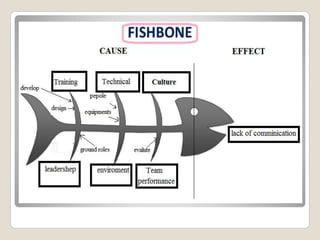
the case she didn't tell the nurse of the next shift that she
gave the second dose of the medication so she gave the
medication again which caused tachycardia to the patient.
-His brother out side the country and want to follow his
brother case and consult another doctors.
-His family visited him but they also stay along outside the
icu unit they want to tell their opinion about the service
-Also the patient when discharge want to tell about the
service inside.
Team
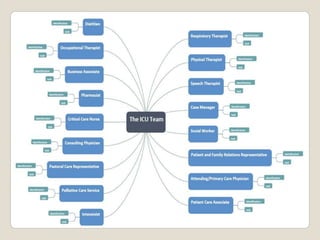
From the ICU team we need the following specialties:
1- Consulting physician: a senior doctor who practises
in one of the medical specialties and here we need
pulmonologist.
role:
- To assume the full responsibility towards the case.
- Guiding team members about how they will treat the
patient.
- Giving them information towards improving patient
safety, and any information they need to make a clinical
decision.
2- ICU physician: who will be a receiver for the
information from the consultant and available all the
time with case, so he will be the team leader because
he is available most of the time.
ROLE:
- To apply consultant decisions.
- To be responsible for taking quick decisions to treat the
patient.
- To be Available all the time to treat the case and get
contact with other ICU team.
3- Clinical pharmacist: is a member of the team who will
guide the team about the most appropriate medication for
the case.
role:
- To help the physician in making a decision about the
most appropriate medication and its dose.
- To give the team information about the alternatives of
the medications.
- To insure about the patient take the right dose of
medication that are will management the disease.
- To care for drug interactions.
4- ICU nurse : is the member of the team who will provide
nursing care for the patient.
role:
- To administer medications as doctor ordered.
- To take care of the patient.
- To assess and report any changes happened to the
patient like changes in Vital signs or anything else.
5- Nursing aid: he is the team member who will assist the
nurse in providing patient care.
role:
- To send and receive laboratory results.
- To help in all nursing procedures that the patient may
need with the nurse
6- ICU housekeeping : he is the member who will be
responsible for making patient environment clean.
role:
- To clean and disinfect patient environment, to avoid
transferring of infection to and from team, patient or
visitors.
7-ICU HI:
he is a professional person take a place between information technology
and medical practice, enabling ICU team to provide optimum intensive care
for the patient.
ROLE:
1-Informatics can provide a mechanism for patients to provide their clinician(s) with
critical information and to share information with family, friends, and other patients
have the ability to access this information.
2-This information may enable patients to exert greater control over their own care.
Clinicians may use information systems. (e.g., electronic medical records) to
coordinate care and share information with other clinicians. Patients and clinicians
may use communication tools and information resources to interact with one another
in new ways.
PLACE:
ICU unit in chest hospital.
Purpose for the case:
-Stop worsening organ function by make good collaboration between the team.
-introduce high medical serves as Support organ function.
-Optimize (=improve or maximize) organ function.
-Monitoring ‘high risk’ interventions.
-decrease the icu time for patient.
Goals of the team:
The main goal is Goal is to develop highly skilled teams in order to improve patient outcomes.
by
1) Increase Patient Care.
2) Increase Medical Knowledge.
3) Practice-Based Learning and Improvement.
4) Increase Interpersonal and Communication Skills.
5) Professionalism.
6) Systems-Based Practice.
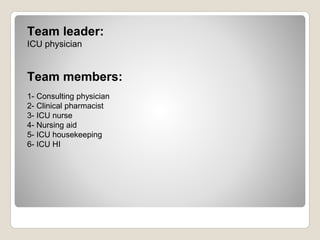
Team members:
1- Consulting physician
2- Clinical pharmacist
3- ICU nurse
4- Nursing aid
5- ICU housekeeping
6- ICU HI
Team leader:
ICU physician
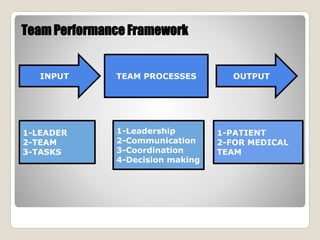
INPUT TEAM PROCESSES OUTPUT
1-LEADER
2-TEAM
3-TASKS
1-Leadership
2-Communication
3-Coordination
4-Decision making
1-PATIENT
2-FOR MEDICAL
TEAM
Team Performance Framework
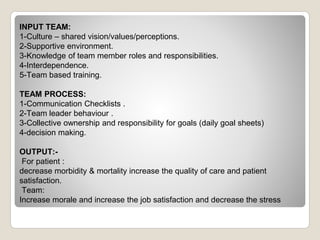
INPUT TEAM:
1-Culture – shared vision/values/perceptions.
2-Supportive environment.
3-Knowledge of team member roles and responsibilities.
4-Interdependence.
5-Team based training.
TEAM PROCESS:
1-Communication Checklists .
2-Team leader behaviour .
3-Collective ownership and responsibility for goals (daily goal sheets)
4-decision making.
OUTPUT:-
For patient :
decrease morbidity & mortality increase the quality of care and patient
satisfaction.
Team:
Increase morale and increase the job satisfaction and decrease the stress
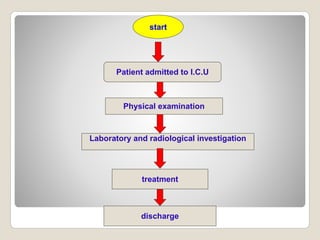
start
Patient admitted to I.C.U
Physical examination
Laboratory and radiological investigation
treatment
discharge
●“The single biggest problem in
communication is the illusion that it has
taken place”
George Bernard Shaw
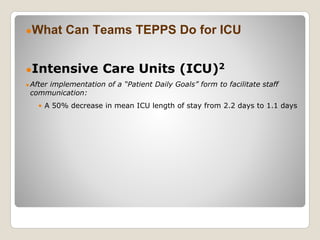
●What Can Teams TEPPS Do for ICU
●Intensive Care Units (ICU)2
● After implementation of a “Patient Daily Goals” form to facilitate staff
communication:
• A 50% decrease in mean ICU length of stay from 2.2 days to 1.1 days
●Between the team the communication is
important and the can use in
communication skype between the
members of the team
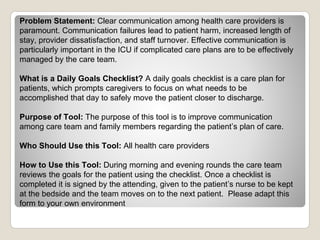
Problem Statement: Clear communication among health care providers is
paramount. Communication failures lead to patient harm, increased length of
stay, provider dissatisfaction, and staff turnover. Effective communication is
particularly important in the ICU if complicated care plans are to be effectively
managed by the care team.
What is a Daily Goals Checklist? A daily goals checklist is a care plan for
patients, which prompts caregivers to focus on what needs to be
accomplished that day to safely move the patient closer to discharge.
Purpose of Tool: The purpose of this tool is to improve communication
among care team and family members regarding the patient’s plan of care.
Who Should Use this Tool: All health care providers
How to Use this Tool: During morning and evening rounds the care team
reviews the goals for the patient using the checklist. Once a checklist is
completed it is signed by the attending, given to the patient’s nurse to be kept
at the bedside and the team moves on to the next patient. Please adapt this
form to your own environment
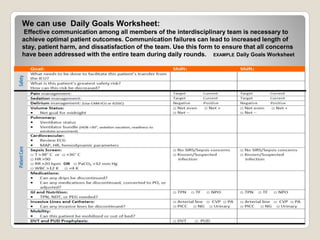
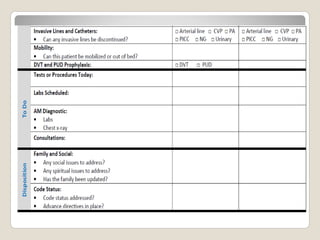
We can use Daily Goals Worksheet:
Effective communication among all members of the interdisciplinary team is necessary to
achieve optimal patient outcomes. Communication failures can lead to increased length of
stay, patient harm, and dissatisfaction of the team. Use this form to ensure that all concerns
have been addressed with the entire team during daily rounds. EXAMPLE Daily Goals Worksheet
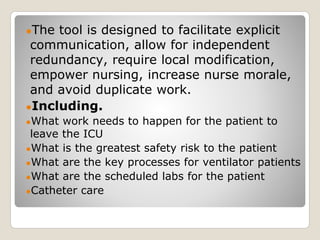
●The tool is designed to facilitate explicit
communication, allow for independent
redundancy, require local modification,
empower nursing, increase nurse morale,
and avoid duplicate work.
●Including.
●What work needs to happen for the patient to
leave the ICU
●What is the greatest safety risk to the patient
●What are the key processes for ventilator patients
●What are the scheduled labs for the patient
●Catheter care
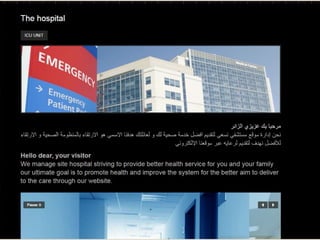
Also to increase the communication with the patient families out side and can take opinion of
other doctors about his case make website can access to his data throw strong password and
also can put his opinion about the service introduce to him and to his family throw the time he
stay in ICU by using Google survey with the number of the patient .
This web sit we made.
http://brain-power.weebly.com/icu-unit.html.
And a sample of daily report and manage the case.
http://brain-power.weebly.com/english.html.
In this video we show how to use this website.
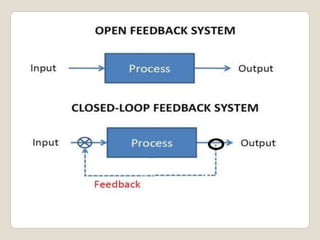
As we see we use closed loop
feedback system
For introduce better health care.
By using Google forum and make
survey throw use it about the team
performance.
As shown in this model

ICU interdisciplinary team

  • 1.
  • 2.
    MEMBERS 1-Hussien Mohammed Hussein 2-Sherifabd elbade 3-Abdullah atteya 4-Mahmoud sallam
  • 3.
    WHAT IS ICU? Specific unit in hospital designed to have the highest medical services and also highest nurse care to provide intensive treatment medicine. For saving life of severe illnesses and injuries which require continuous monitoring the case and supported with special equipments to ensure about the normal body function.
  • 6.
    Type of ICU Neonatalintensive care unit Pediatric intensive care unit Surgical Intensive care Unit High dependency unit Post-anesthesia care unit Trauma intensive care unit Coronary care unit Psychiatric intensive care unit Neurological intensive care unit ICU can specialise in
  • 9.
    CASE:- 75 years oldpatient present to ICU with dyspnea, cough, chest tightness and wheezing. Severity of asthma assessed by the following 1-Unable to speak full sentences. 2-Increased Respiratory rate. 3-Use of accessory muscle. 4-Increased Pulse rate. 5-Pulsus paradoxus ( Inspiratory decrease in systolic blood pressure) 6-Decrease in sensorium, fatigue. Auscultation: Wheezes and crackles; silent chest signifies very severe airflow obstruction.
  • 10.
    The scenario The patientwas admitted to the ER then referred to ICU. The consultant doctor asked the nurse to make chest x-ray for the patient to rule out pneumothorax, look for degree of hyperinflation, or any lung infiltrate suggestive of atelectasis or collapse consolidation. the nurse asked the nursing aid to call radiology department and help the technician in bringing x-ray machine to make chest x-ray for the patient in the ICU unit, and th then the consultant doctor ensured that the patient suffer from acute severe asthma.
  • 11.
    The scenario The consultanttold the junior doctor that he should monitor spo2 and try to keep it more than 90%, and told him to ask clinical pharmacist about the dose of Nebulized salbutamol that they should give to keep spo2 higher than 90%, the clinical pharmacist advised him that the dose should be 2.5 mg (0.5 ml of 5% solution in 2.5 ml saline) or levosalbutamol.The consultant asked to repeat every 20 mins for 3 doses then less frequently dictated by patient's clinical response.
  • 12.
    The scenario The clinicalpharmacist suggested that Ipratropium 0.5 mg nebulization every 20 mts should be included in initial treatment, and the junior doctor asked if Corticosteroids should be initiated at the earliest to prevent respiratory failure, the consultant agreed with him, then the clinical pharmacist suggested that The usual doses are: Inj Hydrocortisone 100 mg every 6 hours or methylprednisolone 60-125 mg q 6-8 hourly, also the consultant said that they should give Quibron 150 mg twice daily. .
  • 13.
    The scenario the juniorasked the consultant that should we give antibiotics, the consultant said that Antibiotics are not required routinely in bronchial asthma exacerbation and should be given only if there is evidence of infection.
  • 14.
    The scenario The consultantasked the junior to write the medication in the patient record, so that the nurse will be able to administer what the consultant ordered, the junior asked the nurse to observe patient vital signs every 15 minutes and report any changes happen to the patient, he also ordered for ABG, the nurse took a blood sample and then asked the nursing aid to send it to the lab, also she asked the housekeeping to clean the patient environment at the end of the shift , she also give the second dose of quibron 150 mg at the end of her shift,but when she endorsed
  • 15.
    The scenario the caseshe didn't tell the nurse of the next shift that she gave the second dose of the medication so she gave the medication again which caused tachycardia to the patient. -His brother out side the country and want to follow his brother case and consult another doctors. -His family visited him but they also stay along outside the icu unit they want to tell their opinion about the service -Also the patient when discharge want to tell about the service inside.
  • 17.
    Team From the ICUteam we need the following specialties: 1- Consulting physician: a senior doctor who practises in one of the medical specialties and here we need pulmonologist. role: - To assume the full responsibility towards the case. - Guiding team members about how they will treat the patient. - Giving them information towards improving patient safety, and any information they need to make a clinical decision.
  • 18.
    2- ICU physician:who will be a receiver for the information from the consultant and available all the time with case, so he will be the team leader because he is available most of the time. ROLE: - To apply consultant decisions. - To be responsible for taking quick decisions to treat the patient. - To be Available all the time to treat the case and get contact with other ICU team.
  • 19.
    3- Clinical pharmacist:is a member of the team who will guide the team about the most appropriate medication for the case. role: - To help the physician in making a decision about the most appropriate medication and its dose. - To give the team information about the alternatives of the medications. - To insure about the patient take the right dose of medication that are will management the disease. - To care for drug interactions.
  • 20.
    4- ICU nurse: is the member of the team who will provide nursing care for the patient. role: - To administer medications as doctor ordered. - To take care of the patient. - To assess and report any changes happened to the patient like changes in Vital signs or anything else.
  • 21.
    5- Nursing aid:he is the team member who will assist the nurse in providing patient care. role: - To send and receive laboratory results. - To help in all nursing procedures that the patient may need with the nurse
  • 22.
    6- ICU housekeeping: he is the member who will be responsible for making patient environment clean. role: - To clean and disinfect patient environment, to avoid transferring of infection to and from team, patient or visitors.
  • 23.
    7-ICU HI: he isa professional person take a place between information technology and medical practice, enabling ICU team to provide optimum intensive care for the patient. ROLE: 1-Informatics can provide a mechanism for patients to provide their clinician(s) with critical information and to share information with family, friends, and other patients have the ability to access this information. 2-This information may enable patients to exert greater control over their own care. Clinicians may use information systems. (e.g., electronic medical records) to coordinate care and share information with other clinicians. Patients and clinicians may use communication tools and information resources to interact with one another in new ways.
  • 24.
    PLACE: ICU unit inchest hospital. Purpose for the case: -Stop worsening organ function by make good collaboration between the team. -introduce high medical serves as Support organ function. -Optimize (=improve or maximize) organ function. -Monitoring ‘high risk’ interventions. -decrease the icu time for patient. Goals of the team: The main goal is Goal is to develop highly skilled teams in order to improve patient outcomes. by 1) Increase Patient Care. 2) Increase Medical Knowledge. 3) Practice-Based Learning and Improvement. 4) Increase Interpersonal and Communication Skills. 5) Professionalism. 6) Systems-Based Practice.
  • 25.
    Team members: 1- Consultingphysician 2- Clinical pharmacist 3- ICU nurse 4- Nursing aid 5- ICU housekeeping 6- ICU HI Team leader: ICU physician
  • 26.
    INPUT TEAM PROCESSESOUTPUT 1-LEADER 2-TEAM 3-TASKS 1-Leadership 2-Communication 3-Coordination 4-Decision making 1-PATIENT 2-FOR MEDICAL TEAM Team Performance Framework
  • 27.
    INPUT TEAM: 1-Culture –shared vision/values/perceptions. 2-Supportive environment. 3-Knowledge of team member roles and responsibilities. 4-Interdependence. 5-Team based training. TEAM PROCESS: 1-Communication Checklists . 2-Team leader behaviour . 3-Collective ownership and responsibility for goals (daily goal sheets) 4-decision making. OUTPUT:- For patient : decrease morbidity & mortality increase the quality of care and patient satisfaction. Team: Increase morale and increase the job satisfaction and decrease the stress
  • 29.
    start Patient admitted toI.C.U Physical examination Laboratory and radiological investigation treatment discharge
  • 30.
    ●“The single biggestproblem in communication is the illusion that it has taken place” George Bernard Shaw
  • 31.
    ●What Can TeamsTEPPS Do for ICU ●Intensive Care Units (ICU)2 ● After implementation of a “Patient Daily Goals” form to facilitate staff communication: • A 50% decrease in mean ICU length of stay from 2.2 days to 1.1 days
  • 32.
    ●Between the teamthe communication is important and the can use in communication skype between the members of the team
  • 33.
    Problem Statement: Clearcommunication among health care providers is paramount. Communication failures lead to patient harm, increased length of stay, provider dissatisfaction, and staff turnover. Effective communication is particularly important in the ICU if complicated care plans are to be effectively managed by the care team. What is a Daily Goals Checklist? A daily goals checklist is a care plan for patients, which prompts caregivers to focus on what needs to be accomplished that day to safely move the patient closer to discharge. Purpose of Tool: The purpose of this tool is to improve communication among care team and family members regarding the patient’s plan of care. Who Should Use this Tool: All health care providers How to Use this Tool: During morning and evening rounds the care team reviews the goals for the patient using the checklist. Once a checklist is completed it is signed by the attending, given to the patient’s nurse to be kept at the bedside and the team moves on to the next patient. Please adapt this form to your own environment
  • 34.
    We can useDaily Goals Worksheet: Effective communication among all members of the interdisciplinary team is necessary to achieve optimal patient outcomes. Communication failures can lead to increased length of stay, patient harm, and dissatisfaction of the team. Use this form to ensure that all concerns have been addressed with the entire team during daily rounds. EXAMPLE Daily Goals Worksheet
  • 36.
    ●The tool isdesigned to facilitate explicit communication, allow for independent redundancy, require local modification, empower nursing, increase nurse morale, and avoid duplicate work. ●Including. ●What work needs to happen for the patient to leave the ICU ●What is the greatest safety risk to the patient ●What are the key processes for ventilator patients ●What are the scheduled labs for the patient ●Catheter care
  • 37.
    Also to increasethe communication with the patient families out side and can take opinion of other doctors about his case make website can access to his data throw strong password and also can put his opinion about the service introduce to him and to his family throw the time he stay in ICU by using Google survey with the number of the patient . This web sit we made. http://brain-power.weebly.com/icu-unit.html. And a sample of daily report and manage the case. http://brain-power.weebly.com/english.html. In this video we show how to use this website.
  • 38.
    As we seewe use closed loop feedback system For introduce better health care. By using Google forum and make survey throw use it about the team performance. As shown in this model