General Course
Education Team
Nursing Education Team 2
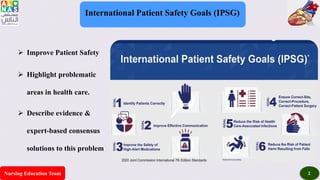
International Patient Safety Goals (IPSG)
 Improve Patient Safety
 Highlight problematic
areas in health care.
 Describe evidence &
expert-based consensus
solutions to this problem
Nursing Education Team 3
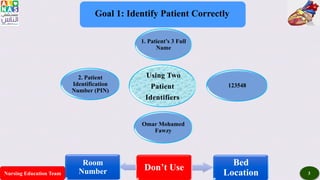
Goal 1: Identify Patient Correctly
Using Two
Patient
Identifiers
1. Patient’s 3 Full
Name
123548
Omar Mohamed
Fawzy
2. Patient
Identification
Number (PIN)
Bed
Location
Don’t Use
Room
Number
Nursing Education Team 4
Special cases of identification
 For unknown patient: use unknown (1) or (2),…. And MRN.
 For dead patient: must be identified to prevent mix in mortuary.
Nursing Education Team 5
Goal 1: Identify Patient Correctly
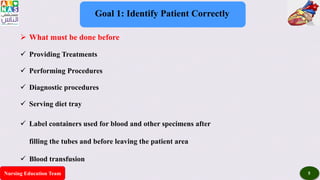
 What must be done before
 Providing Treatments
 Performing Procedures
 Diagnostic procedures
 Serving diet tray
 Label containers used for blood and other specimens after
filling the tubes and before leaving the patient area
 Blood transfusion
Nursing Education Team 6
Goal 1: Identify Patient Correctly
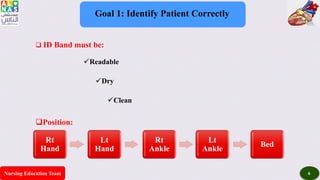
 ID Band must be:
Readable
Dry
Clean
Position:
Rt
Hand
Lt
Hand
Rt
Ankle
Lt
Ankle
Bed
Nursing Education Team 7
I.D Band
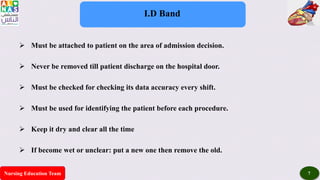
 Must be attached to patient on the area of admission decision.
 Never be removed till patient discharge on the hospital door.
 Must be checked for checking its data accuracy every shift.
 Must be used for identifying the patient before each procedure.
 Keep it dry and clear all the time
 If become wet or unclear: put a new one then remove the old.
Nursing Education Team 8
Goal 1: Identify Patient Correctly
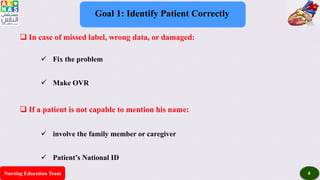
 In case of missed label, wrong data, or damaged:
 Fix the problem
 Make OVR
 If a patient is not capable to mention his name:
 involve the family member or caregiver
 Patient’s National ID
Nursing Education Team 9
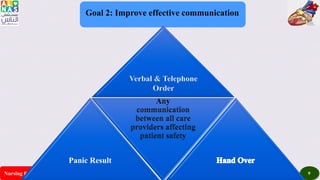
Goal 2: Improve effective communication
Panic Result
Nursing Education Team 10
Goal 2: Improve effective communication
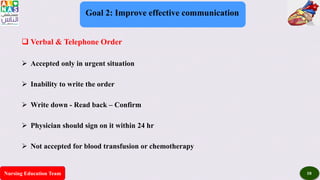
 Verbal & Telephone Order
 Accepted only in urgent situation
 Inability to write the order
 Write down - Read back – Confirm
 Physician should sign on it within 24 hr
 Not accepted for blood transfusion or chemotherapy
Nursing Education Team 11
Goal 2: Improve effective communication
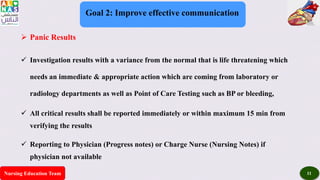
 Panic Results
 Investigation results with a variance from the normal that is life threatening which
needs an immediate & appropriate action which are coming from laboratory or
radiology departments as well as Point of Care Testing such as BP or bleeding,
 All critical results shall be reported immediately or within maximum 15 min from
verifying the results
 Reporting to Physician (Progress notes) or Charge Nurse (Nursing Notes) if
physician not available
Nursing Education Team 12
Goal 2: Improve effective communication
Area Assessment, Transfer sheet
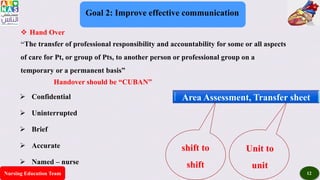
Handover should be “CUBAN”
 Confidential
 Uninterrupted
 Brief
 Accurate
 Named – nurse
 Hand Over
“The transfer of professional responsibility and accountability for some or all aspects
of care for Pt, or group of Pts, to another person or professional group on a
temporary or a permanent basis”
Unit to
unit
shift to
shift
Nursing Education Team 13
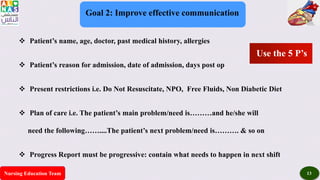
Goal 2: Improve effective communication
 Patient’s name, age, doctor, past medical history, allergies
 Patient’s reason for admission, date of admission, days post op
 Present restrictions i.e. Do Not Resuscitate, NPO, Free Fluids, Non Diabetic Diet
 Plan of care i.e. The patient’s main problem/need is………and he/she will
need the following……....The patient’s next problem/need is………. & so on
 Progress Report must be progressive: contain what needs to happen in next shift
Use the 5 P’s
Nursing Education Team 14
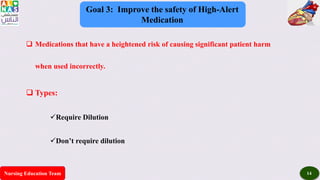
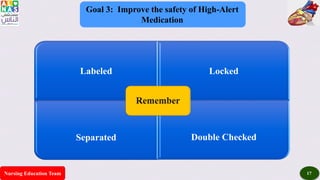
Goal 3: Improve the safety of High-Alert
Medication
 Medications that have a heightened risk of causing significant patient harm
when used incorrectly.
 Types:
Require Dilution
Don’t require dilution
Nursing Education Team 15
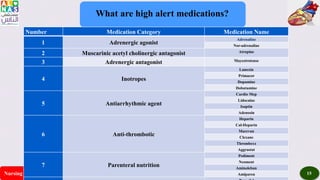
What are high alert medications?
Number Medication Category Medication Name
1 Adrenergic agonist
Adrenaline
Nor-adrenaline
2 Muscarinic acetyl cholinergic antagonist Atropine
3 Adrenergic antagonist Mayestrotense
4 Inotropes
Lanoxin
Primacor
Dopamine
Dobutamine
5 Antiarrhythmic agent
Cardio Mep
Lidocaine
Isoptin
Adenosin
6 Anti-thrombotic
Heparin
Cal-Heparin
Marevan
Clexane
Thrombexx
Aggrastat
7 Parenteral nutrition
Pediment
Neoment
Aminoleban
Amiparen
Nursing Education Team 16
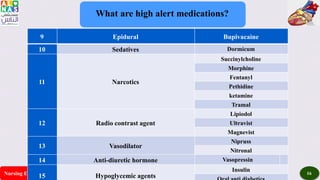
What are high alert medications?
9 Epidural Bupivacaine
10 Sedatives Dormicum
11 Narcotics
Succinylcholine
Morphine
Fentanyl
Pethidine
ketamine
Tramal
12 Radio contrast agent
Lipiodol
Ultravist
Magnevist
13 Vasodilator
Nipruss
Nitronal
14 Anti-diuretic hormone Vasopressin
15 Hypoglycemic agents
Insulin
Nursing Education Team 17
Goal 3: Improve the safety of High-Alert
Medication
Labeled Locked
Separated Double Checked
Nursing Education Team 18
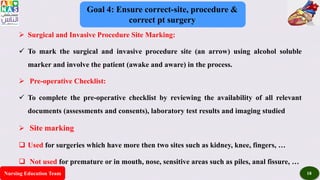
Goal 4: Ensure correct-site, procedure &
correct pt surgery
 Surgical and Invasive Procedure Site Marking:
 To mark the surgical and invasive procedure site (an arrow) using alcohol soluble
marker and involve the patient (awake and aware) in the process.
 Pre-operative Checklist:
 To complete the pre-operative checklist by reviewing the availability of all relevant
documents (assessments and consents), laboratory test results and imaging studied
 Site marking
 Used for surgeries which have more then two sites such as kidney, knee, fingers, …
 Not used for premature or in mouth, nose, sensitive areas such as piles, anal fissure, …
Nursing Education Team 19
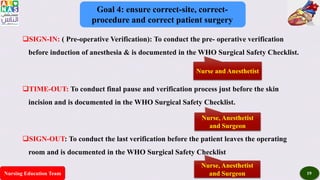
Goal 4: ensure correct-site, correct-
procedure and correct patient surgery
Nurse, Anesthetist
and Surgeon
SIGN-IN: ( Pre-operative Verification): To conduct the pre- operative verification
before induction of anesthesia & is documented in the WHO Surgical Safety Checklist.
TIME-OUT: To conduct final pause and verification process just before the skin
incision and is documented in the WHO Surgical Safety Checklist.
SIGN-OUT: To conduct the last verification before the patient leaves the operating
room and is documented in the WHO Surgical Safety Checklist
Nurse and Anesthetist
Nurse, Anesthetist
and Surgeon
Nursing Education Team 20
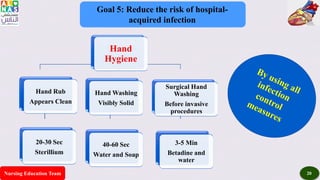
Goal 5: Reduce the risk of hospital-
acquired infection
Hand
Hygiene
Hand Rub
Appears Clean
20-30 Sec
Sterillium
Hand Washing
Visibly Solid
40-60 Sec
Water and Soap
Surgical Hand
Washing
Before invasive
procedures
3-5 Min
Betadine and
water
Nursing Education Team 21
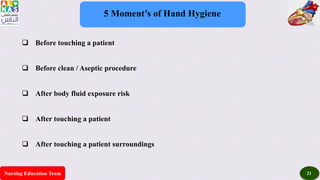
5 Moment’s of Hand Hygiene
 Before touching a patient
 Before clean / Aseptic procedure
 After body fluid exposure risk
 After touching a patient
 After touching a patient surroundings
Nursing Education Team 22
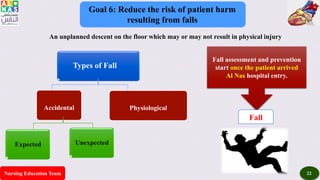
Goal 6: Reduce the risk of patient harm
resulting from falls
An unplanned descent on the floor which may or may not result in physical injury
Types of Fall
Accidental Physiological
Expected Unexpected
Fall assessment and prevention
start once the patient arrived
Al Nas hospital entry.
Fall
Nursing Education Team 23
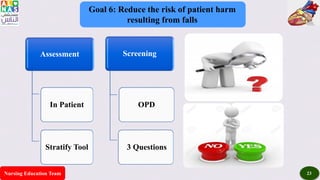
Goal 6: Reduce the risk of patient harm
resulting from falls
Assessment
In Patient
Stratify Tool
Screening
OPD
3 Questions
Nursing Education Team 24
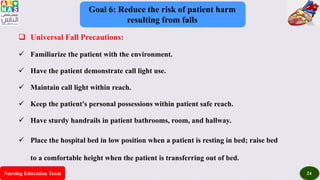
Goal 6: Reduce the risk of patient harm
resulting from falls
 Universal Fall Precautions:
 Familiarize the patient with the environment.
 Have the patient demonstrate call light use.
 Maintain call light within reach.
 Keep the patient's personal possessions within patient safe reach.
 Have sturdy handrails in patient bathrooms, room, and hallway.
 Place the hospital bed in low position when a patient is resting in bed; raise bed
to a comfortable height when the patient is transferring out of bed.
Nursing Education Team 25
Universal Fall Precautions:
 Keep hospital bed brakes locked.
 Keep wheelchair wheel locks in "locked" position when stationary.
 Keep nonslip, comfortable, well-fitting footwear on the patient.
 Use night lights or supplemental lighting.
 Keep floor surfaces clean and dry. Clean up all spills promptly.
 Keep patient care areas uncluttered.
 Follow safe patient handling practices.
Nursing Education Team 26
Goal 6: Reduce the risk of patient harm
resulting from falls
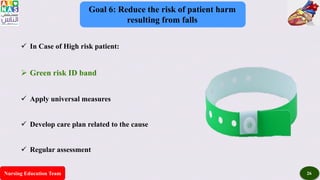
 In Case of High risk patient:
 Green risk ID band
 Apply universal measures
 Develop care plan related to the cause
 Regular assessment
Nursing Education Team 27
IPSG.pحصلونا 😂حصلونا 😂gggggggghhhhhhdf

IPSG.pحصلونا 😂حصلونا 😂gggggggghhhhhhdf

  • 1.
  • 2.
    Nursing Education Team2 International Patient Safety Goals (IPSG)  Improve Patient Safety  Highlight problematic areas in health care.  Describe evidence & expert-based consensus solutions to this problem
  • 3.
    Nursing Education Team3 Goal 1: Identify Patient Correctly Using Two Patient Identifiers 1. Patient’s 3 Full Name 123548 Omar Mohamed Fawzy 2. Patient Identification Number (PIN) Bed Location Don’t Use Room Number
  • 4.
    Nursing Education Team4 Special cases of identification  For unknown patient: use unknown (1) or (2),…. And MRN.  For dead patient: must be identified to prevent mix in mortuary.
  • 5.
    Nursing Education Team5 Goal 1: Identify Patient Correctly  What must be done before  Providing Treatments  Performing Procedures  Diagnostic procedures  Serving diet tray  Label containers used for blood and other specimens after filling the tubes and before leaving the patient area  Blood transfusion
  • 6.
    Nursing Education Team6 Goal 1: Identify Patient Correctly  ID Band must be: Readable Dry Clean Position: Rt Hand Lt Hand Rt Ankle Lt Ankle Bed
  • 7.
    Nursing Education Team7 I.D Band  Must be attached to patient on the area of admission decision.  Never be removed till patient discharge on the hospital door.  Must be checked for checking its data accuracy every shift.  Must be used for identifying the patient before each procedure.  Keep it dry and clear all the time  If become wet or unclear: put a new one then remove the old.
  • 8.
    Nursing Education Team8 Goal 1: Identify Patient Correctly  In case of missed label, wrong data, or damaged:  Fix the problem  Make OVR  If a patient is not capable to mention his name:  involve the family member or caregiver  Patient’s National ID
  • 9.
    Nursing Education Team9 Goal 2: Improve effective communication Panic Result
  • 10.
    Nursing Education Team10 Goal 2: Improve effective communication  Verbal & Telephone Order  Accepted only in urgent situation  Inability to write the order  Write down - Read back – Confirm  Physician should sign on it within 24 hr  Not accepted for blood transfusion or chemotherapy
  • 11.
    Nursing Education Team11 Goal 2: Improve effective communication  Panic Results  Investigation results with a variance from the normal that is life threatening which needs an immediate & appropriate action which are coming from laboratory or radiology departments as well as Point of Care Testing such as BP or bleeding,  All critical results shall be reported immediately or within maximum 15 min from verifying the results  Reporting to Physician (Progress notes) or Charge Nurse (Nursing Notes) if physician not available
  • 12.
    Nursing Education Team12 Goal 2: Improve effective communication Area Assessment, Transfer sheet Handover should be “CUBAN”  Confidential  Uninterrupted  Brief  Accurate  Named – nurse  Hand Over “The transfer of professional responsibility and accountability for some or all aspects of care for Pt, or group of Pts, to another person or professional group on a temporary or a permanent basis” Unit to unit shift to shift
  • 13.
    Nursing Education Team13 Goal 2: Improve effective communication  Patient’s name, age, doctor, past medical history, allergies  Patient’s reason for admission, date of admission, days post op  Present restrictions i.e. Do Not Resuscitate, NPO, Free Fluids, Non Diabetic Diet  Plan of care i.e. The patient’s main problem/need is………and he/she will need the following……....The patient’s next problem/need is………. & so on  Progress Report must be progressive: contain what needs to happen in next shift Use the 5 P’s
  • 14.
    Nursing Education Team14 Goal 3: Improve the safety of High-Alert Medication  Medications that have a heightened risk of causing significant patient harm when used incorrectly.  Types: Require Dilution Don’t require dilution
  • 15.
    Nursing Education Team15 What are high alert medications? Number Medication Category Medication Name 1 Adrenergic agonist Adrenaline Nor-adrenaline 2 Muscarinic acetyl cholinergic antagonist Atropine 3 Adrenergic antagonist Mayestrotense 4 Inotropes Lanoxin Primacor Dopamine Dobutamine 5 Antiarrhythmic agent Cardio Mep Lidocaine Isoptin Adenosin 6 Anti-thrombotic Heparin Cal-Heparin Marevan Clexane Thrombexx Aggrastat 7 Parenteral nutrition Pediment Neoment Aminoleban Amiparen
  • 16.
    Nursing Education Team16 What are high alert medications? 9 Epidural Bupivacaine 10 Sedatives Dormicum 11 Narcotics Succinylcholine Morphine Fentanyl Pethidine ketamine Tramal 12 Radio contrast agent Lipiodol Ultravist Magnevist 13 Vasodilator Nipruss Nitronal 14 Anti-diuretic hormone Vasopressin 15 Hypoglycemic agents Insulin
  • 17.
    Nursing Education Team17 Goal 3: Improve the safety of High-Alert Medication Labeled Locked Separated Double Checked
  • 18.
    Nursing Education Team18 Goal 4: Ensure correct-site, procedure & correct pt surgery  Surgical and Invasive Procedure Site Marking:  To mark the surgical and invasive procedure site (an arrow) using alcohol soluble marker and involve the patient (awake and aware) in the process.  Pre-operative Checklist:  To complete the pre-operative checklist by reviewing the availability of all relevant documents (assessments and consents), laboratory test results and imaging studied  Site marking  Used for surgeries which have more then two sites such as kidney, knee, fingers, …  Not used for premature or in mouth, nose, sensitive areas such as piles, anal fissure, …
  • 19.
    Nursing Education Team19 Goal 4: ensure correct-site, correct- procedure and correct patient surgery Nurse, Anesthetist and Surgeon SIGN-IN: ( Pre-operative Verification): To conduct the pre- operative verification before induction of anesthesia & is documented in the WHO Surgical Safety Checklist. TIME-OUT: To conduct final pause and verification process just before the skin incision and is documented in the WHO Surgical Safety Checklist. SIGN-OUT: To conduct the last verification before the patient leaves the operating room and is documented in the WHO Surgical Safety Checklist Nurse and Anesthetist Nurse, Anesthetist and Surgeon
  • 20.
    Nursing Education Team20 Goal 5: Reduce the risk of hospital- acquired infection Hand Hygiene Hand Rub Appears Clean 20-30 Sec Sterillium Hand Washing Visibly Solid 40-60 Sec Water and Soap Surgical Hand Washing Before invasive procedures 3-5 Min Betadine and water
  • 21.
    Nursing Education Team21 5 Moment’s of Hand Hygiene  Before touching a patient  Before clean / Aseptic procedure  After body fluid exposure risk  After touching a patient  After touching a patient surroundings
  • 22.
    Nursing Education Team22 Goal 6: Reduce the risk of patient harm resulting from falls An unplanned descent on the floor which may or may not result in physical injury Types of Fall Accidental Physiological Expected Unexpected Fall assessment and prevention start once the patient arrived Al Nas hospital entry. Fall
  • 23.
    Nursing Education Team23 Goal 6: Reduce the risk of patient harm resulting from falls Assessment In Patient Stratify Tool Screening OPD 3 Questions
  • 24.
    Nursing Education Team24 Goal 6: Reduce the risk of patient harm resulting from falls  Universal Fall Precautions:  Familiarize the patient with the environment.  Have the patient demonstrate call light use.  Maintain call light within reach.  Keep the patient's personal possessions within patient safe reach.  Have sturdy handrails in patient bathrooms, room, and hallway.  Place the hospital bed in low position when a patient is resting in bed; raise bed to a comfortable height when the patient is transferring out of bed.
  • 25.
    Nursing Education Team25 Universal Fall Precautions:  Keep hospital bed brakes locked.  Keep wheelchair wheel locks in "locked" position when stationary.  Keep nonslip, comfortable, well-fitting footwear on the patient.  Use night lights or supplemental lighting.  Keep floor surfaces clean and dry. Clean up all spills promptly.  Keep patient care areas uncluttered.  Follow safe patient handling practices.
  • 26.
    Nursing Education Team26 Goal 6: Reduce the risk of patient harm resulting from falls  In Case of High risk patient:  Green risk ID band  Apply universal measures  Develop care plan related to the cause  Regular assessment
  • 27.