


ICTA Technology Meetup 06
Enterprise Application
Design Patterns
(Part 01)

By Crishantha Nanayakkara
Agenda
Enterprise Design Patterns – An Introduction
Enterprise Design Pattern Catalogs
Gang Of Four (GOF) Patterns
What Next? ­ Enterprise Application 
Architecture Design Patterns

2
Design Patterns
An Introduction

3
4
●

“The gap between the best
software engineering
practice and the average
practice is very wide –
perhaps wider than the other
engineering ”
–

Fred Brooks (A
famous author, ACM
award winner)

5
What is a Pattern?
This means, a Design Pattern gives you a solution to a
common recurring design problem

However,
The Design Patterns are not meant to be laws or rules;
they are just guidelines that you can even alter to fit to
your needs

6
How to create your own design
pattern?
●

●

Firstly, get the complete design pattern
catalog and get familiar with them
If you find a new pattern, then apply,
The Rule of Three
Pattern can be called a pattern if it has been applied in real
world solution by at least three times

7
OO vs Design Patterns
●

Knowing the OO basics (abstraction,
encapsulation, inheritance, polymorphism)
will not make you a good designer!!!
Oh!!!
What should 
I do then?

8
OO vs Design Patterns
●

●

●

Patterns show you how to build systems with
good OO design qualities
Patterns do not give you code. They give
general solutions to design problems
Patterns are not invented they are
discovered

9
Are patterns always great?
●

NO
–

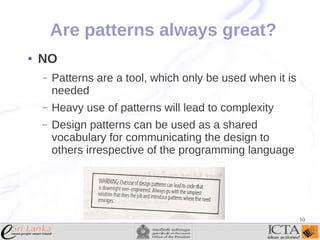
Patterns are a tool, which only be used when it is
needed

–

Heavy use of patterns will lead to complexity

–

Design patterns can be used as a shared
vocabulary for communicating the design to
others irrespective of the programming language

10
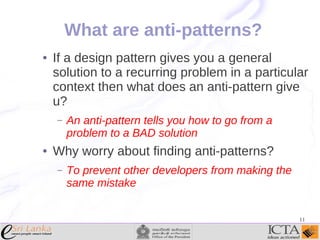
What are anti-patterns?
●

If a design pattern gives you a general
solution to a recurring problem in a particular
context then what does an anti-pattern give
u?
–

●

An anti-pattern tells you how to go from a
problem to a BAD solution

Why worry about finding anti-patterns?
–

To prevent other developers from making the
same mistake
11
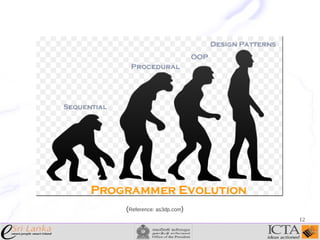
(Reference: as3dp.com)
12
Enterprise Design 
Pattern Catalogs

13
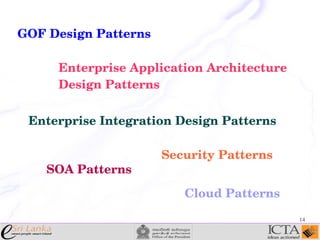
GOF Design Patterns
Enterprise Application Architecture
Design Patterns 
Enterprise Integration Design Patterns 

SOA Patterns

Security Patterns
Cloud Patterns
14
What are Pattern Catalogs?
The much formal way of specifying pattern descriptions

The first and the
most definite
Fundamental
Design Pattern
Catalog is
GOF
(There are 23
fundamental
patterns in it!!)

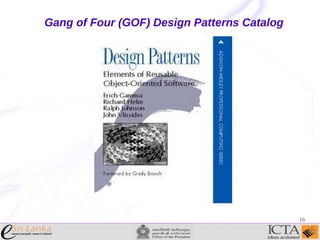
Design Patterns: Elements of Reusable
Object-Oriented Software
(Addison-Wesley, 1995)
15
Gang of Four (GOF) Design Patterns Catalog

16
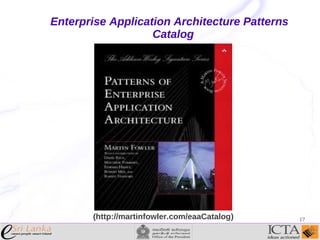
Enterprise Application Architecture Patterns
Catalog

(http://martinfowler.com/eaaCatalog)

17
Enterprise Intergration Patterns Catalog

http://www.eaipatterns.com/
18
GOF Design Patterns
An Introduction

19
20
Behavioural Patterns

21
GOF Design Pattern
Organization

22
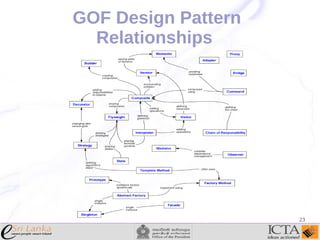
GOF Design Pattern
Relationships

23
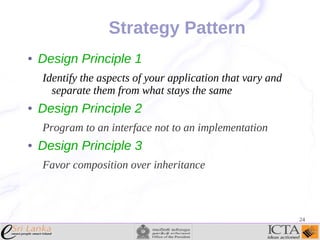
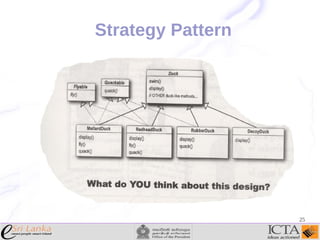
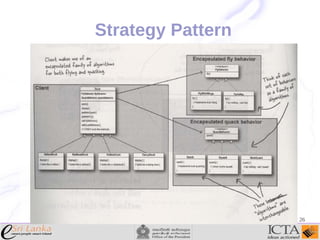
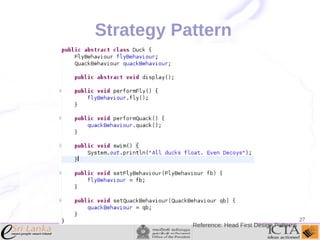
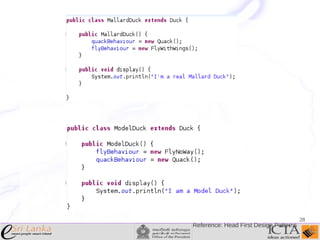
Strategy Pattern
●

Design Principle 1
Identify the aspects of your application that vary and
separate them from what stays the same

●

Design Principle 2
Program to an interface not to an implementation

●

Design Principle 3
Favor composition over inheritance

24
Strategy Pattern

25
Strategy Pattern

26
Strategy Pattern

Reference: Head First Design Patterns

27
Reference: Head First Design Patterns

28
Reference: Head First Design Patterns

29
The Observer Pattern
Observer 1

Observer 2

Subscribers

Subject

Publisher

Observer 3

When the in Subject changes, subscribers
are notified
●The observers are subscribed to the Subject
to receive updates when the Subject data
changes
●

Unsubscribed

30
Command Pattern

Concrete
Command
Objects
Invoker

Receiver

31
Creational Patterns

32
Singleton Pattern
This overcomes
the multiple
threading issue.

However, the synchronization is bit expensive
This way is good if the performance is not an issue

33
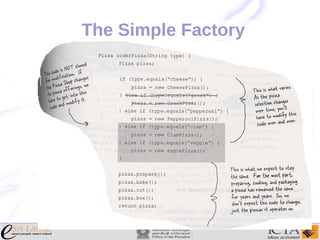
The Simple Factory

34
The Simple Factory

35
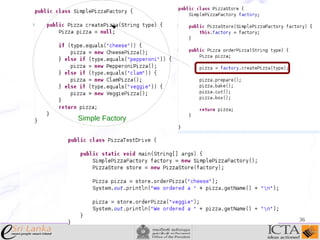
Simple Factory

36
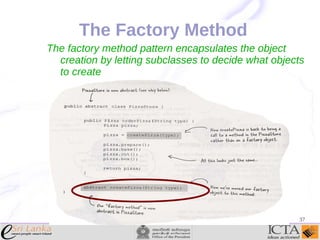
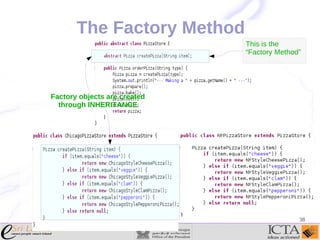
The Factory Method
The factory method pattern encapsulates the object
creation by letting subclasses to decide what objects
to create

37
The Factory Method
This is the
“Factory Method”

Factory objects are created
through INHERITANCE

38
Dependency Inversion
Principle
This is all about reducing dependencies to concrete classes in
our code
●

Before Factory Method

●

After Factory Method

Abstract Class

Concrete
Classes

Though this principle is quite similar to “Program to an
interface” principle, this makes a bigger statement

39
Structural Patterns

40
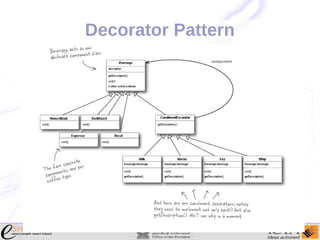
Decorator Pattern

41
Decorator Pattern

42
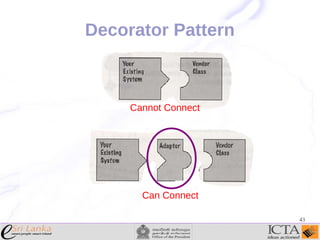
Decorator Pattern

Cannot Connect

Can Connect
43
Decorator Pattern

44
Adapter vs Decorator Pattern
●

Adapter Pattern
“Adapter is used when you have an abstract
interface, and you want to map that interface to
another object, which has similar functional role,
but a different interface”
Basically it is used to
Convert the interface of an object into something
else

45
●

Decorator Pattern
“Decorator is used to extend the functionality of
an object while maintaining its own interface”

Since both “Decorator” and “Adapter” patterns
are used to “wrap” objects, they are basically
known as “Wrapper Patterns”

46
Facade Pattern

47
Facade Pattern
●

●

●

●

●

Facades don’t encapsulate the sub system
classes
They provide a simplified interface to their
functionality
The sub system classes still remain for direct
access to outside clients
One sub system can have any number of facades
linked to it
Decouples the client from a sub system – If you
change any of the sub systems, your client code
does not need to change.
48
Facade Pattern
●

Design Principle
The principle of least knowledge
Talk only to your immediate friends
This prevents us from creating a large number of classes
coupled together. Having too many dependencies creates a
fragile design

49
Proxy Pattern
Remote Proxy

●

There are different kinds of proxy types

●

The above is called the “Remote Proxy”

●

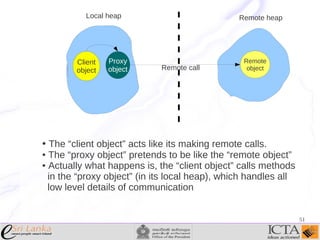
The “Remote Proxy” acts as a local representative for
an remote object. A method call on an “Remote Proxy”
results the call being transferred on the wire and the
result is returned back to the proxy and to the client
50
Local heap

Client
object

Proxy
object

Remote heap

Remote call

Remote
object

The “client object” acts like its making remote calls.
● The “proxy object” pretends to be like the “remote object”
● Actually what happens is, the “client object” calls methods
in the “proxy object” (in its local heap), which handles all
low level details of communication
●

51
Composite Pattern
Composites

Leaf Nodes

52
Composite Pattern
MenuComponent

Menu
MenuItem

MenuItems

53
Composite Pattern
All components must implement the MenuComponent
interface;
Why? In order for the composite to work transparently to the
client, you must implement the same interface for all objects in
the composite
Sometimes, the best possible way is to throw
Run-time Exceptions to all unrelated methods

54
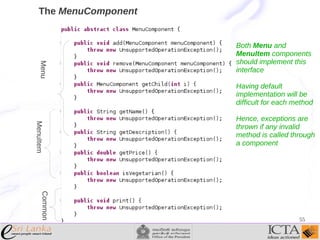
The MenuComponent

Menu

Both Menu and
MenuItem components
should implement this
interface
Having default
implementation will be
difficult for each method

MenuItem

Hence, exceptions are
thrown if any invalid
method is called through
a component

Common

55
56
57

ICTA Technology Meetup 06 - Enterprise Application Design Patterns