By Crishantha Nanayakkara
Head Of Technology, ICTA
@crishantha (Twitter)
Global Trends 
in 
Information Technology
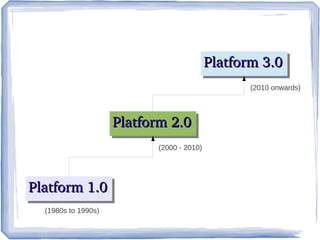
Platform 1.0Platform 1.0Platform 1.0Platform 1.0
Platform 2.0Platform 2.0Platform 2.0Platform 2.0
Platform 3.0Platform 3.0Platform 3.0Platform 3.0
(1980s to 1990s)
(2000 - 2010)
(2010 onwards)
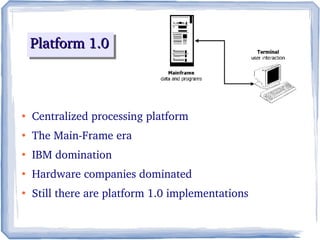
Platform 1.0Platform 1.0Platform 1.0Platform 1.0
●
Centralized processing platform
●
The Main­Frame era
●
IBM domination
●
Hardware companies dominated
●
Still there are platform 1.0 implementations
Platform 2.0Platform 2.0Platform 2.0Platform 2.0
●
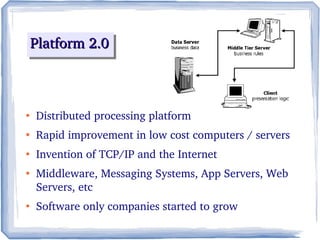
Distributed processing platform
●
Rapid improvement in low cost computers / servers
●
Invention of TCP/IP and the Internet
●
Middleware, Messaging Systems, App Servers, Web 
Servers, etc
●
Software only companies started to grow
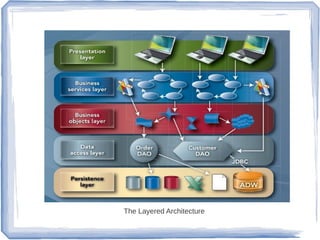
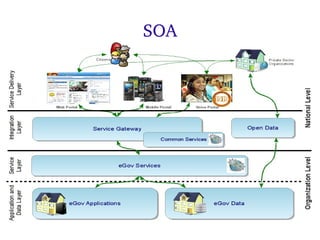
The Layered Architecture
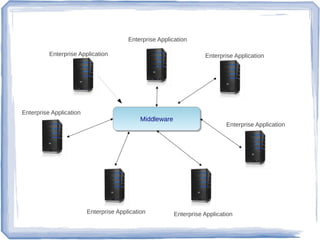
MiddlewareMiddleware
Enterprise Application
Enterprise ApplicationEnterprise Application
Enterprise Application
7
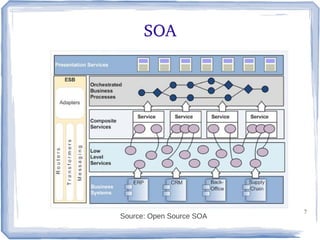
SOA
Source: Open Source SOA
SOA
Platform 2.0 IssuesPlatform 2.0 IssuesPlatform 2.0 IssuesPlatform 2.0 Issues
●
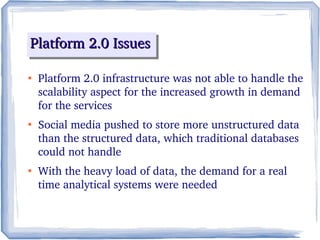
Platform 2.0 infrastructure was not able to handle the 
scalability aspect for the increased growth in demand 
for the services
●
Social media pushed to store more unstructured data 
than the structured data, which traditional databases 
could not handle
●
With the heavy load of data, the demand for a real 
time analytical systems were needed
Platform 3.0Platform 3.0Platform 3.0Platform 3.0
●
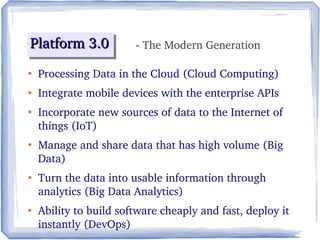
Processing Data in the Cloud (Cloud Computing)
●
Integrate mobile devices with the enterprise APIs
●
Incorporate new sources of data to the Internet of 
things (IoT)
●
Manage and share data that has high volume (Big 
Data)
●
Turn the data into usable information through 
analytics (Big Data Analytics) 
●
Ability to build software cheaply and fast, deploy it 
instantly (DevOps)
- The Modern Generation
Cloud ComputingCloud Computing
12
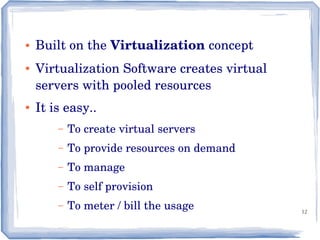
● Built on the Virtualization concept
● Virtualization Software creates virtual 
servers with pooled resources
● It is easy..
– To create virtual servers 
– To provide resources on demand
– To manage
– To self provision
– To meter / bill the usage 
13
14
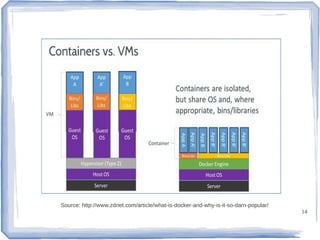
Source: http://www.zdnet.com/article/what-is-docker-and-why-is-it-so-darn-popular/
15
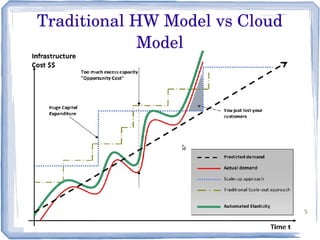
Traditional HW Model vs Cloud 
Model
16
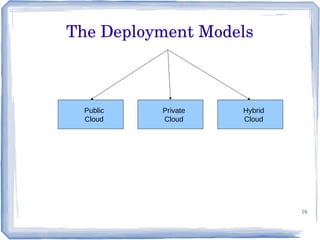
The Deployment Models
Public
Cloud
Private
Cloud
Hybrid
Cloud
17
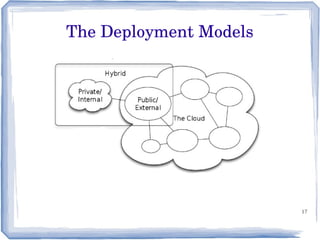
The Deployment Models
18
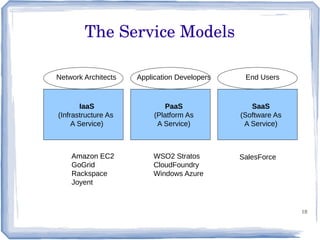
The Service Models
IaaS
(Infrastructure As
A Service)
PaaS
(Platform As
A Service)
SaaS
(Software As
A Service)
Amazon EC2
GoGrid
WSO2 Stratos
CloudFoundry
Windows Azure
Amazon EC2
GoGrid
Rackspace
Joyent
SalesForce
Network Architects Application Developers End Users
19
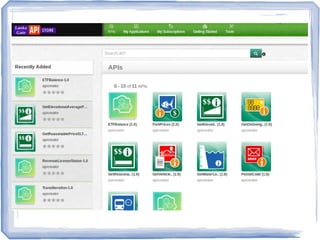
Application Program Interfaces (APIs)Application Program Interfaces (APIs)
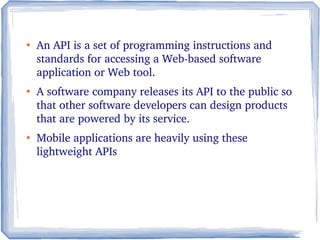
●
An API is a set of programming instructions and 
standards for accessing a Web­based software 
application or Web tool. 
●
A software company releases its API to the public so 
that other software developers can design products 
that are powered by its service.
●
Mobile applications are heavily using these 
lightweight APIs 
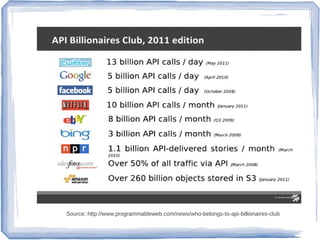
Source: http://www.programmableweb.com/news/who-belongs-to-api-billionaires-club
23
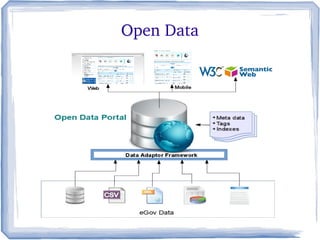
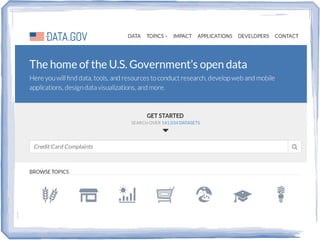
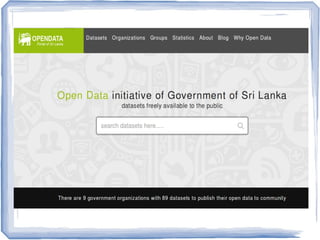
Open DataOpen Data
Open Data
Big DataBig Data
●
Facebook is one of big data's biggest 
champions, and it claims to operate the largest 
single Big Data clusters anywhere, with more 
than 100 petabytes of disk space
●
The site stores more than 250 billion photos, 
with 350 million new ones uploaded every day
●
Uses Hadoop, Hive and Hbase as the core 
technologies in the back end
A new generation of technologies and 
architectures, designed to economically 
extract VALUE from very large VOLUMES of a 
wide variety of data by enabling high­
VELOCITY capture, discovery, and/or analysis.
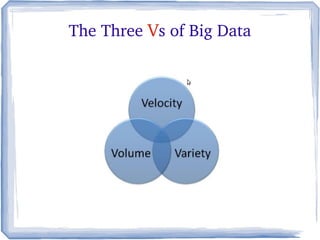
The Three Vs of Big Data
●
Volume – Big
●
Variety – From different sources and types
●
Velocity – Frequency of its generation: how  
quickly the data arrives and is stored, and how 
quickly it can be retrieved
The Three Vs of Big Data
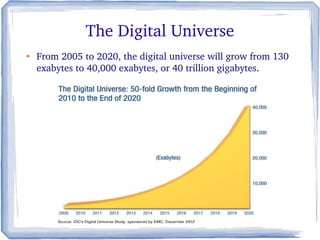
The Digital Universe
● From 2005 to 2020, the digital universe will grow from 130 
exabytes to 40,000 exabytes, or 40 trillion gigabytes. 
According to IDC,  the Big Data technology and service market was about 
US$4.8 billion in 2011. The market is projected to grow at a compound annual 
growth rate (CAGR) of 37.2% between 2011 and 2015. 
By 2015, the market size is expected to be US$16.9 billion.
[Source: IDC. Worldwide Big Data Technology and Services 2012­2015 Forecast.]
Gartner reported that more than 65 billion devices were connected 
to the internet by 2010. By 2020, this number will go up to 230 billion
[Source: https://www.gartner.com/doc/1799626]
●
Over a history that spans more than 30 years, SQL 
database servers have traditionally held gigabytes of  
information — and reaching that milestone took a 
long time. 
●
In the past 15 years, data warehouses and enterprise 
analytics expanded these volumes to terabytes. 
●
And in the last 5 years, the distributed file systems 
that store Big Data now routinely house petabytes of 
information. 
The Statistics
p
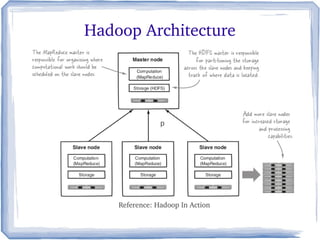
Reference: Hadoop In Action 
Hadoop Architecture
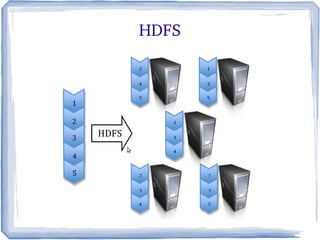
HDFS
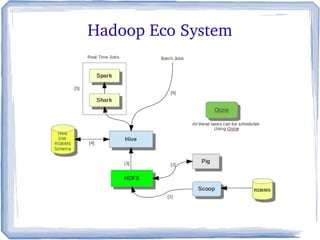
Hadoop Eco System
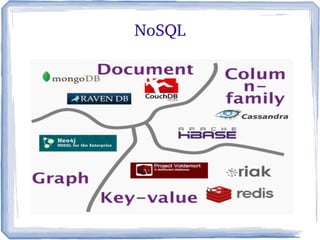
NoSQL
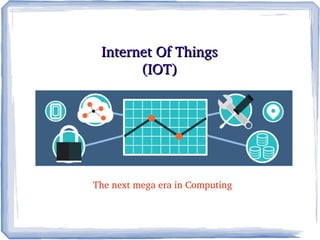
Internet Of ThingsInternet Of Things
(IOT)(IOT)
The next mega era in Computing
IoT  is  a  network  of  uniquely  identifiable 
endpoints/objects  that  communicate  using  IP 
connectivity without human interaction.
Here, all the objects will be “on­line” and ready 
to serve you automatically.
(World Wide IOT Taxonomy, 2015 ­ IDC)
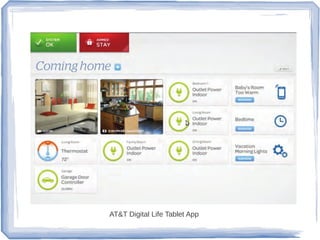
AT&T Digital Life Tablet App
●
A number of important technology changes 
have coincided to enable the rise of the IOT, 
– including cheap sensors, 
– inexpensive bandwidth, 
– cheap processing, 
– smart phones, 
– wireless coverage, 
– big data, 
– open­source technology, 
– IPv6 
●
The worldwide IoT market will grow from 
$655.8 billion in 2014 to $1.7 trillion in 2020  
(IDC).
●
Today 43% of world wide IoT revenue comes 
from manufacturing, transportation and smart 
cities
●
Within next 5 years all industries should come 
up with a business plan for an IoT initiative
●
By 2018, 60% of IT solutions will be “Open 
Sourced” allowing IoT markets to form
Because Open Sourced products are
– Open 
– No vendor locking
– Better Community based development, which is 
good for complex systems like IoT
– Most Big Data options are open source.
Thank YouThank You

Modern Trends in IT