Data Vault Fundamentals &
Best Practices
1
Erik Fransen, managingconsultant
+31 6 159 444 76
@erikfransen
Agenda
• Introduction
• Data Vault Basics
• Benefits & Challenges
• Best practices: Automation & Data
Virtualization
• Recommended reading
2
• Founded in 1998, The Hague, NL
• 40+ consultants
• Business Intelligence, Data Vault, Datawarehousing,
Datawarehouse Automation, Big Data, Data Virtualization
• Business & technical consultancy, end-to-end
implementation projects of Data Vault EDW, audits,
training, certification
• Wide range of customers (profit, non-profit) across various
industries
• Since 2009 Genesee Academy partner for Data Vault Day
and Data Vault Certification in NL, B & D
• Implementation partner of Cisco, MapR, Qlik & Tableau
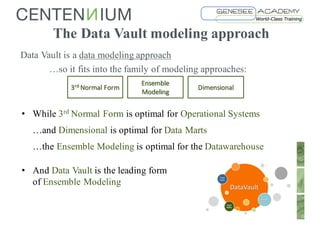
The Data Vault modeling approach
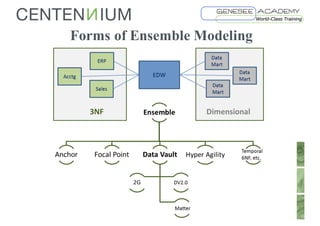
Data Vault is a data modeling approach
…so it fits into the family of modeling approaches:
4
3rd Normal	Form
Ensemble	
Modeling
Dimensional
• While 3rd Normal Form is optimal for Operational Systems
…and Dimensional is optimal for Data Marts
…the Ensemble Modeling is optimal for the Datawarehouse
• And Data Vault is the leading form
of Ensemble Modeling
Forms of Ensemble Modeling
5
Why do we use Data Vault for DWH?
6
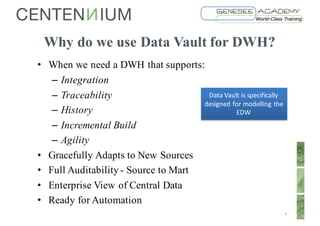
• When we need a DWH that supports:
– Integration
– Traceability
– History
– Incremental Build
– Agility
• Gracefully Adapts to New Sources
• Full Auditability - Source to Mart
• Enterprise View of Central Data
• Ready for Automation
Data	Vault is	specifically
designed for modelling the	
EDW
The Data Vault Ensemble
7
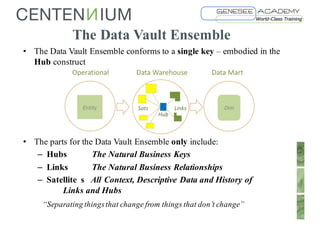
• The Data Vault Ensemble conforms to a single key – embodied in the
Hub construct
• The parts for the Data Vault Ensemble only include:
– Hubs The Natural Business Keys
– Links The Natural Business Relationships
– Satellite s All Context, Descriptive Data and History of
Links and Hubs
“Separating thingsthat change from things that don’t change”
The Data Vault modeling approach
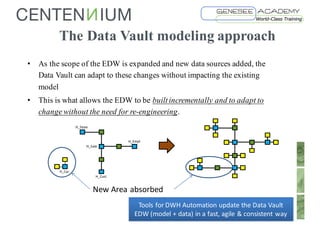
• As the scope of the EDW is expanded and new data sources added, the
Data Vault can adapt to these changes without impacting the existing
model
• This is what allows the EDW to be built incrementally and to adapt to
change without the need for re-engineering.
New	Area	absorbed
8
H_Cust
H_Sale
H_Empl
H_Store
H_Car
Tools	for DWH	Automation	update	the	Data	Vault
EDW	(model	+	data)	in	a	fast,	agile	&	consistent	way
• Business benefits
• Ability to adapt quickly to new business needs
• Data is traceable allowing for a fully auditable, integrated data store
• Allows the EDW to absorb all data all of the time
• Easily adapts to new data sources and changing business rules – without expensive re-
engineering
• Results in an Data Warehouse with lower total cost of ownership (TCO)
• Automation: short time to market, consist quality
• Project/development benefits
• Ideal for agile development techniques resulting in lower project risk and more
frequent deliverables
• Can be built incrementally without compromising the core architecture
• Automation: fast and incremental sprints, predictable costs
• Architectural benefits
• Parallel loading
• Data architecture that supports future expanded scope
• Can scale to virtually any size
• Ready for Automation: forces standardization
Data Vault Benefits
9
Data Vault Modeling Process
The Modeling Process for creating a Data Vault
model includes three primary steps:
1) Identify and Model the Core Business Concepts
• Business Interviews is at the heart of this step
What do you do? What are the main things you work with?
• Also find best/target Natural Business Key
2) Identify and Model the Natural Business Relationships
• Specific Unique Relationships
3) Analyze and Design the Context Satellites
• Consider Rate of Change, Type of Data and also the Sources of
your data during design process
10
Ideally	the	data	vault	is	modelled	based	
on	business	processes	and	business	
concepts
Getting data out of the Data Vault
• Problem:
– The Data Vault EDW is about data decomposition, data
registration and data integration
– Data Vault is not intended, nor designed or optimized for
data distribution and data consumption downstream the
EDW
– Leads typically to many complex physical data marts (high
maintenance, high cost)
• Solution:
– Start thinking differently: focus on creating functional data
products for the business
– Stop loading and replicating data physically, start using
data virtualization
11
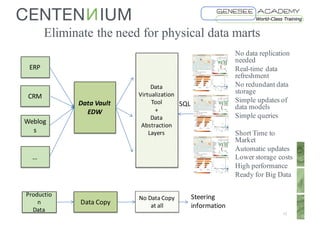
Eliminate the need for physical data marts
No data replication
needed
Real-time data
refreshment
No redundant data
storage
Simple updates of
data models
Simple queries
Short Time to
Market
Automatic updates
Lower storage costs
High performance
Ready for Big Data
Data	Vault
EDW
CRM
ERP
Weblog
s
…
Productio
n
Data
Data	Copy
Steering
information
SQL
Data	
Virtualization
Tool
+	
Data	
Abstraction
Layers
No	Data	Copy	
at	all
12
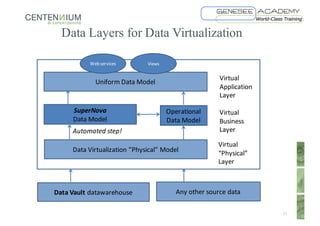
Virtual
13
SuperNova
Data	Model
Operational
Data	Model
Uniform	Data	Model
Data	Virtualization ”Physical”	Model
Virtual
Application	
Layer
Virtual
“Physical”	
Layer
Virtual
Business	
Layer
Web	services Views
Any other source	data	
Data Layers for Data Virtualization
Data	Vault datawarehouse
Automated step!
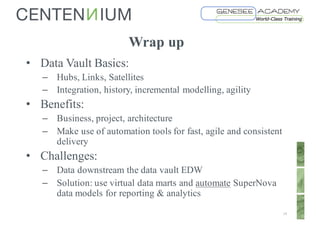
Wrap up
• Data Vault Basics:
– Hubs, Links, Satellites
– Integration, history, incremental modelling, agility
• Benefits:
– Business, project, architecture
– Make use of automation tools for fast, agile and consistent
delivery
• Challenges:
– Data downstream the data vault EDW
– Solution: use virtual data marts and automate SuperNova
data models for reporting & analytics
14
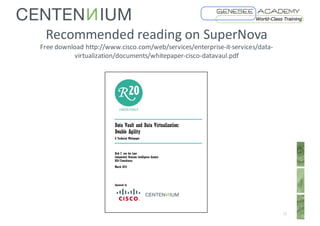
Recommended	reading on	SuperNova
Free	download	http://www.cisco.com/web/services/enterprise-it-services/data-
virtualization/documents/whitepaper-cisco-datavaul.pdf
15
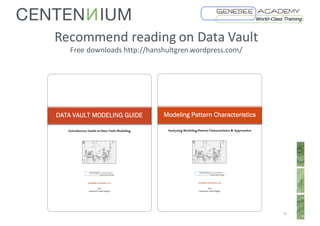
Recommend	reading	on	Data	Vault
Free	downloads	http://hanshultgren.wordpress.com/
16
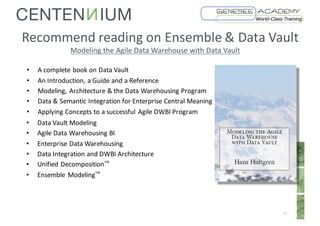
Recommend	reading	on	Ensemble	&	Data	Vault
Modeling	the	Agile	Data	Warehouse	with	Data	Vault	
• Data	Vault	Modeling
• Agile	Data	Warehousing	BI
• Enterprise	Data	Warehousing
• Data	Integration	and	DWBI	Architecture
• Unified	Decomposition™
• Ensemble	Modeling™
• A	complete	book	on	Data	Vault
• An	Introduction,	a	Guide	and	a	Reference
• Modeling,	Architecture	&	the	Data	Warehousing	Program	
• Data	&	Semantic	Integration	for	Enterprise	Central	Meaning
• Applying	Concepts	to	a	successful	Agile	DWBI	Program
17
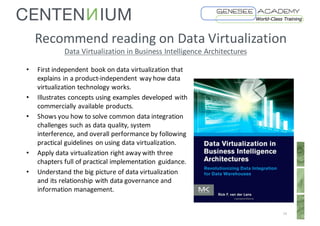
Recommend	reading	on	Data	Virtualization
Data	Virtualization	in	Business	Intelligence	Architectures
• First	independent	book on	data	virtualization that
explains in	a	product-independent	way	how data	
virtualization technology works.
• Illustrates concepts using examples developed with
commercially available products.
• Shows	you how to solve common	data	integration
challenges such as	data	quality,	system	
interference,	and overall	performance	by following
practical	guidelines on	using data	virtualization.
• Apply data	virtualization right	away with three
chapters full	of	practical	implementation guidance.
• Understand	the	big	picture	of	data	virtualization
and its relationship with data	governance and
information	management.
18
Data Vault Training & Certification
• CDVDM: March 31, April 1 2016 Amsterdam
• DVD: March 2, 2016 Diegem
• www.centennium-opleidingen.nl
• For all questions: opleidingen@centennium.nl
19
A short history on Data Vault
• 2002: First papers published by Dan Linstedt
• 2006: Start CDVDM certification program by Genesee
Academy
• 2007: Start of Data Vault EDW implementations
– Primarily in Europe (NL, S), some in USA
• 2008-2015: Several books published on DataVault by Dan
Linstedt, Hans Hultgren and others
• 2013: Data Vault on the radar in B, DACH, UK, USA, AUS,
NZ, Asia
• 2013: Data Vault EDW implementations going worldwide
• 2015: Over 900 CDVDM professionals and 750+ Data Vault
EDW worldwide
20

Data Vault Introduction

  • 1.
    Data Vault Fundamentals& Best Practices 1 Erik Fransen, managingconsultant +31 6 159 444 76 @erikfransen
  • 2.
    Agenda • Introduction • DataVault Basics • Benefits & Challenges • Best practices: Automation & Data Virtualization • Recommended reading 2
  • 3.
    • Founded in1998, The Hague, NL • 40+ consultants • Business Intelligence, Data Vault, Datawarehousing, Datawarehouse Automation, Big Data, Data Virtualization • Business & technical consultancy, end-to-end implementation projects of Data Vault EDW, audits, training, certification • Wide range of customers (profit, non-profit) across various industries • Since 2009 Genesee Academy partner for Data Vault Day and Data Vault Certification in NL, B & D • Implementation partner of Cisco, MapR, Qlik & Tableau
  • 4.
    The Data Vaultmodeling approach Data Vault is a data modeling approach …so it fits into the family of modeling approaches: 4 3rd Normal Form Ensemble Modeling Dimensional • While 3rd Normal Form is optimal for Operational Systems …and Dimensional is optimal for Data Marts …the Ensemble Modeling is optimal for the Datawarehouse • And Data Vault is the leading form of Ensemble Modeling
  • 5.
  • 6.
    Why do weuse Data Vault for DWH? 6 • When we need a DWH that supports: – Integration – Traceability – History – Incremental Build – Agility • Gracefully Adapts to New Sources • Full Auditability - Source to Mart • Enterprise View of Central Data • Ready for Automation Data Vault is specifically designed for modelling the EDW
  • 7.
    The Data VaultEnsemble 7 • The Data Vault Ensemble conforms to a single key – embodied in the Hub construct • The parts for the Data Vault Ensemble only include: – Hubs The Natural Business Keys – Links The Natural Business Relationships – Satellite s All Context, Descriptive Data and History of Links and Hubs “Separating thingsthat change from things that don’t change”
  • 8.
    The Data Vaultmodeling approach • As the scope of the EDW is expanded and new data sources added, the Data Vault can adapt to these changes without impacting the existing model • This is what allows the EDW to be built incrementally and to adapt to change without the need for re-engineering. New Area absorbed 8 H_Cust H_Sale H_Empl H_Store H_Car Tools for DWH Automation update the Data Vault EDW (model + data) in a fast, agile & consistent way
  • 9.
    • Business benefits •Ability to adapt quickly to new business needs • Data is traceable allowing for a fully auditable, integrated data store • Allows the EDW to absorb all data all of the time • Easily adapts to new data sources and changing business rules – without expensive re- engineering • Results in an Data Warehouse with lower total cost of ownership (TCO) • Automation: short time to market, consist quality • Project/development benefits • Ideal for agile development techniques resulting in lower project risk and more frequent deliverables • Can be built incrementally without compromising the core architecture • Automation: fast and incremental sprints, predictable costs • Architectural benefits • Parallel loading • Data architecture that supports future expanded scope • Can scale to virtually any size • Ready for Automation: forces standardization Data Vault Benefits 9
  • 10.
    Data Vault ModelingProcess The Modeling Process for creating a Data Vault model includes three primary steps: 1) Identify and Model the Core Business Concepts • Business Interviews is at the heart of this step What do you do? What are the main things you work with? • Also find best/target Natural Business Key 2) Identify and Model the Natural Business Relationships • Specific Unique Relationships 3) Analyze and Design the Context Satellites • Consider Rate of Change, Type of Data and also the Sources of your data during design process 10 Ideally the data vault is modelled based on business processes and business concepts
  • 11.
    Getting data outof the Data Vault • Problem: – The Data Vault EDW is about data decomposition, data registration and data integration – Data Vault is not intended, nor designed or optimized for data distribution and data consumption downstream the EDW – Leads typically to many complex physical data marts (high maintenance, high cost) • Solution: – Start thinking differently: focus on creating functional data products for the business – Stop loading and replicating data physically, start using data virtualization 11
  • 12.
    Eliminate the needfor physical data marts No data replication needed Real-time data refreshment No redundant data storage Simple updates of data models Simple queries Short Time to Market Automatic updates Lower storage costs High performance Ready for Big Data Data Vault EDW CRM ERP Weblog s … Productio n Data Data Copy Steering information SQL Data Virtualization Tool + Data Abstraction Layers No Data Copy at all 12
  • 13.
  • 14.
    Wrap up • DataVault Basics: – Hubs, Links, Satellites – Integration, history, incremental modelling, agility • Benefits: – Business, project, architecture – Make use of automation tools for fast, agile and consistent delivery • Challenges: – Data downstream the data vault EDW – Solution: use virtual data marts and automate SuperNova data models for reporting & analytics 14
  • 15.
  • 16.
  • 17.
    Recommend reading on Ensemble & Data Vault Modeling the Agile Data Warehouse with Data Vault • Data Vault Modeling • Agile Data Warehousing BI •Enterprise Data Warehousing • Data Integration and DWBI Architecture • Unified Decomposition™ • Ensemble Modeling™ • A complete book on Data Vault • An Introduction, a Guide and a Reference • Modeling, Architecture & the Data Warehousing Program • Data & Semantic Integration for Enterprise Central Meaning • Applying Concepts to a successful Agile DWBI Program 17
  • 18.
    Recommend reading on Data Virtualization Data Virtualization in Business Intelligence Architectures • First independent book on data virtualizationthat explains in a product-independent way how data virtualization technology works. • Illustrates concepts using examples developed with commercially available products. • Shows you how to solve common data integration challenges such as data quality, system interference, and overall performance by following practical guidelines on using data virtualization. • Apply data virtualization right away with three chapters full of practical implementation guidance. • Understand the big picture of data virtualization and its relationship with data governance and information management. 18
  • 19.
    Data Vault Training& Certification • CDVDM: March 31, April 1 2016 Amsterdam • DVD: March 2, 2016 Diegem • www.centennium-opleidingen.nl • For all questions: opleidingen@centennium.nl 19
  • 20.
    A short historyon Data Vault • 2002: First papers published by Dan Linstedt • 2006: Start CDVDM certification program by Genesee Academy • 2007: Start of Data Vault EDW implementations – Primarily in Europe (NL, S), some in USA • 2008-2015: Several books published on DataVault by Dan Linstedt, Hans Hultgren and others • 2013: Data Vault on the radar in B, DACH, UK, USA, AUS, NZ, Asia • 2013: Data Vault EDW implementations going worldwide • 2015: Over 900 CDVDM professionals and 750+ Data Vault EDW worldwide 20