GOOD DAY EVERYONE
SPEAKER’S
Ambutong Albasir
Reel , Eguia
Abarri farrah
Gasfar mohammad nur
Moneral carryl f.
Ferrer jenice
Hadjihil nurhaifa
CLEAN-UP REQUIREMENTS FOR
DRAWING TYPES OF
MODEL SHEETS
OBJECTIVES
At the end of the lesson students should be able to:
Identify and differentiate the types of model sheets
Define what is model sheets
Apply his/her knowledge to ensure consistency and quality in character design
CLEAN-UP
•Is a part of the workflow in the production
of hand-drawn animation.
•In traditional animation, the first drawing
are called “roughs” or “raffs” animation.
REQUIREMENTS FOR THE CLEAN-UP DRAWINGS
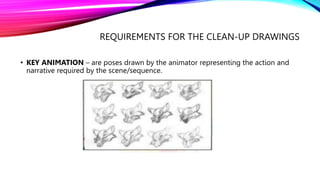
• KEY ANIMATION – are poses drawn by the animator representing the action and
narrative required by the scene/sequence.
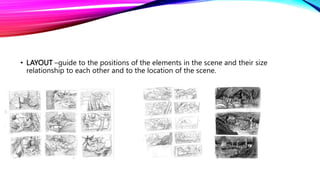
• LAYOUT –guide to the positions of the elements in the scene and their size
relationship to each other and to the location of the scene.
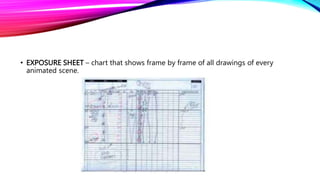
• EXPOSURE SHEET – chart that shows frame by frame of all drawings of every
animated scene.
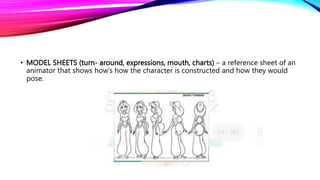
• MODEL SHEETS (turn- around, expressions, mouth, charts) – a reference sheet of an
animator that shows how’s how the character is constructed and how they would
pose.
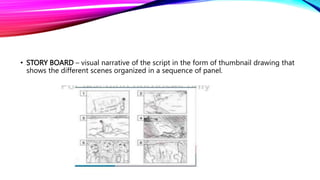
• STORY BOARD – visual narrative of the script in the form of thumbnail drawing that
shows the different scenes organized in a sequence of panel.
COLLECTING ALL RELEVANT MODEL SHEETS
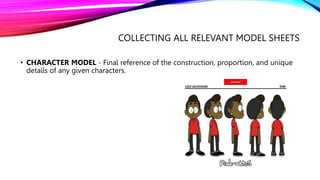
• CHARACTER MODEL - Final reference of the construction, proportion, and unique
details of any given characters.
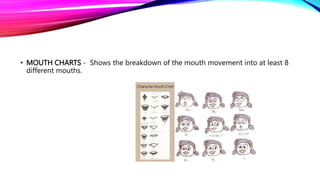
• MOUTH CHARTS - Shows the breakdown of the mouth movement into at least 8
different mouths.
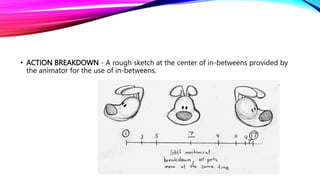
• ACTION BREAKDOWN - A rough sketch at the center of in-betweens provided by
the animator for the use of in-betweens.
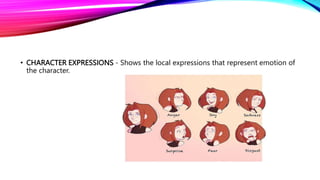
• CHARACTER EXPRESSIONS - Shows the local expressions that represent emotion of
the character.
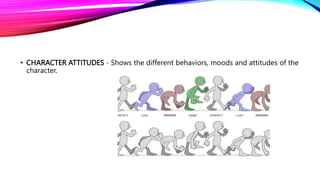
• CHARACTER ATTITUDES - Shows the different behaviors, moods and attitudes of the
character.
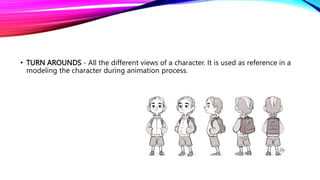
• TURN AROUNDS - All the different views of a character. It is used as reference in a
modeling the character during animation process.
TYPES OF MODEL SHEETS
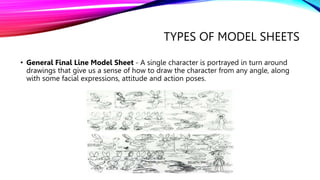
• General Final Line Model Sheet - A single character is portrayed in turn around
drawings that give us a sense of how to draw the character from any angle, along
with some facial expressions, attitude and action poses.
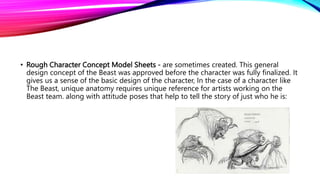
• Rough Character Concept Model Sheets - are sometimes created. This general
design concept of the Beast was approved before the character was fully finalized. It
gives us a sense of the basic design of the character, In the case of a character like
The Beast, unique anatomy requires unique reference for artists working on the
Beast team. along with attitude poses that help to tell the story of just who he is:
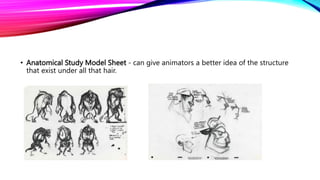
• Anatomical Study Model Sheet - can give animators a better idea of the structure
that exist under all that hair.
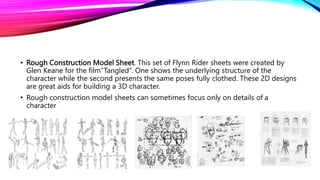
• Rough Construction Model Sheet. This set of Flynn Rider sheets were created by
Glen Keane for the film”Tangled”. One shows the underlying structure of the
character while the second presents the same poses fully clothed. These 2D designs
are great aids for building a 3D character.
• Rough construction model sheets can sometimes focus only on details of a
character
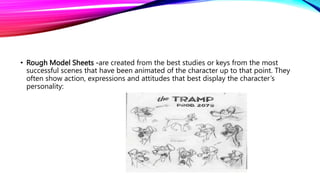
• Rough Model Sheets -are created from the best studies or keys from the most
successful scenes that have been animated of the character up to that point. They
often show action, expressions and attitudes that best display the character’s
personality:
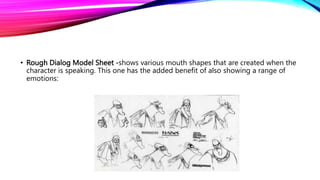
• Rough Dialog Model Sheet -shows various mouth shapes that are created when the
character is speaking. This one has the added benefit of also showing a range of
emotions:
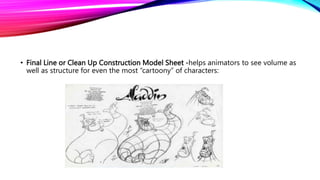
• Final Line or Clean Up Construction Model Sheet -helps animators to see volume as
well as structure for even the most “cartoony” of characters:
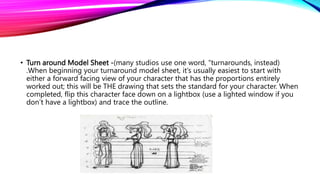
• Turn around Model Sheet -(many studios use one word, “turnarounds, instead)
.When beginning your turnaround model sheet, it’s usually easiest to start with
either a forward facing view of your character that has the proportions entirely
worked out; this will be THE drawing that sets the standard for your character. When
completed, flip this character face down on a lightbox (use a lighted window if you
don’t have a lightbox) and trace the outline.
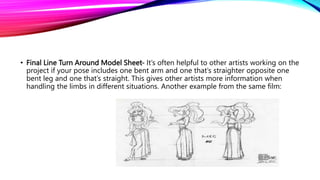
• Final Line Turn Around Model Sheet- It’s often helpful to other artists working on the
project if your pose includes one bent arm and one that’s straighter opposite one
bent leg and one that’s straight. This gives other artists more information when
handling the limbs in different situations. Another example from the same film:
THANK YOU

ICT-4-TYPES-OF-MODEL-SHEETS.pptx.........

  • 1.
  • 2.
    SPEAKER’S Ambutong Albasir Reel ,Eguia Abarri farrah Gasfar mohammad nur Moneral carryl f. Ferrer jenice Hadjihil nurhaifa
  • 3.
    CLEAN-UP REQUIREMENTS FOR DRAWINGTYPES OF MODEL SHEETS
  • 4.
    OBJECTIVES At the endof the lesson students should be able to: Identify and differentiate the types of model sheets Define what is model sheets Apply his/her knowledge to ensure consistency and quality in character design
  • 5.
    CLEAN-UP •Is a partof the workflow in the production of hand-drawn animation. •In traditional animation, the first drawing are called “roughs” or “raffs” animation.
  • 6.
    REQUIREMENTS FOR THECLEAN-UP DRAWINGS • KEY ANIMATION – are poses drawn by the animator representing the action and narrative required by the scene/sequence.
  • 7.
    • LAYOUT –guideto the positions of the elements in the scene and their size relationship to each other and to the location of the scene.
  • 8.
    • EXPOSURE SHEET– chart that shows frame by frame of all drawings of every animated scene.
  • 9.
    • MODEL SHEETS(turn- around, expressions, mouth, charts) – a reference sheet of an animator that shows how’s how the character is constructed and how they would pose.
  • 10.
    • STORY BOARD– visual narrative of the script in the form of thumbnail drawing that shows the different scenes organized in a sequence of panel.
  • 11.
    COLLECTING ALL RELEVANTMODEL SHEETS • CHARACTER MODEL - Final reference of the construction, proportion, and unique details of any given characters.
  • 12.
    • MOUTH CHARTS- Shows the breakdown of the mouth movement into at least 8 different mouths.
  • 13.
    • ACTION BREAKDOWN- A rough sketch at the center of in-betweens provided by the animator for the use of in-betweens.
  • 14.
    • CHARACTER EXPRESSIONS- Shows the local expressions that represent emotion of the character.
  • 15.
    • CHARACTER ATTITUDES- Shows the different behaviors, moods and attitudes of the character.
  • 16.
    • TURN AROUNDS- All the different views of a character. It is used as reference in a modeling the character during animation process.
  • 17.
    TYPES OF MODELSHEETS • General Final Line Model Sheet - A single character is portrayed in turn around drawings that give us a sense of how to draw the character from any angle, along with some facial expressions, attitude and action poses.
  • 18.
    • Rough CharacterConcept Model Sheets - are sometimes created. This general design concept of the Beast was approved before the character was fully finalized. It gives us a sense of the basic design of the character, In the case of a character like The Beast, unique anatomy requires unique reference for artists working on the Beast team. along with attitude poses that help to tell the story of just who he is:
  • 19.
    • Anatomical StudyModel Sheet - can give animators a better idea of the structure that exist under all that hair.
  • 20.
    • Rough ConstructionModel Sheet. This set of Flynn Rider sheets were created by Glen Keane for the film”Tangled”. One shows the underlying structure of the character while the second presents the same poses fully clothed. These 2D designs are great aids for building a 3D character. • Rough construction model sheets can sometimes focus only on details of a character
  • 21.
    • Rough ModelSheets -are created from the best studies or keys from the most successful scenes that have been animated of the character up to that point. They often show action, expressions and attitudes that best display the character’s personality:
  • 22.
    • Rough DialogModel Sheet -shows various mouth shapes that are created when the character is speaking. This one has the added benefit of also showing a range of emotions:
  • 23.
    • Final Lineor Clean Up Construction Model Sheet -helps animators to see volume as well as structure for even the most “cartoony” of characters:
  • 24.
    • Turn aroundModel Sheet -(many studios use one word, “turnarounds, instead) .When beginning your turnaround model sheet, it’s usually easiest to start with either a forward facing view of your character that has the proportions entirely worked out; this will be THE drawing that sets the standard for your character. When completed, flip this character face down on a lightbox (use a lighted window if you don’t have a lightbox) and trace the outline.
  • 25.
    • Final LineTurn Around Model Sheet- It’s often helpful to other artists working on the project if your pose includes one bent arm and one that’s straighter opposite one bent leg and one that’s straight. This gives other artists more information when handling the limbs in different situations. Another example from the same film:
  • 26.