Downloaded 10 times


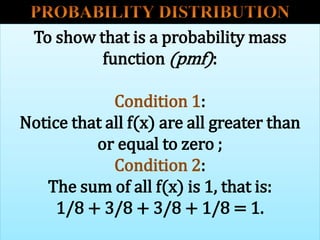
![If X is a random variable, the function given by
f(x) = P [ X = x ] for each X within the range of X is called
the probability mass function (pmf ) of X.
A function can serve as probability mass function of a
discrete random variable X if and only if its values f(x),
satisfies the following conditions:
1. f(x) 0 for all values of x;
2. of all f(x) is equal to 1.](https://image.slidesharecdn.com/ictlesson4-130911015026-phpapp01/85/Ict-lesson-4-random-variables-5-320.jpg)
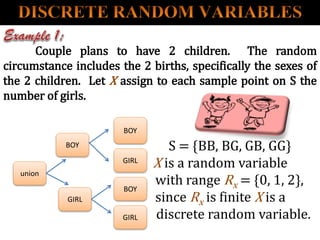
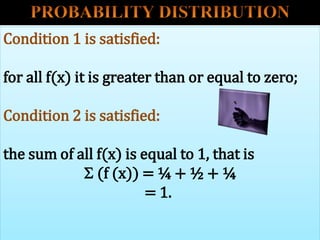
![Referring to example # 2.
The experiment on the plan of the couple who wanted
to have two children. There are 6 possible outcomes
belonging to the sample space S. Let X assign to each sample
point on S the number of girls.
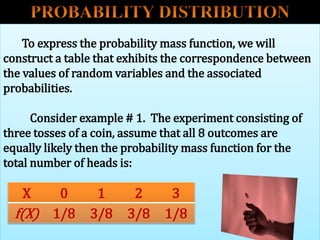
X is a random variable defined by a function f(x) = P [
X =x ], thus it would be a (pmf) such that:
x 0 1 2
f(x) ¼ ½ ¼](https://image.slidesharecdn.com/ictlesson4-130911015026-phpapp01/85/Ict-lesson-4-random-variables-8-320.jpg)


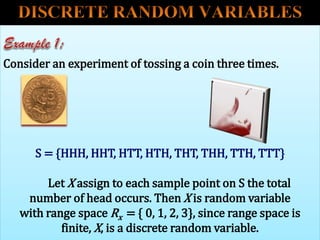
A random variable assigns a numerical value to each outcome of a random experiment. It can be discrete or continuous depending on the values it can take. A discrete random variable takes on countable values like the number of heads in a coin toss, while a continuous variable can take any value in an interval like height. The probability mass function (pmf) of a discrete random variable gives the probability of each possible value and must be non-negative and sum to 1. Examples show how to construct pmfs for different experiments and verify they satisfy the conditions.


