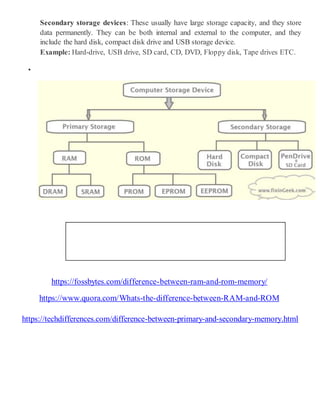
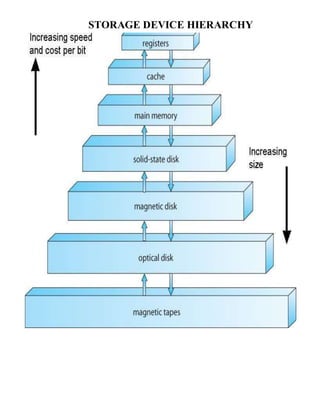
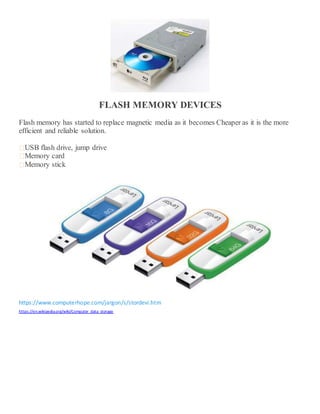
The document discusses computer storage devices. It defines primary storage devices as smaller and designed to hold data temporarily within the computer, such as RAM and cache memory. Secondary storage devices are larger capacity devices that store data permanently, both internally and externally, such as hard disks, USB drives, SD cards, CDs, DVDs, and tape drives. The document provides examples of different types of storage devices, including magnetic, optical, and flash memory, and discusses the differences between RAM and ROM. It includes multiple choice questions to test understanding of storage device terminology and functions.