ICN Publish/Subscribe Networking
Junxiao Shi
2012-04-26
Paper
Antonio Carzaniga, Michele Papalini, and Alexander L.
Wolf. 2011. Content-based publish/subscribe
networking and information-centric networking. In
Proceedings of the ACM SIGCOMM workshop on
Information-centric networking (ICN '11). ACM, New
York, NY, USA, 56-61.
DOI=10.1145/2018584.2018599
http://doi.acm.org/10.1145/2018584.2018599
Table of Contents
● Publish/Subscribe Event Notification
● It's different from On-Demand Content
Delivery primitive
● Unified Content-based Network Layer
● To support both primitives
● The New Node Model
● To reduce space overhead of PIT
Publish/Subscribe Event Notification
NDN is Receiver-Driven
● On-demand content delivery
● Consumer initiate requests
● Data transmitted in replies
● Good for persistent information
Publish/Subscribe Event Notification
● Producer-driven, push to subscribers
● Tell me when @yoursunny posts a new tweet
● Text ON yoursunny to 40404
● Alert me when it rains in Tucson
● #ifttt
● Sound the alarm when a sensor detects an intrusion
● IP multicast
Pub/Sub on top of On-Demand
● Implementing Publish/Subscribe Event
Notification on top of On-Demand Content
Delivery
● Conceptually feasible
● Lots of problems, not the best technical
solution
Polling the Producer
● The consumer continually issues interests at
regular intervals, and the producer replies with
a “null” packet or an event notification.
● Problems
● States overhead, for only a few effective
transmissions
● Caching cannot be used
Producer-initiated Transmission
● The producer sends an interest that is not
intended to return any data, but carries a
callback prefix or the notification itself
● Problems
● States overhead
● Overloaded use of interests as notifications
Long-Lived Interests
● Keep interests in producer for a long time, reply
when there is a notification
● Long HTTP connection in WebIM
● Problems
● Lock valuable PIT entries for a long time
● Events between last reply and new interest are
lost
They are Different Enough
● It makes little sense to implement one on top of
the other
● Each requires some level of specialized support
in an underlying network fabric
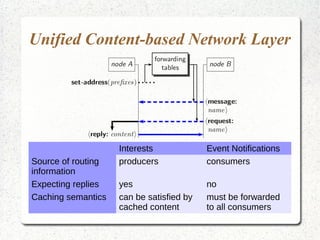
Unified Content-based Network Layer
They have commonality
● Interest: goes to
prefix of producer
● Event notification:
goes to predicate
of consumer
Unified Content-based Network Layer
Interests Event Notifications
Source of routing
information
producers consumers
Expecting replies yes no
Caching semantics can be satisfied by
cached content
must be forwarded
to all consumers
Node Interface and Packet Formats
Forwarding Messages and Requests
● Forwarding is controlled by prefixes + policies
● Forwarding strategy
● Compare names against prefixes at each hop
● Source routing
● Both messages and requests can be forwarded
using exactly the same scheme
Handling Replies
● Flow backward toward consumers
● Soft state (PIT) is still needed
● Negative Replies
● “No such data exist on this path”
● How to reduce the space overhead of PIT?
The New Node Model
The New Node Model
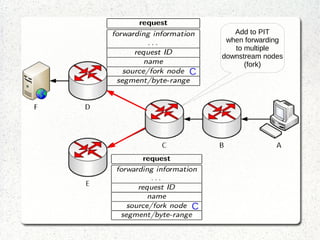
● Create a PIT entry only at the source node of
the request, and wherever a request is
duplicated over two or more downstream paths
(fork)
● Send replies upstream using standard IP
forwarding
A
Add to PIT
on the source
node
A
Don't add to PIT
when forwarding
to a single
downstream path
C
C
Add to PIT
when forwarding
to multiple
downstream nodes
(fork)
C
Don't add to PIT
when forwarding
to a single
downstream path
C
IP
IP
negative reply
A
IP
Is it Evil?
● ICN relies on IP
● Same content may traverse a link multiple times
● Forwarding strategy is limited No PIT entry on B.
Another request of
same name will be
forwarded to C.
C must decide: single downstream, or fork?
C cannot try D first then try E after 2 seconds.

ICN Publish/Subscribe Networking

  • 1.
  • 2.
    Paper Antonio Carzaniga, MichelePapalini, and Alexander L. Wolf. 2011. Content-based publish/subscribe networking and information-centric networking. In Proceedings of the ACM SIGCOMM workshop on Information-centric networking (ICN '11). ACM, New York, NY, USA, 56-61. DOI=10.1145/2018584.2018599 http://doi.acm.org/10.1145/2018584.2018599
  • 3.
    Table of Contents ●Publish/Subscribe Event Notification ● It's different from On-Demand Content Delivery primitive ● Unified Content-based Network Layer ● To support both primitives ● The New Node Model ● To reduce space overhead of PIT
  • 4.
  • 5.
    NDN is Receiver-Driven ●On-demand content delivery ● Consumer initiate requests ● Data transmitted in replies ● Good for persistent information
  • 6.
    Publish/Subscribe Event Notification ●Producer-driven, push to subscribers ● Tell me when @yoursunny posts a new tweet ● Text ON yoursunny to 40404 ● Alert me when it rains in Tucson ● #ifttt ● Sound the alarm when a sensor detects an intrusion ● IP multicast
  • 7.
    Pub/Sub on topof On-Demand ● Implementing Publish/Subscribe Event Notification on top of On-Demand Content Delivery ● Conceptually feasible ● Lots of problems, not the best technical solution
  • 8.
    Polling the Producer ●The consumer continually issues interests at regular intervals, and the producer replies with a “null” packet or an event notification. ● Problems ● States overhead, for only a few effective transmissions ● Caching cannot be used
  • 9.
    Producer-initiated Transmission ● Theproducer sends an interest that is not intended to return any data, but carries a callback prefix or the notification itself ● Problems ● States overhead ● Overloaded use of interests as notifications
  • 10.
    Long-Lived Interests ● Keepinterests in producer for a long time, reply when there is a notification ● Long HTTP connection in WebIM ● Problems ● Lock valuable PIT entries for a long time ● Events between last reply and new interest are lost
  • 11.
    They are DifferentEnough ● It makes little sense to implement one on top of the other ● Each requires some level of specialized support in an underlying network fabric
  • 12.
  • 13.
    They have commonality ●Interest: goes to prefix of producer ● Event notification: goes to predicate of consumer
  • 14.
    Unified Content-based NetworkLayer Interests Event Notifications Source of routing information producers consumers Expecting replies yes no Caching semantics can be satisfied by cached content must be forwarded to all consumers
  • 15.
    Node Interface andPacket Formats
  • 16.
    Forwarding Messages andRequests ● Forwarding is controlled by prefixes + policies ● Forwarding strategy ● Compare names against prefixes at each hop ● Source routing ● Both messages and requests can be forwarded using exactly the same scheme
  • 17.
    Handling Replies ● Flowbackward toward consumers ● Soft state (PIT) is still needed ● Negative Replies ● “No such data exist on this path” ● How to reduce the space overhead of PIT?
  • 18.
  • 19.
    The New NodeModel ● Create a PIT entry only at the source node of the request, and wherever a request is duplicated over two or more downstream paths (fork) ● Send replies upstream using standard IP forwarding
  • 20.
    A Add to PIT onthe source node
  • 21.
    A Don't add toPIT when forwarding to a single downstream path
  • 22.
    C C Add to PIT whenforwarding to multiple downstream nodes (fork)
  • 23.
    C Don't add toPIT when forwarding to a single downstream path
  • 24.
  • 25.
  • 26.
    Is it Evil? ●ICN relies on IP ● Same content may traverse a link multiple times ● Forwarding strategy is limited No PIT entry on B. Another request of same name will be forwarded to C. C must decide: single downstream, or fork? C cannot try D first then try E after 2 seconds.