Using Visuals to convey information  Luís Manuel Borges Gouveia   [email_address] Multimedia Resource Centre Fernando Pessoa University Porto - Portugal  ICEIS 2004 Conference, 14-17 April
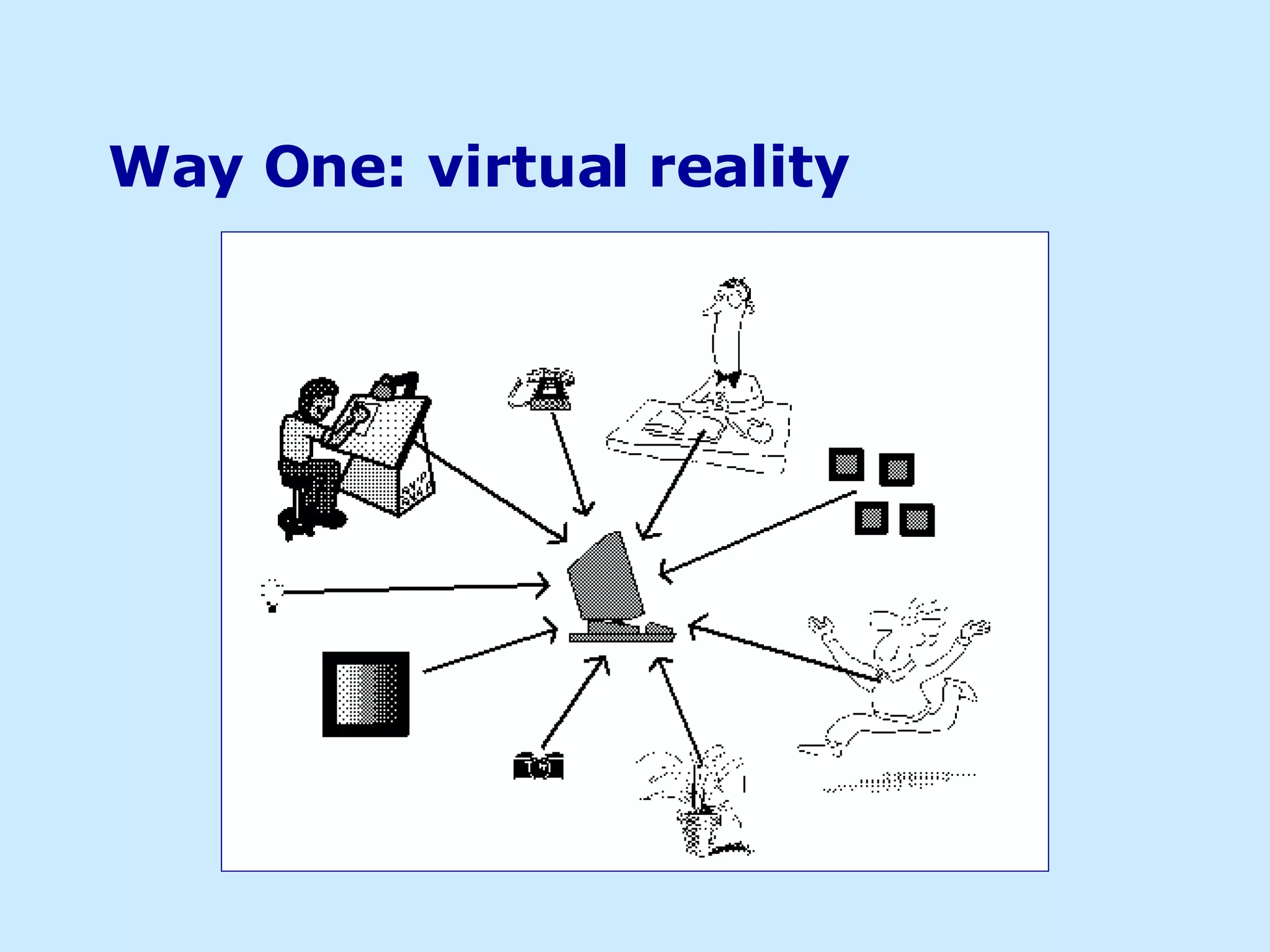
Way One: virtual reality
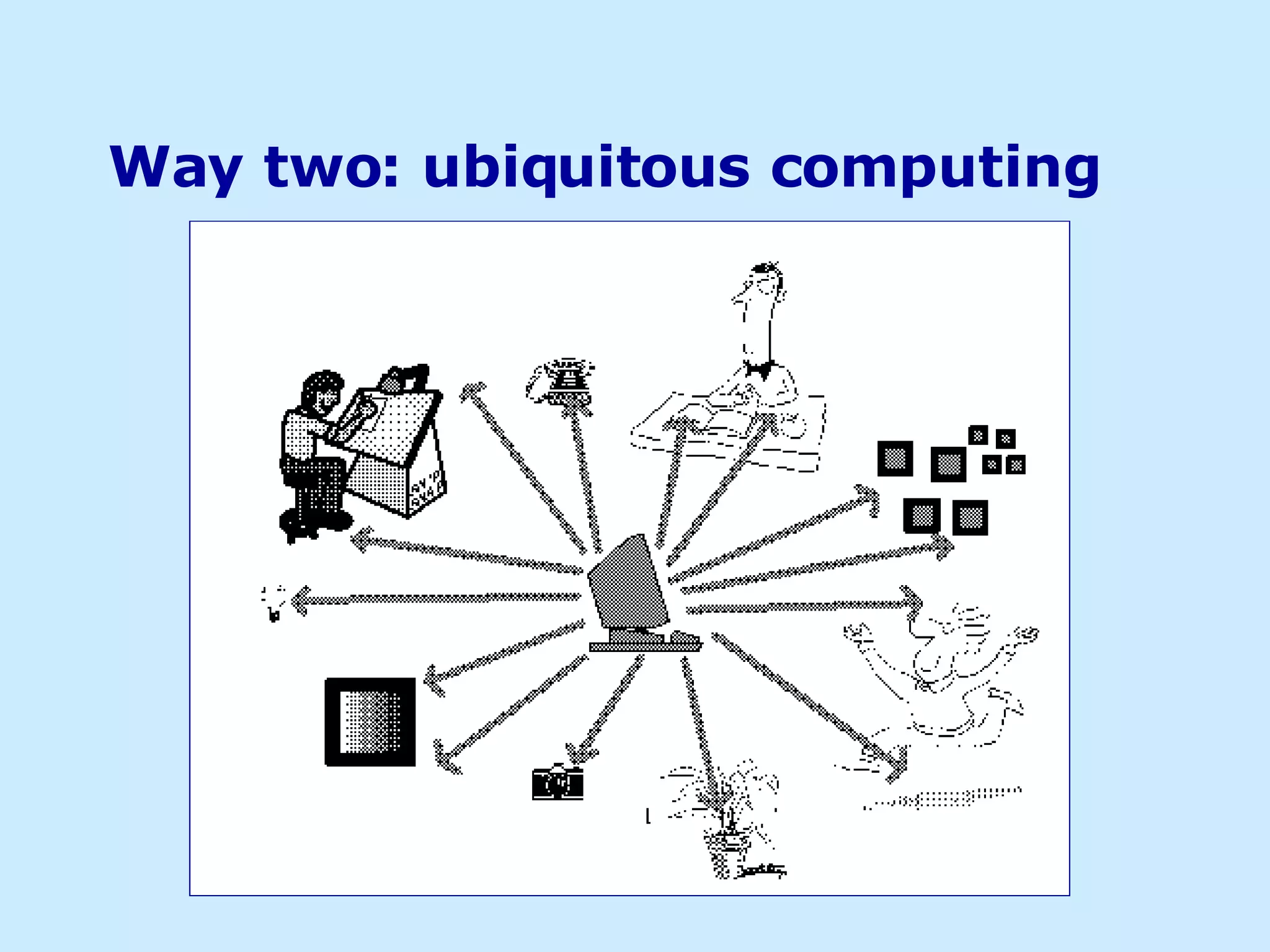
Way two: ubiquitous computing
“ Two way” integration: visualisation definition : use of images and animations to convey information goal  :effectively convey information to the user transforms the abstract and symbolic into the geometric harnesses the human perception system (visual?)
Motivation   different representations can enhance the understanding level of a particular problem [ Tufte ]. the form of representation makes a dramatic difference in the ease of the task [ Norman ]. Norman proposes that external representations, that can be part of a workspace shared with others, require some sort of constructed device to support them: an artefact. is proposed an interface that tries to remove the computer as an object of perception, allowing the user to interact directly with the generated environment as discussed by [ Hubbold et al ].
Example one: using old fashion text Semantic Maps strategy for graphically representing concepts, portraying the schematic relations that compose a concept assumes that there are multiple relations between a concept and the knowledge that is associated with the concept for any concept there are at least these types of associations: class: the order of things the concept falls into; property: the attributes that define the concept; example: exemplars of the concept.
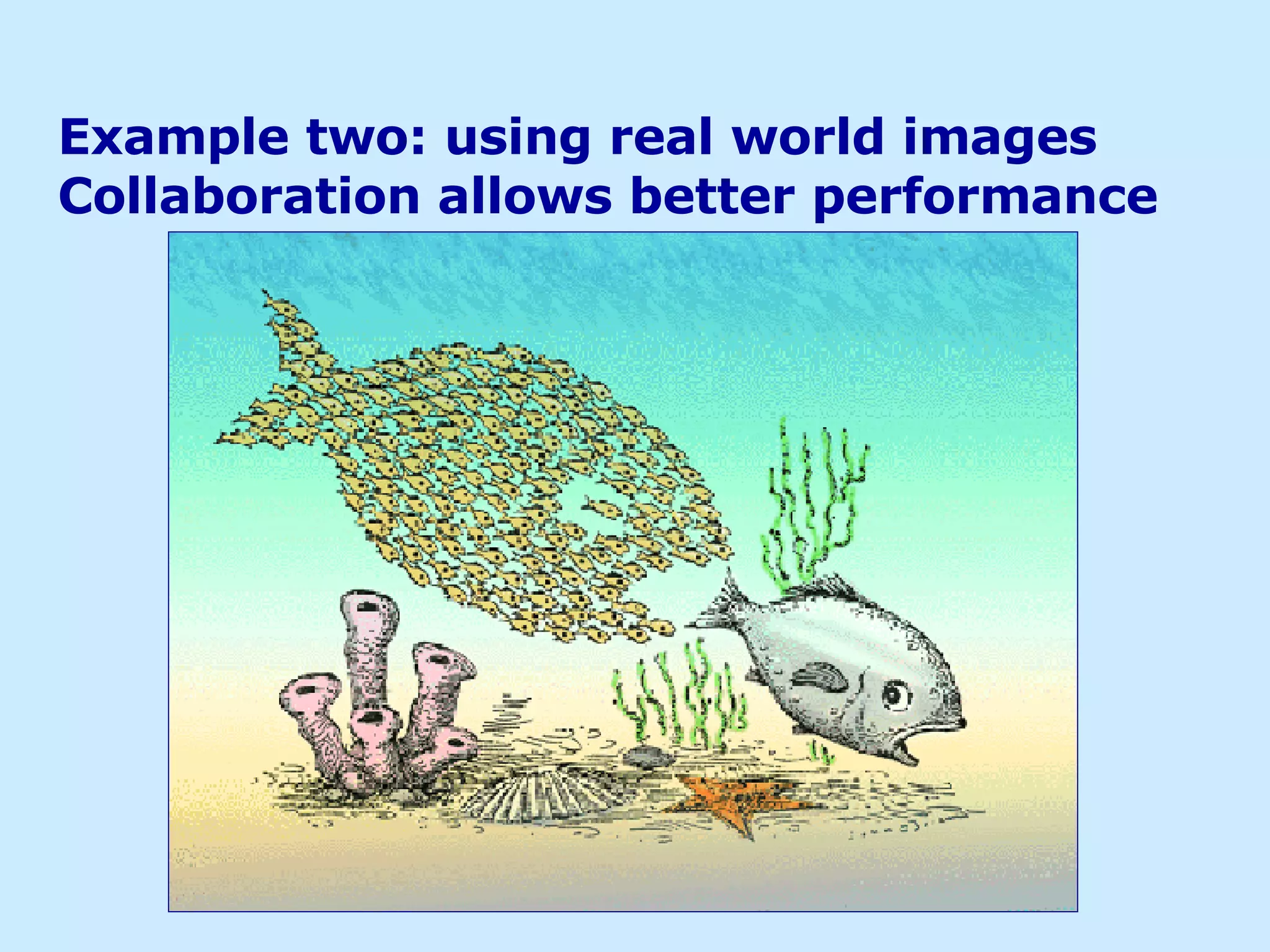
Example two: using real world images Collaboration allows better performance
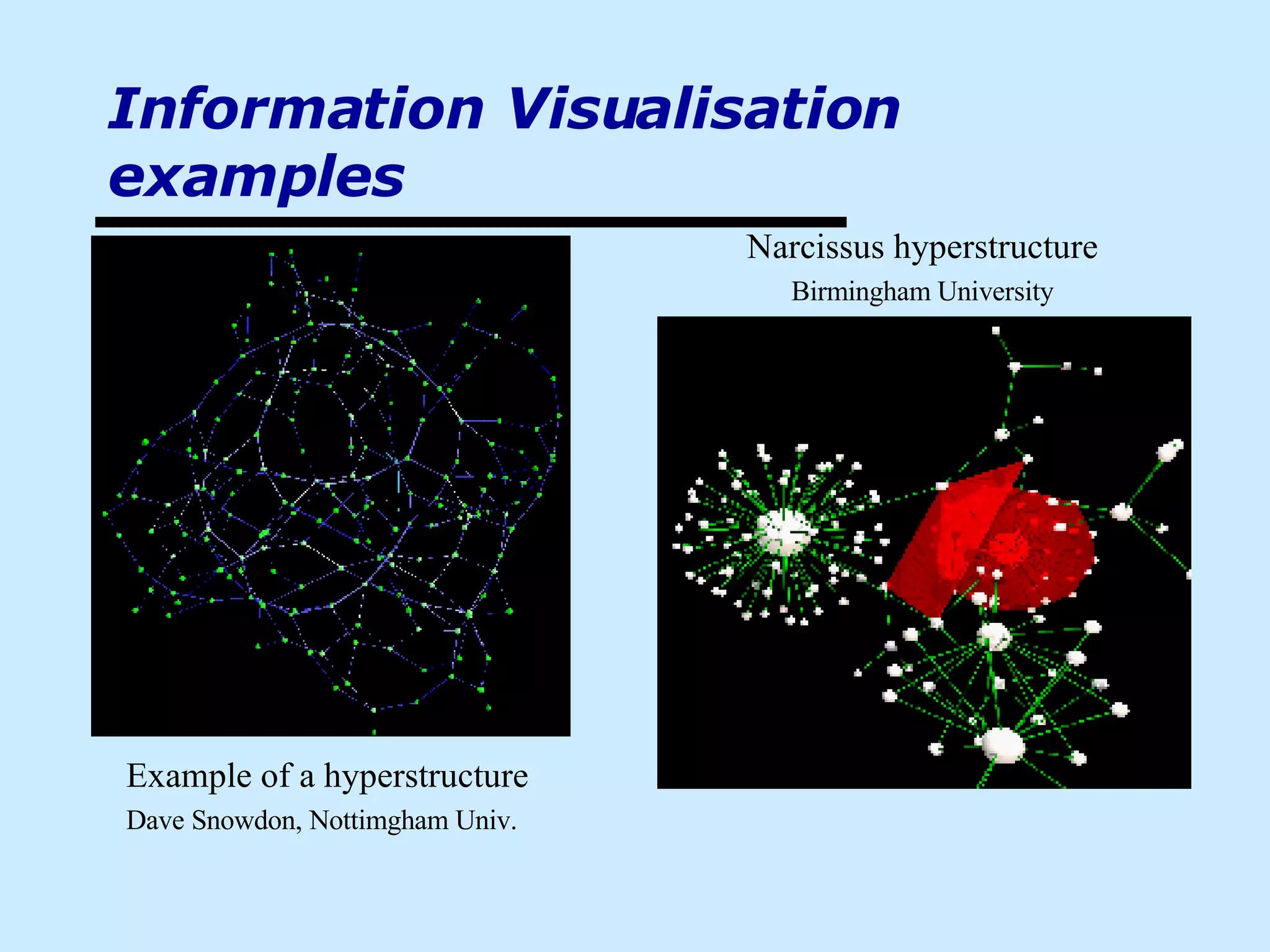
Information Visualisation examples Example of a hyperstructure Dave Snowdon, Nottimgham Univ. Narcissus hyperstructure Birmingham University
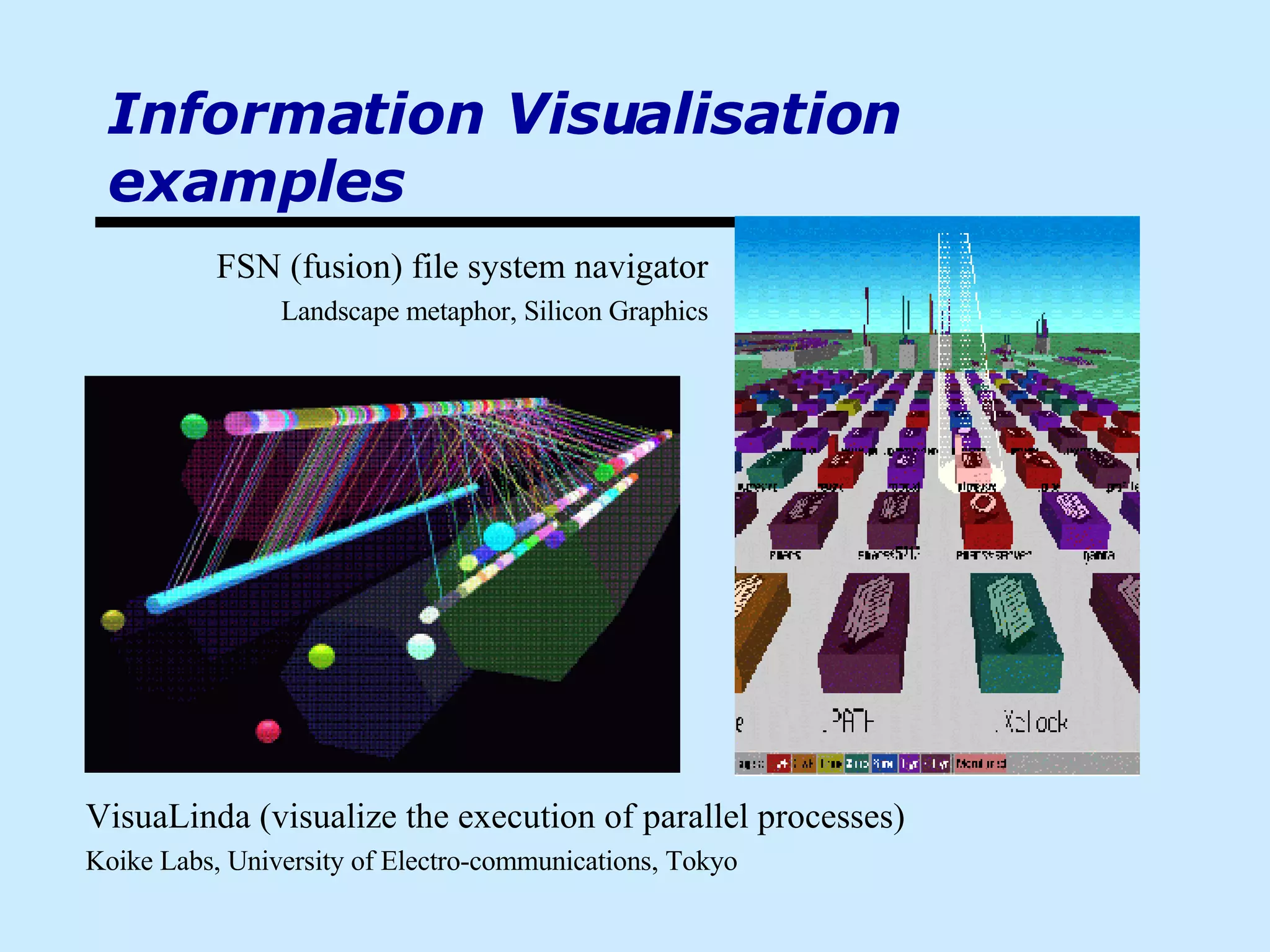
Information Visualisation examples VisuaLinda (visualize the execution of parallel processes) Koike Labs, University of Electro-communications, Tokyo FSN (fusion) file system navigator Landscape metaphor, Silicon Graphics
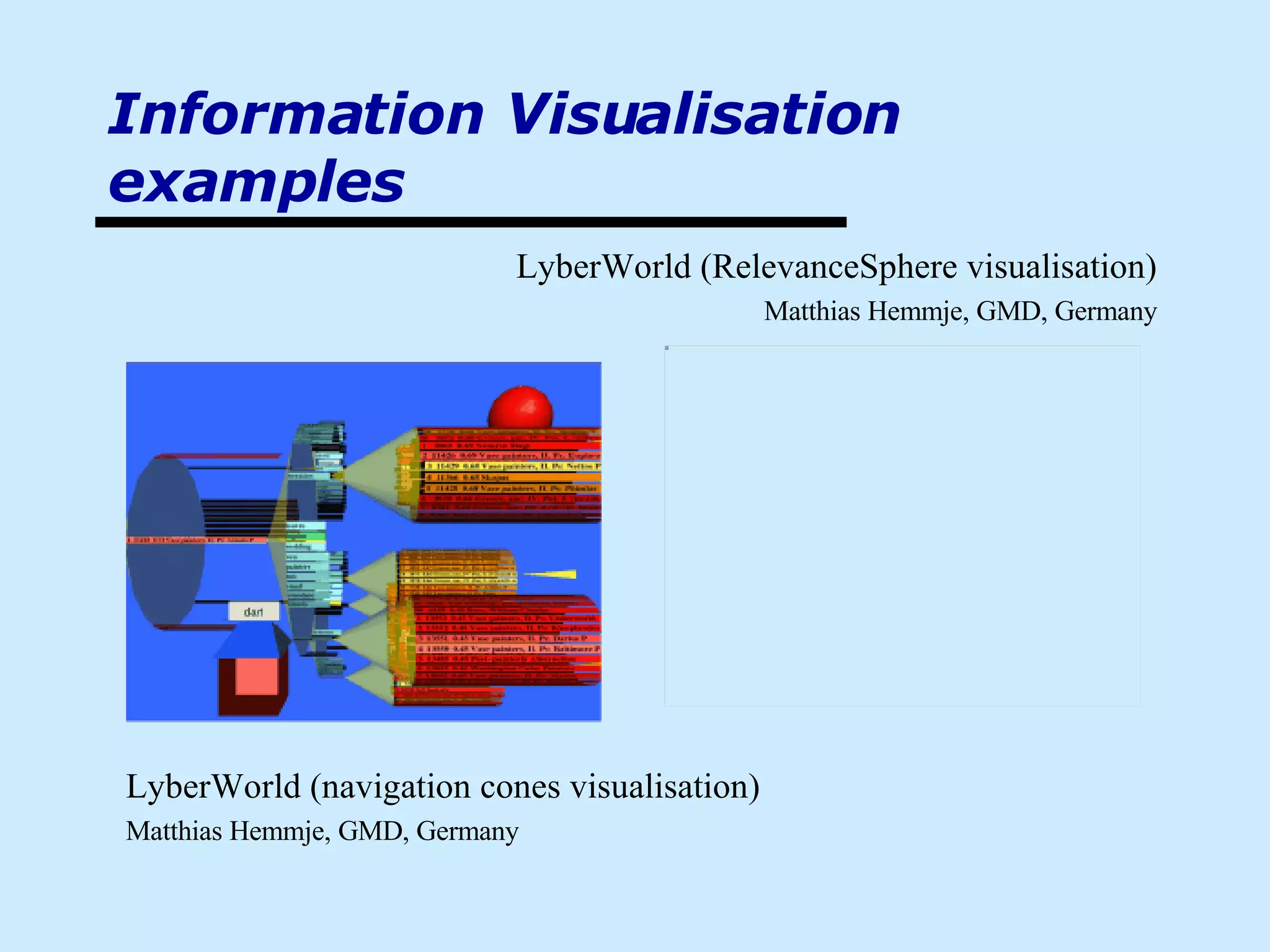
Information Visualisation examples LyberWorld (navigation cones visualisation) Matthias Hemmje, GMD, Germany LyberWorld (RelevanceSphere visualisation) Matthias Hemmje, GMD, Germany
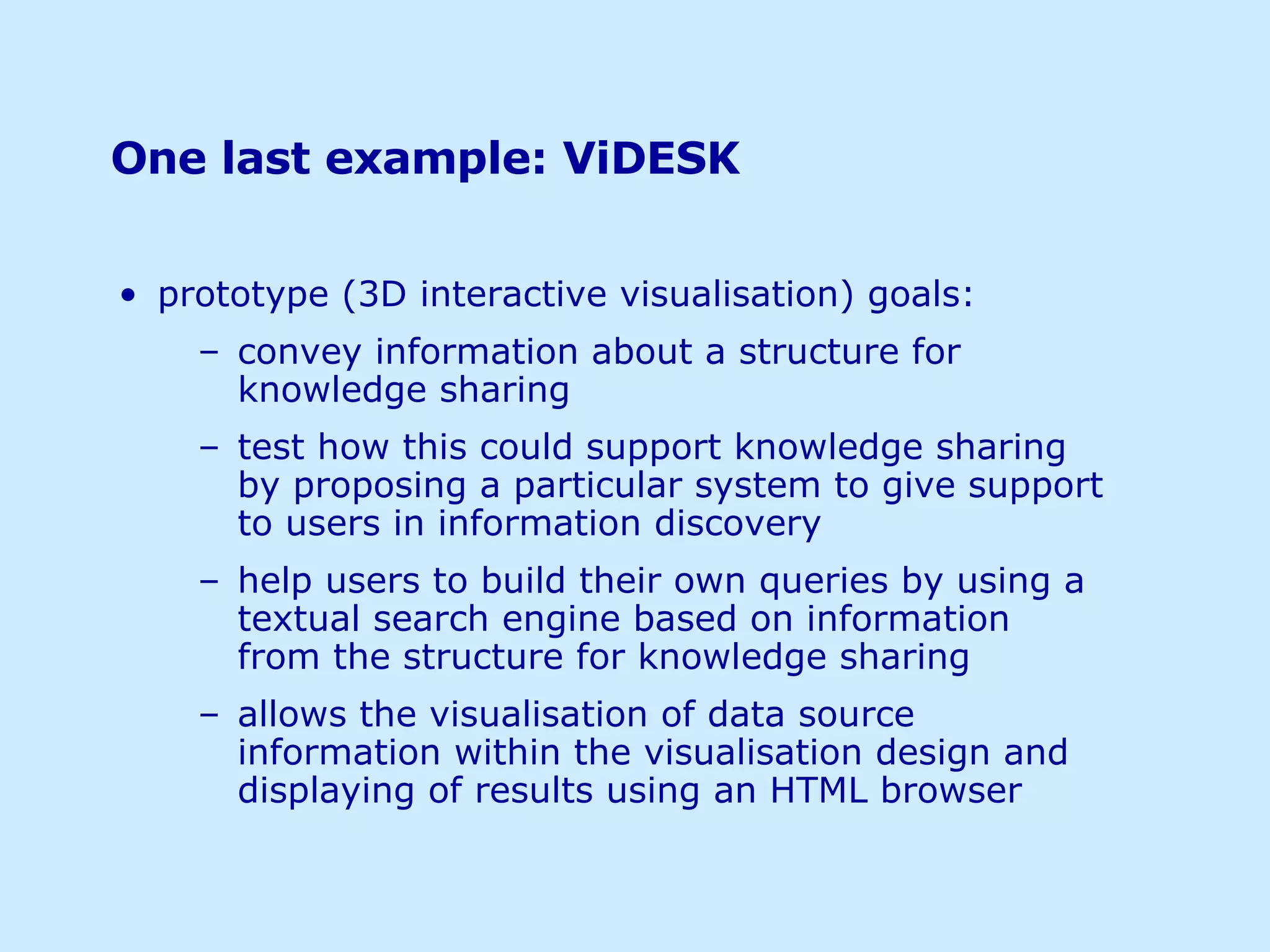
Information Visualisation examples VR-Vibe (searching visualisation) Steve Benford et al., GMD, Germany Internet Foyer (collaborative visualisations) Brown, Benford, and Snowdon, Univ. of Nottingham Overview of the Internet Foyer A group of users around a web page
  Visualisation (why?) 3D visualisation can offer a more convenient and natural way for people to interact with information spaces (as distinct from environments that are naturally 3D) [ Tufte ] and [ Benedikt ]. to date, there is not much evidence to support it, other than in cases where the information has a natural spatial component [ Hubbold et al. ] many problems still exist, as user sense of position that can be lost if the layout changes [ Ingram and Benford ]
Visualisation   (task approach) an application for testing the visualisation design: information discovery: support user efforts to find relevant information within a given knowledge domain [ Li-Jen and Gaines, 1998 ]  setting up a context, a query generation tool and an Information Visualisation [ Card et al., 1999 ]; providing context and information about a particular data source for analysis and comparison. based on a given context shared as a 3D interactive visualisation, users can be assisted to retrieve information and analyse it ― information discovery [ Baeza-Yates and Ribeiro-Neto, 1990 ]
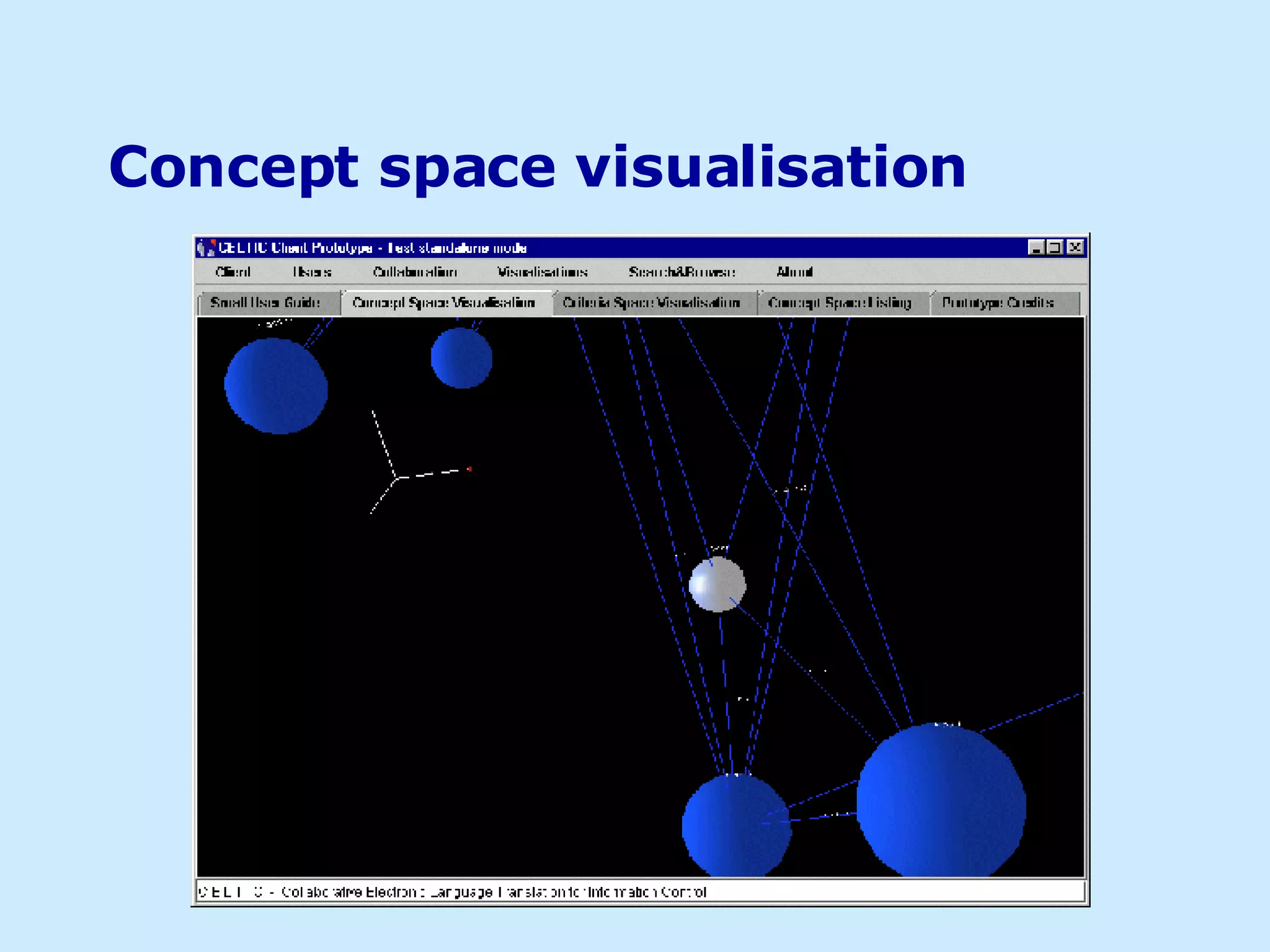
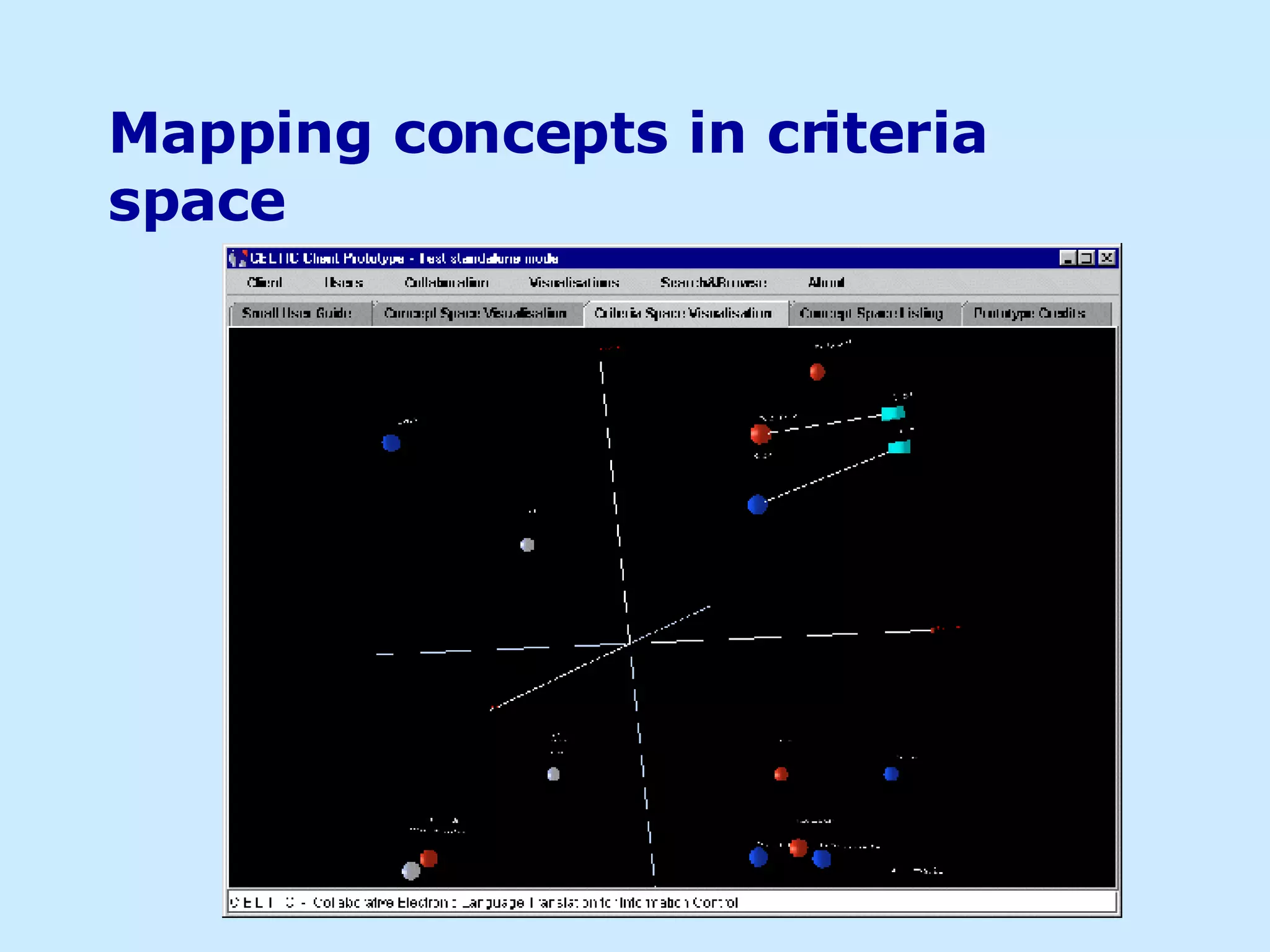
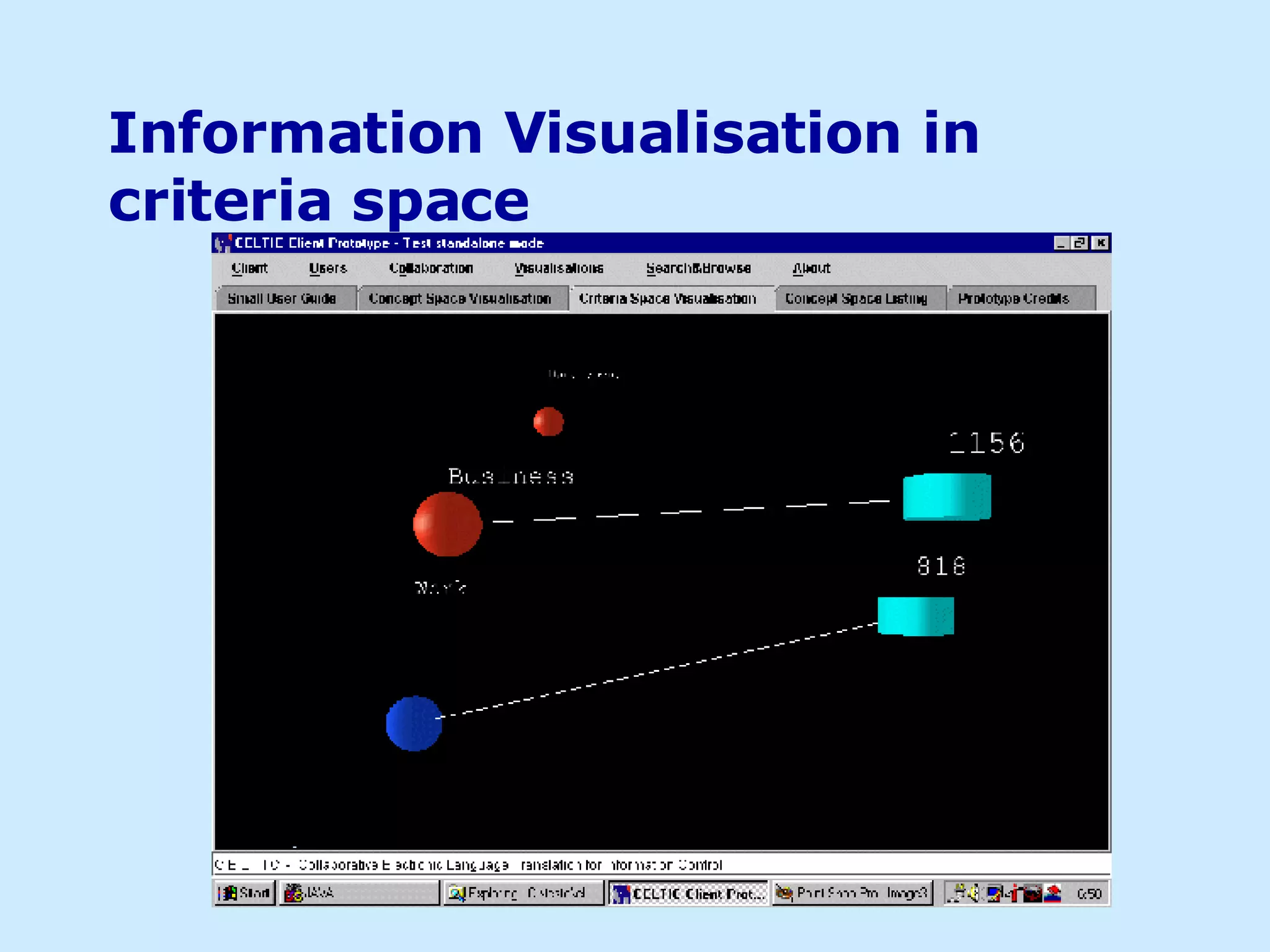
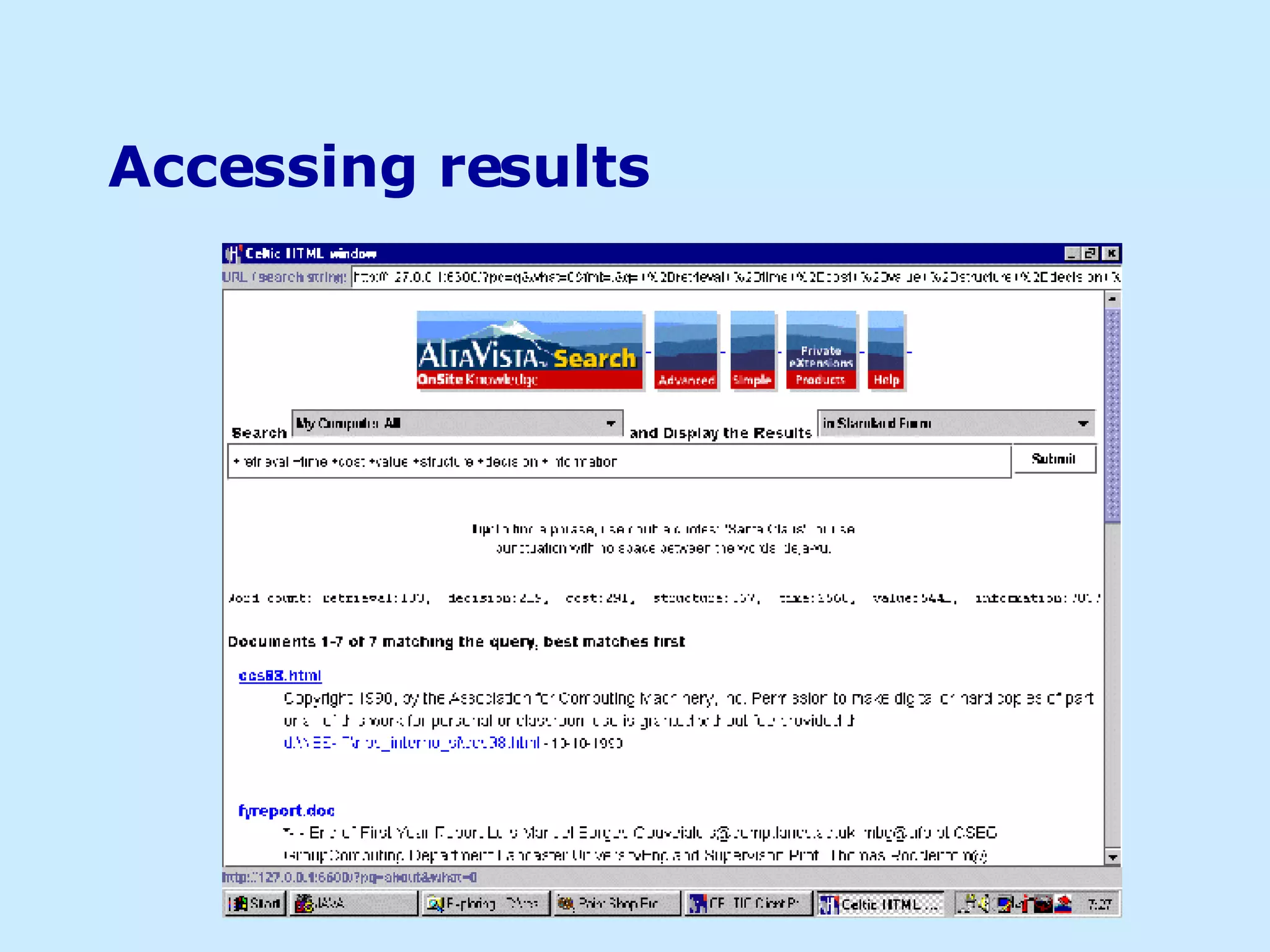
One last example: ViDESK prototype (3D interactive visualisation) goals: convey information about a structure for knowledge sharing test how this could support knowledge sharing by proposing a particular system to give support to users in information discovery help users to build their own queries by using a textual search engine based on information from the structure for knowledge sharing allows the visualisation of data source information within the visualisation design and displaying of results using an HTML browser
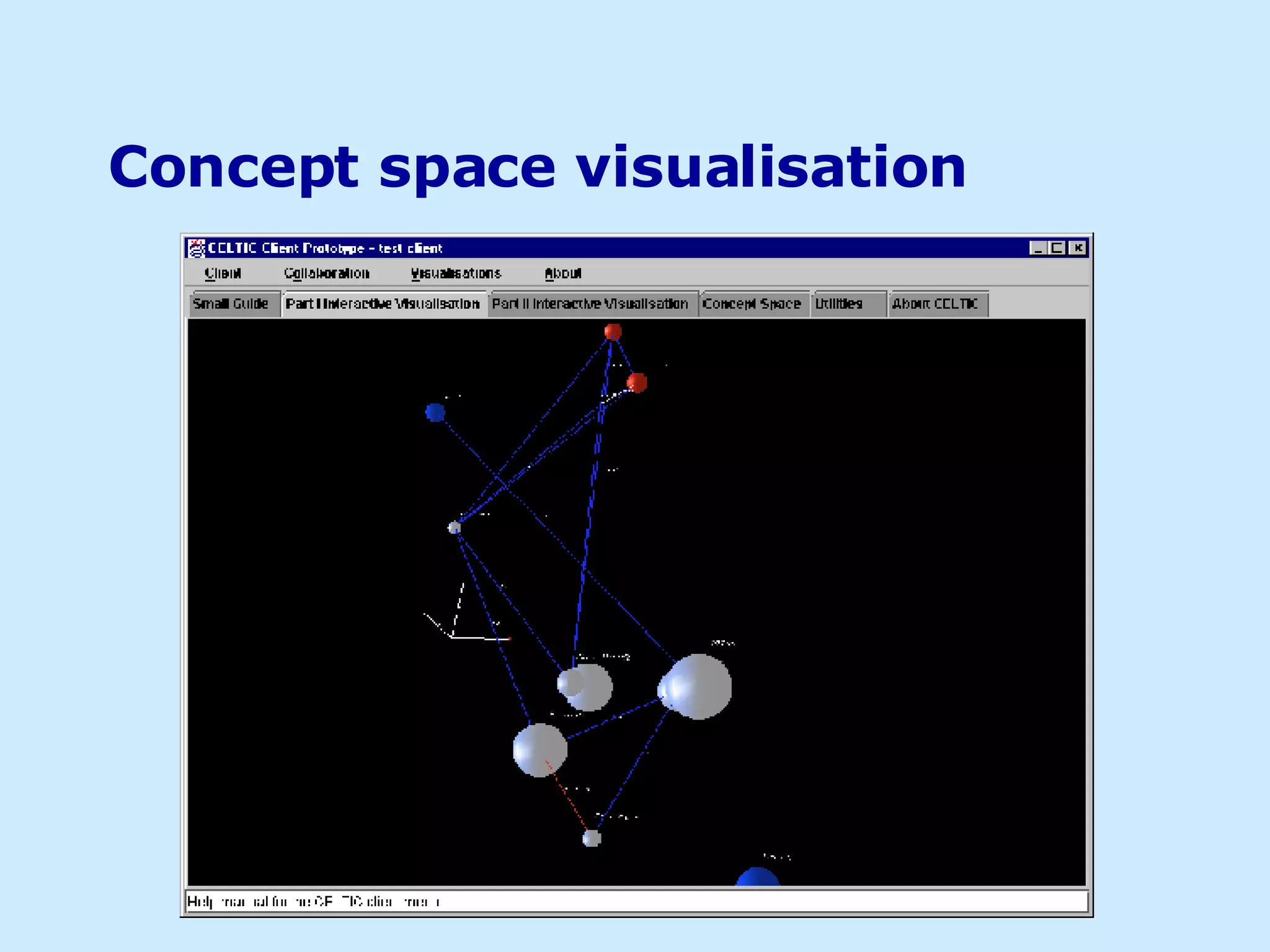
Concept space visualisation
Mapping concepts in criteria space
Information Visualisation in criteria space
Accessing results
Concluding remarks use of visualisation techniques can  improve the interface by  supporting familiar cues  to user perception  and thus  convey information  for knowledge sharing people were able  to use  the several described visualisation designs as the one presented further research need to be conducted in order to  adopt visualisation practices  within current information current use
The birth   of visualisation    based software?

Using visuals to convey information

  • 1.
    Using Visuals toconvey information Luís Manuel Borges Gouveia [email_address] Multimedia Resource Centre Fernando Pessoa University Porto - Portugal ICEIS 2004 Conference, 14-17 April
  • 2.
  • 3.
  • 4.
    “ Two way”integration: visualisation definition : use of images and animations to convey information goal :effectively convey information to the user transforms the abstract and symbolic into the geometric harnesses the human perception system (visual?)
  • 5.
    Motivation different representations can enhance the understanding level of a particular problem [ Tufte ]. the form of representation makes a dramatic difference in the ease of the task [ Norman ]. Norman proposes that external representations, that can be part of a workspace shared with others, require some sort of constructed device to support them: an artefact. is proposed an interface that tries to remove the computer as an object of perception, allowing the user to interact directly with the generated environment as discussed by [ Hubbold et al ].
  • 6.
    Example one: usingold fashion text Semantic Maps strategy for graphically representing concepts, portraying the schematic relations that compose a concept assumes that there are multiple relations between a concept and the knowledge that is associated with the concept for any concept there are at least these types of associations: class: the order of things the concept falls into; property: the attributes that define the concept; example: exemplars of the concept.
  • 7.
    Example two: usingreal world images Collaboration allows better performance
  • 8.
    Information Visualisation examplesExample of a hyperstructure Dave Snowdon, Nottimgham Univ. Narcissus hyperstructure Birmingham University
  • 9.
    Information Visualisation examplesVisuaLinda (visualize the execution of parallel processes) Koike Labs, University of Electro-communications, Tokyo FSN (fusion) file system navigator Landscape metaphor, Silicon Graphics
  • 10.
    Information Visualisation examplesLyberWorld (navigation cones visualisation) Matthias Hemmje, GMD, Germany LyberWorld (RelevanceSphere visualisation) Matthias Hemmje, GMD, Germany
  • 11.
    Information Visualisation examplesVR-Vibe (searching visualisation) Steve Benford et al., GMD, Germany Internet Foyer (collaborative visualisations) Brown, Benford, and Snowdon, Univ. of Nottingham Overview of the Internet Foyer A group of users around a web page
  • 12.
    Visualisation(why?) 3D visualisation can offer a more convenient and natural way for people to interact with information spaces (as distinct from environments that are naturally 3D) [ Tufte ] and [ Benedikt ]. to date, there is not much evidence to support it, other than in cases where the information has a natural spatial component [ Hubbold et al. ] many problems still exist, as user sense of position that can be lost if the layout changes [ Ingram and Benford ]
  • 13.
    Visualisation (task approach) an application for testing the visualisation design: information discovery: support user efforts to find relevant information within a given knowledge domain [ Li-Jen and Gaines, 1998 ] setting up a context, a query generation tool and an Information Visualisation [ Card et al., 1999 ]; providing context and information about a particular data source for analysis and comparison. based on a given context shared as a 3D interactive visualisation, users can be assisted to retrieve information and analyse it ― information discovery [ Baeza-Yates and Ribeiro-Neto, 1990 ]
  • 14.
    One last example:ViDESK prototype (3D interactive visualisation) goals: convey information about a structure for knowledge sharing test how this could support knowledge sharing by proposing a particular system to give support to users in information discovery help users to build their own queries by using a textual search engine based on information from the structure for knowledge sharing allows the visualisation of data source information within the visualisation design and displaying of results using an HTML browser
  • 15.
  • 16.
  • 17.
    Mapping concepts incriteria space
  • 18.
  • 19.
  • 20.
    Concluding remarks useof visualisation techniques can improve the interface by supporting familiar cues to user perception and thus convey information for knowledge sharing people were able to use the several described visualisation designs as the one presented further research need to be conducted in order to adopt visualisation practices within current information current use
  • 21.
    The birth of visualisation based software?