Chapter 6

SANITATION
PROCEDURES
Sanitation Procedures
 Last chapter we talked about the three
  hazards …
 What were they?
Sanitation Procedures
 Biological, Chemical and Physical
 Biological hazards pose the greatest
  threat to foodservice
 Preventing chemical and physical is
  easy, just be careful, biological is
  much more complicated
Time and Temperature
Principle
 Both time and temp need to be
  controlled to prevent pathogen
  contamination
 To protect food from contamination
  you must ensure the following …
Temperature
   Make sure food is either above or
    below the temperature danger zone
    ◦ 41 degrees to 135 degrees
Time
   When food must be in the temperature
    danger zone, limit the time to no more
    than 4 TOTAL hours
When Thawing …
 Most of the time frozen food is thawed
  unsafely
 There are only three safe ways to
  thaw food
    ◦ 1. Thaw the product under cold running
      water
    ◦ 2. Thaw the product in the fridge
    ◦ 3. Cook product directly from a frozen
      state without thawing first
When Cooking …
 As food cooks, heat destroys the
  biological hazards that are present in the
  food
 Most potentially hazardous food is
  cooked to 145 degrees internal temp.
 Use an instant read thermometer
    ◦ 165 degrees for poultry, stuffing, stuffed food
      products, and leftovers
    ◦ 155 degrees for hot-held eggs, ground
      meats, fish
    ◦ 145 degrees for whole muscle meats and
      fish, raw eggs that are broken and
      immediately cooked to order
When Hot Holding …
 In foodservice it is
  often necessary to
  hold cooked food
  and keep it hot until
  it is needed
 Hot held food must
  maintain and
  internal temp of
  135
    ◦ Steam table
    ◦ Warming ovens
When Cooling …
 Most time and temp abuses happen
  during cooling
 Cooked foods must be cooled from
  135 to 70 in two hours or less
 In less than a total of 6 hours, the food
  must be cooled to 41
 If food is not cooled properly, it
  becomes a breeding ground for
  biological hazards
When Cooling …
   Place food in shallow pans for cooling
    ◦ Increasing the surface area speeds up
      cooling
   Place the container of hot food in an
    ice water bath and stir the in
    ingredients frequently
    ◦ Water transfers heat taking the heat away
      from items
   Place food in a blast chiller or other
    rapid cooling equipment
    ◦ Large equipment that continually blasts
      cold air
When Storing …
 Potentially hazardous food must be
  stored at temps below 41º, a temp
  where pathogen growth is slowed, but
  the food will eventually spoil
 Freezer temps under 0º stops
  pathogen growth
 All fridges and freezers must have
  thermometers
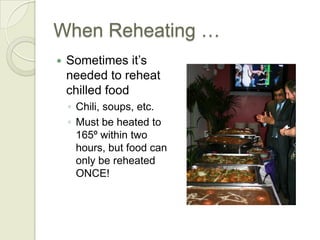
When Reheating …
   Sometimes it’s
    needed to reheat
    chilled food
    ◦ Chili, soups, etc.
    ◦ Must be heated to
      165º within two
      hours, but food can
      only be reheated
      ONCE!
Cross-Contamination
 Cross-contamination occurs when
  harmful microorganisms are
  transferred from one product to
  another by hands, utensils,
  equipment, or other physical contact
 One of the largest sources of food
  borne illnesses
 Often the result of negligence or
  ignorance on the part of the food
  service worker
Cross-Contamination
   Hands are often
    the culprit …
    ◦ Moving raw chicken
      then making a
      sandwich, but never
      washing your hands
    ◦ 80% of all raw
      chicken was tested
      POSITIVE for
      salmonella in the US
Scenario
 Joe is cutting pork steaks on a cutting
  board. Mary, the sandwich cook, needed
  to cut up a large number of sandwiches
  and is in a hurry. She asks Joe to help
  her cut some sandwiches in half. Joe,
  eager to help a fellow cook, quickly
  wipes off his cutting board and knife
  using a side towel. He takes half of the
  sandwiches and cuts them using the
  knife and cutting board that he just wiped
  off.
 What was wrong in the scenario? What
  was right?
Clean v. Sanitary
   Clean is the visual appearance that
    something is unsoiled
    ◦ An items that is clean is not always sanitary
   Sanitary refers to an environment that is
    free from pathogens
    ◦ Kitchens have many places that need
      sanitization
    ◦ Any surface such as a table, cutting board or
      a piece of equipment that comes in contact
      with food is considered a food-contact
      surface
      Food-contact surfaces must be cleaned and
       sanitized before food prep, completing only one of
       the steps is not enough
Step One: Cleaning
 The first step toward a sanitary work
  environment is cleaning, or the
  removal of any visible dirt, grime, or
  pieces of food
 Proper cleaning requires hot water,
  detergents and sometimes grease
  cutters
 Clean all food contact surfaces after
  completing a task and before starting
  a new one
Step Two: Sanitizing
   Sanitizing kills pathogens, there are
    two powerful strategies and when they
    are used correctly they will kill most
    pathogens
    ◦ Heat
    ◦ Chemicals
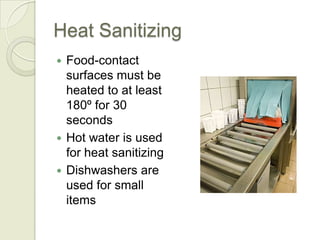
Heat Sanitizing
 Food-contact
  surfaces must be
  heated to at least
  180º for 30
  seconds
 Hot water is used
  for heat sanitizing
 Dishwashers are
  used for small
  items
Chemical Sanitizing
 Most common technique used
 Some chemicals can be dangerous is
  mixed improperly
    ◦ Ammonia and bleach
   Precautions:
    ◦   Follow manufacturer's instructions
    ◦   Wear protective gear
    ◦   Dilute properly
    ◦   Never mix random chemicals
Clean and Sanitizing the Whole
Kitchen
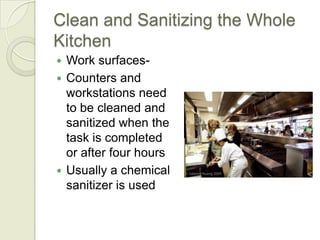
 Work surfaces-
 Counters and
  workstations need
  to be cleaned and
  sanitized when the
  task is completed
  or after four hours
 Usually a chemical
  sanitizer is used
Clean and Sanitizing the Whole
Kitchen
 Small equipment and dishes-
 Need to be cleaned after each use or after
  four hours
 Use a combination of heat and chemicals
 Dish machines or three compartment sinks
    ◦ Dish machines-conveyor belt, three cycles
      1st cycle- removes physical objects and grease
      2nd cycle rinses off detergent
      3rd cycle- sanitizers either with hot water or chemicals
   Three compartment sink
    ◦ 1st compartment- clean
    ◦ 2nd- rinse
    ◦ 3rd -sanitize
Clean and Sanitizing the Whole
Kitchen
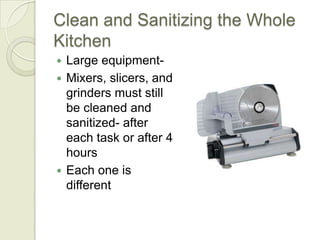
 Large equipment-
 Mixers, slicers, and
  grinders must still
  be cleaned and
  sanitized- after
  each task or after 4
  hours
 Each one is
  different
Personal Hygiene- Hands
   Hands- common culprit germ spreader
   Where to wash you hands:
    ◦ Designated hand washing sinks, antimicrobial
      soap, nail brush, disposable towels
   When to wash your hands:
    ◦   Before beginning a work shift
    ◦   After using the restroom
    ◦   After eating, drinking, or taking a break
    ◦   At end of a job task
    ◦   After handling toxic chemicals
    ◦   After taking out trash
    ◦   After handling dirty dishes or linens
    ◦   After coughing or sneezing
    ◦   After touching hair or skin
Personal Hygiene- Hands
 Glove- some states require gloves, but
  they give a false sense of security
 Wounds- open wounds are breeding
  grounds for bacteria, cover with clean
  band aid or latex sheath
 Fingernails- pathogens hide under
  nails, use finger brush and keep nails
  short and clean
Personal Hygiene- Hair
 Keep hair up and
  secured at all times
 hair is always dirty
 Hair net, beard net
Personal Hygiene- gross stuff
 Eating/drinking- should never be done
  in the kitchen, tasting by chefs is done
  properly
 Cooks should never be in the kitchen
  with a contagious illness
 Clothes should be clean
Insect and Rodent Control
   Insects and rodents spread biological
    hazards in many ways
   Urine and feces contain pathogens
   Feet and bodies track pathogens
   Flies and cockroaches, Mice and rats
   Air curtains to prevent flying bugs,
    cockroaches usually come in boxes,
    rats/mice through cracks and holes
   Many counties require pest control
    operators to visit and spray chemicals
    and set traps
Waste control
 Garbage is a breeding ground for
  bacteria and pathogens
 You should …
    ◦ Empty containers often
    ◦ Put grease into separate containers,
      separate from garbage
    ◦ Dumpsters need to be emptied when they
      are filled, and should be washed periodically
    ◦ Lids need to fit snuggly
    ◦ Containers should be washed inside and out
      often
Health Inspections
   Health departments monitor
    compliance with health codes
    ◦ Inspectors make sure the public is being
      served safe food in a safe environment
    ◦ Not the enemy
    ◦ Certificate has to be posted in the
      restaurant
Activity
   Add to your booklet …
    ◦   temperature danger zone and definition
    ◦   Three ways to thaw food safely
    ◦   Safe cooking temps (3)
    ◦   Cross-contamination info page
    ◦   Definition of clean
    ◦   Definition of sanitary
    ◦   When to wash your hands (9)

6 sanitation procedures

  • 1.
  • 2.
    Sanitation Procedures  Lastchapter we talked about the three hazards …  What were they?
  • 3.
    Sanitation Procedures  Biological,Chemical and Physical  Biological hazards pose the greatest threat to foodservice  Preventing chemical and physical is easy, just be careful, biological is much more complicated
  • 4.
    Time and Temperature Principle Both time and temp need to be controlled to prevent pathogen contamination  To protect food from contamination you must ensure the following …
  • 5.
    Temperature  Make sure food is either above or below the temperature danger zone ◦ 41 degrees to 135 degrees
  • 6.
    Time  When food must be in the temperature danger zone, limit the time to no more than 4 TOTAL hours
  • 7.
    When Thawing … Most of the time frozen food is thawed unsafely  There are only three safe ways to thaw food ◦ 1. Thaw the product under cold running water ◦ 2. Thaw the product in the fridge ◦ 3. Cook product directly from a frozen state without thawing first
  • 8.
    When Cooking … As food cooks, heat destroys the biological hazards that are present in the food  Most potentially hazardous food is cooked to 145 degrees internal temp.  Use an instant read thermometer ◦ 165 degrees for poultry, stuffing, stuffed food products, and leftovers ◦ 155 degrees for hot-held eggs, ground meats, fish ◦ 145 degrees for whole muscle meats and fish, raw eggs that are broken and immediately cooked to order
  • 9.
    When Hot Holding…  In foodservice it is often necessary to hold cooked food and keep it hot until it is needed  Hot held food must maintain and internal temp of 135 ◦ Steam table ◦ Warming ovens
  • 10.
    When Cooling … Most time and temp abuses happen during cooling  Cooked foods must be cooled from 135 to 70 in two hours or less  In less than a total of 6 hours, the food must be cooled to 41  If food is not cooled properly, it becomes a breeding ground for biological hazards
  • 11.
    When Cooling …  Place food in shallow pans for cooling ◦ Increasing the surface area speeds up cooling  Place the container of hot food in an ice water bath and stir the in ingredients frequently ◦ Water transfers heat taking the heat away from items  Place food in a blast chiller or other rapid cooling equipment ◦ Large equipment that continually blasts cold air
  • 12.
    When Storing … Potentially hazardous food must be stored at temps below 41º, a temp where pathogen growth is slowed, but the food will eventually spoil  Freezer temps under 0º stops pathogen growth  All fridges and freezers must have thermometers
  • 13.
    When Reheating …  Sometimes it’s needed to reheat chilled food ◦ Chili, soups, etc. ◦ Must be heated to 165º within two hours, but food can only be reheated ONCE!
  • 14.
    Cross-Contamination  Cross-contamination occurswhen harmful microorganisms are transferred from one product to another by hands, utensils, equipment, or other physical contact  One of the largest sources of food borne illnesses  Often the result of negligence or ignorance on the part of the food service worker
  • 15.
    Cross-Contamination  Hands are often the culprit … ◦ Moving raw chicken then making a sandwich, but never washing your hands ◦ 80% of all raw chicken was tested POSITIVE for salmonella in the US
  • 16.
    Scenario  Joe iscutting pork steaks on a cutting board. Mary, the sandwich cook, needed to cut up a large number of sandwiches and is in a hurry. She asks Joe to help her cut some sandwiches in half. Joe, eager to help a fellow cook, quickly wipes off his cutting board and knife using a side towel. He takes half of the sandwiches and cuts them using the knife and cutting board that he just wiped off.  What was wrong in the scenario? What was right?
  • 17.
    Clean v. Sanitary  Clean is the visual appearance that something is unsoiled ◦ An items that is clean is not always sanitary  Sanitary refers to an environment that is free from pathogens ◦ Kitchens have many places that need sanitization ◦ Any surface such as a table, cutting board or a piece of equipment that comes in contact with food is considered a food-contact surface  Food-contact surfaces must be cleaned and sanitized before food prep, completing only one of the steps is not enough
  • 18.
    Step One: Cleaning The first step toward a sanitary work environment is cleaning, or the removal of any visible dirt, grime, or pieces of food  Proper cleaning requires hot water, detergents and sometimes grease cutters  Clean all food contact surfaces after completing a task and before starting a new one
  • 19.
    Step Two: Sanitizing  Sanitizing kills pathogens, there are two powerful strategies and when they are used correctly they will kill most pathogens ◦ Heat ◦ Chemicals
  • 20.
    Heat Sanitizing  Food-contact surfaces must be heated to at least 180º for 30 seconds  Hot water is used for heat sanitizing  Dishwashers are used for small items
  • 21.
    Chemical Sanitizing  Mostcommon technique used  Some chemicals can be dangerous is mixed improperly ◦ Ammonia and bleach  Precautions: ◦ Follow manufacturer's instructions ◦ Wear protective gear ◦ Dilute properly ◦ Never mix random chemicals
  • 22.
    Clean and Sanitizingthe Whole Kitchen  Work surfaces-  Counters and workstations need to be cleaned and sanitized when the task is completed or after four hours  Usually a chemical sanitizer is used
  • 23.
    Clean and Sanitizingthe Whole Kitchen  Small equipment and dishes-  Need to be cleaned after each use or after four hours  Use a combination of heat and chemicals  Dish machines or three compartment sinks ◦ Dish machines-conveyor belt, three cycles  1st cycle- removes physical objects and grease  2nd cycle rinses off detergent  3rd cycle- sanitizers either with hot water or chemicals  Three compartment sink ◦ 1st compartment- clean ◦ 2nd- rinse ◦ 3rd -sanitize
  • 24.
    Clean and Sanitizingthe Whole Kitchen  Large equipment-  Mixers, slicers, and grinders must still be cleaned and sanitized- after each task or after 4 hours  Each one is different
  • 25.
    Personal Hygiene- Hands  Hands- common culprit germ spreader  Where to wash you hands: ◦ Designated hand washing sinks, antimicrobial soap, nail brush, disposable towels  When to wash your hands: ◦ Before beginning a work shift ◦ After using the restroom ◦ After eating, drinking, or taking a break ◦ At end of a job task ◦ After handling toxic chemicals ◦ After taking out trash ◦ After handling dirty dishes or linens ◦ After coughing or sneezing ◦ After touching hair or skin
  • 26.
    Personal Hygiene- Hands Glove- some states require gloves, but they give a false sense of security  Wounds- open wounds are breeding grounds for bacteria, cover with clean band aid or latex sheath  Fingernails- pathogens hide under nails, use finger brush and keep nails short and clean
  • 27.
    Personal Hygiene- Hair Keep hair up and secured at all times  hair is always dirty  Hair net, beard net
  • 28.
    Personal Hygiene- grossstuff  Eating/drinking- should never be done in the kitchen, tasting by chefs is done properly  Cooks should never be in the kitchen with a contagious illness  Clothes should be clean
  • 29.
    Insect and RodentControl  Insects and rodents spread biological hazards in many ways  Urine and feces contain pathogens  Feet and bodies track pathogens  Flies and cockroaches, Mice and rats  Air curtains to prevent flying bugs, cockroaches usually come in boxes, rats/mice through cracks and holes  Many counties require pest control operators to visit and spray chemicals and set traps
  • 30.
    Waste control  Garbageis a breeding ground for bacteria and pathogens  You should … ◦ Empty containers often ◦ Put grease into separate containers, separate from garbage ◦ Dumpsters need to be emptied when they are filled, and should be washed periodically ◦ Lids need to fit snuggly ◦ Containers should be washed inside and out often
  • 31.
    Health Inspections  Health departments monitor compliance with health codes ◦ Inspectors make sure the public is being served safe food in a safe environment ◦ Not the enemy ◦ Certificate has to be posted in the restaurant
  • 32.
    Activity  Add to your booklet … ◦ temperature danger zone and definition ◦ Three ways to thaw food safely ◦ Safe cooking temps (3) ◦ Cross-contamination info page ◦ Definition of clean ◦ Definition of sanitary ◦ When to wash your hands (9)