DISTRIBUTION: GROSS • RAEBELLO • WALLACE 10
QPS
WAYNEMILLER/MAGNUMPHOTOS
84 BUSINESS WEEK / AUGUST 25, 1997
PE
JMP
EDIT OK / :D: C M Y K 02 EDIT PASS
B
SVIC 33
DAD
SCTXX ASIA
X XXX EUR-LAXX INT
ASIADOMESTIC EURO/LAINT’L
84
point start a company,” says Patterson.
The loyalty and affection alumni show
their alma maters is part of the Silicon
Valley perpetual motion machine. Silicon
Graphics Inc., started by Stanford engi-
neering professor James H. Clark, be-
came a huge donor of money and equip-
ment. Equally important, alums donate
their personal time. Wilson Sonsini
Goodrich & Rosati partner Sonsini and
Mario M. Rosati, for example, both
teach courses at Berkeley.
“NO LIMIT.” David Kelley, the successful
head of Palo Alto’s IDEO industrial de-
sign firm, exemplifies what goes right in
the Valley’s academic/industry relations.
When he’s not running IDEO, he’s help-
ing to steer a product-design program at
his alma mater, Stanford. “The reason I
knock myself out and work two full-
time jobs is I feel indebted to Stan-
ford,” says Kelley. Thanks to the school’s
business-cum-science orientation, “I be-
came a guy who made products instead
of calculating brackets.”
It seems like nobody does just one
thing around here. Stanford’s current
engineering dean, John Hennessy, did
pioneering computer-science work in
RISC chips in the early 1980s. Then,
Hennessy took a sabbatical, raised some
venture capital, and founded MIPS Com-
puting. He returned to Stanford in 1985.
“The gap between research and what’s
in production,” says Hennessy, “has nar-
rowed to almost nothing.”
For all his vision, Dean Terman might
well have gaped at 1990s-style entre-
preneurship. He could never have pic-
tured Internet darling Yahoo! Inc.,
which started out in a grungy campus
trailer in 1994, where electrical engi-
neering grad students David Fhilo and
Jerry Yang were bored to tears with
their PhD thesis. They began almost
mindlessly making lists of their favorite
Web sites. Rather than crack down on
the digital goofing, the engineering
school cut the pair slack.
Fast-forward two years to a hugely
successful 1996 initial public offering—
and a time to return favors. Filo and
Yang, worth more than $100 million
apiece, became the youngest individuals
ever to endow a professorship in the
Stanford engineering school, with a gift
of $2 million. “As long as we maintain
the practices that have made us what
we are today,” Terman wrote in 1973,
describing Silicon Valley’s energy and
success, “then there is no limit to the
longevity of the situation.”
Amen, say today’s entrepreneurs. Or
rather, Yahoo!
By Joan O’ C. Hamilton in Palo Alto,
with Linda Himelstein in Menlo Park
1981 Linear
Technology
Robert Swanson,
Robert Dobkin
1983 Sierra
Semiconductor
James Diller,
four others
1983 SDA Systems* James Soloman
1983 Cypress
T. J. Rodgers, Lowell Turiff
1996 PlanetWeb
Kamran Elahian
1984 Xilinx
Bernard Vonderschmitt
1986 Synaptics
Federico Faggin, Carver Mead
1994 3Dfx
Gordon Campbell,
Scott Sellers
1989 S3
Ron Yara,
Dado Banatao
1983 Wafer
Scale Integration
Eli Harari
1979 VLSI
Technology
Jack Baletto,
Dan Floyd,
Gunnar Wetlesen
1985 Atmel
George Perlegos,
Tsung-Ching Wu
1969 Four Phase*
Lee Boysel, Jack Faith
1972 Kleiner Perkins
Caufield & Byers
Eugene Kleiner
1980 LSI Logic
Wilfred Corrigan
1985 Chips
& Technologies*
Gordon Campbell, Dado
Banatao, two others
1981 SEEQ
Gordon Campbell,
George Perlegos
1974 Zilog*
Federico Faggin,
Ralph Ungermann
1973 Synertek*
Robert Schreiner,
R. Barringer, six others
1968 Computer
Microtechnology*
John Schroeder,
Jack Schmidt, two others
1993 NeoMagic
Kamran Elahian,
Prakash Agarwal
1985 Cirrus Logic
Michael Hackworth, Kam-
ran Elahian, five others
1961 Signetics*
(now Philips Semiconductor)
David Allison, David James,
Lionel Kattner, Mark
Weissenstern, two others
1967 National
Semiconductor
Charles Sporck, two others
After leaving Fairchild,
Sporck ran National for 24
years, building it into a
giant in analog and
digital chips.
1968 Intel
Robert Noyce, Gordon Moore
The king of PC micro-
processors, Intel is now the
largest chip company in the
world, with revenues top-
ping $20 billion. Most Intel
execs stay on board instead
of launching startups.
1969 AMD
W.J.SandersIII,seven others
Flamboyant Sanders left
Fairchild to found this up-
and-down rival to Intel. The
swing is up right now.
1957 Fairchild
Semiconductor*
(From left) Gordon Moore,
Sheldon Roberts, Eugene
Kleiner, Robert Noyce, Victor
Grinich, Julius Blank, Jean
Hoerni, Jay Last
Founded by “The Traitorous
Eight” from Shockley, Fair-
child was the first company
to work exclusively in silicon.
It spawned more than 30
Silicon Valley companies,
including Intel, Advanced
Micro Devices, and National.
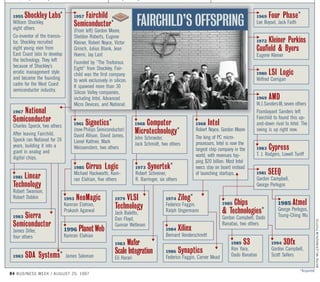
FAIRCHILD’S OFFSPRING
1955 Shockley Labs*
William Shockley,
eight others
Co-inventor of the transis-
tor, Shockley recruited
eight young men from
East Coast labs to develop
the technology. They left
because of Shockley’s
erratic management style
and became the founding
cadre for the West Coast
semiconductor industry.
̄
̇
̈
̄ ̄
̄
̈
̈
̆
̈
̈
̈
̈
̄
̄
̄
̄
̄
̄
̄
̄ ̄
̄
̄
̄
̄ ̄
̄
*Acquired

IC Family Tree

  • 1.
    DISTRIBUTION: GROSS •RAEBELLO • WALLACE 10 QPS WAYNEMILLER/MAGNUMPHOTOS 84 BUSINESS WEEK / AUGUST 25, 1997 PE JMP EDIT OK / :D: C M Y K 02 EDIT PASS B SVIC 33 DAD SCTXX ASIA X XXX EUR-LAXX INT ASIADOMESTIC EURO/LAINT’L 84 point start a company,” says Patterson. The loyalty and affection alumni show their alma maters is part of the Silicon Valley perpetual motion machine. Silicon Graphics Inc., started by Stanford engi- neering professor James H. Clark, be- came a huge donor of money and equip- ment. Equally important, alums donate their personal time. Wilson Sonsini Goodrich & Rosati partner Sonsini and Mario M. Rosati, for example, both teach courses at Berkeley. “NO LIMIT.” David Kelley, the successful head of Palo Alto’s IDEO industrial de- sign firm, exemplifies what goes right in the Valley’s academic/industry relations. When he’s not running IDEO, he’s help- ing to steer a product-design program at his alma mater, Stanford. “The reason I knock myself out and work two full- time jobs is I feel indebted to Stan- ford,” says Kelley. Thanks to the school’s business-cum-science orientation, “I be- came a guy who made products instead of calculating brackets.” It seems like nobody does just one thing around here. Stanford’s current engineering dean, John Hennessy, did pioneering computer-science work in RISC chips in the early 1980s. Then, Hennessy took a sabbatical, raised some venture capital, and founded MIPS Com- puting. He returned to Stanford in 1985. “The gap between research and what’s in production,” says Hennessy, “has nar- rowed to almost nothing.” For all his vision, Dean Terman might well have gaped at 1990s-style entre- preneurship. He could never have pic- tured Internet darling Yahoo! Inc., which started out in a grungy campus trailer in 1994, where electrical engi- neering grad students David Fhilo and Jerry Yang were bored to tears with their PhD thesis. They began almost mindlessly making lists of their favorite Web sites. Rather than crack down on the digital goofing, the engineering school cut the pair slack. Fast-forward two years to a hugely successful 1996 initial public offering— and a time to return favors. Filo and Yang, worth more than $100 million apiece, became the youngest individuals ever to endow a professorship in the Stanford engineering school, with a gift of $2 million. “As long as we maintain the practices that have made us what we are today,” Terman wrote in 1973, describing Silicon Valley’s energy and success, “then there is no limit to the longevity of the situation.” Amen, say today’s entrepreneurs. Or rather, Yahoo! By Joan O’ C. Hamilton in Palo Alto, with Linda Himelstein in Menlo Park 1981 Linear Technology Robert Swanson, Robert Dobkin 1983 Sierra Semiconductor James Diller, four others 1983 SDA Systems* James Soloman 1983 Cypress T. J. Rodgers, Lowell Turiff 1996 PlanetWeb Kamran Elahian 1984 Xilinx Bernard Vonderschmitt 1986 Synaptics Federico Faggin, Carver Mead 1994 3Dfx Gordon Campbell, Scott Sellers 1989 S3 Ron Yara, Dado Banatao 1983 Wafer Scale Integration Eli Harari 1979 VLSI Technology Jack Baletto, Dan Floyd, Gunnar Wetlesen 1985 Atmel George Perlegos, Tsung-Ching Wu 1969 Four Phase* Lee Boysel, Jack Faith 1972 Kleiner Perkins Caufield & Byers Eugene Kleiner 1980 LSI Logic Wilfred Corrigan 1985 Chips & Technologies* Gordon Campbell, Dado Banatao, two others 1981 SEEQ Gordon Campbell, George Perlegos 1974 Zilog* Federico Faggin, Ralph Ungermann 1973 Synertek* Robert Schreiner, R. Barringer, six others 1968 Computer Microtechnology* John Schroeder, Jack Schmidt, two others 1993 NeoMagic Kamran Elahian, Prakash Agarwal 1985 Cirrus Logic Michael Hackworth, Kam- ran Elahian, five others 1961 Signetics* (now Philips Semiconductor) David Allison, David James, Lionel Kattner, Mark Weissenstern, two others 1967 National Semiconductor Charles Sporck, two others After leaving Fairchild, Sporck ran National for 24 years, building it into a giant in analog and digital chips. 1968 Intel Robert Noyce, Gordon Moore The king of PC micro- processors, Intel is now the largest chip company in the world, with revenues top- ping $20 billion. Most Intel execs stay on board instead of launching startups. 1969 AMD W.J.SandersIII,seven others Flamboyant Sanders left Fairchild to found this up- and-down rival to Intel. The swing is up right now. 1957 Fairchild Semiconductor* (From left) Gordon Moore, Sheldon Roberts, Eugene Kleiner, Robert Noyce, Victor Grinich, Julius Blank, Jean Hoerni, Jay Last Founded by “The Traitorous Eight” from Shockley, Fair- child was the first company to work exclusively in silicon. It spawned more than 30 Silicon Valley companies, including Intel, Advanced Micro Devices, and National. FAIRCHILD’S OFFSPRING 1955 Shockley Labs* William Shockley, eight others Co-inventor of the transis- tor, Shockley recruited eight young men from East Coast labs to develop the technology. They left because of Shockley’s erratic management style and became the founding cadre for the West Coast semiconductor industry. ̄ ̇ ̈ ̄ ̄ ̄ ̈ ̈ ̆ ̈ ̈ ̈ ̈ ̄ ̄ ̄ ̄ ̄ ̄ ̄ ̄ ̄ ̄ ̄ ̄ ̄ ̄ ̄ *Acquired