INTRODUCTION TO
OBJECT - ORIENTED
PROGRAMMING
PREPARED BY
Patel Shruti J.
BE- 4th sem
Programming Languages
• Programming languages allow programmers to code
software.
• The three major families of languages are:
– Machine languages
– Assembly languages
– High-Level languages
Machine Languages
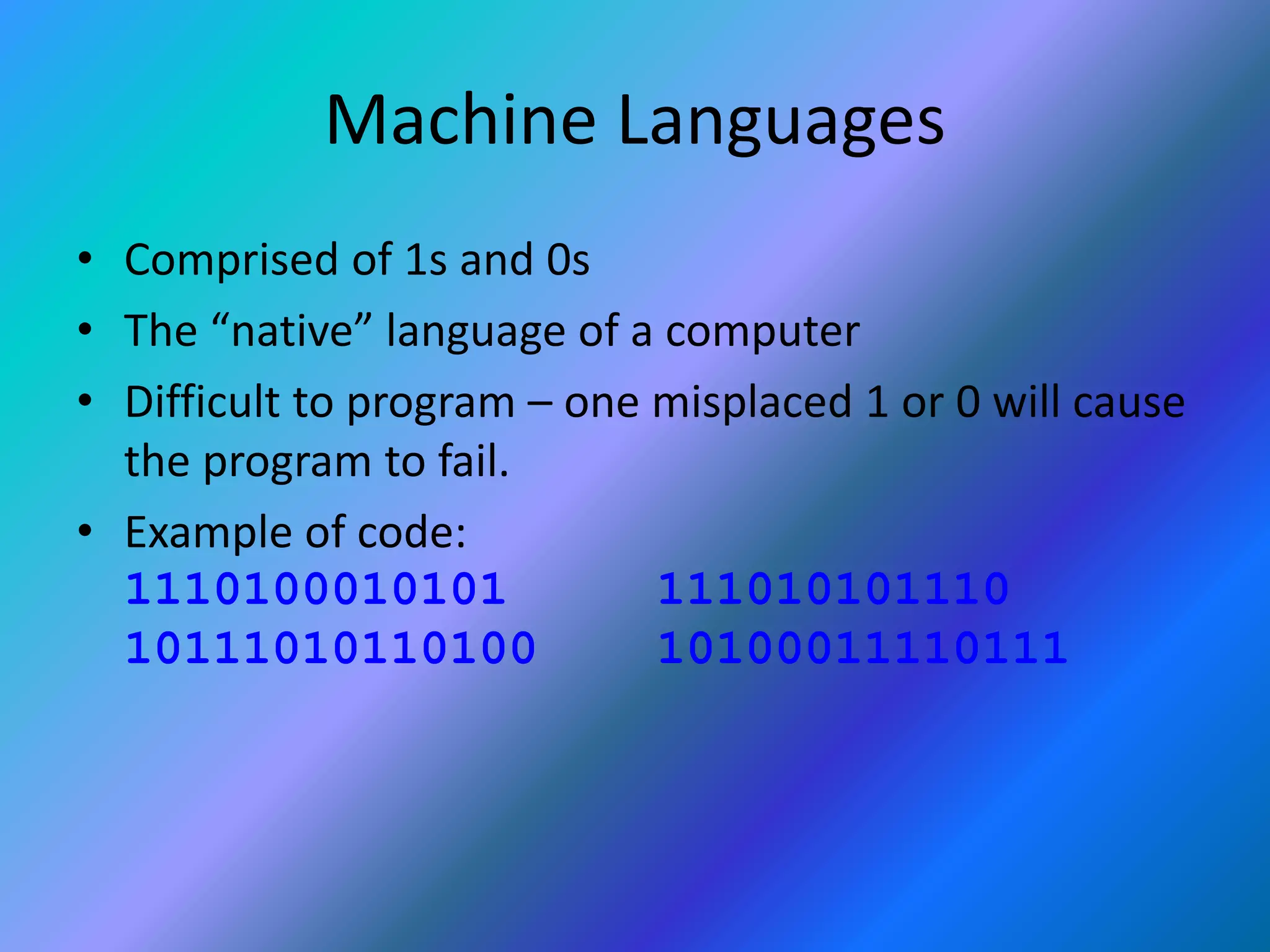
• Comprised of 1s and 0s
• The “native” language of a computer
• Difficult to program – one misplaced 1 or 0 will cause
the program to fail.
• Example of code:
1110100010101 111010101110
10111010110100 10100011110111
Assembly Languages
• Assembly languages are a step towards easier
programming.
• Each assembly language is specific to a particular
computer architecture.
• Assembly language code needs to be translated to
machine language before the computer processes it.
• They are translated by an assembler into machine
language.
• Assembly language uses mnemonic to represent
each low level machine instruction or opcode, also
each architectural register,flag.
High-Level Languages
• High-level languages represent a giant leap towards
easier programming.
• The syntax of HL languages is similar to English.
• It is converted into machine level language by
compiler.
• Historically, we divide HL languages into two groups:
– Procedure oriented programming
– Object-Oriented programming (OOP)
Procedure oriented programming
• Early high-level languages are typically called
procedural languages.
• Procedural languages are characterized by sequential
sets of linear commands. The focus of such
languages is on structure.
• Examples include C, COBOL, Fortran, LISP, Perl,
HTML, VBScript
Procedure oriented programming
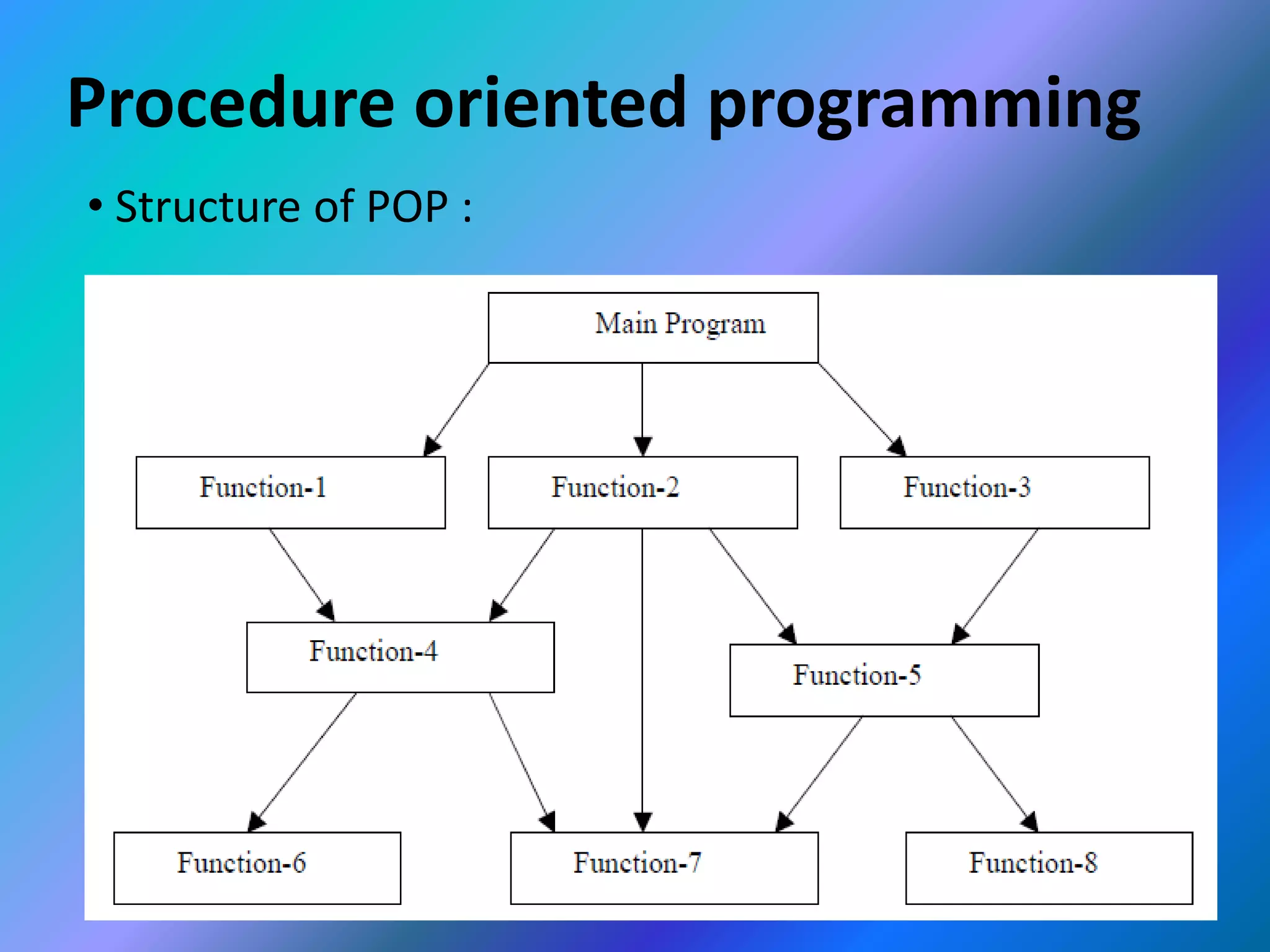
• Structure of POP :
Procedure oriented programming
• Features :
 Emphasis is on procedure of doing things.
 Larger programs are divided into smaller programs
called functions.
 Data can move openly around the system from
function to function.
 Adding of data and function is difficult.
 Top down approach in program design.
Object-Oriented Programming
Definition of OOP:
• Object oriented programming is a programming
methodology that associates data structures with a
set of operators which act upon it.
Object-Oriented Programming
• Most object-oriented languages are high-level
languages.
• The focus of OOP languages is not on structure, but
on modeling data.
• Programmers code using “blueprints” of data models
called classes.
• Examples of OOP languages include C++, Visual
Basic.NET and Java.
Object-Oriented Programming
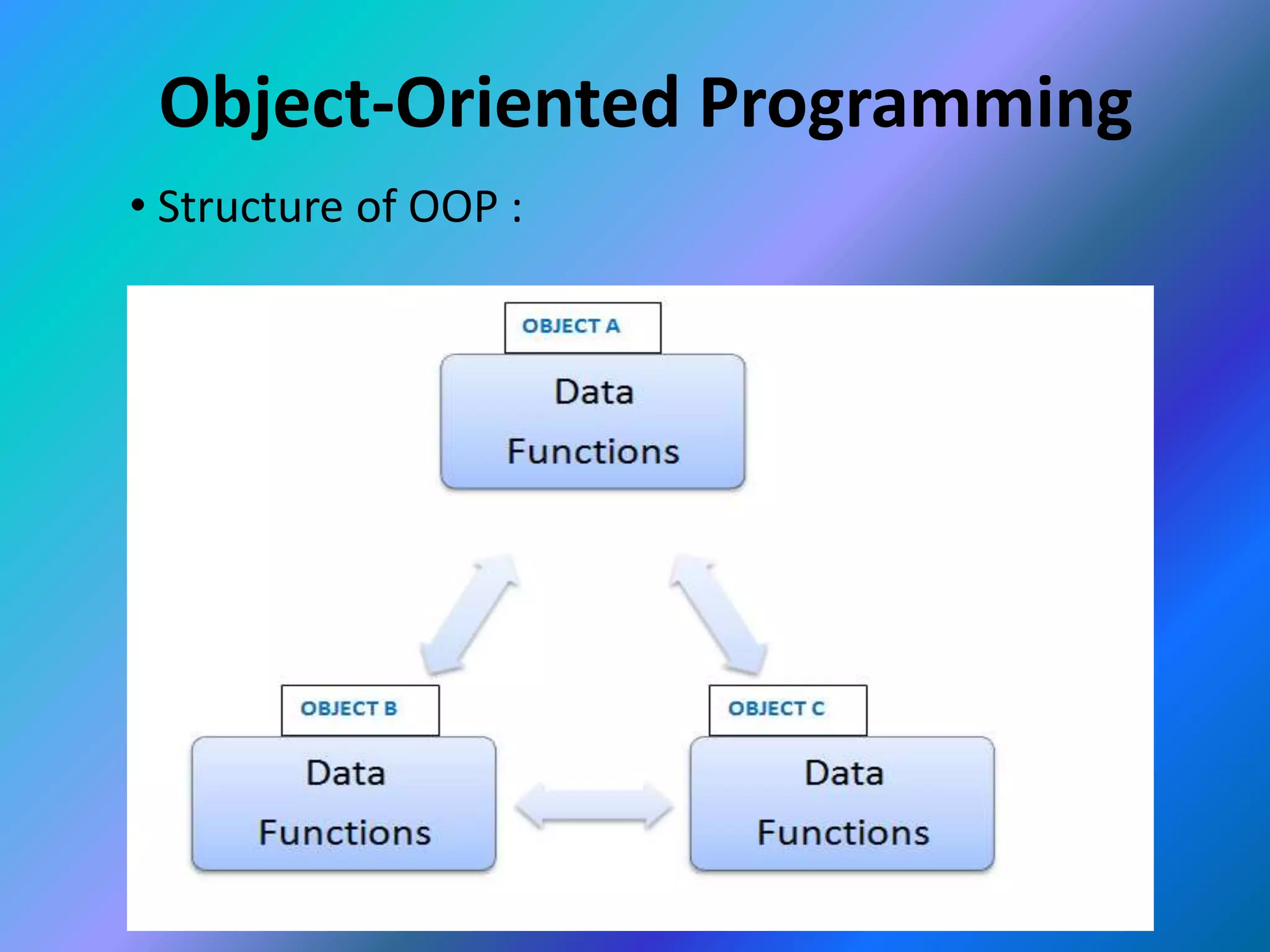
• Structure of OOP :
Object-Oriented Programming
• Features :
 Emphasis is on data.
 Programs are divided into objects and classes.
 Data is hidden and cannot be accessed by the
external function.
 New data and functions can be added when
necessary.
 Bottom up approach in program design.
Elements of OOP
• Objects
• Classes
• Encapsulation
• Data Abstraction
• Inheritance
• Polymorphism
• Message Passing
Objects
• OOP uses objects as its fundamental building blocks.
• Objects are the basic run-time entities in an object-
oriented system.
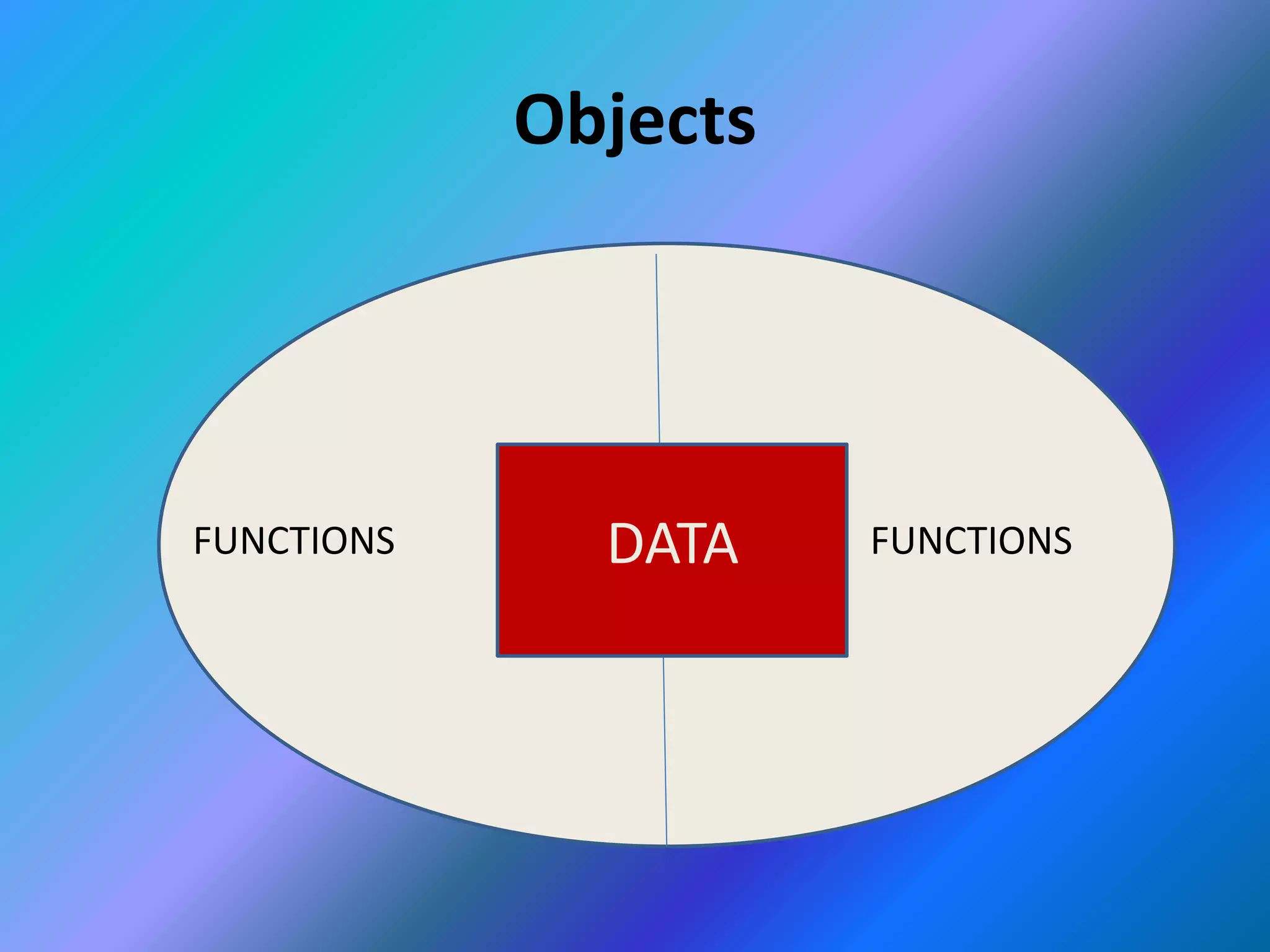
• Every object is associated with data and functions
which define meaningful operations on that object.
• Object is a real world existing entity.
• Object is an Instance of a particular class.
Objects
DATAFUNCTIONS FUNCTIONS
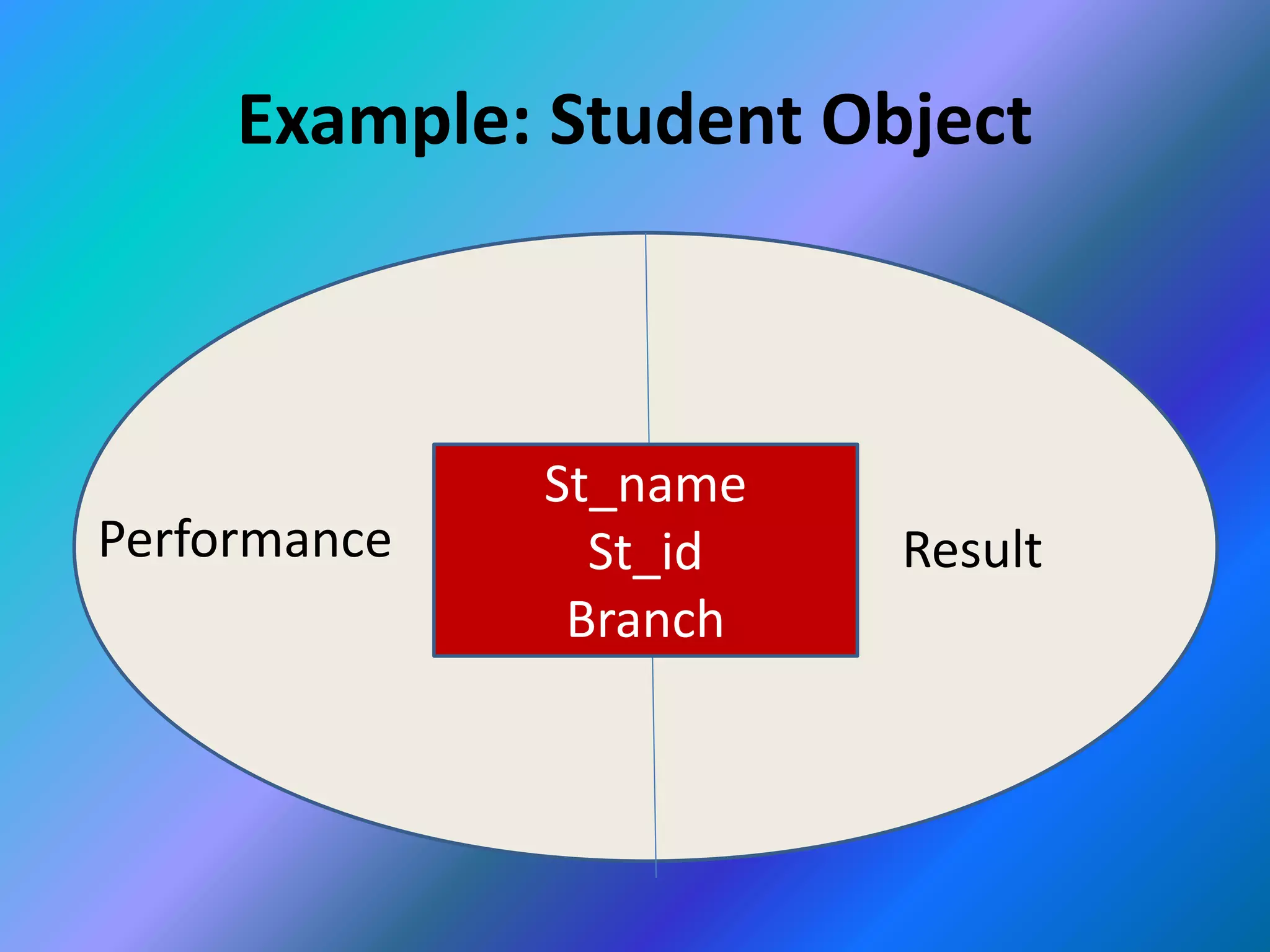
Example: Student Object
St_name
St_id
Branch
Performance Result
Class
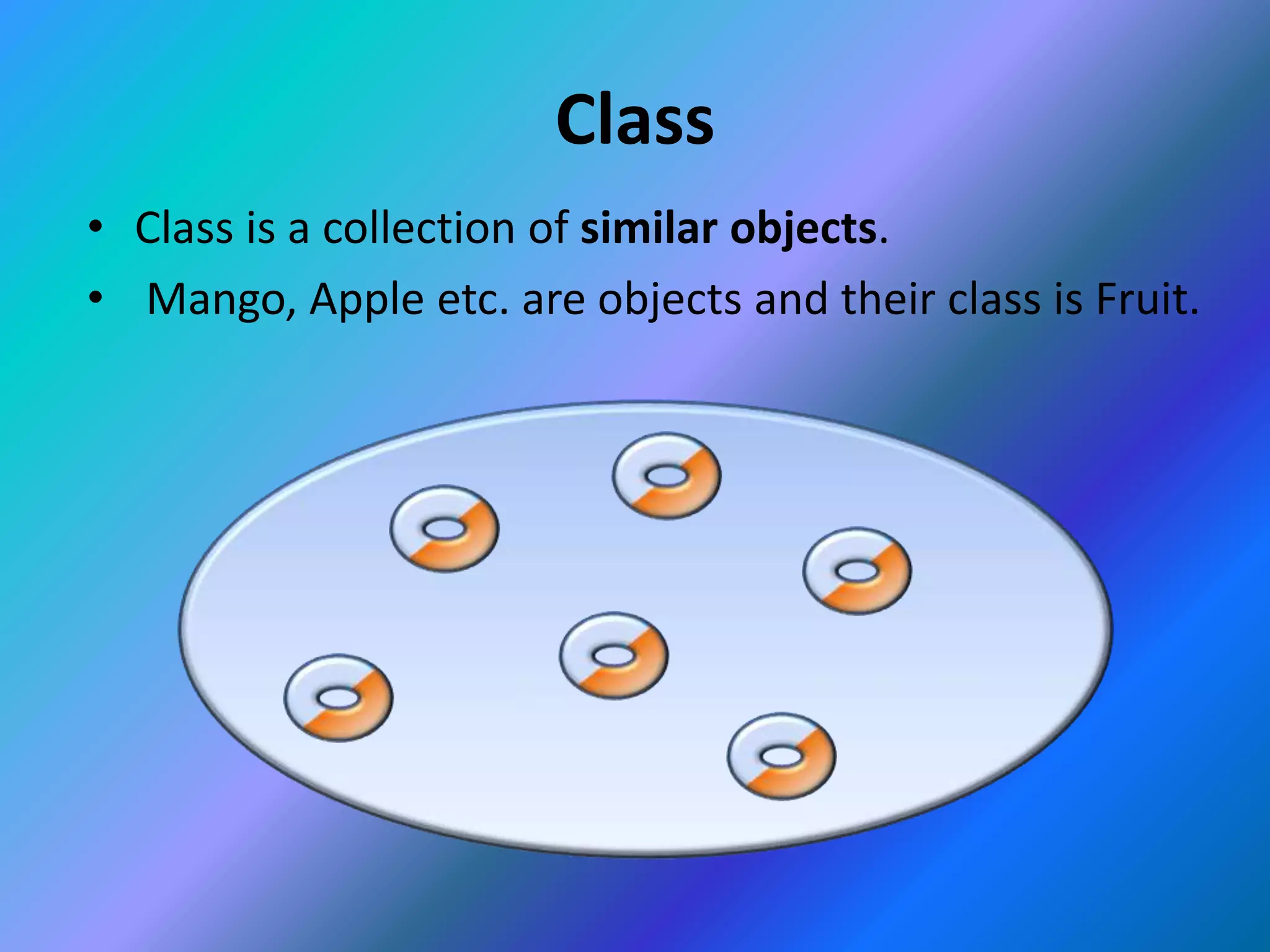
• Class is a collection of similar objects.
• Mango, Apple etc. are objects and their class is Fruit.
Encapsulation
• Wrapping up of data and functions into a single unit
(class) is called encapsulation.
• Data is not accessible to outside world.
• Only those functions which are which are wrapped in
the class can access it.
Data Abstraction
• A data abstraction is a simplified view of an object
that includes only features one is interested in while
hides away the unnecessary details.
• Data abstraction becomes an abstract data type
(ADT)or a user-defined type.
Inheritance
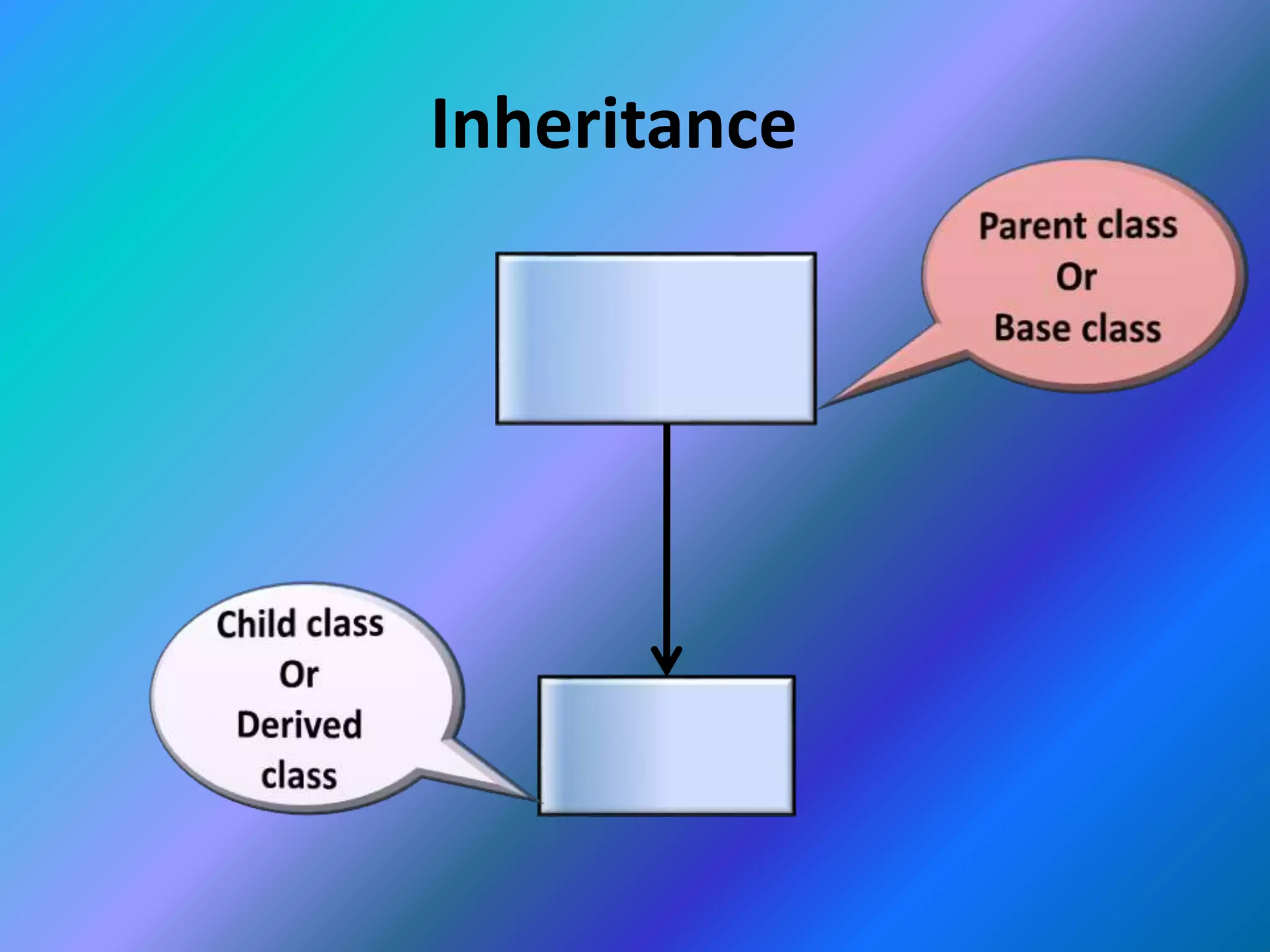
• Inheritance is the mechanism to provides the power
of reusability and extendibility.
• Inheritance is the process by which one object can
acquire the properties of another
object.
• Types :
 Single
 Multilevel
 Multiple
 Hybrid
 Hierarchical
Inheritance
Polymorphism
• Poly means many. Morphism means forms.
• Polymorphism means that the same thing can exist
in two forms.
• Polymorphism is in short the ability to call different
functions by just using one type of function call.
• Ex : Bank can be used as - bank (river)
- bank (finance)
Message Passing
• Information or message of one object can be sent to
other object.
• Object communicate with one another by sending
and receiving information much the same way as
people communicate with each other.
• A message for an object is a request for execution of
a proedure and it will invoke a procedure in receiving
object that generates the desired result.
Message Passing
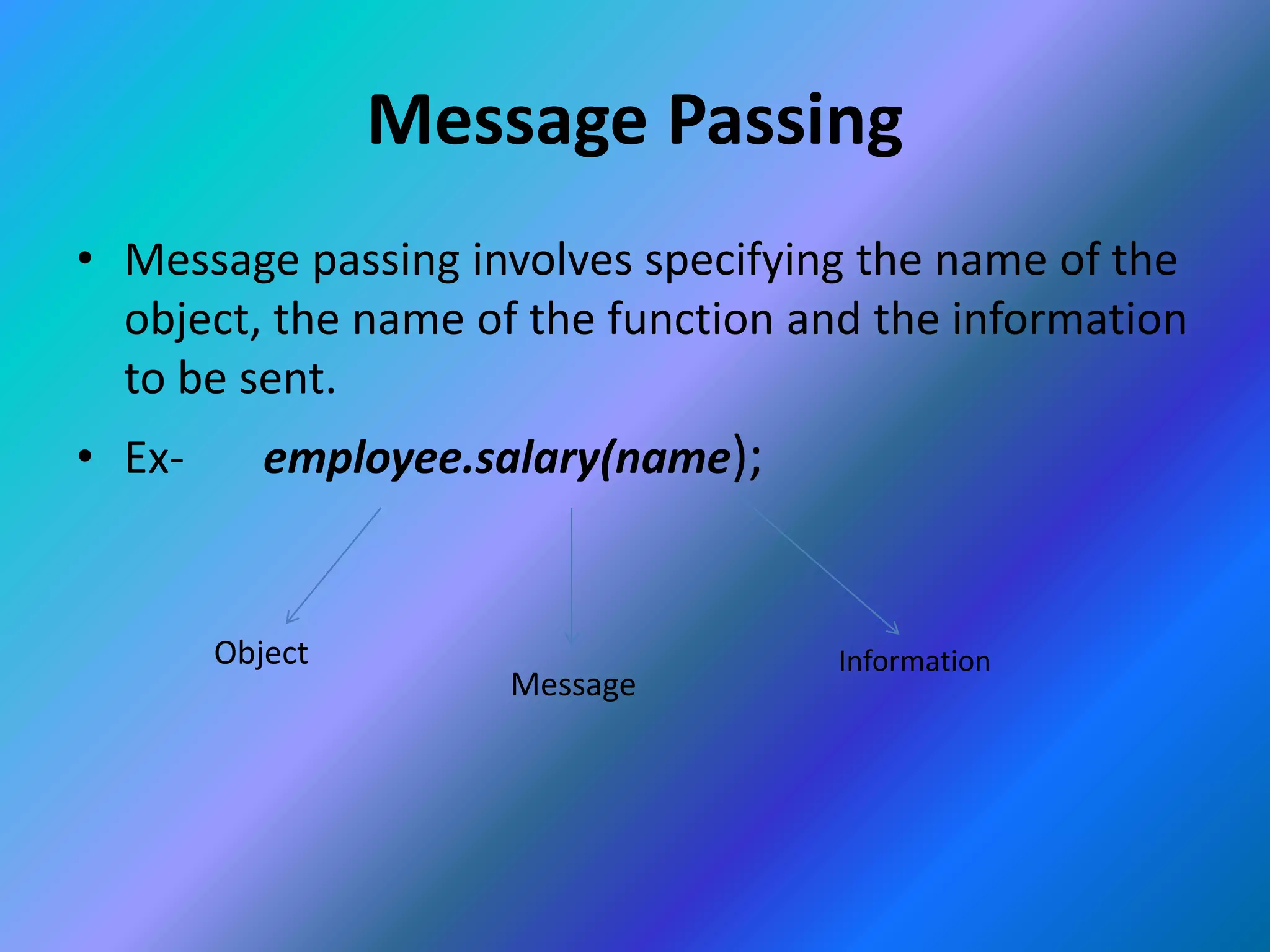
• Message passing involves specifying the name of the
object, the name of the function and the information
to be sent.
• Ex- employee.salary(name);
Object
Message
Information
Benefits of OOP
• Through inheritance we can extend the use of
existing classes.
• Build secure program by data hiding.
• Message passing techniques for communication
between objects make is much simplier.
• It is easy to partition the work in a project based on
object.
Applications of OOP
• Database management systems
• Data security
• Artificial intelligence and expert systems
• Mobile computing
• Real time systems
• Simulation and modeling
• Distributed computing
Introduction to oop with c++

Introduction to oop with c++

  • 1.
    INTRODUCTION TO OBJECT -ORIENTED PROGRAMMING PREPARED BY Patel Shruti J. BE- 4th sem
  • 2.
    Programming Languages • Programminglanguages allow programmers to code software. • The three major families of languages are: – Machine languages – Assembly languages – High-Level languages
  • 3.
    Machine Languages • Comprisedof 1s and 0s • The “native” language of a computer • Difficult to program – one misplaced 1 or 0 will cause the program to fail. • Example of code: 1110100010101 111010101110 10111010110100 10100011110111
  • 4.
    Assembly Languages • Assemblylanguages are a step towards easier programming. • Each assembly language is specific to a particular computer architecture. • Assembly language code needs to be translated to machine language before the computer processes it. • They are translated by an assembler into machine language. • Assembly language uses mnemonic to represent each low level machine instruction or opcode, also each architectural register,flag.
  • 5.
    High-Level Languages • High-levellanguages represent a giant leap towards easier programming. • The syntax of HL languages is similar to English. • It is converted into machine level language by compiler. • Historically, we divide HL languages into two groups: – Procedure oriented programming – Object-Oriented programming (OOP)
  • 6.
    Procedure oriented programming •Early high-level languages are typically called procedural languages. • Procedural languages are characterized by sequential sets of linear commands. The focus of such languages is on structure. • Examples include C, COBOL, Fortran, LISP, Perl, HTML, VBScript
  • 7.
  • 8.
    Procedure oriented programming •Features :  Emphasis is on procedure of doing things.  Larger programs are divided into smaller programs called functions.  Data can move openly around the system from function to function.  Adding of data and function is difficult.  Top down approach in program design.
  • 9.
    Object-Oriented Programming Definition ofOOP: • Object oriented programming is a programming methodology that associates data structures with a set of operators which act upon it.
  • 10.
    Object-Oriented Programming • Mostobject-oriented languages are high-level languages. • The focus of OOP languages is not on structure, but on modeling data. • Programmers code using “blueprints” of data models called classes. • Examples of OOP languages include C++, Visual Basic.NET and Java.
  • 11.
  • 12.
    Object-Oriented Programming • Features:  Emphasis is on data.  Programs are divided into objects and classes.  Data is hidden and cannot be accessed by the external function.  New data and functions can be added when necessary.  Bottom up approach in program design.
  • 13.
    Elements of OOP •Objects • Classes • Encapsulation • Data Abstraction • Inheritance • Polymorphism • Message Passing
  • 14.
    Objects • OOP usesobjects as its fundamental building blocks. • Objects are the basic run-time entities in an object- oriented system. • Every object is associated with data and functions which define meaningful operations on that object. • Object is a real world existing entity. • Object is an Instance of a particular class.
  • 15.
  • 16.
  • 17.
    Class • Class isa collection of similar objects. • Mango, Apple etc. are objects and their class is Fruit.
  • 18.
    Encapsulation • Wrapping upof data and functions into a single unit (class) is called encapsulation. • Data is not accessible to outside world. • Only those functions which are which are wrapped in the class can access it.
  • 19.
    Data Abstraction • Adata abstraction is a simplified view of an object that includes only features one is interested in while hides away the unnecessary details. • Data abstraction becomes an abstract data type (ADT)or a user-defined type.
  • 20.
    Inheritance • Inheritance isthe mechanism to provides the power of reusability and extendibility. • Inheritance is the process by which one object can acquire the properties of another object. • Types :  Single  Multilevel  Multiple  Hybrid  Hierarchical
  • 21.
  • 22.
    Polymorphism • Poly meansmany. Morphism means forms. • Polymorphism means that the same thing can exist in two forms. • Polymorphism is in short the ability to call different functions by just using one type of function call. • Ex : Bank can be used as - bank (river) - bank (finance)
  • 23.
    Message Passing • Informationor message of one object can be sent to other object. • Object communicate with one another by sending and receiving information much the same way as people communicate with each other. • A message for an object is a request for execution of a proedure and it will invoke a procedure in receiving object that generates the desired result.
  • 24.
    Message Passing • Messagepassing involves specifying the name of the object, the name of the function and the information to be sent. • Ex- employee.salary(name); Object Message Information
  • 25.
    Benefits of OOP •Through inheritance we can extend the use of existing classes. • Build secure program by data hiding. • Message passing techniques for communication between objects make is much simplier. • It is easy to partition the work in a project based on object.
  • 26.
    Applications of OOP •Database management systems • Data security • Artificial intelligence and expert systems • Mobile computing • Real time systems • Simulation and modeling • Distributed computing