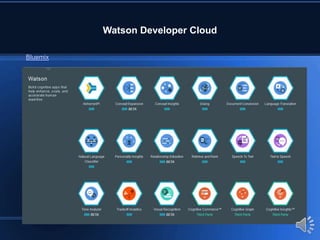
Cognitive Service Introduction
Twitter:@huiwenhan
Weibo:@huiwenhan
Agenda
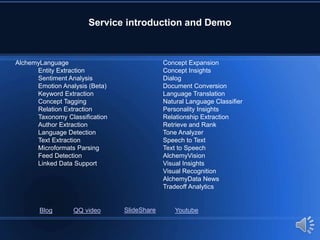
Watson Developer Cloud
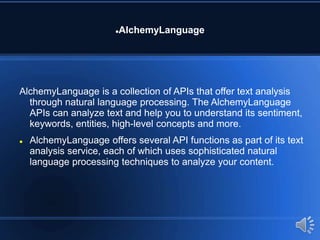
Service introduction and Demo
Watson-developer-cloud SDK
Resources
Watson Developer Cloud
Bluemix
Service introduction and Demo
AlchemyLanguage
Entity Extraction
Sentiment Analysis
Emotion Analysis (Beta)
Keyword Extraction
Concept Tagging
Relation Extraction
Taxonomy Classification
Author Extraction
Language Detection
Text Extraction
Microformats Parsing
Feed Detection
Linked Data Support
Concept Expansion
Concept Insights
Dialog
Document Conversion
Language Translation
Natural Language Classifier
Personality Insights
Relationship Extraction
Retrieve and Rank
Tone Analyzer
Speech to Text
Text to Speech
AlchemyVision
Visual Insights
Visual Recognition
AlchemyData News
Tradeoff Analytics
Blog QQ video SlideShare Youtube
AlchemyLanguage
AlchemyLanguage is a collection of APIs that offer text analysis
through natural language processing. The AlchemyLanguage
APIs can analyze text and help you to understand its sentiment,
keywords, entities, high-level concepts and more.
 AlchemyLanguage offers several API functions as part of its text
analysis service, each of which uses sophisticated natural
language processing techniques to analyze your content.
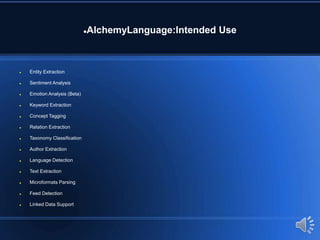
AlchemyLanguage:Intended Use
 Entity Extraction
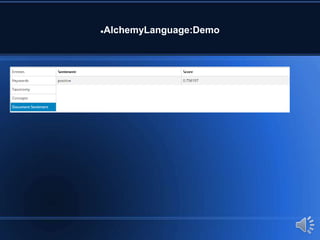
 Sentiment Analysis
 Emotion Analysis (Beta)
 Keyword Extraction
 Concept Tagging
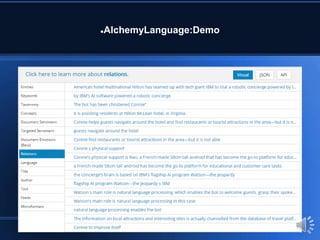
 Relation Extraction
 Taxonomy Classification
 Author Extraction
 Language Detection
 Text Extraction
 Microformats Parsing
 Feed Detection
 Linked Data Support
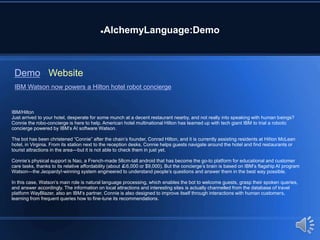
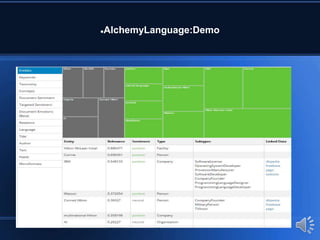
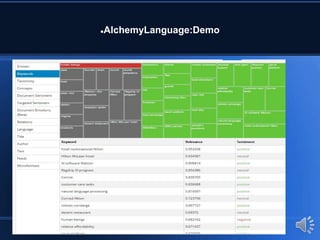
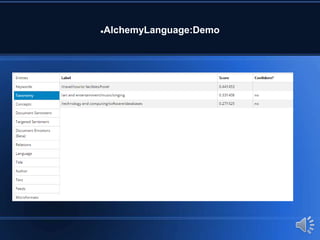
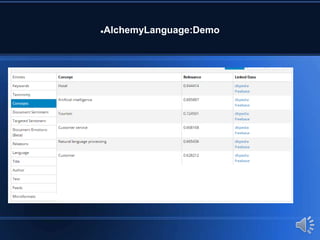
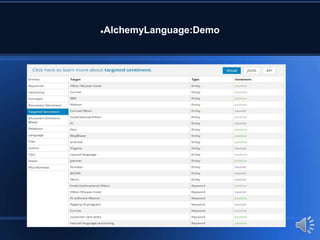
AlchemyLanguage:Demo
Demo Website
IBM/Hilton
Just arrived to your hotel, desperate for some munch at a decent restaurant nearby, and not really into speaking with human beings?
Connie the robo-concierge is here to help. American hotel multinational Hilton has teamed up with tech giant IBM to trial a robotic
concierge powered by IBM’s AI software Watson.
The bot has been christened “Connie” after the chain’s founder, Conrad Hilton, and it is currently assisting residents at Hilton McLean
hotel, in Virginia. From its station next to the reception desks, Connie helps guests navigate around the hotel and find restaurants or
tourist attractions in the area—but it is not able to check them in just yet.
Connie’s physical support is Nao, a French-made 58cm-tall android that has become the go-to platform for educational and customer
care tasks, thanks to its relative affordability (about £6,000 or $9,000). But the concierge’s brain is based on IBM’s flagship AI program
Watson—the Jeopardy!-winning system engineered to understand people’s questions and answer them in the best way possible.
In this case, Watson’s main role is natural language processing, which enables the bot to welcome guests, grasp their spoken queries,
and answer accordingly. The information on local attractions and interesting sites is actually channelled from the database of travel
platform WayBlazer, also an IBM’s partner. Connie is also designed to improve itself through interactions with human customers,
learning from frequent queries how to fine-tune its recommendations.
IBM Watson now powers a Hilton hotel robot concierge
AlchemyLanguage:Demo
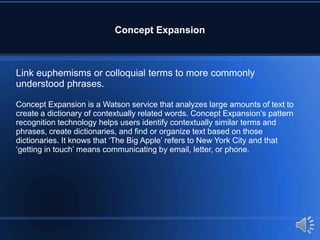
Concept Expansion
Link euphemisms or colloquial terms to more commonly
understood phrases.
Concept Expansion is a Watson service that analyzes large amounts of text to
create a dictionary of contextually related words. Concept Expansion’s pattern
recognition technology helps users identify contextually similar terms and
phrases, create dictionaries, and find or organize text based on those
dictionaries. It knows that ‘The Big Apple’ refers to New York City and that
‘getting in touch’ means communicating by email, letter, or phone.
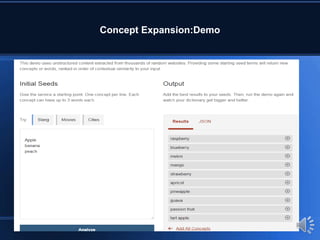
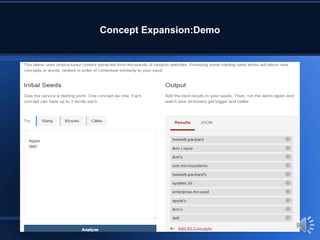
Concept Expansion:Demo
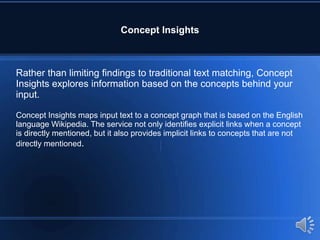
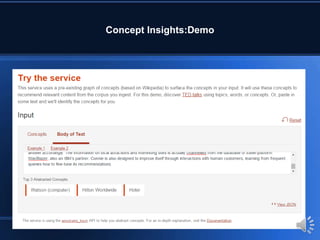
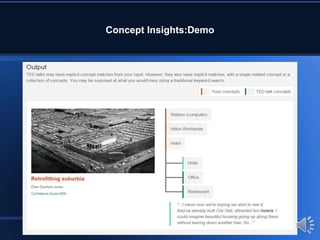
Concept Insights
Rather than limiting findings to traditional text matching, Concept
Insights explores information based on the concepts behind your
input.
Concept Insights maps input text to a concept graph that is based on the English
language Wikipedia. The service not only identifies explicit links when a concept
is directly mentioned, but it also provides implicit links to concepts that are not
directly mentioned.
Concept Insights:Demo
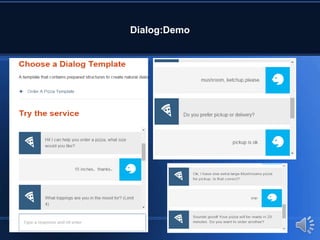
Dialog
Script conversations any way you like to answer questions, walk
through processes, or just to chat!
The IBM Watson Dialog service enables a developer to automate branching
conversations between a user and your application. The Dialog service enables
your applications to use natural language to automatically respond to user
questions, cross-sell and up-sell, walk users through processes or applications, or
even hand-hold users through difficult tasks. The Dialog service can track and
store user profile information to learn more about end users, guide them through
processes based on their unique situation, or pass their information to a back-end
system to help them take action and get the help they need.
Dialog:Demo
Document Conversion
Converts PDF, Word, or HTML documents into HTML, Plain Text, or
JSON Answer Units needed by other Watson services
Service provides an Application Programming Interface (API) that enables
developers to transform a document into a new format. The input is a single PDF,
Word, or HTML document and the output is an HTML document, a Text document,
or Answer units that can be used with other Watson services.
Language Translation
Translate and publish content in multiple languages.
The Watson Language Translation service provides domain-specific translation
utilizing Statistical Machine Translation techniques that have been perfected in our
research labs over the past few decades. Currently, three domains are available
that provide translation among a total of seven languages. For best results, a
domain that matches the content to be translated should be chosen.
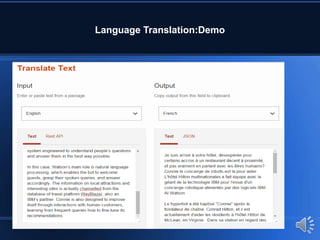
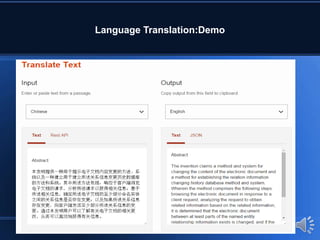
Language Translation:Demo
Natural Language Classifier
Interpret and classify natural language with confidence.
The service enables developers without a background in machine learning or
statistical algorithms to create natural language interfaces for their applications.
The service interprets the intent behind text and returns a corresponding
classification with associated confidence levels. The return value can then be
used to trigger a corresponding action, such as redirecting the request or
answering a question.
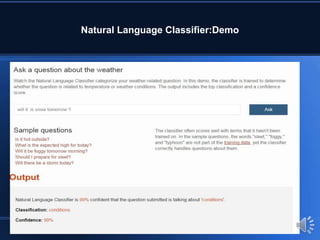
Natural Language Classifier:Demo
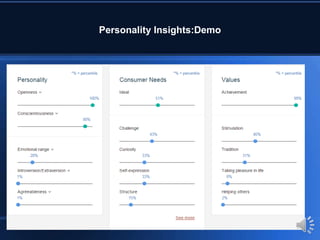
Personality Insights
Uncover a deeper understanding of people’s personality
characteristics, needs, and values to drive personalization.
Personality Insights extracts and analyzes a spectrum of personality attributes to
help discover actionable insights about people and entities, and in turn guides
end users to highly personalized interactions. The service outputs personality
characteristics that are divided into three dimensions: the Big 5, Values, and
Needs. While some services are contextually specific depending on the domain
model and content, Personality Insights only requires a minimum of 3500+
words of any text.
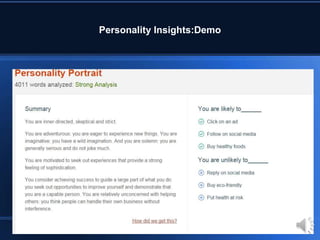
Personality Insights:Demo
Relationship Extraction
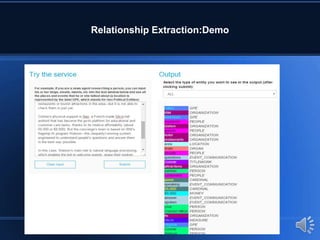
Extracts relationships between different text entities.
Unlike general-purpose text analytics tools, Relationship Extraction leverages
Watson machine learning technologies. The API can analyze news articles and
use statistical modeling to perform linguistic analysis of the input text. It then
finds spans of text and clusters them together to form entities, before finally
extracting the relationships between them.
Relationship Extraction:Demo
Retrieve and Rank
Enhance information retrieval with machine learning.
helps users find the most relevant information for their query by using a
combination of search and machine learning algorithms to detect “signals” in the
data. Built on top of Apache Solr, developers load their data into the service, train
a machine learning model based on known relevant results, then leverage this
model to provide improved results to their end users based on their question or
query.
Tone Analyzer
Discover, understand, and revise the language tones in text.
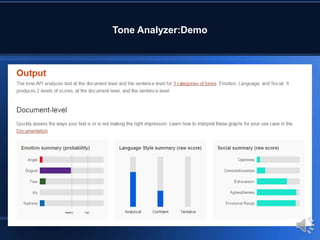
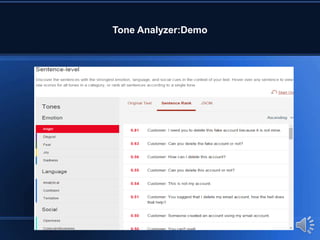
Tone Analyzer might be able to help. The service uses linguistic analysis to detect
and interpret emotional, social, and writing cues found in text.
Tone Analyzer:Demo
Tone Analyzer:Demo
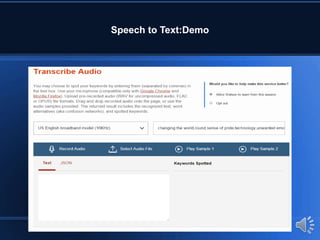
Speech to Text
 The Speech to Text service converts the human voice into the
written word.
 Watson Speech to Text can be used anywhere there is a need to bridge the
gap between the spoken word and its written form. This easy-to-use service
uses machine intelligence to combine information about grammar and
language structure with knowledge of the composition of an audio signal to
generate an accurate transcription. It uses IBM’s speech recognition
capabilities to convert speech in multiple languages into text. The
transcription of incoming audio is continuously sent back to the client with
minimal delay, and it is corrected as more speech is heard. Additionally, the
service now includes the ability to detect one or more keywords in the audio
stream. The service is accessed via a WebSocket connection or REST API.
Speech to Text:Demo
Text to Speech
 Designed for streaming low-latency synthesis of audio from
written text. The service synthesizes natural-sounding speech
from input text in a variety of languages and voices that speak
with appropriate cadence and intonation.
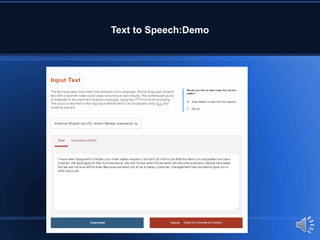
 Watson Text to Speech provides a REST API to synthesize speech audio
from an input of plain text. Multiple voices, both male and female, are
available across Brazilian Portuguese, English, French, German, Italian,
Japanese, and Spanish. Once synthesized in real-time, the audio is
streamed back to the client with minimal delay. The Text to Speech service
now enables developers to control the pronunciation of specific words.
Text to Speech:Demo
AlchemyVision
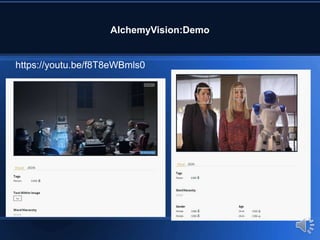
 AlchemyVision is an API that can analyze an image and return
the objects, people, and text found within the image.
AlchemyVision can enhance the way businesses make
decisions by integrating image cognition.
 AlchemyVision employs our deep learning innovations to understand a
picture’s content and context.
AlchemyVision:Demo
https://youtu.be/f8T8eWBmls0
Visual Insights
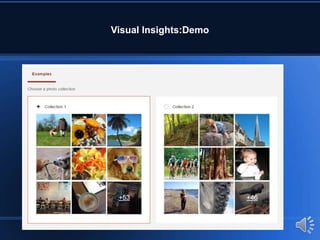
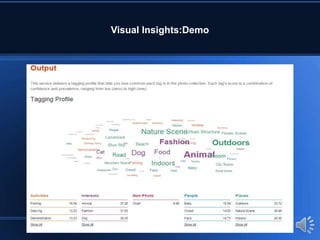
 Visual Insights enhances the customer view by analyzing online
photos and video to extract consumer insights related to
interests, activities, hobbies, life events, and products
 With so many social media channels used by a brand it’s important to know
not only your customers, but also your competitors to ensure alignment
across channels. Visual Insights works to give users tools to ensure
consistency across those social media channels, segment customers to an
individual level, create targeted campaigns, and align their social media
output to followers’ preferences by running comparative analysis with
competitors’ feeds.
Visual Insights:Demo
Visual Recognition
 Understand the contents of images. Trainable for custom
content.
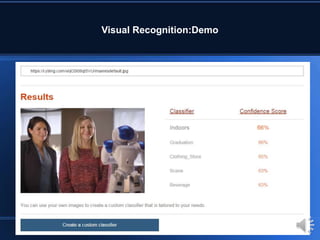
 Visual Recognition allows users to understand the contents of an image or
video frame, answering the question: “What is in this image?” Submit an
image, and the service returns scores for relevant classifiers representing
things such as objects, events and settings. What types of images are
relevant to your business? How could you benefit from understanding and
organizing those images based on their contents? With Visual Recognition,
users can automatically identify subjects and objects contained within the
image and organize and classify these images into logical categories. Need
to train Visual Recognition on specific or custom content? Easily train a new
classifier by sending examples and voila! Custom image recognition!
Visual Recognition:Demo
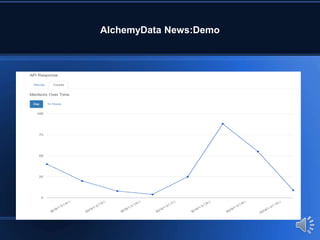
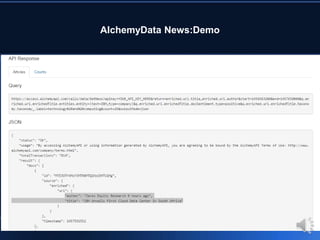
AlchemyData News
 AlchemyData provides news and blog content enriched with
natural language processing to allow for highly targeted search
and trend analysis. Now you can query the world’s news
sources and blogs like a database.
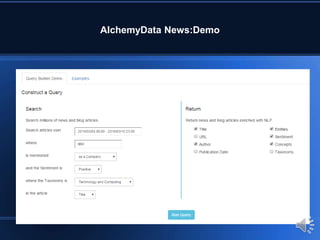
 AlchemyData News indexes 250k to 300k English language news and blog
articles every day with historical search available for the past 60 days. You
can query the News API directly with no need to acquire, enrich and store
the data themselves – enabling you to go beyond simple keyword-based
searches.
AlchemyData News:Demo
Tradeoff Analytics
 Helps users make better choices to best meet multiple
conflicting goals.
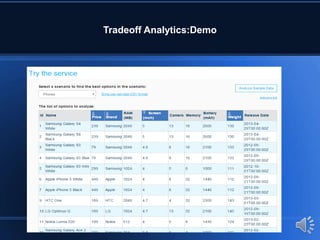
 Tradeoff Analytics is a Watson service that helps people make decisions
when balancing multiple objectives. The service uses a mathematical
filtering technique called “Pareto Optimization,” that enables users to explore
tradeoffs when considering multiple criteria for a single decision. When your
company makes decisions, how many factors need to be considered?
What’s the process like? How do you know when you’ve found the best
option? With Tradeoff Analytics, users can avoid lists of endless options and
identify the right option by considering multiple objectives.
Tradeoff Analytics:Demo
Watson-developer-cloud SDK and App
 SDK: Github
 python-sdk
 ios-sdk
 node-sdk
 speech-javascript-sdk
 speech-android-sdk
 java-sdk
 unity-sdk
 speech-ios-sdk
Watson-developer-cloud SDK and App
App Gallery :Gallery :
 IBM Watson Trend,
 Sentiment and Emotion,
 Election Insights,
 Investment Advisor,
 Speech to Speech,
 Questions on the Natural Language Classifier,
 What's In Theaters,
 News Explorer,
 Watson Rover,
 Cognitive Head Hunter,
 Designer Match,
 NYC School Finder,
 Nests,
 SF Life,
 Your Celebrity Match,
 People in the News.
Watson-developer-cloud SDK
 Java SDK :
 Installation
 Maven
 Gradle
 Usage
 Getting the Service Credentials
 Questions
 IBM Watson Services
 Alchemy Language
 Alchemy Vision
 Alchemy Data News
 Concept Expansion
 Concept Insights
 Dialog
 Document Conversion
 Language Translation
Watson-developer-cloud SDK
 Java SDK :
 Natural Language Classifier
 Personality Insights
 Relationship Extraction
 Retrieve and Rank
 Speech to Text
 Text to Speech
 Tone Analyzer
 Tradeoff Analytics
 Visual Insights
 Visual Recognition
 Android
 Running in Bluemix
 Eclipse and Intellij
Watson-developer-cloud SDK
 Alchemy Data News
 Alchemy Data News indexes 250k to 300k English language news and blog articles every day with historical search available for the past 60 days.
Example: Get 7 documents between Friday 28th August 2015 and Friday 4th September 2015.
 AlchemyDataNews service = new AlchemyDataNews();
 service.setApiKey("<api_key>");
 Map<String, Object> params = new HashMap<String, Object>();
 String[] fields =
 new String[] {"enriched.url.title", "enriched.url.url", "enriched.url.author",
 "enriched.url.publicationDate", "enriched.url.enrichedTitle.entities",
 "enriched.url.enrichedTitle.docSentiment"};
 params.put(AlchemyDataNews.RETURN, StringUtils.join(fields, ","));
 params.put(AlchemyDataNews.START, "1440720000");
 params.put(AlchemyDataNews.END, "1441407600");
 params.put(AlchemyDataNews.COUNT, 7);
 DocumentsResult result = service.getNewsDocuments(params);
 System.out.println(result);
Watson-developer-cloud SDK
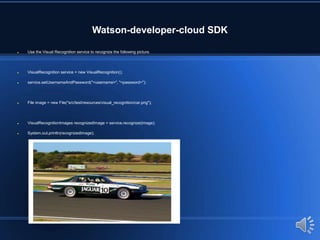
 Use the Visual Recognition service to recognize the following picture.
 VisualRecognition service = new VisualRecognition();
 service.setUsernameAndPassword("<username>", "<password>");
 File image = new File("src/test/resources/visual_recognition/car.png");
 VisualRecognitionImages recognizedImage = service.recognize(image);
 System.out.println(recognizedImage);
Resources
 DW:
 https://developer.ibm.com/watson/
 https://www.ibm.com/developerworks/topics/watson/
 Weibo:
 http://weibo.com/huiwenhan
 WeChat offical Acount :
 intelligentcomputing
Contact me:
WeChat: huiwen_han
Weibo
Facebook
Linkedin
Twitter

IBM cognitive service introduction

  • 1.
  • 2.
    Agenda Watson Developer Cloud Serviceintroduction and Demo Watson-developer-cloud SDK Resources
  • 3.
  • 4.
    Service introduction andDemo AlchemyLanguage Entity Extraction Sentiment Analysis Emotion Analysis (Beta) Keyword Extraction Concept Tagging Relation Extraction Taxonomy Classification Author Extraction Language Detection Text Extraction Microformats Parsing Feed Detection Linked Data Support Concept Expansion Concept Insights Dialog Document Conversion Language Translation Natural Language Classifier Personality Insights Relationship Extraction Retrieve and Rank Tone Analyzer Speech to Text Text to Speech AlchemyVision Visual Insights Visual Recognition AlchemyData News Tradeoff Analytics Blog QQ video SlideShare Youtube
  • 5.
    AlchemyLanguage AlchemyLanguage is acollection of APIs that offer text analysis through natural language processing. The AlchemyLanguage APIs can analyze text and help you to understand its sentiment, keywords, entities, high-level concepts and more.  AlchemyLanguage offers several API functions as part of its text analysis service, each of which uses sophisticated natural language processing techniques to analyze your content.
  • 6.
    AlchemyLanguage:Intended Use  EntityExtraction  Sentiment Analysis  Emotion Analysis (Beta)  Keyword Extraction  Concept Tagging  Relation Extraction  Taxonomy Classification  Author Extraction  Language Detection  Text Extraction  Microformats Parsing  Feed Detection  Linked Data Support
  • 7.
    AlchemyLanguage:Demo Demo Website IBM/Hilton Just arrivedto your hotel, desperate for some munch at a decent restaurant nearby, and not really into speaking with human beings? Connie the robo-concierge is here to help. American hotel multinational Hilton has teamed up with tech giant IBM to trial a robotic concierge powered by IBM’s AI software Watson. The bot has been christened “Connie” after the chain’s founder, Conrad Hilton, and it is currently assisting residents at Hilton McLean hotel, in Virginia. From its station next to the reception desks, Connie helps guests navigate around the hotel and find restaurants or tourist attractions in the area—but it is not able to check them in just yet. Connie’s physical support is Nao, a French-made 58cm-tall android that has become the go-to platform for educational and customer care tasks, thanks to its relative affordability (about £6,000 or $9,000). But the concierge’s brain is based on IBM’s flagship AI program Watson—the Jeopardy!-winning system engineered to understand people’s questions and answer them in the best way possible. In this case, Watson’s main role is natural language processing, which enables the bot to welcome guests, grasp their spoken queries, and answer accordingly. The information on local attractions and interesting sites is actually channelled from the database of travel platform WayBlazer, also an IBM’s partner. Connie is also designed to improve itself through interactions with human customers, learning from frequent queries how to fine-tune its recommendations. IBM Watson now powers a Hilton hotel robot concierge
  • 8.
  • 9.
  • 10.
  • 11.
  • 12.
  • 13.
  • 14.
  • 15.
    Concept Expansion Link euphemismsor colloquial terms to more commonly understood phrases. Concept Expansion is a Watson service that analyzes large amounts of text to create a dictionary of contextually related words. Concept Expansion’s pattern recognition technology helps users identify contextually similar terms and phrases, create dictionaries, and find or organize text based on those dictionaries. It knows that ‘The Big Apple’ refers to New York City and that ‘getting in touch’ means communicating by email, letter, or phone.
  • 16.
  • 17.
  • 18.
    Concept Insights Rather thanlimiting findings to traditional text matching, Concept Insights explores information based on the concepts behind your input. Concept Insights maps input text to a concept graph that is based on the English language Wikipedia. The service not only identifies explicit links when a concept is directly mentioned, but it also provides implicit links to concepts that are not directly mentioned.
  • 19.
  • 20.
  • 21.
    Dialog Script conversations anyway you like to answer questions, walk through processes, or just to chat! The IBM Watson Dialog service enables a developer to automate branching conversations between a user and your application. The Dialog service enables your applications to use natural language to automatically respond to user questions, cross-sell and up-sell, walk users through processes or applications, or even hand-hold users through difficult tasks. The Dialog service can track and store user profile information to learn more about end users, guide them through processes based on their unique situation, or pass their information to a back-end system to help them take action and get the help they need.
  • 22.
  • 23.
    Document Conversion Converts PDF,Word, or HTML documents into HTML, Plain Text, or JSON Answer Units needed by other Watson services Service provides an Application Programming Interface (API) that enables developers to transform a document into a new format. The input is a single PDF, Word, or HTML document and the output is an HTML document, a Text document, or Answer units that can be used with other Watson services.
  • 24.
    Language Translation Translate andpublish content in multiple languages. The Watson Language Translation service provides domain-specific translation utilizing Statistical Machine Translation techniques that have been perfected in our research labs over the past few decades. Currently, three domains are available that provide translation among a total of seven languages. For best results, a domain that matches the content to be translated should be chosen.
  • 25.
  • 26.
  • 27.
    Natural Language Classifier Interpretand classify natural language with confidence. The service enables developers without a background in machine learning or statistical algorithms to create natural language interfaces for their applications. The service interprets the intent behind text and returns a corresponding classification with associated confidence levels. The return value can then be used to trigger a corresponding action, such as redirecting the request or answering a question.
  • 28.
  • 29.
    Personality Insights Uncover adeeper understanding of people’s personality characteristics, needs, and values to drive personalization. Personality Insights extracts and analyzes a spectrum of personality attributes to help discover actionable insights about people and entities, and in turn guides end users to highly personalized interactions. The service outputs personality characteristics that are divided into three dimensions: the Big 5, Values, and Needs. While some services are contextually specific depending on the domain model and content, Personality Insights only requires a minimum of 3500+ words of any text.
  • 30.
  • 31.
  • 32.
    Relationship Extraction Extracts relationshipsbetween different text entities. Unlike general-purpose text analytics tools, Relationship Extraction leverages Watson machine learning technologies. The API can analyze news articles and use statistical modeling to perform linguistic analysis of the input text. It then finds spans of text and clusters them together to form entities, before finally extracting the relationships between them.
  • 33.
  • 34.
    Retrieve and Rank Enhanceinformation retrieval with machine learning. helps users find the most relevant information for their query by using a combination of search and machine learning algorithms to detect “signals” in the data. Built on top of Apache Solr, developers load their data into the service, train a machine learning model based on known relevant results, then leverage this model to provide improved results to their end users based on their question or query.
  • 35.
    Tone Analyzer Discover, understand,and revise the language tones in text. Tone Analyzer might be able to help. The service uses linguistic analysis to detect and interpret emotional, social, and writing cues found in text.
  • 36.
  • 37.
  • 38.
    Speech to Text The Speech to Text service converts the human voice into the written word.  Watson Speech to Text can be used anywhere there is a need to bridge the gap between the spoken word and its written form. This easy-to-use service uses machine intelligence to combine information about grammar and language structure with knowledge of the composition of an audio signal to generate an accurate transcription. It uses IBM’s speech recognition capabilities to convert speech in multiple languages into text. The transcription of incoming audio is continuously sent back to the client with minimal delay, and it is corrected as more speech is heard. Additionally, the service now includes the ability to detect one or more keywords in the audio stream. The service is accessed via a WebSocket connection or REST API.
  • 39.
  • 40.
    Text to Speech Designed for streaming low-latency synthesis of audio from written text. The service synthesizes natural-sounding speech from input text in a variety of languages and voices that speak with appropriate cadence and intonation.  Watson Text to Speech provides a REST API to synthesize speech audio from an input of plain text. Multiple voices, both male and female, are available across Brazilian Portuguese, English, French, German, Italian, Japanese, and Spanish. Once synthesized in real-time, the audio is streamed back to the client with minimal delay. The Text to Speech service now enables developers to control the pronunciation of specific words.
  • 41.
  • 42.
    AlchemyVision  AlchemyVision isan API that can analyze an image and return the objects, people, and text found within the image. AlchemyVision can enhance the way businesses make decisions by integrating image cognition.  AlchemyVision employs our deep learning innovations to understand a picture’s content and context.
  • 43.
  • 44.
    Visual Insights  VisualInsights enhances the customer view by analyzing online photos and video to extract consumer insights related to interests, activities, hobbies, life events, and products  With so many social media channels used by a brand it’s important to know not only your customers, but also your competitors to ensure alignment across channels. Visual Insights works to give users tools to ensure consistency across those social media channels, segment customers to an individual level, create targeted campaigns, and align their social media output to followers’ preferences by running comparative analysis with competitors’ feeds.
  • 45.
  • 46.
  • 47.
    Visual Recognition  Understandthe contents of images. Trainable for custom content.  Visual Recognition allows users to understand the contents of an image or video frame, answering the question: “What is in this image?” Submit an image, and the service returns scores for relevant classifiers representing things such as objects, events and settings. What types of images are relevant to your business? How could you benefit from understanding and organizing those images based on their contents? With Visual Recognition, users can automatically identify subjects and objects contained within the image and organize and classify these images into logical categories. Need to train Visual Recognition on specific or custom content? Easily train a new classifier by sending examples and voila! Custom image recognition!
  • 48.
  • 49.
    AlchemyData News  AlchemyDataprovides news and blog content enriched with natural language processing to allow for highly targeted search and trend analysis. Now you can query the world’s news sources and blogs like a database.  AlchemyData News indexes 250k to 300k English language news and blog articles every day with historical search available for the past 60 days. You can query the News API directly with no need to acquire, enrich and store the data themselves – enabling you to go beyond simple keyword-based searches.
  • 50.
  • 51.
  • 52.
  • 53.
    Tradeoff Analytics  Helpsusers make better choices to best meet multiple conflicting goals.  Tradeoff Analytics is a Watson service that helps people make decisions when balancing multiple objectives. The service uses a mathematical filtering technique called “Pareto Optimization,” that enables users to explore tradeoffs when considering multiple criteria for a single decision. When your company makes decisions, how many factors need to be considered? What’s the process like? How do you know when you’ve found the best option? With Tradeoff Analytics, users can avoid lists of endless options and identify the right option by considering multiple objectives.
  • 54.
  • 55.
    Watson-developer-cloud SDK andApp  SDK: Github  python-sdk  ios-sdk  node-sdk  speech-javascript-sdk  speech-android-sdk  java-sdk  unity-sdk  speech-ios-sdk
  • 56.
    Watson-developer-cloud SDK andApp App Gallery :Gallery :  IBM Watson Trend,  Sentiment and Emotion,  Election Insights,  Investment Advisor,  Speech to Speech,  Questions on the Natural Language Classifier,  What's In Theaters,  News Explorer,  Watson Rover,  Cognitive Head Hunter,  Designer Match,  NYC School Finder,  Nests,  SF Life,  Your Celebrity Match,  People in the News.
  • 57.
    Watson-developer-cloud SDK  JavaSDK :  Installation  Maven  Gradle  Usage  Getting the Service Credentials  Questions  IBM Watson Services  Alchemy Language  Alchemy Vision  Alchemy Data News  Concept Expansion  Concept Insights  Dialog  Document Conversion  Language Translation
  • 58.
    Watson-developer-cloud SDK  JavaSDK :  Natural Language Classifier  Personality Insights  Relationship Extraction  Retrieve and Rank  Speech to Text  Text to Speech  Tone Analyzer  Tradeoff Analytics  Visual Insights  Visual Recognition  Android  Running in Bluemix  Eclipse and Intellij
  • 59.
    Watson-developer-cloud SDK  AlchemyData News  Alchemy Data News indexes 250k to 300k English language news and blog articles every day with historical search available for the past 60 days. Example: Get 7 documents between Friday 28th August 2015 and Friday 4th September 2015.  AlchemyDataNews service = new AlchemyDataNews();  service.setApiKey("<api_key>");  Map<String, Object> params = new HashMap<String, Object>();  String[] fields =  new String[] {"enriched.url.title", "enriched.url.url", "enriched.url.author",  "enriched.url.publicationDate", "enriched.url.enrichedTitle.entities",  "enriched.url.enrichedTitle.docSentiment"};  params.put(AlchemyDataNews.RETURN, StringUtils.join(fields, ","));  params.put(AlchemyDataNews.START, "1440720000");  params.put(AlchemyDataNews.END, "1441407600");  params.put(AlchemyDataNews.COUNT, 7);  DocumentsResult result = service.getNewsDocuments(params);  System.out.println(result);
  • 60.
    Watson-developer-cloud SDK  Usethe Visual Recognition service to recognize the following picture.  VisualRecognition service = new VisualRecognition();  service.setUsernameAndPassword("<username>", "<password>");  File image = new File("src/test/resources/visual_recognition/car.png");  VisualRecognitionImages recognizedImage = service.recognize(image);  System.out.println(recognizedImage);
  • 61.
    Resources  DW:  https://developer.ibm.com/watson/ https://www.ibm.com/developerworks/topics/watson/  Weibo:  http://weibo.com/huiwenhan  WeChat offical Acount :  intelligentcomputing Contact me: WeChat: huiwen_han Weibo Facebook Linkedin Twitter