CONFIDENTIAL: The information in this document belongs to Boston Institute of Analytics LLC. Any unauthorized sharing of this
material is prohibited and subject to legal action under breach of IP and confidentiality clauses.
Employee Retention Prediction
BY
Subhash kumar
Batch :- AND-JUN2024-DSAI-1
Room NO :- TR 2
Place :- Mumbai
CONFIDENTIAL: The information in this document belongs to Boston Institute of Analytics LLC. Any unauthorized sharing of this
material is prohibited and subject to legal action under breach of IP and confidentiality clauses.
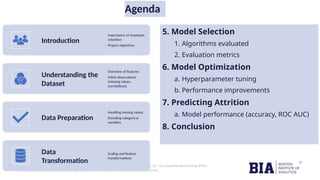
Agenda
Introduction
Importance of employee
retention
Project objectives
Understanding the
Dataset
Overview of features
Initial observations
(missing values,
correlations)
Data Preparation
Handling missing values
Encoding categorical
variables
Data
Transformation
Scaling and feature
transformations
5. Model Selection
1. Algorithms evaluated
2. Evaluation metrics
6. Model Optimization
a. Hyperparameter tuning
b. Performance improvements
7. Predicting Attrition
a. Model performance (accuracy, ROC AUC)
8. Conclusion
CONFIDENTIAL: The information in this document belongs to Boston Institute of Analytics LLC. Any unauthorized sharing of this
material is prohibited and subject to legal action under breach of IP and confidentiality clauses.
Click to edit
Master title
style
Importance of employee retention
• Employee retention is a critical issue for organizations as losing
valuable employees can lead to increased costs, reduced
productivity, and a negative impact on team morale.
Objectives of the project
• This project focuses on using machine learning to predict
employee attrition, helping organizations proactively
address retention challenges.
Introduction
CONFIDENTIAL: The information in this document belongs to Boston Institute of Analytics LLC. Any unauthorized sharing of this
material is prohibited and subject to legal action under breach of IP and confidentiality clauses.
Understanding the Dataset
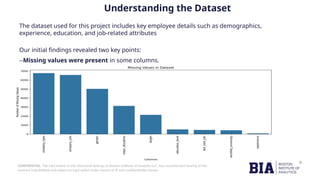
The dataset used for this project includes key employee details such as demographics,
experience, education, and job-related attributes
Our initial findings revealed two key points:
--Missing values were present in some columns.
CONFIDENTIAL: The information in this document belongs to Boston Institute of Analytics LLC. Any unauthorized sharing of this
material is prohibited and subject to legal action under breach of IP and confidentiality clauses.
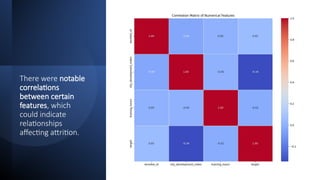
There were notable
correlations
between certain
features, which
could indicate
relationships
affecting attrition.
CONFIDENTIAL: The information in this document belongs to Boston Institute of Analytics LLC. Any unauthorized sharing of this
material is prohibited and subject to legal action under breach of IP and confidentiality clauses.
Preparing the Data
To ensure the data was ready for modeling, we applied several preprocessing steps:
We addressed missing values by imputing the mean for numerical features and the mode
for categorical ones
Categorical data, such as job roles or education levels, was transformed into numeric
formats using one-hot encoding.
These steps were critical in standardizing the dataset and making it usable for machine
learning models.
CONFIDENTIAL: The information in this document belongs to Boston Institute of Analytics LLC. Any unauthorized sharing of this
material is prohibited and subject to legal action under breach of IP and confidentiality clauses.
Transforming the Data
• Next, we scaled the numerical features using a
StandardScaler to normalize the data. This step
was especially important for algorithms
sensitive to feature magnitudes.
• Additionally, we transformed specific features
like 'experience levels' into numerical
equivalents, ensuring consistency and
interpretability.
CONFIDENTIAL: The information in this document belongs to Boston Institute of Analytics LLC. Any unauthorized sharing of this
material is prohibited and subject to legal action under breach of IP and confidentiality clauses.
Choosing the Right Model
• Several machine learning models were
tested, including Logistic Regression,
Random Forest, XGBoost, and
LightGBM
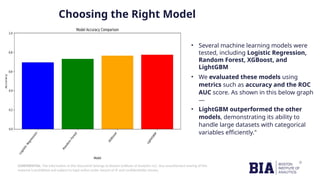
• We evaluated these models using
metrics such as accuracy and the ROC
AUC score. As shown in this below graph
—
• LightGBM outperformed the other
models, demonstrating its ability to
handle large datasets with categorical
variables efficiently."
CONFIDENTIAL: The information in this document belongs to Boston Institute of Analytics LLC. Any unauthorized sharing of this
material is prohibited and subject to legal action under breach of IP and confidentiality clauses.
Improving the Model with Hyperparameter
Tuning
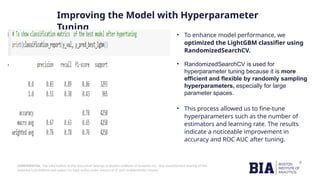
• To enhance model performance, we
optimized the LightGBM classifier using
RandomizedSearchCV.
• RandomizedSearchCV is used for
hyperparameter tuning because it is more
efficient and flexible by randomly sampling
hyperparameters, especially for large
parameter spaces.
• This process allowed us to fine-tune
hyperparameters such as the number of
estimators and learning rate. The results
indicate a noticeable improvement in
accuracy and ROC AUC after tuning.
CONFIDENTIAL: The information in this document belongs to Boston Institute of Analytics LLC. Any unauthorized sharing of this
material is prohibited and subject to legal action under breach of IP and confidentiality clauses.
Predicting Employee Attrition
• With an optimized LightGBM model
achieving 82%accuracy, we were able to
predict employees at risk of attrition
effectively.
• This demonstrates the model’s performance and
its ability to classify high-risk employees accurately.
CONFIDENTIAL: The information in this document belongs to Boston Institute of Analytics LLC. Any unauthorized sharing of this
material is prohibited and subject to legal action under breach of IP and confidentiality clauses.
Impact and Future
Directions
• In terms of impact, this project provides
actionable insights for HR teams to
improve retention, reduce recruitment
costs, and enhance workforce stability.
CONFIDENTIAL: The information in this document belongs to Boston Institute of Analytics LLC. Any unauthorized sharing of this
material is prohibited and subject to legal action under breach of IP and confidentiality clauses.
Conclusion
We developed a model to predict if a data scientist is looking for a job
change, achieving 82% accuracy. This helps the firm improve talent
retention, recruitment planning, and workforce management. By
identifying employees at risk of leaving, the company can take steps to
keep them, resulting in a more stable and motivated team..
CONFIDENTIAL: The information in this document belongs to Boston Institute of Analytics LLC. Any unauthorized sharing of this
material is prohibited and subject to legal action under breach of IP and confidentiality clauses.
Questions ?
CONFIDENTIAL: The information in this document belongs to Boston Institute of Analytics LLC. Any unauthorized sharing of this
material is prohibited and subject to legal action under breach of IP and confidentiality clauses.
Thank You!

Employee Retention Prediction: Enhancing Workforce Stability

  • 1.
    CONFIDENTIAL: The informationin this document belongs to Boston Institute of Analytics LLC. Any unauthorized sharing of this material is prohibited and subject to legal action under breach of IP and confidentiality clauses. Employee Retention Prediction BY Subhash kumar Batch :- AND-JUN2024-DSAI-1 Room NO :- TR 2 Place :- Mumbai
  • 2.
    CONFIDENTIAL: The informationin this document belongs to Boston Institute of Analytics LLC. Any unauthorized sharing of this material is prohibited and subject to legal action under breach of IP and confidentiality clauses. Agenda Introduction Importance of employee retention Project objectives Understanding the Dataset Overview of features Initial observations (missing values, correlations) Data Preparation Handling missing values Encoding categorical variables Data Transformation Scaling and feature transformations 5. Model Selection 1. Algorithms evaluated 2. Evaluation metrics 6. Model Optimization a. Hyperparameter tuning b. Performance improvements 7. Predicting Attrition a. Model performance (accuracy, ROC AUC) 8. Conclusion
  • 3.
    CONFIDENTIAL: The informationin this document belongs to Boston Institute of Analytics LLC. Any unauthorized sharing of this material is prohibited and subject to legal action under breach of IP and confidentiality clauses. Click to edit Master title style Importance of employee retention • Employee retention is a critical issue for organizations as losing valuable employees can lead to increased costs, reduced productivity, and a negative impact on team morale. Objectives of the project • This project focuses on using machine learning to predict employee attrition, helping organizations proactively address retention challenges. Introduction
  • 4.
    CONFIDENTIAL: The informationin this document belongs to Boston Institute of Analytics LLC. Any unauthorized sharing of this material is prohibited and subject to legal action under breach of IP and confidentiality clauses. Understanding the Dataset The dataset used for this project includes key employee details such as demographics, experience, education, and job-related attributes Our initial findings revealed two key points: --Missing values were present in some columns.
  • 5.
    CONFIDENTIAL: The informationin this document belongs to Boston Institute of Analytics LLC. Any unauthorized sharing of this material is prohibited and subject to legal action under breach of IP and confidentiality clauses. There were notable correlations between certain features, which could indicate relationships affecting attrition.
  • 6.
    CONFIDENTIAL: The informationin this document belongs to Boston Institute of Analytics LLC. Any unauthorized sharing of this material is prohibited and subject to legal action under breach of IP and confidentiality clauses. Preparing the Data To ensure the data was ready for modeling, we applied several preprocessing steps: We addressed missing values by imputing the mean for numerical features and the mode for categorical ones Categorical data, such as job roles or education levels, was transformed into numeric formats using one-hot encoding. These steps were critical in standardizing the dataset and making it usable for machine learning models.
  • 7.
    CONFIDENTIAL: The informationin this document belongs to Boston Institute of Analytics LLC. Any unauthorized sharing of this material is prohibited and subject to legal action under breach of IP and confidentiality clauses. Transforming the Data • Next, we scaled the numerical features using a StandardScaler to normalize the data. This step was especially important for algorithms sensitive to feature magnitudes. • Additionally, we transformed specific features like 'experience levels' into numerical equivalents, ensuring consistency and interpretability.
  • 8.
    CONFIDENTIAL: The informationin this document belongs to Boston Institute of Analytics LLC. Any unauthorized sharing of this material is prohibited and subject to legal action under breach of IP and confidentiality clauses. Choosing the Right Model • Several machine learning models were tested, including Logistic Regression, Random Forest, XGBoost, and LightGBM • We evaluated these models using metrics such as accuracy and the ROC AUC score. As shown in this below graph — • LightGBM outperformed the other models, demonstrating its ability to handle large datasets with categorical variables efficiently."
  • 9.
    CONFIDENTIAL: The informationin this document belongs to Boston Institute of Analytics LLC. Any unauthorized sharing of this material is prohibited and subject to legal action under breach of IP and confidentiality clauses. Improving the Model with Hyperparameter Tuning • To enhance model performance, we optimized the LightGBM classifier using RandomizedSearchCV. • RandomizedSearchCV is used for hyperparameter tuning because it is more efficient and flexible by randomly sampling hyperparameters, especially for large parameter spaces. • This process allowed us to fine-tune hyperparameters such as the number of estimators and learning rate. The results indicate a noticeable improvement in accuracy and ROC AUC after tuning.
  • 10.
    CONFIDENTIAL: The informationin this document belongs to Boston Institute of Analytics LLC. Any unauthorized sharing of this material is prohibited and subject to legal action under breach of IP and confidentiality clauses. Predicting Employee Attrition • With an optimized LightGBM model achieving 82%accuracy, we were able to predict employees at risk of attrition effectively. • This demonstrates the model’s performance and its ability to classify high-risk employees accurately.
  • 11.
    CONFIDENTIAL: The informationin this document belongs to Boston Institute of Analytics LLC. Any unauthorized sharing of this material is prohibited and subject to legal action under breach of IP and confidentiality clauses. Impact and Future Directions • In terms of impact, this project provides actionable insights for HR teams to improve retention, reduce recruitment costs, and enhance workforce stability.
  • 12.
    CONFIDENTIAL: The informationin this document belongs to Boston Institute of Analytics LLC. Any unauthorized sharing of this material is prohibited and subject to legal action under breach of IP and confidentiality clauses. Conclusion We developed a model to predict if a data scientist is looking for a job change, achieving 82% accuracy. This helps the firm improve talent retention, recruitment planning, and workforce management. By identifying employees at risk of leaving, the company can take steps to keep them, resulting in a more stable and motivated team..
  • 13.
    CONFIDENTIAL: The informationin this document belongs to Boston Institute of Analytics LLC. Any unauthorized sharing of this material is prohibited and subject to legal action under breach of IP and confidentiality clauses. Questions ?
  • 14.
    CONFIDENTIAL: The informationin this document belongs to Boston Institute of Analytics LLC. Any unauthorized sharing of this material is prohibited and subject to legal action under breach of IP and confidentiality clauses. Thank You!