I.S.F.D LENGUAS VIVAS BARILOCHE –
PRÁCTICA DOCENTE II
ENTREGA DE PLANIFICACIÓN
ALUMNO PRACTICANTE: Mariela Gisela Iannaci
TUTOR: Aurelia Velázsquez
Grado y sección: Mixed-age class (5th and 6th)
Nivel lingüístico del curso: Beginners
Cantidad de alumnos: 7
Tipo de Planificación: Clase
Unidad Temática:
 Students ´ talking about friends (names, age and country of origin)
 Students´ talking about their families.
Clase Nº: 2
Teaching points:
 Pronouns : he/she;
 The verb “is”;
 The verb “have”;
 Members of the family: mother, father, (sister/s), brother(s).
Duración de la clase: 45 minutes
Comentado [A1]: FRIENDS AND FAMILY (?)
Fecha de la clase: September 25th
Fecha de entrega de la planificación: September 20th
Learning Aims
 To revise the vocabulary and structures learnt in the previous lesson;
 To introduce the pronouns “he” and “she”;
 To introduce the verb to be: “is”;
 To introduce vocabulary related to family in order for students to speak about
their families;
 To introduce the verb “have” for students to talk about their families;
 To promote students´ development of all language skills, namely speaking,
listening, reading and writing.
Language Focus
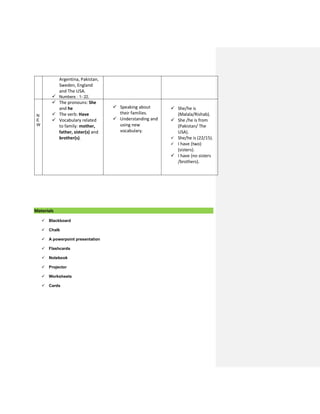
LEXIS FUNCTIONS STRUCTURE
R
E
V
 Greeting: Hello
 Pronoun: I
 The verb to be: Am
(´m)
 Names of countries:
 Introducing
themselves. (name,
age and country of
origin)
 I´m (PÍa)
 I´m (11)
 I´m from
(Argentina)
Argentina, Pakistan,
Sweden, England
and The USA.
 Numbers : 1- 22.
N
E
W
 The pronouns: She
and he
 The verb: Have
 Vocabulary related
to family: mother,
father, sister(s) and
brother(s).
 Speaking about
their families.
 Understanding and
using new
vocabulary.
 She/he is
(Malala/Rishab).
 She /he is from
(Pakistan/ The
USA).
 She/he is (22/15).
 I have (two)
(sisters).
 I have (no sisters
/brothers).
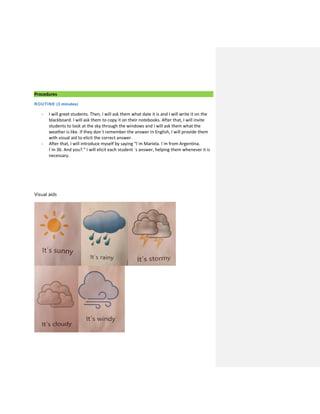
Materials
 Blackboard
 Chalk
 A powerpoint presentation
 Flashcards
 Notebook
 Projector
 Worksheets
 Cards
Procedures
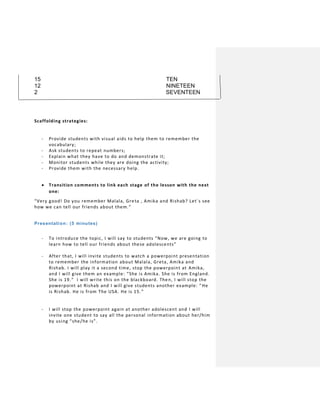
ROUTINE (3 minutes)
- I will greet students. Then, I will ask them what date it is and I will write it on the
blackboard. I will ask them to copy it on their notebooks. After that, I will invite
students to look at the sky through the windows and I will ask them what the
weather is like. If they don´t remember the answer In English, I will provide them
with visual aid to elicit the correct answer.
- After that, I will introduce myself by saying “I´m Mariela. I´m from Argentina.
I´m 36. And you?.” I will elicit each student ´s answer, helping them whenever it is
necessary.
Visual aids
WARM- UP (6 minutes)
- To revise and consolidate the numbers which students learnt in the
previous class, I will show them flashcards of numbers 1-22 and I will
encourage them to say them aloud. If they don´t remember the
numbers, I will say them aloud and I ask students to repeat after me.
- After that, I will give students the following worksheet and I will ask
them to do a task in which they will have to match numbers with the
words. I will go around helping students complete the activity.
This is the worksheet:
Match the numbers
11 TWELVE
1 NINE
3 EIGHTEEN
18 FIVE
9 SEVEN
5 ONE
13 THREE
7 TWENTY
14 FOUR
18 SIX
21 EIGHT
4 TWENTY-ONE
17 FOURTEEN
6 TWO
20 FIFTEEN
22 SIXTEEN
10 ELEVEN
19 THIRTEEN
16 TWENTY-TWO
Comentado [A2]: No context?
Comentado [A3]: How clear will it be after they draw all
the lines?
You should either include less numbers or design a
different task. What about a crossword? It might be
more challenging. Students would be writing the words
themselves.
15 TEN
12 NINETEEN
2 SEVENTEEN
Scaffolding strategies:
- Provide students with visual aids to help them to remember the
vocabulary;
- Ask students to repeat numbers;
- Explain what they have to do and demonstrate it;
- Monitor students while they are doing the activity;
- Provide them with the necessary help.
 Transition comments to link each stage of the lesson with the next
one:
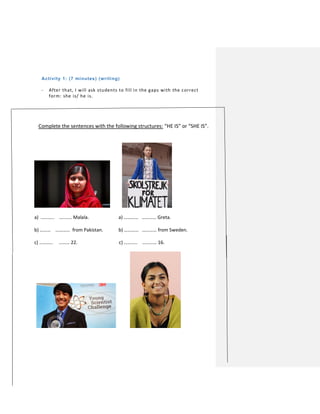
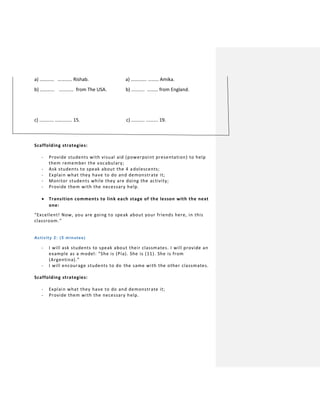
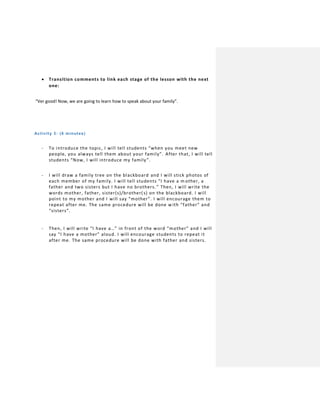
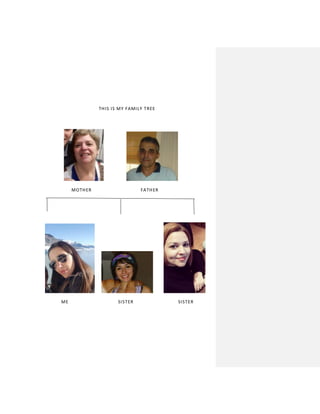
“Very good! Do you remember Malala, Greta , Amika and Rishab? Let´s see
how we can tell our friends about them.”
Presentation: (5 minutes)
- To introduce the topic, I will say to students “Now, we are going to
learn how to tell our friends about these adolescents”
- After that, I will invite students to watch a powerpoint presentation
to remember the information about Malala, Greta, Amika and
Rishab. I will play it a second time, stop the powerpoint at Amika,
and I will give them an example: “She is Amika. She is from England.
She is 19.” I will write this on the blackboard. Then, I will stop the
powerpoint at Rishab and I will give students another example: “ He
is Rishab. He is from The USA. He is 15. ”
- I will stop the powerpoint again at another adolescent and I will
invite one student to say all the personal information about her/him
by using “she/he is”.
Activity 1: (7 minutes) (writing)
- After that, I will ask students to fill in the gaps with the correct
form: she is/ he is.
Complete the sentences with the following structures: “HE IS” or “SHE IS”.
a) ……….. …....... Malala. a) ………… ………… Greta.
b) ……… ………… from Pakistan. b) ………… ………… from Sweden.
c) ……….. ……… 22. c) ……….. ………… 16.
a) ………… ………… Rishab. a) …………. ……… Amika.
b) ………… ………… from The USA. b) ……….. ……… from England.
c) ………… ………….. 15. c) ……….. ………. 19.
Scaffolding strategies:
- Provide students with visual aid (powerpoint presentation) to help
them remember the vocabulary;
- Ask students to speak about the 4 adolescents;
- Explain what they have to do and demonstrate it;
- Monitor students while they are doing the activity;
- Provide them with the necessary help.
 Transition comments to link each stage of the lesson with the next
one:
“Excellent! Now, you are going to speak about your friends here, in this
classroom.”
Activity 2: (5 minutes)
- I will ask students to speak about their classmates. I will provide an
example as a model: “She is (Pía). She is (11). She is from
(Argentina).”
- I will encourage students to do the same with the other classmates.
Scaffolding strategies:
- Explain what they have to do and demonstrate it;
- Provide them with the necessary help.
 Transition comments to link each stage of the lesson with the next
one:
“Ver good! Now, we are going to learn how to speak about your family”.
Activity 3: (6 minutes)
- To introduce the topic, I will tell students “when you meet new
people, you always tell them about your family”. After that, I will tell
students “Now, I will introduce my family”.
- I will draw a family tree on the blackboard and I will stick photos of
each member of my family. I will tell students “I have a m other, a
father and two sisters but I have no brothers. ” Then, I will write the
words mother, father, sister(s)/brother( s) on the blackboard. I will
point to my mother and I will say “mother”. I will encourage them to
repeat after me. The same procedure will be done w ith “father” and
“sisters”.
- Then, I will write “I have a…” in front of the word “mother” and I will
say “I have a mother” aloud. I will encourage students to repeat it
after me. The same procedure will be done with father and sisters.
THIS IS MY FAMILY TREE
MOTHER FATHER
ME SISTER SISTER
Scaffolding strategies:
- Draw a tree family to help students to understand the new
vocabulary related to family;
- Ask students to repeat vocabulary related to family;
- Provide them with the necessary help.
 Transition comments to link each stage of the lesson with the next
one:
“Great job! Now, I would like to know about your family.”
Activity 4: (10 minutes) (writing and speaking)
- I will say to students that they have to draw their family tree on
their notebooks. I will explain to students that they have to draw
themselves and each member of their family. (mother, father, sister,
brother).
- After that, I will ask students to write a full sentence below the
family tree. I will provide an example: “I have a mother, a father, a
sister and a brother.” I will write it on the blackboard.
Scaffolding strategies:
- Explain what they have to do and demonstrate it;
- Monitor students while they are doing the task;
- Provide students with the necessary help.
 Transition comments to link each stage of the lesson with the next
one:
“Excellent!! Now, we are going to play a fun game.”
Comentado [A4]: Careful with this topic. Talk with the
class teacher about it.
All families are different, we know that!
CLOSURE : (3 minutes)
-To end the lesson I will ask students to sit in circle to play a game called
the memory game. I will put cards in the middle face down. I will explain to
students that the cards have all the vocabulary learnt: numbers, countries
and family members.
- Then, I will tell them how to play the game. I will explain that they have
to find two cards with the same word to make a pair and that they can only
turn two cards. If they make a pair, they get another turn. If not, they miss
a turn. I will encourage students to say the words on the cards they turn
aloud in order for them to practise pronunciation. The student who gets
the most pair is the winner.1
- When they finish playing the game, I will say “fantastic”. “It was reall y
fun”. See you next class.
ARGENTINA ARGENTINA SISTER
MOTHER MOTHER TWO TWO
To be completed by your tutor:
1
This game is taken from (and adapted): Roth Genevieve, “teaching very Young children”, page 49.
SISTER
SWEDEN
S
SWEDEN TWELVE TWELVE
BROTHER
S
BROTHER
R
S
TEN
S
TEN
WEDEN
SELEVEN
S
ELEVEN
WEDEN
S
THREE
WEDEN
S
THREE
S
PAKISTAN
S
PAKISTAN
S
FATHER
S
FATHER
S
Comentado [A5]: Encourage students to produce
some sentences. You may provide the sentences
yourself, too.
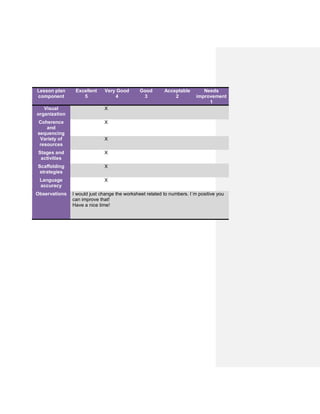
Lesson plan
component
Excellent
5
Very Good
4
Good
3
Acceptable
2
Needs
improvement
1
Visual
organization
X
Coherence
and
sequencing
X
Variety of
resources
X
Stages and
activities
X
Scaffolding
strategies
X
Language
accuracy
X
Observations I would just change the worksheet related to numbers. I´m positive you
can improve that!
Have a nice time!

Iannaci lesson plan 2 - passed

  • 1.
    I.S.F.D LENGUAS VIVASBARILOCHE – PRÁCTICA DOCENTE II ENTREGA DE PLANIFICACIÓN ALUMNO PRACTICANTE: Mariela Gisela Iannaci TUTOR: Aurelia Velázsquez Grado y sección: Mixed-age class (5th and 6th) Nivel lingüístico del curso: Beginners Cantidad de alumnos: 7 Tipo de Planificación: Clase Unidad Temática:  Students ´ talking about friends (names, age and country of origin)  Students´ talking about their families. Clase Nº: 2 Teaching points:  Pronouns : he/she;  The verb “is”;  The verb “have”;  Members of the family: mother, father, (sister/s), brother(s). Duración de la clase: 45 minutes Comentado [A1]: FRIENDS AND FAMILY (?)
  • 2.
    Fecha de laclase: September 25th Fecha de entrega de la planificación: September 20th Learning Aims  To revise the vocabulary and structures learnt in the previous lesson;  To introduce the pronouns “he” and “she”;  To introduce the verb to be: “is”;  To introduce vocabulary related to family in order for students to speak about their families;  To introduce the verb “have” for students to talk about their families;  To promote students´ development of all language skills, namely speaking, listening, reading and writing. Language Focus LEXIS FUNCTIONS STRUCTURE R E V  Greeting: Hello  Pronoun: I  The verb to be: Am (´m)  Names of countries:  Introducing themselves. (name, age and country of origin)  I´m (PÍa)  I´m (11)  I´m from (Argentina)
  • 3.
    Argentina, Pakistan, Sweden, England andThe USA.  Numbers : 1- 22. N E W  The pronouns: She and he  The verb: Have  Vocabulary related to family: mother, father, sister(s) and brother(s).  Speaking about their families.  Understanding and using new vocabulary.  She/he is (Malala/Rishab).  She /he is from (Pakistan/ The USA).  She/he is (22/15).  I have (two) (sisters).  I have (no sisters /brothers). Materials  Blackboard  Chalk  A powerpoint presentation  Flashcards  Notebook  Projector  Worksheets  Cards
  • 4.
    Procedures ROUTINE (3 minutes) -I will greet students. Then, I will ask them what date it is and I will write it on the blackboard. I will ask them to copy it on their notebooks. After that, I will invite students to look at the sky through the windows and I will ask them what the weather is like. If they don´t remember the answer In English, I will provide them with visual aid to elicit the correct answer. - After that, I will introduce myself by saying “I´m Mariela. I´m from Argentina. I´m 36. And you?.” I will elicit each student ´s answer, helping them whenever it is necessary. Visual aids
  • 5.
    WARM- UP (6minutes) - To revise and consolidate the numbers which students learnt in the previous class, I will show them flashcards of numbers 1-22 and I will encourage them to say them aloud. If they don´t remember the numbers, I will say them aloud and I ask students to repeat after me. - After that, I will give students the following worksheet and I will ask them to do a task in which they will have to match numbers with the words. I will go around helping students complete the activity. This is the worksheet: Match the numbers 11 TWELVE 1 NINE 3 EIGHTEEN 18 FIVE 9 SEVEN 5 ONE 13 THREE 7 TWENTY 14 FOUR 18 SIX 21 EIGHT 4 TWENTY-ONE 17 FOURTEEN 6 TWO 20 FIFTEEN 22 SIXTEEN 10 ELEVEN 19 THIRTEEN 16 TWENTY-TWO Comentado [A2]: No context? Comentado [A3]: How clear will it be after they draw all the lines? You should either include less numbers or design a different task. What about a crossword? It might be more challenging. Students would be writing the words themselves.
  • 6.
    15 TEN 12 NINETEEN 2SEVENTEEN Scaffolding strategies: - Provide students with visual aids to help them to remember the vocabulary; - Ask students to repeat numbers; - Explain what they have to do and demonstrate it; - Monitor students while they are doing the activity; - Provide them with the necessary help.  Transition comments to link each stage of the lesson with the next one: “Very good! Do you remember Malala, Greta , Amika and Rishab? Let´s see how we can tell our friends about them.” Presentation: (5 minutes) - To introduce the topic, I will say to students “Now, we are going to learn how to tell our friends about these adolescents” - After that, I will invite students to watch a powerpoint presentation to remember the information about Malala, Greta, Amika and Rishab. I will play it a second time, stop the powerpoint at Amika, and I will give them an example: “She is Amika. She is from England. She is 19.” I will write this on the blackboard. Then, I will stop the powerpoint at Rishab and I will give students another example: “ He is Rishab. He is from The USA. He is 15. ” - I will stop the powerpoint again at another adolescent and I will invite one student to say all the personal information about her/him by using “she/he is”.
  • 7.
    Activity 1: (7minutes) (writing) - After that, I will ask students to fill in the gaps with the correct form: she is/ he is. Complete the sentences with the following structures: “HE IS” or “SHE IS”. a) ……….. …....... Malala. a) ………… ………… Greta. b) ……… ………… from Pakistan. b) ………… ………… from Sweden. c) ……….. ……… 22. c) ……….. ………… 16.
  • 8.
    a) ………… …………Rishab. a) …………. ……… Amika. b) ………… ………… from The USA. b) ……….. ……… from England. c) ………… ………….. 15. c) ……….. ………. 19. Scaffolding strategies: - Provide students with visual aid (powerpoint presentation) to help them remember the vocabulary; - Ask students to speak about the 4 adolescents; - Explain what they have to do and demonstrate it; - Monitor students while they are doing the activity; - Provide them with the necessary help.  Transition comments to link each stage of the lesson with the next one: “Excellent! Now, you are going to speak about your friends here, in this classroom.” Activity 2: (5 minutes) - I will ask students to speak about their classmates. I will provide an example as a model: “She is (Pía). She is (11). She is from (Argentina).” - I will encourage students to do the same with the other classmates. Scaffolding strategies: - Explain what they have to do and demonstrate it; - Provide them with the necessary help.
  • 9.
     Transition commentsto link each stage of the lesson with the next one: “Ver good! Now, we are going to learn how to speak about your family”. Activity 3: (6 minutes) - To introduce the topic, I will tell students “when you meet new people, you always tell them about your family”. After that, I will tell students “Now, I will introduce my family”. - I will draw a family tree on the blackboard and I will stick photos of each member of my family. I will tell students “I have a m other, a father and two sisters but I have no brothers. ” Then, I will write the words mother, father, sister(s)/brother( s) on the blackboard. I will point to my mother and I will say “mother”. I will encourage them to repeat after me. The same procedure will be done w ith “father” and “sisters”. - Then, I will write “I have a…” in front of the word “mother” and I will say “I have a mother” aloud. I will encourage students to repeat it after me. The same procedure will be done with father and sisters.
  • 10.
    THIS IS MYFAMILY TREE MOTHER FATHER ME SISTER SISTER
  • 11.
    Scaffolding strategies: - Drawa tree family to help students to understand the new vocabulary related to family; - Ask students to repeat vocabulary related to family; - Provide them with the necessary help.  Transition comments to link each stage of the lesson with the next one: “Great job! Now, I would like to know about your family.” Activity 4: (10 minutes) (writing and speaking) - I will say to students that they have to draw their family tree on their notebooks. I will explain to students that they have to draw themselves and each member of their family. (mother, father, sister, brother). - After that, I will ask students to write a full sentence below the family tree. I will provide an example: “I have a mother, a father, a sister and a brother.” I will write it on the blackboard. Scaffolding strategies: - Explain what they have to do and demonstrate it; - Monitor students while they are doing the task; - Provide students with the necessary help.  Transition comments to link each stage of the lesson with the next one: “Excellent!! Now, we are going to play a fun game.” Comentado [A4]: Careful with this topic. Talk with the class teacher about it. All families are different, we know that!
  • 12.
    CLOSURE : (3minutes) -To end the lesson I will ask students to sit in circle to play a game called the memory game. I will put cards in the middle face down. I will explain to students that the cards have all the vocabulary learnt: numbers, countries and family members. - Then, I will tell them how to play the game. I will explain that they have to find two cards with the same word to make a pair and that they can only turn two cards. If they make a pair, they get another turn. If not, they miss a turn. I will encourage students to say the words on the cards they turn aloud in order for them to practise pronunciation. The student who gets the most pair is the winner.1 - When they finish playing the game, I will say “fantastic”. “It was reall y fun”. See you next class. ARGENTINA ARGENTINA SISTER MOTHER MOTHER TWO TWO To be completed by your tutor: 1 This game is taken from (and adapted): Roth Genevieve, “teaching very Young children”, page 49. SISTER SWEDEN S SWEDEN TWELVE TWELVE BROTHER S BROTHER R S TEN S TEN WEDEN SELEVEN S ELEVEN WEDEN S THREE WEDEN S THREE S PAKISTAN S PAKISTAN S FATHER S FATHER S Comentado [A5]: Encourage students to produce some sentences. You may provide the sentences yourself, too.
  • 13.
    Lesson plan component Excellent 5 Very Good 4 Good 3 Acceptable 2 Needs improvement 1 Visual organization X Coherence and sequencing X Varietyof resources X Stages and activities X Scaffolding strategies X Language accuracy X Observations I would just change the worksheet related to numbers. I´m positive you can improve that! Have a nice time!