PRÁCTICA DOCENTE IV
ENTREGA DE PLANIFICACIÓN
ALUMNO PRACTICANTE: Soledad González
Institución educativa: E.E.S N°1
Año y sección: 1° II
Nivel lingüístico del curso: Beginers
Cantidad de alumnos: 21
Tipo de Planificación: Clase
Unidad Temática: My family
Clase Nº: 5-6
Duración de la clase: 105’
Fecha de la clase: 27/06
Fecha de entrega de la planificación: 16/06
Learning Aims
During this lesson, learners will be able to…
- Provide the opportunity to identify themselves and express it in a respectful
environment.
- Practise vocabulary related to family members.
- Identify specific information in a text.
- Discover the uses of possessives.
- Introduce their family names and ages.
Language Focus
LEXIS FUNCTIONS STRUCTURE
R
E
V
Personal pronouns
Introduce and describe other
people
I am…
She is..
He is…
N
E
W
Family members: mother,
father, sister, brother,
grandma, grandpa
Introduce the different family
members
“This is me, I’m … years old,
and this is my family.
My parents/grandparents
are….., who’s …. And
……who’s…….
I love my family.
Materials
- Family tree
- Worksheets about the family
- Folders and markers
- The poem printed in big
-
Procedures
- Ask them how they are and take attendance. Then, ask them what date it is and
write it on the blackboard.
I will start by asking them to recall our previous class
Do you remember that we talked about urban Tribes? And we said that being part of
a group is part of our IDENTITY.
I will write the word IDENTITY on the board, and I’ll brainstorm some ideas about
this topic. I will write their answers. Possible answers: name, surname, style, fashion,
family, nationality, gender
As want to introduce the topic FAMILY, as well as students brainstorm this word, I’ll
circle it in red. If they don’t brainstorm the word family, I’ll elicit it by asking questions
such as Who gave you your name? Who gave you your surname? Possible answers,
“my mother”, “my father”, Ok. And they are part of your Fa…(I’ll pronounce the first
syllable)
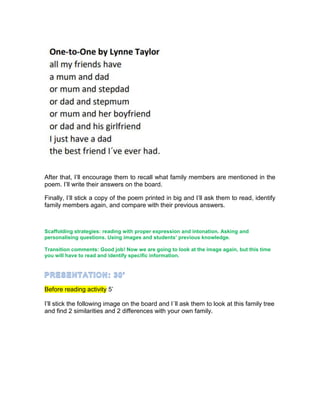
I’ll continue the class by reading a poem about the family
After that, I’ll encourage them to recall what family members are mentioned in the
poem. I’ll write their answers on the board.
Finally, I’ll stick a copy of the poem printed in big and I’ll ask them to read, identify
family members again, and compare with their previous answers.
Scaffolding strategies: reading with proper expression and intonation. Asking and
personalising questions. Using images and students’ previous knowledge.
Transition comments: Good job! Now we are going to look at the image again, but this time
you will have to read and identify specific information.
Before reading activity 5’
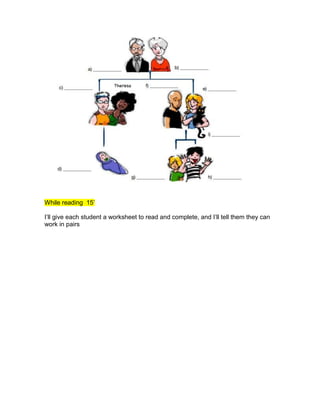
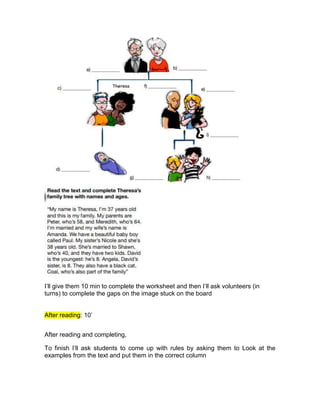
I’ll stick the following image on the board and I´ll ask them to look at this family tree
and find 2 similarities and 2 differences with your own family.
While reading 15’
I’ll give each student a worksheet to read and complete, and I’ll tell them they can
work in pairs
I’ll give them 10 min to complete the worksheet and then I’ll ask volunteers (in
turns) to complete the gaps on the image stuck on the board
After reading: 10’
After reading and completing,
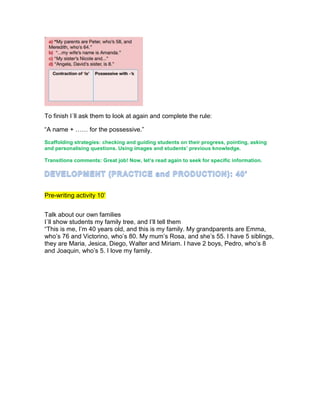
To finish I’ll ask students to come up with rules by asking them to Look at the
examples from the text and put them in the correct column
To finish I´ll ask them to look at again and complete the rule:
“A name + …… for the possessive.”
Scaffolding strategies: checking and guiding students on their progress, pointing, asking
and personalising questions. Using images and students’ previous knowledge.
Transitions comments: Great job! Now, let’s read again to seek for specific information.
Pre-writing activity 10’
Talk about our own families
I´ll show students my family tree, and I’ll tell them
“This is me, I’m 40 years old, and this is my family. My grandparents are Emma,
who’s 76 and Victorino, who’s 80. My mum’s Rosa, and she’s 55. I have 5 siblings,
they are Maria, Jesica, Diego, Walter and Miriam. I have 2 boys, Pedro, who’s 8
and Joaquin, who’s 5. I love my family.
Writing activity: 20’min
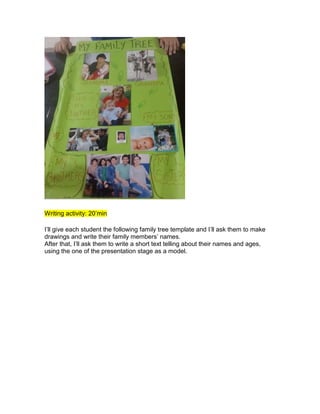
I’ll give each student the following family tree template and I’ll ask them to make
drawings and write their family members’ names.
After that, I’ll ask them to write a short text telling about their names and ages,
using the one of the presentation stage as a model.
After writing: 10min
I’ll ask students to read aloud their writings
Scaffolding strategies: providing texts and formats as a model for their own writings,
providing authentic images to be observed.
Transitions comments: Great job! Now, let’s see if you can remember some of your mates
writings.
I’ll chose one of the student’s work that had been read in the previous stage, I´ll tell
them they have to say YES or NO.
For example, Diego is Pilar’s father.
After that, I’ll ask volunteers to continue with the activity.
Scaffolding strategies: Vocabulary from previous activities. Giving them time to reflect on
the language by their own. Giving examples, and recasting to English when necessary.
Transition comments: Great job! All of us have great families, and they part of our identity.
Thanks a lot for tell us about them.
It’s time to say goodbye! See you next Tuesday!
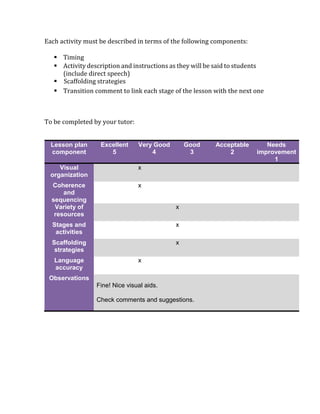
Each activity must be described in terms of the following components:
 Timing
 Activity description and instructions as they will be said to students
(include direct speech)
 Scaffolding strategies
 Transition comment to link each stage of the lesson with the next one
To be completed by your tutor:
Lesson plan
component
Excellent
5
Very Good
4
Good
3
Acceptable
2
Needs
improvement
1
Visual
organization
x
Coherence
and
sequencing
x
Variety of
resources
x
Stages and
activities
x
Scaffolding
strategies
x
Language
accuracy
x
Observations
Fine! Nice visual aids.
Check comments and suggestions.

Lesson 3 GONZALEZ Soledad.docx

  • 1.
    PRÁCTICA DOCENTE IV ENTREGADE PLANIFICACIÓN ALUMNO PRACTICANTE: Soledad González Institución educativa: E.E.S N°1 Año y sección: 1° II Nivel lingüístico del curso: Beginers Cantidad de alumnos: 21 Tipo de Planificación: Clase Unidad Temática: My family Clase Nº: 5-6 Duración de la clase: 105’ Fecha de la clase: 27/06 Fecha de entrega de la planificación: 16/06 Learning Aims During this lesson, learners will be able to… - Provide the opportunity to identify themselves and express it in a respectful environment. - Practise vocabulary related to family members. - Identify specific information in a text. - Discover the uses of possessives. - Introduce their family names and ages. Language Focus LEXIS FUNCTIONS STRUCTURE R E V Personal pronouns Introduce and describe other people I am… She is.. He is…
  • 2.
    N E W Family members: mother, father,sister, brother, grandma, grandpa Introduce the different family members “This is me, I’m … years old, and this is my family. My parents/grandparents are….., who’s …. And ……who’s……. I love my family. Materials - Family tree - Worksheets about the family - Folders and markers - The poem printed in big - Procedures - Ask them how they are and take attendance. Then, ask them what date it is and write it on the blackboard. I will start by asking them to recall our previous class Do you remember that we talked about urban Tribes? And we said that being part of a group is part of our IDENTITY. I will write the word IDENTITY on the board, and I’ll brainstorm some ideas about this topic. I will write their answers. Possible answers: name, surname, style, fashion, family, nationality, gender As want to introduce the topic FAMILY, as well as students brainstorm this word, I’ll circle it in red. If they don’t brainstorm the word family, I’ll elicit it by asking questions such as Who gave you your name? Who gave you your surname? Possible answers, “my mother”, “my father”, Ok. And they are part of your Fa…(I’ll pronounce the first syllable) I’ll continue the class by reading a poem about the family
  • 3.
    After that, I’llencourage them to recall what family members are mentioned in the poem. I’ll write their answers on the board. Finally, I’ll stick a copy of the poem printed in big and I’ll ask them to read, identify family members again, and compare with their previous answers. Scaffolding strategies: reading with proper expression and intonation. Asking and personalising questions. Using images and students’ previous knowledge. Transition comments: Good job! Now we are going to look at the image again, but this time you will have to read and identify specific information. Before reading activity 5’ I’ll stick the following image on the board and I´ll ask them to look at this family tree and find 2 similarities and 2 differences with your own family.
  • 4.
    While reading 15’ I’llgive each student a worksheet to read and complete, and I’ll tell them they can work in pairs
  • 5.
    I’ll give them10 min to complete the worksheet and then I’ll ask volunteers (in turns) to complete the gaps on the image stuck on the board After reading: 10’ After reading and completing, To finish I’ll ask students to come up with rules by asking them to Look at the examples from the text and put them in the correct column
  • 6.
    To finish I´llask them to look at again and complete the rule: “A name + …… for the possessive.” Scaffolding strategies: checking and guiding students on their progress, pointing, asking and personalising questions. Using images and students’ previous knowledge. Transitions comments: Great job! Now, let’s read again to seek for specific information. Pre-writing activity 10’ Talk about our own families I´ll show students my family tree, and I’ll tell them “This is me, I’m 40 years old, and this is my family. My grandparents are Emma, who’s 76 and Victorino, who’s 80. My mum’s Rosa, and she’s 55. I have 5 siblings, they are Maria, Jesica, Diego, Walter and Miriam. I have 2 boys, Pedro, who’s 8 and Joaquin, who’s 5. I love my family.
  • 7.
    Writing activity: 20’min I’llgive each student the following family tree template and I’ll ask them to make drawings and write their family members’ names. After that, I’ll ask them to write a short text telling about their names and ages, using the one of the presentation stage as a model.
  • 8.
    After writing: 10min I’llask students to read aloud their writings Scaffolding strategies: providing texts and formats as a model for their own writings, providing authentic images to be observed. Transitions comments: Great job! Now, let’s see if you can remember some of your mates writings. I’ll chose one of the student’s work that had been read in the previous stage, I´ll tell them they have to say YES or NO. For example, Diego is Pilar’s father. After that, I’ll ask volunteers to continue with the activity. Scaffolding strategies: Vocabulary from previous activities. Giving them time to reflect on the language by their own. Giving examples, and recasting to English when necessary. Transition comments: Great job! All of us have great families, and they part of our identity. Thanks a lot for tell us about them. It’s time to say goodbye! See you next Tuesday!
  • 9.
    Each activity mustbe described in terms of the following components:  Timing  Activity description and instructions as they will be said to students (include direct speech)  Scaffolding strategies  Transition comment to link each stage of the lesson with the next one To be completed by your tutor: Lesson plan component Excellent 5 Very Good 4 Good 3 Acceptable 2 Needs improvement 1 Visual organization x Coherence and sequencing x Variety of resources x Stages and activities x Scaffolding strategies x Language accuracy x Observations Fine! Nice visual aids. Check comments and suggestions.