I.S.F.D LENGUAS VIVAS BARILOCHE
PRÁCTICA DOCENTE III
ENTREGA DE PLANIFICACIÓN
ALUMNO PRACTICANTE: Bravo Débora
Institución educativa: C.P.E.M. N°85
Año y sección: 2° “B” (Plan 052 – adultos)
Nivel lingüístico del curso: Beginners
Cantidad de alumnos: 28
Tipo de Planificación: Clase
Unidad Temática: Family
Clase Nº: 1 y 2
Duración de la clase: 80 minutos (40 cada clase)
Fecha de la clase: 30 de mayo
Fecha de entrega de la planificación: 24 de mayo
Learning Aims
During this lesson, learners will be able to…
 Review previous vocabulary (colors, numbers and family members)
 Focus on spelling
 Infer meaning of possessive ‘s
Language Focus
LEXIS FUNCTIONS STRUCTURE
R
E
V
 Colors
 Numbers (0-100)
 Family members
Description of family
members.
 Verb “to be”
This is my sister. She is 18
years old.
N
E
W
 Family members Show the relationship
between people
 Possessive ‘s
Marge is Homer’s wife.
Materials
 Board
 Markers
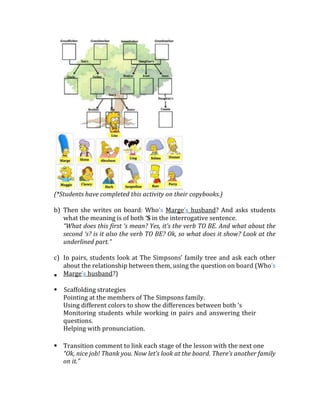
 The Simpsons’ family tree
 Mobile phones
 Students’ Booklet
Procedures
 Take attendance
 Timing: 15’
 Activity description and instructions as they will be said to students
(include direct speech)
Unscramble the words (colours, number and family members)
a) Class activity. The teacher writes a word on the board and tells students
they have 10 seconds to order the letters.
Words:
1) K N P I (pink)
2) E E E L N V (eleven)
3) W Y L O L E (yellow)
4) T R O H B E R (brother)
5) E N E S V (seven)
6) T I S E S R (sister)
“Ready, steady, go! What’s this? It’s a colour/number/family member.
It starts with (a letter). Yes! Congrats”
“What’s this? Perfect! It’s pink! Is “pink” a number, a colour or a family
member? Well done!”
b) Small groups competition. Teacher divides students in groups of three or
four and assigns each member a number. Each group chooses a name
related to “families”, for example, The Simpsons. Then the teacher calls out
a number and all students that have this number have to stand up and
unscramble the word the teacher writes on board. The first one wins a
point for the group. They win an extra point if they say the category.
Words:
1) W N R O B (brown)
2) E E W L V T (twelve)
3) N S H U A B D (husband)
4) I W E F (wife)
5) R A O N G E (orange)
6) E Y E T N S (seventy)
7) T D A E H U G R (daughter)
8) L N E C U (uncle)
“You’re number 1, you’re number 2, and you’re number 3”.
“Number 1 stand up, please! You’ve 10 seconds to order the letters. What’s
this? Yes! Is it a colour, a number or family member? You are the champion!”
 Scaffolding strategies
Pointing at the first letter of the word.
Telling the category.
 Transition comment to link each stage of the lesson with the next one
“Congrats to today’s champions! Now, let’s look at The Simpsons’
family tree”
 Timing: 15 minutes
 Activity description and instructions as they will be said to students
(include direct speech)
Activity 1:
a) Class activity. The teacher tells students to go back to their copybooks and
look at The Simpsons’ family tree and answer the questions.
“Who’s Marge’s husband? Yes! He’s Homer! What about Bart’s sisters? Who are
they?”
(*Students have completed this activity on their copybooks.)
b) Then she writes on board: Who’s Marge’s husband? And asks students
what the meaning is of both ‘S in the interrogative sentence.
“What does this first ‘s mean? Yes, it’s the verb TO BE. And what about the
second ‘s? is it also the verb TO BE? Ok, so what does it show? Look at the
underlined part.”
c) In pairs, students look at The Simpsons’ family tree and ask each other
about the relationship between them, using the question on board (Who’s
Marge’s husband?)

 Scaffolding strategies
Pointing at the members of The Simpsons family.
Using different colors to show the differences between both ‘s
Monitoring students while working in pairs and answering their
questions.
Helping with pronunciation.
 Transition comment to link each stage of the lesson with the next one
“Ok, nice job! Thank you. Now let’s look at the board. There’s another family
on it.”
 Timing 15 minutes
 Activity description and instructions as they will be said to students
(include direct speech)
Activity 2
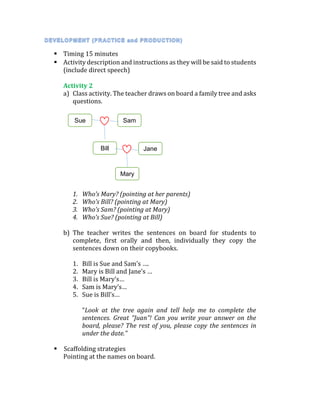
a) Class activity. The teacher draws on board a family tree and asks
questions.
1. Who’s Mary? (pointing at her parents)
2. Who’s Bill? (pointing at Mary)
3. Who’s Sam? (pointing at Mary)
4. Who’s Sue? (pointing at Bill)
b) The teacher writes the sentences on board for students to
complete, first orally and then, individually they copy the
sentences down on their copybooks.
1. Bill is Sue and Sam’s ….
2. Mary is Bill and Jane’s …
3. Bill is Mary’s…
4. Sam is Mary’s…
5. Sue is Bill’s…
“Look at the tree again and tell help me to complete the
sentences. Great “Juan”! Can you write your answer on the
board, please? The rest of you, please copy the sentences in
under the date.”
 Scaffolding strategies
Pointing at the names on board.
Sue Sam
Bill Jane
Mary
 Transition comment to link each stage of the lesson with the next one
Activity 3
 Timing 20 minutes
 Activity description and instructions as they will be said to students
(include direct speech)
Pre reading:
Teacher tells students to use their phones to find information on
the web about Madonna’s family. And she writes on the board some
questions to help them:
1. Where’s Madonna from?
2. How old is she?
3. What’s her father’s name?
4. Has she got any brothers or sisters? What are their names?
While reading
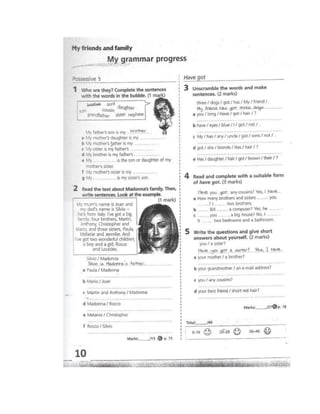
Teacher tells students to open their booklet at page 10 and
concentrate on activity 2. The teacher reads the text aloud and
students follow.
Then she asks:
“Is her family small? How many brothers and sisters has she got? Has
she got children? What are their names?”
Post reading
The teacher points to the example in the booklet, and individually,
students complete the activity.
“Is Silvio Madonna’s brother? Who’s he? Nice! He’s Madonna’s father.
Now work individually, please.”
 Scaffolding strategies
Monitoring while students surf the net on their phones.
Intonation and stressing ‘s
Body language
 Transition comment to link each stage of the lesson with the next one
“Well done! Now, let’s have a break!”
 Timing 15 minutes
 Activity description and instructions as they will be said to students
(include direct speech)
Brain gym activity: Triangle Circle
The teacher encourages students to draw a circle in the air with
their left hand, and a triangle in the air with their right hand. Then,
they switch hands and say how many they can do without messing
up.
“Stand up! Pencils on the desks. Stretch your arms and mace a circle
with the left hand and a triangle with the right one! Easy or difficult?
 Scaffolding strategies
Body language
 Transition comment to link each stage of the lesson with the next one
“I challenge you to answer as fast as possible… is there a champion in the class?”
Guesses
The teacher reads some sentences for students to complete orally as a
class. The winner gets some candies.
1. My father’s son is my….. (brother)
2. My mother’s daughter is my …. (sister)
3. My mother’s father is my …. (grandfather)
4. My sister is my father’s …. (daughter)
5. My brother is my father’s … (son)
6. My mother’s sister is my …. (aunt)
Homework
Booklet page 10 activity 1
 Scaffolding strategies
Body language
Intonation
 Transition comment to link each stage of the lesson with the next one
“Let’s call it a day! Have a nice week!”
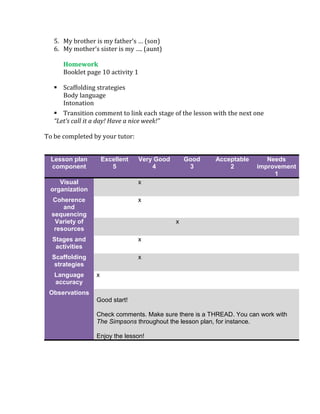
To be completed by your tutor:
Lesson plan
component
Excellent
5
Very Good
4
Good
3
Acceptable
2
Needs
improvement
1
Visual
organization
x
Coherence
and
sequencing
x
Variety of
resources
x
Stages and
activities
x
Scaffolding
strategies
x
Language
accuracy
x
Observations
Good start!
Check comments. Make sure there is a THREAD. You can work with
The Simpsons throughout the lesson plan, for instance.
Enjoy the lesson!

Lessons 1 & 2 - Bravo - Pass.docx

  • 1.
    I.S.F.D LENGUAS VIVASBARILOCHE PRÁCTICA DOCENTE III ENTREGA DE PLANIFICACIÓN ALUMNO PRACTICANTE: Bravo Débora Institución educativa: C.P.E.M. N°85 Año y sección: 2° “B” (Plan 052 – adultos) Nivel lingüístico del curso: Beginners Cantidad de alumnos: 28 Tipo de Planificación: Clase Unidad Temática: Family Clase Nº: 1 y 2 Duración de la clase: 80 minutos (40 cada clase) Fecha de la clase: 30 de mayo Fecha de entrega de la planificación: 24 de mayo Learning Aims During this lesson, learners will be able to…  Review previous vocabulary (colors, numbers and family members)  Focus on spelling  Infer meaning of possessive ‘s Language Focus LEXIS FUNCTIONS STRUCTURE R E V  Colors  Numbers (0-100)  Family members Description of family members.  Verb “to be” This is my sister. She is 18 years old. N E W  Family members Show the relationship between people  Possessive ‘s Marge is Homer’s wife.
  • 2.
    Materials  Board  Markers The Simpsons’ family tree  Mobile phones  Students’ Booklet Procedures  Take attendance  Timing: 15’  Activity description and instructions as they will be said to students (include direct speech) Unscramble the words (colours, number and family members) a) Class activity. The teacher writes a word on the board and tells students they have 10 seconds to order the letters. Words: 1) K N P I (pink) 2) E E E L N V (eleven) 3) W Y L O L E (yellow) 4) T R O H B E R (brother) 5) E N E S V (seven) 6) T I S E S R (sister) “Ready, steady, go! What’s this? It’s a colour/number/family member. It starts with (a letter). Yes! Congrats” “What’s this? Perfect! It’s pink! Is “pink” a number, a colour or a family member? Well done!” b) Small groups competition. Teacher divides students in groups of three or four and assigns each member a number. Each group chooses a name related to “families”, for example, The Simpsons. Then the teacher calls out a number and all students that have this number have to stand up and unscramble the word the teacher writes on board. The first one wins a point for the group. They win an extra point if they say the category. Words:
  • 3.
    1) W NR O B (brown) 2) E E W L V T (twelve) 3) N S H U A B D (husband) 4) I W E F (wife) 5) R A O N G E (orange) 6) E Y E T N S (seventy) 7) T D A E H U G R (daughter) 8) L N E C U (uncle) “You’re number 1, you’re number 2, and you’re number 3”. “Number 1 stand up, please! You’ve 10 seconds to order the letters. What’s this? Yes! Is it a colour, a number or family member? You are the champion!”  Scaffolding strategies Pointing at the first letter of the word. Telling the category.  Transition comment to link each stage of the lesson with the next one “Congrats to today’s champions! Now, let’s look at The Simpsons’ family tree”  Timing: 15 minutes  Activity description and instructions as they will be said to students (include direct speech) Activity 1: a) Class activity. The teacher tells students to go back to their copybooks and look at The Simpsons’ family tree and answer the questions. “Who’s Marge’s husband? Yes! He’s Homer! What about Bart’s sisters? Who are they?”
  • 4.
    (*Students have completedthis activity on their copybooks.) b) Then she writes on board: Who’s Marge’s husband? And asks students what the meaning is of both ‘S in the interrogative sentence. “What does this first ‘s mean? Yes, it’s the verb TO BE. And what about the second ‘s? is it also the verb TO BE? Ok, so what does it show? Look at the underlined part.” c) In pairs, students look at The Simpsons’ family tree and ask each other about the relationship between them, using the question on board (Who’s Marge’s husband?)   Scaffolding strategies Pointing at the members of The Simpsons family. Using different colors to show the differences between both ‘s Monitoring students while working in pairs and answering their questions. Helping with pronunciation.  Transition comment to link each stage of the lesson with the next one “Ok, nice job! Thank you. Now let’s look at the board. There’s another family on it.”
  • 5.
     Timing 15minutes  Activity description and instructions as they will be said to students (include direct speech) Activity 2 a) Class activity. The teacher draws on board a family tree and asks questions. 1. Who’s Mary? (pointing at her parents) 2. Who’s Bill? (pointing at Mary) 3. Who’s Sam? (pointing at Mary) 4. Who’s Sue? (pointing at Bill) b) The teacher writes the sentences on board for students to complete, first orally and then, individually they copy the sentences down on their copybooks. 1. Bill is Sue and Sam’s …. 2. Mary is Bill and Jane’s … 3. Bill is Mary’s… 4. Sam is Mary’s… 5. Sue is Bill’s… “Look at the tree again and tell help me to complete the sentences. Great “Juan”! Can you write your answer on the board, please? The rest of you, please copy the sentences in under the date.”  Scaffolding strategies Pointing at the names on board. Sue Sam Bill Jane Mary
  • 6.
     Transition commentto link each stage of the lesson with the next one Activity 3  Timing 20 minutes  Activity description and instructions as they will be said to students (include direct speech) Pre reading: Teacher tells students to use their phones to find information on the web about Madonna’s family. And she writes on the board some questions to help them: 1. Where’s Madonna from? 2. How old is she? 3. What’s her father’s name? 4. Has she got any brothers or sisters? What are their names? While reading Teacher tells students to open their booklet at page 10 and concentrate on activity 2. The teacher reads the text aloud and students follow.
  • 8.
    Then she asks: “Isher family small? How many brothers and sisters has she got? Has she got children? What are their names?” Post reading The teacher points to the example in the booklet, and individually, students complete the activity. “Is Silvio Madonna’s brother? Who’s he? Nice! He’s Madonna’s father. Now work individually, please.”  Scaffolding strategies Monitoring while students surf the net on their phones. Intonation and stressing ‘s Body language  Transition comment to link each stage of the lesson with the next one “Well done! Now, let’s have a break!”  Timing 15 minutes  Activity description and instructions as they will be said to students (include direct speech) Brain gym activity: Triangle Circle The teacher encourages students to draw a circle in the air with their left hand, and a triangle in the air with their right hand. Then, they switch hands and say how many they can do without messing up. “Stand up! Pencils on the desks. Stretch your arms and mace a circle with the left hand and a triangle with the right one! Easy or difficult?  Scaffolding strategies Body language  Transition comment to link each stage of the lesson with the next one “I challenge you to answer as fast as possible… is there a champion in the class?” Guesses The teacher reads some sentences for students to complete orally as a class. The winner gets some candies. 1. My father’s son is my….. (brother) 2. My mother’s daughter is my …. (sister) 3. My mother’s father is my …. (grandfather) 4. My sister is my father’s …. (daughter)
  • 9.
    5. My brotheris my father’s … (son) 6. My mother’s sister is my …. (aunt) Homework Booklet page 10 activity 1  Scaffolding strategies Body language Intonation  Transition comment to link each stage of the lesson with the next one “Let’s call it a day! Have a nice week!” To be completed by your tutor: Lesson plan component Excellent 5 Very Good 4 Good 3 Acceptable 2 Needs improvement 1 Visual organization x Coherence and sequencing x Variety of resources x Stages and activities x Scaffolding strategies x Language accuracy x Observations Good start! Check comments. Make sure there is a THREAD. You can work with The Simpsons throughout the lesson plan, for instance. Enjoy the lesson!