LOAD AREA FREQUENCY CONTROL FOR MULTI AREA POWER
SYSYTEM HAVING COMMINICATION DELAYS
P. MAHESH DR.K.RAMASUDHA
P.G scholar Professor
ABSTRACT
Load frequency control (LFC) has
been used as an effective ancillary service in
power systems for many years . An effective
power system market highly needs an open
communication infrastructure to support the
increasing decentralized property of control
services. Normally there exist usually
unreliable factors in open communication
links, such as time delays and communication
failures. When open communication,
infrastructures are embedded into modern
power system to support vast amounts of data
exchange, it becomes more challenging to
keep the complex power system reliable and
stable. In specific, we consider a general case
that there exist time varying delays in two
channels. One is the feed-forward channel in
which control centers send control signals to
remote terminal units (RTUs). The other one
is the feedback channel where measurement
signals are transmitted from RTUs to the
control centers. The state space models of
LFC including two channel time varying
delays are presented.
INTRODUCTION
Load frequency control basic
objective is to restore the balance between
load and generation in each control area. With
the deregulation of power industry, the
monitoring and operation of power system
among interconnected areas are becoming
much more challenging than ever before.
Several large blackouts happened for lack of
system level of situation awareness, such as
the well-known 2003 North American and
European blackouts. To support the vast
amounts of information exchange in real-
time power system, the rapidly developed
high speed open communication
infrastructures are urgently needed to be
implemented in large scale power system.
While the advanced open communication
links can be used to support the large amount
of remote data transmission, they bring in
new challenges in reliability and stability
issues for next generation intelligent power
system. As it is well known that
communication networks, especially wireless
networks, are unreliable because time delays
and packet losses are unavoidable. These
network-associated problems will degrade the
dynamic performance of power system and
even make it instable.
In conventional LFC schemes,
dedicated communication channels are used
for transmission of measurements to the
control center and control signals from the
control center to the generator unit. The open
communication infrastructure will also allow
a bilateral market for the provision of load
following and third party frequency control.
Under this case, a certain part of generator
units will receive a control signal to increase
or reduce the power output, from either a
control center or from the customer side
directly. With the introduction of open
communication channel, both constant delay
and time-varying delay will be arisen in LFC
problem. The operation of frequency control
is fundamental in determining the way in
which the frequency will change when load
changes happen. When open communication
links are embedded in power system, new
control strategies are also necessarily needed
to keep LFC performance robust to unreliable
factors such as time delays and
communication failures.
MODEL OF LFC WITH TIME
VARYING DELAYS
In this section, the classical model of
LFC is extended to include time varying
delays existing in both states and control
inputs for multi-area interconnected power
systems.
INTERNATIONAL CONFERENCE ON CIVIL AND MECHANICAL ENGINEERING, ICCME-2014
INTERNATIONAL ASSOCIATION OF ENGINEERING & TECHNOLOGY FOR SKILL DEVELOPMENT www.iaetsd.in
34
ISBN:378-26-138420-0240
For LFC studies, all the generators in each
area are represented equivalently by one
single machine. In the following models in
this paper, we omit the time ‫ݐ‬ in every
variable for convenience, such as (‫ݐ‬) is
written as ‫ݔ‬.
For area i, the dynamics of LFC are described
by
)(
111
11
111
P jPiT ijPij
tie
Pci
T gi
Pvi
T gi
f i
T giRi
Pvi
Pvi
T chi
Pmi
T chi
Pmi
PLi
M i
Pij
tie
M i
Pmi
M i
f i
M i
Dif i
∆−∆=
∆+∆−∆
−
=•∆
∆+∆
−
=∆ •
∆−∆−∆+∆
−
=∆ •
where
f i∆ frequency deviation
pmi∆ generator mechanical power deviation
Pvi∆ turbine valve position deviation
Pci∆ load reference set-point
Pij
tie∆ tie-line power flow between area i and j
PLi∆ load deviation
Mi moment of inertia of generator i;
Di damping coefficient of generator i;
T gi time constant of governor i
Tchi time constant of turbine i
Tij stiffness constant
Ri speed droop coefficient
PLiFix j
N
ijj
AijuiBixiAixi ∆+∑
≠=
++=•
,1
.




























∑
≠=
−
−−
−
−−
=
000
,1
0
1
0
1
0
11
0
1
0
1
N
ijj
Tij
T giT giRi
TchiTchi
MiMiMi
Di
Ai
















=
000
0000
0000
0000
Tij
Aij








= 0
1
00
T gi
Bi





 −
= 000
1
Mi
Fi
The ACE signal in a multi-area LFC
scheme is defined as follows:
Ptieif iBiACEi ∆+∆= .
For the whole multi-area power system, an
linear time invariant(LTI) interconnected
model is given by
PLFBuAxx ∆++=
•
Moreover, we consider two time varying
bounded delays ݀1(‫ݐ‬), ݀2(‫ݐ‬) existing in states
x and control input u. The two delays satisfy
the following conditions:
0 ≤ ݀1(‫ݐ‬) ≤ ݀ˆ1, 0 ≤ ݀2(‫ݐ‬) ≤ ݀ˆ2; ݀1˙(‫ݐ‬) ≤ ߩ1
≤ 1, ݀2˙(‫ݐ‬) ≤ ߩ2 ≤ 1.
The LFC model with states and
control inputs delays is given by
PLFtdtuBdButdtxAdAxx ∆+−++−+=
•
))(2(_))(1(
where
{ }T
AdnAdAddiagAd 21=
{ }T
BdnBdBddiagBd 21=















 −−
=
0000
0000
0000
1
00
MiMi
Di
Adi








= 0
1
00
T gi
Bdi
[ ]Pij
tiePviPmif ixi ∆∆∆∆=
INTERNATIONAL CONFERENCE ON CIVIL AND MECHANICAL ENGINEERING, ICCME-2014
INTERNATIONAL ASSOCIATION OF ENGINEERING & TECHNOLOGY FOR SKILL DEVELOPMENT www.iaetsd.in
35
ISBN:378-26-138420-0241
DELAY DEPENDANT
CONTROLLER FOR LFC
In this section, we proposed the
following delay dependant full state
feedback controller for power system:
Kxu = .
After combining system with the
above controller, the closed–loop system is
given by
PLFtdtKxBdtdtxAdxAclx ∆+−+−+=
•
))(2())(1(
BKAAcl +=
CASE STUDIES
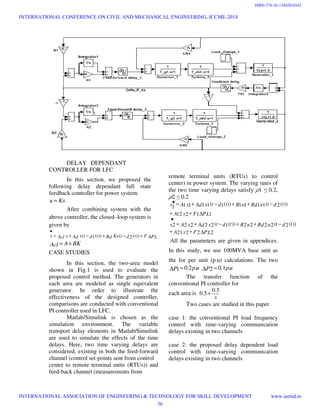
In this section, the two-area model
shown in Fig.1 is used to evaluate the
proposed control method. The generators in
each area are modeled as single equivalent
generator. In order to illustrate the
effectiveness of the designed controller,
comparisons are conducted with conventional
PI controller used in LFC.
Matlab/Simulink is chosen as the
simulation environment. The variable
transport delay elements in Matlab/Simulink
are used to simulate the effects of the time
delays. Here, two time varying delays are
considered, existing in both the feed-forward
channel (control set-points sent from control
center to remote terminal units (RTUs)) and
feed-back channel (measurements from
remote terminal units (RTUs) to control
center) in power system. The varying rates of
the two time varying delays satisfy ߩ1 ≤ 0.2,
ߩ2 ≤ 0.2
PLFxA
tdtuBduBtdtxAdxAx
PLFxA
tdtuBduBtdtxAdxAx
∆++
−++−+=
•
∆++
−++−+=•
22221
))(2(2222))(1(22222
11212
))(2(1111))(1(11111
All the parameters are given in appendices.
In this study, we use 100MVA base unit as
the for per unit (p.u) calculations. The two
upP .2.01=∆ upP .1.02 =∆
The transfer function of the
conventional PI controller for
each area is
s
5.0
5.0 +
Two cases are studied in this paper
case 1: the conventional PI load frequency
control with time-varying communication
delays existing in two channels
case 2: the proposed delay dependent load
control with time-varying communication
delays existing in two channels
INTERNATIONAL CONFERENCE ON CIVIL AND MECHANICAL ENGINEERING, ICCME-2014
INTERNATIONAL ASSOCIATION OF ENGINEERING & TECHNOLOGY FOR SKILL DEVELOPMENT www.iaetsd.in
36
ISBN:378-26-138420-0242
Fig(2) for area2
Fig(3) for area 1
CONCLUSION
This paper considers the modeling and delay
dependent stabilization problems of LFC for
power system with both feed
feedback time varying communication delays.
The state space models of LFC are presented,
including the two-channel time varying
delays. In case studies, two-area LFC model
is built to
evaluate the effectiveness of the proposed
method. With the comparison to the
conventional PI controller, it is shown that the
proposed controller can keep the power
system robustly stable and good convergence
rate when there exist time varying delays i
two channels.
REFERENCES
[1] Shichao liu,Xiaping P.Liu,”Load
frequency control for wide area monitoring
and control system in power system with
communication links”,IEEE transaction
2012.
[2]G.Anderson,P.Donalek et.al,”Causes of the
2003 major grid blockouts in North America
and Europe,and recommended means to
improve system dynamic performance”,IEEE
Transcationspowersystems,vol.20,n0.4,pp.19
22-1928,2005
[3] D. Karlsson, M. Hemmingsson and S.
Lindahl, “Wide area system
and control: terminology, phenomena, and
solution implementationstrategies ,”
Power and Energy Magazine, vol. 2, no. 5,
pp. 68-76, 2004.
[4] J. Machovski, J. W. Blalek, and J. R.
Bumby, “Power system dynamics
stability,” John Wiley & Sons, 1998.
[5] S. Bhovmik, K. Tomsovic, and A.
Bose, “Communication models
party load frequency control,”
Transactions on PowerSystems
no. 1, pp. 543-548, 2004
[6] L. Jiang, W. Yao, Q. H. Wu et. al,
“Delay-dependent stability for load
CONCLUSION
This paper considers the modeling and delay
stabilization problems of LFC for
power system with both feed-forward and
feedback time varying communication delays.
The state space models of LFC are presented,
channel time varying
area LFC model
evaluate the effectiveness of the proposed
method. With the comparison to the
conventional PI controller, it is shown that the
proposed controller can keep the power
system robustly stable and good convergence
rate when there exist time varying delays in
REFERENCES
[1] Shichao liu,Xiaping P.Liu,”Load
frequency control for wide area monitoring
and control system in power system with
communication links”,IEEE transaction
[2]G.Anderson,P.Donalek et.al,”Causes of the
lockouts in North America
and Europe,and recommended means to
improve system dynamic performance”,IEEE
Transcationspowersystems,vol.20,n0.4,pp.19
D. Karlsson, M. Hemmingsson and S.
Lindahl, “Wide area system monitoring
ogy, phenomena, and
solution implementationstrategies ,” IEEE
, vol. 2, no. 5,
] J. Machovski, J. W. Blalek, and J. R.
Bumby, “Power system dynamics and
stability,” John Wiley & Sons, 1998.
Tomsovic, and A.
Bose, “Communication models for third
party load frequency control,” IEEE
Transactions on PowerSystems, vol. 19,
Jiang, W. Yao, Q. H. Wu et. al,
dependent stability for load
INTERNATIONAL CONFERENCE ON CIVIL AND MECHANICAL ENGINEERING, ICCME-2014
INTERNATIONAL ASSOCIATION OF ENGINEERING & TECHNOLOGY FOR SKILL DEVELOPMENT www.iaetsd.in
37
ISBN:378-26-138420-0243
frequency control with constant and time-
varying delays,” in Power and Energy
Society General Meeting, 2009. PES ’09.
IEEE , Calgary, AB, Canada, 2009
[7] S. Xu, J. Lam, and Y. Zou,“improved
conditions for delay-dependant robust
stability and stabilization of uncertain
discrete time delay systems,”Asian J.
Control, vol. 7, no. 3, pp. 344-348, 2005
[8] L. E. Ghaoui, F. Oustry, and M.
Aitrami, “A cone complementary
linearization algorithm for static output-
feedback and related problems,” IEEE
Transactions on Autom. Control, vol. 19,
no. 3, pp. 1508-1515, 2004.
[9] V.C. Gungor, and F.C. Lambert, “A
survey on communication networks
for electric system automation,” Computer
Networks, vol. 50, no. 7, pp.
877-897, 2006
[10] P. Kundar, Power system stability and
control, Stateplace, New York:
McGraw-Hill, 1994.
APPENDIX A
Two–area power system parameters are
shown as follows
Area 1:
5.411
1
1
1
,121
,5.11,05.01,4.01,17.01
=+=
=
====
D
R
B
M
DRsT gsTch
Area 2:
8.612
2
1
2
,122
,8.12,05.02,35.02,2.02
=+=
=
====
D
R
B
M
DRsT gsTch
APPENDIX B
Area 2
[ ]
[ ]
[ ]T
F
T
Bd
Ad
T
B
A
A
0000833.02
088571.2002
0000
0000
0000
0833.00015.0
2
08571.2002
0005.0
0000
0000
0000
21
0005.0
08571.201429.57
0550
0833.000833.015.0
1
−=
=
−−
=
=
=
−−
−
−−
=
















































[ ]
[ ]
[ ]T
F
T
Bd
T
B
Ad
A
A
AREA
000833.01
05.2001
05.2001
0000
0000
0000
0833.000125.0
1
0005.0
0000
0000
0000
12
0005.0
05.2050
08824.58824.50
0833.000833.0125.0
1
1
−=
=
=
−−
=
=
−−
−
−−
=
















































INTERNATIONAL CONFERENCE ON CIVIL AND MECHANICAL ENGINEERING, ICCME-2014
INTERNATIONAL ASSOCIATION OF ENGINEERING & TECHNOLOGY FOR SKILL DEVELOPMENT www.iaetsd.in
38
ISBN:378-26-138420-0244

Iaetsd load area frequency control for multi area power

  • 1.
    LOAD AREA FREQUENCYCONTROL FOR MULTI AREA POWER SYSYTEM HAVING COMMINICATION DELAYS P. MAHESH DR.K.RAMASUDHA P.G scholar Professor ABSTRACT Load frequency control (LFC) has been used as an effective ancillary service in power systems for many years . An effective power system market highly needs an open communication infrastructure to support the increasing decentralized property of control services. Normally there exist usually unreliable factors in open communication links, such as time delays and communication failures. When open communication, infrastructures are embedded into modern power system to support vast amounts of data exchange, it becomes more challenging to keep the complex power system reliable and stable. In specific, we consider a general case that there exist time varying delays in two channels. One is the feed-forward channel in which control centers send control signals to remote terminal units (RTUs). The other one is the feedback channel where measurement signals are transmitted from RTUs to the control centers. The state space models of LFC including two channel time varying delays are presented. INTRODUCTION Load frequency control basic objective is to restore the balance between load and generation in each control area. With the deregulation of power industry, the monitoring and operation of power system among interconnected areas are becoming much more challenging than ever before. Several large blackouts happened for lack of system level of situation awareness, such as the well-known 2003 North American and European blackouts. To support the vast amounts of information exchange in real- time power system, the rapidly developed high speed open communication infrastructures are urgently needed to be implemented in large scale power system. While the advanced open communication links can be used to support the large amount of remote data transmission, they bring in new challenges in reliability and stability issues for next generation intelligent power system. As it is well known that communication networks, especially wireless networks, are unreliable because time delays and packet losses are unavoidable. These network-associated problems will degrade the dynamic performance of power system and even make it instable. In conventional LFC schemes, dedicated communication channels are used for transmission of measurements to the control center and control signals from the control center to the generator unit. The open communication infrastructure will also allow a bilateral market for the provision of load following and third party frequency control. Under this case, a certain part of generator units will receive a control signal to increase or reduce the power output, from either a control center or from the customer side directly. With the introduction of open communication channel, both constant delay and time-varying delay will be arisen in LFC problem. The operation of frequency control is fundamental in determining the way in which the frequency will change when load changes happen. When open communication links are embedded in power system, new control strategies are also necessarily needed to keep LFC performance robust to unreliable factors such as time delays and communication failures. MODEL OF LFC WITH TIME VARYING DELAYS In this section, the classical model of LFC is extended to include time varying delays existing in both states and control inputs for multi-area interconnected power systems. INTERNATIONAL CONFERENCE ON CIVIL AND MECHANICAL ENGINEERING, ICCME-2014 INTERNATIONAL ASSOCIATION OF ENGINEERING & TECHNOLOGY FOR SKILL DEVELOPMENT www.iaetsd.in 34 ISBN:378-26-138420-0240
  • 2.
    For LFC studies,all the generators in each area are represented equivalently by one single machine. In the following models in this paper, we omit the time ‫ݐ‬ in every variable for convenience, such as (‫ݐ‬) is written as ‫ݔ‬. For area i, the dynamics of LFC are described by )( 111 11 111 P jPiT ijPij tie Pci T gi Pvi T gi f i T giRi Pvi Pvi T chi Pmi T chi Pmi PLi M i Pij tie M i Pmi M i f i M i Dif i ∆−∆= ∆+∆−∆ − =•∆ ∆+∆ − =∆ • ∆−∆−∆+∆ − =∆ • where f i∆ frequency deviation pmi∆ generator mechanical power deviation Pvi∆ turbine valve position deviation Pci∆ load reference set-point Pij tie∆ tie-line power flow between area i and j PLi∆ load deviation Mi moment of inertia of generator i; Di damping coefficient of generator i; T gi time constant of governor i Tchi time constant of turbine i Tij stiffness constant Ri speed droop coefficient PLiFix j N ijj AijuiBixiAixi ∆+∑ ≠= ++=• ,1 .                             ∑ ≠= − −− − −− = 000 ,1 0 1 0 1 0 11 0 1 0 1 N ijj Tij T giT giRi TchiTchi MiMiMi Di Ai                 = 000 0000 0000 0000 Tij Aij         = 0 1 00 T gi Bi       − = 000 1 Mi Fi The ACE signal in a multi-area LFC scheme is defined as follows: Ptieif iBiACEi ∆+∆= . For the whole multi-area power system, an linear time invariant(LTI) interconnected model is given by PLFBuAxx ∆++= • Moreover, we consider two time varying bounded delays ݀1(‫ݐ‬), ݀2(‫ݐ‬) existing in states x and control input u. The two delays satisfy the following conditions: 0 ≤ ݀1(‫ݐ‬) ≤ ݀ˆ1, 0 ≤ ݀2(‫ݐ‬) ≤ ݀ˆ2; ݀1˙(‫ݐ‬) ≤ ߩ1 ≤ 1, ݀2˙(‫ݐ‬) ≤ ߩ2 ≤ 1. The LFC model with states and control inputs delays is given by PLFtdtuBdButdtxAdAxx ∆+−++−+= • ))(2(_))(1( where { }T AdnAdAddiagAd 21= { }T BdnBdBddiagBd 21=                 −− = 0000 0000 0000 1 00 MiMi Di Adi         = 0 1 00 T gi Bdi [ ]Pij tiePviPmif ixi ∆∆∆∆= INTERNATIONAL CONFERENCE ON CIVIL AND MECHANICAL ENGINEERING, ICCME-2014 INTERNATIONAL ASSOCIATION OF ENGINEERING & TECHNOLOGY FOR SKILL DEVELOPMENT www.iaetsd.in 35 ISBN:378-26-138420-0241
  • 3.
    DELAY DEPENDANT CONTROLLER FORLFC In this section, we proposed the following delay dependant full state feedback controller for power system: Kxu = . After combining system with the above controller, the closed–loop system is given by PLFtdtKxBdtdtxAdxAclx ∆+−+−+= • ))(2())(1( BKAAcl += CASE STUDIES In this section, the two-area model shown in Fig.1 is used to evaluate the proposed control method. The generators in each area are modeled as single equivalent generator. In order to illustrate the effectiveness of the designed controller, comparisons are conducted with conventional PI controller used in LFC. Matlab/Simulink is chosen as the simulation environment. The variable transport delay elements in Matlab/Simulink are used to simulate the effects of the time delays. Here, two time varying delays are considered, existing in both the feed-forward channel (control set-points sent from control center to remote terminal units (RTUs)) and feed-back channel (measurements from remote terminal units (RTUs) to control center) in power system. The varying rates of the two time varying delays satisfy ߩ1 ≤ 0.2, ߩ2 ≤ 0.2 PLFxA tdtuBduBtdtxAdxAx PLFxA tdtuBduBtdtxAdxAx ∆++ −++−+= • ∆++ −++−+=• 22221 ))(2(2222))(1(22222 11212 ))(2(1111))(1(11111 All the parameters are given in appendices. In this study, we use 100MVA base unit as the for per unit (p.u) calculations. The two upP .2.01=∆ upP .1.02 =∆ The transfer function of the conventional PI controller for each area is s 5.0 5.0 + Two cases are studied in this paper case 1: the conventional PI load frequency control with time-varying communication delays existing in two channels case 2: the proposed delay dependent load control with time-varying communication delays existing in two channels INTERNATIONAL CONFERENCE ON CIVIL AND MECHANICAL ENGINEERING, ICCME-2014 INTERNATIONAL ASSOCIATION OF ENGINEERING & TECHNOLOGY FOR SKILL DEVELOPMENT www.iaetsd.in 36 ISBN:378-26-138420-0242
  • 4.
    Fig(2) for area2 Fig(3)for area 1 CONCLUSION This paper considers the modeling and delay dependent stabilization problems of LFC for power system with both feed feedback time varying communication delays. The state space models of LFC are presented, including the two-channel time varying delays. In case studies, two-area LFC model is built to evaluate the effectiveness of the proposed method. With the comparison to the conventional PI controller, it is shown that the proposed controller can keep the power system robustly stable and good convergence rate when there exist time varying delays i two channels. REFERENCES [1] Shichao liu,Xiaping P.Liu,”Load frequency control for wide area monitoring and control system in power system with communication links”,IEEE transaction 2012. [2]G.Anderson,P.Donalek et.al,”Causes of the 2003 major grid blockouts in North America and Europe,and recommended means to improve system dynamic performance”,IEEE Transcationspowersystems,vol.20,n0.4,pp.19 22-1928,2005 [3] D. Karlsson, M. Hemmingsson and S. Lindahl, “Wide area system and control: terminology, phenomena, and solution implementationstrategies ,” Power and Energy Magazine, vol. 2, no. 5, pp. 68-76, 2004. [4] J. Machovski, J. W. Blalek, and J. R. Bumby, “Power system dynamics stability,” John Wiley & Sons, 1998. [5] S. Bhovmik, K. Tomsovic, and A. Bose, “Communication models party load frequency control,” Transactions on PowerSystems no. 1, pp. 543-548, 2004 [6] L. Jiang, W. Yao, Q. H. Wu et. al, “Delay-dependent stability for load CONCLUSION This paper considers the modeling and delay stabilization problems of LFC for power system with both feed-forward and feedback time varying communication delays. The state space models of LFC are presented, channel time varying area LFC model evaluate the effectiveness of the proposed method. With the comparison to the conventional PI controller, it is shown that the proposed controller can keep the power system robustly stable and good convergence rate when there exist time varying delays in REFERENCES [1] Shichao liu,Xiaping P.Liu,”Load frequency control for wide area monitoring and control system in power system with communication links”,IEEE transaction [2]G.Anderson,P.Donalek et.al,”Causes of the lockouts in North America and Europe,and recommended means to improve system dynamic performance”,IEEE Transcationspowersystems,vol.20,n0.4,pp.19 D. Karlsson, M. Hemmingsson and S. Lindahl, “Wide area system monitoring ogy, phenomena, and solution implementationstrategies ,” IEEE , vol. 2, no. 5, ] J. Machovski, J. W. Blalek, and J. R. Bumby, “Power system dynamics and stability,” John Wiley & Sons, 1998. Tomsovic, and A. Bose, “Communication models for third party load frequency control,” IEEE Transactions on PowerSystems, vol. 19, Jiang, W. Yao, Q. H. Wu et. al, dependent stability for load INTERNATIONAL CONFERENCE ON CIVIL AND MECHANICAL ENGINEERING, ICCME-2014 INTERNATIONAL ASSOCIATION OF ENGINEERING & TECHNOLOGY FOR SKILL DEVELOPMENT www.iaetsd.in 37 ISBN:378-26-138420-0243
  • 5.
    frequency control withconstant and time- varying delays,” in Power and Energy Society General Meeting, 2009. PES ’09. IEEE , Calgary, AB, Canada, 2009 [7] S. Xu, J. Lam, and Y. Zou,“improved conditions for delay-dependant robust stability and stabilization of uncertain discrete time delay systems,”Asian J. Control, vol. 7, no. 3, pp. 344-348, 2005 [8] L. E. Ghaoui, F. Oustry, and M. Aitrami, “A cone complementary linearization algorithm for static output- feedback and related problems,” IEEE Transactions on Autom. Control, vol. 19, no. 3, pp. 1508-1515, 2004. [9] V.C. Gungor, and F.C. Lambert, “A survey on communication networks for electric system automation,” Computer Networks, vol. 50, no. 7, pp. 877-897, 2006 [10] P. Kundar, Power system stability and control, Stateplace, New York: McGraw-Hill, 1994. APPENDIX A Two–area power system parameters are shown as follows Area 1: 5.411 1 1 1 ,121 ,5.11,05.01,4.01,17.01 =+= = ==== D R B M DRsT gsTch Area 2: 8.612 2 1 2 ,122 ,8.12,05.02,35.02,2.02 =+= = ==== D R B M DRsT gsTch APPENDIX B Area 2 [ ] [ ] [ ]T F T Bd Ad T B A A 0000833.02 088571.2002 0000 0000 0000 0833.00015.0 2 08571.2002 0005.0 0000 0000 0000 21 0005.0 08571.201429.57 0550 0833.000833.015.0 1 −= = −− = = = −− − −− =                                                 [ ] [ ] [ ]T F T Bd T B Ad A A AREA 000833.01 05.2001 05.2001 0000 0000 0000 0833.000125.0 1 0005.0 0000 0000 0000 12 0005.0 05.2050 08824.58824.50 0833.000833.0125.0 1 1 −= = = −− = = −− − −− =                                                 INTERNATIONAL CONFERENCE ON CIVIL AND MECHANICAL ENGINEERING, ICCME-2014 INTERNATIONAL ASSOCIATION OF ENGINEERING & TECHNOLOGY FOR SKILL DEVELOPMENT www.iaetsd.in 38 ISBN:378-26-138420-0244