I
HATE
LEARNING
STICKINESS
Suggested Reading
Benassi, V. A., Overson, C. E., & Hakala, C. M. (2014). Applying science of learning in education: Infusing
psychological science into the curriculum.
Retrieved from the Society for the Teaching of Psychology web site:
http://teachpsych.org/ebooks/asle2014/index.php
Viewed May 23, 2015
Some of the following specific titles are from the above cited document and from the website:
http://www.memrise.com/science/
Spacing and Interleaving of Study and Practice, Shana K. Carpenter, Iowa State University (2014)
V. A. Benassi, C. E. Overson, & C. M. Hakala (Eds.) (2014). Applying the science of learning in education:
Infusing psychological science into the curriculum. Society for the Teaching of Psychology web
site: http://teachpsych.org/ebooks/asle2014/index.php .
Bjork, R. A., Dunlosky, J., & Kornell, N. (2013). Self-regulated learning: Beliefs, techniques, and
illusions. Annual Review of Psychology, 64, 417-
444.http://bjorklab.psych.ucla.edu/pubs/RBjork_Dunlosky_Kornell_2013.pdf .
Brown, P. C., Roediger, H. L., & McDaniel, M. A. (2014). Make it stick: The science of successful
learning. Cambridge, MA: Harvard University Press.
Pashler, H., Bain, P. M., Bottge, B. A., Graesser, A., McDaniel, M. A., & Metcalfe, J. (2007). Organizing
instruction and study to improve student learning (NCER Publication No. 2007–2004). Washington, DC:
National Center for Education Research, Institute of Education Sciences, U.S. Department of
Education. http://ies.ed.gov/ncee/wwc/pdf/practice_guides/20072004.pdf
Potts, R. & Shanks, D. R. (2014). The benefit of generating errors during learning. Journal of Experimental
Psychology: General, 143, 644-667.http://discovery.ucl.ac.uk/1399515/1/RPottsLastRevision.pdf
Roediger, H. L., Putnam, A. L., & Smith, M. A. (2011). Ten benefits of testing and their applications to
educational practice. In J. Mestre & B. Ross (Eds.), Psychology of learning and motivation: Cognition in education
(pp. 1-36).http://psych.wustl.edu/memory/Roddy%20article%20PDF's/BC_Roediger%20et%20al%20(2011)_PLM.pd
Suggested Reading
WHAT IS ONE GLARING PROBLEM
WITH TRAINING?
In short, there is an assumption that
what occurs in a training program will be
quickly applied to the job and the
learning will be re-enforced until it
“sinks-in”, is easily recalled and is
practical with measurable returns.
If you do not practice, using a defined
schedule of what you just learned, then
your learning will have minimal value
and be quickly lost.
ARE YOU SURPRISED TO LEARN…
Pre-Learning
Value
Knowing Expectations
Asking me about my needs
Learning Event Marketing
Ease of access (LMS)
Receiving Feedback
Learning Event
Value
Post-Learning
Value
Follow-on activities
Practice
Group learning
Teaching
Gaming/Competition
Feedback
Social learning
Online course
Classroom event
Webinar
External conference
Academic class
In Training Magazine’s survey,1,200 learners stated that the value
from training has three segments:
26% 24% 50%
VALUE AND FUNDING
Pre-Work Learning Event Post Training Activities
26% 24% 50%
10% 85% 5%
Estimates of how the current learning process is funded. The greatest
value is the least funded.
The Value of the Learning Activity
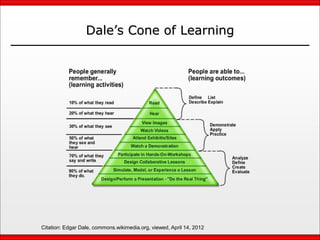
Dale’s Cone of Learning
Citation: Edgar Dale, commons.wikimedia.org, viewed, April 14, 2012
WHAT IS APPLIED LEARNING EXTENSIONS™
Applied Learning Extensions™
is a process with specific
learning activities that will be
generated about 10 times over
90 days following a training
program.
An activity can be as simple as
a 1 minute email or a 20
minute practice.
The information gained in
the learning program is moved
into long term memory
through use, repetition and
applied practice.
ALE™ re-enforces that
learning on the job through
immediate application and
recall.
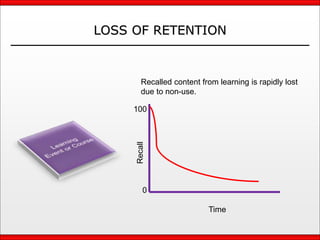
LOSS OF RETENTION
Time
Recall
Recalled content from learning is rapidly lost
due to non-use.
0
100
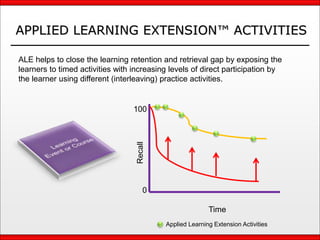
APPLIED LEARNING EXTENSION™ ACTIVITIES
Time
Recall
0
100
Applied Learning Extension Activities
ALE helps to close the learning retention and retrieval gap by exposing the
learners to timed activities with increasing levels of direct participation by
the learner using different (interleaving) practice activities.
APPLIED LEARNING EXTENSION™ ACTIVITIES
Business
Acumen
Event or Course
Not all training is considered as having equal value in terms of investment
return. Select which of your existing training has the greatest value and
then apply the 90 day ALE™ approach.
Sales Training
Event or Course
Leadership Event
or Course
Computer
Security Event or
Course
1. Select the training that will
participate in ALE™
2. Incorporate the training
language into the ALE™
program
3. Define the success
measurements
4. Create company specific
cases to be used with ALE™
5. Generate the activities
6. Incorporate measurement
follow-up
The Process
APPLIED LEARNING EXTENSION™ ACTIVITIES
Learning
Event or
Course
Time
Recall
0
100
Applied Learning Extension Activities
ALE helps to close the learning retention gap by exposing the learners to
timed activities with increasing levels of direct participation by the learner.
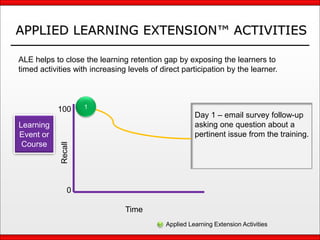
Day 1 – email survey follow-up
asking one question about a
pertinent issue from the training.
1
APPLIED LEARNING EXTENSION™ ACTIVITIES
Learning
Event or
Course
Time
Recall
0
100
Applied Learning Extension Activities
ALE helps to close the learning retention gap by exposing the learners to
timed activities with increasing levels of direct participation by the learner.
3
Day 3 – email survey follow-up
asking three questions about
pertinent issues from the
training and doing one topic
repetition.
APPLIED LEARNING EXTENSION™ ACTIVITIES
Learning
Event or
Course
Time
Recall
0
100
Applied Learning Extension Activities
ALE helps to close the learning retention gap by exposing the learners to
timed activities with increasing levels of direct participation by the learner.
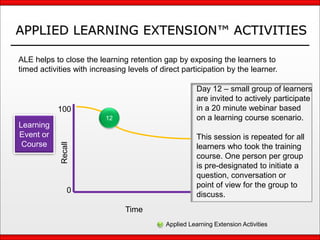
12
Day 12 – small group of learners
are invited to actively participate
in a 20 minute webinar based
on a learning course scenario.
This session is repeated for all
learners who took the training
course. One person per group
is pre-designated to initiate a
question, conversation or
point of view for the group to
discuss.
APPLIED LEARNING EXTENSION™ ACTIVITIES
Learning
Event or
Course
Time
Recall
0
100
Applied Learning Extension Activities
ALE helps to close the learning retention gap by exposing the learners to
timed activities with increasing levels of direct participation by the learner.
30
Day 30 – small group of learners
are invited to actively participate
in a 30 minute webinar .
The session situation applies
the training to the company.
Two people per group
are pre-designated to design
and facilitate the webinar. This
is a PC video webinar.
APPLIED LEARNING EXTENSION™ ACTIVITIES
Learning
Event or
Course
Time
Recall
0
100
Applied Learning Extension Activities
ALE helps to close the learning retention gap by exposing the learners to
timed activities with increasing levels of direct participation by the learner.
45
Day 45 – all of the learners will
receive a 10 question quiz
designed to provide
transference of the learning to
other external or company
specific situations.
A brief audio podcast of the
optimum responses to the
questions is delivered to the
learners within 24 hours.
APPLIED LEARNING EXTENSION™ ACTIVITIES
Learning
Event or
Course
Time
Recall
0
100
Applied Learning Extension Activities
ALE helps to close the learning retention gap by exposing the learners to
timed activities with increasing levels of direct participation by the learner.
60
Day 60 – each of the previous
small groups will be provided
an email case study to resolve,
present and defend to the other
groups. Each small group will
select their own facilitator in
the presentation and defense
which occurs at Day 90.
APPLIED LEARNING EXTENSION™ ACTIVITIES
Learning
Event or
Course
Time
Recall
0
100
Applied Learning Extension Activities
ALE helps to close the learning retention gap by exposing the learners to
timed activities with increasing levels of direct participation by the learner.
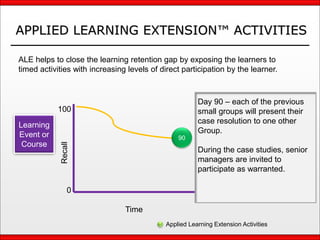
90
Day 90 – each of the previous
small groups will present their
case resolution to one other
Group.
During the case studies, senior
managers are invited to
participate as warranted.
APPLIED LEARNING EXTENSION™ ACTIVITIES
Learning
Event or
Course
Test delay (how long do you wish your employee to retain
and recall the training)
0
90
Applied Learning Extension Activities
Important note on timed spacing of practice:
The optimal spacing gap depends on the test delay,
such that shorter spacing gaps tended to produce
better retention after longer delays. More specifically,
memory retention was best when the spacing gap was
about 10-20% of the test delay.
Cepeda, N.J., Vul, E.,et al, (2008), Spacing Effects in Learning,
Psychological Science, 19, 1095-1102
SpacingGaps
IMPLEMENTING RETAINED LEARNING
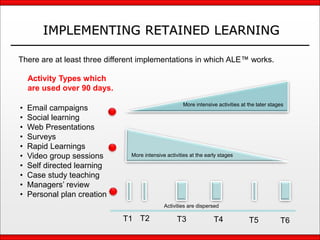
There are at least three different implementations in which ALE™ works.
T1 T2 T3 T4 T5 T6
.More intensive activities at the later stages
More intensive activities at the early stages
Activities are dispersed
• Email campaigns
• Social learning
• Web Presentations
• Surveys
• Rapid Learnings
• Video group sessions
• Self directed learning
• Case study teaching
• Managers’ review
• Personal plan creation
Activity Types which
are used over 90 days.
CLOSING THE GAP
If you wish to learn more or
to attend our next webinar
that describes the process and
the learning extensions, please
contact us. Thank you.
Dave Goodman
dgood@softassist.com
610.265.8484
Time
Recall0
100
Applied Learning Extension Activities

I Hate Learning Stickiness

  • 1.
  • 2.
    Suggested Reading Benassi, V.A., Overson, C. E., & Hakala, C. M. (2014). Applying science of learning in education: Infusing psychological science into the curriculum. Retrieved from the Society for the Teaching of Psychology web site: http://teachpsych.org/ebooks/asle2014/index.php Viewed May 23, 2015 Some of the following specific titles are from the above cited document and from the website: http://www.memrise.com/science/ Spacing and Interleaving of Study and Practice, Shana K. Carpenter, Iowa State University (2014)
  • 3.
    V. A. Benassi,C. E. Overson, & C. M. Hakala (Eds.) (2014). Applying the science of learning in education: Infusing psychological science into the curriculum. Society for the Teaching of Psychology web site: http://teachpsych.org/ebooks/asle2014/index.php . Bjork, R. A., Dunlosky, J., & Kornell, N. (2013). Self-regulated learning: Beliefs, techniques, and illusions. Annual Review of Psychology, 64, 417- 444.http://bjorklab.psych.ucla.edu/pubs/RBjork_Dunlosky_Kornell_2013.pdf . Brown, P. C., Roediger, H. L., & McDaniel, M. A. (2014). Make it stick: The science of successful learning. Cambridge, MA: Harvard University Press. Pashler, H., Bain, P. M., Bottge, B. A., Graesser, A., McDaniel, M. A., & Metcalfe, J. (2007). Organizing instruction and study to improve student learning (NCER Publication No. 2007–2004). Washington, DC: National Center for Education Research, Institute of Education Sciences, U.S. Department of Education. http://ies.ed.gov/ncee/wwc/pdf/practice_guides/20072004.pdf Potts, R. & Shanks, D. R. (2014). The benefit of generating errors during learning. Journal of Experimental Psychology: General, 143, 644-667.http://discovery.ucl.ac.uk/1399515/1/RPottsLastRevision.pdf Roediger, H. L., Putnam, A. L., & Smith, M. A. (2011). Ten benefits of testing and their applications to educational practice. In J. Mestre & B. Ross (Eds.), Psychology of learning and motivation: Cognition in education (pp. 1-36).http://psych.wustl.edu/memory/Roddy%20article%20PDF's/BC_Roediger%20et%20al%20(2011)_PLM.pd Suggested Reading
  • 4.
    WHAT IS ONEGLARING PROBLEM WITH TRAINING? In short, there is an assumption that what occurs in a training program will be quickly applied to the job and the learning will be re-enforced until it “sinks-in”, is easily recalled and is practical with measurable returns. If you do not practice, using a defined schedule of what you just learned, then your learning will have minimal value and be quickly lost.
  • 5.
    ARE YOU SURPRISEDTO LEARN… Pre-Learning Value Knowing Expectations Asking me about my needs Learning Event Marketing Ease of access (LMS) Receiving Feedback Learning Event Value Post-Learning Value Follow-on activities Practice Group learning Teaching Gaming/Competition Feedback Social learning Online course Classroom event Webinar External conference Academic class In Training Magazine’s survey,1,200 learners stated that the value from training has three segments: 26% 24% 50%
  • 6.
    VALUE AND FUNDING Pre-WorkLearning Event Post Training Activities 26% 24% 50% 10% 85% 5% Estimates of how the current learning process is funded. The greatest value is the least funded. The Value of the Learning Activity
  • 7.
    Dale’s Cone ofLearning Citation: Edgar Dale, commons.wikimedia.org, viewed, April 14, 2012
  • 8.
    WHAT IS APPLIEDLEARNING EXTENSIONS™ Applied Learning Extensions™ is a process with specific learning activities that will be generated about 10 times over 90 days following a training program. An activity can be as simple as a 1 minute email or a 20 minute practice. The information gained in the learning program is moved into long term memory through use, repetition and applied practice. ALE™ re-enforces that learning on the job through immediate application and recall.
  • 9.
    LOSS OF RETENTION Time Recall Recalledcontent from learning is rapidly lost due to non-use. 0 100
  • 10.
    APPLIED LEARNING EXTENSION™ACTIVITIES Time Recall 0 100 Applied Learning Extension Activities ALE helps to close the learning retention and retrieval gap by exposing the learners to timed activities with increasing levels of direct participation by the learner using different (interleaving) practice activities.
  • 11.
    APPLIED LEARNING EXTENSION™ACTIVITIES Business Acumen Event or Course Not all training is considered as having equal value in terms of investment return. Select which of your existing training has the greatest value and then apply the 90 day ALE™ approach. Sales Training Event or Course Leadership Event or Course Computer Security Event or Course 1. Select the training that will participate in ALE™ 2. Incorporate the training language into the ALE™ program 3. Define the success measurements 4. Create company specific cases to be used with ALE™ 5. Generate the activities 6. Incorporate measurement follow-up The Process
  • 12.
    APPLIED LEARNING EXTENSION™ACTIVITIES Learning Event or Course Time Recall 0 100 Applied Learning Extension Activities ALE helps to close the learning retention gap by exposing the learners to timed activities with increasing levels of direct participation by the learner. Day 1 – email survey follow-up asking one question about a pertinent issue from the training. 1
  • 13.
    APPLIED LEARNING EXTENSION™ACTIVITIES Learning Event or Course Time Recall 0 100 Applied Learning Extension Activities ALE helps to close the learning retention gap by exposing the learners to timed activities with increasing levels of direct participation by the learner. 3 Day 3 – email survey follow-up asking three questions about pertinent issues from the training and doing one topic repetition.
  • 14.
    APPLIED LEARNING EXTENSION™ACTIVITIES Learning Event or Course Time Recall 0 100 Applied Learning Extension Activities ALE helps to close the learning retention gap by exposing the learners to timed activities with increasing levels of direct participation by the learner. 12 Day 12 – small group of learners are invited to actively participate in a 20 minute webinar based on a learning course scenario. This session is repeated for all learners who took the training course. One person per group is pre-designated to initiate a question, conversation or point of view for the group to discuss.
  • 15.
    APPLIED LEARNING EXTENSION™ACTIVITIES Learning Event or Course Time Recall 0 100 Applied Learning Extension Activities ALE helps to close the learning retention gap by exposing the learners to timed activities with increasing levels of direct participation by the learner. 30 Day 30 – small group of learners are invited to actively participate in a 30 minute webinar . The session situation applies the training to the company. Two people per group are pre-designated to design and facilitate the webinar. This is a PC video webinar.
  • 16.
    APPLIED LEARNING EXTENSION™ACTIVITIES Learning Event or Course Time Recall 0 100 Applied Learning Extension Activities ALE helps to close the learning retention gap by exposing the learners to timed activities with increasing levels of direct participation by the learner. 45 Day 45 – all of the learners will receive a 10 question quiz designed to provide transference of the learning to other external or company specific situations. A brief audio podcast of the optimum responses to the questions is delivered to the learners within 24 hours.
  • 17.
    APPLIED LEARNING EXTENSION™ACTIVITIES Learning Event or Course Time Recall 0 100 Applied Learning Extension Activities ALE helps to close the learning retention gap by exposing the learners to timed activities with increasing levels of direct participation by the learner. 60 Day 60 – each of the previous small groups will be provided an email case study to resolve, present and defend to the other groups. Each small group will select their own facilitator in the presentation and defense which occurs at Day 90.
  • 18.
    APPLIED LEARNING EXTENSION™ACTIVITIES Learning Event or Course Time Recall 0 100 Applied Learning Extension Activities ALE helps to close the learning retention gap by exposing the learners to timed activities with increasing levels of direct participation by the learner. 90 Day 90 – each of the previous small groups will present their case resolution to one other Group. During the case studies, senior managers are invited to participate as warranted.
  • 19.
    APPLIED LEARNING EXTENSION™ACTIVITIES Learning Event or Course Test delay (how long do you wish your employee to retain and recall the training) 0 90 Applied Learning Extension Activities Important note on timed spacing of practice: The optimal spacing gap depends on the test delay, such that shorter spacing gaps tended to produce better retention after longer delays. More specifically, memory retention was best when the spacing gap was about 10-20% of the test delay. Cepeda, N.J., Vul, E.,et al, (2008), Spacing Effects in Learning, Psychological Science, 19, 1095-1102 SpacingGaps
  • 20.
    IMPLEMENTING RETAINED LEARNING Thereare at least three different implementations in which ALE™ works. T1 T2 T3 T4 T5 T6 .More intensive activities at the later stages More intensive activities at the early stages Activities are dispersed • Email campaigns • Social learning • Web Presentations • Surveys • Rapid Learnings • Video group sessions • Self directed learning • Case study teaching • Managers’ review • Personal plan creation Activity Types which are used over 90 days.
  • 21.
    CLOSING THE GAP Ifyou wish to learn more or to attend our next webinar that describes the process and the learning extensions, please contact us. Thank you. Dave Goodman dgood@softassist.com 610.265.8484 Time Recall0 100 Applied Learning Extension Activities