Hypertensive Disorders in
Pregnancy-II
Women with elevated BP during pregnancy are
associated with significant maternal & fetal morbidity
and mortality .
 Morbidity will remain high in our environment until
there is general improvement in maternity services.
Blood pressure
>150/100 / < 150/100with proteinuria
<150/100
Inv for High-risk factors
Negative Positive Admit to Hospital
Out-Patient care.
24-hour urine for Protein/wkly
CBC,U R/M,LDH, Liver enzymes
S. urea, creatinine, uric acid
Antihypertensive treatment
Betamethasone if <34wks
Umbilical & MCA doppler
DFMC
Repeat laboratory 2-3times/wkly
Assesments remains
within normal limits Worsening of situation
Out-patient care
Delivery at term Delivery
Gest.hypertension
Assesment remains normal
Self monitoring of B.P. at home
Rest at home
Frequent hospital visits
Ultrasound for fetal growth/3-4wk
Uterine, umbilical and MCA
doppler/wkly or biwkly
Weekly liquor status
Gestational hypertension with risk
factors :
Objectives of care are-
pharmacological control of their BP
early detection of Pre-eclampsia,
 end organ damage &
 fetal decompensation.
Labetalol 1st
line of antihypertensive
IV bolus of 20 mg
↓
if not decrease to Diastolic
80 -110 mm Hg in 10 mins
2nd
dose of IV bolus of 40 mg
if not controlled 3rd
IV bolus of 80 mg
↓
When controlled oral labetalol
200 – 400 mg of 12 hrly
(if we give by continuous IV
then 20mg / hr , max up to 200 mg / hr)
↓
once BP stabilized 100 – 400 mg orally every 6 – 12 hrs
Nifedipine should be given orally not sublingually.
5-10 mg cap start
BP monitored every 15 min
Repeat 10 mg every 30-60 mins till adequate response
Methyl dopa
Hydralazine
Na nitroprusside
Nitroglycerine
Expectant management is terminated
• When hypertension cannot be controlled
or there is evidence of end organ damage.
• Abruptio-placentae
• Arrest of fetal growth.
• Absent or reversed umbilical artery
diastolic flow
• Non reassuring test of fetal wellbeing
Mild preeclampsia Gest.age
<32 wks 32-36 wks ≥37wks
Continuous assessment
Daily BP, Wt. ,urine dipstick, DFMC
Questioning ?,sr. uric acid
Platelets ,LFT, RFT wkly
Gravidogram , USG for fetal
growth, Doppler study every wk
Fundoscopy
Stable
Continue expectancy
Deliver at 37 wks
Delivery
Delivery
Uncontrolled
BP > 160/110
Proteinuria >5gm/24 hrs
Platelets<100,000/cmm
AST > 70IU/L OR ALT >70IU/L
LDH > 600 U/L
sr. uric acid ≥ 6mg %
Minimal or no fetal growth by USG
Absent or reversed UA Doppler
Oligohydramnios (AFI<5cm)
Progressive increase in serum creatinine
Severe preeclampsia Gest. Age
<24 wks
24-34 wks
>34wks
MgSO4
BP control
immediate
delivery
MgSO4
BP control
immediate
delivery
continuous assessment
BP ≥160/110 despite of treatment
Urine output < 400ml/24hrs
CBC ,Urine R/M,TPC<100,000
Elevated LFT , RFT, serum uric acid
Severe symptoms, HELLP,
Absent or reversed diastolic flow UA D.
Oligohydramnious, IUGR
Nonreassuring FHR, fundoscopy
YESNO
Bed rest , DFMC ,BP 4hrly,daily wt.& I/O,
Daily CBC,LFT,RFT if normal
12hrly urinary protein ,steroids
UA & MCA Doppler ,Liquor status twice wkly
Gravidogram, USG for fetal growth every 2wks
Unstable
MgSO4 & Immediate delivery
Stable
Continue expectancy
MgSO4
BP control
Steroids ?
immediate
delivery
Do not
1. Do not attempt to normal Blood pressure.
( Rapid lowering of BP will cause ↓ Blood
flow to renal, cerebral ,coronary, placental
pressure flow).
2. Do not give diuretics before delivery. Give
diuretics after delivery.
3. Do not give diazepam or phenytoin to stop
an eclamptic seizure. Mgt of seizure O2 ,
avoid trauma to tongue and other organs
and waiting for spontaneous resolution.
4. Do not push the padded tongue blade to
the back of the throat ( will stimulate gag
reflex and vomit)
Eclampsia
Pre-eclampsia when complicated with
convulsion and / or coma is called
eclampsia.
Diagnosis
When a pregnant woman present with
seizeres, hypertension and protienuria.
Approximately 15% of the cases hypertension
and proteinuria are absent.
Treatment of eclamptic seizures
Airway
Assess
Maintain patency
Apply oxygen
Breathing
Assess
Protect airway
Ventilate as required
Circulation
Evaluate pulse & BP if absent,
initiate CPR & call arrest
team
Secure IV access
Diurectis :
• Diuretics contraindicated in
preeclampsia & eclampsia before
delivery except those with …..
Pulmonary edema, severe edema or
renal failure.
• Furosemide 20 – 40 mg IV / 6 – 12 hrly
should be initiated shortly after
delivery ( VD/CS) then orally when
patient able to.
Intermittent i.m injections (pritchard)
 4g of 20% magnesium sulfate i.v @ not exceeding
1g/min.
 Followed by 10g of 50% magnesium sulfate 5g each
in both the buttocks through a 3 inch long, 20 G
needle(1 ml of 2% lidocaine minimises discomfort).
 If convulsions persists after 15 min. give upto 2 g
more in i.v 20% magnesium sulfate @ not exceeding
1 g /min
If the women is large upto 4g may be given.
 Thereafter give 5gm of 50% solution of magnesium
sulphate every 4hr in alternate buttock
Magnesium sulfate is to be continued 24 hrs after
delivery or if eclampsia develops post-partum , 24hrs
after the last seizure .
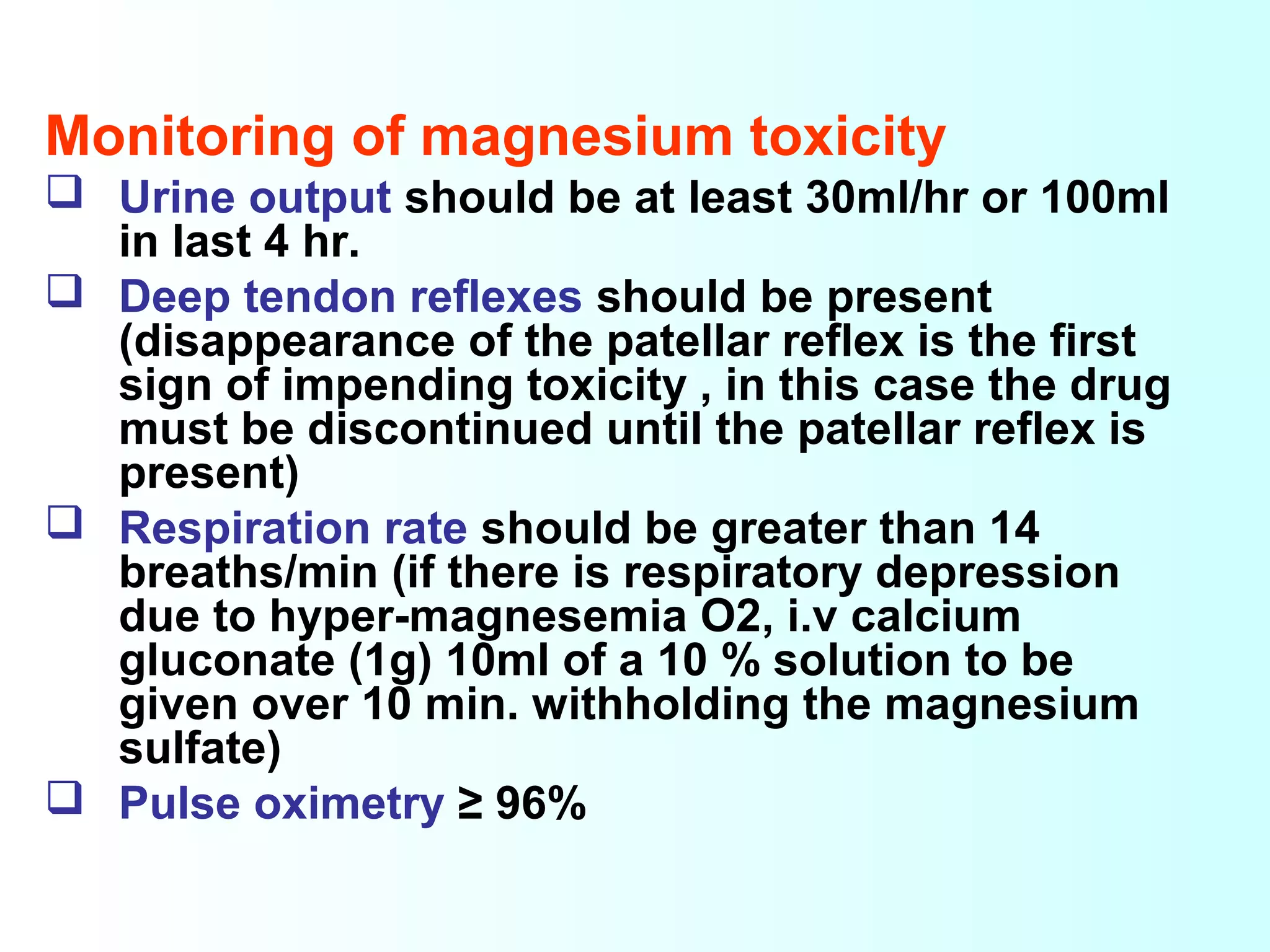
Monitoring of magnesium toxicity
 Urine output should be at least 30ml/hr or 100ml
in last 4 hr.
 Deep tendon reflexes should be present
(disappearance of the patellar reflex is the first
sign of impending toxicity , in this case the drug
must be discontinued until the patellar reflex is
present)
 Respiration rate should be greater than 14
breaths/min (if there is respiratory depression
due to hyper-magnesemia O2, i.v calcium
gluconate (1g) 10ml of a 10 % solution to be
given over 10 min. withholding the magnesium
sulfate)
 Pulse oximetry ≥ 96%
What is the therapeutic plasma level & describe
the toxicity according to the plasma level of
MgSO4?
Plasma Level of
magnesium (mEq/lit)
Signs of Toxicity
4 -7
Nil -this is a required level
for prevention of eclampsia
8-10 Uterine relaxation
10 Patellar reflex disappears
10-12 Respiratory depression
>12 Respiratory paralysis
Eclampsia
ABC
Place the patient in lt. lat position
Insert padded tongue blade ,avoiding gag reflex
Suction oral secretions
Give O2 mask at 8-10L/min.
Elevate bed side rails & pad them to avoid injury
Use physical restrains if necessary
IVF (80 ml/hr or 1ml /kg/hr)
Indications for C.S.
•Unripe cervix
•GA < 32wks
•Inadequate BP control
•Obstetric indication for C.S.
•Fetal distress, Status eclampticus
Loading dose of MgSO4 & then maintenance
(if referred with MgSO4 then only maintenance )
Antihypertensive , if DBP ≥ 110 mm Hg after MgSO4
Delivery :
In eclampsia the definitive treatment is delivery.
However it is inappropriate to deliver an unstable
mother even if there is fetal distress.
Once seizures are controlled ,severe hypertension
treated & hypoxia corrected, delivery can be
expedited.
In 3rd
stage of labour oxytocin 10U IV/IM,
prostaglandin 125or250mg IM, misoprostol
given . Ergometrine is avoided.
In caesarean section : antibiotic prophylaxis.
RCOG 2006
Hypertensive disorder in pregnancy   1

Hypertensive disorder in pregnancy 1

  • 1.
  • 2.
    Women with elevatedBP during pregnancy are associated with significant maternal & fetal morbidity and mortality .  Morbidity will remain high in our environment until there is general improvement in maternity services.
  • 4.
    Blood pressure >150/100 /< 150/100with proteinuria <150/100 Inv for High-risk factors Negative Positive Admit to Hospital Out-Patient care. 24-hour urine for Protein/wkly CBC,U R/M,LDH, Liver enzymes S. urea, creatinine, uric acid Antihypertensive treatment Betamethasone if <34wks Umbilical & MCA doppler DFMC Repeat laboratory 2-3times/wkly Assesments remains within normal limits Worsening of situation Out-patient care Delivery at term Delivery Gest.hypertension Assesment remains normal Self monitoring of B.P. at home Rest at home Frequent hospital visits Ultrasound for fetal growth/3-4wk Uterine, umbilical and MCA doppler/wkly or biwkly Weekly liquor status
  • 5.
    Gestational hypertension withrisk factors : Objectives of care are- pharmacological control of their BP early detection of Pre-eclampsia,  end organ damage &  fetal decompensation.
  • 6.
    Labetalol 1st line ofantihypertensive IV bolus of 20 mg ↓ if not decrease to Diastolic 80 -110 mm Hg in 10 mins 2nd dose of IV bolus of 40 mg if not controlled 3rd IV bolus of 80 mg ↓ When controlled oral labetalol 200 – 400 mg of 12 hrly (if we give by continuous IV then 20mg / hr , max up to 200 mg / hr) ↓ once BP stabilized 100 – 400 mg orally every 6 – 12 hrs Nifedipine should be given orally not sublingually. 5-10 mg cap start BP monitored every 15 min Repeat 10 mg every 30-60 mins till adequate response
  • 7.
  • 8.
    Expectant management isterminated • When hypertension cannot be controlled or there is evidence of end organ damage. • Abruptio-placentae • Arrest of fetal growth. • Absent or reversed umbilical artery diastolic flow • Non reassuring test of fetal wellbeing
  • 9.
    Mild preeclampsia Gest.age <32wks 32-36 wks ≥37wks Continuous assessment Daily BP, Wt. ,urine dipstick, DFMC Questioning ?,sr. uric acid Platelets ,LFT, RFT wkly Gravidogram , USG for fetal growth, Doppler study every wk Fundoscopy Stable Continue expectancy Deliver at 37 wks Delivery Delivery Uncontrolled BP > 160/110 Proteinuria >5gm/24 hrs Platelets<100,000/cmm AST > 70IU/L OR ALT >70IU/L LDH > 600 U/L sr. uric acid ≥ 6mg % Minimal or no fetal growth by USG Absent or reversed UA Doppler Oligohydramnios (AFI<5cm) Progressive increase in serum creatinine
  • 10.
    Severe preeclampsia Gest.Age <24 wks 24-34 wks >34wks MgSO4 BP control immediate delivery MgSO4 BP control immediate delivery continuous assessment BP ≥160/110 despite of treatment Urine output < 400ml/24hrs CBC ,Urine R/M,TPC<100,000 Elevated LFT , RFT, serum uric acid Severe symptoms, HELLP, Absent or reversed diastolic flow UA D. Oligohydramnious, IUGR Nonreassuring FHR, fundoscopy YESNO Bed rest , DFMC ,BP 4hrly,daily wt.& I/O, Daily CBC,LFT,RFT if normal 12hrly urinary protein ,steroids UA & MCA Doppler ,Liquor status twice wkly Gravidogram, USG for fetal growth every 2wks Unstable MgSO4 & Immediate delivery Stable Continue expectancy MgSO4 BP control Steroids ? immediate delivery
  • 11.
    Do not 1. Donot attempt to normal Blood pressure. ( Rapid lowering of BP will cause ↓ Blood flow to renal, cerebral ,coronary, placental pressure flow). 2. Do not give diuretics before delivery. Give diuretics after delivery. 3. Do not give diazepam or phenytoin to stop an eclamptic seizure. Mgt of seizure O2 , avoid trauma to tongue and other organs and waiting for spontaneous resolution. 4. Do not push the padded tongue blade to the back of the throat ( will stimulate gag reflex and vomit)
  • 12.
    Eclampsia Pre-eclampsia when complicatedwith convulsion and / or coma is called eclampsia. Diagnosis When a pregnant woman present with seizeres, hypertension and protienuria. Approximately 15% of the cases hypertension and proteinuria are absent.
  • 13.
    Treatment of eclampticseizures Airway Assess Maintain patency Apply oxygen Breathing Assess Protect airway Ventilate as required Circulation Evaluate pulse & BP if absent, initiate CPR & call arrest team Secure IV access
  • 14.
    Diurectis : • Diureticscontraindicated in preeclampsia & eclampsia before delivery except those with ….. Pulmonary edema, severe edema or renal failure. • Furosemide 20 – 40 mg IV / 6 – 12 hrly should be initiated shortly after delivery ( VD/CS) then orally when patient able to.
  • 15.
    Intermittent i.m injections(pritchard)  4g of 20% magnesium sulfate i.v @ not exceeding 1g/min.  Followed by 10g of 50% magnesium sulfate 5g each in both the buttocks through a 3 inch long, 20 G needle(1 ml of 2% lidocaine minimises discomfort).  If convulsions persists after 15 min. give upto 2 g more in i.v 20% magnesium sulfate @ not exceeding 1 g /min If the women is large upto 4g may be given.  Thereafter give 5gm of 50% solution of magnesium sulphate every 4hr in alternate buttock Magnesium sulfate is to be continued 24 hrs after delivery or if eclampsia develops post-partum , 24hrs after the last seizure .
  • 16.
    Monitoring of magnesiumtoxicity  Urine output should be at least 30ml/hr or 100ml in last 4 hr.  Deep tendon reflexes should be present (disappearance of the patellar reflex is the first sign of impending toxicity , in this case the drug must be discontinued until the patellar reflex is present)  Respiration rate should be greater than 14 breaths/min (if there is respiratory depression due to hyper-magnesemia O2, i.v calcium gluconate (1g) 10ml of a 10 % solution to be given over 10 min. withholding the magnesium sulfate)  Pulse oximetry ≥ 96%
  • 17.
    What is thetherapeutic plasma level & describe the toxicity according to the plasma level of MgSO4? Plasma Level of magnesium (mEq/lit) Signs of Toxicity 4 -7 Nil -this is a required level for prevention of eclampsia 8-10 Uterine relaxation 10 Patellar reflex disappears 10-12 Respiratory depression >12 Respiratory paralysis
  • 18.
    Eclampsia ABC Place the patientin lt. lat position Insert padded tongue blade ,avoiding gag reflex Suction oral secretions Give O2 mask at 8-10L/min. Elevate bed side rails & pad them to avoid injury Use physical restrains if necessary IVF (80 ml/hr or 1ml /kg/hr) Indications for C.S. •Unripe cervix •GA < 32wks •Inadequate BP control •Obstetric indication for C.S. •Fetal distress, Status eclampticus Loading dose of MgSO4 & then maintenance (if referred with MgSO4 then only maintenance ) Antihypertensive , if DBP ≥ 110 mm Hg after MgSO4
  • 19.
    Delivery : In eclampsiathe definitive treatment is delivery. However it is inappropriate to deliver an unstable mother even if there is fetal distress. Once seizures are controlled ,severe hypertension treated & hypoxia corrected, delivery can be expedited. In 3rd stage of labour oxytocin 10U IV/IM, prostaglandin 125or250mg IM, misoprostol given . Ergometrine is avoided. In caesarean section : antibiotic prophylaxis. RCOG 2006