Hypertension (HTN)
SYSTEMIC HYPERTENSION
What is hypertension?
 A.k.a high blood pressure.
 Is basically the force which the blood exerts on the walls of blood vessels.
 Simply defined as a systolic BP of >140mmHg and/or diastolic BP of >90mmHg.
 Is a major cause of premature vascular disease, leading to cerebrovascular events,
ischaemic heart disease & peripheral vascular disease.
 Mortality rises with increasing BP.
 The prevalence may be 30-45% of the general population.
(cont’d)
 Present in more than half of cases of myocardial infarction, stroke & chronic renal
disease.
 It is included in the “metabolic syndrome”, along with hyperglycemia, insulin
resistance, dyslipidemia, & obesity.
 In 95% of patients, HTN occurs without an identifiable cause, a condition referred to
as primary hypertension.
 Secondary hypertension is a result of a number of diseases including:
 Renal artery stenosis, most forms of chronic renal disease. diabetes mellitus, primary
elevation of aldosterone levels, Cushing syndrome, hyperthyroidism, coarctation of the
aorta & renin-secreting tumors.
 Atherosclerosis as well.
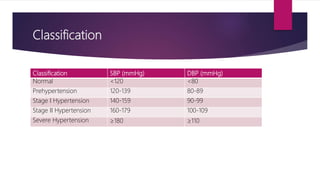
Classification
Classification SBP (mmHg) DBP (mmHg)
Normal <120 <80
Prehypertension 120-139 80-89
Stage I Hypertension 140-159 90-99
Stage II Hypertension 160-179 100-109
Severe Hypertension ≥180 ≥110
Measuring BP
 BP should be measured in a quiet room; the patient should be seated.
 With an outstretched & supported arm at level of heart (recommended)
 If possible, measure in both arms with the highest reading taken for subsequent referral.
 If postural hypotension is suspected, then BP should be repeated after 1 minute of standing.
 Ensure to prevent occurrence of “white coat syndrome”
 That is patients exhibit a BP level above the normal range, in a clinical setting, though they do not exhibit
it in other settings
 Believed to be due to anxiety experienced during a clinic visit.
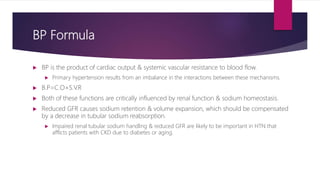
BP Formula
 BP is the product of cardiac output & systemic vascular resistance to blood flow.
 Primary hypertension results from an imbalance in the interactions between these mechanisms.
 B.P=C.O×S.V.R
 Both of these functions are critically influenced by renal function & sodium homeostasis.
 Reduced GFR causes sodium retention & volume expansion, which should be compensated
by a decrease in tubular sodium reabsorption.
 Impaired renal tubular sodium handling & reduced GFR are likely to be important in HTN that
afflicts patients with CKD due to diabetes or aging.
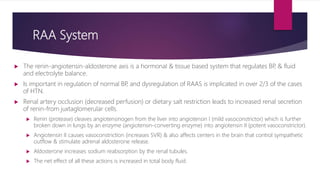
RAA System
 The renin-angiotensin-aldosterone axis is a hormonal & tissue based system that regulates BP, & fluid
and electrolyte balance.
 Is important in regulation of normal BP, and dysregulation of RAAS is implicated in over 2/3 of the cases
of HTN.
 Renal artery occlusion (decreased perfusion) or dietary salt restriction leads to increased renal secretion
of renin-from juxtaglomerular cells.
 Renin (protease) cleaves angiotensinogen from the liver into angiotensin I (mild vasoconstrictor) which is further
broken down in lungs by an enzyme (angiotensin-converting enzyme) into angiotensin II (potent vasoconstrictor).
 Angiotensin II causes vasoconstriction (increases SVR) & also affects centers in the brain that control sympathetic
outflow & stimulate adrenal aldosterone release.
 Aldosterone increases sodium reabsorption by the renal tubules.
 The net effect of all these actions is increased in total body fluid.
(RAA system cont’d)
 Thus, the RAA system elevates BP by 3 mechanisms:
 Increased sympathetic output
 Increased mineralocorticoid secretion
 Direct vasoconstriction
 Angiotensin II also stimulates thirst.
 Stimulates cardiac hypertrophy & vascular hypertrophy.
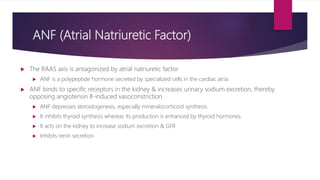
ANF (Atrial Natriuretic Factor)
 The RAAS axis is antagonized by atrial natriuretic factor
 ANF is a polypeptide hormone secreted by specialized cells in the cardiac atria.
 ANF binds to specific receptors in the kidney & increases urinary sodium excretion, thereby
opposing angiotensin II-induced vasoconstriction.
 ANF depresses steroidogenesis, especially mineralocorticoid synthesis.
 It inhibits thyroid synthesis whereas its production is enhanced by thyroid hormones.
 It acts on the kidney to increase sodium excretion & GFR
 Inhibits renin secretion
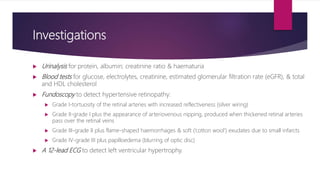
Investigations
 Urinalysis for protein, albumin; creatinine ratio & haematuria
 Blood tests for glucose, electrolytes, creatinine, estimated glomerular filtration rate (eGFR), & total
and HDL cholesterol
 Fundoscopy to detect hypertensive retinopathy:
 Grade I-tortuosity of the retinal arteries with increased reflectiveness (silver wiring)
 Grade II-grade I plus the appearance of arteriovenous nipping, produced when thickened retinal arteries
pass over the retinal veins
 Grade III-grade II plus flame-shaped haemorrhages & soft (‘cotton wool’) exudates due to small infarcts
 Grade IV-grade III plus papilloedema (blurring of optic disc)
 A 12-lead ECG to detect left ventricular hypertrophy.
Management:
 Lifestyle interventions:
 Diet: high consumptions of vegetables & fruits and low-fat diet.
 Regular physical exercise: 30min of moderate-intensity aerobic exercise 5-7 days/week)
 Reduction in alcohol intake (<140g/week men, <80g/week women)
 Reduction in dietary sodium intake (5-6g/day) & use of low-sodium salt.
 Smoking cessation
 Weight reduction (BMI 25kg/m(^2), waist circumference <102cm men, <88cm women)
(cont’d)
 Pharmacological Therapy:
 Treatment should be offered to all people under 80yo with stage 1 hypertension & at least one of
the following risk factors:
 Target organ damage
 Cardiovascular disease
 Renal disease diabetes
 10-year cardiovascular risk
 Patients <40yo with no risk factors should be referred to a specialist to exclude secondary causes of
hypertension
 All patients with stage 2 should be offered treatment
(cont’d)
 The target for treated patients is <140/90 mmHg in patients below 80yo.
 <150/90 mmHg in patients of 80yo and above.
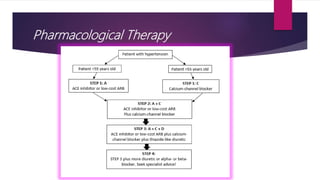
Pharmacological Therapy
The End
 Lelo Me Nomu!

Hypertension (htn)

  • 1.
  • 2.
    What is hypertension? A.k.a high blood pressure.  Is basically the force which the blood exerts on the walls of blood vessels.  Simply defined as a systolic BP of >140mmHg and/or diastolic BP of >90mmHg.  Is a major cause of premature vascular disease, leading to cerebrovascular events, ischaemic heart disease & peripheral vascular disease.  Mortality rises with increasing BP.  The prevalence may be 30-45% of the general population.
  • 3.
    (cont’d)  Present inmore than half of cases of myocardial infarction, stroke & chronic renal disease.  It is included in the “metabolic syndrome”, along with hyperglycemia, insulin resistance, dyslipidemia, & obesity.  In 95% of patients, HTN occurs without an identifiable cause, a condition referred to as primary hypertension.  Secondary hypertension is a result of a number of diseases including:  Renal artery stenosis, most forms of chronic renal disease. diabetes mellitus, primary elevation of aldosterone levels, Cushing syndrome, hyperthyroidism, coarctation of the aorta & renin-secreting tumors.  Atherosclerosis as well.
  • 4.
    Classification Classification SBP (mmHg)DBP (mmHg) Normal <120 <80 Prehypertension 120-139 80-89 Stage I Hypertension 140-159 90-99 Stage II Hypertension 160-179 100-109 Severe Hypertension ≥180 ≥110
  • 5.
    Measuring BP  BPshould be measured in a quiet room; the patient should be seated.  With an outstretched & supported arm at level of heart (recommended)  If possible, measure in both arms with the highest reading taken for subsequent referral.  If postural hypotension is suspected, then BP should be repeated after 1 minute of standing.  Ensure to prevent occurrence of “white coat syndrome”  That is patients exhibit a BP level above the normal range, in a clinical setting, though they do not exhibit it in other settings  Believed to be due to anxiety experienced during a clinic visit.
  • 6.
    BP Formula  BPis the product of cardiac output & systemic vascular resistance to blood flow.  Primary hypertension results from an imbalance in the interactions between these mechanisms.  B.P=C.O×S.V.R  Both of these functions are critically influenced by renal function & sodium homeostasis.  Reduced GFR causes sodium retention & volume expansion, which should be compensated by a decrease in tubular sodium reabsorption.  Impaired renal tubular sodium handling & reduced GFR are likely to be important in HTN that afflicts patients with CKD due to diabetes or aging.
  • 7.
    RAA System  Therenin-angiotensin-aldosterone axis is a hormonal & tissue based system that regulates BP, & fluid and electrolyte balance.  Is important in regulation of normal BP, and dysregulation of RAAS is implicated in over 2/3 of the cases of HTN.  Renal artery occlusion (decreased perfusion) or dietary salt restriction leads to increased renal secretion of renin-from juxtaglomerular cells.  Renin (protease) cleaves angiotensinogen from the liver into angiotensin I (mild vasoconstrictor) which is further broken down in lungs by an enzyme (angiotensin-converting enzyme) into angiotensin II (potent vasoconstrictor).  Angiotensin II causes vasoconstriction (increases SVR) & also affects centers in the brain that control sympathetic outflow & stimulate adrenal aldosterone release.  Aldosterone increases sodium reabsorption by the renal tubules.  The net effect of all these actions is increased in total body fluid.
  • 8.
    (RAA system cont’d) Thus, the RAA system elevates BP by 3 mechanisms:  Increased sympathetic output  Increased mineralocorticoid secretion  Direct vasoconstriction  Angiotensin II also stimulates thirst.  Stimulates cardiac hypertrophy & vascular hypertrophy.
  • 9.
    ANF (Atrial NatriureticFactor)  The RAAS axis is antagonized by atrial natriuretic factor  ANF is a polypeptide hormone secreted by specialized cells in the cardiac atria.  ANF binds to specific receptors in the kidney & increases urinary sodium excretion, thereby opposing angiotensin II-induced vasoconstriction.  ANF depresses steroidogenesis, especially mineralocorticoid synthesis.  It inhibits thyroid synthesis whereas its production is enhanced by thyroid hormones.  It acts on the kidney to increase sodium excretion & GFR  Inhibits renin secretion
  • 10.
    Investigations  Urinalysis forprotein, albumin; creatinine ratio & haematuria  Blood tests for glucose, electrolytes, creatinine, estimated glomerular filtration rate (eGFR), & total and HDL cholesterol  Fundoscopy to detect hypertensive retinopathy:  Grade I-tortuosity of the retinal arteries with increased reflectiveness (silver wiring)  Grade II-grade I plus the appearance of arteriovenous nipping, produced when thickened retinal arteries pass over the retinal veins  Grade III-grade II plus flame-shaped haemorrhages & soft (‘cotton wool’) exudates due to small infarcts  Grade IV-grade III plus papilloedema (blurring of optic disc)  A 12-lead ECG to detect left ventricular hypertrophy.
  • 11.
    Management:  Lifestyle interventions: Diet: high consumptions of vegetables & fruits and low-fat diet.  Regular physical exercise: 30min of moderate-intensity aerobic exercise 5-7 days/week)  Reduction in alcohol intake (<140g/week men, <80g/week women)  Reduction in dietary sodium intake (5-6g/day) & use of low-sodium salt.  Smoking cessation  Weight reduction (BMI 25kg/m(^2), waist circumference <102cm men, <88cm women)
  • 12.
    (cont’d)  Pharmacological Therapy: Treatment should be offered to all people under 80yo with stage 1 hypertension & at least one of the following risk factors:  Target organ damage  Cardiovascular disease  Renal disease diabetes  10-year cardiovascular risk  Patients <40yo with no risk factors should be referred to a specialist to exclude secondary causes of hypertension  All patients with stage 2 should be offered treatment
  • 13.
    (cont’d)  The targetfor treated patients is <140/90 mmHg in patients below 80yo.  <150/90 mmHg in patients of 80yo and above.
  • 14.
  • 15.