HYPERTENSION
Dr. Samee M Adnan
MD Resident (Phase A), Neurology
CMCH
FACTS & FIGURES
 HTN is one of the leading causes of the global
burden of disease. (WHO identified)
 Approximately 9.4 million deaths (13 –15% of the
total) and > 1 billion disability-adjusted life years
worldwide.
 Doubles the risk of cardiovascular diseases
 Often is associated with additional cardiovascular
disease risk factors.
 Antihypertensive therapy clearly reduces the risks
of cardiovascular and renal disease
 But large segments of the hypertensive population
are either untreated or inadequately treated.
FACTORS INFLUENCING BLOOD
PRESSURE
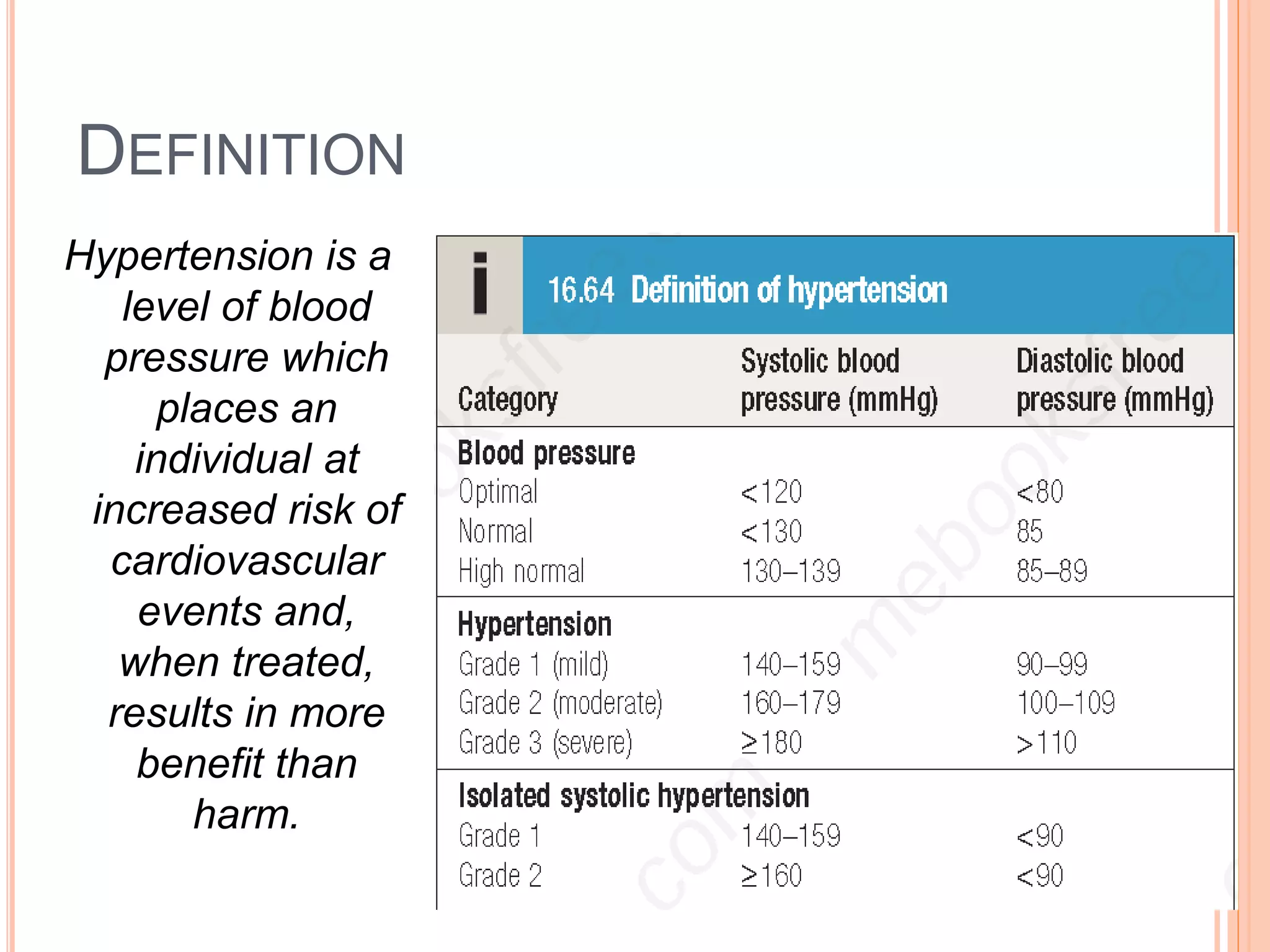
DEFINITION
Hypertension is a
level of blood
pressure which
places an
individual at
increased risk of
cardiovascular
events and,
when treated,
results in more
benefit than
harm.
CLASSIFICATION
 Essential hypertension is a heterogeneous genetic
and environmental condition. It accounts almost for
80-95% of cases.
 Secondary hypertension implies increased BP is
secondary to an underlying disorder and accounts
for 5-20% of cases.
MECHANISM OF HTN
Intravascular Volume
 Sodium is predominantly an extracellular ion -
primary determinant of the extracellular fluid
volume
 When NaCl intake exceeds the capacity of the
kidney to excrete sodium, vascular volume initially
expands and cardiac output increases.
 In individuals with an impaired capacity to excrete
sodium, greater increases on arterial pressure is
needed to achieve natriuresis & sodium balance.
CONT.
Autonomic Nervous System
 Adrenergic reflexes - short term.
 Adrenergic function, in concert with hormonal and
volume related factors- long-term regulation.
 Chronic activation may have a role in the genesis of
long-term increase in BP in those with a genetic
predisposition.
 SNS activation causes:
 increase in stroke volume (via beta 1 receptors).
 increase in heart rate (via beta 1 receptors).
 increase in systemic vascular resistance (via alpha 1
receptors).
 Activation of the RAS (via beta 1 receptor-mediated renin
release)
CONT.
Renin-Angiotensin-
Aldosterone
Renin release is mediated
by:
 Decreased afferent
arteriolar (i.e. renal
perfusion) pressure of
any cause.
 Sympathetic nervous
system activation
(through beta 1
receptors).
 Decreased Na+ delivery
to the distal tubule
(sensed by the macula
densa).
CONT.
Actions of angiotensin II
 Arteriolar vasoconstriction (and venular constriction
to a lesser extent).
 Efferent renal arteriolar vasoconstriction.
 Aldosterone secretion.
 Adrenaline (epinephrine) release.
 Smooth muscle hypertrophy.
 Increased reabsorption of sodium in PCT.
 Inhibits renin release (negative feedback loop).
 Renal mesangial cell growth and matrix expansion.
 Myocardial growth and matrix expansion.
 Stimulates thirst and ADH release.
CONT.
Vasucular mechanism
 Structural, mechanical, or functional changes may
reduce the lumen diameter of small arteries and
arterioles .
 Hypertrophic (increased cell size, and increased
deposition of intercellular matrix) or eutrophic
vascular remodeling results in decreased lumen
size and, hence, increased peripheral resistance
Immune mechanism, inflammation & oxidative
stress
 Inflammation, vascular stretch, angiotensin II, and
salt have all been shown to result in the generation
of reactive oxygen species (ROS), which modify T
cell function and further enhance inflammation.
 ROS also attenuate the effects of endogenous
small-molecule vasodilators.
ESSENTIAL HYPERTENSION
Primary hypertension tends to be familial and is likely
to be the consequence of an interaction between
environmental and genetic factors.
Etiology-
 Environmental factors
 Genetic factors
 Fetal factors
 Humoral mechanisms
 Insulin resistance - Metabolic syndrome
CONT.
Environmental factors
 –Obesity
 Fat people have higher blood pressures than thin people.
 Sleep disordered breathing often seen with obesity may be an
additional risk factor
 Alcohol intake
 Close relationship between the consumption of alcohol and
blood pressure level.
 But small amounts of alcohol seem to be beneficial
 Sodium intake
 Directly proportional
 Some evidence that a high potassium diet can protect
against the effects of a high sodium intake
 Stress
 Chronic stress – uncertain
 Acute pain or stress can raise blood pressure
CONT.
Genetic factors
 Tends to run in families, by shared environmental
influences.
 Still largely unidentified genetic component.
Fetal factors
Low birth weight: May be due to fetal adaptation to
intrauterine undernutrition with
 long-term changes in blood vessel structure
 Or the function of crucial hormonal systems.
CONT.
Humoral mechanisms
 Autonomic nervous system, renin angiotensin system,
natriuretic peptide and kallikrein-kinin system - short-
term changes in blood pressure
 But no convincing evidence - directly involved in the
maintenance of hypertension
Insulin resistance - Metabolic syndrome
 Hyperinsulinaemia, glucose intolerance, reduced levels
of HDL cholesterol, hypertriglyceridaemia and central
obesity with with hypertension
 Association between diabetes and hypertension has
long been recognized
SECONDARY HYPERTENSION
HIGH INDEX OF SUSPICION OF
SECONDARY HYPERTENSION
BLOOD PRESSURE MEASUREMENT
 Blood pressure should be measured after the
patient has emptied their bladder and has been
seated for five minutes with back supported and
legs resting on the ground (not crossed).
 Arm used for measurement should rest on a table,
at heart level.
 Use a sphygmomanometer/stethoscope or
automated electronic device (preferred) with the
correct size arm cuff.
 Take two readings one to two minutes apart, and
average the readings (preferred).
 Measure blood pressure in both arms at initial
evaluation. Use the higher reading for
measurements thereafter.
COMPLICATIONS OF HYPERTENSION
The primary target organs of HTN include-
 Heart.
 Vascular system.
 Brain.
 Kidney.
 Retina.
COMPLICATIONS: HEART
 Left ventricular
hypertrophy,
dysfunction and failure.
 Arrhythmias
 Coronary artery
disease, Acute MI
 Arterial aneurysm,
dissection, and rupture.
COMPLICATIONS: BLOOD VESSELS
 Atherosclerosis
(frequently involving
large & medium sized
arteries).
 Hyaline arteiosclerosis.
 Hyperplastic
arteriosclerosis.
COMPLICATIONS: BRAIN
 Cerebro-vascular
accidents:
 TIA
 Stroke (Ishchaemic or
Haemorrhagic)
 Sub-arachnoid
haemorrhage.
 Hypertensive
Encephalopathy
 Multi-infarct Dementia
COMPLICATIONS: KIDNEYS
 Primarily affect preglomerular arterioles, resulting in ischemic
changes in the glomeruli and postglomerular structures.
 Glomerular injury also may be a consequence of direct damage to
the glomerular capillaries due to glomerular hyperperfusion.
 Loss of autoregulation of renal blood flow at the afferent arteriole
results in transmission of elevated pressures to an unprotected
glomerulus with ensuing hyperfiltration, hypertrophy, and eventual
focal segmental glomerular sclerosis.
 The renal lesion associated with malignant hypertension consists of
fibrinoid necrosis of the afferent arterioles, sometimes extending into
the glomerulus, and may result in focal necrosis of the glomerular
tuft.
 Clinically, macroalbuminuria (a random urine albumin/creatinine
ratio >300 mg/g) or microalbuminuria (a random urine albumin/
creatinine ratio 30–300 mg/g) are early markers of renal injury.
COMPLICATIONS: RETINA
 Retinopathy, retinal hemorrhages and impaired
vision.
 Vitreous hemorrhage, retinal detachment
 Neuropathy of the nerves leading to extraoccular
muscle paralysis and dysfunction
NORMAL RETINA AND HYPERTENSIVE
RETINOPATHY
Normal Retina Hypertensive RetinopathyA: Hemorrhages
B: Exudates (Fatty
Deposits)
C: Cotton Wool Spots
(Micro Strokes)
A B
C
STAGE I- ARTERIOLAR NARROWING
Arteriolar Narrowing
STAGE II- AV NIPPING
AV Nicking
AV Nicking
AV Nicking
STAGE III- HEMORRHAGES (H), COTTON
WOOL SPOTS AND EXUDATS (E)
H
E
STAGE IV- STAGE III+PAPILLOEDEMA
INVESTIGATION OF PATIENTS WITH
HYPERTENSION
All Patients:
CONT.
Special Conditions:
TARGET BP IN ADULTS
According to JNC 8-
CONT.
According to ACC
CONT.
According to NICE
MANGEMENT: NON PHARMACOLOGICAL
INTERVANTIONS
ADDITIONAL LIFESTYLE MEASURES TO
DECREASE CARDIOVASCULAR RISK
 Stop smoking. Does not decrease BP but will
improve overall CV risk. Quitting before middle age
returns life expectancy to near that of lifelong non-
smokers.
 Reduce total fat intake.
 Replace dietary saturated fats with
monounsaturated fats.
 Increase consumption of oily fish.
INDICATIONS TO START
PHARMACOTHERAPY
ORAL ANTI HYPERTENSIVE DRUGS
HYPERTENSION MANAGEMENT ALGORITHM
NICE guideline
JNC
8
JNC 8
ACC GUIDELINE
ACC IN SPECIAL SITUATIONS
HYPERTENSIVE CRISIS
Hypertensive crises are classified as emergencies or
urgencies , based on the presence or absence of
progressive target organ dysfunction.
 Emergencies: severe increase in BP complicated
by evidence of acute or progressive organ
dysfunction.
 Urgencies: severe increase in BP without evidence
of acute or progressive target organ dysfunction.
ACUTE TARGET ORGAN DAMAGE
 Neurological symptoms: at risk for haemorrhagic or
thrombotic stroke, encephalopathy (altered
consciousness, fits, focal signs).
 LVF.
 Acute kidney injury failure (send U&E, dipstick
urine).
 Chest pain. Acute coronary syndrome  MI or
aortic dissection. Perform ECG, and check pulses.
If in doubt: CT aorta.
 Visual symptoms +/- either grade III or IV
hypertensive retinopathy.
 Pancreatitis due to haemorrhagic infarction (rare).
DRUGS USED IN HYPERTENSIVE
CRISIS
REFERENCE
 Harrison's principles of internal medicine (20th
edition)
 Davidson’s Principles and Practice of Medicine
(23rd edition)
 Oxford handbook of nephrology & Hypertension
(2nd edition)
 JNC 8
 NICE 2011
 ACC 2017
Hypertension

Hypertension

  • 1.
    HYPERTENSION Dr. Samee MAdnan MD Resident (Phase A), Neurology CMCH
  • 2.
    FACTS & FIGURES HTN is one of the leading causes of the global burden of disease. (WHO identified)  Approximately 9.4 million deaths (13 –15% of the total) and > 1 billion disability-adjusted life years worldwide.  Doubles the risk of cardiovascular diseases  Often is associated with additional cardiovascular disease risk factors.  Antihypertensive therapy clearly reduces the risks of cardiovascular and renal disease  But large segments of the hypertensive population are either untreated or inadequately treated.
  • 3.
  • 4.
    DEFINITION Hypertension is a levelof blood pressure which places an individual at increased risk of cardiovascular events and, when treated, results in more benefit than harm.
  • 5.
    CLASSIFICATION  Essential hypertensionis a heterogeneous genetic and environmental condition. It accounts almost for 80-95% of cases.  Secondary hypertension implies increased BP is secondary to an underlying disorder and accounts for 5-20% of cases.
  • 6.
    MECHANISM OF HTN IntravascularVolume  Sodium is predominantly an extracellular ion - primary determinant of the extracellular fluid volume  When NaCl intake exceeds the capacity of the kidney to excrete sodium, vascular volume initially expands and cardiac output increases.  In individuals with an impaired capacity to excrete sodium, greater increases on arterial pressure is needed to achieve natriuresis & sodium balance.
  • 7.
    CONT. Autonomic Nervous System Adrenergic reflexes - short term.  Adrenergic function, in concert with hormonal and volume related factors- long-term regulation.  Chronic activation may have a role in the genesis of long-term increase in BP in those with a genetic predisposition.  SNS activation causes:  increase in stroke volume (via beta 1 receptors).  increase in heart rate (via beta 1 receptors).  increase in systemic vascular resistance (via alpha 1 receptors).  Activation of the RAS (via beta 1 receptor-mediated renin release)
  • 8.
    CONT. Renin-Angiotensin- Aldosterone Renin release ismediated by:  Decreased afferent arteriolar (i.e. renal perfusion) pressure of any cause.  Sympathetic nervous system activation (through beta 1 receptors).  Decreased Na+ delivery to the distal tubule (sensed by the macula densa).
  • 9.
    CONT. Actions of angiotensinII  Arteriolar vasoconstriction (and venular constriction to a lesser extent).  Efferent renal arteriolar vasoconstriction.  Aldosterone secretion.  Adrenaline (epinephrine) release.  Smooth muscle hypertrophy.  Increased reabsorption of sodium in PCT.  Inhibits renin release (negative feedback loop).  Renal mesangial cell growth and matrix expansion.  Myocardial growth and matrix expansion.  Stimulates thirst and ADH release.
  • 10.
    CONT. Vasucular mechanism  Structural,mechanical, or functional changes may reduce the lumen diameter of small arteries and arterioles .  Hypertrophic (increased cell size, and increased deposition of intercellular matrix) or eutrophic vascular remodeling results in decreased lumen size and, hence, increased peripheral resistance Immune mechanism, inflammation & oxidative stress  Inflammation, vascular stretch, angiotensin II, and salt have all been shown to result in the generation of reactive oxygen species (ROS), which modify T cell function and further enhance inflammation.  ROS also attenuate the effects of endogenous small-molecule vasodilators.
  • 11.
    ESSENTIAL HYPERTENSION Primary hypertensiontends to be familial and is likely to be the consequence of an interaction between environmental and genetic factors. Etiology-  Environmental factors  Genetic factors  Fetal factors  Humoral mechanisms  Insulin resistance - Metabolic syndrome
  • 12.
    CONT. Environmental factors  –Obesity Fat people have higher blood pressures than thin people.  Sleep disordered breathing often seen with obesity may be an additional risk factor  Alcohol intake  Close relationship between the consumption of alcohol and blood pressure level.  But small amounts of alcohol seem to be beneficial  Sodium intake  Directly proportional  Some evidence that a high potassium diet can protect against the effects of a high sodium intake  Stress  Chronic stress – uncertain  Acute pain or stress can raise blood pressure
  • 13.
    CONT. Genetic factors  Tendsto run in families, by shared environmental influences.  Still largely unidentified genetic component. Fetal factors Low birth weight: May be due to fetal adaptation to intrauterine undernutrition with  long-term changes in blood vessel structure  Or the function of crucial hormonal systems.
  • 14.
    CONT. Humoral mechanisms  Autonomicnervous system, renin angiotensin system, natriuretic peptide and kallikrein-kinin system - short- term changes in blood pressure  But no convincing evidence - directly involved in the maintenance of hypertension Insulin resistance - Metabolic syndrome  Hyperinsulinaemia, glucose intolerance, reduced levels of HDL cholesterol, hypertriglyceridaemia and central obesity with with hypertension  Association between diabetes and hypertension has long been recognized
  • 15.
  • 16.
    HIGH INDEX OFSUSPICION OF SECONDARY HYPERTENSION
  • 17.
    BLOOD PRESSURE MEASUREMENT Blood pressure should be measured after the patient has emptied their bladder and has been seated for five minutes with back supported and legs resting on the ground (not crossed).  Arm used for measurement should rest on a table, at heart level.  Use a sphygmomanometer/stethoscope or automated electronic device (preferred) with the correct size arm cuff.  Take two readings one to two minutes apart, and average the readings (preferred).  Measure blood pressure in both arms at initial evaluation. Use the higher reading for measurements thereafter.
  • 18.
    COMPLICATIONS OF HYPERTENSION Theprimary target organs of HTN include-  Heart.  Vascular system.  Brain.  Kidney.  Retina.
  • 19.
    COMPLICATIONS: HEART  Leftventricular hypertrophy, dysfunction and failure.  Arrhythmias  Coronary artery disease, Acute MI  Arterial aneurysm, dissection, and rupture.
  • 20.
    COMPLICATIONS: BLOOD VESSELS Atherosclerosis (frequently involving large & medium sized arteries).  Hyaline arteiosclerosis.  Hyperplastic arteriosclerosis.
  • 21.
    COMPLICATIONS: BRAIN  Cerebro-vascular accidents: TIA  Stroke (Ishchaemic or Haemorrhagic)  Sub-arachnoid haemorrhage.  Hypertensive Encephalopathy  Multi-infarct Dementia
  • 22.
    COMPLICATIONS: KIDNEYS  Primarilyaffect preglomerular arterioles, resulting in ischemic changes in the glomeruli and postglomerular structures.  Glomerular injury also may be a consequence of direct damage to the glomerular capillaries due to glomerular hyperperfusion.  Loss of autoregulation of renal blood flow at the afferent arteriole results in transmission of elevated pressures to an unprotected glomerulus with ensuing hyperfiltration, hypertrophy, and eventual focal segmental glomerular sclerosis.  The renal lesion associated with malignant hypertension consists of fibrinoid necrosis of the afferent arterioles, sometimes extending into the glomerulus, and may result in focal necrosis of the glomerular tuft.  Clinically, macroalbuminuria (a random urine albumin/creatinine ratio >300 mg/g) or microalbuminuria (a random urine albumin/ creatinine ratio 30–300 mg/g) are early markers of renal injury.
  • 23.
    COMPLICATIONS: RETINA  Retinopathy,retinal hemorrhages and impaired vision.  Vitreous hemorrhage, retinal detachment  Neuropathy of the nerves leading to extraoccular muscle paralysis and dysfunction
  • 24.
    NORMAL RETINA ANDHYPERTENSIVE RETINOPATHY Normal Retina Hypertensive RetinopathyA: Hemorrhages B: Exudates (Fatty Deposits) C: Cotton Wool Spots (Micro Strokes) A B C
  • 25.
    STAGE I- ARTERIOLARNARROWING Arteriolar Narrowing
  • 26.
    STAGE II- AVNIPPING AV Nicking AV Nicking AV Nicking
  • 27.
    STAGE III- HEMORRHAGES(H), COTTON WOOL SPOTS AND EXUDATS (E) H E
  • 28.
    STAGE IV- STAGEIII+PAPILLOEDEMA
  • 29.
    INVESTIGATION OF PATIENTSWITH HYPERTENSION All Patients:
  • 30.
  • 31.
    TARGET BP INADULTS According to JNC 8-
  • 32.
  • 33.
  • 34.
  • 36.
    ADDITIONAL LIFESTYLE MEASURESTO DECREASE CARDIOVASCULAR RISK  Stop smoking. Does not decrease BP but will improve overall CV risk. Quitting before middle age returns life expectancy to near that of lifelong non- smokers.  Reduce total fat intake.  Replace dietary saturated fats with monounsaturated fats.  Increase consumption of oily fish.
  • 37.
  • 38.
  • 40.
  • 41.
  • 42.
  • 43.
  • 44.
    ACC IN SPECIALSITUATIONS
  • 48.
    HYPERTENSIVE CRISIS Hypertensive crisesare classified as emergencies or urgencies , based on the presence or absence of progressive target organ dysfunction.  Emergencies: severe increase in BP complicated by evidence of acute or progressive organ dysfunction.  Urgencies: severe increase in BP without evidence of acute or progressive target organ dysfunction.
  • 49.
    ACUTE TARGET ORGANDAMAGE  Neurological symptoms: at risk for haemorrhagic or thrombotic stroke, encephalopathy (altered consciousness, fits, focal signs).  LVF.  Acute kidney injury failure (send U&E, dipstick urine).  Chest pain. Acute coronary syndrome  MI or aortic dissection. Perform ECG, and check pulses. If in doubt: CT aorta.  Visual symptoms +/- either grade III or IV hypertensive retinopathy.  Pancreatitis due to haemorrhagic infarction (rare).
  • 50.
    DRUGS USED INHYPERTENSIVE CRISIS
  • 52.
    REFERENCE  Harrison's principlesof internal medicine (20th edition)  Davidson’s Principles and Practice of Medicine (23rd edition)  Oxford handbook of nephrology & Hypertension (2nd edition)  JNC 8  NICE 2011  ACC 2017