What is
Hyperloop
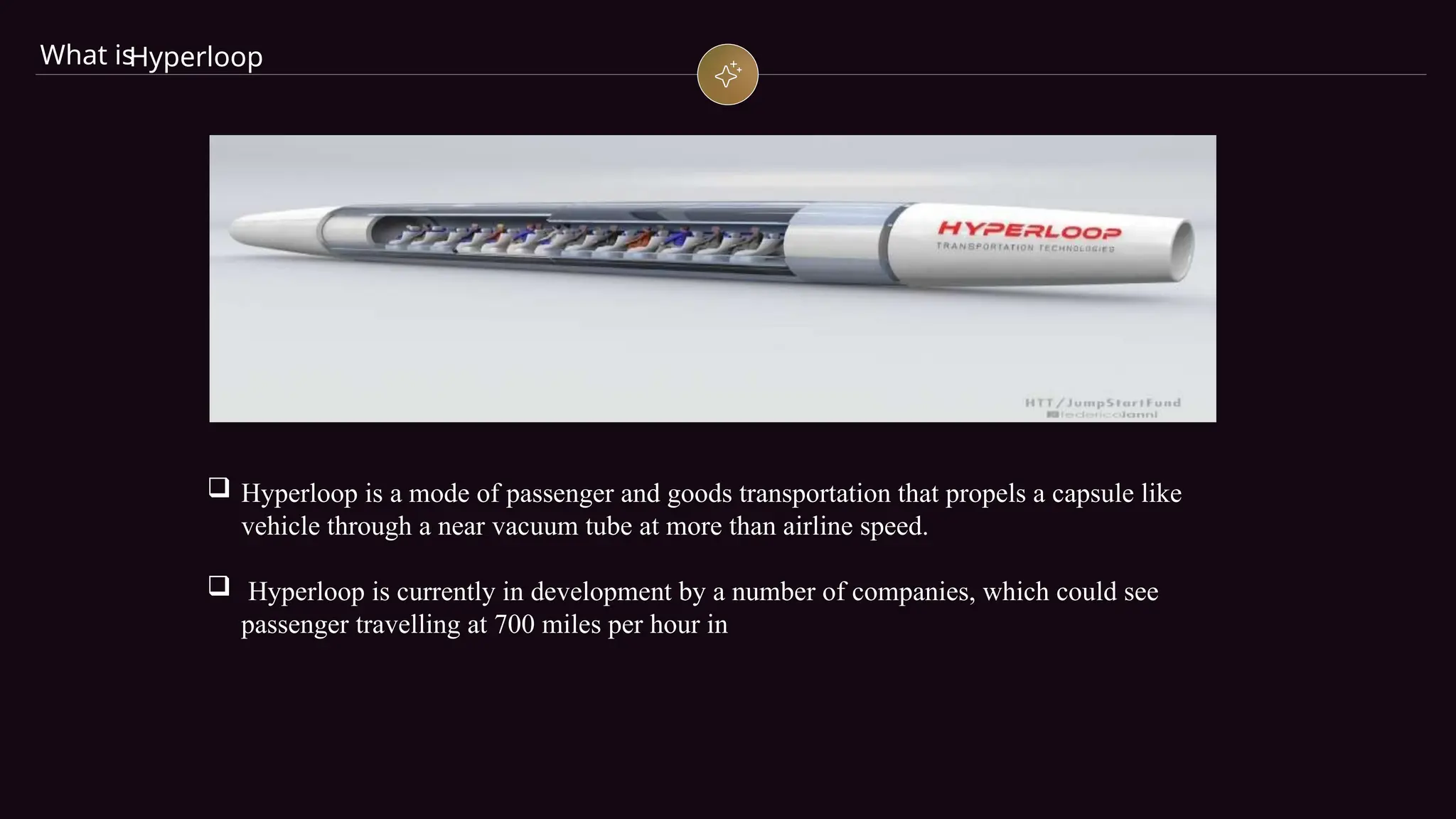
Hyperloopis a mode of passenger and goods transportation that propels a capsule like
vehicle through a near vacuum tube at more than airline speed.
Hyperloop is currently in development by a number of companies, which could see
passenger travelling at 700 miles per hour in
Component
s
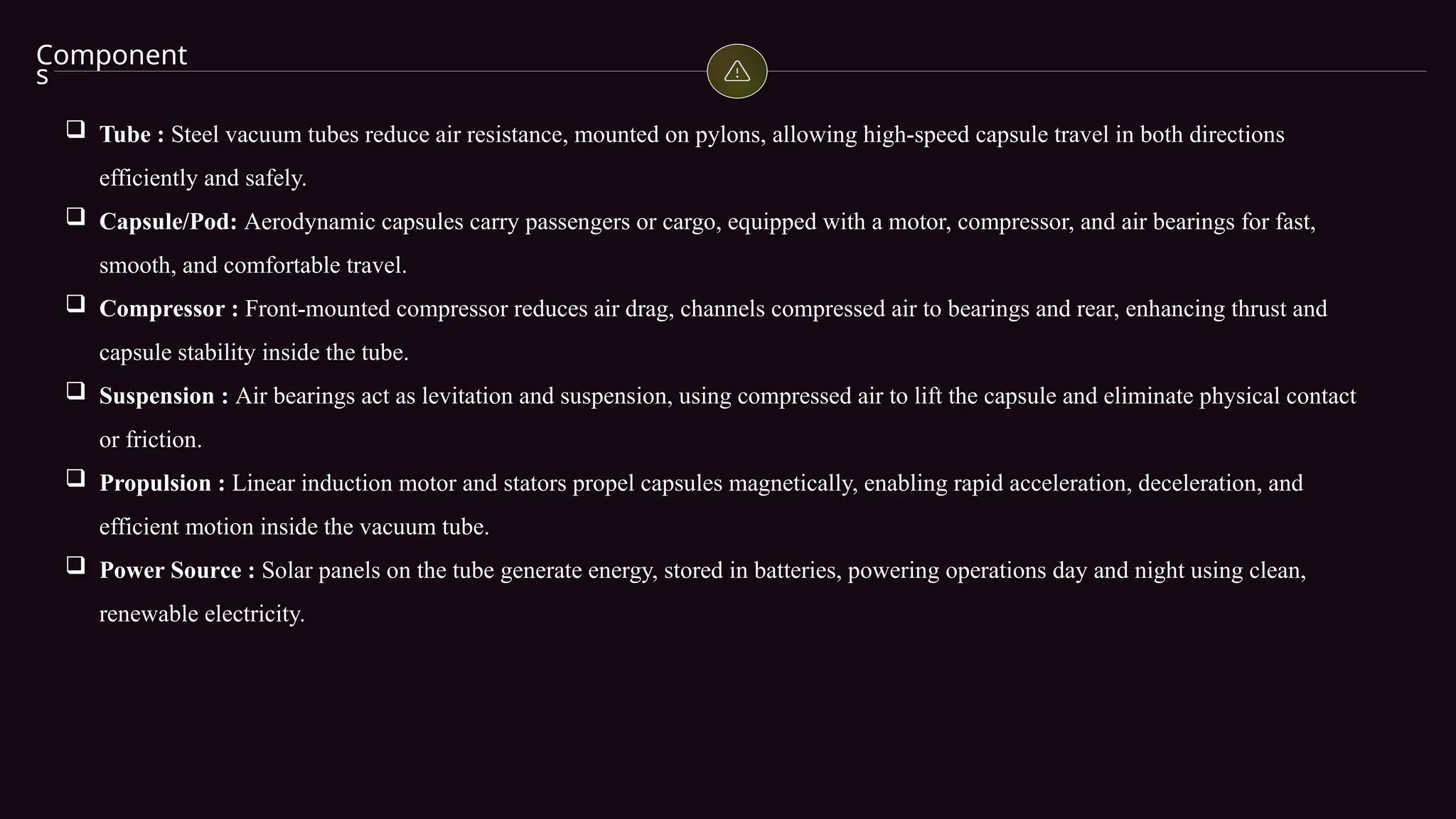
Tube :Steel vacuum tubes reduce air resistance, mounted on pylons, allowing high-speed capsule travel in both directions
efficiently and safely.
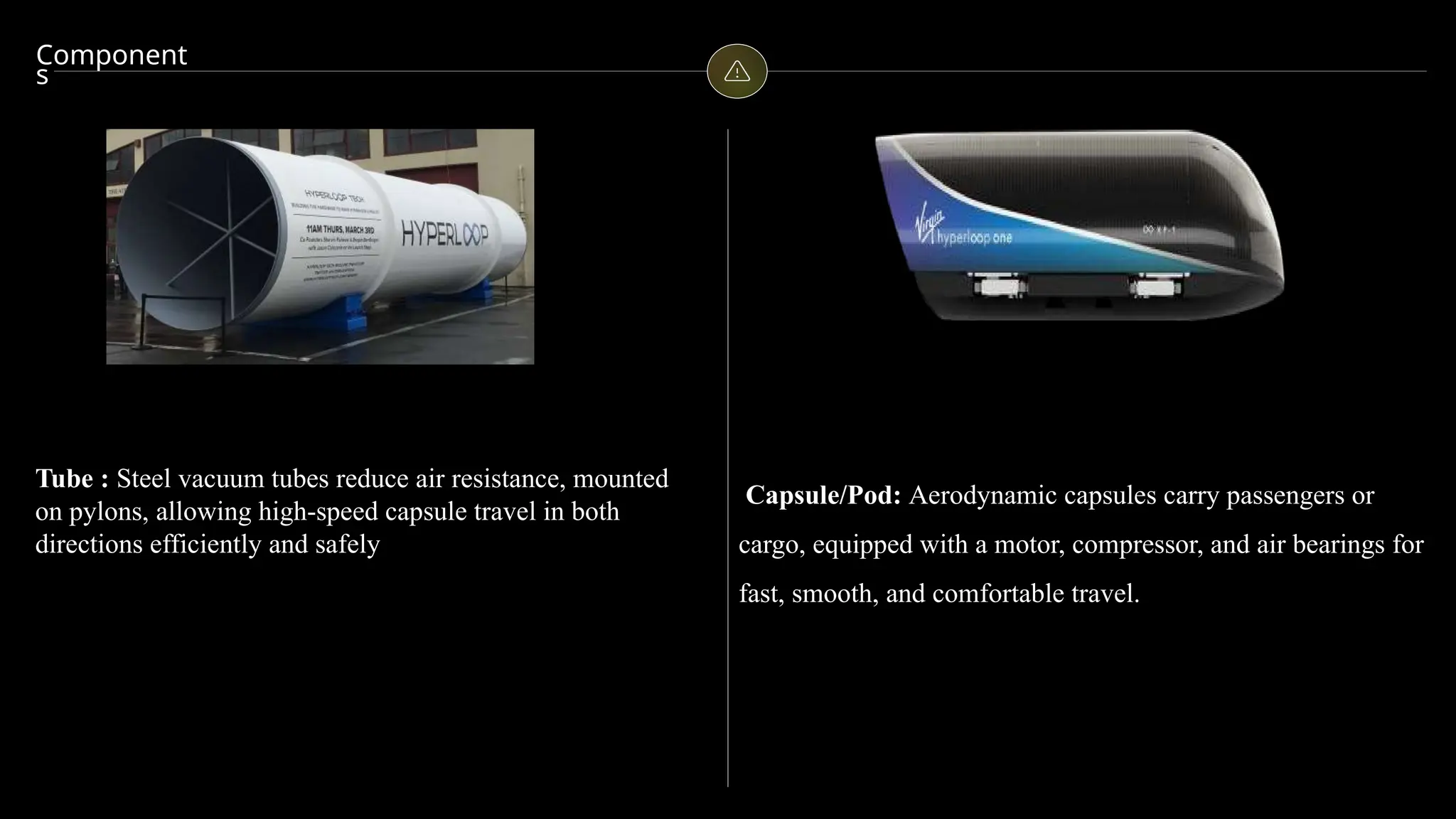
Capsule/Pod: Aerodynamic capsules carry passengers or cargo, equipped with a motor, compressor, and air bearings for fast,
smooth, and comfortable travel.
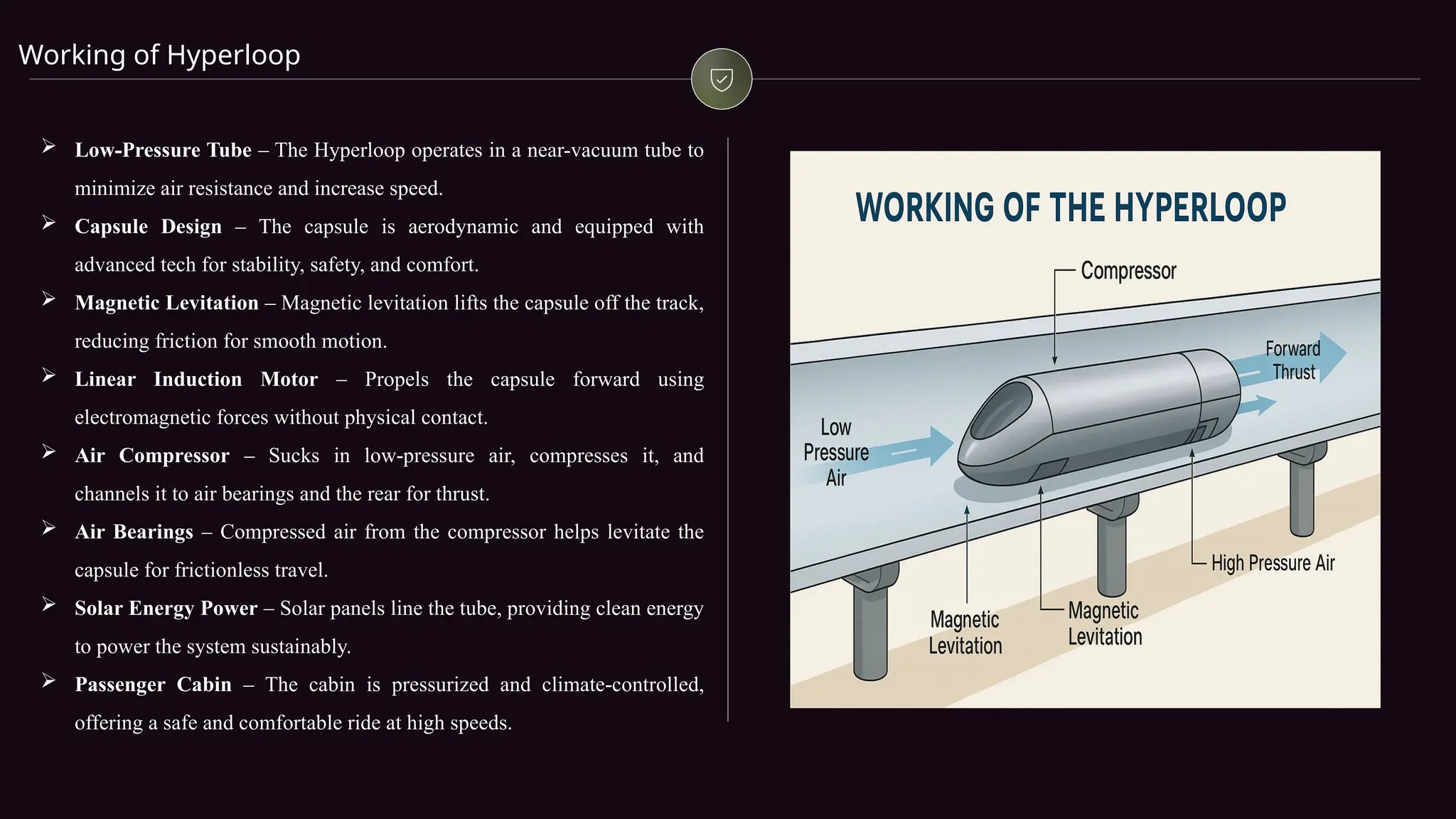
Compressor : Front-mounted compressor reduces air drag, channels compressed air to bearings and rear, enhancing thrust and
capsule stability inside the tube.
Suspension : Air bearings act as levitation and suspension, using compressed air to lift the capsule and eliminate physical contact
or friction.
Propulsion : Linear induction motor and stators propel capsules magnetically, enabling rapid acceleration, deceleration, and
efficient motion inside the vacuum tube.
Power Source : Solar panels on the tube generate energy, stored in batteries, powering operations day and night using clean,
renewable electricity.
7.
Component
s
Tube : Steelvacuum tubes reduce air resistance, mounted
on pylons, allowing high-speed capsule travel in both
directions efficiently and safely
Capsule/Pod: Aerodynamic capsules carry passengers or
cargo, equipped with a motor, compressor, and air bearings for
fast, smooth, and comfortable travel.
8.
Component
s
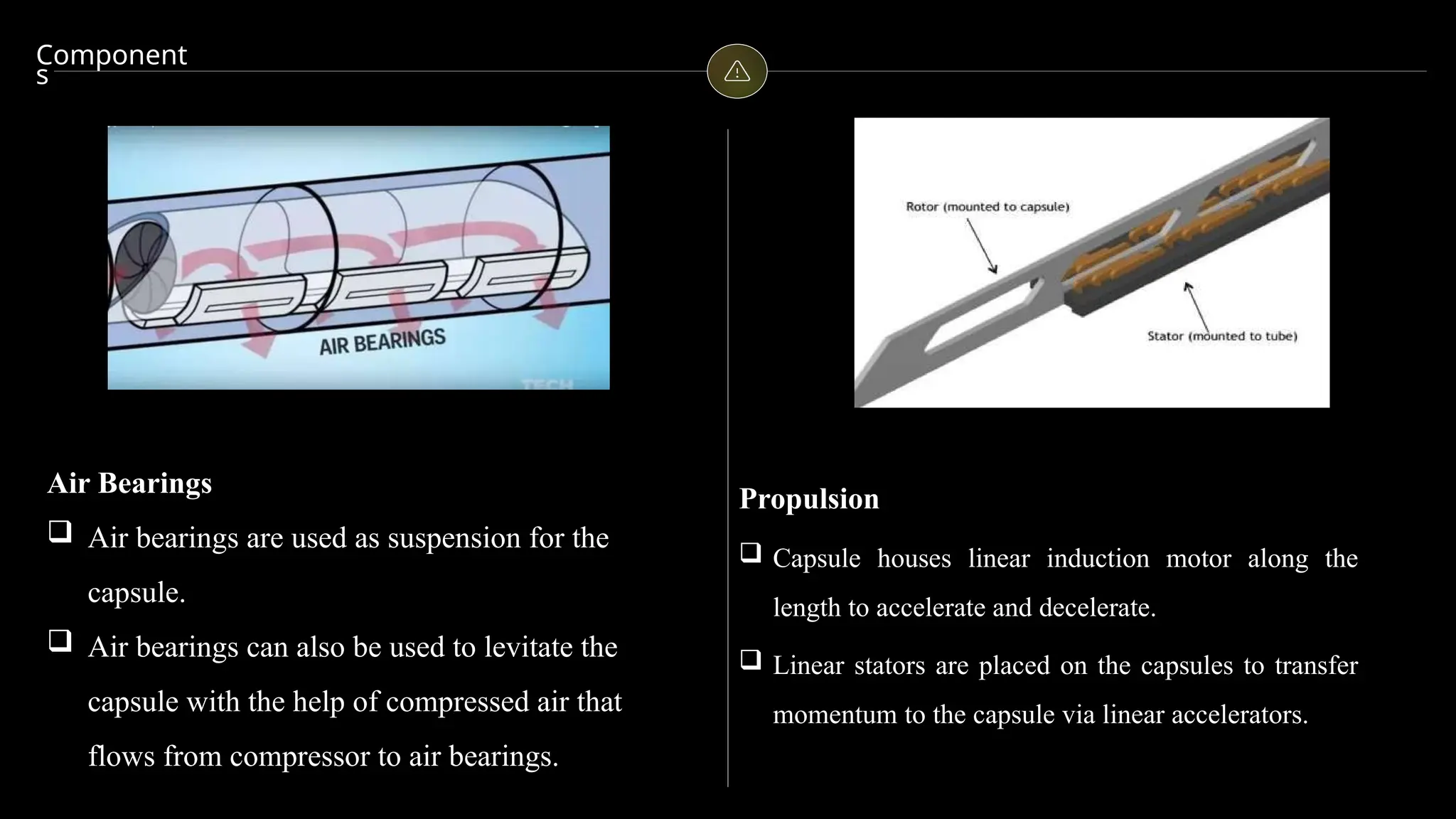
Propulsion
Capsule houseslinear induction motor along the
length to accelerate and decelerate.
Linear stators are placed on the capsules to transfer
momentum to the capsule via linear accelerators.
Air Bearings
Air bearings are used as suspension for the
capsule.
Air bearings can also be used to levitate the
capsule with the help of compressed air that
flows from compressor to air bearings.
9.
Component
s
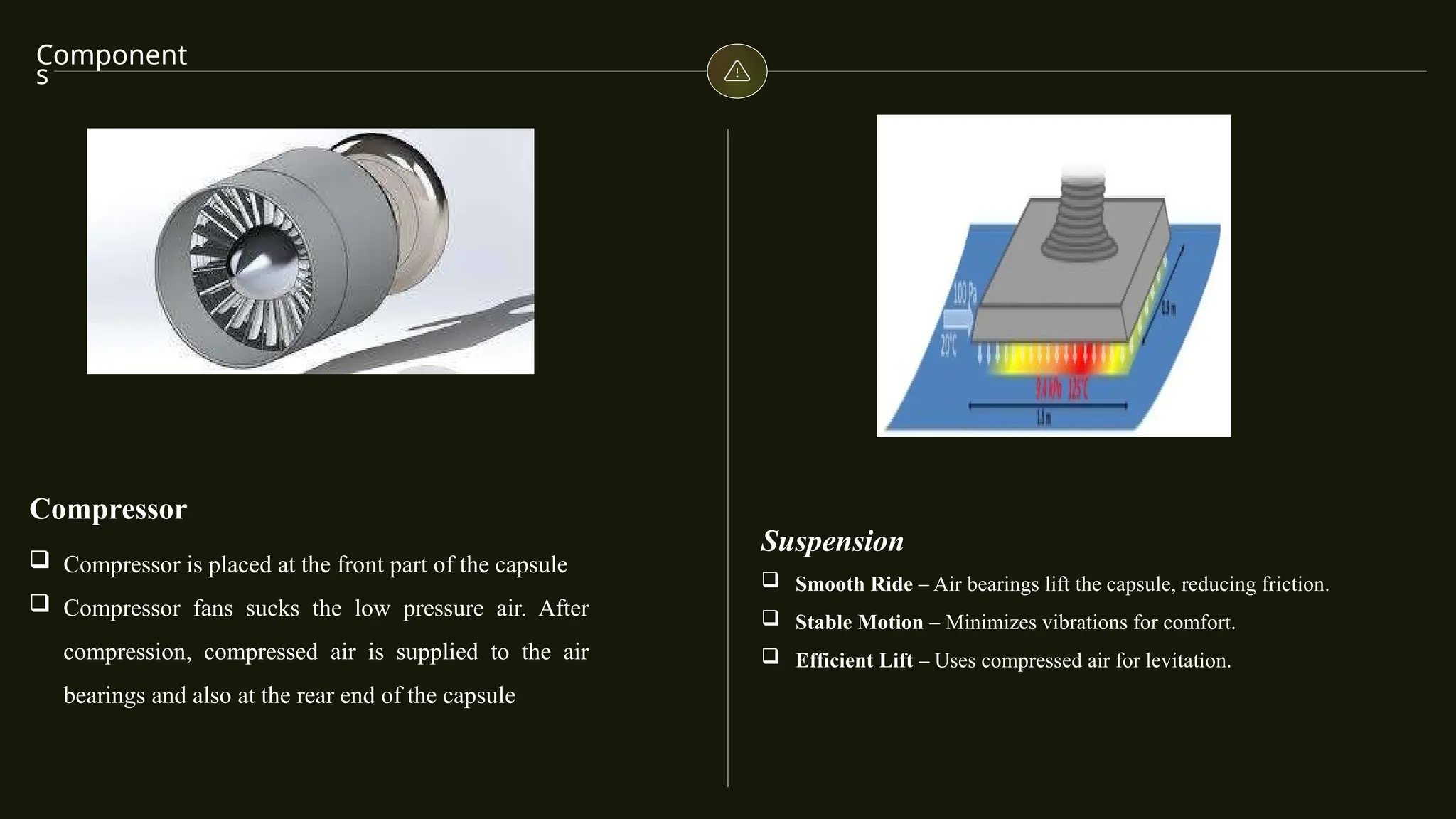
Compressor
Compressor isplaced at the front part of the capsule
Compressor fans sucks the low pressure air. After
compression, compressed air is supplied to the air
bearings and also at the rear end of the capsule
Suspension
Smooth Ride – Air bearings lift the capsule, reducing friction.
Stable Motion – Minimizes vibrations for comfort.
Efficient Lift – Uses compressed air for levitation.
Working of Hyperloop
Low-Pressure Tube – The Hyperloop operates in a near-vacuum tube to
minimize air resistance and increase speed.
Capsule Design – The capsule is aerodynamic and equipped with
advanced tech for stability, safety, and comfort.
Magnetic Levitation – Magnetic levitation lifts the capsule off the track,
reducing friction for smooth motion.
Linear Induction Motor – Propels the capsule forward using
electromagnetic forces without physical contact.
Air Compressor – Sucks in low-pressure air, compresses it, and
channels it to air bearings and the rear for thrust.
Air Bearings – Compressed air from the compressor helps levitate the
capsule for frictionless travel.
Solar Energy Power – Solar panels line the tube, providing clean energy
to power the system sustainably.
Passenger Cabin – The cabin is pressurized and climate-controlled,
offering a safe and comfortable ride at high speeds.
Progress of Hyperloopin india
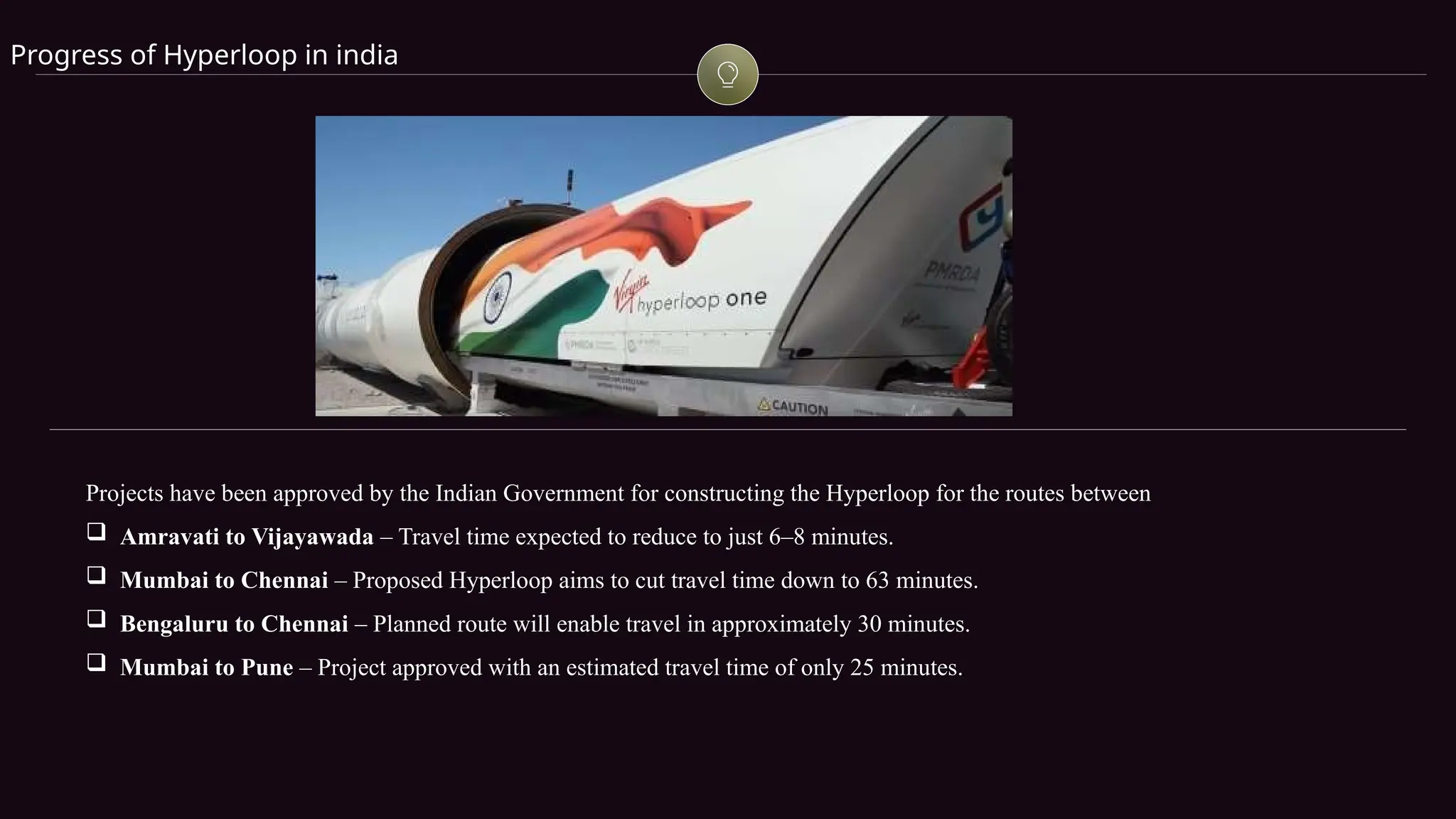
Projects have been approved by the Indian Government for constructing the Hyperloop for the routes between
Amravati to Vijayawada – Travel time expected to reduce to just 6–8 minutes.
Mumbai to Chennai – Proposed Hyperloop aims to cut travel time down to 63 minutes.
Bengaluru to Chennai – Planned route will enable travel in approximately 30 minutes.
Mumbai to Pune – Project approved with an estimated travel time of only 25 minutes.
Growth
Strategy
MERITS
Itsaves the travelling time.
There is no problem of traffic.
It is powered by the solar panel.
Immune to weather.
Cost of hyperloop is low.
More convenient.
Resistance to earthquake.
Safer.
DEMERITS
May occur critical situation at turnings.
Less movable space.
May occur dizziness in passengers.
Conclusion
High Speed– Hyperloop offers ultra-fast travel, significantly
reducing journey times.
Energy Efficient – Powered by solar energy, making it a
sustainable transport mode.
Comfortable Travel – Provides a smooth, modern, and
passenger-friendly experience.
Cost-Effective – Lower operational costs compared to
traditional transportation in the long run.
Future-Oriented – Represents a leap in transportation
technology with global development underway.
Safe & Resilient – Designed to be weather-proof and
earthquake-resistant, ensuring safety.
20.
References
[1]. Paper byMark Sakowski, “The Next Contender in High Speed Transport Elon Musks Hyperloop”, 2016.
[2]. N. Kayela, editor of scientific and technical department, “Hyperloop: A Fifth Mode of Transportation”,
2014.
[3]. Mohammed Imran, international journal of engineering research, 2016.
[4]. Musk, Elon (August 12, 2013). "Hyperloop Alpha"(PDF). SpaceX. Retrieved August 13, 2013.
[5]. Compressor:https://patrickenewman.files.wordpress.co m/2016/03/compressoriso.png
[6]. Operating principle of hyper loop http://web- japan.org/kidsweb/hitech/maglev/images/004.jpg.
[7]. Tubehttps://upload.wikimedia.org/wikipedia/common







![References
[1]. Paper by Mark Sakowski, “The Next Contender in High Speed Transport Elon Musks Hyperloop”, 2016.
[2]. N. Kayela, editor of scientific and technical department, “Hyperloop: A Fifth Mode of Transportation”,
2014.
[3]. Mohammed Imran, international journal of engineering research, 2016.
[4]. Musk, Elon (August 12, 2013). "Hyperloop Alpha"(PDF). SpaceX. Retrieved August 13, 2013.
[5]. Compressor:https://patrickenewman.files.wordpress.co m/2016/03/compressoriso.png
[6]. Operating principle of hyper loop http://web- japan.org/kidsweb/hitech/maglev/images/004.jpg.
[7]. Tubehttps://upload.wikimedia.org/wikipedia/common](https://image.slidesharecdn.com/vrlwnelxto2tvlff9anipitchzoomtemplate-250421083631-60619716/75/vrLwNeLxTo2TvLff9AnI_Pitch-Zoom-Template-pptx-20-2048.jpg)


![hyperloop(3)[4)[1].pptx](https://cdn.slidesharecdn.com/ss_thumbnails/hyperloop341-231004170809-eae76d8a-thumbnail.jpg?width=640&height=640&fit=bounds)


