HYPERKALEMEA
MANAGEMENT
MEDICATIONS
• Hyperkalemia is an elevated level of
potassium (K+) in the blood serum.[1] Normal
potassium levels are between 3.5 and 5.0
mmol/L
• Levels above 5.5 mmol/L defined as
hyperkalemia
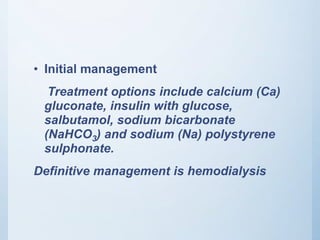
• Initial management
Treatment options include calcium (Ca)
gluconate, insulin with glucose,
salbutamol, sodium bicarbonate
(NaHCO3) and sodium (Na) polystyrene
sulphonate.
Definitive management is hemodialysis
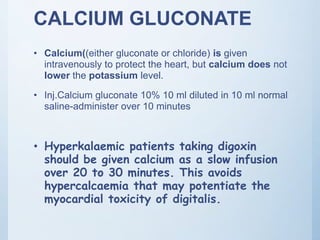
CALCIUM GLUCONATE
• Calcium((either gluconate or chloride) is given
intravenously to protect the heart, but calcium does not
lower the potassium level.
• Inj.Calcium gluconate 10% 10 ml diluted in 10 ml normal
saline-administer over 10 minutes
• Hyperkalaemic patients taking digoxin
should be given calcium as a slow infusion
over 20 to 30 minutes. This avoids
hypercalcaemia that may potentiate the
myocardial toxicity of digitalis.
INSULIN WITH GLUCOSE
• Insulin administered with glucose: Facilitates
the uptake of glucose into the cell, which results
in an intracellular shift of potassium
• 50%Dextrose is a carbohydrate, which is one part
of nutrition in a normal diet. ... When the cells take
in the extra glucose, they also take in potassium.
This helps to lower a person's blood potassium
levels. The dextrose is given to prevent the person
from being hypoglycemic.
• Dextrose 50 % 50 ml+ actrapid 10 units
administered over 30 minutes.
SALBUTAMOL
• Ventolin is an adrenergic agonist that has an
additive effect with insulin and glucose, which may
in turn help shift potassium into the intracellular
space.
• This agent lowers the serum potassium level by
0.5-1.5 mEq/L. It can be very beneficial in patients
with renal failure when fluid overload is concern
SODIUM BICARBONATE
• It has no significant action on plasma K in the first
60 minutes after administration.
• It may be indicated in severe metabolic acidosis (pH
<7.2),which may be an associated feature in ARF.
• Potential risks in giving NaHCO3 include
hypernatraemia, volume overload and tetany in
patients with CRF and coexistent hypocalcaemia
SODIUM/CALCIUM
POLYSTYRENE SULPHONATE
(Resonium)
• This resin binds K in the intestinal lumen, especially
large bowel and ileum-it increases faecal K
excretion
• It may be indicated if haemodialysis is delayed (>2–
3 hours).
HAEMODIALYSIS
• This is the definitive and most effective
hypokalaemic measure.
• It is indicated in severe hyperkalaemia. Mild to
moderate hyperkalaemia in CRF may be managed
without haemodialysis as an emergency depending
on the cause.
CONCLUSION
• The emergency management involves (1) determining the
cause and (2) instituting temporising measures to
stabilise the myocardium and lower the plasma K by
redistribution to the intracellular compartment while
arranging haemodialysis if necessary.
• Moderate to severe hyperkalaemia in the emergency
department should be treated with
• (1) Ca gluconate if there are any ECG changes followed
by
• (2) insulin with glucose and
• (3) intravenous salbutamol (nebulised if there is evidence
of ischemic heart disease).
• NaHCO3
• Sodium polystyrene sulphonate can be given if there is an
anticipated delay in haemodialysis
Hyperkalemea management

Hyperkalemea management

  • 1.
  • 2.
    • Hyperkalemia isan elevated level of potassium (K+) in the blood serum.[1] Normal potassium levels are between 3.5 and 5.0 mmol/L • Levels above 5.5 mmol/L defined as hyperkalemia
  • 5.
    • Initial management Treatmentoptions include calcium (Ca) gluconate, insulin with glucose, salbutamol, sodium bicarbonate (NaHCO3) and sodium (Na) polystyrene sulphonate. Definitive management is hemodialysis
  • 6.
    CALCIUM GLUCONATE • Calcium((eithergluconate or chloride) is given intravenously to protect the heart, but calcium does not lower the potassium level. • Inj.Calcium gluconate 10% 10 ml diluted in 10 ml normal saline-administer over 10 minutes • Hyperkalaemic patients taking digoxin should be given calcium as a slow infusion over 20 to 30 minutes. This avoids hypercalcaemia that may potentiate the myocardial toxicity of digitalis.
  • 7.
    INSULIN WITH GLUCOSE •Insulin administered with glucose: Facilitates the uptake of glucose into the cell, which results in an intracellular shift of potassium • 50%Dextrose is a carbohydrate, which is one part of nutrition in a normal diet. ... When the cells take in the extra glucose, they also take in potassium. This helps to lower a person's blood potassium levels. The dextrose is given to prevent the person from being hypoglycemic. • Dextrose 50 % 50 ml+ actrapid 10 units administered over 30 minutes.
  • 8.
    SALBUTAMOL • Ventolin isan adrenergic agonist that has an additive effect with insulin and glucose, which may in turn help shift potassium into the intracellular space. • This agent lowers the serum potassium level by 0.5-1.5 mEq/L. It can be very beneficial in patients with renal failure when fluid overload is concern
  • 9.
    SODIUM BICARBONATE • Ithas no significant action on plasma K in the first 60 minutes after administration. • It may be indicated in severe metabolic acidosis (pH <7.2),which may be an associated feature in ARF. • Potential risks in giving NaHCO3 include hypernatraemia, volume overload and tetany in patients with CRF and coexistent hypocalcaemia
  • 10.
    SODIUM/CALCIUM POLYSTYRENE SULPHONATE (Resonium) • Thisresin binds K in the intestinal lumen, especially large bowel and ileum-it increases faecal K excretion • It may be indicated if haemodialysis is delayed (>2– 3 hours).
  • 11.
    HAEMODIALYSIS • This isthe definitive and most effective hypokalaemic measure. • It is indicated in severe hyperkalaemia. Mild to moderate hyperkalaemia in CRF may be managed without haemodialysis as an emergency depending on the cause.
  • 12.
    CONCLUSION • The emergencymanagement involves (1) determining the cause and (2) instituting temporising measures to stabilise the myocardium and lower the plasma K by redistribution to the intracellular compartment while arranging haemodialysis if necessary. • Moderate to severe hyperkalaemia in the emergency department should be treated with • (1) Ca gluconate if there are any ECG changes followed by • (2) insulin with glucose and • (3) intravenous salbutamol (nebulised if there is evidence of ischemic heart disease). • NaHCO3 • Sodium polystyrene sulphonate can be given if there is an anticipated delay in haemodialysis