HYDROSEEDING FOR EROSION CONTROL
COASTLAND GEOTECHNICS LLP
C-60 APIE,Balanagar,Hyderabad Tel:8879253634 040-42410162
TEAM
P.T. Raju has wide experience in design of ground improvement and soil
retentions structures over more than 12 years, which includes most
prestigious projects building 42 m high retaining walls. His papers are
published in international conferences and technical books.
Mr. Sreedhar Vanta has over 15 years experience in the geotechnical and
construction industry. His key area of expertise includes turkey execution of
slope retentions, deep foundations and bridges.
Mr..Rajesh Sunke has wide experience in business development over 15
years in construction industry. His key area of expertise includes sales and
marketing strategies for large civil projects.
COASTLAND
COMPANY
Coastland has provided reliable, top-quality construction of pre-designed geotechnical
systems. Our team also provides design-built solutions that are customized to your specific
needs and requirements. Our team also provides design-built solutions that are customized
to your specific needs and requirements.
COASTLAND
Erosion Control
Ground
Improvement
Earth Retention Deep Foundations
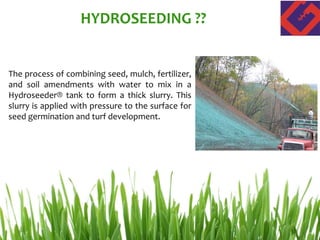
HYDROSEEDING ??
The process of combining seed, mulch, fertilizer,
and soil amendments with water to mix in a
Hydroseeder® tank to form a thick slurry. This
slurry is applied with pressure to the surface for
seed germination and turf development.
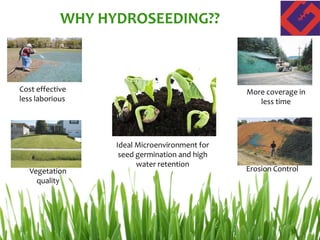
WHY HYDROSEEDING??
Cost effective
less laborious
Vegetation
quality
More coverage in
less time
Erosion Control
Ideal Microenvironment for
seed germination and high
water retention
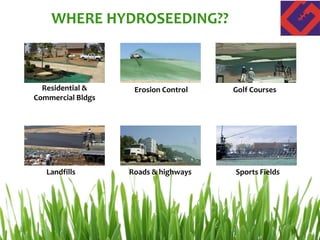
WHERE HYDROSEEDING??
Residential &
Commercial Bldgs
Erosion Control Golf Courses
Landfills Roads & highways Sports Fields
CASE STUDY
PROJECT : JAMMU Central University
Location : Village Bagla – Samba District
Application : Erosion control on 65°Reinforced soil slope with WMM Facing
Area : 40000 sqm
CASE STUDY : SOIL CHARACTERISATION
Soil core sample collected from project site was subjected to analysis at Laboratory
• Soil pH – 6.5-7
• Organic matter content - >3.5%
• Nitrogen – Low
• Phosphorous – Medium
• Potassium - Medium
By considering the soil test report, suitable fertilizer mix was added along with hydromulch
to provide sufficient nutrients to vegetation
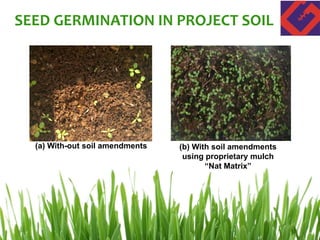
SEED GERMINATION IN PROJECT SOIL
(a) With-out soil amendments (b) With soil amendments
using proprietary mulch
“Nat Matrix”
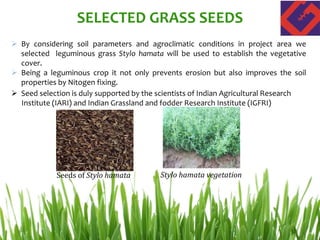
SELECTED GRASS SEEDS
Seeds of Stylo hamata Stylo hamata vegetation
 By considering soil parameters and agroclimatic conditions in project area we
selected leguminous grass Stylo hamata will be used to establish the vegetative
cover.
 Being a leguminous crop it not only prevents erosion but also improves the soil
properties by Nitogen fixing.
 Seed selection is duly supported by the scientists of Indian Agricultural Research
Institute (IARI) and Indian Grassland and fodder Research Institute (IGFRI)
SEED PURITY TESTING
 In order to avoid the contamination with other weed seeds at we are testing the
seed purity using Polymerase Chain Reaction (PCR) and genetic analyzer at our
facility
Thermocycler Genetic Analyzer
 CG hydro mulch is a proprietary blend of cellulosic fiber, cocopeat, fertilizer
and tackifier.
 CG mulch product is composed of organic fibers that will degrade over
several months.
CONTENT PARAMETER
Moisture Content 20%
Organic Matter 95%
pH 6-6.5%
Water Holding Capacity 100 gm DW will hold 1000
grams of water
“CG MULCH” – PRORIETERY MULCH
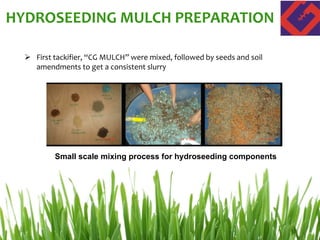
 First tackifier, “CG MULCH” were mixed, followed by seeds and soil
amendments to get a consistent slurry
Small scale mixing process for hydroseeding components
HYDROSEEDING MULCH PREPARATION
LABORATORY TEST SCALE
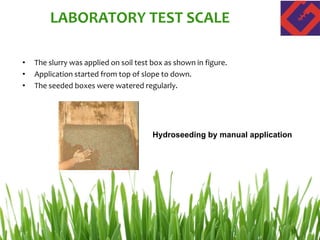
• The slurry was applied on soil test box as shown in figure.
• Application started from top of slope to down.
• The seeded boxes were watered regularly.
Hydroseeding by manual application
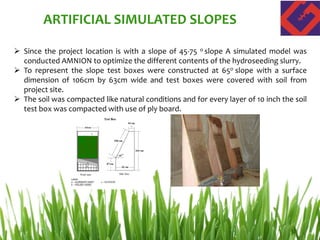
 Since the project location is with a slope of 45-75 o slope A simulated model was
conducted AMNION to optimize the different contents of the hydroseeding slurry.
 To represent the slope test boxes were constructed at 65o slope with a surface
dimension of 106cm by 63cm wide and test boxes were covered with soil from
project site.
 The soil was compacted like natural conditions and for every layer of 10 inch the soil
test box was compacted with use of ply board.
ARTIFICIAL SIMULATED SLOPES
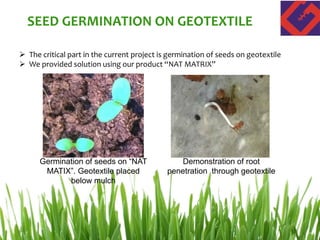
 The critical part in the current project is germination of seeds on geotextile
 We provided solution using our product “NAT MATRIX”
Germination of seeds on “NAT
MATIX”. Geotextile placed
below mulch
Demonstration of root
penetration through geotextile
SEED GERMINATION ON GEOTEXTILE
 1.The areas to be hydroseeded shall be uniform. Minor shaping and
uniforming of uneven and rough areas shall be performed in order to provide
more effective erosion control and for ease of subsequent mowing
operations.
 2.Vertical stritations or grooves shall be absent from the final trimmed slope.
Instead a rough textured surface with loose soil shall be prepared. Where the
surface microtopography varies by ±20mm from the formation level, an
acceptable treatment is to provide horizontal grooving with semicircular or
“v” shaped groove, 20mm deep, at an interval of 200mm downslope on all
cut slopes. Any surface rills in excess of 25mm shall be rectified by retrimming
SITE PREPARENATION
3.Gullies or local washouts shall be backfilled with suitable material
places in layers of up to 200mm thick, each layer being compacted by
hand ramming or by light weight vibration plate compactors. Large
stones greater than 50mm shall be removed. Slopes that have been
exposed for a long time must be trimmed and scaled to remove any
oxidized layer prior to hydroseeding.
SITE PREPARENATION
METHODOLOGY
 Hydromulch material is a proprietary blend of mulch fiber, seeds, tackifiers and
fertilizer, which need to be sprayed at a rate of 200g per square meter in case of 45°
slopes and 350g per square meter in case of 75° slopes
 In order to ensure the complete vegetation, first round of hydromuch material will be
applied on stabilized slopes. Soon after the sprouting of grass seeds (approximately in
a week time), erosion control blanket will be laid on the slopes.
 The second round of hydromulch material will be applied on the erosion control
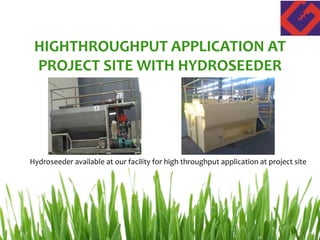
blanket to ensure complete vegetation using AMNIONs mobile Hydroseeder unit.
HIGHTHROUGHPUT APPLICATION AT
PROJECT SITE WITH HYDROSEEDER
Hydroseeder available at our facility for high throughput application at project site

Hydroseeding for erosion control

  • 1.
    HYDROSEEDING FOR EROSIONCONTROL COASTLAND GEOTECHNICS LLP C-60 APIE,Balanagar,Hyderabad Tel:8879253634 040-42410162
  • 2.
    TEAM P.T. Raju haswide experience in design of ground improvement and soil retentions structures over more than 12 years, which includes most prestigious projects building 42 m high retaining walls. His papers are published in international conferences and technical books. Mr. Sreedhar Vanta has over 15 years experience in the geotechnical and construction industry. His key area of expertise includes turkey execution of slope retentions, deep foundations and bridges. Mr..Rajesh Sunke has wide experience in business development over 15 years in construction industry. His key area of expertise includes sales and marketing strategies for large civil projects. COASTLAND
  • 3.
    COMPANY Coastland has providedreliable, top-quality construction of pre-designed geotechnical systems. Our team also provides design-built solutions that are customized to your specific needs and requirements. Our team also provides design-built solutions that are customized to your specific needs and requirements. COASTLAND Erosion Control Ground Improvement Earth Retention Deep Foundations
  • 4.
    HYDROSEEDING ?? The processof combining seed, mulch, fertilizer, and soil amendments with water to mix in a Hydroseeder® tank to form a thick slurry. This slurry is applied with pressure to the surface for seed germination and turf development.
  • 5.
    WHY HYDROSEEDING?? Cost effective lesslaborious Vegetation quality More coverage in less time Erosion Control Ideal Microenvironment for seed germination and high water retention
  • 6.
    WHERE HYDROSEEDING?? Residential & CommercialBldgs Erosion Control Golf Courses Landfills Roads & highways Sports Fields
  • 7.
    CASE STUDY PROJECT :JAMMU Central University Location : Village Bagla – Samba District Application : Erosion control on 65°Reinforced soil slope with WMM Facing Area : 40000 sqm
  • 8.
    CASE STUDY :SOIL CHARACTERISATION Soil core sample collected from project site was subjected to analysis at Laboratory • Soil pH – 6.5-7 • Organic matter content - >3.5% • Nitrogen – Low • Phosphorous – Medium • Potassium - Medium By considering the soil test report, suitable fertilizer mix was added along with hydromulch to provide sufficient nutrients to vegetation
  • 9.
    SEED GERMINATION INPROJECT SOIL (a) With-out soil amendments (b) With soil amendments using proprietary mulch “Nat Matrix”
  • 10.
    SELECTED GRASS SEEDS Seedsof Stylo hamata Stylo hamata vegetation  By considering soil parameters and agroclimatic conditions in project area we selected leguminous grass Stylo hamata will be used to establish the vegetative cover.  Being a leguminous crop it not only prevents erosion but also improves the soil properties by Nitogen fixing.  Seed selection is duly supported by the scientists of Indian Agricultural Research Institute (IARI) and Indian Grassland and fodder Research Institute (IGFRI)
  • 11.
    SEED PURITY TESTING In order to avoid the contamination with other weed seeds at we are testing the seed purity using Polymerase Chain Reaction (PCR) and genetic analyzer at our facility Thermocycler Genetic Analyzer
  • 12.
     CG hydromulch is a proprietary blend of cellulosic fiber, cocopeat, fertilizer and tackifier.  CG mulch product is composed of organic fibers that will degrade over several months. CONTENT PARAMETER Moisture Content 20% Organic Matter 95% pH 6-6.5% Water Holding Capacity 100 gm DW will hold 1000 grams of water “CG MULCH” – PRORIETERY MULCH
  • 13.
     First tackifier,“CG MULCH” were mixed, followed by seeds and soil amendments to get a consistent slurry Small scale mixing process for hydroseeding components HYDROSEEDING MULCH PREPARATION
  • 14.
    LABORATORY TEST SCALE •The slurry was applied on soil test box as shown in figure. • Application started from top of slope to down. • The seeded boxes were watered regularly. Hydroseeding by manual application
  • 15.
     Since theproject location is with a slope of 45-75 o slope A simulated model was conducted AMNION to optimize the different contents of the hydroseeding slurry.  To represent the slope test boxes were constructed at 65o slope with a surface dimension of 106cm by 63cm wide and test boxes were covered with soil from project site.  The soil was compacted like natural conditions and for every layer of 10 inch the soil test box was compacted with use of ply board. ARTIFICIAL SIMULATED SLOPES
  • 16.
     The criticalpart in the current project is germination of seeds on geotextile  We provided solution using our product “NAT MATRIX” Germination of seeds on “NAT MATIX”. Geotextile placed below mulch Demonstration of root penetration through geotextile SEED GERMINATION ON GEOTEXTILE
  • 17.
     1.The areasto be hydroseeded shall be uniform. Minor shaping and uniforming of uneven and rough areas shall be performed in order to provide more effective erosion control and for ease of subsequent mowing operations.  2.Vertical stritations or grooves shall be absent from the final trimmed slope. Instead a rough textured surface with loose soil shall be prepared. Where the surface microtopography varies by ±20mm from the formation level, an acceptable treatment is to provide horizontal grooving with semicircular or “v” shaped groove, 20mm deep, at an interval of 200mm downslope on all cut slopes. Any surface rills in excess of 25mm shall be rectified by retrimming SITE PREPARENATION
  • 18.
    3.Gullies or localwashouts shall be backfilled with suitable material places in layers of up to 200mm thick, each layer being compacted by hand ramming or by light weight vibration plate compactors. Large stones greater than 50mm shall be removed. Slopes that have been exposed for a long time must be trimmed and scaled to remove any oxidized layer prior to hydroseeding. SITE PREPARENATION
  • 19.
    METHODOLOGY  Hydromulch materialis a proprietary blend of mulch fiber, seeds, tackifiers and fertilizer, which need to be sprayed at a rate of 200g per square meter in case of 45° slopes and 350g per square meter in case of 75° slopes  In order to ensure the complete vegetation, first round of hydromuch material will be applied on stabilized slopes. Soon after the sprouting of grass seeds (approximately in a week time), erosion control blanket will be laid on the slopes.  The second round of hydromulch material will be applied on the erosion control blanket to ensure complete vegetation using AMNIONs mobile Hydroseeder unit.
  • 20.
    HIGHTHROUGHPUT APPLICATION AT PROJECTSITE WITH HYDROSEEDER Hydroseeder available at our facility for high throughput application at project site