10.014 HYDROGRAPHIC ECHO-SOUNDER
Approval Date: 20 May 1998
Reviewed on : 23 October 2007 Version: 1
Equipment Specification: HYDROGRAPHIC ECHO-SOUNDER Version 1 10.014-1/4
Purpose
The hydrographic echo-sounder is to measure depth in reservoirs and rivers and make the
readings available to a data collection system.
Conditions & Requirements
• The hydrographic echo-sounder shall be of such a design that it operates reliably and
accurately under the prevailing environmental and operational conditions.
• The echo-sounder shall be easy to operate and maintain.
• The echo-sounder shall be supplied with the accessories as needed for effective
deployment.
• All materials on the echo-sounder exterior shall be non-corrosive.
• The echo-sounder shall be of a rugged design that can cope with the prevailing shock
and vibration as experienced in mobile operations.
• The echo-sounder shall have an expected technical lifetime of not less than 10 years.
• Operating and maintenance manuals related to the type and model of the echo-sounder,
shall be part of the delivery.
• Actual water depth shall be digitally presented, and recorded by an integrated chart
recorder.
• The sounding data shall be transmitted by serial communication to the controlling PC.
• Power will be supplied by standard car batteries, either one or two in series, depending
on the voltage requirements of the echo-sounder.
• Power consumption shall be moderate.
• Depth readings shall be visualised on a LCD display.
• The displayed value shall not depend on supply voltage.
• The indicated range shall be distance to the bottom, in meters. Hence, the echo-
sounder should suppress multiple echoes and echoes from the water surface (backward
sensitivity).
• The echo-sounder shall have adjustment facilities for draft, speed of sound, sensitivity,
recording range, time dependent gain control and grey scale.
• The echo-sounder shall have illumination on the chart recorder and on the digital
display.
• An integrated digitiser shall convert the depth readings into numerical data.
• The echo-sounder shall have a good performance in sediment laden waters.
Specifications
depth ranges selectable up to 200 m (0 to 10, 20, 50, 100, 200 m) or equivalent
minimum depth 0.3 m below transducer
acoustic frequency approximately 200 kHz
transducer beam width 10 degrees or less
output power 250 W pulse
transducer cable length 8 m
alarm low depth indication
Optionally, a second frequency may be included for firm bottom detection.
acoustic frequency 12 to 45 kHz
Equipment Specification: HYDROGRAPHIC ECHO-SOUNDER Version 1 10.014-2/4
transducer beam width 30 degrees or less
transducer cable length 8 m
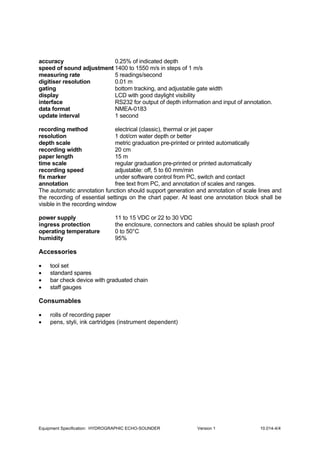
accuracy 0.25% of indicated depth
speed of sound adjustment 1400 to 1550 m/s in steps of 1 m/s
measuring rate 5 readings/second
digitiser resolution 0.01 m
gating bottom tracking, and adjustable gate width
display LCD with good daylight visibility
interface RS232 for output of depth information and input of annotation.
data format NMEA-0183
update interval 1 second
recording method electrical (classic), thermal or jet paper
resolution 1 dot/cm water depth or better
depth scale metric graduation pre-printed or printed automatically
recording width 20 cm
paper length 15 m
time scale regular graduation pre-printed or printed automatically
recording speed adjustable: off, 5 to 60 mm/min
fix marker under software control from PC, switch and contact
annotation free text from PC, and annotation of scales and ranges.
The automatic annotation function should support generation and annotation of scale lines and
the recording of essential settings on the chart paper. At least one annotation block shall be
visible in the recording window
power supply 11 to 15 VDC or 22 to 30 VDC
ingress protection the enclosure, connectors and cables should be splash proof
operating temperature 0 to 50°C
humidity 95%
Accessories
• tool set
• standard spares
• bar check device with graduated chain
• staff gauges
Consumables
• rolls of recording paper
• pens, styli, ink cartridges (instrument dependent)
10.014 HYDROGRAPHIC ECHO-SOUNDER
As per HP-I
Approval Date: 20 May 1998 Version: 1
Equipment Specification: HYDROGRAPHIC ECHO-SOUNDER Version 1 10.014-3/4
Purpose
The hydrographic echo-sounder is to measure depth in reservoirs and rivers and make the
readings available to a data collection system.
Conditions & Requirements
• The hydrographic echo-sounder shall be of such a design that it operates reliably and
accurately under the prevailing environmental and operational conditions.
• The echo-sounder shall be easy to operate and maintain.
• The echo-sounder shall be supplied with the accessories as needed for effective
deployment.
• All materials on the echo-sounder exterior shall be non-corrosive.
• The echo-sounder shall be of a rugged design that can cope with the prevailing shock
and vibration as experienced in mobile operations.
• The echo-sounder shall have an expected technical lifetime of not less than 10 years.
• Operating and maintenance manuals related to the type and model of the echo-sounder,
shall be part of the delivery.
• Actual water depth shall be digitally presented, and recorded by an integrated chart
recorder.
• The sounding data shall be transmitted by serial communication to the controlling PC.
• Power will be supplied by standard car batteries, either one or two in series, depending
on the voltage requirements of the echo-sounder.
• Power consumption shall be moderate.
• Depth readings shall be visualised on a LCD display.
• The displayed value shall not depend on supply voltage.
• The indicated range shall be distance to the bottom, in meters. Hence, the echo-
sounder should suppress multiple echoes and echoes from the water surface (backward
sensitivity).
• The echo-sounder shall have adjustment facilities for draft, speed of sound, sensitivity,
recording range, time dependent gain control and grey scale.
• The echo-sounder shall have illumination on the chart recorder and on the digital
display.
• An integrated digitiser shall convert the depth readings into numerical data.
• The echo-sounder shall have a good performance in sediment laden waters.
Specifications
depth ranges selectable up to 200 m (0 to 10, 20, 50, 100, 200 m) or equivalent
minimum depth 0.3 m below transducer
acoustic frequency approximately 200 kHz
transducer beam width 10 degrees or less
output power 250 W pulse
transducer cable length 8 m
alarm low depth indication
Optionally, a second frequency may be included for firm bottom detection.
acoustic frequency 12 to 45 kHz
transducer beam width 30 degrees or less
transducer cable length 8 m
Equipment Specification: HYDROGRAPHIC ECHO-SOUNDER Version 1 10.014-4/4
accuracy 0.25% of indicated depth
speed of sound adjustment 1400 to 1550 m/s in steps of 1 m/s
measuring rate 5 readings/second
digitiser resolution 0.01 m
gating bottom tracking, and adjustable gate width
display LCD with good daylight visibility
interface RS232 for output of depth information and input of annotation.
data format NMEA-0183
update interval 1 second
recording method electrical (classic), thermal or jet paper
resolution 1 dot/cm water depth or better
depth scale metric graduation pre-printed or printed automatically
recording width 20 cm
paper length 15 m
time scale regular graduation pre-printed or printed automatically
recording speed adjustable: off, 5 to 60 mm/min
fix marker under software control from PC, switch and contact
annotation free text from PC, and annotation of scales and ranges.
The automatic annotation function should support generation and annotation of scale lines and
the recording of essential settings on the chart paper. At least one annotation block shall be
visible in the recording window
power supply 11 to 15 VDC or 22 to 30 VDC
ingress protection the enclosure, connectors and cables should be splash proof
operating temperature 0 to 50°C
humidity 95%
Accessories
• tool set
• standard spares
• bar check device with graduated chain
• staff gauges
Consumables
• rolls of recording paper
• pens, styli, ink cartridges (instrument dependent)

Hydrographic echo sounder

  • 1.
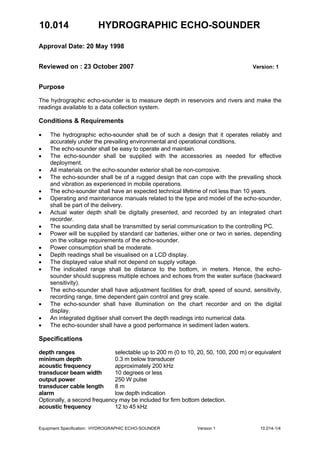
    10.014 HYDROGRAPHIC ECHO-SOUNDER ApprovalDate: 20 May 1998 Reviewed on : 23 October 2007 Version: 1 Equipment Specification: HYDROGRAPHIC ECHO-SOUNDER Version 1 10.014-1/4 Purpose The hydrographic echo-sounder is to measure depth in reservoirs and rivers and make the readings available to a data collection system. Conditions & Requirements • The hydrographic echo-sounder shall be of such a design that it operates reliably and accurately under the prevailing environmental and operational conditions. • The echo-sounder shall be easy to operate and maintain. • The echo-sounder shall be supplied with the accessories as needed for effective deployment. • All materials on the echo-sounder exterior shall be non-corrosive. • The echo-sounder shall be of a rugged design that can cope with the prevailing shock and vibration as experienced in mobile operations. • The echo-sounder shall have an expected technical lifetime of not less than 10 years. • Operating and maintenance manuals related to the type and model of the echo-sounder, shall be part of the delivery. • Actual water depth shall be digitally presented, and recorded by an integrated chart recorder. • The sounding data shall be transmitted by serial communication to the controlling PC. • Power will be supplied by standard car batteries, either one or two in series, depending on the voltage requirements of the echo-sounder. • Power consumption shall be moderate. • Depth readings shall be visualised on a LCD display. • The displayed value shall not depend on supply voltage. • The indicated range shall be distance to the bottom, in meters. Hence, the echo- sounder should suppress multiple echoes and echoes from the water surface (backward sensitivity). • The echo-sounder shall have adjustment facilities for draft, speed of sound, sensitivity, recording range, time dependent gain control and grey scale. • The echo-sounder shall have illumination on the chart recorder and on the digital display. • An integrated digitiser shall convert the depth readings into numerical data. • The echo-sounder shall have a good performance in sediment laden waters. Specifications depth ranges selectable up to 200 m (0 to 10, 20, 50, 100, 200 m) or equivalent minimum depth 0.3 m below transducer acoustic frequency approximately 200 kHz transducer beam width 10 degrees or less output power 250 W pulse transducer cable length 8 m alarm low depth indication Optionally, a second frequency may be included for firm bottom detection. acoustic frequency 12 to 45 kHz
  • 2.
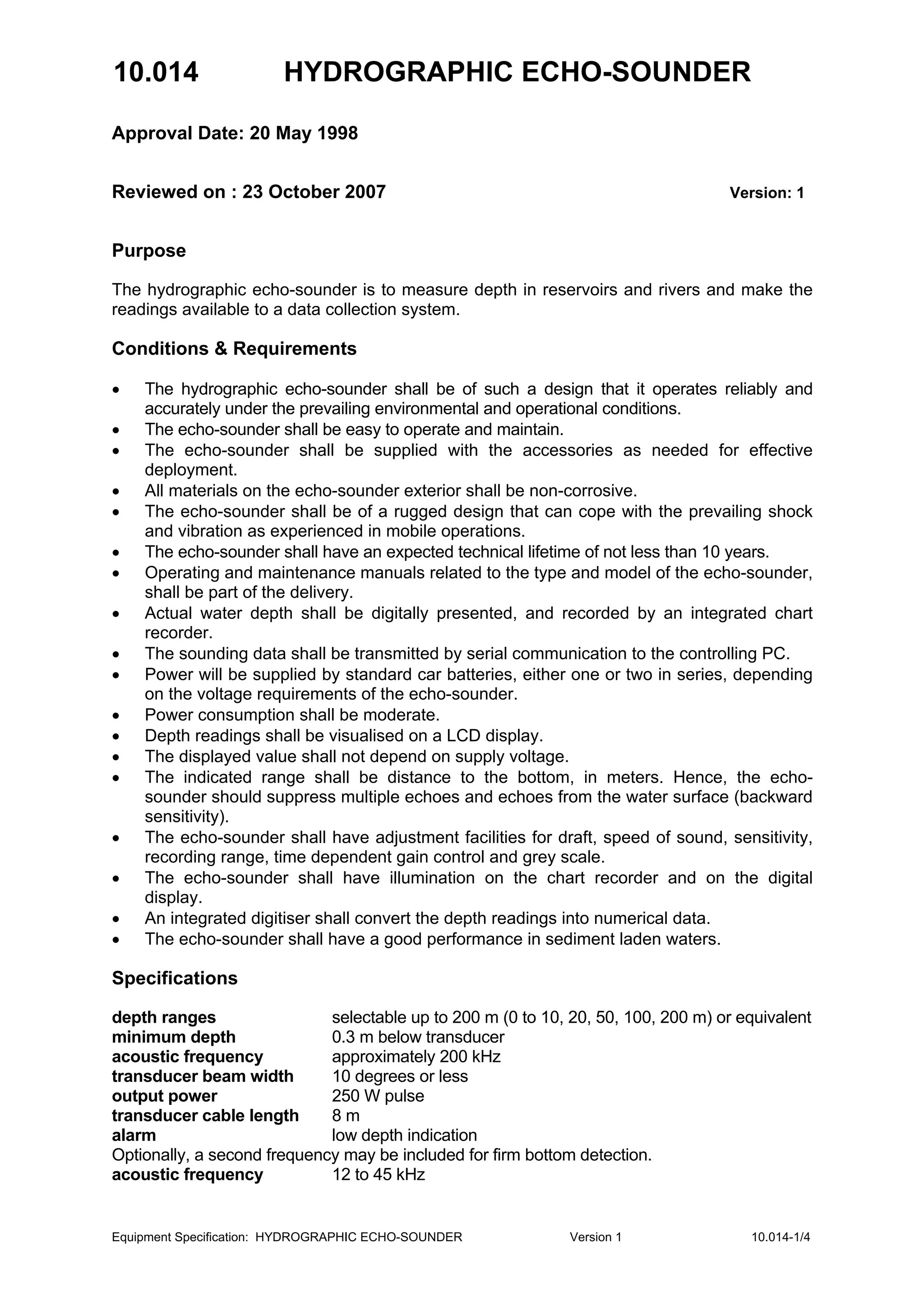
    Equipment Specification: HYDROGRAPHICECHO-SOUNDER Version 1 10.014-2/4 transducer beam width 30 degrees or less transducer cable length 8 m accuracy 0.25% of indicated depth speed of sound adjustment 1400 to 1550 m/s in steps of 1 m/s measuring rate 5 readings/second digitiser resolution 0.01 m gating bottom tracking, and adjustable gate width display LCD with good daylight visibility interface RS232 for output of depth information and input of annotation. data format NMEA-0183 update interval 1 second recording method electrical (classic), thermal or jet paper resolution 1 dot/cm water depth or better depth scale metric graduation pre-printed or printed automatically recording width 20 cm paper length 15 m time scale regular graduation pre-printed or printed automatically recording speed adjustable: off, 5 to 60 mm/min fix marker under software control from PC, switch and contact annotation free text from PC, and annotation of scales and ranges. The automatic annotation function should support generation and annotation of scale lines and the recording of essential settings on the chart paper. At least one annotation block shall be visible in the recording window power supply 11 to 15 VDC or 22 to 30 VDC ingress protection the enclosure, connectors and cables should be splash proof operating temperature 0 to 50°C humidity 95% Accessories • tool set • standard spares • bar check device with graduated chain • staff gauges Consumables • rolls of recording paper • pens, styli, ink cartridges (instrument dependent)
  • 3.
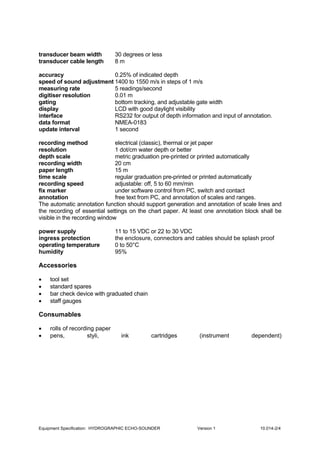
    10.014 HYDROGRAPHIC ECHO-SOUNDER Asper HP-I Approval Date: 20 May 1998 Version: 1 Equipment Specification: HYDROGRAPHIC ECHO-SOUNDER Version 1 10.014-3/4 Purpose The hydrographic echo-sounder is to measure depth in reservoirs and rivers and make the readings available to a data collection system. Conditions & Requirements • The hydrographic echo-sounder shall be of such a design that it operates reliably and accurately under the prevailing environmental and operational conditions. • The echo-sounder shall be easy to operate and maintain. • The echo-sounder shall be supplied with the accessories as needed for effective deployment. • All materials on the echo-sounder exterior shall be non-corrosive. • The echo-sounder shall be of a rugged design that can cope with the prevailing shock and vibration as experienced in mobile operations. • The echo-sounder shall have an expected technical lifetime of not less than 10 years. • Operating and maintenance manuals related to the type and model of the echo-sounder, shall be part of the delivery. • Actual water depth shall be digitally presented, and recorded by an integrated chart recorder. • The sounding data shall be transmitted by serial communication to the controlling PC. • Power will be supplied by standard car batteries, either one or two in series, depending on the voltage requirements of the echo-sounder. • Power consumption shall be moderate. • Depth readings shall be visualised on a LCD display. • The displayed value shall not depend on supply voltage. • The indicated range shall be distance to the bottom, in meters. Hence, the echo- sounder should suppress multiple echoes and echoes from the water surface (backward sensitivity). • The echo-sounder shall have adjustment facilities for draft, speed of sound, sensitivity, recording range, time dependent gain control and grey scale. • The echo-sounder shall have illumination on the chart recorder and on the digital display. • An integrated digitiser shall convert the depth readings into numerical data. • The echo-sounder shall have a good performance in sediment laden waters. Specifications depth ranges selectable up to 200 m (0 to 10, 20, 50, 100, 200 m) or equivalent minimum depth 0.3 m below transducer acoustic frequency approximately 200 kHz transducer beam width 10 degrees or less output power 250 W pulse transducer cable length 8 m alarm low depth indication Optionally, a second frequency may be included for firm bottom detection. acoustic frequency 12 to 45 kHz transducer beam width 30 degrees or less transducer cable length 8 m
  • 4.
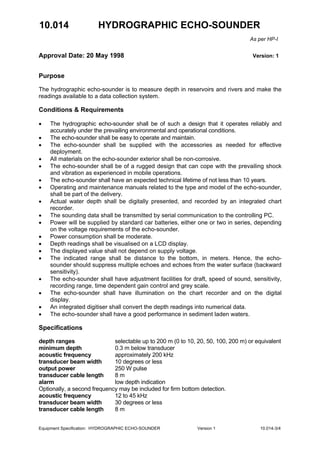
    Equipment Specification: HYDROGRAPHICECHO-SOUNDER Version 1 10.014-4/4 accuracy 0.25% of indicated depth speed of sound adjustment 1400 to 1550 m/s in steps of 1 m/s measuring rate 5 readings/second digitiser resolution 0.01 m gating bottom tracking, and adjustable gate width display LCD with good daylight visibility interface RS232 for output of depth information and input of annotation. data format NMEA-0183 update interval 1 second recording method electrical (classic), thermal or jet paper resolution 1 dot/cm water depth or better depth scale metric graduation pre-printed or printed automatically recording width 20 cm paper length 15 m time scale regular graduation pre-printed or printed automatically recording speed adjustable: off, 5 to 60 mm/min fix marker under software control from PC, switch and contact annotation free text from PC, and annotation of scales and ranges. The automatic annotation function should support generation and annotation of scale lines and the recording of essential settings on the chart paper. At least one annotation block shall be visible in the recording window power supply 11 to 15 VDC or 22 to 30 VDC ingress protection the enclosure, connectors and cables should be splash proof operating temperature 0 to 50°C humidity 95% Accessories • tool set • standard spares • bar check device with graduated chain • staff gauges Consumables • rolls of recording paper • pens, styli, ink cartridges (instrument dependent)