HURRICANES
CYCLONES Are centres of low Pressure surrounded by closed isobars Having increasing pressure outward and closed air circulation towards central L.P. Air blows in Anticlockwise in Northern Hemisphere and Clockwise in Southern Hemisphere.
TYPES TROPICAL CYCLONES TEMPERATE OR EXTRA TROPICAL CYCLONES
TROPICAL CYCLONES Developed in the regions lying between the Tropics of Cancer and Capricorn are called TROPICAL CYCLONES.
Characteristics Size : 80 – 300km diameter Velocity : 32 – 180kms/hr Moves with very high velocity in ocean and becomes weak in land. The centre is characterised by Low Pressure.
Types of Tropical Cyclones On the basis of intensity: Weak cyclones: a) Tropical Disturbances   b)  Tropical Depression Strong Cyclones   a) Hurricanes b) Tornadoes
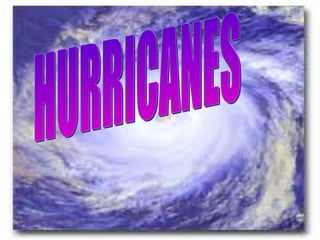
HURRICANES
HURRICANES The extensive Tropical Cyclones surrounded by several closed isobars are called Hurricanes in U.S.A
Other Names Typhoon – China Willy Willy – Australia Cyclones – Indian Ocean Baguio – Phillippines Taifu - Japan
Characteristic Feature Represented by more symmetrical and circular isobars. Pressure increases sharply from centre towards outer margin Steep pressure gradient Heavy down pour.
Properties  Diameter ranges from 160 – 640km Size is small near equator and increases away from equator. Pressure range between 900 – 950mb which is lowest of all tropical cyclones. Pressure gradient range between 10mb – 55mb.
Eye of cyclone The area between 6 – 48sqkm around the centre of hurricane is dry, rainless and winds are feeble.. This is called eye of the cyclone
Eye of cyclone
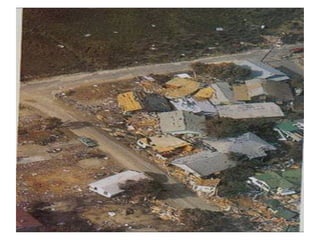
Effects Physical Damage Casualities and Public health: Malaria, Diarhoea, contamination of water. Damage to crops Water supplies: ground and piped water supply gets contaminated by flood.
Major Hurricane Tracks
After 1945 hurricanes were named in Alphabetical order of their occurences each year.


Beach surge of Katrina – August 3 2005
Hazel – 1954 Camille – 1969 Agnes – 1972 Gilbert – 1988 Hugo – 1989 Katrina – 2005 Wilma - 2005 Major Hurricanes
2008 NAMES Arthur Bertha Cesar Dolly Edouard Fran Gustav Horrtense Isidore Josephine Kyle Lili Marco Nana Omar Paloma Rene Sally Teddy Vicky Wilfred
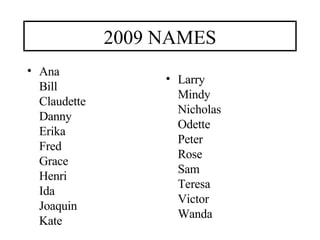
2009 NAMES Ana Bill Claudette Danny Erika Fred Grace Henri Ida Joaquin Kate  Larry Mindy Nicholas Odette Peter Rose Sam Teresa Victor Wanda
2010 NAMES Alex Bonnie Colin Danielle Earl Fiona Gaston Hermine Igor Julia  Karl Lisa Matthew Nicole Otto Paula Richard Shary Tomas Virginie Walter
Mitigation Strategies Hazard Mapping Landuse Control Design Engineered Structures Coastal Shelter Belt Improving Vegetation Cover
SUNDARAM  & PRADOSH KUMAR

Hurricane

  • 1.
  • 2.
    CYCLONES Are centresof low Pressure surrounded by closed isobars Having increasing pressure outward and closed air circulation towards central L.P. Air blows in Anticlockwise in Northern Hemisphere and Clockwise in Southern Hemisphere.
  • 3.
    TYPES TROPICAL CYCLONESTEMPERATE OR EXTRA TROPICAL CYCLONES
  • 4.
    TROPICAL CYCLONES Developedin the regions lying between the Tropics of Cancer and Capricorn are called TROPICAL CYCLONES.
  • 5.
    Characteristics Size :80 – 300km diameter Velocity : 32 – 180kms/hr Moves with very high velocity in ocean and becomes weak in land. The centre is characterised by Low Pressure.
  • 6.
    Types of TropicalCyclones On the basis of intensity: Weak cyclones: a) Tropical Disturbances b) Tropical Depression Strong Cyclones a) Hurricanes b) Tornadoes
  • 7.
  • 8.
    HURRICANES The extensiveTropical Cyclones surrounded by several closed isobars are called Hurricanes in U.S.A
  • 9.
    Other Names Typhoon– China Willy Willy – Australia Cyclones – Indian Ocean Baguio – Phillippines Taifu - Japan
  • 10.
    Characteristic Feature Representedby more symmetrical and circular isobars. Pressure increases sharply from centre towards outer margin Steep pressure gradient Heavy down pour.
  • 11.
    Properties Diameterranges from 160 – 640km Size is small near equator and increases away from equator. Pressure range between 900 – 950mb which is lowest of all tropical cyclones. Pressure gradient range between 10mb – 55mb.
  • 12.
    Eye of cycloneThe area between 6 – 48sqkm around the centre of hurricane is dry, rainless and winds are feeble.. This is called eye of the cyclone
  • 13.
  • 14.
    Effects Physical DamageCasualities and Public health: Malaria, Diarhoea, contamination of water. Damage to crops Water supplies: ground and piped water supply gets contaminated by flood.
  • 15.
  • 16.
    After 1945 hurricaneswere named in Alphabetical order of their occurences each year.
  • 17.
  • 18.
  • 19.
  • 20.
  • 21.
  • 22.
    Beach surge ofKatrina – August 3 2005
  • 23.
    Hazel – 1954Camille – 1969 Agnes – 1972 Gilbert – 1988 Hugo – 1989 Katrina – 2005 Wilma - 2005 Major Hurricanes
  • 24.
    2008 NAMES ArthurBertha Cesar Dolly Edouard Fran Gustav Horrtense Isidore Josephine Kyle Lili Marco Nana Omar Paloma Rene Sally Teddy Vicky Wilfred
  • 25.
    2009 NAMES AnaBill Claudette Danny Erika Fred Grace Henri Ida Joaquin Kate Larry Mindy Nicholas Odette Peter Rose Sam Teresa Victor Wanda
  • 26.
    2010 NAMES AlexBonnie Colin Danielle Earl Fiona Gaston Hermine Igor Julia Karl Lisa Matthew Nicole Otto Paula Richard Shary Tomas Virginie Walter
  • 27.
    Mitigation Strategies HazardMapping Landuse Control Design Engineered Structures Coastal Shelter Belt Improving Vegetation Cover
  • 28.
    SUNDARAM &PRADOSH KUMAR