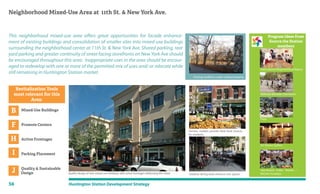
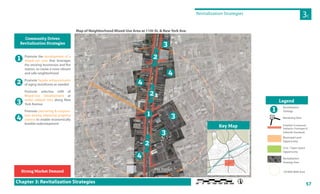
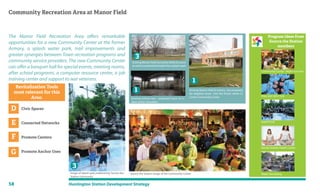
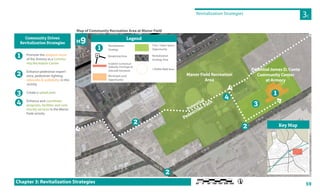
Huntington Station Development Strategy
A Comprehensive Approach to Engage the Community in Shaping the Future of its Neighborhood Areas and Community Places
April 26, 2013
Town Supervisor Frank P. Petrone
Councilwoman Susan A. Berland
Councilman Eugene Cook
Councilman Mark Cuthbertson
Councilman Mark Mayoka
In partnership with:
Town of Huntington
Town of Huntington
Economic Development
Corporation
Town of Huntington
Community Development
Agency
Huntington Station
Community
Huntington Station once had a thriving downtown, and like all communities deserves a re-energized vibrant downtown with a mix of uses that
can be enjoyed by both residents and visitors alike. To achieve this goal, Renaissance Downtowns has partnered with the Town of Huntington, the
Huntington Economic Development Corporation, property and business owners and most importantly, the Huntington Station Community in an
effort to revitalize Downtown Huntington Station. This Development Strategy document outlines a year of Renaissance funded (private equity)
community collaboration that has culminated in implementable revitalization strategies which can result in the comprehensive redevelopment of
under-utilized municipal land into tax generating mixed-use developments. Huntington has a distinctive advantage on Long Island of having a
thriving and successful Village. It is of great importance that the Huntington Station Revitalization works with the Village’s entrepreneurs to ensure
the success of the Town as a whole.
Executive Summary
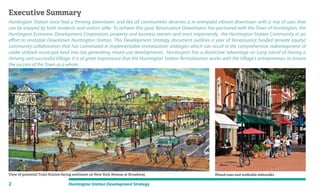
View of potential Train Station facing southeast on New York Avenue at Broadway Mixed-uses and walkable sidewalks
2 Huntington Station Development Strategy
 Promote the Town as a preeminent regional destination, by enhancing the vibrancy of Down-
town Huntington Station through the creation of a diversity of uses (a live, work, shop, learn,
and play setting).
 Ensure that economic redevelopment efforts at Huntington Station both complement and sup-
port businesses in Huntington Village.
 Create economic value, jobs and career opportunities for residents by focusing on the Hunting-
ton Station downtown core and the adaptive reuse of vacant parcels and buildings, where ap-
propriate.
 Provide an avenue for private property owners to partner with both the public sector and Re-
naissance to foster the redevelopment of under-utilized assets for the benefit of the community.
 Create a blueprint for the redevelopment of public and private parcels that will result in quality
development and commercial revitalization of Downtown Huntington Station.
 Engage all parts of the community in the process of creating concepts and guidelines for the De-
velopment Strategy.
 Incorporate Town EDC and CDA owned property located within the Study Area.
 Utilize the proximity and accessibility of the Long Island Rail Road connection to NYC to benefit
the commercial development within Huntington Station.
 Provide a downtown development, which includes commercial, retail, residential, office, hospi-
tality, parks, open space, cultural and civic uses.
 Improve streetscapes to promote pedestrian and bicycle-friendly environments, create and en-
hance Town gateways, and create civic spaces.
 Increase neighborhood safety and reduce crime by providing “eyes on the street” resulting from
new development.
 Provide a broad range of housing types and price points.
Goals of the Public-Private Partnership
Objectives of the Development Strategy
Before embarking upon this revitalization journey, a distinct set of goals and objectives
were established as a guide for the redevelopment efforts.
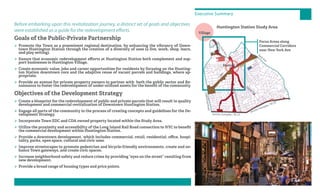
Huntington Station Study Area
Village
Station
Focus Areas along
Commercial Corridors
near New York Ave
Jericho Turnpike / Rt 25
Park Ave
Depot Rd
OakwoodRoad
NewYorkAve/Rt110
New
YorkAve
Executive Summary
StStSttSSSStStSStttStStStStStSStSSSStSStSSSSSSttStStSttSSStttttttttSS attatatatatatttatatatatattttattataaattaa ioiooiooooioooooooooiooooooiooooooooooioooioooooooooooii nnnnnnnnnnnnnnnnnnnnnnnnnnnnnnnnnnnnnnnnnnnnnnnnnnnnnnnnnttttttttta
Focus Areas along
Commercial Corrido
near New York Ave
JeJJJJ richo Turnpike / Rt 25
Jericho Turnpike / Rt 25
Park Ave
DeDeDeDDeDDDDDDDDDDDDDDDDDeDeDDDeDeDDDDDDDeDeDDDeDDDeDeDDDDeDeDDeDeDDDeDDDepopopopopopopoopopopopopopopopopopoooooottttttttttttttttttt RRdRdRdRdRdRRdRdRdRdRdRdRRdRdRdRdRdRdRdRdRddddddddddddddddddddddddddddddddddddd
OakwkkoodRoad
NNNeNNNNNNNNNNNNNNNNNNNNwwwwwwwwwwwwwwwwwwwwwwYoYoYoYoYoYoYoYoYoYoYoYoYoYoYoYoYoYoYoYoYoYoYoorkrkrkrkrkrkrrkkrkrkrrkrkkkkkkkkkAAAAAAAAAAAAAAAAAAAAAvevevvevevevevevevevevveeeeee////////////////RtRtRtRtRtRRtRtRtRtRt11111111010101010110101010000000000000000
NeNNN
w
YorkAve
LIRR
3
It’s Huntington Station’s Time
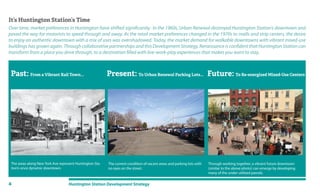
Over time, market preferences in Huntington have shifted significantly. In the 1960s, Urban Renewal destroyed Huntington Station’s downtown and
paved the way for motorists to speed through and away. As the retail market preferences changed in the 1970s to malls and strip centers, the desire
to enjoy an authentic downtown with a mix of uses was overshadowed. Today, the market demand for walkable downtowns with vibrant mixed-use
buildings has grown again. Through collaborative partnerships and this Development Strategy, Renaissance is confident that Huntington Station can
transform from a place you drive through, to a destination filled with live-work-play experiences that makes you want to stay.
Past: From a Vibrant Rail Town... Present: To Urban Renewal Parking Lots... Future: To Re-energized Mixed-Use Centers
The areas along New York Ave represent Huntington Sta-
tion’s once dynamic downtown.
The current condition of vacant areas and parking lots with
no eyes on the street.
Through working together, a vibrant future downtown
(similar to the above photo) can emerge by developing
many of the under-utilized parcels.
4 Huntington Station Development Strategy
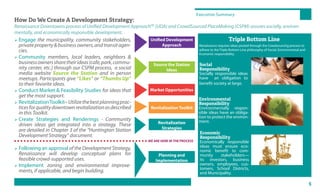
How Do We Create A Development Strategy:
Renaissance Downtowns process of Unified Development ApproachTM
(UDA) and CrowdSourced PlaceMaking (CSPM) assures socially, environ-
mentally, and economically responsible development.
Executive Summary
Unified Development
Approach
Source the Station
Ideas
Market Opportunities
Revitalization Toolkit
Revitalization
Strategies
Planning and
Implementation
 Engage the municipality, community stakeholders,
privateproperty&businessowners,andtransitagen-
cies.
 Community members, local leaders, neighbors &
businessownerssharetheirideas(cafe,park,commu-
nity center, etc.) through our CSPM process, a social
media website Source the Station and in person
meetups. Participants give “Likes” or “Thumbs Up”
to their favorite ideas.
 Conduct Market & Feasibility Studies for ideas that
get the most support.
 RevitalizationToolkit–Utilizethebestplanningprac-
ticesforqualitydowntownrevitalizationasdescribed
in this Toolkit.
 Create Strategies and Renderings - Community
driven ideas get integrated into a strategy. These
are detailed in Chapter 3 of the “Huntington Station
Development Strategy” document.
 Following an approval of the Development Strategy,
Renaissance will develop conceptual plans for
feasible crowd-supported uses.
 Implement zoning and environmental improve-
ments, if applicable, and begin building.
WE ARE HERE IN THE PROCESS
5
Triple Bottom Line
Renaissance requires ideas posted through the Cowdsourcing process to
adhere to the Triple Bottom Line philosophy of Social, Environmental and
Economic responsibility.
Social
Responsibility
Socially responsible ideas
have an obligation to
benefit society at large.
Economic
Responsibility
Economically responsible
ideas must ensure eco-
nomic benefit to com-
munity stakeholders—
its investors, business
owners, employees, cus-
tomers, School Districts,
and Municipality.
Environmental
Responsibility
Environmentally respon-
sible ideas have an obliga-
tion to protect the environ-
ment.
List of some of the
Stakeholder Group meetings
(in alphabetical order) :
 Bethel AME Church
 Family Service League
 Greater Huntington Civic Group
 HS Enrichment Center
 Huntington Chamber of Commerce
 Huntington Historical Society
 Huntington Housing Coalition
 Huntington Public Library
 Huntington Sanctuary
 Huntington Station Business Im-
provement District
 Huntington Station Latin Quarter
 Leadership Huntington Foundation
 Mahanaim School
 Melville Chamber of Commerce
 NAACP, Huntington Chapter
 Porter-Trejo Action Network
 Project HOPE
 School District
 South Huntington Against Drugs
 South Huntington Community Ac-
tivists
 Suffolk County Police Department
 Town of Huntington Youth Bureau
 Tri-CYA
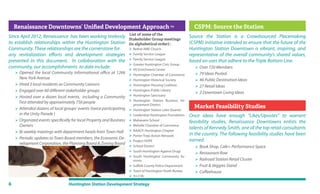
Since April 2012, Renaissance has been working tirelessly
to establish relationships within the Huntington Station
Community. These relationships are the cornerstone for
any revitalization efforts and development strategies
presented in this document. In collaboration with the
community, our accomplishments to date include:
Renaissance Downtowns’ Unified Development Approach TM
CSPM: Source the Station
Market Feasibility Studies
 Opened the local Community Informational office at 1266
New York Avenue
 Hired 3 local residents as Community Liaisons
 Engaged over 60 different stakeholder groups
 Hosted over a dozen local events, including a Community
Fest attended by approximately 750 people
 Attended dozens of local groups’ events (twice participating
in the Unity Parade )
 Organized events specifically for local Property and Business
Owners
 Bi-weekly meetings with department heads from Town Hall
 Periodic updates to Town Board members, the Economic De-
velopment Corporation, the Planning Board & Zoning Board
Source the Station is a Crowdsourced Placemaking
(CSPM) initiative intended to ensure that the future of the
Huntington Station Downtown is vibrant, inspiring, and
representative of the overall community’s shared values,
based on uses that adhere to the Triple Bottom Line.
Once ideas have enough “Likes/Upvotes” to warrant
feasibility studies, Renaissance Downtowns enlists the
talents of Kennedy Smith, one of the top retail consultants
in the country. The following feasibility studies have been
earned:
 Over 720 Members
 79 Ideas Posted
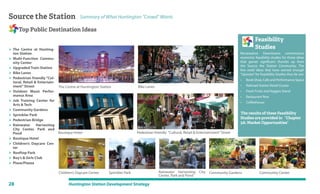
 46 Public Destination Ideas
 27 Retail Ideas
 3 Downtown Living Ideas
 Book Shop, Cafe+ Performance Space
 Restaurant Row
 Railroad Station Retail Cluster
 Fruit & Veggies Stand
 Coffeehouse
6 Huntington Station Development Strategy
NewY
wndesAve
NewYorkAve
NewYorkAve
Winding St
BiltmoreCir
TownhouseRdN
E 2nd St
E 2nd St
Parking Lot
Broadway
Broa
RailroadAve
LowndesAve
Winding St
BiltmoreCi
TownhouseRdN
E 2
5
2.5 Min Walk to
Neighborhood Center
Broadway Ave
Commuter Parking
Structure
Second Street
Commuter
Parking
Structure
Huntington
Rail Station
1
1
1
1
5
4
AAAAAAAAAAAAA
YorkAve
E 4th StDepot Rd
oad St
FairgroundAve
E 3rd St
5
3
3
5
2
3
BBBBBBBBBBBBB
Neighbor
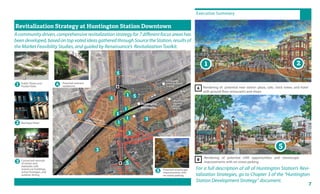
Revitalization Strategy at Huntington Station Downtown
Acommunitydriven,comprehensiverevitalizationstrategyfor7differentfocusareashas
beendeveloped,basedontopvotedideasgatheredthroughSourcetheStation,resultsof
the Market Feasibility Studies, and guided by Renaissance’s Revitalization Toolkit.
Executive Summary
For a full description of all of Huntington Station’s Revi-
talization Strategies, go to Chapter 3 of the “Huntington
Station Development Strategy” document.
4 Potential veterans
residences
5 Potential streetscape
improvements with
on-street parking
1 Public Plazas and
Pocket Parks
2
3
Boutique Hotel
Connected network
of streets and
sidewalks with
mixed-use buildings,
active frontages, and
outdoor dining
1
7
Rendering of potential new station plaza, cafe, clock tower, and hotel
with ground floor restaurants and shops
Rendering of potential infill opportunities and streetscape
improvements with on-street parking
A
B
1 2
5
8 Huntington Station Development Strategy
Table of Contents
Executive Summary 42
Our Commitment to Huntington Station 9
CHAPTER 1: Comprehensive Revitalization 10
A. Huntington Station Development Strategy 10
B. Renaissance Downtowns Team & Approach 12
C. Huntington Station History 14
D. Study Areas 18
CHAPTER 2: Building Consensus 20
A. Unified Development ApproachTM
20
B. Crowdsourced Placemaking 22
C. Source the Station 24
CHAPTER 3: Revitalization Strategies 32
A. Market Opportunities 32
B. Revitalization Toolkit 38
C. Revitalization Strategies (presented from North to South) 40
Neighborhood Transition Area at Huntington Village 42
Neighborhood Mixed-Use Area at Woodland St. & New York Ave. 44
Neighborhood Mixed-Use Area at Holdsworth Dr. & New York Ave. 46
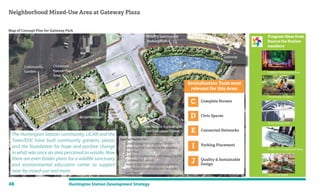
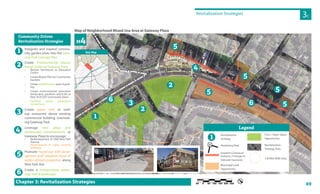
Neighborhood Mixed-Use Area at Gateway Plaza 48
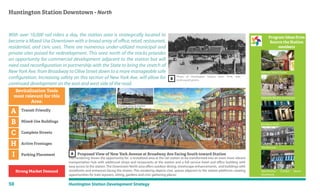
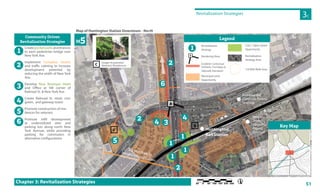
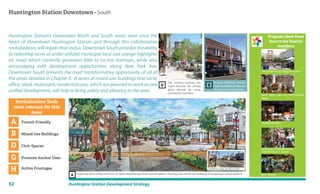
Huntington Station Downtown - North 50
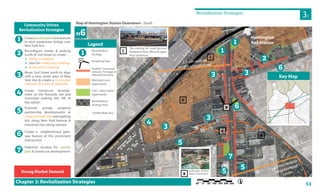
Huntington Station Downtown - South 52
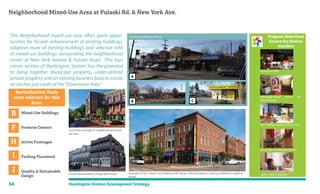
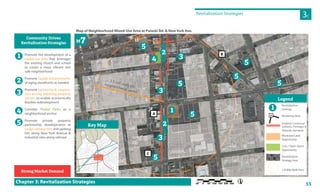
Neighborhood Mixed-Use Area at Pulaski Rd & New York Ave. 54
Neighborhood Mixed-Use Area at 11th St & New York Ave. 56
Community Recreation Area at Manor Field 58
CHAPTER 4: Next Steps 60
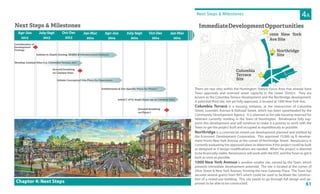
A. Next Steps & Milestones 61
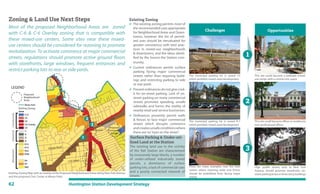
B. Zoning & Land Use Next Steps 62
C. Enhancing Transportation Choices 64
D. Infrastructure & Public Safety Opportunities 66
E. Local Community Benefits & Community Festivals 68
9
Our Commitment to Huntington Station
Introduction
Our Commitment to Huntington Station
ship between Renaissance Downtowns and the Town. This
allows a transparent ongoing dialogue to occur among
local residents, businesses and stakeholders ensuring that
the resulting Development Strategy responds to public
wishes while simultaneously tending to specific needs of
the community.
Listen to the Community
Utilizing its proprietary “Crowdsourced Placemaking”
program (SourcetheStation.com), Renaissance has already
achieved significant success through a grass roots, social
media approach to community outreach and engagement.
By listening to, and working with the community, Renais-
sance can assure the Town that the resulting development
will not only be attuned to the local market, but also have
a built in base of support that will help ensure its success
moving forward.
Renaissance & its relationship with the Town
It is essential to note that Renaissance and the Town of
Huntington are partners and that Renaissance has NOT
been hired by the Town as a consultant. Renaissance is a
private development firm which is privately funded. Renais-
sance believes that Huntington Station represents enor-
mous opportunity for successful development in a manner
where the community is a partner to all that is developed.
Our team is extremely impressed with the
forward thinking and active role that the
community has taken, and we strive to
continue these efforts well into the future.
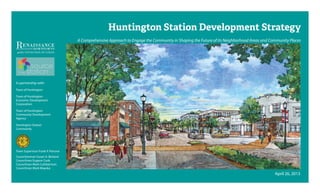
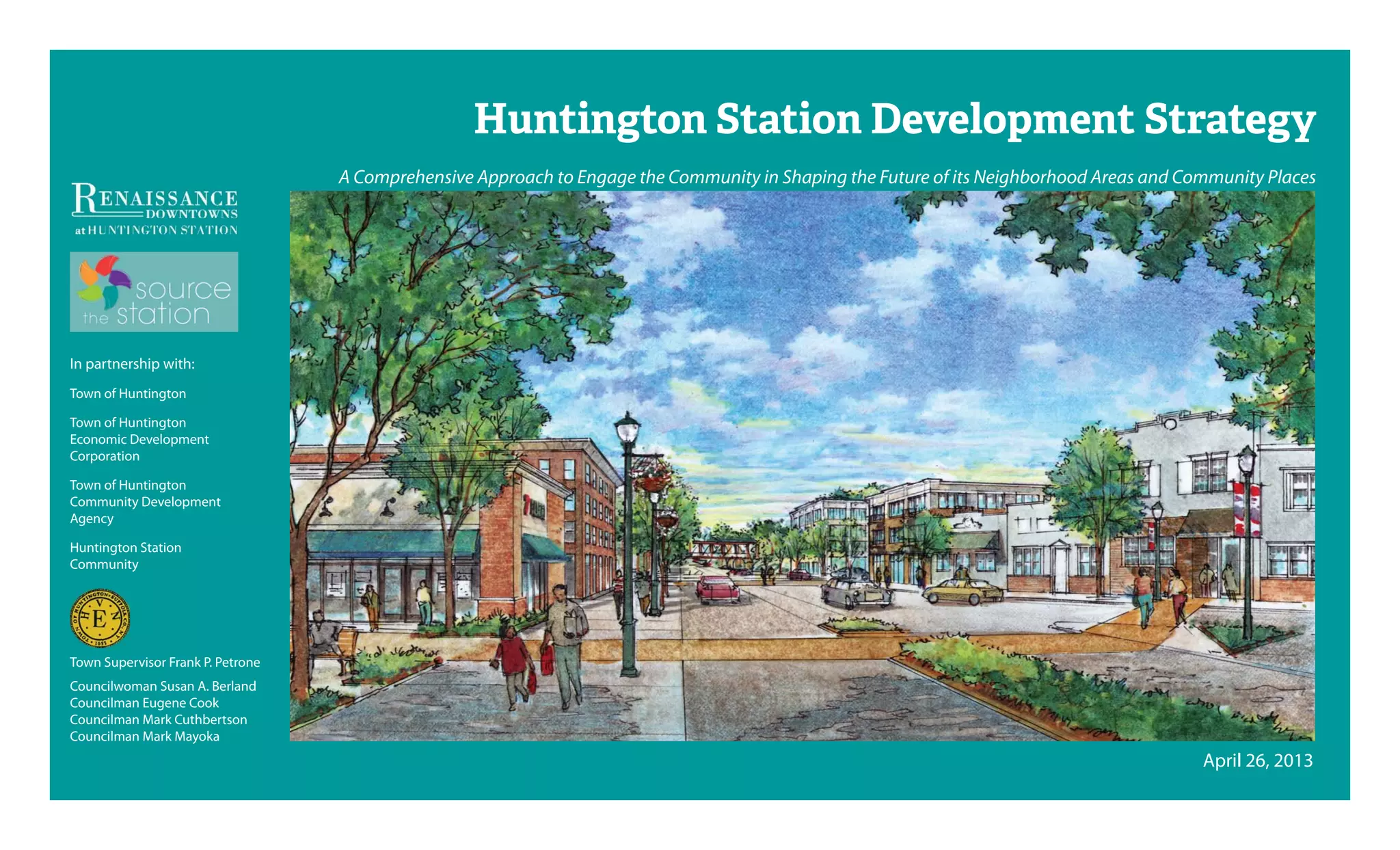
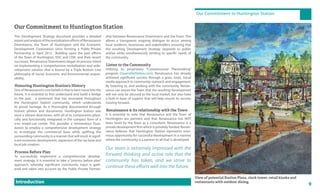
View of potential Station Plaza, clock tower, retail kiosks and
restaurants with outdoor dining.
This Development Strategy document provides a detailed
reportandanalysisoftherevitalizationeffortsofRenaissance
Downtowns, the Town of Huntington and the Economic
Development Corporation since forming a Public-Private
Partnership in April 2012. Building upon the past efforts
of the Town of Huntington, EDC and CDA, and their recent
successes, Renaissance Downtowns began its process intent
on implementing a comprehensive revitalization and rede-
velopment solution that is bound by a Triple Bottom Line
philosophy of Social, Economic and Environmental respon-
sibility.
Honoring Huntington Station’s History
One of Renaissance’s core beliefs is that to best move into the
future, it is essential to first understand and build a bridge
to the past - a sentiment that has resonated throughout
the Huntington Station community, which understands
its proud heritage. As is thoroughly documented through
historic photos and documents, Huntington Station was
once a vibrant downtown, with all of its components physi-
cally and functionally integrated in the compact form of a
true mixed-use center. This provides a tremendous foun-
dation to employ a comprehensive development strategy
to re-energize the commercial base while uplifting the
surrounding community in a manner that will result in signif-
icant economic development, expansion of the tax base and
local job creation.
Process Before Plan
To successfully implement a comprehensive develop-
ment strategy, it is essential to take a “process before plan”
approach, whereby significant community input is gath-
ered and taken into account by the Public-Private Partner-
10 Huntington Station Development Strategy
Huntington Station Development Strategy
What is the purpose of the Development Strategy?
The purpose of the Huntington Station Development Strategy is to outline the
key initiatives developed through collaboration among the Town of Huntington,
Huntington Economic Development Corporation, Huntington Stakeholders, the
Huntington Station Community and Renaissance Downtowns, which will lead to
the redevelopment and revitalization of the Huntington Station Downtown.
Chapter 1: Comprehensive Revitalization
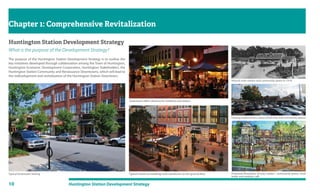
Typical Downtown Setting
Downtown offers vibrancy for residents and visitors
Proposed illustration of train station , community green, clock
tower and outdoor cafe
Typical mixed-use buildings with storefronts on the ground floor
Existing station lacks a sense of identity and community spaces
Historic train station and community green in 1918
11
Huntington Station Development Strategy
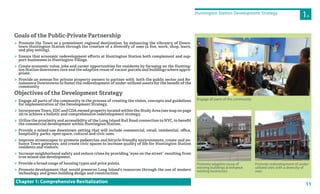
Engage all parts of the community
Promote redevelopment of under-
utilized sites with a diversity of
uses
Promote adaptive reuse of
existing buildings & enhance
existing businesses
Chapter 1: Comprehensive Revitalization
1A
 Promote the Town as a preeminent regional destination, by enhancing the vibrancy of Down-
town Huntington Station through the creation of a diversity of uses (a live, work, shop, learn,
and play setting).
 Ensure that economic redevelopment efforts at Huntington Station both complement and sup-
port businesses in Huntington Village.
 Create economic value, jobs and career opportunities for residents by focusing on the Hunting-
ton Station downtown core and the adaptive reuse of vacant parcels and buildings where appro-
priate.
 Provide an avenue for private property owners to partner with both the public sector and Re-
naissance Downtowns to foster the redevelopment of under-utilized assets for the benefit of the
community
 Engage all parts of the community in the process of creating the vision, concepts and guidelines
for implementation of the Development Strategy.
 Incorporate Town, EDC and CDA owned propertylocated within the Study Area (see map on page
18) to achieve a holistic and comprehensive redevelopment strategy.
 Utilize the proximity and accessibility of the Long Island Rail Road connection to NYC, to benefit
the commercial development within Huntington Station.
 Provide a mixed-use downtown setting that will include commercial, retail, residential, office,
hospitality, parks, open space, cultural and civic uses.
 Improve streetscapes to promote pedestrian and bicycle-friendly environments, create and en-
hance Town gateways, and create civic spaces to increase quality of life for Huntington Station
residents and visitors.
 Increase neighborhood safety and reduce crime by providing “eyes on the street” resulting from
true mixed-use development.
 Provide a broad range of housing types and price points.
 Promote development that would preserve Long Island’s resources through the use of modern
technology and green building design and construction.
Goals of the Public-Private Partnership
Objectives of the Development Strategy
12 Huntington Station Development Strategy
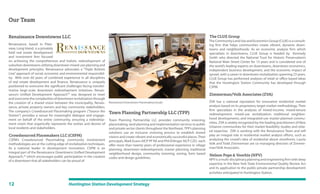
Renaissance Downtowns LLC
Renaissance, based in Plain-
view, Long Island, is a privately
held real estate development
and investment firm focused
on achieving the comprehensive and holistic redevelopment of
suburban downtowns utilizing downtown mixed-use planning and
development principles. Renaissance advocates a “Triple Bottom
Line”approach of social, economic and environmental responsibil-
ity. With over 60 years of combined experience in all disciplines
of real estate development and finance, Renaissance is uniquely
positioned to overcome the significant challenges facing transfor-
mative large-scale downtown redevelopment initiatives. Renais-
sance’s Unified Development Approach™ was designed to meet
andovercomethecomplexitiesofdowntownrevitalizationthrough
the creation of a shared vision between the municipality, Renais-
sance, private property owners and key community stakeholders.
The company’s Crowdsourced Placemaking program (“Source the
Station”) provides a venue for meaningful dialogue and engage-
ment on behalf of the entire community, ensuring a redevelop-
ment vision that organically represents the wishes and desires of
local residents and stakeholders.
Crowdsourced Placemakers LLC (CSPM)
CSPM’s Crowdsourced Placemaking community involvement
methodologies are at the cutting edge of revitalization techniques.
As a national leader in development innovation, CSPM is an
integral part of the Renaissance Downtowns Unified Development
Approach,™ which encourages public participation in the creation
of a downtown that all stakeholders can be proud of.
Town Planning Partnership LLC (TPP)
Town Planning Partnership LLC provides community visioning,
placemaking, land planning and implementation services to public
and private sector clients throughout the Northeast.TPP’s planning
solutions use an inclusive visioning process to establish shared
visions and create vibrant and economically successful places.Their
principals, Mark Evans AICP PP RA and Phil Ehlinger AICP CZO, each
offer more than twenty years of professional experience in village
planning, downtown redevelopment, master planning, traditional
neighborhood design, community visioning, zoning, form based
codes and design guidelines.
The CLUE Group
The Community Land Use and Economics Group (CLUE) is a consult-
ing firm that helps communities create vibrant, dynamic down-
towns and neighborhoods. As an economic analysis firm which
specializes in downtowns, CLUE Group is headed by Kennedy
Smith who directed the National Trust for Historic Preservation’s
National Main Street Center for 13 years and is considered one of
the world’s leading experts on downtowns, downtown economics,
independent business development, and the economic impact of
sprawl, with a career in downtown revitalization spanning 23 years.
CLUE Group has performed analyses of retail or office based ideas
that the Huntington Station Community has developed through
CSPM.
Zimmerman/Volk Associates (ZVA)
ZVA has a national reputation for innovative residential market
analysis based on its proprietary target market methodology. Their
firm specializes in the analyses of mixed-income, mixed-tenure
redevelopment; mixed-use revitalization; traditional neighbor-
hood developments; and integrated-use master-planned commu-
nities. ZVA is widely recognized by the leading practitioners of New
Urbanist communities for their market feasibility studies and relat-
ed expertise. ZVA is working with the Renaissance Team and will
play an integral role in residential market analysis efforts, such as
analyzing the crowd’s idea of residential above storefronts. Laurie
Volk and Todd Zimmerman are co-managing directors of Zimmer-
man/Volk Associates.
Nelson Pope & Voorhis (NPV)
NPV is a multi-disciplinary planning and engineering firm with deep
expertise in the New York State Environmental Quality Review Act
and its application to the public-private partnership development
activities anticipated in Huntington Station.
Our Team
Renaissance Downtowns Placemaking Studio
13
To ensure that meaningful
dialogue with the commu-
nity becomes a reality, and to
provide a venue for residents
and stakeholders to learn about
the revitalization efforts, Renais-
sance opened a community
informational office that is open
tothepublic,locatedintheheart
of the redevelopment area.
This office not only provides
information for community
members, but also serves as
home to the Source the Station
Crowdsourced Placemaking
campaign. In addition to provid-
ing a “bricks and mortar” home
for Source the Station, the office
is available for use by residents
and stakeholders for meetings
and get-togethers, helping to
further build a bond between
the efforts of Renaissance
Downtowns and the commu-
nity at large.
Renaissance’s Community
Informational Office at 1266
New York Avenue provides
the opportunity for residents,
stakeholders and local business
owners to stop by, ask questions
of the development team and
become involved in the process.
Office hours:
Monday 9:00am- 5:00pm
Tuesday 9:00am- 6:00pm
Wednesday 9:00am- 5:00pm
Thursday 10:00am-5:00pm
Friday 9:00am- 3:00pm
Community Liaisons:
Erika Forland:
erika@sourcethestation.com
Andrea Bonilla:
andrea@sourcethestation.com
Loretta Wilson:
loretta@sourcethestation.com
Facebook: facebook.com/
sourcethestation
Twitter: @sourcestation
YouTube: youtube.com/sources-
tation
Instagram: source_the_station
Chapter 1: Comprehensive Revitalization
Renaissance Downtowns &
Source the Station
Community Office
Chapter 1: Comprehensive Revitalization
Renaissance Downtowns Team & Approach
1B
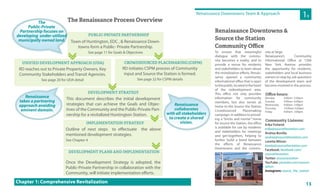
The Renaissance Process Overview
PUBLIC-PRIVATE PARTNERSHIP
UNIFIED DEVELOPMENT APPROACH (UDA)
DEVELOPMENT STRATEGY
IMPLEMENTATION STRATEGY
DEVELOPMENT PLANS AND IMPLEMENTATION
CROWDSOURCED PLACEMAKING (CSPM)
Town of Huntington, EDC , & Renaissance Down-
towns form a Public- Private Partnership.
See page 11 for Goals & Objectives
RD reaches out to Private Property Owners, Key
Community Stakeholders and Transit Agencies.
See page 20 for UDA detail
This document describes the initial development
strategies that can achieve the Goals and Objec-
tives of the Community and the Public-Private Part-
nership for a revitalized Huntington Station.
Outline of next steps to effectuate the above
mentioned development strategies.
See Chapter 4
Once the Development Strategy is adopted, the
Public-Private Partnership in collaboration with the
Community, will initiate implementation efforts.
RD initiates CSPM process of Community
input and Source the Station is formed.
See page 22 for CSPM details
The
Public-Private
Partnership focuses on
developing under-utilized
municipally owned land.
Renaissance
collaborates
with all stakeholders
to create a shared
vision.
Renaissance
takes a partnering
approach avoiding
eminent domain.
14 Huntington Station Development Strategy
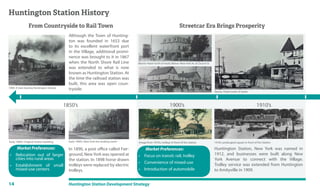
Huntington Station History
1900’s
Huntington Station, New York was named in
1912, and businesses were built along New
York Avenue to connect with the Village.
Trolley service was extended from Huntington
to Amityville in 1909.
1850’s 1910’s
Although the Town of Hunting-
ton was founded in 1653 due
to its excellent waterfront port
in the Village, additional promi-
nence was brought to it in 1867
when the North Shore Rail Line
was extended to what is now
known as Huntington Station. At
the time the railroad station was
built, this area was open coun-
tryside.
From Countryside to Rail Town Streetcar Era Brings Prosperity
Market Preferences:
• Focus on transit: rail, trolley
• Convenience of mixed-use
• Introduction of automobile
In 1890, a post office called Fair-
ground, NewYork was opened at
the station. In 1898 horse drawn
trolleys were replaced by electric
trolleys.
Market Preferences:
• Relocation out of larger
cities into rural areas
• Establishment of small
mixed-use centers
Above: Hotel south of tracks
Early 1900’s: New York Ave looking south Image from 1910’s: trolleys in front of the station 1918: Landscaped square in front of the StationEarly 1900’s: Original Station building
1904: A train leaving Huntington Station
Above: Hotel north of tracks Below: NewYork Av. & Church St
15
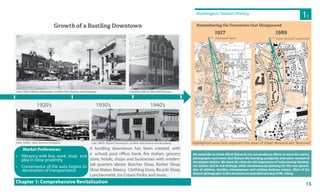
A bustling downtown has been created, with
a school, post office, bank, fire station, grocery
store, hotels, shops and businesses with residen-
tial quarters above. Butcher Shop, Barber Shop,
Shoe Maker, Bakery, Clothing Store, Bicycle Shop,
Luncheonette, Ice Cream Parlor and more...
Remembering the Downtown that Disappeared
1920’s 1940’s1930’s
Growth of a Bustling Downtown
Market Preferences:
• Vibrancy with live, work, shop and
play in close proximity
• Convenience of the auto begins its
domination of transportation
1917 1989
Chapter 1: Comprehensive Revitalization
Huntington Station History
1C
We would like to thank Alfred Sforza for his extraordinary efforts to share the stories,
photographs and events that feature the founding, prosperity and urban renewal of
Huntington Station. We share his vision for the importance of rediscovering Hunting-
ton Station and its rich heritage, while simultaneously planning for this new genera-
tion of children, families, entrepreneurs and existing business owners. Most of the
historic photographs in this document are provided courtesy of Mr. Sforza.
Highlighted areas best represent the areas of Urban Renewal aka“Removal”
Late 1930’s: Vibrant Downtown, on New York Avenue and Broadway Columbia Hall on New York Avenue
Late 1940’s: Vibrant Downtown, on New York Avenue and BroadwayEarly 1940’s: Auto Services Company
Downtown fabric Urban“removal”, vacant land
16 Huntington Station Development Strategy
1980’s1970’s
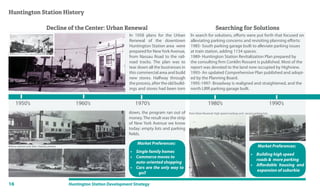
Decline of the Center: Urban Renewal
1960’s
Huntington Station History
Searching for Solutions
1990’s1950’s
Market Preferences:
• Single family homes
• Commerce moves to
auto-oriented shopping
• Cars are the only way to
go!!
Market Preferences:
• Building high speed
roads & more parking
• Affordable housing and
expansion of suburbia
In search for solutions, efforts were put forth that focused on
alleviating parking concerns and revisiting planning efforts:
1985- South parking garage built to alleviate parking issues
at train station, adding 1134 spaces.
1989- Huntington Station Revitalization Plan prepared by
the consulting firm Conklin Rossant is published. Most of the
report was devoted to the land now occupied by Highview.
1993- An updated Comprehensive Plan published and adopt-
ed by the Planning Board.
1995-1997- Broadway is realigned and straightened, and the
north LIRR parking garage built.
In 1958 plans for the Urban
Renewal of the downtown
Huntington Station area were
prepared for NewYork Avenue,
from Nassau Road to the rail-
road tracks. The plan was to
tear down all the businesses in
this commercial area and build
new stores. Halfway through
theprocess,aftertheoldbuild-
ings and stores had been torn
Before (above) and after (below) photos
down, the program ran out of
money.The result was the strip
of New York Avenue we know
today: empty lots and parking
fields.
Post Urban Renewal: high speed roadway and vacant parking lots:
17
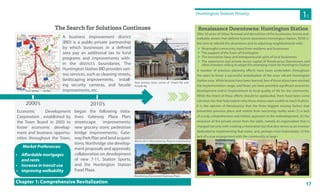
After 50 years of Urban Renewal and demolition of the businesses, homes and
walkable streets that defined historic downtown Huntington Station, NOW is
the time to rebuild this downtown and its adjoining neighborhoods with:
2000’s 2010’s
The Search for Solutions Continues Renaissance Downtowns: Huntington Station
Market Preferences:
• Affordable mortgages
and rents
• Increase in transit use
• Improving walkability
#
E RTE. 25
DEP
O
T
RO
AD
LENOX
ROAD
BR
OA
DW
AY
W
RTE. 110NEW YO
RK
AVE
HUNTINGTON STATION
SOUTH HUNTINGTON
HUNTINGTON HUNTINGTON
WEST HILLS
LI
R
R
LENOX RD
8AV
E 25
3AV
E 4
7AV
10AV
E 8
E 21
WHILLSRD
E 5
E 24
6AV
E 3
E 13
BR
OA
DW
AY
E 9
E 22
RT110
2 ST
E 16
4AV
W 9
W 21
9AV
MELVILLERD
RT 25
E 12TH
ST
4THAV
W 22
W 14TH ST
W 11
KE
LS
EY
AV
W
10
E 5T
H
ST
E 13T
H ST
R
A
IL
R
O
A
D
AV
LOW
NDE
SAV
11AV
H
O
W
E
E 19
E 15
W PULASK
I RD
W 11TH ST
CR 11
VA
RN
EY
AV
9THAV
E 17
E 23RD ST
E 20TH ST
CROMBIE
NORTH ST
COREY PL
E 11
WY
MA
NAV
OAKLEY DR
KILBURNAV
HA
ZA
RD
AV
SEMON RD
E 6TH
ST
E 11TH
ST
TH
OR
NE
YAV
1AV
OSA
GE
DR
DE
PO
T
RDW 19TH ST
HORIZONDR
E 2N
D
ST
W 23
CA
LD
WE
LL
E 3R
D
ST
LE
YD
EN
ST
CO
RL
ET
TPL
12THAV
OR
EG
ON
DR
E 2
W 19
W
IN
D
IN
G
JON
ESLN
3 ST
TIPPIN
DR
TOW
ERST
PAR
KWA
YDR
W 4TH ST
E 19TH ST
WHI
TS
ON
RD
19TH ST
2AV
W 10TH ST
VO
ND
RA
N
W 18TH ST
W 15
E 18
HOLTSWORTH
DR
MU
LF
OR
DAV
SC
HI
LL
ER
AV
E 23
5AV
E 6
HIL
LW
OO
DDR
K
IV
Y
ST
E 4T
H
ST
E ROGUES PATH
OL
IVE
W 21ST ST
MON
ATO
NDR
WIN
OKA
DR
E 12
TERR
AC
E DR
JA
ME
S
5T
HAV
MAY
FRONT DR
FA
IR
FI
EL
DS
LN
FAI
RG
RO
UN
DAV
W 13
JERICHO TPKE
CR92
C
O
LU
M
B
IA
AV
11THAV
ALBANY
ROYALOAKDR
DAVID
CT
BIR
CH
DR
BI
SC
AY
NE
DR
MAR
A
RD
HUNTERS LN
LIEPER
ST
ALL
EY
SR
110
ADAM
S
PL
REGALDR
E PULASKI RD
COT
TAG
ECT
E 14TH
ST
FR
OG
PO
ND
RD
MA
RC
HE
RAV
W
PA
RK
DR
E9T
H ST
BO
GA
RT
ST
PANO
RAMADR
ARM
ELL
ST
A B C D
ECKERT
ST
5T
HST
R
A
IL
R
O
A
D
ST
CR
11
1
ARNOL
D DR
CRAVEN ST
SR 25
BROM
PTON
PL
BOXER
CT
12TH
ST
E
FI
FT
H
ST
HOMECRESTAV
SIO
UX
PL
R
A
IL
R
O
A
D
PL
OKLAHOMA AV
LY
NC
H
M
CKAY
RD
W 16TH ST
C
O
LU
M
B
IA
ST
S7AV
TUTHILL
BARCLAY
E 18TH ST
PA
R
K
AV
TIM
OT
HY
LN
1STAV
E 17TH
ST
LIEPER
MAY
ST
SIBLEYPL
MILLER
PL
BAYLEY PL
PRO
SPE
CTDRN
FOL
SOMAV
CR
35
A
BARKER
S
LN
MAYOAV
PU
LA
SK
I RD
SO
UTH DR
E 24TH ST
RD 35
MANOR
PL
LONGLE
YPL
NO
RT
H
DR
WY
OM
ING
DR
LUTHE
RPL
PR
ES
IDE
NT
HO
LL
Y
PL
WILLET
SPL
MO
HE
GA
N PL
PI
N
E
ST
PUTNAMPL
GRAYLEYPL
E 10TH ST
E
20
ED
WA
RD
SPL
KELLOGGPLE 9TH
ST
LY
NC
H ST
STEVEN
SPL
ROXBURY
ALBANY ST
GOELLERAV
E 8TH
ST
A
R
M
ELL
DARNLEYPL
M
C
K
AY
R
D
POPLARAV
FOLE
YPL
R
A
IL
R
O
A
D
KER
RYAV
TO
W
ER
W 22ND ST
M
APL
EW
O
O
D
RD
OL
IVE
ST
LE
YD
EN
LOCKWOODAV
UNNAM
ED
ST
E
25
TH
ST
BRADBURYAV
HEN
RY
LU
D
LA
M
LU
D
LA
M
ST
NASS
AU
RD
HO
LLISPL
TASMAN LN
OAKW
OODRD
FA
IR
VI
EW
LN
7THAV
BU
FFET
TPL
3RDAV
CO
LORA
DO
PL
WIC
KS
AV
FIELDPL
R
IC
H
M
O
N
D
PL
SAG
ECT
CHESH
IRE
ST
BIR
CH
WO
OD
DR
NORD
EN LN
16TH ST
B
R
EW
STE
R
CR
ES
TW
OO
DDR
E
PA
RK
DR
CLIFFORD CT
WALT
WHITMANRD
TOWN
HOUSERDN
NEW
YOR
K AV
W
AV
ER
LY
ROXBURY ST
OA
KL
AN
DRD
BERGENST
NA
TH
AN
PL
JOSHUA
JE
RICH
O
TR
NP
K
WARRENDR
RE
VE
RE
DR
RO
XANN
E CT
W 12TH ST
CRAVEN
CAGERPL
HE
NR
Y ST
ME
RO
KE
CT
M
ER
CE
R
CT
W 9TH ST
JONES AV
SAN
DRA
CT
CHARLESPL
AN
CH
OR
CT
VO
ND
RA
N ST
U
TA
H
PL
FA
RM
PA
HU
NT
IN
GTO
N
BV
BOGUE
PL
FO
XW
O
O
D
D
R
E
MEREDITHDR
CHURCH
SEDGEW
ICK ST
HIG
HP
OIN
TDR
IN
G
ER
SO
LL
ST
RIC
HW
OO
DPL
ALL
IS
O
N
CT
WALLICECT
DE
VO
NS
HIR
E PL
HIC
KO
RY
PL
KL
AR
MA
N CT
GA
RD
IN
ER
AV
5T
HAV
S
FRA
NK
PL
PL
UM
B
CT
PU
BL
IC
RD
W 13TH ST
NORTHRIDGE ST
CARLOW ST
RE
GIN
A CT
DA
WS
ON
PL
TO
WNH
OU
SE
RD
S
E JE
RI
CH
O
TR
NP
K
NEV
ADA
PL
HAY
LO
FT
CT
1ST
ST
BA
RN
RU
N
CT
E 15TH ST
SPENCE
R CT
E JERICHO TPKE
SEA
GRO
VEPL
AL
BE
RM
ARL
E
ST
ST
AN
N
CT
JO
EL
CT
U
N
N
A
M
ED
W
ATE
R
CHALDENCT
WEXFORD ST
HIL
LS
IDE
AV
SCHAEFFER
NASSAVRD
TEDD
YCT
5T
HAV
4TH
AV
E
5T
H
ST
1AV
CR
35A
MC
KA
Y RD
SR110
E 17
E 17
E
24
C
R
35
A
CR
11
TH
OR
NE
Y AV
W 22ND
ST
UNNAME
DST
11THAV
5THST
W22
E 12T
H ST
CR
11
E ROGUES PATH
CR 11
OL
IVE
ST
NORTHRIDG
E ST
WALL
ICE CT
CR92
RT110
RT110
CR
11
1
DEP
O
T
RD
E 4TH
ST
5T
H AV
SR110
E 15
SR
110
OL
IVE
ST
W 21
PA
RK
AV
E 17TH ST
W 22ND ST
OAKW
OODRDCR92
NE
W
YO
RK
AV
PULASK
I RD
W 11TH
ST
NEWYORKAV
11AV
E 19T
H ST
E 17
E 17TH ST
5THST
SR110
JERICHO TPKE
W 21
E 9
RT110
W 9
R
A
IL
R
O
A
D
ST
MCKAY
RD
E 10TH
ST
E
PU
LA
SK
I RD
W 10TH ST
NEWYORKAV
RT 25
E 11
FO
LS
OM
AV
11AV
FAIRFI
ELD
S LN
RT110
RT
25
5AV
E 23R
D ST
W
YO
M
IN
G
D
R
W 10
LEN
O
X
RD
RT110
W
HIT
SO
N
RD
0 1,400 2,800 4,200 5,600700
Feet
Town of
Huntington
1 inch equals 1,250 feet
Draft for Intra-Inter Agency Review
TOH Planning & Envuironment DCD
Dec. 02, 2010
Area of
Detail
North
East 17th St
Huntington Station BID
East 19th St
Holdsworth Dr.
Jericho Tpke. Rte 25
West Hills Rd.
Legend
Huntington Station BID
Coastal Water
Harbor
Town Boundary
Primary Roads
# LIRR Stations
LIRR Tracks
Roads
Census Designated Places
Inc. Villages
Chapter 1: Comprehensive Revitalization
Huntington Station History
1C
A business improvement district
(BID) is a public-private partnership
by which businesses in a defined
area pay an additional tax to fund
programs and improvements with-
in the district’s boundaries. The
Huntington Station BID provides vari-
ous services, such as cleaning streets,
landscaping improvements, install-
ing security cameras, and facade
improvements, etc.
Economic Development
Corporation , established by
the Town Board in 2003 to
foster economic develop-
ment and business opportu-
nities throughout the Town,
 Meaningful community input from residents and businesses
 The support of the Town of Huntington
 The innovative ideas and entrepreneurial spirit of local businesses
 The experience and private sector capital of Renaissance Downtowns and
other investors willing to adopt this emerging vision for Huntington Station
A number of previous planning efforts have been undertaken throughout
the years to foster a successful revitalization of the once vibrant Huntington
Station area. While lessons have been learned, few of these plans have reached
the implementation stage, and fewer yet have provided significant economic
development and/or improvement to local quality of life for the community.
While the intent of these efforts should be applauded, there have been some
common ties that help explain why these visions were unable to reach fruition.
It is the opinion of Renaissance that the three biggest missing factors that
prevented previous plans and visions from becoming reality were (1) a lack
of a truly comprehensive and holistic approach to the redevelopment, (2) the
exclusion of the private sector from the table, namely an organization that is
charged not only with creating a vision/plan but that also serves as an investor
dedicated to implementing that vision, and, perhaps most importantly, (3) the
lack of a true engagement with the community at large.
New grocery store, corner of Depot Rd. and
Pulaski Rd.
March 2013: New Gateway Plaza in construction
Rendering of proposed Gateway Plaza
began the following initia-
tives: Gateway Plaza Plan;
streetscape improvements;
new grocery store; pedestrian
bridge improvements; Gate-
way Park Plan and land acquisi-
tions; Northridge site develop-
ment proposals and approvals;
collaboration on development
of new 7-11, Station Sports,
and the Huntington Station
Food Plaza.
18 Huntington Station Development Strategy
Huntington Station Study Area Municipal & Private Development Sites near the
Station offer excellent early phase Development
Opportunities
Mixed-Use Neighborhood Areas
Along New York Avenue
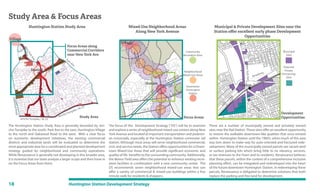
The Huntington Station Study Area is generally bounded by Jeri-
cho Turnpike to the south, Park Ave to the east, Huntington Village
to the north and Oakwood Road to the west. With a clear focus
on economic development initiatives, the existing commercial
districts and industrial lands will be evaluated to determine the
most appropriate area for a coordinated and planned development
strategy guided by neighborhood and community aspirations.
While Renaissance is generally not developing in this broader area,
it is essential that our team analyze a larger scope and then hone in
on the Focus Areas from there.
The focus of this Development Strategy (“DS”) will be to examine
and explore a series of neighborhood mixed-use centers along New
York Avenue and located at important transportation and pedestri-
an crossroads, especially at the Huntington Station commuter rail
station. Although most areas will serve neighborhood commercial,
civic and service needs, the Station offers opportunities for a Down-
town Mixed-Use Areas that will provide significant economic and
quality of life benefits to the surrounding community. Additionally,
the Manor Field area offers the potential to enhance existing recre-
ation facilities in combination with a new community center. The
DS recommends seven neighborhood mixed-use areas that can
offer a variety of commercial & mixed-use buildings within a five
minute walk for residents & shoppers.
There are a number of municipally owned and privately owned
sites near the Rail Station.These sites offer an excellent opportunity
to restore the walkable downtown-like qualities that once existed
within Huntington Station until the 1960’s, when much of this area
was torn down to make way for auto-oriented and fractured rede-
velopment. Many of the municipally owned parcels are vacant land
or surface parking lots which bring little to no vibrancy, services,
or tax revenues to the Town and its residents. Renaissance believes
that these parcels, within the context of a comprehensive inclusive
planning effort, can be integrated and redeveloped into the heart
of the future downtown Huntington Station. In redeveloping these
parcels, Renaissance is obligated to determine solutions that both
replace the parking and free land for development.
Study Area & Focus Areas
Village
Station
Focus Areas along
Commercial Corridors
near New York Ave
Jericho Turnpike / Rt 25
Park Ave
OakwoodRoad
NewYorkAve/Rt110
New
YorkAve
Study Area
NewYorkAve
NewYorkAve
Broadway Ave
Railroad
Ave
Pulaski Ave
Pulaski Ave
Station
LIRR
LIRR
Station
NewYorkAve
Railroad
Ave
Broadway
Depot Rd
2nd St
Community
Recreation Area
Neighborhood
Mixed-Use Areas
Downtown
Huntington
Station
Municipal
Sites
Potential
Private
Partnership
Sites
Focus Areas
Development
Opportunities
Village
Broadway
11th St
19
Study Areas
For much of the last 60 years, America
has built new shopping centers and
neighborhoods with little regard for
the importance of pedestrian-scaled
places. Simultaneously, American
communities have destroyed once
vibrant places such as Huntington
Station in the name of “progress”, to
construct overly wide roadways that
encourage speeding, making pedes-
trian safety very difficult to achieve. To
store our vehicles, we have dedicated
vast landscapes for single purpose
paved parking lots that further contrib-
ute to rapid runoff, destruction of our
natural environment and increased
flooding within our communities, not
to mention a lack of overall aesthetic
appeal.
In many ways, Huntington Station is a
microcosm of those issues that most
communities are facing all across
America.
Walkable Mixed-Use Areas Connect to
Huntington Station Neighborhoods
Chapter 1: Comprehensive Revitalization
1D
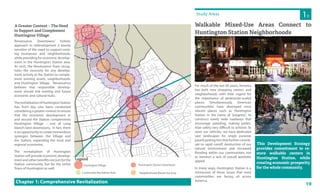
A Greater Context – The Need
to Support and Complement
Huntington Village
Renaissance Downtowns’ holistic
approach to redevelopment is keenly
sensitive of the need to support exist-
ing businesses and neighborhoods,
while providing for economic develop-
ment in the Huntington Station area.
As such, the Renaissance Team recog-
nizes the necessity for any develop-
ment activity at the Station to comple-
ment existing assets, neighborhoods,
and Huntington Village. Renaissance
believes that responsible develop-
ment should link existing and future
economic and cultural hubs.
TherevitalizationofHuntingtonStation
has, from day one, been conducted
considering a greater context to ensure
that the economic development in
and around the Station complements
Huntington Village – one of Long
Island’s best downtowns. In fact, there
is an opportunity to create tremendous
synergies between the Village and
the Station, expanding the local and
regional economies.
The revitalization of Huntington
Station will provide economic develop-
ment and other benefits not just for the
Station community, but for the entire
Town of Huntington as well.
This Development Strategy
provides commitment to re-
store walkable centers in
Huntington Station, while
creating economic prosperity
for the whole community.
Community Recreation Area Neighborhood Mixed-Use Area
Huntington Station DowntownHuntington Village
Legend
20 Huntington Station Development Strategy
Chapter 2: Building Consensus
A Platform for Positive ChangeUnified Development ApproachTM
The Process and Benefits
The Unified Development Approach™ (UDA) provides a framework that facilitates the creation and implementation
of a comprehensive downtown redevelopment strategy by bringing together disparate aspects of a community to
collectively create and implement a shared redevelopment vision in a holistic manner, and helps to ensure project
sustainability, thus maximizing social, economic and environmental benefits.
 Individual PPOs benefit from the mul-
tiple economic development drivers
and investment that occurs through-
out the area.
 Individual PPOs could never realize full
development potential without work-
ing in collaboration.
Private
Property
Owners
Transit Agencies
Key
Community
Stakeholders
Master
Developer
Municipality
 Partner with Municipality
Through a Public-Private Partnership
between the Master Developer and
the Municipality, under-utilized
municipal properties are primed
for economic development that
will provide numerous benefits to
the community at large, including
bringing these sites back on the tax
rolls.
 Partner with Private Property
Owners (PPO)– In conventional ap-
proaches to redevelopment, munici-
palities engage in the use of eminent
domain, as was the case during the
Urban Renewal period in Huntington
Station. Renaissance Downtowns
does not believe in such practice and
has implemented a UDA, the col-
laborative redevelopment effort, to
maximize property values for PPOs
by either partnering with them or
showing them the path to redevelop
on their own.
 Engage Key Community Stake-
holders – The UDA emphasizes
meaningful public outreach and
engagement which Renaissance
Downtowns accomplishes by utiliz-
ing its proprietary and patent pend-
ing Crowdsourced Placemaking
Program (see page 22). In addition,
Renaissance works with existing
and future business owners to forge
business plans in collaboration with
property owners and the community
at large.
 A comprehensive approach results in
significantly higher levels of economic
development, including local entre-
preneurship and job creation.
 An inclusive approach helps the
developer identify and address
social, environmental, and economic
concerns of the community on a very
personal level.
EngageTransitAgencies Some
of the prime properties that will
contribute to economic development
and improvements in the quality of life
for local residents are under the control
of transit agencies, which are included
within the visioning process to ensure a
positive outcome for all parties.
 By taking a comprehensive approach,
private investment is assured a greater
likelihood of lasting success, and eco-
nomic sustainability.The municipality is
assured quality development resulting
in tax generation and job creation.
 Utilizing redevelopment that examines
the full context of an area, the Munici-
pality has the ability to implement a
comprehensive vision that could never
be feasible through one-off, traditional
infill redevelopment methodologies.
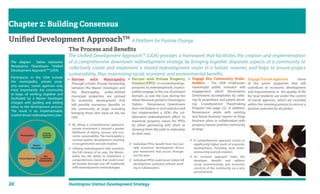
The diagram below represents
Renaissance Downtowns “Unified
Development Approach™”(UDA)
Participants in the UDA include
the municipality, private prop-
erty owners, transit agencies and,
most importantly, the community
at large, all working together and
facilitated by a Master Developer
charged with guiding and adding
value to the development process.
The result is an implementable,
market driven redevelopment plan.
21
Unified Development Approach TM
2A
One of the hallmarks of Renaissance’s development approach
is a“Process before Plan”philosophy that enables the organic
co-creation of a shared development vision resulting from a
partnership among Renaissance Downtowns (as the Master
Developer), its municipal partners and, most importantly,
the community. Rather than begin a redevelopment effort
with preconceived notions, Renaissance employs its Unified
Development Approach™ and its Crowdsourced Placemak-
ing program to push aside preconceived notions and garner
ideas and insight from local residents, businesses and stake-
holders, following the principles of Triple Bottom Line devel-
opment- social, economic and environmental responsibility.
A Comprehensive, Not A Piecemeal, Approach
To successfully implement mixed-use downtown revitaliza-
tion, it is essential to take into account the context of the
Process Before Plan
entire area, rather than seeking to improve separate small
areas, possibly to the detriment of the whole.
 A downtown must be a woven, neighborhood fabric
rather than a patchwork of disconnected projects .
 A successful downtown is comprised of distinct neigh-
borhoods and districts, each with a unique character
that, together, work in harmony with each other to cre-
ate a true sense of place while fostering economic de-
velopment.
 A holistic and comprehensive approach provides the
right mix and balance of uses to support an active re-
tail and commercial environment, while also including
a residential component that provides “eyes on the
street”and a true neighborhood feeling.
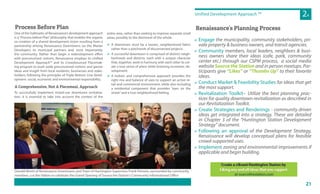
Donald Monti of Renaissance Downtowns and Town of Huntington Supervisor Frank Petrone, surrounded by community
members, cut the ribbon to celebrate the Grand Opening of Source the Station's Community Informational Office
Renaissance’s Planning Process
 Engage the municipality, community stakeholders, pri-
vate property & business owners, and transit agencies.
 Community members, local leaders, neighbors & busi-
ness owners share their ideas (cafe, park, community
center etc.) through our CSPM process, a social media
website Source the Station and in person meetups. Par-
ticipants give “Likes” or “Thumbs Up” to their favorite
ideas.
 Conduct Market & Feasibility Studies for ideas that get
the most support.
 Revitalization Toolkit– Utilize the best planning prac-
tices for quality downtown revitalization as described in
our Revitalization Toolkit.
 Create Strategies and Renderings - community driven
ideas get integrated into a strategy. These are detailed
in Chapter 3 of the “Huntington Station Development
Strategy” document.
 Following an approval of the Development Strategy,
Renaissance will develop conceptual plans for feasible
crowd-supported uses.
 Implement zoning and environmental improvements if
applicable and begin building.
22 Huntington Station Development Strategy
Crowdsourced Placemaking
Renaissance Downtowns utilizes a unique community-driven
‘Crowdsourced Placemaking’ program that produces an
enthusiastic group of supporters and investors for economically,
socially and environmentally responsible (triple bottom line)
revitalization.
Empowering Small Business Entrepreneurs &
Community Members
CSPM represents a fundamental shift in the decision-making
process by empowering small business entrepreneurs and
community members to better define the future of their commu-
nity. CSPM used in real estate development creates opportuni-
ties for individuals and small businesses that collectively have
more investment capital and influence than the few that typically
make the majority of real estate decisions. When the collective
will of those who apply socially, economically and environmen-
tally responsible ideas in their community is implemented, the
outcome becomes consistent with community values.
Source the Station, the Huntington Station Crowdsourced
Placemaking community, debuted at its grand opening on July 18,
2012. Sixty people braved through severe weather to initiate the
first phase of the Crowdsourced Placemaking (CSPM) process by
describing the kinds of places and destinations they’d like to see in
their downtown.
SourcetheStationisaninitiativeintendedtoensurethatthefuture
of the Huntington Station Downtown is vibrant, inspiring and
representative of the overall community’s shared values, based on
uses that adhere to the triple bottom line of being economically,
socially and environmentally responsible, while complementing
the Huntington Village Downtown District.
Our approach is a transparent, inclusionary and fun process, that
allows community members to participate in an innovative means
to realize the vibrant downtown they wish to experience.
Through this Crowdsourced Placemaking community, residents
and stakeholders are able to:
 Collaborate with others in their community, to revitalize Hun-
tington Station’s Downtown, both face-to-face and online.
 Become a member of the site to propose, vote & ”Like”, and dis-
cuss and campaign for the ideas that individuals support.
 Support the local businesses, organizations and entrepreneurs
engaged in the collaborative effort to revitalize downtown.
The goal of the Source the Station community is to build a
forward-thinking group that will function as a valued partner in
making major decisions regarding downtown investments. Until
the last building is built, Renaissance Downtowns will continue to
collaborate with the community to develop a downtown that is
inspired by, and reflects community values.
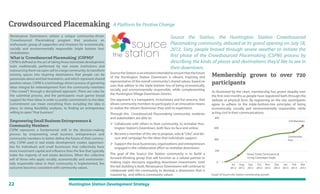
Membership grows to over 720
participants
As illustrated by the chart, membership has grown steadily over
the first nine months as people have registered both through the
website or physical form. By registering on the site, participants
agree to adhere to the triple-bottom-line principles of being
economically, socially and environmentally responsible, while
acting civil in their communications.
What is ‘Crowdsourced Placemaking’ (CSPM)?
CSPM is defined as the act of taking those real estate development
tasks traditionally performed by real estate institutions and
outsourcing them via open call to a large community, to transform
existing spaces into inspiring destinations that people can be
passionate about and feel invested in, and which represent shared
positive values. CSPM is a technology-driven process of garnering
ideas integral for redevelopment from the community members
(“the crowd”) through a disciplined approach. There are rules for
the submittal process, and the participants must garner broad
support for their ideas in order to justify commitment to the idea.
Commitment can mean everything from including the idea in
plans, to doing feasibility analyses, to finding an entrepreneur
willing to open“that business”.
Graph of Source the Station membership growth
A Platform for Positive Change
720 Members
Jul
2012
800
600
400
200
0
Aug
2012
Sep
2012
Oct
2012
Nov
2012
Dec
2012
Jan
2013
Feb
2013
Mar
2013
Community
Fest
Retail, Public Destination &
Living Campaigns begin
23
Crowdsourced Placemaking
How does Crowdsourced
Placemaking (CSPM) relate to
the Development Strategy?
One of the hallmarks of Renaissance’s develop-
ment approach is a“Process before Plan”philos-
ophy that allows for the organic creation of a
shared development vision that results from the
partnership among Renaissance Downtowns as
the Master Developer, its municipal partner and
most importantly, the public at large. Source the
Station ideas guide this shared vision and the
Development Strategy concepts.
Chapter 2: Building Consensus
Find Best Ideas
Identification of small business and entrepre-
neur ideas are fundamental to the Crowdsourced
Placemaking process. Small business decision
makers often do not participate in large business
forums, but rather in more intimate social circles.
Many of them are entrepreneurs and social orga-
nizers who won’t typically participate in the
formal public process, but who still contribute
significantly to the overall economic well being
of Huntington Station. Thus, Source the Station
hosts happy hours and meetups to provide a
forum in which these leaders can identify them-
selves and participate within their comfort zone.
Launch website
The SourcetheStation.com website was launched
in June 2012, as an information resource. Infra-
structure was in place to accept member reg-
istrations and ideas in July 2012. Renovemos-
laEstacion.com, the Spanish version of the site,
launched in January 2013. Source the Station
features include:
 A home page slideshow
 Meetup and event recaps
 A gallery of user-submitted ideas
 Discussion forums
 Information pages
 A membership directory
 Groups
 Inspirational ideas pages
 Campaign info
 Office hours/contact info
Define Principles
Agreement to the Triple-Bottom-Line Statement
and Crowdsourced Placemaking Agreement rules
of conduct is required at registration and ensures
that members post ideas that will advance re-
sponsible revitalization efforts.
Meet with Stakeholders
Renaissance and the Source the Station team has
met with dozens of groups and organizations,
leaders and stakeholders that represent
Huntington Station, and who have provided
insight to better understand the community
values and needs in order to more effectively
incorporate those values and needs into future
development plans. These groups include:
 Business Owners
 Town, County, State representatives
 Minority Community members
 Hispanic Community members
 African-American Community members
 Property Owners
 Other interested parties
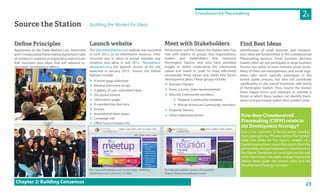
The Spanish website version of Source the
Station: RenovemoslaEstacion.com
The SourcetheStation.com home page, featuring
upcoming events and over 75 ideas.
Source the Station Building the Market for Ideas
2B
24 Huntington Station Development Strategy
Photo below: The January 2013 meetup at La Hacienda
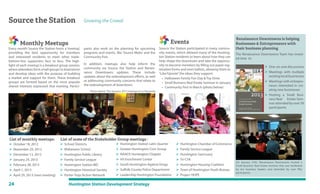
Monthly Meetups
Every month Source the Station hosts a ‘meetup’,
providing the best opportunity for members
and interested residents to meet other triple-
bottom-line supporters face to face. The high-
light of each meetup is a breakout group session,
where attendees form small groups to brainstorm
and develop ideas with the purpose of building
a market and support for them. These breakout
groups are formed based on the most popular
shared interests expressed that evening. Partici-
pants also work on the planning for upcoming
programs and events, like ‘Source Mobs’ and the
Community Fest.
In addition, meetups also help inform the
community via Source the Station and Renais-
sance Downtowns updates. These include
updates about the redevelopment efforts, as well
as addressing community concerns that relate to
the redevelopment of downtown.
Events
Source the Station participated in many commu-
nity events, which allowed many of the Hunting-
ton Station residents to learn about how they can
help shape the downtown and take the opportu-
nity to become members by filling out paper reg-
istration forms and even ballots, allowing them to
“Like/Upvote”the ideas they support:
• Halloween Family Fun Day & Toy Drive
• Small Business Real Estate Seminar in January
• Community Fest in March (photo below)
Renaissance Downtowns is helping
Businesses & Entrepreneurs with
their business planning
The Renaissance Downtowns Team has invest-
ed time in:
On January 27th, Renaissance Downtowns hosted a
Small Business Real Estate Seminar that was facilitated
by ten business leaders and attended by over fifty
participants.
 One-on-one discussions
 Meetings with multiple
existing local businesses
 Meetings with entrepre-
neurs interested in cre-
ating new businesses
 Hosting a Small Busi-
ness Real Estate Sem-
inar attended by over 50
participants
Source the Station Growing the Crowd
List of monthly meetups: List of some of the Stakeholder Group meetings :
 October 18, 2012
 November 29, 2012
 December 13, 2012
 January 24, 2013
 February 28, 2013
 April 1, 2013
 April 29, 2013 (next meeting)
 School Districts
 Mahanaim School
 Huntington Public Library
 Family Service League
 Huntington Station BID
 Huntington Historical Society
 Porter-Trejo Action Network
 Huntington Station Latin Quarter
 Greater Huntington Civic Group
 NAACP, Huntington Chapter
 HS Enrichment Center
 South Huntington Against Drugs
 Suffolk County Police Department
 Leadership Huntington Foundation
 Huntington Chamber of Commerce
 Family Service League
 Huntington Sanctuary
 Tri-CYA
 Huntington Housing Coalition
 Town of Huntington Youth Bureau
 Project HOPE
25
Apartments/Condos
Over Retail
Feasibility StudiesLaunching Campaigns
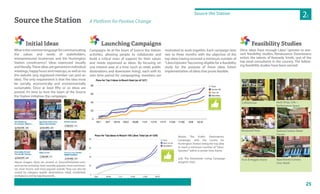
Campaigns lie at the heart of Source the Station
activities, allowing people to collaborate and
build a critical mass of support for their values
and needs expressed as ideas. By focusing on
one interest area at a time (such as retail, public
destinations and downtown living), each with its
own time period for campaigning, members are
motivated to work together. Each campaign lasts
two to three months with the objective of the
top ideas having received a minimum number of
“Likes/Upvotes”becoming eligible for a feasibility
study for the purpose of those ideas future
implementation of ideas that prove feasible.
Left: The Downtown Living Campaign
progress chart.
Initial Ideas
Whatisthecommonlanguageforcommunicating
the values and needs of stakeholders,
entrepreneurial businesses and the Huntington
Station constituency? Ideas expressed visually
andliterally.Theseideasaregarneredinindividual
meetings,happyhoursandmeetups,aswellasvia
the website (any registered member can post an
idea). The only requirement is that the idea must
be socially, economically and environmentally
sustainable. Once at least fifty or so ideas are
posted, it’s time to host the heart of the Source
the Station initiative; the campaigns.
Above images: Ideas are posted as SourcetheStation.com,
and can be sorted by most recently popular, most comment-
ed, most recent, and most popular overall. They can also be
sorted by category (public destinations, retail, residential,
workplace) and by tags/keywords.
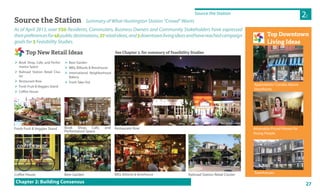
Restaurant Row
Book Shop, Cafe +
Performance Space
Railroad Station Retail
Cluster
Fruit & Veggies Stand
Coffeehouse
2C
Source the Station A Platform for Positive Change
Source the Station
Above: The Public Destinations
Campaign, with the Centre for
Huntington Station being the top idea
to reach a minimum number of “Likes/
Upvotes’”within a certain time-frame.
Once ideas have enough Likes/ Upvotes to war-
rant feasibility studies, Renaissance Downtowns
enlists the talents of Kennedy Smith, one of the
top retail consultants in the country. The follow-
ing feasibility studies have been earned:
26 Huntington Station Development Strategy
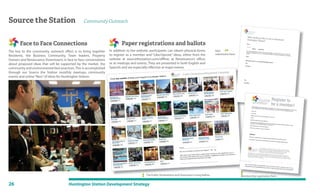
Paper registrations and ballots
In addition to the website, participants can obtain physical forms
to register as a member and “Like/Upvote” ideas, either from the
website at sourcethestation.com/offline; at Renaissance’s office;
or at meetups and events. They are presented in both English and
Spanish and are especially effective at major events.
Face to Face Connections
Spanish and are especially effective at major events.
What would you like to see in downtownHuntington Station?
Name:
Circle one:
Member Non-Member
If you are not registered as a member on the sourcethestation.com website, please also send completed
membership registration form (see sourcethestation.com/offline) or write your email below so we can send
you one:
Email:
What would you like to see in downtown Huntington Station?
Title:
Description:
Title:
Description:
The Public Destinations and Downtown Living ballots Membership registration form
Idea
submission form
Membership registration formM
These questions need to be filled out to validate your ‘votes’ on the sourcethestation.com site if you
haven’t registered yet. This is only to validate your vote, we do not sell or distribute this info.First name:
Last name:
Display name (how your name appears on the site):Email:
Birthdate (required for age validation):
Do you/have you lived/worked in the Town of Huntington, frequent Huntington Station or have
strong ties to the Huntington Station community??:Who referred you to Source the Station?:
What is your interest in Source the Station?:
Optional
Would you consider living in a vibrant revitalized downtown if the price was right?I would like to submit this idea that would make downtown Huntington Station vibrant:
Use your email to login to sourcethestation.com to Like/vote for ideas or submit your own! To set a
new password, go to sourcethestation.com, click on ‘Login’ (top right of site), then ‘Lost Password?’
Tear this off as a reminder
Register to
be a member!
...is an initiative to ensure that the future of the Huntington Station
downtown is vibrant, inspiring and representative of its community’s
shared values, and is based on the triple bottom line of being
economically, socially and environmentally sustainable.
Our approach is a transparent and inclusionary process, in partnership with Renaissance
Downtowns, that allows community members to participate in an innovative “crowdsourced
placemaking” program (sourcing the crowd to make extraordinary places) to realize the vibrant
downtown they wish to experience.
The key to the community outreach effort is to bring together
Residents, the Business Community, Town leaders, Property
Owners and Renaissance Downtowns in face to face conversations
about proposed ideas that will be supported by the market, the
community and environmental best practices.This is accomplished
through our Source the Station monthly meetups, community
events and online“likes”of ideas for Huntington Station.
Source the Station Community Outreach
27
Top New Retail Ideas
Top Downtown
Living Ideas
Apartments/ Condos Above
Storefronts
 Book Shop, Cafe, and Perfor-
mance Space
 Railroad Station Retail Clus-
ter
 Restaurant Row
 Fresh Fruit & Veggies Stand
 Coffee House
 Beer Garden
 BBQ, Billiards & Brewhouse
 International Neighborhood
Bakery
 Fresh Take Out
As of April 2013, over 720 Residents, Commuters, Business Owners and Community Stakeholders have expressed
theirpreferencesfor46publicdestinations,27retailideas,and3downtownlivingideasandhavereachedcampaign
goals for 5 Feasibility Studies.
Fresh Fruit & Veggies Stand
Beer GardenCoffee House BBQ, Billiards & Brewhouse
Restaurant RowBook Shop, Cafe, and
Performance Space
Railroad Station Retail Cluster
Chapter 2: Building Consensus
2C
Source the Station
Source the Station Summary of What Huntington Station “Crowd” Wants
Townhouses
Attainably-Priced Homes for
Young People
See Chapter 3. for summary of Feasibility Studies
28 Huntington Station Development Strategy
 The Centre at Hunting-
ton Station
 Multi-Function Commu-
nity Center
 Upgraded Train Station
 Bike Lanes
 Pedestrian friendly “Cul-
tural, Retail & Entertain-
ment”Street
 Outdoor Music Perfor-
mance Area
 Job Training Center for
Arts & Tech
 Community Gardens
 Sprinkler Park
 Pedestrian Bridge
 Rainwater Harvesting
City Center, Park and
Pond
 Boutique Hotel
 Children’s Daycare Cen-
ter
 Rooftop Park
 Boy’s & Girls Club
 Plaza/Piazza
Top Public Destination Ideas
Feasibility
Studies
Renaissance Downtowns commissions
economic feasibility studies for those ideas
that garner significant thumbs up from
the Source the Station Community. The
five retail ideas that have earned enough
“Upvotes”for Feasibility Studies thus far are:
• Book Shop, Cafe and Performance Space
• Railroad Station Retail Cluster
• Fresh Fruits and Veggies Stand
• Restaurant Row
• Coffeehouse
The results of these Feasibility
Studies are provided in “Chapter
3A: Market Opportunities”
The Centre at Huntington Station
Community Center
Pedestrian friendly “Cultural, Retail & Entertainment”Street
Bike Lanes
Rainwater Harvesting City
Center, Park and Pond
Children’s Daycare Center Sprinkler Park
Boutique Hotel
Community Gardens
Source the Station Summary of What Huntington “Crowd” Wants
29Chapter 2: Building Consensus
Top Voted Idea
The Centre at Huntington Station - these 2 images capture the importance of creating a well defined place and are
shown for illustrative purposes only. One should not conclude that the specific architecture or building designs are
entirely appropriate for Huntington Station.
From a February 2013 survey to all members:
“The Centre for Huntington Station idea, submitted by a Source the Station member, is the most popular on
the site. We’d like to hear how you’d like to further develop this idea. What experiences would you like to have
in a downtown Huntington Station square? Check off up to 20 of the choices below:”
Here are the results from all responses:
The most popular idea (submitted by a Huntington Station resident,
teamHawkinsUSA), is the‘Centre for Huntington Station idea’. The original description
is as follows:
“A vibrant outdoor shopping, residential and entertainment center with a unique
combination of specialty retail stores (including book store, accessories boutique,
clothing,shoes,bank,etc.)excitingupscalediverserestaurants(Hispanic,Caribbean,
Soul, etc.) and amenities that include fitness (gym, dance studio and All American
Sports Restaurant), a central plaza with outdoor cafes and meeting areas, an ice-
skating rink (November through March), and cultural outdoor events including
summer concerts that provides a neighborhood gathering spot for residents. Not
your typical shopping center – it’s an experience. In one visit you can pick up a new
outfit, buy a new pair of shoes, work out at the gym, buy your groceries, stop by the
dry cleaners, grab a bite to eat, dine in or simply enjoy your surroundings.”
5
17
17
19
31
31
33
36
36
38
38
40
45
48
50
50
52
55
55
55
57
60
62
69
74
74
86
0 10 20 30 40 50 60 70 80 90 100
Outdoor ping pong tables
Moveable tables and chairs
Outdoor big screen sports games
Mobile working areas
Fire pit
Outdoor chess tables
Extended business hours' events
Children's splash pad
Outdoor movies
Ethnic events
Outdoor stage area
Places to have conversations
Offices overlooking square
Lawn area
Apartments overlooking square
Winter ice skating rink
Bike parking/sharing
Public transit access
Recycled material benches
Water feature (e.g. fountain)
Public art
Window flower boxes
Outdoor concerts
Seasonal events
Free wi fi
Outdoor dining scene
Public/farmers market
‘What experiences would you like to have in a downtown public destination?’
2C
Source the Station
Survey Results
Source the Station is, at its root, about engaging the community in a meaningful dialogue, to
garner ideas and input regarding what local residents and businesses wish to see built in their
revitalized downtown. This page provides a glimpse into the idea which has received the most
likes – and subsequently is being studied by Renaissance Downtowns, to ascertain feasibility. The
“Centre at Huntington Station”, the top voted idea to-date, represents a mixed-use center that is
highly consistent with revitalization success stories from around the country. The Huntington
Station Community is expressing their preference to create a dynamic, vibrant destination filled
with a mix of activities that will enhance their every day experiences, as well as a special place for
community gatherings.
30 Huntington Station Development Strategy
Chapter 2: Building Consensus
Supporting Local Small Businesses
Small businesses are the driver of the U.S. economy, representing 99.7% of all employer
firms and generating 65% of net new jobs over the past 17 years. Thus, the focus of
Crowdsourced Placemaking applies effectively to small businesses as well. Here’s how
Source the Station, Renaissance Downtowns and the Crowdsourced Placemaking effort
is supporting them (see right).
Investing in a safe and vibrant downtown
Location, location, location. The most important metric for a small business is
foot traffic, and the most effective way to generate foot traffic is by creating
a true “sense of place” within a vibrant, active and safe downtown that draws
and maintains a steady customer base.
Crowdsource new customer bases for existing
businesses
‘Source Mobs’ are a way members can help existing businesses by ‘mobbing’
them as customers on designated days. At the same time, they’re also
supporting a new service or experience that the business owner is willing to
test market to bring in new customers.
Business Seminars
Renaissance Downtowns and Source the Station periodically host business
seminars to assist existing local businesses and aspiring entrepreneurs. The
first was held in January 2013 with a focus on real estate.
Crowdsource customer bases for new businesses
Members collaborate to build a market for new businesses they feel should
exist in the downtown, but don’t... yet. Via the new retail campaign, they’ve
supported five ideas for small businesses that have earned feasibility studies,
with the intent of identifying a business operator. Source the Station will
assist with crowdsourcing a customer base for any entrepreneur with a solid
business plan.
Entrepreneurs of Huntington Station
Six crowd-posted ideas have not only received support but have either been proposed by or adopted by entrepreneurs
now pursuing these businesses. Renaissance and Source the Station have been working with many of these striving
business owners to refine their business plans which will then be used to both expand crowd support and approach lending
institutions for the needed capital to open these ventures. Below are sample of those ideas there are going through the
Source the Station Entrepreneurs Process.
Soul Food Restaurant Fresh Fruit & Veggie Stand PublicMarket&KitchenIncubator
An American Tavern Fresh Food Railroad Kiosk Drive Through Wedding Venue
31
Quotes from Source the Station members
Chapter 2: Building Consensus
2D
Source the Station
Bring the community
together in a grass roots
manner:
Nancy Berg (October 2, 2012 at 3:45 pm):
“I’d love to see a cafe that serves
coffee, wine & beer plus some light
meals & has a small coffee house type
atmosphere, like the old Greenwich
Village coffee houses where small
groups or individuals could perform.”
Finding solutions to keep our youth here
at home
DFor04 (October 24, 2012 at 4:28 pm):
“I think the idea of (Stores) with apartments above would be a great idea to bring
local demand for businesses and provide affordable housing for young profes-
sionals who can then walk to the train station for commuting to the big city.”
Community input and ideas:Elissa (December 19, 2012 at 9:43 am) :
“I’d like to see a Computer resource center, wi-fi,
art gallery, relaxing areas to read a book inside
and outside, meeting rooms offering workshops,
continuing education, and guest speakers.”
Supporting local arts & culture:
Dan Nigro (March 5, 2013 at 2:12 pm): “The arts are
always an attraction, so not only is having them in
your own community beneficial to residents, but
people will travel for culture, which creates revenue
for your community.”
32 Huntington Station Development Strategy
Chapter 3: Revitalization Strategies
To best understand the commer-
cial uses that are viable in Hunting-
ton Station Renaissance Downtowns
commissioned Community Land Use +
Economics Group LLC (CLUE Group) to
prepare a commercial market study. By
combining the preferred uses identi-
fied by the Source the Station commu-
nity and this market study, we can
determine which uses are likely to have
sufficient market demand necessary to
be viable.
Commercial Market Study
The CLUE Group research focused
primarily on these topics and ques-
tions:
 Market niches that might comple-
ment, rather than compete with
independently owned businesses
in Huntington Village and the na-
tional retail chains at Walt Whitman
Mall and the mix of national chains.
 The extent to which existing busi-
nesses in the project area might
absorb additional sales, either by
adjustments in marketing or mer-
chandising or by opening an addi-
tional location or relocating to new
space in the project area.
 Additional markets that businesses
catering to Long Island Rail Road
commuters during peak commut-
ing hours might tap during slower
times of day, or additional product
or service lines they might add to
complement rush-‐hour commuter-
‐focused sales.
 Opportunities for infill develop-
ment along the Route 110 corridor
 Tools and resources that might be
helpful in stimulating new business
development and growth of exist-
ing businesses.
Challenges
There are several potential challenges
for retail development in Huntington
Station, and our research focused on
these, also:
 Retail businesses and restaurants
located in close proximity to com-
muter rail stations usually do brisk
business during morning and eve-
ning rush hours, but business is
usually slow between peak com-
muting times.
 Lots of shopping is within easy
reach. Shopping centers and shop-
ping malls abound, and Manhattan
is scarcely an hour’s train ride away.
 Retail businesses once densely lined
New York Avenue, with a series of
cohesive retail clusters that encour-
aged pedestrian movement along
the street and created market syn-
ergy between businesses. But, as
older buildings have been demol-
ished, much of this street-level
synergy has disappeared, leaving
New York Avenue without strong
retail clusters.
Opportunities
Huntington Station also has a number
of unique characteristics that make
it a promising candidate community
for retail and office development. For
example:
 Proximity to the LIRR train station
gives Huntington Station a signif-
icant advantage in attracting new
customers, new workers, and new
residents. In essence, it could open
Huntington Station to the New York
metropolitan area.
 Huntington Station’s cultural diver-
sity can be a powerful tool in dif-
ferentiating its retail offerings and
office environment from those of
nearby communities that are more
culturally homogeneous.
 Huntington Station has a relatively
high percentage of locally owned
businesses, suggesting a healthy
foundation for entrepreneurship.
 Huntington Station has many small
personal and professional services
businesses – general and special-
ized building contractors, food
wholesalers, even a custom sailmak-
er – that could become the founda-
tion of stronger and more vertically
oriented industry clusters.
 The availability of affordable retail,
office, and small manufacturing
space in Huntington Station – rela-
tive to nearby communities – could
give Huntington Station a competi-
tive advantage over its neighbors.
 New York Avenue was historically a
very strong commercial backbone.
While its physical form and eco-
nomic synergy have been eroded
over the years, there are still several
nodes that, bolstered by infill de-
velopment, could help reconstitute
New York Avenue’s historic market
power.
Example of retail storefronts in a
mixed-use downtown
33Chapter 3: Revitalization Strategies
3A
Market Opportunities
The current residents of the Town of Huntington have a calculated sales leakage of over
$650,000,000 annually.
 $650 million is spent by the Town of Huntington residents every year outside the Town
boundaries.
 $50 million is spent by Huntington Station residents on retail and restaurants annually
outside of Huntington Station boundaries.
 This represents an enormous opportunity for entrepreneurs in a revitalized Huntington
Station, and for the Village of Huntington.
Sales Leakage defined:
“A measure of retail sales lost by a community to a competitive market, indicating
the need for more retail development in an area”
Example of a mixed-use downtown
Examples of a mixed-use downtown
Apartments above Restaurant Row
34 Huntington Station Development Strategy
Market Feasibility Studies
earned by Source the Station community
Five Market Studies
Commissioned by
Renaissance Downtowns
to date
The Source the Station community
has voted on their favorite retail
ideas and five of those have earned
enough votes to qualify for a market
feasibility study:
 Book Shop, Cafe and Performance
Space
 Railroad Station Retail Cluster
 Fresh Fruits and Veggies Stand
 Restaurant Row
 Coffee House (in progress)
Storefront window from a Book Shop, Cafe &
Performance Space
Railroad Station Retail Cluster Restaurant Row
What Source the Station members want:
“Stationery store, cleaners, coffee shop, bank, etc. located at the Huntington
Station Railroad. A collection of convenient shopping and service businesses
to accommodate commuters. Could include take out food, a coffee/wine bar,
and snack shop.”
Railroad Station Retail Cluster is feasible:
We found that, with moderate marketing efforts, there are several business types
that could likely be supported at the Huntington Station LIRR site, with LIRR
passengers who embark or disembark at Huntington Station being these busi-
nesses’primary customer group. In particular, it seems that demand may likely be
strong for restaurants and carry-out dinners. The viability of a retail cluster at the
train station would be greatly enhanced if the retail cluster were visible from New
York Avenue, and therefore readily accessible to non-‐LIRR customers.
What Source the Station members want:
“A diverse cluster of restaurants and cafes that make up a culturally rich dining
destination in Huntington Station. This could offer a different variety and price
point than the Village currently offers, including ethnic, international and
experience-‐based’ places that go beyond just serving food and drink.”
Restaurant Row is feasible:
A healthy amount of market demand exists for a cluster of restaurants in Hunting-
ton Station. The following are suggestions to help the cluster succeed:
 Physical proximity to one another is essential. Each restaurant would almost
certainly be more successful as part of a cluster than if it were sited alone.
 People commuting through Huntington Station’s LIRR station will be an impor-
tant customer segment, but not as important asTown of Huntington residents.
 Good visibility & access from New York Ave. will be critical for success.
 Huntington Station’s Restaurant Row would likely be most successful by differ-
entiating itself from restaurant offerings in HuntingtonVillage and by focusing
on cuisine reflecting the community’s cultural heritage.
 The restaurant cluster should offer a high quality dining experience – excellent
interior and exterior design, proper signage, superior service, and great food.
363Likes for
retail-related ideas
388 Likes for
restaurant-related ideas
Current residents of the Station spend over $30 million
every year on furniture & home furnishings, electronics
& appliances stores and general merchandise stores
outside the Huntington Station census district.
CurrentresidentsoftheStationspendalmost$20million
every year in restaurants outside the Huntington Station
census district. Restaurant uses are collectively the most
liked uses on Source the Station.
35
Book Shop, Cafe & Performance
Space
Fresh Fruits & Veggies Stand
What we heard:
“What if we could provide a place for all people (including students) to meet
and study? Imagine a beautiful place of our own that is a bookstore, café,
eatery, and a performance space all in one! This shop would be the perfect
place for all Huntington Station residents.”
Recommended mix of uses:
 Bookstores and newsstands
 Restaurants
 Live entertainment (movies, theatre & other non-sports ticketed events)
A Book Shop, Cafe & Performance Space is feasible:
There is market demand to support a combination bookstore, restaurant, and en-
tertainment venue in Huntington Station, relying primarily on sales to Hunting-
ton Station residents. The business chances of success would therefore almost
certainly be bolstered if it were located in within easy walking distance of the
train station. Good visibility from New York Avenue will be crucial.
Existing fruit/vegetable store environment
There are twelve grocery stores within a two-‐mile radius of the Huntington
Station LIRR station. In addition, there are fifteen convenience stores, four meat
markets, three fish and seafood markets and two fruit and vegetable markets
(Sunny’s Market and Happy Farm).
Retail Sales Surplus for Food and Beverage Stores
Huntington Station has a retail sales surplus of approximately $68.8 million in
food and beverage stores, meaning that the community’s food stores are captur-
ing more sales than the community’s residents alone are likely responsible for.
Because of the likelihood that most area residents will buy most of their fruits &
vegetables from the store in which they do their routine grocery shopping, we
believe that LIRR commuters whose trips begin or end at Huntington Station
would represent the most significant customer segment for a fruit/vegetable
stand.
Fruit/ Vegetable Store is feasible:
It appears that there is enough market demand to support a fruit/vegetable
stand near the Huntington Station train station – although its margins would be
relatively thin.
Huntington Station
residents
Town of Huntington
residents
LIRR commuters
whose trips begin or
end at Huntington
Station
LIRR commuters
who live east of
Huntington Station
Meals and alcohol consumed in restaurants 340,400 835,500 137,100 ---
Books, magazines, newspapers 47,700 35,200 19,400 5,100
Movie, theatre, and other entertainment 80,600 130,900 17,700 5,700
Estimated Annual Gross Sales from Purchases made by
Assuming Moderate Market Penetration with Strong New York Avenue visiblity
(other scenarios were studied in the Study)
Market Analysis Summary
3A
Market Opportunities
What is a Restaurant
Cluster?
Restaurant clusters - generally
considered to be a group of six or
more restaurants located within
500 feet of one another – are a very
popular component of many new
and historic mixed-use downtowns.
When successful, the restaurants
serve as a regional magnet, attracting
customers throughout and beyond
the community.
94Likes for this
idea
78Likes for this
idea
36 Huntington Station Development Strategy
Hotel Opportunities
View A
A quality full service hotel with catering and
restaurant service can be a catalyst for economic
development, introducing new patrons to the
existing and revitalized market. Source the Sta-
tion members have expressed a strong desire to
have a reasonably priced catering venue for wed-
dings, family gatherings, and other celebrations.
If this facility is incorporated into a hotel with a
full service restaurant, bar and shops, directly
across from the LIRR train station, the entire
Town of Huntington could take advantage of it.
Huntington Station is in a unique position on
Long Island, with its direct rail access to JFK Inter-
national Airport and its proximity to Huntington
Village. Business travelers may choose to stay
there rather than the more isolated options in
Melville and Plainview. The hotel could become
not only a place to stay, but also a place of enter-
tainment for local residents.
Rendering of a potential New Boutique Hotel and office space at southwest corner of Railroad St. & New York Avenue
1
1
2
2
Broadway Ave
NewYorkAvenue
Fairground Ave
LIRR
Rail Station
RailroadSt.
Location Map for historic hotels in Huntington Station
Former North Side Hotel/ Mullen’s Hotel on the northwest
side of the station
Former Colonial House Hotel
Image of Boutique Hotel
Broadway Ave
NewYorkAvenue
Rail Station
Former Hotels at the Station Hotel Opportunities & Benefits
A mid-range boutique hotel with between 125 - 175 rooms would create a vibrant environment in
the Huntington Station Downtown area. The restaurant would not only serve patrons of the hotel,
but also commuters and full time residents alike. A series of small retail shops connected to the hotel
and fronting New York Avenue would help to activate the street and provide needed services and
shopping opportunities in the market.
Additionally, hotels and restaurants create more jobs per square foot than other commercial uses. A
mixed-use hotel would be an excellent employer for local Huntington Station residents who could
walk to work, eliminating costs of commuting to and from their place of employment.
37Chapter 3: Revitalization Strategies
3AMarket Opportunities
Long Island’s lack of attainably priced down-
town living choices has had serious conse-
quences for its residents. A significant portion of
Long Island’s young people is leaving for good.
Therefore, it is not surprising that some of the
most supported ideas on the Source the Station
site were “Attainably Priced Homes for Young
People” and “Apartments/Condos Above Store-
fronts”. The changing composition of American
households and their changing housing prefer-
ences are both shaped by the two largest gener-
ations in the history of America: Baby Boomers
and Millennials; Baby Boomers are currently
estimated at 77 million and born between 1946
and 1964, and Millennials are estimated at 78
million, born from 1977 to 1996 and, in 2010,
surpassed the Boomers in population.
Residential Market Study
Top Downtown Living Ideas
Apartments/ Condos Above Storefronts Townhouses
Long Island Precedents
Mixed-Use Development in Port Jefferson, New York
Mixed-Use Development in Bayshore, New York
Apartments
above Storefronts
% of
Units
Size
(SqFt)
Micro-Studio/1ba 15% 400
Studio/1ba 15% 450
1br/1ba 15% 500
1br/1ba 20% 550
1br/1ba 20% 600
2br/2ba 5% 700
2br/2ba 5% 800
2br/2ba 5% 950
100%
Regardless of the difference in their ages, many
Boomers and Millenials have remarkably similar
living preferences. In addition to a shared pref-
erence for downtown living, they are changing
housing markets in multiple ways. In contrast
to the traditional family (married couples with
children) that comprised the typical post-war
American household, Boomers and Millennials
are households of predominantly singles and
couples. As a result, the 21st Century home-
buying market now contains more than 63
percent one and two person households, and the
remaining 37 percent of home buyers that could
be categorized as“family households”are equally
likely to be non-traditional as traditional families.
As a result, walkable mixed-use neighborhoods
are now more likely to succeed, particularly when
served by transit.
This table details likely unit mix and sizes in
a downtown setting.
Apartments/condos above storefronts is one of the TOP FIVE liked ideas on Source the Station.
Attainably Priced Homes for Young Professionals
The crowd earned a feasibility study... Not only are they feasible, but they’re necessary!
38 Huntington Station Development Strategy
TRANSIT FRIENDLY: Enhance transit connectivi-
ty between commuter rail, buses and compact, walk-
able neighborhood centers
MIXED-USE BUILDINGS: Incentivize mixed-use
buildings within neighborhood centers to promote
economic sustainability
Revitalization Toolkit for Huntington Station Centers
B
PROMOTE CENTERS: Establish neighborhood
mixed-use centers within a five minute walk,
promoting economic vitality & pedestrian walkability
F
A
G
PROMOTE ANCHOR USES: Consolidate lots
& incentivize development of anchor uses that
will generate pedestrian activity, commerce &
employment
Diagram of Renaissance Downtowns’ approach to Revitalizating Huntington
Station
Renaissance Downtowns Approach
to Revitalizing Huntington Station
Our unique approach to engag-
ing public & private property
owners - see Chapter 2A
Hundreds of local voices & their
socially, economically, environ-
mentally responsible ideas - see
Chapter 2B
Our market experts telling us
the underlying economics on
which ideas are likely to succeed
- see Chapter 3A
Our national toolbox of time-
tested revitalization tools that
have proven success in other
downtowns - see Chapter 3D
Strategies specifically crafted for
Huntington Station that form
the foundation of the successful
revitalization - see Chapter 3E
Here is how all these great community ideas,
marketdemandandourdevelopmentexperience
all come together to form the Revitalization
Strategies:
+
+
+
=
Unified Development Approach
Source the Station Ideas
Market Opportunities
Revitalization Toolkit
Revitalization Strategies
39
CONNECTED NETWORKS: Promote a connected
street and pedestrian network to achieve healthy
walkable communities & reduce traffic congestion
CIVIC SPACES: Create civic spaces that encourage
walking, gathering and community engagement
COMPLETE STREETS: Establish street design
standards that embrace the needs of pedestrians,
vehicles, safety, emergency services & the
environment
E
Revitalization Toolkit
C D
H
ACTIVE FRONTAGES: Line commercial streets
with storefronts & frequently spaced doors and
windows to promote pedestrian activity, commerce
& safety
PARKING PLACEMENT: Locate off-street parking
at the rear & side of buildings to maintain continuity
of sidewalk and storefront experience
I J
QUALITY & SUSTAINABLE DESIGN: Set clear
design guidelines to set high standard for sites, civic
spaces, green design, building and storefronts
X √
Parking Lot in Rear
3B
Chapter 3: Revitalization Strategies
Street
Street
40 Huntington Station Development Strategy
Visual Guide to the Revitalization
Strategies
Principles for Walkable Neighborhoods
Walkable Neighborhood Areas are proven strategies for Downtown Revitalization The following pages outline the development strategies
for Huntington Station Downtown and Neighborhood
Mixed-Use Areas. The keys below are utilized within
Revitalization Strategies, adjacent to each area map for
graphic representation of strategies, tools and garnered
ideas.
TOWN CENTER
NEIGHBORHOOD
CENTER
RAIN GARDENS
BUS LINES
PLAYGROUNDS
POCKET PARK
COMMUTER
RAIL &
STATION
BOULEVARD
WORKSHOPS
AND OFFICES
ALONG
BOULEVARD
MIXED-USE
BUILDINGS
MIXED-USE
BUILDINGS
BUS STOP
BUS STOP
1/8 MILE
RADIUS,
2.5 MIN WALK
1/8 MILE
RADIUS,
2.5 MIN WALK
1/4 MILE
RADIUS,
5 MIN WALK
1/4 MILE
RADIUS,
5 MIN WALK
BUS STOPBB
The Neighborhood Center diagram (left) is
based upon Clarence Perry’s “Neighborhood
Unit” from the 1930’s and the nationally
recognized planning principle that walkable
communities typically occur within 1/4 mile
& a 5 minute walk of a neighborhood center.
The core of these neighborhood areas is 1/8
mile in radius. At major transportation hubs &
downtown areas with welcoming architecture,
storefronts and pedestrian amenities, this
distance can increase to 1/2 mile and a 10
minute walk.
Green text and boxes identify some of
the Source the Station ideas applied to each
area.
Orange text and boxes identify some of
the Revitalization Tools applied to each area.
Blue text and descriptive circles
identify and map some of the strategies
applied to each area.
Red box indicates a strong market demand
for items identified on pages 32-37.
The symbols on the left
are the components of the
Legend included with each
area map.
Source the Station Ideas
Revitalization Strategies
Strong Market Demand
Revitalization Toolkit
1
H
Rendering View
Establish Contextual
Setbacks, Frontages, and
Sidewalk Standards
Municipal Land Opportunity
Civic / Open Space
Opportunity
Revitalization Strategy Area
1/8 Mile Walk Area
AA
41
Revitalization Strategies
Huntington Station Downtown & Neighborhood Mixed-Use Areas
Neighborhood Transition Area
at Huntington Village
Neighborhood Mixed-Use Area
at Woodland St & New York Ave
Neighborhood Mixed-Use Area at
Holdsworth Dr. & New York Av.
Neighborhood Mixed-Use Area
at Gateway Plaza
Huntington Station Downtown
Mixed-Use Area
Community Recreation Area at
Manor Field
Neighborhood Mixed-Use Area
at Pulaski Road & New York Ave
Neighborhood Mixed-Use Area
at 11th Street & New York Ave
3C
Chapter 3: Revitalization Strategies
Five Minute 1/4 Mile
Walk
2.5 Minute
1/8 Mile Walk
Neighborhood Mixed-Use
Areas
Map of Huntington Station Downtown Neighborhood & Community Recreation Area
Legend
Community Recreation
Area
Neighborhood Mixed-
Use Area
Huntington Station
Downtown Mixed-Use
Area
Huntington Village
Manor Field
NewYorkAve
New York Ave
DepotRoad
Broadway Ave
Pulaski Road
FairgroundAv
Rail Station
Olive St
Henry St
Holdsworth Dr
New
YorkAve
Pulaski Road
11th St
Huntington Village
Woodland St
Below depicts the 8 neighborhood focus areas. The following section will walk the reader
through the revitalization strategies for each area, working from the Village border to
11th Street. Revitalization of these areas will not only spark the reinvention of Downtown
Huntington Station, but will have lasting positive economic impacts on the rest of
Huntington Station and the Town as a whole.
Below are a series of character images that show poten-
tial scale and form, illustrating differences between a
“Downtown Area” and a “Neighborhood Area”.
Huntington Station Downtown Mixed-Use Areas
Streets
Buildings
Civic Spaces
Neighborhood Mixed-Use Areas
Civic Spaces & Streets Buildings
42 Huntington Station Development Strategy
Neighborhood Transition Area at Huntington Village
WiththeheartofHuntingtonVillagelocatedafiveminute
walk away, this Neighborhood Area is characterized by
professional service uses located in buildings originally
constructed as residences. The goal for this area is to
maintain the remarkable character of the traditional
architecture and promote site landscaping, signage and
land uses that will further reinforce the “residential look”
of this neighborhood and its adjoining single family
residential community. Where feasible, parking should
be placed behind the primary structures, with hedges
and ornamental fences at the street.
Mixed-Use Buildings
Active Frontages
Parking Placement
Quality & Sustainable
Design
Revitalization Tools
most relevant for this
Area:
B
H
I
J
Program Ideas from
Source the Station
members
Townhouses
Bike Lanes
Maker/ Coworking Space
Dance Studio
Woodshop Studio
Bus Stop
Though typically used for commerce now, existing buildings were originally built as residences.
Pedestrian crosswalks
Bike LanesMaker/ Coworking SpacePedestrian friendly streets
43
Knollwood Ave
New York Ave
Knollwood Ave Knollwood Ave
CrescentDr
CrescentDr
Oakwood Rd
HillcrestSt
HighSt
CrescentGate
New York Ave
illcrestSt
Knollwood Ave
d Ave Knollwood Ave
CrescentDr
CrescentDr
HillcrestS
C
illcrestSt
Map of Neighborhood Transition Area at Huntington Village
Revitalization Strategies
M1
3C
Chapter 3: Revitalization Strategies
Protect historic character of
existing commercial neighbor-
hoods
Enhance and expand profes-
sional office and small service/
retail uses to permit and
promote continued adaptive
reuse opportunities
Promote Artisan Production
uses and associated retail
opportunities
Establish contextual setback/
build-to lines to activate side-
walk and building frontages
facing New York Avenue
Enhance Village Gateway and
improve access and function of
existing transit stop
1
2
3
4
5
Community Driven
Revitalization Strategies
M5
StSt
Key Map
1
3
4
4 4
Knollwood
Oakwood Rd
HighSt
dd
Revitalization
Strategy
Rendering View
Establish Contextual
Setbacks, Frontages &
Sidewalk Standards
Municipal Land
Opportunity
Civic / Open Space
Opportunity
Revitalization
Strategy Area
1/8 Mile Walk Area
Legend
1
AA
ate
2
5
44 Huntington Station Development Strategy
This neighborhood area’s existing conditions contain a va-
riety of uses which include office, light industrial and auto
related services. Building upon these conditions, the revi-
talization of this area should include the expansion of of-
fice and artisan/industrial uses. Service based businesses,
along with civic opportunities in the form of pocket parks,
can complement both existing and future uses.
Neighborhood Mixed-Use Area at Woodland St. & New York Ave.
Promote Centers
Active Frontages
Parking Placement
Quality & Sustainable
Design
H
I
J
F
Revitalization Tools
most relevant for this
Area:
Program Ideas from
Source the Station
members
Bike Lanes
Pocket Park
Job Training Center in Arts
& Tech
DIY Design & Education Center
Children’s Day-care Center
Existing woodworking studio Existing office building
Mixed-use buildings with quality designArtisan production space
Pocket park near office
45
New York Ave
HoldsworthDr
New York Ave
New York Ave
HoldsworthDr
Map of Neighborhood Mixed-Use Area at Woodland St. & New York Ave.
Key Map
M2
Revitalization Strategies
3C
Chapter 3: Revitalization Strategies
Promote Artisan Production
uses and associated retail
opportunities
Promote a mix of uses with a
focus on Regional Office oppor-
tunities and supporting Service
Uses
Establish contextual setback/
build-to lines to activate side-
walk and building frontages
facing New York Avenue
Consider large industrial sites as
possible receiving areas for the
relocation of industrial uses in
the Huntington Station Down-
town Area.
1
2
3
4
Community Driven
Revitalization Strategies
1
4
2
3
1
3
2
4
3
Revitalization
Strategy
Rendering View
Establish Contextual
Setbacks, Frontages &
Sidewalk Standards
Municipal Land
Opportunity
Civic / Open Space
Opportunity
Revitalization
Strategy Area
1/8 Mile Walk Area
Legend
1
AA
46 Huntington Station Development Strategy
At the site of the former Hess Estate, the Big H Shopping
Center and adjoining commercial buildings should fo-
cus on creating more pedestrian-oriented storefronts,
streetscapes, landscaping, crosswalks and commercial an-
chor stores. Land owners should consider a broader mix of
usestoinfillunder-utilizedparkinglotsandcreateaMixed-
Use Area more welcoming to pedestrians. Innovative solu-
tions to remove or reduce the blank retaining walls & auto-
oriented character of the district should be explored.
Neighborhood Mixed-Use Area at Holdsworth Dr. & New York Ave.
Mixed-Use Buildings
Complete Streets
Promote Anchor Uses
Active Frontages
Parking Placement
B
C
G
H
I
Revitalization Tools
most relevant for this
Area:
Program Ideas from
Source the Station
members
Existing“Big H”Shopping Center
Mural activates an empty wall area
Pedestrian friendly shopping centers
Existing office building
Townhouses
Bike Lanes
Credit Union
Unique Bus Stops
Diner
The Cedars, the Harry Bellas Hess estate designed by Howells
& Stokes c. 1914 in Huntington. Hess was president of the
National Bellas Hess Company, a mail order business which
made cloaks and suits. The Cedars burned down in the 1950s
and part of the Huntington High School was erected on the
property. Hess died in 1960 at the age of 88.
47
New York Ave
AllisonCt
H
LowndesAve
HoldsworthDr
ew York Ave
HorizonDr
Tower St
Parking Lot
ParkingLot
Holdsworth Dr
Parking Lot
ParkingLot
ParkingLot
HorizonDr
Map of Neighborhood Mixed-Use Area at Holdsworth Dr. & New York Ave.
Revitalization Strategies
3C
Chapter 3: Revitalization Strategies
Promotelandscape,streetscape,
pedestrian lighting and signage
improvements especially within
roadway areas striped for no
vehicles
Promote selective infill of
commercial buildings at under-
utilized sites along New York
Avenue
Promote shared parking to
permit infill development near
New York Avenue and reduce
the extended frontages with
no storefronts and areas unwel-
coming to pedestrians
Enhance pedestrian experience
at Big H retaining walls on west
side of New York Ave
1
2
3
4
Community Driven
Revitalization Strategies
ParkingLot
Key Map
M3
1
4
2
3
3
3
LowndesAve
AllisonCt
Tower St
Revitalization
Strategy
Rendering View
Establish Contextual
Setbacks, Frontages &
Sidewalk Standards
Municipal Land
Opportunity
Civic / Open Space
Opportunity
Revitalization
Strategy Area
1/8 Mile Walk Area
Legend
1
AA
48 Huntington Station Development Strategy
Neighborhood Mixed-Use Area at Gateway Plaza
Wildlife Sanctuary &
Walking Path
Community
Garden
Children’s
Nature Play
Area
New Nature Agricultural
and Education Center
Gateway
Plaza
Amphitheater
Map of Concept Plan for Gateway Park
Complete Streets
Civic Spaces
Connected Networks
Parking Placement
Quality & Sustainable
Design
C
D
E
I
J
Revitalization Tools most
relevant for this Area:
The Huntington Station community, LICAN and the
Town/EDC have built community gardens, plazas
and the foundation for hope and positive change
in what was once an area perceived as unsafe. Now
there are even bolder plans for a wildlife sanctuary
and environmental education center to support
near-by mixed-use and more.
NewYork Ave
LowndesAve
i lt li lt l
Academy Pl
Outdoor Performance Area
Community Gardens
Thrift and Consignment Shop
Fresh Fruit Stand
Program Ideas from
Source the Station
members
Green Energy Park
Special thanks to :
• Laurel Group for volunteering their
expertise and creation of the Gateway
Park Plan.
• LICAN for organizing and managing the
Community Garden.
• Town & EDC for their efforts and imple-
mentation coordination for the Gate-
way Plaza
49
L
OliveSt
Townhouse Rd S
Woodh
NorthridgeSt
HenrySt
Lowndes Ave
Ramp
MaySt
Northridge St
T
TowerSt
AcademyPl
Lowndes Ave
New York Ave
et Pl
New York Ave
W
Cheshire St
New York Ave
Hendrickson Ave
Townhouse Rd N
ChurchSt
MaySt
M4
Revitalization Strategies
Key Map
3C
Chapter 3: Revitalization Strategies
Map of Neighborhood Mixed-Use Area at Gateway Plaza
To
W
T
Townhouse Rd N
Integrate and expand commu-
nity garden plots into the Gate-
way Park Concept Plan
Create Environmental Educa-
tional Center at Gateway Park:
• Restore farmhouse as Education
Center
• Create Master Plan for Community
Gardens
• Create amphitheater, park, & park-
ing
• Create environmental education
landscapes, pavilions and trails at
New York DOT stormwater basin
• Facilitate better pedestrian
connections
Create green roof or roof-
top restaurant above existing
commercial building, overlook-
ing Gateway Park
Leverage new plaza and
streetscape enhancements at
Gateway Plaza to encourage:
• Redevelopment of 1000 New York
Avenue
• Reinvestment in aging existing
buildings
Promote mixed-use infill devel-
opment and/ adaptive reuse of
under-utilized properties along
New York Ave
Create a multipurpose green-
way, trail & landscape
Community Driven
Revitalization Strategies
1
2
3
4
5
6
Gateway Plaza
5
1
4
2
3
5
5
5
2
5
66
Lowndes Ave
Townhouse Rd S
Revitalization
Strategy
Rendering View
Establish Contextual
Setbacks, Frontages &
Sidewalk Standards
Municipal Land
Opportunity
Legend
1
ow
AA
Civic / Open Space
Opportunity
Revitalization
Strategy Area
1/8 Mile Walk Area
50 Huntington Station Development Strategy
With over 10,000 rail riders a day, the station area is strategically located to
become a Mixed-Use Downtown with a broad array of office, retail, restaurant,
residential, and civic uses. There are numerous under-utilized municipal and
private sites poised for redevelopment. This area north of the tracks provides
an opportunity for commercial development adjacent to the station but will
need road reconfiguration in partnership with the State to bring the stretch of
New York Ave. from Broadway to Olive Street down to a more manageable safe
configuration. Increasing safety on this section of New York Ave. will allow for
continued development on the east and west side of the road.
Proposed View of New York Avenue at Broadway Ave Facing South toward Station
This rendering shows the opportunity for a revitalized area at the rail station to be transformed into an even more vibrant
transportation hub with additional shops and restaurants at the station and a full service hotel and office building with
easy access to the station.The Downtown North area offers outdoor dining, streetscape enhancements, and buildings with
storefronts and entrances facing the streets. This rendering depicts civic spaces adjacent to the station platforms creating
opportunities for train layovers, sitting, gardens and civic gathering places.
Huntington Station Downtown - North
Program Ideas from
Source the Station
members
Transit Friendly
Mixed-Use Buildings
Complete Streets
Active Frontages
Parking Placement
A
B
C
H
I
Revitalization Tools
most relevant for this
Area:
Railroad Retail Cluster
Walkable Bikable Downtown
Boutique Hotel
Townhouses
Apartments/ Condos above
Storefronts
Photo of Huntington Station from 1918, with
landscaped greens.
Strong Market Demand
Existing view at Station
A
B
LowndesAve
HighviewAve
S
Broadway
E 3rd StNewYorkAve
NewYorkAve
Winding St
May St
WymanAve
BiltmoreCir
TownhouseRdN
E 2nd St
Parking Lot
Broadway
Broadway
E 2nd
RailroadAve
LowndesAve
May St
51
Createpocketparksatentrances
to each pedestrian bridge over
New York Ave.
Implement Complete Streets
and traffic calming to increase
development potential by
reducing the width of New York
Ave.
Develop New Boutique Hotel
and Office at SW corner of
Railroad St. & New York Ave.
Create Railroad St. retail, civic
green, and gateway tower
Promote construction of resi-
dences for veterans
Promote infill development
at underutilized sites and
parking lots along north New
York Avenue, while providing
parking for commuters in
alternative configurations
1
2
3
4
5
6
Community Driven
Revitalization Strategies
3C
Winding St
S
Map of Huntington Station Downtown - North
HighviewAve
St
Wy
St
TownhouseRdN
6
2.5 Min Walk to
Neighborhood Center
C
C
B
2.522.5.5.5
Neighborho
Ne
orhoorhoorho
E 3rd St
Key Map
Broadway Ave
Commuter Parking
Structure
Second
Street
Commuter
Parking
Structure
Huntington
Rail Station
1
1
4
1
1
4
2
2
2
5
M5
Image of potential
Veteran’s Residences
AAAAAAAAAAAAAA
Cir
WymanAve
BiltmoreCi
May St
Revitalization
Strategy
Rendering View
Establish Contextual
Setbacks, Frontages &
Sidewalk Standards
Municipal Land
Opportunity
Legend
1
AA
Civic / Open Space
Opportunity
Revitalization
Strategy Area
1/8 Mile Walk Area
3
Chapter 3: Revitalization Strategies
52 Huntington Station Development Strategy
Program Ideas from
Source the Station
members
Huntington Station Downtown - South
Huntington Station’s Downtown North and South areas were once the
heart of Downtown Huntington Station and through this collaborative
revitalization, will regain that status. Downtown South provides the ability
to redevelop acres of under-utilized municipal land (see orange highlights
on map) which currently generates little to no tax revenues, while also
encouraging infill development opportunities along New York Ave.
Downtown South presents the most transformative opportunity of all of
the areas detailed in Chapter 3. A series of mixed-use buildings that serve
office, retail, restaurant, residential uses, which are planned to work as one
unified development, will help to bring safety and vibrancy to the area.
Transit Friendly
Mixed-Use Buildings
Civic Spaces
Promote Anchor Uses
Active Frontages
Proposed View of New York Ave. at Depot Road facing north toward station, showing new mixed-use buildings & streetscape enhancements
A
B
D
G
Revitalization Tools
most relevant for this
Area:
H
The Centre at Huntington Station
Book Shop, Café and Performance
Space
Restaurant Row
Pedestrian“Cultural, Retail,
Entertainment” Street
Beer Garden
Existing view at Depot Rd.
A
D
Existing buildings demon-
strate excellent architectur-
al character to build upon
E
The existing parking lots
could become the central
plaza desired by many
community members
NewYorkAve
E 4th St
YorkAve
Depot Rd
1stAve
Railroad St
Depot Rd
W 4th St
Columbia St
E 2nd St
E 2nd St
NewY
Fairground
E 5th
RailroadAve
E 3rd St
W 4th St
53
Createpocketparksatentrances
to each pedestrian bridge over
New York Ave
Reconfigure streets & parking
north of 2nd Street to create :
 better circulation,
 sites for mixed-use buildings
 replacement parking
Move 2nd Street north to align
with a new street west of New
York Ave & create a connected
network of streets & sidewalks
Create mixed-use develop-
ment on the Rotundo site and
municipal parking lots SW of
the station
Promote private property
partnership developments at
under-utilized sites and parking
lots along New York Avenue &
industrial sites along railroad
Create a neighborhood gate-
way feature at this prominent
intersection
Potential location for pocket
park & mixed-use development
Community Driven
Revitalization Strategies
1
2
3
4
5
6
Fairground
E 5th
Map of Huntington Station Downtown - South
6
6
a St
W 4th St
3
5
5
Revitalization Strategies
3C
s1s1s1s1ttttAAAvAvAvveeeee
2.5 Min Walk to
Neighborhood
Center
wY
2.5 min walk to
neighborhood center
neighborghbghb hood centertete
Chapter 3: Revitalization Strategies
5
7
6
C
C
B
B
Strong Market Demand
Huntington
Rail Station
4
3
M6
7
1
1
3
Columbia S
Revitalization
Strategy
Rendering View
Establish Contextual
Setbacks, Frontages &
Sidewalk Standards
Municipal Land
Opportunity
Civic / Open Space
Opportunity
Revitalization
Strategy Area
1/8 Mile Walk Area
Legend
1
AAAAAA
3 Key Map
D
E
The existing lot could become
Restaurant Row, offices & upper
floor residences
build upon Station
Sports investment
AAAAAAAAAAAAAAA
2
54 Huntington Station Development Strategy
Neighborhood Mixed-Use Area at Pulaski Rd. & New York Ave.
This Neighborhood mixed-use area offers great oppor-
tunities for facade enhancement of existing buildings,
adaptive reuse of existing buildings and selective infill
of mixed-use buildings surrounding the neighborhood
center at New York Avenue & Pulaski Road. This four
corner section of Huntington Station has the potential
to bring together Municipal property, under-utilized
private property and an existing business base to create
an anchor just south of the “Downtown Area.”
Mixed-Use Buildings
Promote Centers
Active Frontages
Parking Placement
Quality & Sustainable
Design
B
F
H
I
J
Revitalization Tools
most relevant for this
Area:
Restaurant Row
Attainably-Priced Homes for
Young People
Job Training Center in Arts & Tech
DIY Design & Education Center
Junior- Senior Daycare
Program Ideas from
Source the Station
members
Existing Conditions Photos
Long Island precedent image (Bay Shore) Example of new mixed-use building with design that strengthens existing traditional neighbor-
hoods
Successful example of neighborhood mixed-
use area
A
B C
55
Community Driven
Revitalization Strategies
Map of Neighborhood Mixed-Use Area at Pulaski Rd. & New York Ave.
Revitalization Strategies
3C
M7
Chapter 3: Revitalization Strategies
1
2
3
Promote the development of a
mixed-use area that leverages
the existing church and school
to create a more vibrant and
safe neighborhood
Promote façade enhancements
of aging storefronts as needed
Promote partnering & coopera-
tion among adjoining property
owners to enable economically
feasible redevelopment
Consider Pocket Parks as a
neighborhood anchor
Promote private property
partnership developments at
under-utilized sites and parking
lots along New York Avenue &
industrial sites along railroad
M6
4
Strong Market Demand
5
E 5th St
3rdAve
W Pulaski Rd
W 9th St
Rd
1stAve
DepotRd
1stAve
1stAve
W 9th St
E Pulaski Rd
Depot Rd
Depot Rd
W 4th St
E 9th St
3rdAve
E Pulaski Rd
NewYorkAve
E 6th St
W Pulaski Rd
FairgroundAve
NewYorkAve
2ndAve
E 5th St
E Pulaski Rd
E 6th St
E 9th St
1
5
5
5
5
5
5
5
3
3
3
DepotRd
Revitalization
Strategy
Rendering View
Establish Contextual
Setbacks, Frontages &
Sidewalk Standards
Municipal Land
Opportunity
Civic / Open Space
Opportunity
Revitalization
Strategy Area
1/8 Mile Walk Area
Legend
1
pot
AA
Key Map
2.5 min walk toneighborhood center
4
M7
A
B
C
2
2
56 Huntington Station Development Strategy
Mixed-Use Buildings
Promote Centers
Active Frontages
Parking Placement
Quality & Sustainable
Design
Neighborhood Mixed-Use Area at 11th St. & New York Ave.
This neighborhood mixed-use area offers great opportunities for facade enhance-
ment of existing buildings and consolidation of smaller sites into mixed-use buildings
surrounding the neighborhood center at 11th St. & New York Ave. Shared parking, rear
yard parking and greater continuity of street facing storefronts on New York Ave should
be encouraged throughout this area. Inappropriate uses in the area should be encour-
aged to redevelop with one or more of the permitted mix of uses and/ or relocate while
still remaining in Huntington Station market.
B
F
H
I
J
Revitalization Tools
most relevant for this
Area:
International Neighborhood Bakery
Walkable Bikeable Downtown
Plaza
Art Shows/ Gallery
Year-Round Public Market /
Kitchen Incubator
Program Ideas from
Source the Station
members
Existing condition: under-utilized property
Quality design of new mixed-use buildings with active frontages addressing the street Outdoor dining areas enhance civic spaces
Farmers markets provide fresh food choices
for residents
57
M8
Revitalization Strategies
3C
Chapter 3: Revitalization Strategies
Promote the development of a
mixed-use area that leverages
the existing businesses and fire
station, to create a more vibrant
and safe neighborhood
Promote façade enhancements
of aging storefronts as needed
Promote selective infill of
Mixed-Use Development at
under utilized sites along New
York Avenue
Promote partnering & coopera-
tion among adjoining property
owners to enable economically
feasible redevelopment
Community Driven
Revitalization Strategies
1
2
3
4
Strong Market Demand
E 11th St
1stA
E 10th St
1stAve
3rdAve
W 10th St
NewYorkAve
kAveNewYorkAve
E 11th St
E 11th St
1stAve
W 10th St
W 11th St
3rdAve
W 11th St
GrandPl
E 11th St
1stAve
W 10th St
NewYorkAve
3rdAve
E 12th St
E 11th St
E 10th St
1stAve
E 11th St
11th St
1stAve
GrandPl
E 11th St
1stAve
3rdAve
W 10th St
W 11th St
3rdAve
W 11th St
W 10th St
3rdAve
2.5 min walk to
neighborhood center
Fire Station
3
3
1
4
4
4
3
Map of Neighborhood Mixed-Use Area at 11th St. & New York Ave.
Revitalization
Strategy
Rendering View
Establish Contextual
Setbacks, Frontages &
Sidewalk Standards
Municipal Land
Opportunity
Civic / Open Space
Opportunity
Revitalization
Strategy Area
1/8 Mile Walk Area
Legend
1
AA
3
Key Map
2
2
2
58 Huntington Station Development Strategy
Civic Spaces
Connected Networks
Promote Centers
Promote Anchor Uses
Community Recreation Area at Manor Field
The Manor Field Recreation Area offers remarkable
opportunities for a new Community Center at the former
Armory, a splash water park, trail improvements and
greater synergies between Town recreation programs and
community service providers. The new Community Center
can offer a banquet hall for special events, meeting rooms,
after school programs, a computer resource center, a job
training center and support to war veterans.
Revitalization Tools
most relevant for this
Area:
D
E
F
G
Community Center - Multi-Function
Boys and Girls Club
Splash Park
Family Holistic Health Center
Park and Pond with Rain
Water Harvesting
Program Ideas from
Source the Station
members
Existing Manor Field & armory site proposed
for adaptive reuse into the future James D.
Conte Community Center
Existing Manor Field recreation fields & courts
as well as a potential location for a splash park
Existing armory bay - proposed reuse as in-
door event/ recreation
Source the Station image of the Community Center
3
1
1
3
Image of splash park preferred by Source the
Station community
59
Community Driven
Revitalization Strategies
1
2
3
4
Map of Community Recreation Area at Manor Field
Key MapKe
M9
Revitalization Strategies
3C
Chapter 3: Revitalization Strategies
Promote the adaptive reuse
of the Armory as a Commu-
nity Recreation Center
Enhance pedestrian experi-
ence, pedestrian lighting,
sidewalks & walkability in this
vicinity
Create a splash park
Enhance and coordinate
programs, facilities and com-
munity services in the Manor
Field vicinity
Manor Field Recreation
Area
Potential James D. Conte
Community Center
at Armory
Potential
Pedestrian Path
14
2
2
2
3
Revitalization
Strategy
Rendering View
Establish Contextual
Setbacks, Frontages &
Sidewalk Standards
Municipal Land
Opportunity
Legend
1
AA
Civic / Open Space
Opportunity
Revitalization
Strategy Area
1/8 Mile Walk Area
60 Huntington Station Development Strategy
CHAPTER 4: Next Steps
Approval Process & Conclusion
This Development Strategy represents a twelve month outreach
and collaboration effort with the community and the
municipality in Huntington Station. However, there is still a
substantial amount of work to be done after this document is
adopted by the Town Board. Chapter 4 begins the discussion
on several of the major items that will need to be addressed
including:
 Next Steps & Milestones
 Immediate Development Opportunities
 Zoning & Land Use Next Steps
 Parking Lot Opportunities
 Enhanced Transportation Choices
 Infrastructure
 Public Safety
 Local Community Benefits
 Community Festivals
61
There are two sites within the Huntington Station Focus Area that already have
Town approvals and reserved sewer capacity in the Sewer District. They are
known as the Columbia Terrace development and the Northridge development.
A potential third site, not yet fully approved, is located at 1000 New York Ave.
Columbia Terrace is a housing initiative, at the intersection of Columbia
Street, Lowndes Avenue & Railroad Street, which has been spearheaded by the
Community Development Agency. It is planned as for-sale housing reserved for
Veterans currently residing in the Town of Huntington. Renaissance fully sup-
ports this development and will continue to make it a priority to work with the
Town to get the project built and occupied as expeditiously as possible.
Northridge is a commercial mixed-use development planned and entitled by
the Economic Development Corporation. This approved 15,000 sq ft develop-
ment fronts New York Avenue at the corner of Northridge Street. Renaissance is
currently evaluating the approved plans to determine if the project could be built
as designed or if design modifications are needed. When the project is deemed
to be financially viable, Renaissance will work with the EDC and the Town to get it
built as soon as possible.
1000 New York Avenue is another smaller site, owned by the Town, which
presents immediate development potential. The site is located at the corner of
Olive Street & New York Avenue, fronting the new Gateway Plaza. The Town has
secured several grants from NYS which could be used to facilitate the construc-
tion of a mixed-use building. This site needs to go through full design and ap-
provals to be able to be constructed.Chapter 4: Next Steps
4ANext Steps & Milestones
Next Steps & Milestones ImmediateDevelopmentOpportunities
1000 New York
Ave Site
Columbia
Terrace
Site
Northridge
Site
Apr-Jun
2013
July-Sept
2013
Oct-Dec
2013
Jan-Mar
2014
Apr-Jun
2014
July-Sept
2014
Oct-Dec
2014
Jan-Mar
2014
Consideration of
Development
Strategy
Ground-breaking
on Catalyst Sites
Ground-breaking
on Phase I
Initiate In-Depth Zoning, SEQRA & Infrastructure Analysis
Develop Catalyst Sites (i.e. Columbia Terrace, etc)
Initiate Conceptual Site Plans for Downtown
Entitlements & Site Specific Plans for Phase I
Initial C of O, begin lease-up on Catalyst Sites
nallysisnningg, SEQRRA & Innfrastrucctuure An& frastr re An
tess (i..e. CColummbia TTerrraace, eetc)bb
oownttownnoal SSitee Plans for Dal P ns or D
begginn leaase-uup on CCaataalyst Sitessaa e- on lyse tt
foor Phhasee Iote Sppeciific PPlans fte ec c P ns f
62 Huntington Station Development Strategy
Most of the proposed Neighborhood Areas are zoned
with C-6 & C-6 Overlay zoning that is compatible with
these mixed-use centers. Some sites near these mixed-
use centers should be considered for rezoning to promote
revitalization. To activate commerce at major commercial
streets, regulations should promote active ground floors
with storefronts, large windows, frequent entrances and
restrict parking lots to rear or side yards.
Zoning & Land Use Next Steps Existing Zoning
 The existing zoning permits most of
the recommended uses appropriate
for Neighborhood Areas and Down-
towns, however the list of permit-
ted uses should be reevaluated for
greater consistency with best prac-
tices in mixed-use neighborhoods
& downtowns, and the ideas identi-
fied by the Source the Station com-
munity.
 Current ordinances permit surface
parking facing major commercial
streets rather than requiring build-
ings and restricting parking to side
or rear yards
 Present ordinances do not give cred-
it for on-street parking. Lack of on-
street parking on many commercial
streets promotes speeding, unsafe
sidewalks and harms the vitality of
nearby retail and service businesses.
 Ordinances presently permit walls
& fences to face major commercial
streets which disrupts commerce
andcreatesunsafeconditionswhere
there are no“eyes on the street”.
The municipal parking lot is zoned I-5
which prohibits mixed-used development
This site could become a walkable mixed-
use center with a central civic space
1
2
3
The municipal parking lot is zoned R-7
which prohibits mixed-used development
This site could become offices or residences
over professional offices
There are many examples near the train
station where retaining walls and fences
should be prohibited from facing major
streets
High profile streets such as New York
Avenue, should promote storefronts, on-
streetparking&twoorthreestorybuildingsExisting Zoning Map with an overlay of the Proposed Neighborhood Areas along New York Avenue
and the proposed Civic Center at Manor Field.
king lots to rear or side yards.
1
2
3
Proposed
Neighborhood
Areas
Existing Zoning
LEGEND
Railroad
Ave
Proposed
Community
Center
NewYorkAve
New York Ave
DepotRoad
Broadway Ave
Pulaski Road
11th Street
Rail Station
CommercialIndustrialResidential
Surface Parking & Under-uti-
lized Land at the Station
The existing land use in the vicinity
of the Rail Station are characterized
by excessively large blocks, a number
of under-utilized industrially zoned
parcels, a dominance of surface
parking lots, a lack of commercial uses
and a poorly connected network of
streets.
Challenges Opportunities
63
Parking Lot Opportunities
1
2
3
4
4BZoning & Land Use Next Steps
Chapter 4: Next Steps
LIRR
NewYorkAve
NewYorkAve
The Station Area has 3,469
Public Parking Spaces
Surface Parking Structured Parking
Number of Parking Spaces 1,467 Spaces 1,916 Spaces
Total Parking (%) 44% 56%
Surface Parking (% of land) 86 % 14 %
Surface Parking Structured Parking
Number of Parking Spaces 0 Spaces 3,832 Spaces
Surface Parking (% of land) 0% 28%
Conversions of surface parking into structured parking provides revitalization
opportunities and more efficient use of land
Successful revitalization depends
on active street frontages and the
presence of “eyes on the street”.
Screening parking structures and
surface lots with liner buildings can
satisfy the need for parking, while
providing a pleasing experience for
users of all adjacent public spaces.
*All numbers are approximate, for illustrative purpose only.
Replace Surface Parking with Structured Parking Screened Parking Next Steps
Existing Parking*
Potential Transfer of Surface Parking Into Structured*
 Shared parking strategies allow
for more efficient parking by hav-
ing more than one user utilize each
parking space
 Shared parking takes advantage of
the fact that most parking spaces
are only used part time in connec-
tion with a particular land use (e.g.
office users would typically occupy
parking lots during the business
hours, with restaurant users occupy-
ing the same spaces in the evening)
Share Parking
 The example in the chart below demonstrates an opportunity to
create additional tax revenue: if all surface parking is transferred
into structured parking, with 500 additional parking spaces creat-
ed, 72% of land currently used for surface parking becomes avail-
able and can be used for redevelopment.
Allow Mixed-Use Devel-
opment on Surface Park-
ing & Under-utilized
Land
Re-evaluate existing zoning to
allow development of a wide
range of uses and greater con-
sistency with best practices in
mixed-use neighborhoods.
Require Shared Parking
Shared Parking increases land
efficiency and tax revenue.
Unlock Development
Potential of Surface
Parking Lots
Develop additional structured
parking and allow develop-
ment on existing surface lots.
Active Frontages
Provide Design Guidelines that
would ensure vibrancy of pub-
lic spaces by:
 screening parking struc-
tures and surface lots
 requiring placement of
parking in the rear
 requiring connection of
adjoining parking lots to
maximize the continuity of
building frontages and pe-
destrian flow
Street
Street
Parking Lot or Structure
64 Huntington Station Development Strategy
Enhance Transportation Choices
Boulevard Avenue Street w Angled Parking Neighborhood Street
The existing street network in Huntington Station
is presently experiencing speeding, inadequate
on-street parking, overly wide lanes, no bike lanes
& poorly marked crosswalks. During the Urban
Renewal period of the 1960’s to 1980’s, much of
the connected network of streets & sidewalks was
demolished.Theresultingoverlylargeblockshave
contributed to the unsafe pedestrian conditions.
The new Street Types identified on this page
address the needs of pedestrians and vehicles.
Although the stretch of NewYork Ave (shown left)
is posted for 30 mph, our transportation planner
clocked average speeds in the mid to upper
40’s with peak speeds of 58 miles per hour! New
York Avenue is two lanes north & south of this
location. Additionally, downsizing this stretch of
New York Avenue could increase development
opportunities on its west side without impeding
vehicular traffic flows.
Next Step: Additional Traffic Studies
Additional traffic studies must be conducted
to better asses the overall development
and coordinate traffic calming, roadway
improvements, signalization & new streets.
Challenges & New Street Types
Potential New Street Types Balance Vehicular and Pedestrian Purposes
10’ 8’ 11’ 11’ 8’ 10’
58’Right Of Way
6’ 4’ 18’ 11’ 11’ 18’ 4’ 6’
78’Right Of Way
8’ 4’ 8’ 11’ 10’ 11’ 8’ 4’ 8’
72’Right Of Way
8’ 4’ 8’ 11’ 10’ 10’ 10’ 11’ 8’ 4’ 8’
92’Right Of Way
Center Landscape
Median/ Left Turn
Lane
Center Landscape
Median/ Left Turn
Lane
Angled Parking Angled Parking
To balance pedestrian and vehicular needs, lanes should be
no wider than 11’ to discourage speeding & a center land-
scaped median/ turn lane offers a safe haven for pedestrians.
On-street parking provides retail customers convenient
access to stores while protecting pedestrians from moving
vehicles & an incentive for motorists to drive slower.
Angled parking provides even more parking for retail
customers while protecting pedestrians from moving
vehicles.
Neighborhood streets provide both on-street parking and
narrow lanes to make it easy and safe to cross streets.
Wider roads, with four wide lanes, encourage speeding &
decreases pedestrian safety.
65
4CEnhance Transportation Choices
Chapter 4: Next Steps
Enhance Pedestrian & Bike NetworkEnhance Transportation Network
Legend for Transit Map
LIRR Rail Line
H-10 Bus Line
H-20 Bus Line
S-1 Bus Line
Huntington Station has great access to
65 minute express trains to Manhattan
and three bus routes connecting the
station to the Village & Route 110
employers. Bus service during weekday
rush hours is typically every 45 minutes.
Areas for improvement include better
bus shelters, more highly concentrated
employment centers, more frequent
bus service and the addition of well-
marked crosswalks.
Calm Traffic
Make crosswalks more visible
Install bike shelters near transit stops
Create more bike lanes and share the road
markings
Improve bus, bike and pedestrian connectivity
to the rail station
Build bus shelters at frequently used bus stops
Map of existing bus and rail routes
Promote Pedestrian & Bike
Connectivity
Healthy walkable and bikable
communities offer a connected
network of sidewalks, crosswalks &
bikeways and provide short blocks of
typically less than 600 feet in length.
The orange arrows identify locations
for desired connectivity to overcome
the oversized blocks along New York
Avenue. The red dots identify potential
sidewalk & crosswalk improvements.
Landscaped medians and highly visible
crosswalks can provide visual cues to motorists
to reduce vehicle speeds and improve
pedestrian safety.
On-street parking, pedestrian scaled lighting,
street trees and landscaped medians can
contribute to traffic calming.
Roundabouts with center island landscaping
can contribute to community identity, & reduce
speeding.
Pedestrian & bike route connectivity should
be enhanced with new walkways, crosswalks
& bikeways. Red dots show areas for
improvements.
66 Huntington Station Development Strategy
Sewer, Stormwater & Sustainability
Huntington Sewer District
Portions of five of the seven Neighborhood Areas for this
Development Strategy are located within the Huntington Sewer
District. In many cases those Neighborhood Areas located south of
the Long Island Railroad line are outside the Sewer District and it
will be challenging to develop in these areas until a comprehensive
sewer study is commissioned and implemented.
A full study of the sewer district and waste water
treatmentfacilitymustbecompletedbeforenew
development can occur. Preliminary inquiries
identify plant capacity as a major hurdle to
development.Itmaybepossibletoeitherexpand
the existing sewer district or create a new sewer
district south of the railroad tracks.
New Thinking for New Infrastructure
Whereverpossible,Renaissancewillimplementgreeninfrastructure
technologies to reduce the burden on existing water, sewer &
stormwater systems. In particular, the sewer requirements can
be drastically reduced (by as much as 90%) by collecting “grey
water” (the water used in your sinks and showers) separately from
“black water”(from your toilet).The grey water can be easily treated
and recirculated to flush toilets, irrigate gardens or create public
water features.
Innovative Stormwater Solutions
Huntington Station’s current urban landscape, with its overly
wide roadways & sprawling parking lots —known as impervious
surfaces—hasasignificantimpactonwaterquality.Asanimportant
environmental strategy, green infrastructure (street trees, parks,
green spaces and landscaped islands, green roofs and facades)
Proposed
Mixed-Use
Areas
Huntington
Sewer District
LEGEND
Map of Huntington Sewer District with an overlay of the proposed Mixed-Use
Areas
and reduction of overall quantity of paved (impervious) surfaces
address the root cause of excess stormwater runoff.
Without increased Wastewater
Treatment efficiencies or capacity,
meaningful revitalization of
Huntington Station will not be
possible.
Sustainability through Design Standards
Green infrastructure and Buildings standards should be estab-
lished to incentivize:
 building energy efficiency requirements
 building water efficiency requirements
 water efficient landscape green streets
 stormwater/wastewater management
 heat island reduction
 on-site renewable energy sources
Infrastructure Next Steps
Commission a Sewer Study to explore the
current capacity of the sewer system &
make recommendations to support the
implementation of this Development Strategy
Establish Innovative Water Use Reduction &
Recycling Standards
Source the Station idea: Pond and Park Rainwater Harvesting
1
2
67
Public Safety
4DInfrastructure & Public Safety Opportunities
Chapter 4: Next Steps
Public Safety in Huntington
Station
Huntington Station has faced
numerous public safety challenges
throughout the last few decades such
as gang activity, drug arrests and
violent crimes that have created real
and perceived concerns about safety
in this community. Through a series
of proactive efforts by neighborhood
leaders, the Town of Huntington, the
Huntington School District and Suffolk
County Police Department, the real
crime rates are decreasing.
a vast majority of crimes are
committed by a very small
percentage of the overall population
Deputy Commissioner Lewis, Suffolk County, NY
Community members are working
with Police Community Liaison Officers
and School Resource Officers to
focus efforts on reaching those few
individuals committing crimes in
the community, to prevent future
criminal activity.
Community Policing Progress
The Suffolk County Police Department
has initiated the following initiatives:
 Special patrols have been assigned
around the Jack Abrams School
 Extra foot posts, vehicle patrols and
Community Orientated Police En-
forcement (COPE) section officers
are assigned to Huntington Station.
 “Gang Teams” are conducting on-
going patrols, surveillances and en-
forcement to address street crimes
involving guns and gang activity.
 A Community Liaison Officer has
been assigned to actively coordi-
nate the creation of neighborhood
watch groups, and is attending
community and civic meetings.
Business Improvement
District Surveillance Camera
System
The Huntington Station Business
Improvement District has installed
surveillance cameras on New York
Ave. and Depot Road to deter criminal
activity in the district.
SignificantDeclineinShootings
 2009 25 shootings
 2010 14 shootings
 2011 9 shootings
 2012 3 shootings
Many community members are worried about the reality and the perception of crime in Huntington Station.
Many residents have asked, “How can you build anything when the crime is so bad, that nothing you build will
be occupied? You need to triple the number of police in the area first.”
It can be difficult to attract businesses, renters or other investors to neighborhoods that have significant crime
or that are perceived as being unsafe. It can be equally difficult to engage neighbors in visioning a positive
future for a community, when they are worn down by disorder and blight or disillusioned by crime control
efforts that have failed in the past. Establishing public safety in a community shouldn’t be something that
happens at arm’s length from development efforts. But the issue of crime does not have to be solved before
development can begin to take place in fact, development can and must help solve the issue of crime.
Renaissance is committed to continuing its work with community groups, Huntington Police, Suffolk County
Police and the District Attorney’s office to continue the successful reduction in crime in Huntington Station.
Crime Prevention Through Environmental Design
 Natural surveillance
 Natural access control
 Territorial reinforcement
 Maintenance and management
Public Safety Next Steps
During each development phase, prepare a Crime
Prevention Through Environmental Design strategy to
address public safety design considerations
Engage all levels of public safety agencies in the
Community Development process, to identify specific
design and operational standards
Engage community groups and neighborhood
associations to identify suggested public safety
strategies.
1
2
3
68 Huntington Station Development Strategy
Local Community Benefits
Traditional Community Benefit Agreements (CBAs) are contractual agreements
between a single developer and a community group or groups. The agreement
usually does not affect any other developer or property owner participating in the
redevelopment. Renaissance believes that the benefits implemented in a holistic
and comprehensive revitalization effort should cause all those that participate in
the redevelopment to take part in producing these benefits. The way Renaissance
accomplished this in the Village of Hempstead was to attach Community Benefit
Policies to the zoning code. These policies only apply to anyone that chooses
to develop under the new optional zoning. This was the first time a Community
Benefit has been regulated by municipal zoning law.
Each community is unique in its character and its needs and vision for itself. The
particular interests for the Village of Hempstead, which were concentrated on
local job and contractor opportunities, may or may not fit the Huntington Station
community. At the appropriate time, (when potential development has been
regulated by SEQRA & Zoning), the Huntington Station community, the Town
of Huntington and Renaissance Downtowns will work towards developing the
proper benefits for Huntington Station.
Some of the Village of Hempstead’s
adopted CBA policies:
 Construction jobs for local resi-
dents
 Local contracting opportunities
 Permanent jobs for local resi-
dents
 Fees for community programs
and facilities
 Open space and civic space de-
velopment
 Commitment from Renaissance
not to seek eminent domain
Every Downtown is
different. The Village of
Hempstead’s Community
Benefit Agreement (CBA)
(where Renaissance is
a designated Master
Developer) was adopted on
January 20, 2013
One idea that has been supported by many residents, community groups and
political leaders, which may be incorporated, is a preference for employment
and housing for ourVeterans and those who are actively serving in our Armed
Forces. Renaissance Downtowns believes that the efforts to support these
men and women are of great importance. Huntington Station can provide
a great quality of life and Downtown living and employment opportunities
offered nowhere else on Long Island. Let Huntington lead the way.
Inaddition,severalcommunitymembershaveexpressedthedesiretoexpand
upon the proposed uses by adding opportunities for other underserved
residents of Long Island, such as intellectually and or physically challenged
individuals.
Next Steps:
1
2
Continue collaboration with
the community, stakeholders
groups etc; community ben-
efit;
Organize community festivals
69Chapter 4: Next Steps
Local Community Benefits & Community Festivals
4ESpring Community Fest
Huntington Station Festivals
and Community Events
RenaissanceDowntownsandSourcetheStation,togetherwithlocalcommunity
organizations,hostedakick-offcommunityfestivalinMarchof2013attendedby
approximately 750 people. The event provided the opportunity for community
members to not only learn about Source the Station revitalization efforts, but
also learn about many of the great participating organizations and businesses
that exist in Huntington Station.
Building upon this event, Renaissance and Source the Station are planning
to host a significantly larger community festival in the summer of 2013. This
festival will not only feature the revitalization efforts, community organizations,
and location Huntington businesses, but will also serve as an initial jobs and
career opportunity event.
Coming Summer of 2013
This document represents a year-long collaborative effort that
engaged a wide variety of groups and organizations that provided
their insight and recommendation regarding the Huntington Station
Revitalization:
 Huntington Community & Source the Station Members
 Stakeholder Groups and Civic Associations
 Town Government
 Town Staff
 Town of Huntington Economic Development Corporation
 Town of Huntington Community Development Agency
All images contained within this document are merely visual representations of what a
revitalized Huntington Station could look and feel like. It should be noted that some images
must be viewed within a greater context, rather than a literal interpretation.
Those images associated with Source the Station ideas were provided by Source the Station
members.

Huntington Station Development Strategy

  • 1.
    Huntington Station DevelopmentStrategy A Comprehensive Approach to Engage the Community in Shaping the Future of its Neighborhood Areas and Community Places April 26, 2013 Town Supervisor Frank P. Petrone Councilwoman Susan A. Berland Councilman Eugene Cook Councilman Mark Cuthbertson Councilman Mark Mayoka In partnership with: Town of Huntington Town of Huntington Economic Development Corporation Town of Huntington Community Development Agency Huntington Station Community
  • 2.
    Huntington Station oncehad a thriving downtown, and like all communities deserves a re-energized vibrant downtown with a mix of uses that can be enjoyed by both residents and visitors alike. To achieve this goal, Renaissance Downtowns has partnered with the Town of Huntington, the Huntington Economic Development Corporation, property and business owners and most importantly, the Huntington Station Community in an effort to revitalize Downtown Huntington Station. This Development Strategy document outlines a year of Renaissance funded (private equity) community collaboration that has culminated in implementable revitalization strategies which can result in the comprehensive redevelopment of under-utilized municipal land into tax generating mixed-use developments. Huntington has a distinctive advantage on Long Island of having a thriving and successful Village. It is of great importance that the Huntington Station Revitalization works with the Village’s entrepreneurs to ensure the success of the Town as a whole. Executive Summary View of potential Train Station facing southeast on New York Avenue at Broadway Mixed-uses and walkable sidewalks 2 Huntington Station Development Strategy
  • 3.
     Promote theTown as a preeminent regional destination, by enhancing the vibrancy of Down- town Huntington Station through the creation of a diversity of uses (a live, work, shop, learn, and play setting).  Ensure that economic redevelopment efforts at Huntington Station both complement and sup- port businesses in Huntington Village.  Create economic value, jobs and career opportunities for residents by focusing on the Hunting- ton Station downtown core and the adaptive reuse of vacant parcels and buildings, where ap- propriate.  Provide an avenue for private property owners to partner with both the public sector and Re- naissance to foster the redevelopment of under-utilized assets for the benefit of the community.  Create a blueprint for the redevelopment of public and private parcels that will result in quality development and commercial revitalization of Downtown Huntington Station.  Engage all parts of the community in the process of creating concepts and guidelines for the De- velopment Strategy.  Incorporate Town EDC and CDA owned property located within the Study Area.  Utilize the proximity and accessibility of the Long Island Rail Road connection to NYC to benefit the commercial development within Huntington Station.  Provide a downtown development, which includes commercial, retail, residential, office, hospi- tality, parks, open space, cultural and civic uses.  Improve streetscapes to promote pedestrian and bicycle-friendly environments, create and en- hance Town gateways, and create civic spaces.  Increase neighborhood safety and reduce crime by providing “eyes on the street” resulting from new development.  Provide a broad range of housing types and price points. Goals of the Public-Private Partnership Objectives of the Development Strategy Before embarking upon this revitalization journey, a distinct set of goals and objectives were established as a guide for the redevelopment efforts. Huntington Station Study Area Village Station Focus Areas along Commercial Corridors near New York Ave Jericho Turnpike / Rt 25 Jericho Turnpike / Rt 25 Park Ave Depot Rd OakwoodRoad NewYorkAve/Rt110 New YorkAve Executive Summary StStSttSSSStStSStttStStStStStSStSSSStSStSSSSSSttStStSttSSStttttttttSS attatatatatatttatatatatattttattataaattaa ioiooiooooioooooooooiooooooiooooooooooioooioooooooooooii nnnnnnnnnnnnnnnnnnnnnnnnnnnnnnnnnnnnnnnnnnnnnnnnnnnnnnnnnttttttttta Focus Areas along Commercial Corrido near New York Ave JeJJJJ richo Turnpike / Rt 25 Jericho Turnpike / Rt 25 Park Ave DeDeDeDDeDDDDDDDDDDDDDDDDDeDeDDDeDeDDDDDDDeDeDDDeDDDeDeDDDDeDeDDeDeDDDeDDDepopopopopopopoopopopopopopopopopopoooooottttttttttttttttttt RRdRdRdRdRdRRdRdRdRdRdRdRRdRdRdRdRdRdRdRdRddddddddddddddddddddddddddddddddddddd OakwkkoodRoad NNNeNNNNNNNNNNNNNNNNNNNNwwwwwwwwwwwwwwwwwwwwwwYoYoYoYoYoYoYoYoYoYoYoYoYoYoYoYoYoYoYoYoYoYoYoorkrkrkrkrkrkrrkkrkrkrrkrkkkkkkkkkAAAAAAAAAAAAAAAAAAAAAvevevvevevevevevevevevveeeeee////////////////RtRtRtRtRtRRtRtRtRtRt11111111010101010110101010000000000000000 NeNNN w YorkAve LIRR 3
  • 4.
    It’s Huntington Station’sTime Over time, market preferences in Huntington have shifted significantly. In the 1960s, Urban Renewal destroyed Huntington Station’s downtown and paved the way for motorists to speed through and away. As the retail market preferences changed in the 1970s to malls and strip centers, the desire to enjoy an authentic downtown with a mix of uses was overshadowed. Today, the market demand for walkable downtowns with vibrant mixed-use buildings has grown again. Through collaborative partnerships and this Development Strategy, Renaissance is confident that Huntington Station can transform from a place you drive through, to a destination filled with live-work-play experiences that makes you want to stay. Past: From a Vibrant Rail Town... Present: To Urban Renewal Parking Lots... Future: To Re-energized Mixed-Use Centers The areas along New York Ave represent Huntington Sta- tion’s once dynamic downtown. The current condition of vacant areas and parking lots with no eyes on the street. Through working together, a vibrant future downtown (similar to the above photo) can emerge by developing many of the under-utilized parcels. 4 Huntington Station Development Strategy
  • 5.
    How Do WeCreate A Development Strategy: Renaissance Downtowns process of Unified Development ApproachTM (UDA) and CrowdSourced PlaceMaking (CSPM) assures socially, environ- mentally, and economically responsible development. Executive Summary Unified Development Approach Source the Station Ideas Market Opportunities Revitalization Toolkit Revitalization Strategies Planning and Implementation  Engage the municipality, community stakeholders, privateproperty&businessowners,andtransitagen- cies.  Community members, local leaders, neighbors & businessownerssharetheirideas(cafe,park,commu- nity center, etc.) through our CSPM process, a social media website Source the Station and in person meetups. Participants give “Likes” or “Thumbs Up” to their favorite ideas.  Conduct Market & Feasibility Studies for ideas that get the most support.  RevitalizationToolkit–Utilizethebestplanningprac- ticesforqualitydowntownrevitalizationasdescribed in this Toolkit.  Create Strategies and Renderings - Community driven ideas get integrated into a strategy. These are detailed in Chapter 3 of the “Huntington Station Development Strategy” document.  Following an approval of the Development Strategy, Renaissance will develop conceptual plans for feasible crowd-supported uses.  Implement zoning and environmental improve- ments, if applicable, and begin building. WE ARE HERE IN THE PROCESS 5 Triple Bottom Line Renaissance requires ideas posted through the Cowdsourcing process to adhere to the Triple Bottom Line philosophy of Social, Environmental and Economic responsibility. Social Responsibility Socially responsible ideas have an obligation to benefit society at large. Economic Responsibility Economically responsible ideas must ensure eco- nomic benefit to com- munity stakeholders— its investors, business owners, employees, cus- tomers, School Districts, and Municipality. Environmental Responsibility Environmentally respon- sible ideas have an obliga- tion to protect the environ- ment.
  • 6.
    List of someof the Stakeholder Group meetings (in alphabetical order) :  Bethel AME Church  Family Service League  Family Service League  Greater Huntington Civic Group  HS Enrichment Center  Huntington Chamber of Commerce  Huntington Historical Society  Huntington Housing Coalition  Huntington Public Library  Huntington Sanctuary  Huntington Station Business Im- provement District  Huntington Station Latin Quarter  Leadership Huntington Foundation  Mahanaim School  Melville Chamber of Commerce  NAACP, Huntington Chapter  Porter-Trejo Action Network  Project HOPE  School District  South Huntington Against Drugs  South Huntington Community Ac- tivists  Suffolk County Police Department  Town of Huntington Youth Bureau  Tri-CYA Since April 2012, Renaissance has been working tirelessly to establish relationships within the Huntington Station Community. These relationships are the cornerstone for any revitalization efforts and development strategies presented in this document. In collaboration with the community, our accomplishments to date include: Renaissance Downtowns’ Unified Development Approach TM CSPM: Source the Station Market Feasibility Studies  Opened the local Community Informational office at 1266 New York Avenue  Hired 3 local residents as Community Liaisons  Engaged over 60 different stakeholder groups  Hosted over a dozen local events, including a Community Fest attended by approximately 750 people  Attended dozens of local groups’ events (twice participating in the Unity Parade )  Organized events specifically for local Property and Business Owners  Bi-weekly meetings with department heads from Town Hall  Periodic updates to Town Board members, the Economic De- velopment Corporation, the Planning Board & Zoning Board Source the Station is a Crowdsourced Placemaking (CSPM) initiative intended to ensure that the future of the Huntington Station Downtown is vibrant, inspiring, and representative of the overall community’s shared values, based on uses that adhere to the Triple Bottom Line. Once ideas have enough “Likes/Upvotes” to warrant feasibility studies, Renaissance Downtowns enlists the talents of Kennedy Smith, one of the top retail consultants in the country. The following feasibility studies have been earned:  Over 720 Members  79 Ideas Posted  46 Public Destination Ideas  27 Retail Ideas  3 Downtown Living Ideas  Book Shop, Cafe+ Performance Space  Restaurant Row  Railroad Station Retail Cluster  Fruit & Veggies Stand  Coffeehouse 6 Huntington Station Development Strategy
  • 7.
    NewY wndesAve NewYorkAve NewYorkAve Winding St BiltmoreCir TownhouseRdN E 2ndSt E 2nd St Parking Lot Broadway Broa RailroadAve LowndesAve Winding St BiltmoreCi TownhouseRdN E 2 5 2.5 Min Walk to Neighborhood Center Broadway Ave Commuter Parking Structure Second Street Commuter Parking Structure Huntington Rail Station 1 1 1 1 5 4 AAAAAAAAAAAAA YorkAve E 4th StDepot Rd oad St FairgroundAve E 3rd St 5 3 3 5 2 3 BBBBBBBBBBBBB Neighbor Revitalization Strategy at Huntington Station Downtown Acommunitydriven,comprehensiverevitalizationstrategyfor7differentfocusareashas beendeveloped,basedontopvotedideasgatheredthroughSourcetheStation,resultsof the Market Feasibility Studies, and guided by Renaissance’s Revitalization Toolkit. Executive Summary For a full description of all of Huntington Station’s Revi- talization Strategies, go to Chapter 3 of the “Huntington Station Development Strategy” document. 4 Potential veterans residences 5 Potential streetscape improvements with on-street parking 1 Public Plazas and Pocket Parks 2 3 Boutique Hotel Connected network of streets and sidewalks with mixed-use buildings, active frontages, and outdoor dining 1 7 Rendering of potential new station plaza, cafe, clock tower, and hotel with ground floor restaurants and shops Rendering of potential infill opportunities and streetscape improvements with on-street parking A B 1 2 5
  • 8.
    8 Huntington StationDevelopment Strategy Table of Contents Executive Summary 42 Our Commitment to Huntington Station 9 CHAPTER 1: Comprehensive Revitalization 10 A. Huntington Station Development Strategy 10 B. Renaissance Downtowns Team & Approach 12 C. Huntington Station History 14 D. Study Areas 18 CHAPTER 2: Building Consensus 20 A. Unified Development ApproachTM 20 B. Crowdsourced Placemaking 22 C. Source the Station 24 CHAPTER 3: Revitalization Strategies 32 A. Market Opportunities 32 B. Revitalization Toolkit 38 C. Revitalization Strategies (presented from North to South) 40 Neighborhood Transition Area at Huntington Village 42 Neighborhood Mixed-Use Area at Woodland St. & New York Ave. 44 Neighborhood Mixed-Use Area at Holdsworth Dr. & New York Ave. 46 Neighborhood Mixed-Use Area at Gateway Plaza 48 Huntington Station Downtown - North 50 Huntington Station Downtown - South 52 Neighborhood Mixed-Use Area at Pulaski Rd & New York Ave. 54 Neighborhood Mixed-Use Area at 11th St & New York Ave. 56 Community Recreation Area at Manor Field 58 CHAPTER 4: Next Steps 60 A. Next Steps & Milestones 61 B. Zoning & Land Use Next Steps 62 C. Enhancing Transportation Choices 64 D. Infrastructure & Public Safety Opportunities 66 E. Local Community Benefits & Community Festivals 68
  • 9.
    9 Our Commitment toHuntington Station Introduction Our Commitment to Huntington Station ship between Renaissance Downtowns and the Town. This allows a transparent ongoing dialogue to occur among local residents, businesses and stakeholders ensuring that the resulting Development Strategy responds to public wishes while simultaneously tending to specific needs of the community. Listen to the Community Utilizing its proprietary “Crowdsourced Placemaking” program (SourcetheStation.com), Renaissance has already achieved significant success through a grass roots, social media approach to community outreach and engagement. By listening to, and working with the community, Renais- sance can assure the Town that the resulting development will not only be attuned to the local market, but also have a built in base of support that will help ensure its success moving forward. Renaissance & its relationship with the Town It is essential to note that Renaissance and the Town of Huntington are partners and that Renaissance has NOT been hired by the Town as a consultant. Renaissance is a private development firm which is privately funded. Renais- sance believes that Huntington Station represents enor- mous opportunity for successful development in a manner where the community is a partner to all that is developed. Our team is extremely impressed with the forward thinking and active role that the community has taken, and we strive to continue these efforts well into the future. View of potential Station Plaza, clock tower, retail kiosks and restaurants with outdoor dining. This Development Strategy document provides a detailed reportandanalysisoftherevitalizationeffortsofRenaissance Downtowns, the Town of Huntington and the Economic Development Corporation since forming a Public-Private Partnership in April 2012. Building upon the past efforts of the Town of Huntington, EDC and CDA, and their recent successes, Renaissance Downtowns began its process intent on implementing a comprehensive revitalization and rede- velopment solution that is bound by a Triple Bottom Line philosophy of Social, Economic and Environmental respon- sibility. Honoring Huntington Station’s History One of Renaissance’s core beliefs is that to best move into the future, it is essential to first understand and build a bridge to the past - a sentiment that has resonated throughout the Huntington Station community, which understands its proud heritage. As is thoroughly documented through historic photos and documents, Huntington Station was once a vibrant downtown, with all of its components physi- cally and functionally integrated in the compact form of a true mixed-use center. This provides a tremendous foun- dation to employ a comprehensive development strategy to re-energize the commercial base while uplifting the surrounding community in a manner that will result in signif- icant economic development, expansion of the tax base and local job creation. Process Before Plan To successfully implement a comprehensive develop- ment strategy, it is essential to take a “process before plan” approach, whereby significant community input is gath- ered and taken into account by the Public-Private Partner-
  • 10.
    10 Huntington StationDevelopment Strategy Huntington Station Development Strategy What is the purpose of the Development Strategy? The purpose of the Huntington Station Development Strategy is to outline the key initiatives developed through collaboration among the Town of Huntington, Huntington Economic Development Corporation, Huntington Stakeholders, the Huntington Station Community and Renaissance Downtowns, which will lead to the redevelopment and revitalization of the Huntington Station Downtown. Chapter 1: Comprehensive Revitalization Typical Downtown Setting Downtown offers vibrancy for residents and visitors Proposed illustration of train station , community green, clock tower and outdoor cafe Typical mixed-use buildings with storefronts on the ground floor Existing station lacks a sense of identity and community spaces Historic train station and community green in 1918
  • 11.
    11 Huntington Station DevelopmentStrategy Engage all parts of the community Promote redevelopment of under- utilized sites with a diversity of uses Promote adaptive reuse of existing buildings & enhance existing businesses Chapter 1: Comprehensive Revitalization 1A  Promote the Town as a preeminent regional destination, by enhancing the vibrancy of Down- town Huntington Station through the creation of a diversity of uses (a live, work, shop, learn, and play setting).  Ensure that economic redevelopment efforts at Huntington Station both complement and sup- port businesses in Huntington Village.  Create economic value, jobs and career opportunities for residents by focusing on the Hunting- ton Station downtown core and the adaptive reuse of vacant parcels and buildings where appro- priate.  Provide an avenue for private property owners to partner with both the public sector and Re- naissance Downtowns to foster the redevelopment of under-utilized assets for the benefit of the community  Engage all parts of the community in the process of creating the vision, concepts and guidelines for implementation of the Development Strategy.  Incorporate Town, EDC and CDA owned propertylocated within the Study Area (see map on page 18) to achieve a holistic and comprehensive redevelopment strategy.  Utilize the proximity and accessibility of the Long Island Rail Road connection to NYC, to benefit the commercial development within Huntington Station.  Provide a mixed-use downtown setting that will include commercial, retail, residential, office, hospitality, parks, open space, cultural and civic uses.  Improve streetscapes to promote pedestrian and bicycle-friendly environments, create and en- hance Town gateways, and create civic spaces to increase quality of life for Huntington Station residents and visitors.  Increase neighborhood safety and reduce crime by providing “eyes on the street” resulting from true mixed-use development.  Provide a broad range of housing types and price points.  Promote development that would preserve Long Island’s resources through the use of modern technology and green building design and construction. Goals of the Public-Private Partnership Objectives of the Development Strategy
  • 12.
    12 Huntington StationDevelopment Strategy Renaissance Downtowns LLC Renaissance, based in Plain- view, Long Island, is a privately held real estate development and investment firm focused on achieving the comprehensive and holistic redevelopment of suburban downtowns utilizing downtown mixed-use planning and development principles. Renaissance advocates a “Triple Bottom Line”approach of social, economic and environmental responsibil- ity. With over 60 years of combined experience in all disciplines of real estate development and finance, Renaissance is uniquely positioned to overcome the significant challenges facing transfor- mative large-scale downtown redevelopment initiatives. Renais- sance’s Unified Development Approach™ was designed to meet andovercomethecomplexitiesofdowntownrevitalizationthrough the creation of a shared vision between the municipality, Renais- sance, private property owners and key community stakeholders. The company’s Crowdsourced Placemaking program (“Source the Station”) provides a venue for meaningful dialogue and engage- ment on behalf of the entire community, ensuring a redevelop- ment vision that organically represents the wishes and desires of local residents and stakeholders. Crowdsourced Placemakers LLC (CSPM) CSPM’s Crowdsourced Placemaking community involvement methodologies are at the cutting edge of revitalization techniques. As a national leader in development innovation, CSPM is an integral part of the Renaissance Downtowns Unified Development Approach,™ which encourages public participation in the creation of a downtown that all stakeholders can be proud of. Town Planning Partnership LLC (TPP) Town Planning Partnership LLC provides community visioning, placemaking, land planning and implementation services to public and private sector clients throughout the Northeast.TPP’s planning solutions use an inclusive visioning process to establish shared visions and create vibrant and economically successful places.Their principals, Mark Evans AICP PP RA and Phil Ehlinger AICP CZO, each offer more than twenty years of professional experience in village planning, downtown redevelopment, master planning, traditional neighborhood design, community visioning, zoning, form based codes and design guidelines. The CLUE Group The Community Land Use and Economics Group (CLUE) is a consult- ing firm that helps communities create vibrant, dynamic down- towns and neighborhoods. As an economic analysis firm which specializes in downtowns, CLUE Group is headed by Kennedy Smith who directed the National Trust for Historic Preservation’s National Main Street Center for 13 years and is considered one of the world’s leading experts on downtowns, downtown economics, independent business development, and the economic impact of sprawl, with a career in downtown revitalization spanning 23 years. CLUE Group has performed analyses of retail or office based ideas that the Huntington Station Community has developed through CSPM. Zimmerman/Volk Associates (ZVA) ZVA has a national reputation for innovative residential market analysis based on its proprietary target market methodology. Their firm specializes in the analyses of mixed-income, mixed-tenure redevelopment; mixed-use revitalization; traditional neighbor- hood developments; and integrated-use master-planned commu- nities. ZVA is widely recognized by the leading practitioners of New Urbanist communities for their market feasibility studies and relat- ed expertise. ZVA is working with the Renaissance Team and will play an integral role in residential market analysis efforts, such as analyzing the crowd’s idea of residential above storefronts. Laurie Volk and Todd Zimmerman are co-managing directors of Zimmer- man/Volk Associates. Nelson Pope & Voorhis (NPV) NPV is a multi-disciplinary planning and engineering firm with deep expertise in the New York State Environmental Quality Review Act and its application to the public-private partnership development activities anticipated in Huntington Station. Our Team Renaissance Downtowns Placemaking Studio
  • 13.
    13 To ensure thatmeaningful dialogue with the commu- nity becomes a reality, and to provide a venue for residents and stakeholders to learn about the revitalization efforts, Renais- sance opened a community informational office that is open tothepublic,locatedintheheart of the redevelopment area. This office not only provides information for community members, but also serves as home to the Source the Station Crowdsourced Placemaking campaign. In addition to provid- ing a “bricks and mortar” home for Source the Station, the office is available for use by residents and stakeholders for meetings and get-togethers, helping to further build a bond between the efforts of Renaissance Downtowns and the commu- nity at large. Renaissance’s Community Informational Office at 1266 New York Avenue provides the opportunity for residents, stakeholders and local business owners to stop by, ask questions of the development team and become involved in the process. Office hours: Monday 9:00am- 5:00pm Tuesday 9:00am- 6:00pm Wednesday 9:00am- 5:00pm Thursday 10:00am-5:00pm Friday 9:00am- 3:00pm Community Liaisons: Erika Forland: erika@sourcethestation.com Andrea Bonilla: andrea@sourcethestation.com Loretta Wilson: loretta@sourcethestation.com Facebook: facebook.com/ sourcethestation Twitter: @sourcestation YouTube: youtube.com/sources- tation Instagram: source_the_station Chapter 1: Comprehensive Revitalization Renaissance Downtowns & Source the Station Community Office Chapter 1: Comprehensive Revitalization Renaissance Downtowns Team & Approach 1B The Renaissance Process Overview PUBLIC-PRIVATE PARTNERSHIP UNIFIED DEVELOPMENT APPROACH (UDA) DEVELOPMENT STRATEGY IMPLEMENTATION STRATEGY DEVELOPMENT PLANS AND IMPLEMENTATION CROWDSOURCED PLACEMAKING (CSPM) Town of Huntington, EDC , & Renaissance Down- towns form a Public- Private Partnership. See page 11 for Goals & Objectives RD reaches out to Private Property Owners, Key Community Stakeholders and Transit Agencies. See page 20 for UDA detail This document describes the initial development strategies that can achieve the Goals and Objec- tives of the Community and the Public-Private Part- nership for a revitalized Huntington Station. Outline of next steps to effectuate the above mentioned development strategies. See Chapter 4 Once the Development Strategy is adopted, the Public-Private Partnership in collaboration with the Community, will initiate implementation efforts. RD initiates CSPM process of Community input and Source the Station is formed. See page 22 for CSPM details The Public-Private Partnership focuses on developing under-utilized municipally owned land. Renaissance collaborates with all stakeholders to create a shared vision. Renaissance takes a partnering approach avoiding eminent domain.
  • 14.
    14 Huntington StationDevelopment Strategy Huntington Station History 1900’s Huntington Station, New York was named in 1912, and businesses were built along New York Avenue to connect with the Village. Trolley service was extended from Huntington to Amityville in 1909. 1850’s 1910’s Although the Town of Hunting- ton was founded in 1653 due to its excellent waterfront port in the Village, additional promi- nence was brought to it in 1867 when the North Shore Rail Line was extended to what is now known as Huntington Station. At the time the railroad station was built, this area was open coun- tryside. From Countryside to Rail Town Streetcar Era Brings Prosperity Market Preferences: • Focus on transit: rail, trolley • Convenience of mixed-use • Introduction of automobile In 1890, a post office called Fair- ground, NewYork was opened at the station. In 1898 horse drawn trolleys were replaced by electric trolleys. Market Preferences: • Relocation out of larger cities into rural areas • Establishment of small mixed-use centers Above: Hotel south of tracks Early 1900’s: New York Ave looking south Image from 1910’s: trolleys in front of the station 1918: Landscaped square in front of the StationEarly 1900’s: Original Station building 1904: A train leaving Huntington Station Above: Hotel north of tracks Below: NewYork Av. & Church St
  • 15.
    15 A bustling downtownhas been created, with a school, post office, bank, fire station, grocery store, hotels, shops and businesses with residen- tial quarters above. Butcher Shop, Barber Shop, Shoe Maker, Bakery, Clothing Store, Bicycle Shop, Luncheonette, Ice Cream Parlor and more... Remembering the Downtown that Disappeared 1920’s 1940’s1930’s Growth of a Bustling Downtown Market Preferences: • Vibrancy with live, work, shop and play in close proximity • Convenience of the auto begins its domination of transportation 1917 1989 Chapter 1: Comprehensive Revitalization Huntington Station History 1C We would like to thank Alfred Sforza for his extraordinary efforts to share the stories, photographs and events that feature the founding, prosperity and urban renewal of Huntington Station. We share his vision for the importance of rediscovering Hunting- ton Station and its rich heritage, while simultaneously planning for this new genera- tion of children, families, entrepreneurs and existing business owners. Most of the historic photographs in this document are provided courtesy of Mr. Sforza. Highlighted areas best represent the areas of Urban Renewal aka“Removal” Late 1930’s: Vibrant Downtown, on New York Avenue and Broadway Columbia Hall on New York Avenue Late 1940’s: Vibrant Downtown, on New York Avenue and BroadwayEarly 1940’s: Auto Services Company Downtown fabric Urban“removal”, vacant land
  • 16.
    16 Huntington StationDevelopment Strategy 1980’s1970’s Decline of the Center: Urban Renewal 1960’s Huntington Station History Searching for Solutions 1990’s1950’s Market Preferences: • Single family homes • Commerce moves to auto-oriented shopping • Cars are the only way to go!! Market Preferences: • Building high speed roads & more parking • Affordable housing and expansion of suburbia In search for solutions, efforts were put forth that focused on alleviating parking concerns and revisiting planning efforts: 1985- South parking garage built to alleviate parking issues at train station, adding 1134 spaces. 1989- Huntington Station Revitalization Plan prepared by the consulting firm Conklin Rossant is published. Most of the report was devoted to the land now occupied by Highview. 1993- An updated Comprehensive Plan published and adopt- ed by the Planning Board. 1995-1997- Broadway is realigned and straightened, and the north LIRR parking garage built. In 1958 plans for the Urban Renewal of the downtown Huntington Station area were prepared for NewYork Avenue, from Nassau Road to the rail- road tracks. The plan was to tear down all the businesses in this commercial area and build new stores. Halfway through theprocess,aftertheoldbuild- ings and stores had been torn Before (above) and after (below) photos down, the program ran out of money.The result was the strip of New York Avenue we know today: empty lots and parking fields. Post Urban Renewal: high speed roadway and vacant parking lots:
  • 17.
    17 After 50 yearsof Urban Renewal and demolition of the businesses, homes and walkable streets that defined historic downtown Huntington Station, NOW is the time to rebuild this downtown and its adjoining neighborhoods with: 2000’s 2010’s The Search for Solutions Continues Renaissance Downtowns: Huntington Station Market Preferences: • Affordable mortgages and rents • Increase in transit use • Improving walkability # E RTE. 25 DEP O T RO AD LENOX ROAD BR OA DW AY W RTE. 110NEW YO RK AVE HUNTINGTON STATION SOUTH HUNTINGTON HUNTINGTON HUNTINGTON WEST HILLS LI R R LENOX RD 8AV E 25 3AV E 4 7AV 10AV E 8 E 21 WHILLSRD E 5 E 24 6AV E 3 E 13 BR OA DW AY E 9 E 22 RT110 2 ST E 16 4AV W 9 W 21 9AV MELVILLERD RT 25 E 12TH ST 4THAV W 22 W 14TH ST W 11 KE LS EY AV W 10 E 5T H ST E 13T H ST R A IL R O A D AV LOW NDE SAV 11AV H O W E E 19 E 15 W PULASK I RD W 11TH ST CR 11 VA RN EY AV 9THAV E 17 E 23RD ST E 20TH ST CROMBIE NORTH ST COREY PL E 11 WY MA NAV OAKLEY DR KILBURNAV HA ZA RD AV SEMON RD E 6TH ST E 11TH ST TH OR NE YAV 1AV OSA GE DR DE PO T RDW 19TH ST HORIZONDR E 2N D ST W 23 CA LD WE LL E 3R D ST LE YD EN ST CO RL ET TPL 12THAV OR EG ON DR E 2 W 19 W IN D IN G JON ESLN 3 ST TIPPIN DR TOW ERST PAR KWA YDR W 4TH ST E 19TH ST WHI TS ON RD 19TH ST 2AV W 10TH ST VO ND RA N W 18TH ST W 15 E 18 HOLTSWORTH DR MU LF OR DAV SC HI LL ER AV E 23 5AV E 6 HIL LW OO DDR K IV Y ST E 4T H ST E ROGUES PATH OL IVE W 21ST ST MON ATO NDR WIN OKA DR E 12 TERR AC E DR JA ME S 5T HAV MAY FRONT DR FA IR FI EL DS LN FAI RG RO UN DAV W 13 JERICHO TPKE CR92 C O LU M B IA AV 11THAV ALBANY ROYALOAKDR DAVID CT BIR CH DR BI SC AY NE DR MAR A RD HUNTERS LN LIEPER ST ALL EY SR 110 ADAM S PL REGALDR E PULASKI RD COT TAG ECT E 14TH ST FR OG PO ND RD MA RC HE RAV W PA RK DR E9T H ST BO GA RT ST PANO RAMADR ARM ELL ST A B C D ECKERT ST 5T HST R A IL R O A D ST CR 11 1 ARNOL D DR CRAVEN ST SR 25 BROM PTON PL BOXER CT 12TH ST E FI FT H ST HOMECRESTAV SIO UX PL R A IL R O A D PL OKLAHOMA AV LY NC H M CKAY RD W 16TH ST C O LU M B IA ST S7AV TUTHILL BARCLAY E 18TH ST PA R K AV TIM OT HY LN 1STAV E 17TH ST LIEPER MAY ST SIBLEYPL MILLER PL BAYLEY PL PRO SPE CTDRN FOL SOMAV CR 35 A BARKER S LN MAYOAV PU LA SK I RD SO UTH DR E 24TH ST RD 35 MANOR PL LONGLE YPL NO RT H DR WY OM ING DR LUTHE RPL PR ES IDE NT HO LL Y PL WILLET SPL MO HE GA N PL PI N E ST PUTNAMPL GRAYLEYPL E 10TH ST E 20 ED WA RD SPL KELLOGGPLE 9TH ST LY NC H ST STEVEN SPL ROXBURY ALBANY ST GOELLERAV E 8TH ST A R M ELL DARNLEYPL M C K AY R D POPLARAV FOLE YPL R A IL R O A D KER RYAV TO W ER W 22ND ST M APL EW O O D RD OL IVE ST LE YD EN LOCKWOODAV UNNAM ED ST E 25 TH ST BRADBURYAV HEN RY LU D LA M LU D LA M ST NASS AU RD HO LLISPL TASMAN LN OAKW OODRD FA IR VI EW LN 7THAV BU FFET TPL 3RDAV CO LORA DO PL WIC KS AV FIELDPL R IC H M O N D PL SAG ECT CHESH IRE ST BIR CH WO OD DR NORD EN LN 16TH ST B R EW STE R CR ES TW OO DDR E PA RK DR CLIFFORD CT WALT WHITMANRD TOWN HOUSERDN NEW YOR K AV W AV ER LY ROXBURY ST OA KL AN DRD BERGENST NA TH AN PL JOSHUA JE RICH O TR NP K WARRENDR RE VE RE DR RO XANN E CT W 12TH ST CRAVEN CAGERPL HE NR Y ST ME RO KE CT M ER CE R CT W 9TH ST JONES AV SAN DRA CT CHARLESPL AN CH OR CT VO ND RA N ST U TA H PL FA RM PA HU NT IN GTO N BV BOGUE PL FO XW O O D D R E MEREDITHDR CHURCH SEDGEW ICK ST HIG HP OIN TDR IN G ER SO LL ST RIC HW OO DPL ALL IS O N CT WALLICECT DE VO NS HIR E PL HIC KO RY PL KL AR MA N CT GA RD IN ER AV 5T HAV S FRA NK PL PL UM B CT PU BL IC RD W 13TH ST NORTHRIDGE ST CARLOW ST RE GIN A CT DA WS ON PL TO WNH OU SE RD S E JE RI CH O TR NP K NEV ADA PL HAY LO FT CT 1ST ST BA RN RU N CT E 15TH ST SPENCE R CT E JERICHO TPKE SEA GRO VEPL AL BE RM ARL E ST ST AN N CT JO EL CT U N N A M ED W ATE R CHALDENCT WEXFORD ST HIL LS IDE AV SCHAEFFER NASSAVRD TEDD YCT 5T HAV 4TH AV E 5T H ST 1AV CR 35A MC KA Y RD SR110 E 17 E 17 E 24 C R 35 A CR 11 TH OR NE Y AV W 22ND ST UNNAME DST 11THAV 5THST W22 E 12T H ST CR 11 E ROGUES PATH CR 11 OL IVE ST NORTHRIDG E ST WALL ICE CT CR92 RT110 RT110 CR 11 1 DEP O T RD E 4TH ST 5T H AV SR110 E 15 SR 110 OL IVE ST W 21 PA RK AV E 17TH ST W 22ND ST OAKW OODRDCR92 NE W YO RK AV PULASK I RD W 11TH ST NEWYORKAV 11AV E 19T H ST E 17 E 17TH ST 5THST SR110 JERICHO TPKE W 21 E 9 RT110 W 9 R A IL R O A D ST MCKAY RD E 10TH ST E PU LA SK I RD W 10TH ST NEWYORKAV RT 25 E 11 FO LS OM AV 11AV FAIRFI ELD S LN RT110 RT 25 5AV E 23R D ST W YO M IN G D R W 10 LEN O X RD RT110 W HIT SO N RD 0 1,400 2,800 4,200 5,600700 Feet Town of Huntington 1 inch equals 1,250 feet Draft for Intra-Inter Agency Review TOH Planning & Envuironment DCD Dec. 02, 2010 Area of Detail North East 17th St Huntington Station BID East 19th St Holdsworth Dr. Jericho Tpke. Rte 25 West Hills Rd. Legend Huntington Station BID Coastal Water Harbor Town Boundary Primary Roads # LIRR Stations LIRR Tracks Roads Census Designated Places Inc. Villages Chapter 1: Comprehensive Revitalization Huntington Station History 1C A business improvement district (BID) is a public-private partnership by which businesses in a defined area pay an additional tax to fund programs and improvements with- in the district’s boundaries. The Huntington Station BID provides vari- ous services, such as cleaning streets, landscaping improvements, install- ing security cameras, and facade improvements, etc. Economic Development Corporation , established by the Town Board in 2003 to foster economic develop- ment and business opportu- nities throughout the Town,  Meaningful community input from residents and businesses  The support of the Town of Huntington  The innovative ideas and entrepreneurial spirit of local businesses  The experience and private sector capital of Renaissance Downtowns and other investors willing to adopt this emerging vision for Huntington Station A number of previous planning efforts have been undertaken throughout the years to foster a successful revitalization of the once vibrant Huntington Station area. While lessons have been learned, few of these plans have reached the implementation stage, and fewer yet have provided significant economic development and/or improvement to local quality of life for the community. While the intent of these efforts should be applauded, there have been some common ties that help explain why these visions were unable to reach fruition. It is the opinion of Renaissance that the three biggest missing factors that prevented previous plans and visions from becoming reality were (1) a lack of a truly comprehensive and holistic approach to the redevelopment, (2) the exclusion of the private sector from the table, namely an organization that is charged not only with creating a vision/plan but that also serves as an investor dedicated to implementing that vision, and, perhaps most importantly, (3) the lack of a true engagement with the community at large. New grocery store, corner of Depot Rd. and Pulaski Rd. March 2013: New Gateway Plaza in construction Rendering of proposed Gateway Plaza began the following initia- tives: Gateway Plaza Plan; streetscape improvements; new grocery store; pedestrian bridge improvements; Gate- way Park Plan and land acquisi- tions; Northridge site develop- ment proposals and approvals; collaboration on development of new 7-11, Station Sports, and the Huntington Station Food Plaza.
  • 18.
    18 Huntington StationDevelopment Strategy Huntington Station Study Area Municipal & Private Development Sites near the Station offer excellent early phase Development Opportunities Mixed-Use Neighborhood Areas Along New York Avenue The Huntington Station Study Area is generally bounded by Jeri- cho Turnpike to the south, Park Ave to the east, Huntington Village to the north and Oakwood Road to the west. With a clear focus on economic development initiatives, the existing commercial districts and industrial lands will be evaluated to determine the most appropriate area for a coordinated and planned development strategy guided by neighborhood and community aspirations. While Renaissance is generally not developing in this broader area, it is essential that our team analyze a larger scope and then hone in on the Focus Areas from there. The focus of this Development Strategy (“DS”) will be to examine and explore a series of neighborhood mixed-use centers along New York Avenue and located at important transportation and pedestri- an crossroads, especially at the Huntington Station commuter rail station. Although most areas will serve neighborhood commercial, civic and service needs, the Station offers opportunities for a Down- town Mixed-Use Areas that will provide significant economic and quality of life benefits to the surrounding community. Additionally, the Manor Field area offers the potential to enhance existing recre- ation facilities in combination with a new community center. The DS recommends seven neighborhood mixed-use areas that can offer a variety of commercial & mixed-use buildings within a five minute walk for residents & shoppers. There are a number of municipally owned and privately owned sites near the Rail Station.These sites offer an excellent opportunity to restore the walkable downtown-like qualities that once existed within Huntington Station until the 1960’s, when much of this area was torn down to make way for auto-oriented and fractured rede- velopment. Many of the municipally owned parcels are vacant land or surface parking lots which bring little to no vibrancy, services, or tax revenues to the Town and its residents. Renaissance believes that these parcels, within the context of a comprehensive inclusive planning effort, can be integrated and redeveloped into the heart of the future downtown Huntington Station. In redeveloping these parcels, Renaissance is obligated to determine solutions that both replace the parking and free land for development. Study Area & Focus Areas Village Station Focus Areas along Commercial Corridors near New York Ave Jericho Turnpike / Rt 25 Jericho Turnpike / Rt 25 Park Ave OakwoodRoad NewYorkAve/Rt110 New YorkAve Study Area NewYorkAve NewYorkAve Broadway Ave Railroad Ave Pulaski Ave Pulaski Ave Station LIRR LIRR Station NewYorkAve Railroad Ave Broadway Depot Rd 2nd St Community Recreation Area Neighborhood Mixed-Use Areas Downtown Huntington Station Municipal Sites Potential Private Partnership Sites Focus Areas Development Opportunities Village Broadway 11th St
  • 19.
    19 Study Areas For muchof the last 60 years, America has built new shopping centers and neighborhoods with little regard for the importance of pedestrian-scaled places. Simultaneously, American communities have destroyed once vibrant places such as Huntington Station in the name of “progress”, to construct overly wide roadways that encourage speeding, making pedes- trian safety very difficult to achieve. To store our vehicles, we have dedicated vast landscapes for single purpose paved parking lots that further contrib- ute to rapid runoff, destruction of our natural environment and increased flooding within our communities, not to mention a lack of overall aesthetic appeal. In many ways, Huntington Station is a microcosm of those issues that most communities are facing all across America. Walkable Mixed-Use Areas Connect to Huntington Station Neighborhoods Chapter 1: Comprehensive Revitalization 1D A Greater Context – The Need to Support and Complement Huntington Village Renaissance Downtowns’ holistic approach to redevelopment is keenly sensitive of the need to support exist- ing businesses and neighborhoods, while providing for economic develop- ment in the Huntington Station area. As such, the Renaissance Team recog- nizes the necessity for any develop- ment activity at the Station to comple- ment existing assets, neighborhoods, and Huntington Village. Renaissance believes that responsible develop- ment should link existing and future economic and cultural hubs. TherevitalizationofHuntingtonStation has, from day one, been conducted considering a greater context to ensure that the economic development in and around the Station complements Huntington Village – one of Long Island’s best downtowns. In fact, there is an opportunity to create tremendous synergies between the Village and the Station, expanding the local and regional economies. The revitalization of Huntington Station will provide economic develop- ment and other benefits not just for the Station community, but for the entire Town of Huntington as well. This Development Strategy provides commitment to re- store walkable centers in Huntington Station, while creating economic prosperity for the whole community. Community Recreation Area Neighborhood Mixed-Use Area Huntington Station DowntownHuntington Village Legend
  • 20.
    20 Huntington StationDevelopment Strategy Chapter 2: Building Consensus A Platform for Positive ChangeUnified Development ApproachTM The Process and Benefits The Unified Development Approach™ (UDA) provides a framework that facilitates the creation and implementation of a comprehensive downtown redevelopment strategy by bringing together disparate aspects of a community to collectively create and implement a shared redevelopment vision in a holistic manner, and helps to ensure project sustainability, thus maximizing social, economic and environmental benefits.  Individual PPOs benefit from the mul- tiple economic development drivers and investment that occurs through- out the area.  Individual PPOs could never realize full development potential without work- ing in collaboration. Private Property Owners Transit Agencies Key Community Stakeholders Master Developer Municipality  Partner with Municipality Through a Public-Private Partnership between the Master Developer and the Municipality, under-utilized municipal properties are primed for economic development that will provide numerous benefits to the community at large, including bringing these sites back on the tax rolls.  Partner with Private Property Owners (PPO)– In conventional ap- proaches to redevelopment, munici- palities engage in the use of eminent domain, as was the case during the Urban Renewal period in Huntington Station. Renaissance Downtowns does not believe in such practice and has implemented a UDA, the col- laborative redevelopment effort, to maximize property values for PPOs by either partnering with them or showing them the path to redevelop on their own.  Engage Key Community Stake- holders – The UDA emphasizes meaningful public outreach and engagement which Renaissance Downtowns accomplishes by utiliz- ing its proprietary and patent pend- ing Crowdsourced Placemaking Program (see page 22). In addition, Renaissance works with existing and future business owners to forge business plans in collaboration with property owners and the community at large.  A comprehensive approach results in significantly higher levels of economic development, including local entre- preneurship and job creation.  An inclusive approach helps the developer identify and address social, environmental, and economic concerns of the community on a very personal level. EngageTransitAgencies Some of the prime properties that will contribute to economic development and improvements in the quality of life for local residents are under the control of transit agencies, which are included within the visioning process to ensure a positive outcome for all parties.  By taking a comprehensive approach, private investment is assured a greater likelihood of lasting success, and eco- nomic sustainability.The municipality is assured quality development resulting in tax generation and job creation.  Utilizing redevelopment that examines the full context of an area, the Munici- pality has the ability to implement a comprehensive vision that could never be feasible through one-off, traditional infill redevelopment methodologies. The diagram below represents Renaissance Downtowns “Unified Development Approach™”(UDA) Participants in the UDA include the municipality, private prop- erty owners, transit agencies and, most importantly, the community at large, all working together and facilitated by a Master Developer charged with guiding and adding value to the development process. The result is an implementable, market driven redevelopment plan.
  • 21.
    21 Unified Development ApproachTM 2A One of the hallmarks of Renaissance’s development approach is a“Process before Plan”philosophy that enables the organic co-creation of a shared development vision resulting from a partnership among Renaissance Downtowns (as the Master Developer), its municipal partners and, most importantly, the community. Rather than begin a redevelopment effort with preconceived notions, Renaissance employs its Unified Development Approach™ and its Crowdsourced Placemak- ing program to push aside preconceived notions and garner ideas and insight from local residents, businesses and stake- holders, following the principles of Triple Bottom Line devel- opment- social, economic and environmental responsibility. A Comprehensive, Not A Piecemeal, Approach To successfully implement mixed-use downtown revitaliza- tion, it is essential to take into account the context of the Process Before Plan entire area, rather than seeking to improve separate small areas, possibly to the detriment of the whole.  A downtown must be a woven, neighborhood fabric rather than a patchwork of disconnected projects .  A successful downtown is comprised of distinct neigh- borhoods and districts, each with a unique character that, together, work in harmony with each other to cre- ate a true sense of place while fostering economic de- velopment.  A holistic and comprehensive approach provides the right mix and balance of uses to support an active re- tail and commercial environment, while also including a residential component that provides “eyes on the street”and a true neighborhood feeling. Donald Monti of Renaissance Downtowns and Town of Huntington Supervisor Frank Petrone, surrounded by community members, cut the ribbon to celebrate the Grand Opening of Source the Station's Community Informational Office Renaissance’s Planning Process  Engage the municipality, community stakeholders, pri- vate property & business owners, and transit agencies.  Community members, local leaders, neighbors & busi- ness owners share their ideas (cafe, park, community center etc.) through our CSPM process, a social media website Source the Station and in person meetups. Par- ticipants give “Likes” or “Thumbs Up” to their favorite ideas.  Conduct Market & Feasibility Studies for ideas that get the most support.  Revitalization Toolkit– Utilize the best planning prac- tices for quality downtown revitalization as described in our Revitalization Toolkit.  Create Strategies and Renderings - community driven ideas get integrated into a strategy. These are detailed in Chapter 3 of the “Huntington Station Development Strategy” document.  Following an approval of the Development Strategy, Renaissance will develop conceptual plans for feasible crowd-supported uses.  Implement zoning and environmental improvements if applicable and begin building.
  • 22.
    22 Huntington StationDevelopment Strategy Crowdsourced Placemaking Renaissance Downtowns utilizes a unique community-driven ‘Crowdsourced Placemaking’ program that produces an enthusiastic group of supporters and investors for economically, socially and environmentally responsible (triple bottom line) revitalization. Empowering Small Business Entrepreneurs & Community Members CSPM represents a fundamental shift in the decision-making process by empowering small business entrepreneurs and community members to better define the future of their commu- nity. CSPM used in real estate development creates opportuni- ties for individuals and small businesses that collectively have more investment capital and influence than the few that typically make the majority of real estate decisions. When the collective will of those who apply socially, economically and environmen- tally responsible ideas in their community is implemented, the outcome becomes consistent with community values. Source the Station, the Huntington Station Crowdsourced Placemaking community, debuted at its grand opening on July 18, 2012. Sixty people braved through severe weather to initiate the first phase of the Crowdsourced Placemaking (CSPM) process by describing the kinds of places and destinations they’d like to see in their downtown. SourcetheStationisaninitiativeintendedtoensurethatthefuture of the Huntington Station Downtown is vibrant, inspiring and representative of the overall community’s shared values, based on uses that adhere to the triple bottom line of being economically, socially and environmentally responsible, while complementing the Huntington Village Downtown District. Our approach is a transparent, inclusionary and fun process, that allows community members to participate in an innovative means to realize the vibrant downtown they wish to experience. Through this Crowdsourced Placemaking community, residents and stakeholders are able to:  Collaborate with others in their community, to revitalize Hun- tington Station’s Downtown, both face-to-face and online.  Become a member of the site to propose, vote & ”Like”, and dis- cuss and campaign for the ideas that individuals support.  Support the local businesses, organizations and entrepreneurs engaged in the collaborative effort to revitalize downtown. The goal of the Source the Station community is to build a forward-thinking group that will function as a valued partner in making major decisions regarding downtown investments. Until the last building is built, Renaissance Downtowns will continue to collaborate with the community to develop a downtown that is inspired by, and reflects community values. Membership grows to over 720 participants As illustrated by the chart, membership has grown steadily over the first nine months as people have registered both through the website or physical form. By registering on the site, participants agree to adhere to the triple-bottom-line principles of being economically, socially and environmentally responsible, while acting civil in their communications. What is ‘Crowdsourced Placemaking’ (CSPM)? CSPM is defined as the act of taking those real estate development tasks traditionally performed by real estate institutions and outsourcing them via open call to a large community, to transform existing spaces into inspiring destinations that people can be passionate about and feel invested in, and which represent shared positive values. CSPM is a technology-driven process of garnering ideas integral for redevelopment from the community members (“the crowd”) through a disciplined approach. There are rules for the submittal process, and the participants must garner broad support for their ideas in order to justify commitment to the idea. Commitment can mean everything from including the idea in plans, to doing feasibility analyses, to finding an entrepreneur willing to open“that business”. Graph of Source the Station membership growth A Platform for Positive Change 720 Members Jul 2012 800 600 400 200 0 Aug 2012 Sep 2012 Oct 2012 Nov 2012 Dec 2012 Jan 2013 Feb 2013 Mar 2013 Community Fest Retail, Public Destination & Living Campaigns begin
  • 23.
    23 Crowdsourced Placemaking How doesCrowdsourced Placemaking (CSPM) relate to the Development Strategy? One of the hallmarks of Renaissance’s develop- ment approach is a“Process before Plan”philos- ophy that allows for the organic creation of a shared development vision that results from the partnership among Renaissance Downtowns as the Master Developer, its municipal partner and most importantly, the public at large. Source the Station ideas guide this shared vision and the Development Strategy concepts. Chapter 2: Building Consensus Find Best Ideas Identification of small business and entrepre- neur ideas are fundamental to the Crowdsourced Placemaking process. Small business decision makers often do not participate in large business forums, but rather in more intimate social circles. Many of them are entrepreneurs and social orga- nizers who won’t typically participate in the formal public process, but who still contribute significantly to the overall economic well being of Huntington Station. Thus, Source the Station hosts happy hours and meetups to provide a forum in which these leaders can identify them- selves and participate within their comfort zone. Launch website The SourcetheStation.com website was launched in June 2012, as an information resource. Infra- structure was in place to accept member reg- istrations and ideas in July 2012. Renovemos- laEstacion.com, the Spanish version of the site, launched in January 2013. Source the Station features include:  A home page slideshow  Meetup and event recaps  A gallery of user-submitted ideas  Discussion forums  Information pages  A membership directory  Groups  Inspirational ideas pages  Campaign info  Office hours/contact info Define Principles Agreement to the Triple-Bottom-Line Statement and Crowdsourced Placemaking Agreement rules of conduct is required at registration and ensures that members post ideas that will advance re- sponsible revitalization efforts. Meet with Stakeholders Renaissance and the Source the Station team has met with dozens of groups and organizations, leaders and stakeholders that represent Huntington Station, and who have provided insight to better understand the community values and needs in order to more effectively incorporate those values and needs into future development plans. These groups include:  Business Owners  Town, County, State representatives  Minority Community members  Hispanic Community members  African-American Community members  Property Owners  Other interested parties The Spanish website version of Source the Station: RenovemoslaEstacion.com The SourcetheStation.com home page, featuring upcoming events and over 75 ideas. Source the Station Building the Market for Ideas 2B
  • 24.
    24 Huntington StationDevelopment Strategy Photo below: The January 2013 meetup at La Hacienda Monthly Meetups Every month Source the Station hosts a ‘meetup’, providing the best opportunity for members and interested residents to meet other triple- bottom-line supporters face to face. The high- light of each meetup is a breakout group session, where attendees form small groups to brainstorm and develop ideas with the purpose of building a market and support for them. These breakout groups are formed based on the most popular shared interests expressed that evening. Partici- pants also work on the planning for upcoming programs and events, like ‘Source Mobs’ and the Community Fest. In addition, meetups also help inform the community via Source the Station and Renais- sance Downtowns updates. These include updates about the redevelopment efforts, as well as addressing community concerns that relate to the redevelopment of downtown. Events Source the Station participated in many commu- nity events, which allowed many of the Hunting- ton Station residents to learn about how they can help shape the downtown and take the opportu- nity to become members by filling out paper reg- istration forms and even ballots, allowing them to “Like/Upvote”the ideas they support: • Halloween Family Fun Day & Toy Drive • Small Business Real Estate Seminar in January • Community Fest in March (photo below) Renaissance Downtowns is helping Businesses & Entrepreneurs with their business planning The Renaissance Downtowns Team has invest- ed time in: On January 27th, Renaissance Downtowns hosted a Small Business Real Estate Seminar that was facilitated by ten business leaders and attended by over fifty participants.  One-on-one discussions  Meetings with multiple existing local businesses  Meetings with entrepre- neurs interested in cre- ating new businesses  Hosting a Small Busi- ness Real Estate Sem- inar attended by over 50 participants Source the Station Growing the Crowd List of monthly meetups: List of some of the Stakeholder Group meetings :  October 18, 2012  November 29, 2012  December 13, 2012  January 24, 2013  February 28, 2013  April 1, 2013  April 29, 2013 (next meeting)  School Districts  Mahanaim School  Huntington Public Library  Family Service League  Huntington Station BID  Huntington Historical Society  Porter-Trejo Action Network  Huntington Station Latin Quarter  Greater Huntington Civic Group  NAACP, Huntington Chapter  HS Enrichment Center  South Huntington Against Drugs  Suffolk County Police Department  Leadership Huntington Foundation  Huntington Chamber of Commerce  Family Service League  Huntington Sanctuary  Tri-CYA  Huntington Housing Coalition  Town of Huntington Youth Bureau  Project HOPE
  • 25.
    25 Apartments/Condos Over Retail Feasibility StudiesLaunchingCampaigns Campaigns lie at the heart of Source the Station activities, allowing people to collaborate and build a critical mass of support for their values and needs expressed as ideas. By focusing on one interest area at a time (such as retail, public destinations and downtown living), each with its own time period for campaigning, members are motivated to work together. Each campaign lasts two to three months with the objective of the top ideas having received a minimum number of “Likes/Upvotes”becoming eligible for a feasibility study for the purpose of those ideas future implementation of ideas that prove feasible. Left: The Downtown Living Campaign progress chart. Initial Ideas Whatisthecommonlanguageforcommunicating the values and needs of stakeholders, entrepreneurial businesses and the Huntington Station constituency? Ideas expressed visually andliterally.Theseideasaregarneredinindividual meetings,happyhoursandmeetups,aswellasvia the website (any registered member can post an idea). The only requirement is that the idea must be socially, economically and environmentally sustainable. Once at least fifty or so ideas are posted, it’s time to host the heart of the Source the Station initiative; the campaigns. Above images: Ideas are posted as SourcetheStation.com, and can be sorted by most recently popular, most comment- ed, most recent, and most popular overall. They can also be sorted by category (public destinations, retail, residential, workplace) and by tags/keywords. Restaurant Row Book Shop, Cafe + Performance Space Railroad Station Retail Cluster Fruit & Veggies Stand Coffeehouse 2C Source the Station A Platform for Positive Change Source the Station Above: The Public Destinations Campaign, with the Centre for Huntington Station being the top idea to reach a minimum number of “Likes/ Upvotes’”within a certain time-frame. Once ideas have enough Likes/ Upvotes to war- rant feasibility studies, Renaissance Downtowns enlists the talents of Kennedy Smith, one of the top retail consultants in the country. The follow- ing feasibility studies have been earned:
  • 26.
    26 Huntington StationDevelopment Strategy Paper registrations and ballots In addition to the website, participants can obtain physical forms to register as a member and “Like/Upvote” ideas, either from the website at sourcethestation.com/offline; at Renaissance’s office; or at meetups and events. They are presented in both English and Spanish and are especially effective at major events. Face to Face Connections Spanish and are especially effective at major events. What would you like to see in downtownHuntington Station? Name: Circle one: Member Non-Member If you are not registered as a member on the sourcethestation.com website, please also send completed membership registration form (see sourcethestation.com/offline) or write your email below so we can send you one: Email: What would you like to see in downtown Huntington Station? Title: Description: Title: Description: The Public Destinations and Downtown Living ballots Membership registration form Idea submission form Membership registration formM These questions need to be filled out to validate your ‘votes’ on the sourcethestation.com site if you haven’t registered yet. This is only to validate your vote, we do not sell or distribute this info.First name: Last name: Display name (how your name appears on the site):Email: Birthdate (required for age validation): Do you/have you lived/worked in the Town of Huntington, frequent Huntington Station or have strong ties to the Huntington Station community??:Who referred you to Source the Station?: What is your interest in Source the Station?: Optional Would you consider living in a vibrant revitalized downtown if the price was right?I would like to submit this idea that would make downtown Huntington Station vibrant: Use your email to login to sourcethestation.com to Like/vote for ideas or submit your own! To set a new password, go to sourcethestation.com, click on ‘Login’ (top right of site), then ‘Lost Password?’ Tear this off as a reminder Register to be a member! ...is an initiative to ensure that the future of the Huntington Station downtown is vibrant, inspiring and representative of its community’s shared values, and is based on the triple bottom line of being economically, socially and environmentally sustainable. Our approach is a transparent and inclusionary process, in partnership with Renaissance Downtowns, that allows community members to participate in an innovative “crowdsourced placemaking” program (sourcing the crowd to make extraordinary places) to realize the vibrant downtown they wish to experience. The key to the community outreach effort is to bring together Residents, the Business Community, Town leaders, Property Owners and Renaissance Downtowns in face to face conversations about proposed ideas that will be supported by the market, the community and environmental best practices.This is accomplished through our Source the Station monthly meetups, community events and online“likes”of ideas for Huntington Station. Source the Station Community Outreach
  • 27.
    27 Top New RetailIdeas Top Downtown Living Ideas Apartments/ Condos Above Storefronts  Book Shop, Cafe, and Perfor- mance Space  Railroad Station Retail Clus- ter  Restaurant Row  Fresh Fruit & Veggies Stand  Coffee House  Beer Garden  BBQ, Billiards & Brewhouse  International Neighborhood Bakery  Fresh Take Out As of April 2013, over 720 Residents, Commuters, Business Owners and Community Stakeholders have expressed theirpreferencesfor46publicdestinations,27retailideas,and3downtownlivingideasandhavereachedcampaign goals for 5 Feasibility Studies. Fresh Fruit & Veggies Stand Beer GardenCoffee House BBQ, Billiards & Brewhouse Restaurant RowBook Shop, Cafe, and Performance Space Railroad Station Retail Cluster Chapter 2: Building Consensus 2C Source the Station Source the Station Summary of What Huntington Station “Crowd” Wants Townhouses Attainably-Priced Homes for Young People See Chapter 3. for summary of Feasibility Studies
  • 28.
    28 Huntington StationDevelopment Strategy  The Centre at Hunting- ton Station  Multi-Function Commu- nity Center  Upgraded Train Station  Bike Lanes  Pedestrian friendly “Cul- tural, Retail & Entertain- ment”Street  Outdoor Music Perfor- mance Area  Job Training Center for Arts & Tech  Community Gardens  Sprinkler Park  Pedestrian Bridge  Rainwater Harvesting City Center, Park and Pond  Boutique Hotel  Children’s Daycare Cen- ter  Rooftop Park  Boy’s & Girls Club  Plaza/Piazza Top Public Destination Ideas Feasibility Studies Renaissance Downtowns commissions economic feasibility studies for those ideas that garner significant thumbs up from the Source the Station Community. The five retail ideas that have earned enough “Upvotes”for Feasibility Studies thus far are: • Book Shop, Cafe and Performance Space • Railroad Station Retail Cluster • Fresh Fruits and Veggies Stand • Restaurant Row • Coffeehouse The results of these Feasibility Studies are provided in “Chapter 3A: Market Opportunities” The Centre at Huntington Station Community Center Pedestrian friendly “Cultural, Retail & Entertainment”Street Bike Lanes Rainwater Harvesting City Center, Park and Pond Children’s Daycare Center Sprinkler Park Boutique Hotel Community Gardens Source the Station Summary of What Huntington “Crowd” Wants
  • 29.
    29Chapter 2: BuildingConsensus Top Voted Idea The Centre at Huntington Station - these 2 images capture the importance of creating a well defined place and are shown for illustrative purposes only. One should not conclude that the specific architecture or building designs are entirely appropriate for Huntington Station. From a February 2013 survey to all members: “The Centre for Huntington Station idea, submitted by a Source the Station member, is the most popular on the site. We’d like to hear how you’d like to further develop this idea. What experiences would you like to have in a downtown Huntington Station square? Check off up to 20 of the choices below:” Here are the results from all responses: The most popular idea (submitted by a Huntington Station resident, teamHawkinsUSA), is the‘Centre for Huntington Station idea’. The original description is as follows: “A vibrant outdoor shopping, residential and entertainment center with a unique combination of specialty retail stores (including book store, accessories boutique, clothing,shoes,bank,etc.)excitingupscalediverserestaurants(Hispanic,Caribbean, Soul, etc.) and amenities that include fitness (gym, dance studio and All American Sports Restaurant), a central plaza with outdoor cafes and meeting areas, an ice- skating rink (November through March), and cultural outdoor events including summer concerts that provides a neighborhood gathering spot for residents. Not your typical shopping center – it’s an experience. In one visit you can pick up a new outfit, buy a new pair of shoes, work out at the gym, buy your groceries, stop by the dry cleaners, grab a bite to eat, dine in or simply enjoy your surroundings.” 5 17 17 19 31 31 33 36 36 38 38 40 45 48 50 50 52 55 55 55 57 60 62 69 74 74 86 0 10 20 30 40 50 60 70 80 90 100 Outdoor ping pong tables Moveable tables and chairs Outdoor big screen sports games Mobile working areas Fire pit Outdoor chess tables Extended business hours' events Children's splash pad Outdoor movies Ethnic events Outdoor stage area Places to have conversations Offices overlooking square Lawn area Apartments overlooking square Winter ice skating rink Bike parking/sharing Public transit access Recycled material benches Water feature (e.g. fountain) Public art Window flower boxes Outdoor concerts Seasonal events Free wi fi Outdoor dining scene Public/farmers market ‘What experiences would you like to have in a downtown public destination?’ 2C Source the Station Survey Results Source the Station is, at its root, about engaging the community in a meaningful dialogue, to garner ideas and input regarding what local residents and businesses wish to see built in their revitalized downtown. This page provides a glimpse into the idea which has received the most likes – and subsequently is being studied by Renaissance Downtowns, to ascertain feasibility. The “Centre at Huntington Station”, the top voted idea to-date, represents a mixed-use center that is highly consistent with revitalization success stories from around the country. The Huntington Station Community is expressing their preference to create a dynamic, vibrant destination filled with a mix of activities that will enhance their every day experiences, as well as a special place for community gatherings.
  • 30.
    30 Huntington StationDevelopment Strategy Chapter 2: Building Consensus Supporting Local Small Businesses Small businesses are the driver of the U.S. economy, representing 99.7% of all employer firms and generating 65% of net new jobs over the past 17 years. Thus, the focus of Crowdsourced Placemaking applies effectively to small businesses as well. Here’s how Source the Station, Renaissance Downtowns and the Crowdsourced Placemaking effort is supporting them (see right). Investing in a safe and vibrant downtown Location, location, location. The most important metric for a small business is foot traffic, and the most effective way to generate foot traffic is by creating a true “sense of place” within a vibrant, active and safe downtown that draws and maintains a steady customer base. Crowdsource new customer bases for existing businesses ‘Source Mobs’ are a way members can help existing businesses by ‘mobbing’ them as customers on designated days. At the same time, they’re also supporting a new service or experience that the business owner is willing to test market to bring in new customers. Business Seminars Renaissance Downtowns and Source the Station periodically host business seminars to assist existing local businesses and aspiring entrepreneurs. The first was held in January 2013 with a focus on real estate. Crowdsource customer bases for new businesses Members collaborate to build a market for new businesses they feel should exist in the downtown, but don’t... yet. Via the new retail campaign, they’ve supported five ideas for small businesses that have earned feasibility studies, with the intent of identifying a business operator. Source the Station will assist with crowdsourcing a customer base for any entrepreneur with a solid business plan. Entrepreneurs of Huntington Station Six crowd-posted ideas have not only received support but have either been proposed by or adopted by entrepreneurs now pursuing these businesses. Renaissance and Source the Station have been working with many of these striving business owners to refine their business plans which will then be used to both expand crowd support and approach lending institutions for the needed capital to open these ventures. Below are sample of those ideas there are going through the Source the Station Entrepreneurs Process. Soul Food Restaurant Fresh Fruit & Veggie Stand PublicMarket&KitchenIncubator An American Tavern Fresh Food Railroad Kiosk Drive Through Wedding Venue
  • 31.
    31 Quotes from Sourcethe Station members Chapter 2: Building Consensus 2D Source the Station Bring the community together in a grass roots manner: Nancy Berg (October 2, 2012 at 3:45 pm): “I’d love to see a cafe that serves coffee, wine & beer plus some light meals & has a small coffee house type atmosphere, like the old Greenwich Village coffee houses where small groups or individuals could perform.” Finding solutions to keep our youth here at home DFor04 (October 24, 2012 at 4:28 pm): “I think the idea of (Stores) with apartments above would be a great idea to bring local demand for businesses and provide affordable housing for young profes- sionals who can then walk to the train station for commuting to the big city.” Community input and ideas:Elissa (December 19, 2012 at 9:43 am) : “I’d like to see a Computer resource center, wi-fi, art gallery, relaxing areas to read a book inside and outside, meeting rooms offering workshops, continuing education, and guest speakers.” Supporting local arts & culture: Dan Nigro (March 5, 2013 at 2:12 pm): “The arts are always an attraction, so not only is having them in your own community beneficial to residents, but people will travel for culture, which creates revenue for your community.”
  • 32.
    32 Huntington StationDevelopment Strategy Chapter 3: Revitalization Strategies To best understand the commer- cial uses that are viable in Hunting- ton Station Renaissance Downtowns commissioned Community Land Use + Economics Group LLC (CLUE Group) to prepare a commercial market study. By combining the preferred uses identi- fied by the Source the Station commu- nity and this market study, we can determine which uses are likely to have sufficient market demand necessary to be viable. Commercial Market Study The CLUE Group research focused primarily on these topics and ques- tions:  Market niches that might comple- ment, rather than compete with independently owned businesses in Huntington Village and the na- tional retail chains at Walt Whitman Mall and the mix of national chains.  The extent to which existing busi- nesses in the project area might absorb additional sales, either by adjustments in marketing or mer- chandising or by opening an addi- tional location or relocating to new space in the project area.  Additional markets that businesses catering to Long Island Rail Road commuters during peak commut- ing hours might tap during slower times of day, or additional product or service lines they might add to complement rush-‐hour commuter- ‐focused sales.  Opportunities for infill develop- ment along the Route 110 corridor  Tools and resources that might be helpful in stimulating new business development and growth of exist- ing businesses. Challenges There are several potential challenges for retail development in Huntington Station, and our research focused on these, also:  Retail businesses and restaurants located in close proximity to com- muter rail stations usually do brisk business during morning and eve- ning rush hours, but business is usually slow between peak com- muting times.  Lots of shopping is within easy reach. Shopping centers and shop- ping malls abound, and Manhattan is scarcely an hour’s train ride away.  Retail businesses once densely lined New York Avenue, with a series of cohesive retail clusters that encour- aged pedestrian movement along the street and created market syn- ergy between businesses. But, as older buildings have been demol- ished, much of this street-level synergy has disappeared, leaving New York Avenue without strong retail clusters. Opportunities Huntington Station also has a number of unique characteristics that make it a promising candidate community for retail and office development. For example:  Proximity to the LIRR train station gives Huntington Station a signif- icant advantage in attracting new customers, new workers, and new residents. In essence, it could open Huntington Station to the New York metropolitan area.  Huntington Station’s cultural diver- sity can be a powerful tool in dif- ferentiating its retail offerings and office environment from those of nearby communities that are more culturally homogeneous.  Huntington Station has a relatively high percentage of locally owned businesses, suggesting a healthy foundation for entrepreneurship.  Huntington Station has many small personal and professional services businesses – general and special- ized building contractors, food wholesalers, even a custom sailmak- er – that could become the founda- tion of stronger and more vertically oriented industry clusters.  The availability of affordable retail, office, and small manufacturing space in Huntington Station – rela- tive to nearby communities – could give Huntington Station a competi- tive advantage over its neighbors.  New York Avenue was historically a very strong commercial backbone. While its physical form and eco- nomic synergy have been eroded over the years, there are still several nodes that, bolstered by infill de- velopment, could help reconstitute New York Avenue’s historic market power. Example of retail storefronts in a mixed-use downtown
  • 33.
    33Chapter 3: RevitalizationStrategies 3A Market Opportunities The current residents of the Town of Huntington have a calculated sales leakage of over $650,000,000 annually.  $650 million is spent by the Town of Huntington residents every year outside the Town boundaries.  $50 million is spent by Huntington Station residents on retail and restaurants annually outside of Huntington Station boundaries.  This represents an enormous opportunity for entrepreneurs in a revitalized Huntington Station, and for the Village of Huntington. Sales Leakage defined: “A measure of retail sales lost by a community to a competitive market, indicating the need for more retail development in an area” Example of a mixed-use downtown Examples of a mixed-use downtown Apartments above Restaurant Row
  • 34.
    34 Huntington StationDevelopment Strategy Market Feasibility Studies earned by Source the Station community Five Market Studies Commissioned by Renaissance Downtowns to date The Source the Station community has voted on their favorite retail ideas and five of those have earned enough votes to qualify for a market feasibility study:  Book Shop, Cafe and Performance Space  Railroad Station Retail Cluster  Fresh Fruits and Veggies Stand  Restaurant Row  Coffee House (in progress) Storefront window from a Book Shop, Cafe & Performance Space Railroad Station Retail Cluster Restaurant Row What Source the Station members want: “Stationery store, cleaners, coffee shop, bank, etc. located at the Huntington Station Railroad. A collection of convenient shopping and service businesses to accommodate commuters. Could include take out food, a coffee/wine bar, and snack shop.” Railroad Station Retail Cluster is feasible: We found that, with moderate marketing efforts, there are several business types that could likely be supported at the Huntington Station LIRR site, with LIRR passengers who embark or disembark at Huntington Station being these busi- nesses’primary customer group. In particular, it seems that demand may likely be strong for restaurants and carry-out dinners. The viability of a retail cluster at the train station would be greatly enhanced if the retail cluster were visible from New York Avenue, and therefore readily accessible to non-‐LIRR customers. What Source the Station members want: “A diverse cluster of restaurants and cafes that make up a culturally rich dining destination in Huntington Station. This could offer a different variety and price point than the Village currently offers, including ethnic, international and experience-‐based’ places that go beyond just serving food and drink.” Restaurant Row is feasible: A healthy amount of market demand exists for a cluster of restaurants in Hunting- ton Station. The following are suggestions to help the cluster succeed:  Physical proximity to one another is essential. Each restaurant would almost certainly be more successful as part of a cluster than if it were sited alone.  People commuting through Huntington Station’s LIRR station will be an impor- tant customer segment, but not as important asTown of Huntington residents.  Good visibility & access from New York Ave. will be critical for success.  Huntington Station’s Restaurant Row would likely be most successful by differ- entiating itself from restaurant offerings in HuntingtonVillage and by focusing on cuisine reflecting the community’s cultural heritage.  The restaurant cluster should offer a high quality dining experience – excellent interior and exterior design, proper signage, superior service, and great food. 363Likes for retail-related ideas 388 Likes for restaurant-related ideas Current residents of the Station spend over $30 million every year on furniture & home furnishings, electronics & appliances stores and general merchandise stores outside the Huntington Station census district. CurrentresidentsoftheStationspendalmost$20million every year in restaurants outside the Huntington Station census district. Restaurant uses are collectively the most liked uses on Source the Station.
  • 35.
    35 Book Shop, Cafe& Performance Space Fresh Fruits & Veggies Stand What we heard: “What if we could provide a place for all people (including students) to meet and study? Imagine a beautiful place of our own that is a bookstore, café, eatery, and a performance space all in one! This shop would be the perfect place for all Huntington Station residents.” Recommended mix of uses:  Bookstores and newsstands  Restaurants  Live entertainment (movies, theatre & other non-sports ticketed events) A Book Shop, Cafe & Performance Space is feasible: There is market demand to support a combination bookstore, restaurant, and en- tertainment venue in Huntington Station, relying primarily on sales to Hunting- ton Station residents. The business chances of success would therefore almost certainly be bolstered if it were located in within easy walking distance of the train station. Good visibility from New York Avenue will be crucial. Existing fruit/vegetable store environment There are twelve grocery stores within a two-‐mile radius of the Huntington Station LIRR station. In addition, there are fifteen convenience stores, four meat markets, three fish and seafood markets and two fruit and vegetable markets (Sunny’s Market and Happy Farm). Retail Sales Surplus for Food and Beverage Stores Huntington Station has a retail sales surplus of approximately $68.8 million in food and beverage stores, meaning that the community’s food stores are captur- ing more sales than the community’s residents alone are likely responsible for. Because of the likelihood that most area residents will buy most of their fruits & vegetables from the store in which they do their routine grocery shopping, we believe that LIRR commuters whose trips begin or end at Huntington Station would represent the most significant customer segment for a fruit/vegetable stand. Fruit/ Vegetable Store is feasible: It appears that there is enough market demand to support a fruit/vegetable stand near the Huntington Station train station – although its margins would be relatively thin. Huntington Station residents Town of Huntington residents LIRR commuters whose trips begin or end at Huntington Station LIRR commuters who live east of Huntington Station Meals and alcohol consumed in restaurants 340,400 835,500 137,100 --- Books, magazines, newspapers 47,700 35,200 19,400 5,100 Movie, theatre, and other entertainment 80,600 130,900 17,700 5,700 Estimated Annual Gross Sales from Purchases made by Assuming Moderate Market Penetration with Strong New York Avenue visiblity (other scenarios were studied in the Study) Market Analysis Summary Market Analysis Summary 3A Market Opportunities What is a Restaurant Cluster? Restaurant clusters - generally considered to be a group of six or more restaurants located within 500 feet of one another – are a very popular component of many new and historic mixed-use downtowns. When successful, the restaurants serve as a regional magnet, attracting customers throughout and beyond the community. 94Likes for this idea 78Likes for this idea
  • 36.
    36 Huntington StationDevelopment Strategy Hotel Opportunities View A A quality full service hotel with catering and restaurant service can be a catalyst for economic development, introducing new patrons to the existing and revitalized market. Source the Sta- tion members have expressed a strong desire to have a reasonably priced catering venue for wed- dings, family gatherings, and other celebrations. If this facility is incorporated into a hotel with a full service restaurant, bar and shops, directly across from the LIRR train station, the entire Town of Huntington could take advantage of it. Huntington Station is in a unique position on Long Island, with its direct rail access to JFK Inter- national Airport and its proximity to Huntington Village. Business travelers may choose to stay there rather than the more isolated options in Melville and Plainview. The hotel could become not only a place to stay, but also a place of enter- tainment for local residents. Rendering of a potential New Boutique Hotel and office space at southwest corner of Railroad St. & New York Avenue 1 1 2 2 Broadway Ave NewYorkAvenue Fairground Ave LIRR Rail Station RailroadSt. Location Map for historic hotels in Huntington Station Former North Side Hotel/ Mullen’s Hotel on the northwest side of the station Former Colonial House Hotel Image of Boutique Hotel Broadway Ave NewYorkAvenue Rail Station Former Hotels at the Station Hotel Opportunities & Benefits A mid-range boutique hotel with between 125 - 175 rooms would create a vibrant environment in the Huntington Station Downtown area. The restaurant would not only serve patrons of the hotel, but also commuters and full time residents alike. A series of small retail shops connected to the hotel and fronting New York Avenue would help to activate the street and provide needed services and shopping opportunities in the market. Additionally, hotels and restaurants create more jobs per square foot than other commercial uses. A mixed-use hotel would be an excellent employer for local Huntington Station residents who could walk to work, eliminating costs of commuting to and from their place of employment.
  • 37.
    37Chapter 3: RevitalizationStrategies 3AMarket Opportunities Long Island’s lack of attainably priced down- town living choices has had serious conse- quences for its residents. A significant portion of Long Island’s young people is leaving for good. Therefore, it is not surprising that some of the most supported ideas on the Source the Station site were “Attainably Priced Homes for Young People” and “Apartments/Condos Above Store- fronts”. The changing composition of American households and their changing housing prefer- ences are both shaped by the two largest gener- ations in the history of America: Baby Boomers and Millennials; Baby Boomers are currently estimated at 77 million and born between 1946 and 1964, and Millennials are estimated at 78 million, born from 1977 to 1996 and, in 2010, surpassed the Boomers in population. Residential Market Study Top Downtown Living Ideas Apartments/ Condos Above Storefronts Townhouses Long Island Precedents Mixed-Use Development in Port Jefferson, New York Mixed-Use Development in Bayshore, New York Apartments above Storefronts % of Units Size (SqFt) Micro-Studio/1ba 15% 400 Studio/1ba 15% 450 1br/1ba 15% 500 1br/1ba 20% 550 1br/1ba 20% 600 2br/2ba 5% 700 2br/2ba 5% 800 2br/2ba 5% 950 100% Regardless of the difference in their ages, many Boomers and Millenials have remarkably similar living preferences. In addition to a shared pref- erence for downtown living, they are changing housing markets in multiple ways. In contrast to the traditional family (married couples with children) that comprised the typical post-war American household, Boomers and Millennials are households of predominantly singles and couples. As a result, the 21st Century home- buying market now contains more than 63 percent one and two person households, and the remaining 37 percent of home buyers that could be categorized as“family households”are equally likely to be non-traditional as traditional families. As a result, walkable mixed-use neighborhoods are now more likely to succeed, particularly when served by transit. This table details likely unit mix and sizes in a downtown setting. Apartments/condos above storefronts is one of the TOP FIVE liked ideas on Source the Station. Attainably Priced Homes for Young Professionals The crowd earned a feasibility study... Not only are they feasible, but they’re necessary!
  • 38.
    38 Huntington StationDevelopment Strategy TRANSIT FRIENDLY: Enhance transit connectivi- ty between commuter rail, buses and compact, walk- able neighborhood centers MIXED-USE BUILDINGS: Incentivize mixed-use buildings within neighborhood centers to promote economic sustainability Revitalization Toolkit for Huntington Station Centers B PROMOTE CENTERS: Establish neighborhood mixed-use centers within a five minute walk, promoting economic vitality & pedestrian walkability F A G PROMOTE ANCHOR USES: Consolidate lots & incentivize development of anchor uses that will generate pedestrian activity, commerce & employment Diagram of Renaissance Downtowns’ approach to Revitalizating Huntington Station Renaissance Downtowns Approach to Revitalizing Huntington Station Our unique approach to engag- ing public & private property owners - see Chapter 2A Hundreds of local voices & their socially, economically, environ- mentally responsible ideas - see Chapter 2B Our market experts telling us the underlying economics on which ideas are likely to succeed - see Chapter 3A Our national toolbox of time- tested revitalization tools that have proven success in other downtowns - see Chapter 3D Strategies specifically crafted for Huntington Station that form the foundation of the successful revitalization - see Chapter 3E Here is how all these great community ideas, marketdemandandourdevelopmentexperience all come together to form the Revitalization Strategies: + + + = Unified Development Approach Source the Station Ideas Market Opportunities Revitalization Toolkit Revitalization Strategies
  • 39.
    39 CONNECTED NETWORKS: Promotea connected street and pedestrian network to achieve healthy walkable communities & reduce traffic congestion CIVIC SPACES: Create civic spaces that encourage walking, gathering and community engagement COMPLETE STREETS: Establish street design standards that embrace the needs of pedestrians, vehicles, safety, emergency services & the environment E Revitalization Toolkit C D H ACTIVE FRONTAGES: Line commercial streets with storefronts & frequently spaced doors and windows to promote pedestrian activity, commerce & safety PARKING PLACEMENT: Locate off-street parking at the rear & side of buildings to maintain continuity of sidewalk and storefront experience I J QUALITY & SUSTAINABLE DESIGN: Set clear design guidelines to set high standard for sites, civic spaces, green design, building and storefronts X √ Parking Lot in Rear 3B Chapter 3: Revitalization Strategies Street Street
  • 40.
    40 Huntington StationDevelopment Strategy Visual Guide to the Revitalization Strategies Principles for Walkable Neighborhoods Walkable Neighborhood Areas are proven strategies for Downtown Revitalization The following pages outline the development strategies for Huntington Station Downtown and Neighborhood Mixed-Use Areas. The keys below are utilized within Revitalization Strategies, adjacent to each area map for graphic representation of strategies, tools and garnered ideas. TOWN CENTER NEIGHBORHOOD CENTER RAIN GARDENS BUS LINES PLAYGROUNDS POCKET PARK COMMUTER RAIL & STATION BOULEVARD WORKSHOPS AND OFFICES ALONG BOULEVARD MIXED-USE BUILDINGS MIXED-USE BUILDINGS BUS STOP BUS STOP 1/8 MILE RADIUS, 2.5 MIN WALK 1/8 MILE RADIUS, 2.5 MIN WALK 1/4 MILE RADIUS, 5 MIN WALK 1/4 MILE RADIUS, 5 MIN WALK BUS STOPBB The Neighborhood Center diagram (left) is based upon Clarence Perry’s “Neighborhood Unit” from the 1930’s and the nationally recognized planning principle that walkable communities typically occur within 1/4 mile & a 5 minute walk of a neighborhood center. The core of these neighborhood areas is 1/8 mile in radius. At major transportation hubs & downtown areas with welcoming architecture, storefronts and pedestrian amenities, this distance can increase to 1/2 mile and a 10 minute walk. Green text and boxes identify some of the Source the Station ideas applied to each area. Orange text and boxes identify some of the Revitalization Tools applied to each area. Blue text and descriptive circles identify and map some of the strategies applied to each area. Red box indicates a strong market demand for items identified on pages 32-37. The symbols on the left are the components of the Legend included with each area map. Source the Station Ideas Revitalization Strategies Strong Market Demand Revitalization Toolkit 1 H Rendering View Establish Contextual Setbacks, Frontages, and Sidewalk Standards Municipal Land Opportunity Civic / Open Space Opportunity Revitalization Strategy Area 1/8 Mile Walk Area AA
  • 41.
    41 Revitalization Strategies Huntington StationDowntown & Neighborhood Mixed-Use Areas Neighborhood Transition Area at Huntington Village Neighborhood Mixed-Use Area at Woodland St & New York Ave Neighborhood Mixed-Use Area at Holdsworth Dr. & New York Av. Neighborhood Mixed-Use Area at Gateway Plaza Huntington Station Downtown Mixed-Use Area Community Recreation Area at Manor Field Neighborhood Mixed-Use Area at Pulaski Road & New York Ave Neighborhood Mixed-Use Area at 11th Street & New York Ave 3C Chapter 3: Revitalization Strategies Five Minute 1/4 Mile Walk 2.5 Minute 1/8 Mile Walk Neighborhood Mixed-Use Areas Map of Huntington Station Downtown Neighborhood & Community Recreation Area Legend Community Recreation Area Neighborhood Mixed- Use Area Huntington Station Downtown Mixed-Use Area Huntington Village Manor Field NewYorkAve New York Ave DepotRoad Broadway Ave Pulaski Road FairgroundAv Rail Station Olive St Henry St Holdsworth Dr New YorkAve Pulaski Road 11th St Huntington Village Woodland St Below depicts the 8 neighborhood focus areas. The following section will walk the reader through the revitalization strategies for each area, working from the Village border to 11th Street. Revitalization of these areas will not only spark the reinvention of Downtown Huntington Station, but will have lasting positive economic impacts on the rest of Huntington Station and the Town as a whole. Below are a series of character images that show poten- tial scale and form, illustrating differences between a “Downtown Area” and a “Neighborhood Area”. Huntington Station Downtown Mixed-Use Areas Streets Buildings Civic Spaces Neighborhood Mixed-Use Areas Civic Spaces & Streets Buildings
  • 42.
    42 Huntington StationDevelopment Strategy Neighborhood Transition Area at Huntington Village WiththeheartofHuntingtonVillagelocatedafiveminute walk away, this Neighborhood Area is characterized by professional service uses located in buildings originally constructed as residences. The goal for this area is to maintain the remarkable character of the traditional architecture and promote site landscaping, signage and land uses that will further reinforce the “residential look” of this neighborhood and its adjoining single family residential community. Where feasible, parking should be placed behind the primary structures, with hedges and ornamental fences at the street. Mixed-Use Buildings Active Frontages Parking Placement Quality & Sustainable Design Revitalization Tools most relevant for this Area: B H I J Program Ideas from Source the Station members Townhouses Bike Lanes Maker/ Coworking Space Dance Studio Woodshop Studio Bus Stop Though typically used for commerce now, existing buildings were originally built as residences. Pedestrian crosswalks Bike LanesMaker/ Coworking SpacePedestrian friendly streets
  • 43.
    43 Knollwood Ave New YorkAve Knollwood Ave Knollwood Ave CrescentDr CrescentDr Oakwood Rd HillcrestSt HighSt CrescentGate New York Ave illcrestSt Knollwood Ave d Ave Knollwood Ave CrescentDr CrescentDr HillcrestS C illcrestSt Map of Neighborhood Transition Area at Huntington Village Revitalization Strategies M1 3C Chapter 3: Revitalization Strategies Protect historic character of existing commercial neighbor- hoods Enhance and expand profes- sional office and small service/ retail uses to permit and promote continued adaptive reuse opportunities Promote Artisan Production uses and associated retail opportunities Establish contextual setback/ build-to lines to activate side- walk and building frontages facing New York Avenue Enhance Village Gateway and improve access and function of existing transit stop 1 2 3 4 5 Community Driven Revitalization Strategies M5 StSt Key Map 1 3 4 4 4 Knollwood Oakwood Rd HighSt dd Revitalization Strategy Rendering View Establish Contextual Setbacks, Frontages & Sidewalk Standards Municipal Land Opportunity Civic / Open Space Opportunity Revitalization Strategy Area 1/8 Mile Walk Area Legend 1 AA ate 2 5
  • 44.
    44 Huntington StationDevelopment Strategy This neighborhood area’s existing conditions contain a va- riety of uses which include office, light industrial and auto related services. Building upon these conditions, the revi- talization of this area should include the expansion of of- fice and artisan/industrial uses. Service based businesses, along with civic opportunities in the form of pocket parks, can complement both existing and future uses. Neighborhood Mixed-Use Area at Woodland St. & New York Ave. Promote Centers Active Frontages Parking Placement Quality & Sustainable Design H I J F Revitalization Tools most relevant for this Area: Program Ideas from Source the Station members Bike Lanes Pocket Park Job Training Center in Arts & Tech DIY Design & Education Center Children’s Day-care Center Existing woodworking studio Existing office building Mixed-use buildings with quality designArtisan production space Pocket park near office
  • 45.
    45 New York Ave HoldsworthDr NewYork Ave New York Ave HoldsworthDr Map of Neighborhood Mixed-Use Area at Woodland St. & New York Ave. Key Map M2 Revitalization Strategies 3C Chapter 3: Revitalization Strategies Promote Artisan Production uses and associated retail opportunities Promote a mix of uses with a focus on Regional Office oppor- tunities and supporting Service Uses Establish contextual setback/ build-to lines to activate side- walk and building frontages facing New York Avenue Consider large industrial sites as possible receiving areas for the relocation of industrial uses in the Huntington Station Down- town Area. 1 2 3 4 Community Driven Revitalization Strategies 1 4 2 3 1 3 2 4 3 Revitalization Strategy Rendering View Establish Contextual Setbacks, Frontages & Sidewalk Standards Municipal Land Opportunity Civic / Open Space Opportunity Revitalization Strategy Area 1/8 Mile Walk Area Legend 1 AA
  • 46.
    46 Huntington StationDevelopment Strategy At the site of the former Hess Estate, the Big H Shopping Center and adjoining commercial buildings should fo- cus on creating more pedestrian-oriented storefronts, streetscapes, landscaping, crosswalks and commercial an- chor stores. Land owners should consider a broader mix of usestoinfillunder-utilizedparkinglotsandcreateaMixed- Use Area more welcoming to pedestrians. Innovative solu- tions to remove or reduce the blank retaining walls & auto- oriented character of the district should be explored. Neighborhood Mixed-Use Area at Holdsworth Dr. & New York Ave. Mixed-Use Buildings Complete Streets Promote Anchor Uses Active Frontages Parking Placement B C G H I Revitalization Tools most relevant for this Area: Program Ideas from Source the Station members Existing“Big H”Shopping Center Mural activates an empty wall area Pedestrian friendly shopping centers Existing office building Townhouses Bike Lanes Credit Union Unique Bus Stops Diner The Cedars, the Harry Bellas Hess estate designed by Howells & Stokes c. 1914 in Huntington. Hess was president of the National Bellas Hess Company, a mail order business which made cloaks and suits. The Cedars burned down in the 1950s and part of the Huntington High School was erected on the property. Hess died in 1960 at the age of 88.
  • 47.
    47 New York Ave AllisonCt H LowndesAve HoldsworthDr ewYork Ave HorizonDr Tower St Parking Lot ParkingLot Holdsworth Dr Parking Lot ParkingLot ParkingLot HorizonDr Map of Neighborhood Mixed-Use Area at Holdsworth Dr. & New York Ave. Revitalization Strategies 3C Chapter 3: Revitalization Strategies Promotelandscape,streetscape, pedestrian lighting and signage improvements especially within roadway areas striped for no vehicles Promote selective infill of commercial buildings at under- utilized sites along New York Avenue Promote shared parking to permit infill development near New York Avenue and reduce the extended frontages with no storefronts and areas unwel- coming to pedestrians Enhance pedestrian experience at Big H retaining walls on west side of New York Ave 1 2 3 4 Community Driven Revitalization Strategies ParkingLot Key Map M3 1 4 2 3 3 3 LowndesAve AllisonCt Tower St Revitalization Strategy Rendering View Establish Contextual Setbacks, Frontages & Sidewalk Standards Municipal Land Opportunity Civic / Open Space Opportunity Revitalization Strategy Area 1/8 Mile Walk Area Legend 1 AA
  • 48.
    48 Huntington StationDevelopment Strategy Neighborhood Mixed-Use Area at Gateway Plaza Wildlife Sanctuary & Walking Path Community Garden Children’s Nature Play Area New Nature Agricultural and Education Center Gateway Plaza Amphitheater Map of Concept Plan for Gateway Park Complete Streets Civic Spaces Connected Networks Parking Placement Quality & Sustainable Design C D E I J Revitalization Tools most relevant for this Area: The Huntington Station community, LICAN and the Town/EDC have built community gardens, plazas and the foundation for hope and positive change in what was once an area perceived as unsafe. Now there are even bolder plans for a wildlife sanctuary and environmental education center to support near-by mixed-use and more. NewYork Ave LowndesAve i lt li lt l Academy Pl Outdoor Performance Area Community Gardens Thrift and Consignment Shop Fresh Fruit Stand Program Ideas from Source the Station members Green Energy Park Special thanks to : • Laurel Group for volunteering their expertise and creation of the Gateway Park Plan. • LICAN for organizing and managing the Community Garden. • Town & EDC for their efforts and imple- mentation coordination for the Gate- way Plaza
  • 49.
    49 L OliveSt Townhouse Rd S Woodh NorthridgeSt HenrySt LowndesAve Ramp MaySt Northridge St T TowerSt AcademyPl Lowndes Ave New York Ave et Pl New York Ave W Cheshire St New York Ave Hendrickson Ave Townhouse Rd N ChurchSt MaySt M4 Revitalization Strategies Key Map 3C Chapter 3: Revitalization Strategies Map of Neighborhood Mixed-Use Area at Gateway Plaza To W T Townhouse Rd N Integrate and expand commu- nity garden plots into the Gate- way Park Concept Plan Create Environmental Educa- tional Center at Gateway Park: • Restore farmhouse as Education Center • Create Master Plan for Community Gardens • Create amphitheater, park, & park- ing • Create environmental education landscapes, pavilions and trails at New York DOT stormwater basin • Facilitate better pedestrian connections Create green roof or roof- top restaurant above existing commercial building, overlook- ing Gateway Park Leverage new plaza and streetscape enhancements at Gateway Plaza to encourage: • Redevelopment of 1000 New York Avenue • Reinvestment in aging existing buildings Promote mixed-use infill devel- opment and/ adaptive reuse of under-utilized properties along New York Ave Create a multipurpose green- way, trail & landscape Community Driven Revitalization Strategies 1 2 3 4 5 6 Gateway Plaza 5 1 4 2 3 5 5 5 2 5 66 Lowndes Ave Townhouse Rd S Revitalization Strategy Rendering View Establish Contextual Setbacks, Frontages & Sidewalk Standards Municipal Land Opportunity Legend 1 ow AA Civic / Open Space Opportunity Revitalization Strategy Area 1/8 Mile Walk Area
  • 50.
    50 Huntington StationDevelopment Strategy With over 10,000 rail riders a day, the station area is strategically located to become a Mixed-Use Downtown with a broad array of office, retail, restaurant, residential, and civic uses. There are numerous under-utilized municipal and private sites poised for redevelopment. This area north of the tracks provides an opportunity for commercial development adjacent to the station but will need road reconfiguration in partnership with the State to bring the stretch of New York Ave. from Broadway to Olive Street down to a more manageable safe configuration. Increasing safety on this section of New York Ave. will allow for continued development on the east and west side of the road. Proposed View of New York Avenue at Broadway Ave Facing South toward Station This rendering shows the opportunity for a revitalized area at the rail station to be transformed into an even more vibrant transportation hub with additional shops and restaurants at the station and a full service hotel and office building with easy access to the station.The Downtown North area offers outdoor dining, streetscape enhancements, and buildings with storefronts and entrances facing the streets. This rendering depicts civic spaces adjacent to the station platforms creating opportunities for train layovers, sitting, gardens and civic gathering places. Huntington Station Downtown - North Program Ideas from Source the Station members Transit Friendly Mixed-Use Buildings Complete Streets Active Frontages Parking Placement A B C H I Revitalization Tools most relevant for this Area: Railroad Retail Cluster Walkable Bikable Downtown Boutique Hotel Townhouses Apartments/ Condos above Storefronts Photo of Huntington Station from 1918, with landscaped greens. Strong Market Demand Existing view at Station A B
  • 51.
    LowndesAve HighviewAve S Broadway E 3rd StNewYorkAve NewYorkAve WindingSt May St WymanAve BiltmoreCir TownhouseRdN E 2nd St Parking Lot Broadway Broadway E 2nd RailroadAve LowndesAve May St 51 Createpocketparksatentrances to each pedestrian bridge over New York Ave. Implement Complete Streets and traffic calming to increase development potential by reducing the width of New York Ave. Develop New Boutique Hotel and Office at SW corner of Railroad St. & New York Ave. Create Railroad St. retail, civic green, and gateway tower Promote construction of resi- dences for veterans Promote infill development at underutilized sites and parking lots along north New York Avenue, while providing parking for commuters in alternative configurations 1 2 3 4 5 6 Community Driven Revitalization Strategies Revitalization Strategies 3C Winding St S Map of Huntington Station Downtown - North HighviewAve St Wy St TownhouseRdN 6 2.5 Min Walk to Neighborhood Center C C B 2.522.5.5.5 Neighborho Ne orhoorhoorho E 3rd St Key Map Broadway Ave Commuter Parking Structure Second Street Commuter Parking Structure Huntington Rail Station 1 1 4 1 1 4 2 2 2 5 M5 Image of potential Veteran’s Residences AAAAAAAAAAAAAA Cir WymanAve BiltmoreCi May St Revitalization Strategy Rendering View Establish Contextual Setbacks, Frontages & Sidewalk Standards Municipal Land Opportunity Legend 1 AA Civic / Open Space Opportunity Revitalization Strategy Area 1/8 Mile Walk Area 3 Chapter 3: Revitalization Strategies
  • 52.
    52 Huntington StationDevelopment Strategy Program Ideas from Source the Station members Huntington Station Downtown - South Huntington Station’s Downtown North and South areas were once the heart of Downtown Huntington Station and through this collaborative revitalization, will regain that status. Downtown South provides the ability to redevelop acres of under-utilized municipal land (see orange highlights on map) which currently generates little to no tax revenues, while also encouraging infill development opportunities along New York Ave. Downtown South presents the most transformative opportunity of all of the areas detailed in Chapter 3. A series of mixed-use buildings that serve office, retail, restaurant, residential uses, which are planned to work as one unified development, will help to bring safety and vibrancy to the area. Transit Friendly Mixed-Use Buildings Civic Spaces Promote Anchor Uses Active Frontages Proposed View of New York Ave. at Depot Road facing north toward station, showing new mixed-use buildings & streetscape enhancements A B D G Revitalization Tools most relevant for this Area: H The Centre at Huntington Station Book Shop, Café and Performance Space Restaurant Row Pedestrian“Cultural, Retail, Entertainment” Street Beer Garden Existing view at Depot Rd. A D Existing buildings demon- strate excellent architectur- al character to build upon E The existing parking lots could become the central plaza desired by many community members
  • 53.
    NewYorkAve E 4th St YorkAve DepotRd 1stAve Railroad St Depot Rd W 4th St Columbia St E 2nd St E 2nd St NewY Fairground E 5th RailroadAve E 3rd St W 4th St 53 Createpocketparksatentrances to each pedestrian bridge over New York Ave Reconfigure streets & parking north of 2nd Street to create :  better circulation,  sites for mixed-use buildings  replacement parking Move 2nd Street north to align with a new street west of New York Ave & create a connected network of streets & sidewalks Create mixed-use develop- ment on the Rotundo site and municipal parking lots SW of the station Promote private property partnership developments at under-utilized sites and parking lots along New York Avenue & industrial sites along railroad Create a neighborhood gate- way feature at this prominent intersection Potential location for pocket park & mixed-use development Community Driven Revitalization Strategies 1 2 3 4 5 6 Fairground E 5th Map of Huntington Station Downtown - South 6 6 a St W 4th St 3 5 5 Revitalization Strategies 3C s1s1s1s1ttttAAAvAvAvveeeee 2.5 Min Walk to Neighborhood Center wY 2.5 min walk to neighborhood center neighborghbghb hood centertete Chapter 3: Revitalization Strategies 5 7 6 C C B B Strong Market Demand Huntington Rail Station 4 3 M6 7 1 1 3 Columbia S Revitalization Strategy Rendering View Establish Contextual Setbacks, Frontages & Sidewalk Standards Municipal Land Opportunity Civic / Open Space Opportunity Revitalization Strategy Area 1/8 Mile Walk Area Legend 1 AAAAAA 3 Key Map D E The existing lot could become Restaurant Row, offices & upper floor residences build upon Station Sports investment AAAAAAAAAAAAAAA 2
  • 54.
    54 Huntington StationDevelopment Strategy Neighborhood Mixed-Use Area at Pulaski Rd. & New York Ave. This Neighborhood mixed-use area offers great oppor- tunities for facade enhancement of existing buildings, adaptive reuse of existing buildings and selective infill of mixed-use buildings surrounding the neighborhood center at New York Avenue & Pulaski Road. This four corner section of Huntington Station has the potential to bring together Municipal property, under-utilized private property and an existing business base to create an anchor just south of the “Downtown Area.” Mixed-Use Buildings Promote Centers Active Frontages Parking Placement Quality & Sustainable Design B F H I J Revitalization Tools most relevant for this Area: Restaurant Row Attainably-Priced Homes for Young People Job Training Center in Arts & Tech DIY Design & Education Center Junior- Senior Daycare Program Ideas from Source the Station members Existing Conditions Photos Long Island precedent image (Bay Shore) Example of new mixed-use building with design that strengthens existing traditional neighbor- hoods Successful example of neighborhood mixed- use area A B C
  • 55.
    55 Community Driven Revitalization Strategies Mapof Neighborhood Mixed-Use Area at Pulaski Rd. & New York Ave. Revitalization Strategies 3C M7 Chapter 3: Revitalization Strategies 1 2 3 Promote the development of a mixed-use area that leverages the existing church and school to create a more vibrant and safe neighborhood Promote façade enhancements of aging storefronts as needed Promote partnering & coopera- tion among adjoining property owners to enable economically feasible redevelopment Consider Pocket Parks as a neighborhood anchor Promote private property partnership developments at under-utilized sites and parking lots along New York Avenue & industrial sites along railroad M6 4 Strong Market Demand 5 E 5th St 3rdAve W Pulaski Rd W 9th St Rd 1stAve DepotRd 1stAve 1stAve W 9th St E Pulaski Rd Depot Rd Depot Rd W 4th St E 9th St 3rdAve E Pulaski Rd NewYorkAve E 6th St W Pulaski Rd FairgroundAve NewYorkAve 2ndAve E 5th St E Pulaski Rd E 6th St E 9th St 1 5 5 5 5 5 5 5 3 3 3 DepotRd Revitalization Strategy Rendering View Establish Contextual Setbacks, Frontages & Sidewalk Standards Municipal Land Opportunity Civic / Open Space Opportunity Revitalization Strategy Area 1/8 Mile Walk Area Legend 1 pot AA Key Map 2.5 min walk toneighborhood center 4 M7 A B C 2 2
  • 56.
    56 Huntington StationDevelopment Strategy Mixed-Use Buildings Promote Centers Active Frontages Parking Placement Quality & Sustainable Design Neighborhood Mixed-Use Area at 11th St. & New York Ave. This neighborhood mixed-use area offers great opportunities for facade enhance- ment of existing buildings and consolidation of smaller sites into mixed-use buildings surrounding the neighborhood center at 11th St. & New York Ave. Shared parking, rear yard parking and greater continuity of street facing storefronts on New York Ave should be encouraged throughout this area. Inappropriate uses in the area should be encour- aged to redevelop with one or more of the permitted mix of uses and/ or relocate while still remaining in Huntington Station market. B F H I J Revitalization Tools most relevant for this Area: International Neighborhood Bakery Walkable Bikeable Downtown Plaza Art Shows/ Gallery Year-Round Public Market / Kitchen Incubator Program Ideas from Source the Station members Existing condition: under-utilized property Quality design of new mixed-use buildings with active frontages addressing the street Outdoor dining areas enhance civic spaces Farmers markets provide fresh food choices for residents
  • 57.
    57 M8 Revitalization Strategies 3C Chapter 3:Revitalization Strategies Promote the development of a mixed-use area that leverages the existing businesses and fire station, to create a more vibrant and safe neighborhood Promote façade enhancements of aging storefronts as needed Promote selective infill of Mixed-Use Development at under utilized sites along New York Avenue Promote partnering & coopera- tion among adjoining property owners to enable economically feasible redevelopment Community Driven Revitalization Strategies 1 2 3 4 Strong Market Demand E 11th St 1stA E 10th St 1stAve 3rdAve W 10th St NewYorkAve kAveNewYorkAve E 11th St E 11th St 1stAve W 10th St W 11th St 3rdAve W 11th St GrandPl E 11th St 1stAve W 10th St NewYorkAve 3rdAve E 12th St E 11th St E 10th St 1stAve E 11th St 11th St 1stAve GrandPl E 11th St 1stAve 3rdAve W 10th St W 11th St 3rdAve W 11th St W 10th St 3rdAve 2.5 min walk to neighborhood center Fire Station 3 3 1 4 4 4 3 Map of Neighborhood Mixed-Use Area at 11th St. & New York Ave. Revitalization Strategy Rendering View Establish Contextual Setbacks, Frontages & Sidewalk Standards Municipal Land Opportunity Civic / Open Space Opportunity Revitalization Strategy Area 1/8 Mile Walk Area Legend 1 AA 3 Key Map 2 2 2
  • 58.
    58 Huntington StationDevelopment Strategy Civic Spaces Connected Networks Promote Centers Promote Anchor Uses Community Recreation Area at Manor Field The Manor Field Recreation Area offers remarkable opportunities for a new Community Center at the former Armory, a splash water park, trail improvements and greater synergies between Town recreation programs and community service providers. The new Community Center can offer a banquet hall for special events, meeting rooms, after school programs, a computer resource center, a job training center and support to war veterans. Revitalization Tools most relevant for this Area: D E F G Community Center - Multi-Function Boys and Girls Club Splash Park Family Holistic Health Center Park and Pond with Rain Water Harvesting Program Ideas from Source the Station members Existing Manor Field & armory site proposed for adaptive reuse into the future James D. Conte Community Center Existing Manor Field recreation fields & courts as well as a potential location for a splash park Existing armory bay - proposed reuse as in- door event/ recreation Source the Station image of the Community Center 3 1 1 3 Image of splash park preferred by Source the Station community
  • 59.
    59 Community Driven Revitalization Strategies 1 2 3 4 Mapof Community Recreation Area at Manor Field Key MapKe M9 Revitalization Strategies 3C Chapter 3: Revitalization Strategies Promote the adaptive reuse of the Armory as a Commu- nity Recreation Center Enhance pedestrian experi- ence, pedestrian lighting, sidewalks & walkability in this vicinity Create a splash park Enhance and coordinate programs, facilities and com- munity services in the Manor Field vicinity Manor Field Recreation Area Potential James D. Conte Community Center at Armory Potential Pedestrian Path 14 2 2 2 3 Revitalization Strategy Rendering View Establish Contextual Setbacks, Frontages & Sidewalk Standards Municipal Land Opportunity Legend 1 AA Civic / Open Space Opportunity Revitalization Strategy Area 1/8 Mile Walk Area
  • 60.
    60 Huntington StationDevelopment Strategy CHAPTER 4: Next Steps Approval Process & Conclusion This Development Strategy represents a twelve month outreach and collaboration effort with the community and the municipality in Huntington Station. However, there is still a substantial amount of work to be done after this document is adopted by the Town Board. Chapter 4 begins the discussion on several of the major items that will need to be addressed including:  Next Steps & Milestones  Immediate Development Opportunities  Zoning & Land Use Next Steps  Parking Lot Opportunities  Enhanced Transportation Choices  Infrastructure  Public Safety  Local Community Benefits  Community Festivals
  • 61.
    61 There are twosites within the Huntington Station Focus Area that already have Town approvals and reserved sewer capacity in the Sewer District. They are known as the Columbia Terrace development and the Northridge development. A potential third site, not yet fully approved, is located at 1000 New York Ave. Columbia Terrace is a housing initiative, at the intersection of Columbia Street, Lowndes Avenue & Railroad Street, which has been spearheaded by the Community Development Agency. It is planned as for-sale housing reserved for Veterans currently residing in the Town of Huntington. Renaissance fully sup- ports this development and will continue to make it a priority to work with the Town to get the project built and occupied as expeditiously as possible. Northridge is a commercial mixed-use development planned and entitled by the Economic Development Corporation. This approved 15,000 sq ft develop- ment fronts New York Avenue at the corner of Northridge Street. Renaissance is currently evaluating the approved plans to determine if the project could be built as designed or if design modifications are needed. When the project is deemed to be financially viable, Renaissance will work with the EDC and the Town to get it built as soon as possible. 1000 New York Avenue is another smaller site, owned by the Town, which presents immediate development potential. The site is located at the corner of Olive Street & New York Avenue, fronting the new Gateway Plaza. The Town has secured several grants from NYS which could be used to facilitate the construc- tion of a mixed-use building. This site needs to go through full design and ap- provals to be able to be constructed.Chapter 4: Next Steps 4ANext Steps & Milestones Next Steps & Milestones ImmediateDevelopmentOpportunities 1000 New York Ave Site Columbia Terrace Site Northridge Site Apr-Jun 2013 July-Sept 2013 Oct-Dec 2013 Jan-Mar 2014 Apr-Jun 2014 July-Sept 2014 Oct-Dec 2014 Jan-Mar 2014 Consideration of Development Strategy Ground-breaking on Catalyst Sites Ground-breaking on Phase I Initiate In-Depth Zoning, SEQRA & Infrastructure Analysis Develop Catalyst Sites (i.e. Columbia Terrace, etc) Initiate Conceptual Site Plans for Downtown Entitlements & Site Specific Plans for Phase I Initial C of O, begin lease-up on Catalyst Sites nallysisnningg, SEQRRA & Innfrastrucctuure An& frastr re An tess (i..e. CColummbia TTerrraace, eetc)bb oownttownnoal SSitee Plans for Dal P ns or D begginn leaase-uup on CCaataalyst Sitessaa e- on lyse tt foor Phhasee Iote Sppeciific PPlans fte ec c P ns f
  • 62.
    62 Huntington StationDevelopment Strategy Most of the proposed Neighborhood Areas are zoned with C-6 & C-6 Overlay zoning that is compatible with these mixed-use centers. Some sites near these mixed- use centers should be considered for rezoning to promote revitalization. To activate commerce at major commercial streets, regulations should promote active ground floors with storefronts, large windows, frequent entrances and restrict parking lots to rear or side yards. Zoning & Land Use Next Steps Existing Zoning  The existing zoning permits most of the recommended uses appropriate for Neighborhood Areas and Down- towns, however the list of permit- ted uses should be reevaluated for greater consistency with best prac- tices in mixed-use neighborhoods & downtowns, and the ideas identi- fied by the Source the Station com- munity.  Current ordinances permit surface parking facing major commercial streets rather than requiring build- ings and restricting parking to side or rear yards  Present ordinances do not give cred- it for on-street parking. Lack of on- street parking on many commercial streets promotes speeding, unsafe sidewalks and harms the vitality of nearby retail and service businesses.  Ordinances presently permit walls & fences to face major commercial streets which disrupts commerce andcreatesunsafeconditionswhere there are no“eyes on the street”. The municipal parking lot is zoned I-5 which prohibits mixed-used development This site could become a walkable mixed- use center with a central civic space 1 2 3 The municipal parking lot is zoned R-7 which prohibits mixed-used development This site could become offices or residences over professional offices There are many examples near the train station where retaining walls and fences should be prohibited from facing major streets High profile streets such as New York Avenue, should promote storefronts, on- streetparking&twoorthreestorybuildingsExisting Zoning Map with an overlay of the Proposed Neighborhood Areas along New York Avenue and the proposed Civic Center at Manor Field. king lots to rear or side yards. 1 2 3 Proposed Neighborhood Areas Existing Zoning LEGEND Railroad Ave Proposed Community Center NewYorkAve New York Ave DepotRoad Broadway Ave Pulaski Road 11th Street Rail Station CommercialIndustrialResidential Surface Parking & Under-uti- lized Land at the Station The existing land use in the vicinity of the Rail Station are characterized by excessively large blocks, a number of under-utilized industrially zoned parcels, a dominance of surface parking lots, a lack of commercial uses and a poorly connected network of streets. Challenges Opportunities
  • 63.
    63 Parking Lot Opportunities 1 2 3 4 4BZoning& Land Use Next Steps Chapter 4: Next Steps LIRR NewYorkAve NewYorkAve The Station Area has 3,469 Public Parking Spaces Surface Parking Structured Parking Number of Parking Spaces 1,467 Spaces 1,916 Spaces Total Parking (%) 44% 56% Surface Parking (% of land) 86 % 14 % Surface Parking Structured Parking Number of Parking Spaces 0 Spaces 3,832 Spaces Surface Parking (% of land) 0% 28% Conversions of surface parking into structured parking provides revitalization opportunities and more efficient use of land Successful revitalization depends on active street frontages and the presence of “eyes on the street”. Screening parking structures and surface lots with liner buildings can satisfy the need for parking, while providing a pleasing experience for users of all adjacent public spaces. *All numbers are approximate, for illustrative purpose only. Replace Surface Parking with Structured Parking Screened Parking Next Steps Existing Parking* Potential Transfer of Surface Parking Into Structured*  Shared parking strategies allow for more efficient parking by hav- ing more than one user utilize each parking space  Shared parking takes advantage of the fact that most parking spaces are only used part time in connec- tion with a particular land use (e.g. office users would typically occupy parking lots during the business hours, with restaurant users occupy- ing the same spaces in the evening) Share Parking  The example in the chart below demonstrates an opportunity to create additional tax revenue: if all surface parking is transferred into structured parking, with 500 additional parking spaces creat- ed, 72% of land currently used for surface parking becomes avail- able and can be used for redevelopment. Allow Mixed-Use Devel- opment on Surface Park- ing & Under-utilized Land Re-evaluate existing zoning to allow development of a wide range of uses and greater con- sistency with best practices in mixed-use neighborhoods. Require Shared Parking Shared Parking increases land efficiency and tax revenue. Unlock Development Potential of Surface Parking Lots Develop additional structured parking and allow develop- ment on existing surface lots. Active Frontages Provide Design Guidelines that would ensure vibrancy of pub- lic spaces by:  screening parking struc- tures and surface lots  requiring placement of parking in the rear  requiring connection of adjoining parking lots to maximize the continuity of building frontages and pe- destrian flow Street Street Parking Lot or Structure
  • 64.
    64 Huntington StationDevelopment Strategy Enhance Transportation Choices Boulevard Avenue Street w Angled Parking Neighborhood Street The existing street network in Huntington Station is presently experiencing speeding, inadequate on-street parking, overly wide lanes, no bike lanes & poorly marked crosswalks. During the Urban Renewal period of the 1960’s to 1980’s, much of the connected network of streets & sidewalks was demolished.Theresultingoverlylargeblockshave contributed to the unsafe pedestrian conditions. The new Street Types identified on this page address the needs of pedestrians and vehicles. Although the stretch of NewYork Ave (shown left) is posted for 30 mph, our transportation planner clocked average speeds in the mid to upper 40’s with peak speeds of 58 miles per hour! New York Avenue is two lanes north & south of this location. Additionally, downsizing this stretch of New York Avenue could increase development opportunities on its west side without impeding vehicular traffic flows. Next Step: Additional Traffic Studies Additional traffic studies must be conducted to better asses the overall development and coordinate traffic calming, roadway improvements, signalization & new streets. Challenges & New Street Types Potential New Street Types Balance Vehicular and Pedestrian Purposes 10’ 8’ 11’ 11’ 8’ 10’ 58’Right Of Way 6’ 4’ 18’ 11’ 11’ 18’ 4’ 6’ 78’Right Of Way 8’ 4’ 8’ 11’ 10’ 11’ 8’ 4’ 8’ 72’Right Of Way 8’ 4’ 8’ 11’ 10’ 10’ 10’ 11’ 8’ 4’ 8’ 92’Right Of Way Center Landscape Median/ Left Turn Lane Center Landscape Median/ Left Turn Lane Angled Parking Angled Parking To balance pedestrian and vehicular needs, lanes should be no wider than 11’ to discourage speeding & a center land- scaped median/ turn lane offers a safe haven for pedestrians. On-street parking provides retail customers convenient access to stores while protecting pedestrians from moving vehicles & an incentive for motorists to drive slower. Angled parking provides even more parking for retail customers while protecting pedestrians from moving vehicles. Neighborhood streets provide both on-street parking and narrow lanes to make it easy and safe to cross streets. Wider roads, with four wide lanes, encourage speeding & decreases pedestrian safety.
  • 65.
    65 4CEnhance Transportation Choices Chapter4: Next Steps Enhance Pedestrian & Bike NetworkEnhance Transportation Network Legend for Transit Map LIRR Rail Line H-10 Bus Line H-20 Bus Line S-1 Bus Line Huntington Station has great access to 65 minute express trains to Manhattan and three bus routes connecting the station to the Village & Route 110 employers. Bus service during weekday rush hours is typically every 45 minutes. Areas for improvement include better bus shelters, more highly concentrated employment centers, more frequent bus service and the addition of well- marked crosswalks. Calm Traffic Make crosswalks more visible Install bike shelters near transit stops Create more bike lanes and share the road markings Improve bus, bike and pedestrian connectivity to the rail station Build bus shelters at frequently used bus stops Map of existing bus and rail routes Promote Pedestrian & Bike Connectivity Healthy walkable and bikable communities offer a connected network of sidewalks, crosswalks & bikeways and provide short blocks of typically less than 600 feet in length. The orange arrows identify locations for desired connectivity to overcome the oversized blocks along New York Avenue. The red dots identify potential sidewalk & crosswalk improvements. Landscaped medians and highly visible crosswalks can provide visual cues to motorists to reduce vehicle speeds and improve pedestrian safety. On-street parking, pedestrian scaled lighting, street trees and landscaped medians can contribute to traffic calming. Roundabouts with center island landscaping can contribute to community identity, & reduce speeding. Pedestrian & bike route connectivity should be enhanced with new walkways, crosswalks & bikeways. Red dots show areas for improvements.
  • 66.
    66 Huntington StationDevelopment Strategy Sewer, Stormwater & Sustainability Huntington Sewer District Portions of five of the seven Neighborhood Areas for this Development Strategy are located within the Huntington Sewer District. In many cases those Neighborhood Areas located south of the Long Island Railroad line are outside the Sewer District and it will be challenging to develop in these areas until a comprehensive sewer study is commissioned and implemented. A full study of the sewer district and waste water treatmentfacilitymustbecompletedbeforenew development can occur. Preliminary inquiries identify plant capacity as a major hurdle to development.Itmaybepossibletoeitherexpand the existing sewer district or create a new sewer district south of the railroad tracks. New Thinking for New Infrastructure Whereverpossible,Renaissancewillimplementgreeninfrastructure technologies to reduce the burden on existing water, sewer & stormwater systems. In particular, the sewer requirements can be drastically reduced (by as much as 90%) by collecting “grey water” (the water used in your sinks and showers) separately from “black water”(from your toilet).The grey water can be easily treated and recirculated to flush toilets, irrigate gardens or create public water features. Innovative Stormwater Solutions Huntington Station’s current urban landscape, with its overly wide roadways & sprawling parking lots —known as impervious surfaces—hasasignificantimpactonwaterquality.Asanimportant environmental strategy, green infrastructure (street trees, parks, green spaces and landscaped islands, green roofs and facades) Proposed Mixed-Use Areas Huntington Sewer District LEGEND Map of Huntington Sewer District with an overlay of the proposed Mixed-Use Areas and reduction of overall quantity of paved (impervious) surfaces address the root cause of excess stormwater runoff. Without increased Wastewater Treatment efficiencies or capacity, meaningful revitalization of Huntington Station will not be possible. Sustainability through Design Standards Green infrastructure and Buildings standards should be estab- lished to incentivize:  building energy efficiency requirements  building water efficiency requirements  water efficient landscape green streets  stormwater/wastewater management  heat island reduction  on-site renewable energy sources Infrastructure Next Steps Commission a Sewer Study to explore the current capacity of the sewer system & make recommendations to support the implementation of this Development Strategy Establish Innovative Water Use Reduction & Recycling Standards Source the Station idea: Pond and Park Rainwater Harvesting 1 2
  • 67.
    67 Public Safety 4DInfrastructure &Public Safety Opportunities Chapter 4: Next Steps Public Safety in Huntington Station Huntington Station has faced numerous public safety challenges throughout the last few decades such as gang activity, drug arrests and violent crimes that have created real and perceived concerns about safety in this community. Through a series of proactive efforts by neighborhood leaders, the Town of Huntington, the Huntington School District and Suffolk County Police Department, the real crime rates are decreasing. a vast majority of crimes are committed by a very small percentage of the overall population Deputy Commissioner Lewis, Suffolk County, NY Community members are working with Police Community Liaison Officers and School Resource Officers to focus efforts on reaching those few individuals committing crimes in the community, to prevent future criminal activity. Community Policing Progress The Suffolk County Police Department has initiated the following initiatives:  Special patrols have been assigned around the Jack Abrams School  Extra foot posts, vehicle patrols and Community Orientated Police En- forcement (COPE) section officers are assigned to Huntington Station.  “Gang Teams” are conducting on- going patrols, surveillances and en- forcement to address street crimes involving guns and gang activity.  A Community Liaison Officer has been assigned to actively coordi- nate the creation of neighborhood watch groups, and is attending community and civic meetings. Business Improvement District Surveillance Camera System The Huntington Station Business Improvement District has installed surveillance cameras on New York Ave. and Depot Road to deter criminal activity in the district. SignificantDeclineinShootings  2009 25 shootings  2010 14 shootings  2011 9 shootings  2012 3 shootings Many community members are worried about the reality and the perception of crime in Huntington Station. Many residents have asked, “How can you build anything when the crime is so bad, that nothing you build will be occupied? You need to triple the number of police in the area first.” It can be difficult to attract businesses, renters or other investors to neighborhoods that have significant crime or that are perceived as being unsafe. It can be equally difficult to engage neighbors in visioning a positive future for a community, when they are worn down by disorder and blight or disillusioned by crime control efforts that have failed in the past. Establishing public safety in a community shouldn’t be something that happens at arm’s length from development efforts. But the issue of crime does not have to be solved before development can begin to take place in fact, development can and must help solve the issue of crime. Renaissance is committed to continuing its work with community groups, Huntington Police, Suffolk County Police and the District Attorney’s office to continue the successful reduction in crime in Huntington Station. Crime Prevention Through Environmental Design  Natural surveillance  Natural access control  Territorial reinforcement  Maintenance and management Public Safety Next Steps During each development phase, prepare a Crime Prevention Through Environmental Design strategy to address public safety design considerations Engage all levels of public safety agencies in the Community Development process, to identify specific design and operational standards Engage community groups and neighborhood associations to identify suggested public safety strategies. 1 2 3
  • 68.
    68 Huntington StationDevelopment Strategy Local Community Benefits Traditional Community Benefit Agreements (CBAs) are contractual agreements between a single developer and a community group or groups. The agreement usually does not affect any other developer or property owner participating in the redevelopment. Renaissance believes that the benefits implemented in a holistic and comprehensive revitalization effort should cause all those that participate in the redevelopment to take part in producing these benefits. The way Renaissance accomplished this in the Village of Hempstead was to attach Community Benefit Policies to the zoning code. These policies only apply to anyone that chooses to develop under the new optional zoning. This was the first time a Community Benefit has been regulated by municipal zoning law. Each community is unique in its character and its needs and vision for itself. The particular interests for the Village of Hempstead, which were concentrated on local job and contractor opportunities, may or may not fit the Huntington Station community. At the appropriate time, (when potential development has been regulated by SEQRA & Zoning), the Huntington Station community, the Town of Huntington and Renaissance Downtowns will work towards developing the proper benefits for Huntington Station. Some of the Village of Hempstead’s adopted CBA policies:  Construction jobs for local resi- dents  Local contracting opportunities  Permanent jobs for local resi- dents  Fees for community programs and facilities  Open space and civic space de- velopment  Commitment from Renaissance not to seek eminent domain Every Downtown is different. The Village of Hempstead’s Community Benefit Agreement (CBA) (where Renaissance is a designated Master Developer) was adopted on January 20, 2013 One idea that has been supported by many residents, community groups and political leaders, which may be incorporated, is a preference for employment and housing for ourVeterans and those who are actively serving in our Armed Forces. Renaissance Downtowns believes that the efforts to support these men and women are of great importance. Huntington Station can provide a great quality of life and Downtown living and employment opportunities offered nowhere else on Long Island. Let Huntington lead the way. Inaddition,severalcommunitymembershaveexpressedthedesiretoexpand upon the proposed uses by adding opportunities for other underserved residents of Long Island, such as intellectually and or physically challenged individuals. Next Steps: 1 2 Continue collaboration with the community, stakeholders groups etc; community ben- efit; Organize community festivals
  • 69.
    69Chapter 4: NextSteps Local Community Benefits & Community Festivals 4ESpring Community Fest Huntington Station Festivals and Community Events RenaissanceDowntownsandSourcetheStation,togetherwithlocalcommunity organizations,hostedakick-offcommunityfestivalinMarchof2013attendedby approximately 750 people. The event provided the opportunity for community members to not only learn about Source the Station revitalization efforts, but also learn about many of the great participating organizations and businesses that exist in Huntington Station. Building upon this event, Renaissance and Source the Station are planning to host a significantly larger community festival in the summer of 2013. This festival will not only feature the revitalization efforts, community organizations, and location Huntington businesses, but will also serve as an initial jobs and career opportunity event. Coming Summer of 2013 Coming Summer of 2013
  • 70.
    This document representsa year-long collaborative effort that engaged a wide variety of groups and organizations that provided their insight and recommendation regarding the Huntington Station Revitalization:  Huntington Community & Source the Station Members  Stakeholder Groups and Civic Associations  Town Government  Town Staff  Town of Huntington Economic Development Corporation  Town of Huntington Community Development Agency All images contained within this document are merely visual representations of what a revitalized Huntington Station could look and feel like. It should be noted that some images must be viewed within a greater context, rather than a literal interpretation. Those images associated with Source the Station ideas were provided by Source the Station members.