CITY COUNCIL | MAY 9, 2022
1
Mary Cierebiej, AICP, Executive Director
James Sonnhalter, Planning Manager, Design & Implementation
Rachel Novak, AICP, Senior Planner, Project Lead
Micah Stryker, AICP, Senior Planner
OUR MISSION
“To inform and provide
services in support of
the short and long
term comprehensive
planning, quality of
life, environment, and
economic development
of Cuyahoga County
and its cities, villages
and townships.”
2
AGENDA
1) PLANNING PROCESS REVIEW
• COMMUNITY ENGAGEMENT SUMMARY
2) OVERVIEW OF MASTER PLAN PHASES
3) WHAT’S NEXT?
• IMPLEMENTATION
3
AGENDA ITEM ONE:
PLANNING PROCESS REVIEW
4
WHAT’S THE DIFFERENCE?
5
• A general policy for future growth
• Describes recommendations for
what should happen in the future
• Includes broad recommendations
that can be undertaken by the
City, residents, or partners
• A flexible document that is
intended to be interpreted as
conditions change
MASTER PLAN
• Specific rules for development
• Describes what is and what is not
allowed today
• Includes mandatory regulations
on development that are enforced
by the City unless specifically
waived
• Relatively rigid set of regulations
that can only be changed by a
legal process
ZONING ORDINANCE
OR
HOW DO WE PLAN?
6
• Establish a current snapshot of the community
• Outline a vision that will drive the Plan forward and
shape policies
• Formulate goals and actions that help the community
achieve its vision
• Prioritize goals to assist City officials in allocating
resources for future endeavors
WHY DO WE PLAN?
7
• Provides the opportunity for community input
• Prepares the City, residents, and businesses for the
future
• Shapes future development to match your priorities
• Gives a competitive advantage when applying for grants
and funding
HOW DO WE USE THE PLAN?
8
The Plan is meant to outline the goals and aspirations of
the community
ADOPT the Plan to make it official policy
USE the Plan as a tool and reference when considering
actions and applying for grant funding
UPDATE the Plan over time and when circumstances
change
OUR PROCESS|PHASES
9
Demographic,
housing,
business, land
use, and
transportation
overview
Vision for how
the community
wants to grow
and develop in
the coming
decade
Specific
policies and
actions to
achieve the
community’s
desired future
Partners,
priorities, and
responsibilities
for undertaking
actions
Combined and
completed
Master Plan
document
Current
Conditions
Community
Vision
Goals & Actions Implementation Draft Master Plan
CURRENTPHASE
OUR PROCESS|MEETINGS
10
Current
Conditions
Community
Vision
Goals & Actions Implementation Draft Master Plan
PT #1
PT #2
PT #3 PT #4
PT #5
PT #6 PT #7
Community Engagement #1
+ Online Survey
Community Engagement #2
+ Online Survey
Community Engagement #3
+ Online Survey
Presentation to
Planning
Commission +
City Council
CURRENTPHASE
OVERALL ENGAGEMENT RESULTS
11
• 7 Project Team Meetings Conducted
• 19 Stakeholder Surveys Completed
• 3 Community Engagement Periods & Online Surveys
• 61 Survey Questions
• 1,523 Surveys Taken
• 5,135 Written Comments
• 12,861 Answer Selections
OVERALL ENGAGEMENT RESULTS
12
• 7 Project Team Meetings Conducted
• 19 Stakeholder Surveys Completed
• 3 Community Engagement Periods & Online Surveys
• 61 Survey Questions
• 1,523 Surveys Taken
• 5,135 Written Comments
• 12,861 Answer Selections
13
AGENDA ITEM TWO:
OVERVIEW OF MASTER PLAN PHASES
14
CURRENT CONDITIONS|PHASE 1
• Established a current “snapshot” of
the community
• Compared regional trends within
Cuyahoga County and to peer
communities:
• City of Brecksville
• City of Independence
• City of Strongsville
• City of Westlake
• Created three profiles of the City:
• Living Here
• Working Here
• Traveling Here
15
COMMUNITY VISION|PHASE 2
• Established a unified direction for
the Master Plan
• Included broad themes to frame
the development of actions
• Included a vision for important
areas in the community:
• I-71 & Bagley Road
• Central Park & Municipal
Campus
• Bagley & Pearl Road Intersection
• Greater Southland Area
16
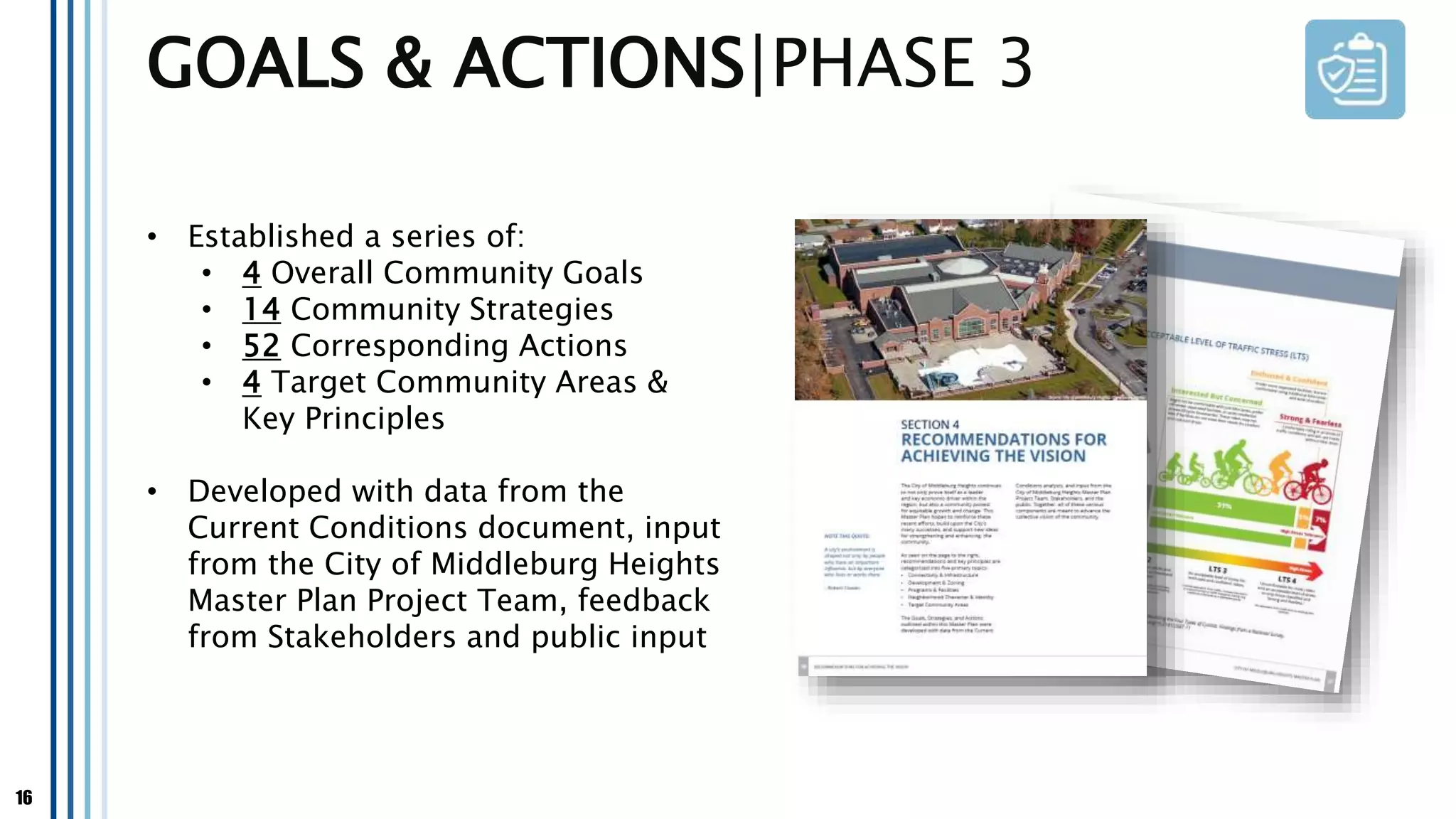
GOALS & ACTIONS|PHASE 3
• Established a series of:
• 4 Overall Community Goals
• 14 Community Strategies
• 52 Corresponding Actions
• 4 Target Community Areas &
Key Principles
• Developed with data from the
Current Conditions document, input
from the City of Middleburg Heights
Master Plan Project Team, feedback
from Stakeholders and public input
17
GOALS & ACTIONS|PHASE 3
FOUR OVERALL MASTER PLAN GOALS
1) Connectivity & Infrastructure
OUR GOAL IS TO...Enhance and expand alternative transportation options by
cognitive barriers in order to promote safe, pedestrian-oriented, and bicycle-
infrastructure improvements, and community gathering spaces.
2) Development & Zoning
OUR GOAL IS TO...Enliven commercial spaces by creating walkable destinations
entertainment options and a combination of uses, develop unique brand
small businesses in the community with new funding models.
3) Programs & Facilities
OUR GOAL IS TO...Improve existing programs and facilities by creating solutions
groups, partnering with key organizations to explore opportunities for new
expanding recreation options for residents.
4) Neighborhood Character & Identity
OUR GOAL IS TO...Maintain neighborhood character by preserving established
bolstering the City's presence at gateways, commercial corridors and key
guidelines to support a community for all ages.
18
GOAL 1|CONNECTIVITY & INFRASTRUCTURE
OUR STRATEGIES ARE...
Enhance streetscapes and public spaces
Improve stormwater management practices
Strengthen tree protections and maintenance
Safely connect pedestrians and bicyclists to
destinations
19
GOAL 2|DEVELOPMENT & ZONING
OUR STRATEGIES ARE...
Update zoning regulations to allow walkable
mixed-use development
Market the City’s assets to attract businesses and
retain a competitive workforce
Enliven existing commercial areas
20
GOAL 3|PROGRAMS & FACILITIES
OUR STRATEGIES ARE...
Expand recreation programs and offerings
Improve and/or expand existing recreation
amenities
Improve existing City facilities
21
GOAL 4|NEIGHBORHOOD CHARACTER & IDENTITY
OUR STRATEGIES ARE...
Create a sense of place by leveraging community
identity and improving gateways
Preserve the quality and character of existing
residential areas and neighborhoods
Support and promote a multi-generational
community
22
GOALS & ACTIONS|PHASE 3
• A deeper analysis was provided for 4
Community Target Areas within the
community, which included:
1) I-71 & Bagley Road
2) Central Park & Municipal
Campus
3) Bagley & Pearl Road Intersection
4) Greater Southland Area
23
I-71 & BAGLEY ROAD
24
CENTRAL PARK & MUNICIPAL CAMPUS
25
BAGLEY & PEARL ROAD INTERSECTION
26
GREATER SOUTHLAND AREA
27
IMPLEMENTATION|PHASE 4
• Includes tables that correspond to
each goal, strategy, and action from
previous phases
• Includes estimated cost ranges,
priority levels, and a list of potential
partners and responsible parties for
undertaking each action
• A list of available funding sources is
also provided
28
IMPLEMENTATION|PHASE 4
• Implementation Best Practices:
1) Use the implementation tables to pick the top actions that will be
undertaken each year and assign personnel responsible for those
actions
2) Establish a Plan Implementation Committee that meets every
quarter to review the actions that are underway
3) Publish an Annual Results Report detailing what has been
accomplished so far
29
SAMPLE IMPLEMENTATION TABLE
30
SAMPLE IMPLEMENTATION TABLE
The Responsible Parties /
Potential Partners describe types
of governmental,
non-profit, private, and civic
organizations that might assist in
completing an action
31
SAMPLE IMPLEMENTATION TABLE
The Responsible Parties /
Potential Partners describe types
of governmental,
non-profit, private, and civic
organizations that might assist in
completing an action
Links to a Symbol
Legend
32
SAMPLE IMPLEMENTATION TABLE
33
DRAFT MASTER PLAN|PHASE 5
34
AGENDA ITEM THREE:
WHAT’S NEXT?
Current Conditions
Community Vision
Goals & Actions
Implementation
Draft Master Plan
NEXT STEPS
35
Approval Process:
Official adoption by the City
Ongoing Maintenance & Implementation:
Create an Implementation Committee, assign tasks, ensure
accountability, and update as needed
Thank you Project Team members,
community stakeholders, and
members of the public!
36
37
Write us an email!
Rachel Novak, AICP
Senior Planner (project lead)
rnovak@cuyahogacounty.us
Micah Stryker, AICP
Senior Planner
mstryker@cuyahogacounty.us
James Sonnhalter
Planning Manager, Design & Implementation
jsonnhalter@cuyahogacounty.us
QUESTIONS?
Website to view Master Plan:
www.CountyPlanning.us/MiddleburgHeights
2 0 7 9 E a s t 9 t h S t r e e t , S u i t e 5 - 3 0 0 | C l e v e l a n d , O h i o 4 4 1 1 5 | ( T ) : 2 1 6 . 4 4 3 . 3 7 0 0 | ( F ) : 2 1 6 . 4 4 3 . 3 7 3 7
38

Middleburg Heights Community Master Plan presentation

  • 1.
    CITY COUNCIL |MAY 9, 2022 1
  • 2.
    Mary Cierebiej, AICP,Executive Director James Sonnhalter, Planning Manager, Design & Implementation Rachel Novak, AICP, Senior Planner, Project Lead Micah Stryker, AICP, Senior Planner OUR MISSION “To inform and provide services in support of the short and long term comprehensive planning, quality of life, environment, and economic development of Cuyahoga County and its cities, villages and townships.” 2
  • 3.
    AGENDA 1) PLANNING PROCESSREVIEW • COMMUNITY ENGAGEMENT SUMMARY 2) OVERVIEW OF MASTER PLAN PHASES 3) WHAT’S NEXT? • IMPLEMENTATION 3
  • 4.
    AGENDA ITEM ONE: PLANNINGPROCESS REVIEW 4
  • 5.
    WHAT’S THE DIFFERENCE? 5 •A general policy for future growth • Describes recommendations for what should happen in the future • Includes broad recommendations that can be undertaken by the City, residents, or partners • A flexible document that is intended to be interpreted as conditions change MASTER PLAN • Specific rules for development • Describes what is and what is not allowed today • Includes mandatory regulations on development that are enforced by the City unless specifically waived • Relatively rigid set of regulations that can only be changed by a legal process ZONING ORDINANCE OR
  • 6.
    HOW DO WEPLAN? 6 • Establish a current snapshot of the community • Outline a vision that will drive the Plan forward and shape policies • Formulate goals and actions that help the community achieve its vision • Prioritize goals to assist City officials in allocating resources for future endeavors
  • 7.
    WHY DO WEPLAN? 7 • Provides the opportunity for community input • Prepares the City, residents, and businesses for the future • Shapes future development to match your priorities • Gives a competitive advantage when applying for grants and funding
  • 8.
    HOW DO WEUSE THE PLAN? 8 The Plan is meant to outline the goals and aspirations of the community ADOPT the Plan to make it official policy USE the Plan as a tool and reference when considering actions and applying for grant funding UPDATE the Plan over time and when circumstances change
  • 9.
    OUR PROCESS|PHASES 9 Demographic, housing, business, land use,and transportation overview Vision for how the community wants to grow and develop in the coming decade Specific policies and actions to achieve the community’s desired future Partners, priorities, and responsibilities for undertaking actions Combined and completed Master Plan document Current Conditions Community Vision Goals & Actions Implementation Draft Master Plan CURRENTPHASE
  • 10.
    OUR PROCESS|MEETINGS 10 Current Conditions Community Vision Goals &Actions Implementation Draft Master Plan PT #1 PT #2 PT #3 PT #4 PT #5 PT #6 PT #7 Community Engagement #1 + Online Survey Community Engagement #2 + Online Survey Community Engagement #3 + Online Survey Presentation to Planning Commission + City Council CURRENTPHASE
  • 11.
    OVERALL ENGAGEMENT RESULTS 11 •7 Project Team Meetings Conducted • 19 Stakeholder Surveys Completed • 3 Community Engagement Periods & Online Surveys • 61 Survey Questions • 1,523 Surveys Taken • 5,135 Written Comments • 12,861 Answer Selections
  • 12.
    OVERALL ENGAGEMENT RESULTS 12 •7 Project Team Meetings Conducted • 19 Stakeholder Surveys Completed • 3 Community Engagement Periods & Online Surveys • 61 Survey Questions • 1,523 Surveys Taken • 5,135 Written Comments • 12,861 Answer Selections
  • 13.
    13 AGENDA ITEM TWO: OVERVIEWOF MASTER PLAN PHASES
  • 14.
    14 CURRENT CONDITIONS|PHASE 1 •Established a current “snapshot” of the community • Compared regional trends within Cuyahoga County and to peer communities: • City of Brecksville • City of Independence • City of Strongsville • City of Westlake • Created three profiles of the City: • Living Here • Working Here • Traveling Here
  • 15.
    15 COMMUNITY VISION|PHASE 2 •Established a unified direction for the Master Plan • Included broad themes to frame the development of actions • Included a vision for important areas in the community: • I-71 & Bagley Road • Central Park & Municipal Campus • Bagley & Pearl Road Intersection • Greater Southland Area
  • 16.
    16 GOALS & ACTIONS|PHASE3 • Established a series of: • 4 Overall Community Goals • 14 Community Strategies • 52 Corresponding Actions • 4 Target Community Areas & Key Principles • Developed with data from the Current Conditions document, input from the City of Middleburg Heights Master Plan Project Team, feedback from Stakeholders and public input
  • 17.
    17 GOALS & ACTIONS|PHASE3 FOUR OVERALL MASTER PLAN GOALS 1) Connectivity & Infrastructure OUR GOAL IS TO...Enhance and expand alternative transportation options by cognitive barriers in order to promote safe, pedestrian-oriented, and bicycle- infrastructure improvements, and community gathering spaces. 2) Development & Zoning OUR GOAL IS TO...Enliven commercial spaces by creating walkable destinations entertainment options and a combination of uses, develop unique brand small businesses in the community with new funding models. 3) Programs & Facilities OUR GOAL IS TO...Improve existing programs and facilities by creating solutions groups, partnering with key organizations to explore opportunities for new expanding recreation options for residents. 4) Neighborhood Character & Identity OUR GOAL IS TO...Maintain neighborhood character by preserving established bolstering the City's presence at gateways, commercial corridors and key guidelines to support a community for all ages.
  • 18.
    18 GOAL 1|CONNECTIVITY &INFRASTRUCTURE OUR STRATEGIES ARE... Enhance streetscapes and public spaces Improve stormwater management practices Strengthen tree protections and maintenance Safely connect pedestrians and bicyclists to destinations
  • 19.
    19 GOAL 2|DEVELOPMENT &ZONING OUR STRATEGIES ARE... Update zoning regulations to allow walkable mixed-use development Market the City’s assets to attract businesses and retain a competitive workforce Enliven existing commercial areas
  • 20.
    20 GOAL 3|PROGRAMS &FACILITIES OUR STRATEGIES ARE... Expand recreation programs and offerings Improve and/or expand existing recreation amenities Improve existing City facilities
  • 21.
    21 GOAL 4|NEIGHBORHOOD CHARACTER& IDENTITY OUR STRATEGIES ARE... Create a sense of place by leveraging community identity and improving gateways Preserve the quality and character of existing residential areas and neighborhoods Support and promote a multi-generational community
  • 22.
    22 GOALS & ACTIONS|PHASE3 • A deeper analysis was provided for 4 Community Target Areas within the community, which included: 1) I-71 & Bagley Road 2) Central Park & Municipal Campus 3) Bagley & Pearl Road Intersection 4) Greater Southland Area
  • 23.
  • 24.
    24 CENTRAL PARK &MUNICIPAL CAMPUS
  • 25.
    25 BAGLEY & PEARLROAD INTERSECTION
  • 26.
  • 27.
    27 IMPLEMENTATION|PHASE 4 • Includestables that correspond to each goal, strategy, and action from previous phases • Includes estimated cost ranges, priority levels, and a list of potential partners and responsible parties for undertaking each action • A list of available funding sources is also provided
  • 28.
    28 IMPLEMENTATION|PHASE 4 • ImplementationBest Practices: 1) Use the implementation tables to pick the top actions that will be undertaken each year and assign personnel responsible for those actions 2) Establish a Plan Implementation Committee that meets every quarter to review the actions that are underway 3) Publish an Annual Results Report detailing what has been accomplished so far
  • 29.
  • 30.
    30 SAMPLE IMPLEMENTATION TABLE TheResponsible Parties / Potential Partners describe types of governmental, non-profit, private, and civic organizations that might assist in completing an action
  • 31.
    31 SAMPLE IMPLEMENTATION TABLE TheResponsible Parties / Potential Partners describe types of governmental, non-profit, private, and civic organizations that might assist in completing an action Links to a Symbol Legend
  • 32.
  • 33.
  • 34.
  • 35.
    Current Conditions Community Vision Goals& Actions Implementation Draft Master Plan NEXT STEPS 35 Approval Process: Official adoption by the City Ongoing Maintenance & Implementation: Create an Implementation Committee, assign tasks, ensure accountability, and update as needed
  • 36.
    Thank you ProjectTeam members, community stakeholders, and members of the public! 36
  • 37.
    37 Write us anemail! Rachel Novak, AICP Senior Planner (project lead) rnovak@cuyahogacounty.us Micah Stryker, AICP Senior Planner mstryker@cuyahogacounty.us James Sonnhalter Planning Manager, Design & Implementation jsonnhalter@cuyahogacounty.us QUESTIONS? Website to view Master Plan: www.CountyPlanning.us/MiddleburgHeights
  • 38.
    2 0 79 E a s t 9 t h S t r e e t , S u i t e 5 - 3 0 0 | C l e v e l a n d , O h i o 4 4 1 1 5 | ( T ) : 2 1 6 . 4 4 3 . 3 7 0 0 | ( F ) : 2 1 6 . 4 4 3 . 3 7 3 7 38

Editor's Notes

  • #15 Demographic, housing, business, land use, and transportation overview
  • #16 Vision for how the community wants to grow and develop in the coming decade
  • #17 Specific policies and actions to achieve the community’s desired future
  • #18 Specific policies and actions to achieve the community’s desired future
  • #19 Specific policies and actions to achieve the community’s desired future
  • #20 Specific policies and actions to achieve the community’s desired future
  • #21 Specific policies and actions to achieve the community’s desired future
  • #22 Specific policies and actions to achieve the community’s desired future
  • #23 Specific policies and actions to achieve the community’s desired future
  • #24 Specific policies and actions to achieve the community’s desired future
  • #25 Specific policies and actions to achieve the community’s desired future
  • #26 Specific policies and actions to achieve the community’s desired future
  • #27 Specific policies and actions to achieve the community’s desired future
  • #28 Partners, priorities, and responsibilities for undertaking actions
  • #29 Partners, priorities, and responsibilities for undertaking actions
  • #30 Partners, priorities, and responsibilities for undertaking actions
  • #31 Partners, priorities, and responsibilities for undertaking actions
  • #32 Partners, priorities, and responsibilities for undertaking actions
  • #33 Partners, priorities, and responsibilities for undertaking actions
  • #34 Combined and completed Master Plan document