ONC and HITECH


David R. Hunt, MD, FACS
Medical Officer
Office of the National Coordinator for Health IT
Sir Cyril Chantler

 Medicine used to be simple,
 ineffective and relatively safe.

 Now it is complex, effective and
 potentially dangerous.
The role and education of doctors in the delivery of healthcare.
Hollister Lecture delivered at the Institute of Health Services Research,
Northwestern University, Illinois, USA. October 1998. Lancet 1999;353:1178–81.
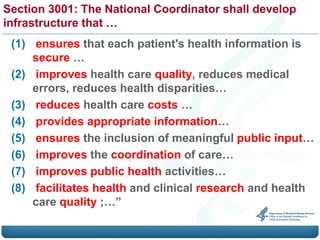
Section 3001: The National Coordinator shall develop
infrastructure that …
 (1) ensures that each patient's health information is
     secure …
 (2) improves health care quality, reduces medical
     errors, reduces health disparities…
 (3) reduces health care costs …
 (4) provides appropriate information…
 (5) ensures the inclusion of meaningful public input…
 (6) improves the coordination of care…
 (7) improves public health activities…
 (8) facilitates health and clinical research and health
     care quality ;…”
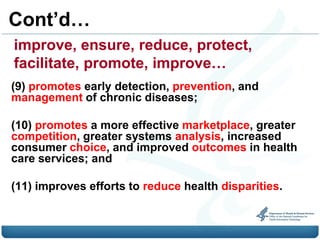
Cont’d…
improve, ensure, reduce, protect,
facilitate, promote, improve…
(9) promotes early detection, prevention, and
management of chronic diseases;

(10) promotes a more effective marketplace, greater
competition, greater systems analysis, increased
consumer choice, and improved outcomes in health
care services; and

(11) improves efforts to reduce health disparities.
Take Home Messages
• Meaningful change must be led by
  clinicians
• Meaningful success is wholly
  dependent on partnership
• Transition requires a system,
  resources, and courage
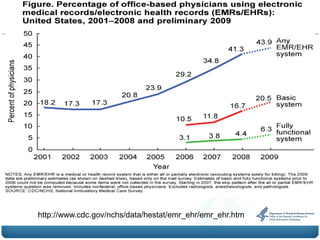
http://www.cdc.gov/nchs/data/hestat/emr_ehr/emr_ehr.htm
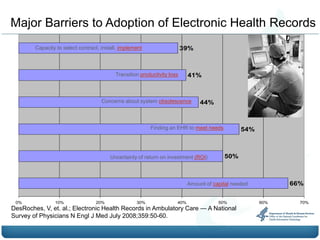
Major Barriers to Adoption of Electronic Health Records
        Capacity to select contract, install, implement                   39%


                                           Transition productivity loss     41%


                                     Concerns about system obsolescence          44%


                                                          Finding an EHR to meet needs           54%


                                         Uncertainty of return on investment (ROI)        50%


                                                                            Amount of capital needed         66%

 0%             10%               20%               30%               40%               50%            60%     70%
DesRoches, V, et. al.; Electronic Health Records in Ambulatory Care — A National
Survey of Physicians N Engl J Med July 2008;359:50-60.
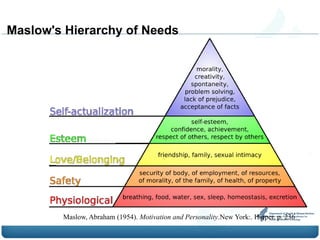
Maslow's Hierarchy of Needs


        Maslow, Abraham (1954). Motivation and Personality.New York:. Harper. p. 236
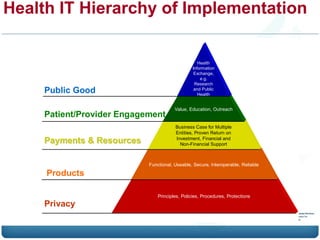
Health IT Hierarchy of Implementation


                                                   Health
                                                Information
                                                 Exchange,
                                                    e.g.
                                                 Research
     Public Good                                 and Public
                                                   Health


                                        Value, Education, Outreach
     Patient/Provider Engagement
                                        Business Case for Multiple
                                        Entities, Proven Return on
     Payments & Resources               Investment, Financial and
                                          Non-Financial Support


                            Functional, Useable, Secure, Interoperable, Reliable

     Products

                                Principles, Policies, Procedures, Protections
     Privacy
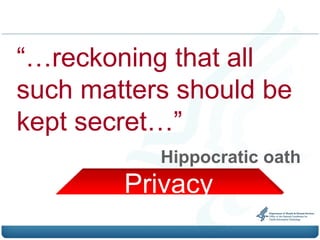
“…reckoning that all
such matters should be
kept secret…”
           Hippocratic oath
        Privacy
Margaret Thatcher
“No one would
remember the Good
Samaritan if he only had
good intentions. He had
money as well.”
P
r
o
g
r
a
m
:

H


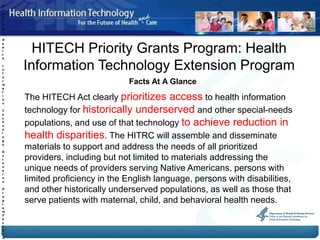
      HITECH Priority Grants Program: Health
e
a
l
t
h

I
n
f
    Information Technology Extension Program
o
r
m
                               Facts At A Glance
a


    The HITECH Act clearly prioritizes access to health information
t
i
o
n

T
e
    technology for historically underserved and other special-needs
    populations, and use of that technology to achieve reduction in
c
h
n
o
l
o
g
    health disparities. The HITRC will assemble and disseminate
y

E
    materials to support and address the needs of all prioritized
x
t
e
    providers, including but not limited to materials addressing the
n
s   unique needs of providers serving Native Americans, persons with
i
o
n   limited proficiency in the English language, persons with disabilities,
P
r
    and other historically underserved populations, as well as those that
    serve patients with maternal, child, and behavioral health needs.
o
g
r
a
m
F
a
c
t
s
-
A
Evidence Of An Emerging Digital Divide
 Among Hospitals That Care For The Poor
 Ashish K. Jha 1*, Catherine M. DesRoches 2, Alexandra E. Shields 3, Paola D. Miralles 4, Jie Zheng
 5, Sara Rosenbaum 6, Eric G. Campbell 7


Some hospitals that disproportionately care for poor
patients are falling behind in adopting electronic health
records (EHRs). Data from a national survey indicate early evidence of
an emerging digital divide: U.S. hospitals that provide care to large numbers
of poor patients also had minimal use of EHRs. These same hospitals
lagged others in quality performance as well, but those with EHR systems
seemed to have eliminated the quality gap. These findings suggest that
adopting EHRs should be a major policy goal of health reform measures
targeting hospitals that serve large populations of poor patients.

[Health Aff (Millwood). 2009;28(6):w1160-70 (published online 26 October
2009; 10.1377/hlthaff.28.6.w1160)]
      http://content.healthaffairs.org/cgi/content/abstract/hlthaff.28.6.w1160
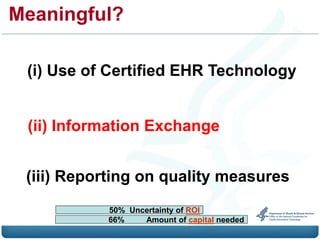
Meaningful?

 (i) Use of Certified EHR Technology


 (ii) Information Exchange


 (iii) Reporting on quality measures
           50% Uncertainty of ROI
           66%    Amount of capital needed
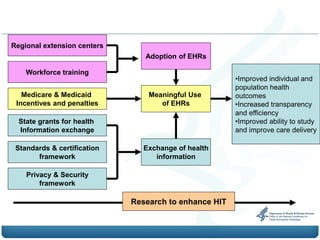
Regional extension centers
                                Adoption of EHRs

    Workforce training
                                                       •Improved individual and
                                                       population health
   Medicare & Medicaid           Meaningful Use        outcomes
 Incentives and penalties           of EHRs            •Increased transparency
                                                       and efficiency
  State grants for health                              •Improved ability to study
  Information exchange                                 and improve care delivery

 Standards & certification      Exchange of health
       framework                   information

    Privacy & Security
        framework

                             Research to enhance HIT
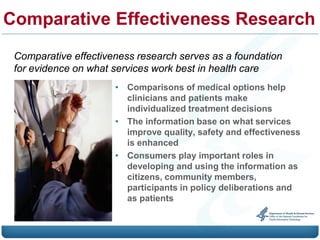
Comparative Effectiveness Research
 Comparative effectiveness research serves as a foundation
 for evidence on what services work best in health care
                      • Comparisons of medical options help
                        clinicians and patients make
                        individualized treatment decisions
                      • The information base on what services
                        improve quality, safety and effectiveness
                        is enhanced
                      • Consumers play important roles in
                        developing and using the information as
                        citizens, community members,
                        participants in policy deliberations and
                        as patients
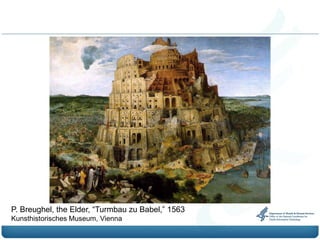
P. Breughel, the Elder, “Turmbau zu Babel,” 1563
Kunsthistorisches Museum, Vienna
Mark Twain 1835-1910

 “A man who carries a cat
 by the tail learns something
 he can learn in no other
 way.”

Hunt Onc Hitech

  • 1.
    ONC and HITECH DavidR. Hunt, MD, FACS Medical Officer Office of the National Coordinator for Health IT
  • 2.
    Sir Cyril Chantler Medicine used to be simple, ineffective and relatively safe. Now it is complex, effective and potentially dangerous. The role and education of doctors in the delivery of healthcare. Hollister Lecture delivered at the Institute of Health Services Research, Northwestern University, Illinois, USA. October 1998. Lancet 1999;353:1178–81.
  • 3.
    Section 3001: TheNational Coordinator shall develop infrastructure that … (1) ensures that each patient's health information is secure … (2) improves health care quality, reduces medical errors, reduces health disparities… (3) reduces health care costs … (4) provides appropriate information… (5) ensures the inclusion of meaningful public input… (6) improves the coordination of care… (7) improves public health activities… (8) facilitates health and clinical research and health care quality ;…”
  • 4.
    Cont’d… improve, ensure, reduce,protect, facilitate, promote, improve… (9) promotes early detection, prevention, and management of chronic diseases; (10) promotes a more effective marketplace, greater competition, greater systems analysis, increased consumer choice, and improved outcomes in health care services; and (11) improves efforts to reduce health disparities.
  • 5.
    Take Home Messages •Meaningful change must be led by clinicians • Meaningful success is wholly dependent on partnership • Transition requires a system, resources, and courage
  • 6.
  • 7.
    Major Barriers toAdoption of Electronic Health Records Capacity to select contract, install, implement 39% Transition productivity loss 41% Concerns about system obsolescence 44% Finding an EHR to meet needs 54% Uncertainty of return on investment (ROI) 50% Amount of capital needed 66% 0% 10% 20% 30% 40% 50% 60% 70% DesRoches, V, et. al.; Electronic Health Records in Ambulatory Care — A National Survey of Physicians N Engl J Med July 2008;359:50-60.
  • 8.
    Maslow's Hierarchy ofNeeds Maslow, Abraham (1954). Motivation and Personality.New York:. Harper. p. 236
  • 9.
    Health IT Hierarchyof Implementation Health Information Exchange, e.g. Research Public Good and Public Health Value, Education, Outreach Patient/Provider Engagement Business Case for Multiple Entities, Proven Return on Payments & Resources Investment, Financial and Non-Financial Support Functional, Useable, Secure, Interoperable, Reliable Products Principles, Policies, Procedures, Protections Privacy
  • 10.
    “…reckoning that all suchmatters should be kept secret…” Hippocratic oath Privacy
  • 11.
    Margaret Thatcher “No onewould remember the Good Samaritan if he only had good intentions. He had money as well.”
  • 12.
    P r o g r a m : H HITECH Priority Grants Program: Health e a l t h I n f Information Technology Extension Program o r m Facts At A Glance a The HITECH Act clearly prioritizes access to health information t i o n T e technology for historically underserved and other special-needs populations, and use of that technology to achieve reduction in c h n o l o g health disparities. The HITRC will assemble and disseminate y E materials to support and address the needs of all prioritized x t e providers, including but not limited to materials addressing the n s unique needs of providers serving Native Americans, persons with i o n limited proficiency in the English language, persons with disabilities, P r and other historically underserved populations, as well as those that serve patients with maternal, child, and behavioral health needs. o g r a m F a c t s - A
  • 13.
    Evidence Of AnEmerging Digital Divide Among Hospitals That Care For The Poor Ashish K. Jha 1*, Catherine M. DesRoches 2, Alexandra E. Shields 3, Paola D. Miralles 4, Jie Zheng 5, Sara Rosenbaum 6, Eric G. Campbell 7 Some hospitals that disproportionately care for poor patients are falling behind in adopting electronic health records (EHRs). Data from a national survey indicate early evidence of an emerging digital divide: U.S. hospitals that provide care to large numbers of poor patients also had minimal use of EHRs. These same hospitals lagged others in quality performance as well, but those with EHR systems seemed to have eliminated the quality gap. These findings suggest that adopting EHRs should be a major policy goal of health reform measures targeting hospitals that serve large populations of poor patients. [Health Aff (Millwood). 2009;28(6):w1160-70 (published online 26 October 2009; 10.1377/hlthaff.28.6.w1160)] http://content.healthaffairs.org/cgi/content/abstract/hlthaff.28.6.w1160
  • 14.
    Meaningful? (i) Useof Certified EHR Technology (ii) Information Exchange (iii) Reporting on quality measures 50% Uncertainty of ROI 66% Amount of capital needed
  • 15.
    Regional extension centers Adoption of EHRs Workforce training •Improved individual and population health Medicare & Medicaid Meaningful Use outcomes Incentives and penalties of EHRs •Increased transparency and efficiency State grants for health •Improved ability to study Information exchange and improve care delivery Standards & certification Exchange of health framework information Privacy & Security framework Research to enhance HIT
  • 16.
    Comparative Effectiveness Research Comparative effectiveness research serves as a foundation for evidence on what services work best in health care • Comparisons of medical options help clinicians and patients make individualized treatment decisions • The information base on what services improve quality, safety and effectiveness is enhanced • Consumers play important roles in developing and using the information as citizens, community members, participants in policy deliberations and as patients
  • 17.
    P. Breughel, theElder, “Turmbau zu Babel,” 1563 Kunsthistorisches Museum, Vienna
  • 18.
    Mark Twain 1835-1910 “A man who carries a cat by the tail learns something he can learn in no other way.”