HIT Policy Committee
Information Exchange Workgroup Meeting


August 26, 2010
Agenda

• Review of presentation to Policy Committee
• Workgroup priorities and activities for remainder of
  2010


                                                         2
HIT Policy Committee
Information Exchange Workgroup
Proposed Next Steps

Micky Tripathi, Chair
David Lansky, Co-Chair

August 19, 2010
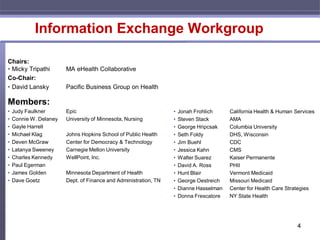
Information Exchange Workgroup

Chairs:
• Micky Tripathi        MA eHealth Collaborative
Co-Chair:
• David Lansky          Pacific Business Group on Health

Members:
•   Judy Faulkner       Epic                                      •   Jonah Frohlich     California Health & Human Services
•   Connie W. Delaney   University of Minnesota, Nursing          •   Steven Stack       AMA
•   Gayle Harrell                                                 •   George Hripcsak    Columbia University
•   Michael Klag        Johns Hopkins School of Public Health     •   Seth Foldy         DHS, Wisconsin
•   Deven McGraw        Center for Democracy & Technology         •   Jim Buehl          CDC
•   Latanya Sweeney     Carnegie Mellon University                •   Jessica Kahn       CMS
•   Charles Kennedy     WellPoint, Inc.                           •   Walter Suarez      Kaiser Permanente
•   Paul Egerman                                                  •   David A. Ross      PHII
•   James Golden        Minnesota Department of Health            •   Hunt Blair         Vermont Medicaid
•   Dave Goetz          Dept. of Finance and Administration, TN   •   George Oestreich   Missouri Medicaid
                                                                  •   Dianne Hasselman   Center for Health Care Strategies
                                                                  •   Donna Frescatore   NY State Health


                                                                                                                    4
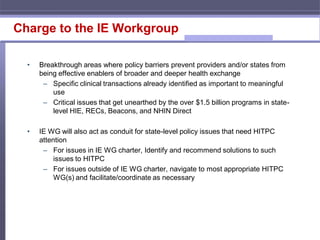
Charge to the IE Workgroup

  •   Breakthrough areas where policy barriers prevent providers and/or states from
      being effective enablers of broader and deeper health exchange
       – Specific clinical transactions already identified as important to meaningful
          use
       – Critical issues that get unearthed by the over $1.5 billion programs in state-
          level HIE, RECs, Beacons, and NHIN Direct

  •   IE WG will also act as conduit for state-level policy issues that need HITPC
      attention
       – For issues in IE WG charter, Identify and recommend solutions to such
           issues to HITPC
       – For issues outside of IE WG charter, navigate to most appropriate HITPC
           WG(s) and facilitate/coordinate as necessary
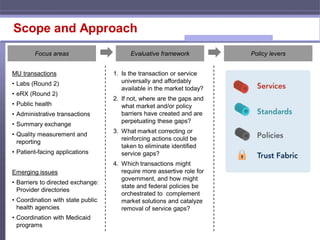
Scope and Approach
        Focus areas                      Evaluative framework           Policy levers


MU transactions                    1. Is the transaction or service
• Labs (Round 2)                      universally and affordably
                                      available in the market today?
• eRX (Round 2)
                                   2. If not, where are the gaps and
• Public health                       what market and/or policy
• Administrative transactions         barriers have created and are
                                      perpetuating these gaps?
• Summary exchange
                                   3. What market correcting or
• Quality measurement and
                                      reinforcing actions could be
  reporting
                                      taken to eliminate identified
• Patient-facing applications         service gaps?
                                   4. Which transactions might
Emerging issues                       require more assertive role for
                                      government, and how might
• Barriers to directed exchange:
                                      state and federal policies be
  Provider directories
                                      orchestrated to complement
• Coordination with state public      market solutions and catalyze
  health agencies                     removal of service gaps?
• Coordination with Medicaid
  programs
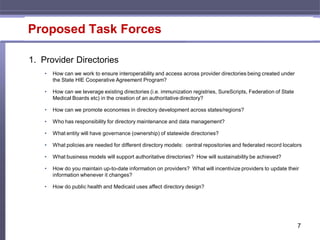
Proposed Task Forces

1. Provider Directories
    •   How can we work to ensure interoperability and access across provider directories being created under
        the State HIE Cooperative Agreement Program?

    •   How can we leverage existing directories (i.e. immunization registries, SureScripts, Federation of State
        Medical Boards etc) in the creation of an authoritative directory?

    •   How can we promote economies in directory development across states/regions?

    •   Who has responsibility for directory maintenance and data management?

    •   What entity will have governance (ownership) of statewide directories?

    •   What policies are needed for different directory models: central repositories and federated record locators

    •   What business models will support authoritative directories? How will sustainability be achieved?

    •   How do you maintain up-to-date information on providers? What will incentivize providers to update their
        information whenever it changes?

    •   How do public health and Medicaid uses affect directory design?


                                                                                                                   7
Proposed Task Forces

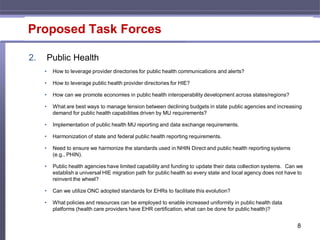
2.       Public Health
     •    How to leverage provider directories for public health communications and alerts?

     •    How to leverage public health provider directories for HIE?

     •    How can we promote economies in public health interoperability development across states/regions?

     •    What are best ways to manage tension between declining budgets in state public agencies and increasing
          demand for public health capabilities driven by MU requirements?

     •    Implementation of public health MU reporting and data exchange requirements.

     •    Harmonization of state and federal public health reporting requirements.

     •    Need to ensure we harmonize the standards used in NHIN Direct and public health reporting systems
          (e.g., PHIN).

     •    Public health agencies have limited capability and funding to update their data collection systems. Can we
          establish a universal HIE migration path for public health so every state and local agency does not have to
          reinvent the wheel?

     •    Can we utilize ONC adopted standards for EHRs to facilitate this evolution?

     •    What policies and resources can be employed to enable increased uniformity in public health data
          platforms (health care providers have EHR certification, what can be done for public health)?


                                                                                                                  8
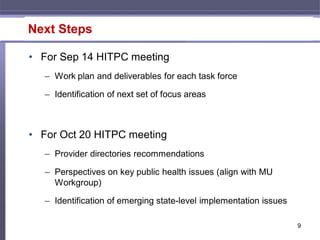
Next Steps

• For Sep 14 HITPC meeting
   – Work plan and deliverables for each task force

   – Identification of next set of focus areas


• For Oct 20 HITPC meeting
   – Provider directories recommendations

   – Perspectives on key public health issues (align with MU
     Workgroup)

   – Identification of emerging state-level implementation issues

                                                                    9
Agenda

• Review of presentation to Policy Committee
• Workgroup priorities and activities for remainder of
  2010


                                                         10
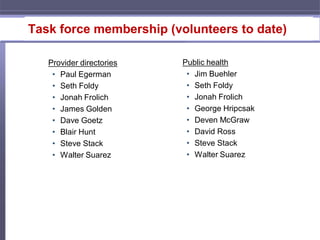
Task force membership (volunteers to date)

   Provider directories   Public health
    • Paul Egerman         • Jim Buehler
    • Seth Foldy           • Seth Foldy
    • Jonah Frolich        • Jonah Frolich
    • James Golden         • George Hripcsak
    • Dave Goetz           • Deven McGraw
    • Blair Hunt           • David Ross
    • Steve Stack          • Steve Stack
    • Walter Suarez        • Walter Suarez
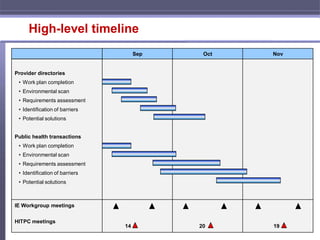
High-level timeline
                                     Sep    Oct   Nov


Provider directories
 • Work plan completion
 • Environmental scan
 • Requirements assessment
 • Identification of barriers
 • Potential solutions


Public health transactions
 • Work plan completion
 • Environmental scan
 • Requirements assessment
 • Identification of barriers
 • Potential solutions


IE Workgroup meetings


HITPC meetings
                                14         20     19
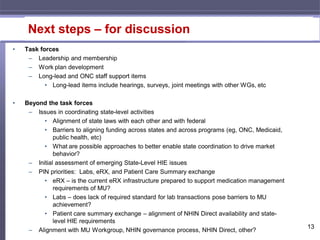
Next steps – for discussion
•   Task forces
     – Leadership and membership
     – Work plan development
     – Long-lead and ONC staff support items
           • Long-lead items include hearings, surveys, joint meetings with other WGs, etc

•   Beyond the task forces
     – Issues in coordinating state-level activities
          • Alignment of state laws with each other and with federal
          • Barriers to aligning funding across states and across programs (eg, ONC, Medicaid,
              public health, etc)
          • What are possible approaches to better enable state coordination to drive market
              behavior?
     – Initial assessment of emerging State-Level HIE issues
     – PIN priorities: Labs, eRX, and Patient Care Summary exchange
          • eRX – is the current eRX infrastructure prepared to support medication management
              requirements of MU?
          • Labs – does lack of required standard for lab transactions pose barriers to MU
              achievement?
          • Patient care summary exchange – alignment of NHIN Direct availability and state-
              level HIE requirements
                                                                                                 13
     – Alignment with MU Workgroup, NHIN governance process, NHIN Direct, other?
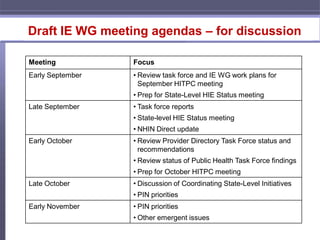
Draft IE WG meeting agendas – for discussion

Meeting           Focus
Early September   • Review task force and IE WG work plans for
                    September HITPC meeting
                  • Prep for State-Level HIE Status meeting
Late September    • Task force reports
                  • State-level HIE Status meeting
                  • NHIN Direct update
Early October     • Review Provider Directory Task Force status and
                    recommendations
                  • Review status of Public Health Task Force findings
                  • Prep for October HITPC meeting
Late October      • Discussion of Coordinating State-Level Initiatives
                  • PIN priorities
Early November    • PIN priorities
                  • Other emergent issues

8-26 HIE Workgroup Meeting

  • 1.
    HIT Policy Committee InformationExchange Workgroup Meeting August 26, 2010
  • 2.
    Agenda • Review ofpresentation to Policy Committee • Workgroup priorities and activities for remainder of 2010 2
  • 3.
    HIT Policy Committee InformationExchange Workgroup Proposed Next Steps Micky Tripathi, Chair David Lansky, Co-Chair August 19, 2010
  • 4.
    Information Exchange Workgroup Chairs: •Micky Tripathi MA eHealth Collaborative Co-Chair: • David Lansky Pacific Business Group on Health Members: • Judy Faulkner Epic • Jonah Frohlich California Health & Human Services • Connie W. Delaney University of Minnesota, Nursing • Steven Stack AMA • Gayle Harrell • George Hripcsak Columbia University • Michael Klag Johns Hopkins School of Public Health • Seth Foldy DHS, Wisconsin • Deven McGraw Center for Democracy & Technology • Jim Buehl CDC • Latanya Sweeney Carnegie Mellon University • Jessica Kahn CMS • Charles Kennedy WellPoint, Inc. • Walter Suarez Kaiser Permanente • Paul Egerman • David A. Ross PHII • James Golden Minnesota Department of Health • Hunt Blair Vermont Medicaid • Dave Goetz Dept. of Finance and Administration, TN • George Oestreich Missouri Medicaid • Dianne Hasselman Center for Health Care Strategies • Donna Frescatore NY State Health 4
  • 5.
    Charge to theIE Workgroup • Breakthrough areas where policy barriers prevent providers and/or states from being effective enablers of broader and deeper health exchange – Specific clinical transactions already identified as important to meaningful use – Critical issues that get unearthed by the over $1.5 billion programs in state- level HIE, RECs, Beacons, and NHIN Direct • IE WG will also act as conduit for state-level policy issues that need HITPC attention – For issues in IE WG charter, Identify and recommend solutions to such issues to HITPC – For issues outside of IE WG charter, navigate to most appropriate HITPC WG(s) and facilitate/coordinate as necessary
  • 6.
    Scope and Approach Focus areas Evaluative framework Policy levers MU transactions 1. Is the transaction or service • Labs (Round 2) universally and affordably available in the market today? • eRX (Round 2) 2. If not, where are the gaps and • Public health what market and/or policy • Administrative transactions barriers have created and are perpetuating these gaps? • Summary exchange 3. What market correcting or • Quality measurement and reinforcing actions could be reporting taken to eliminate identified • Patient-facing applications service gaps? 4. Which transactions might Emerging issues require more assertive role for government, and how might • Barriers to directed exchange: state and federal policies be Provider directories orchestrated to complement • Coordination with state public market solutions and catalyze health agencies removal of service gaps? • Coordination with Medicaid programs
  • 7.
    Proposed Task Forces 1.Provider Directories • How can we work to ensure interoperability and access across provider directories being created under the State HIE Cooperative Agreement Program? • How can we leverage existing directories (i.e. immunization registries, SureScripts, Federation of State Medical Boards etc) in the creation of an authoritative directory? • How can we promote economies in directory development across states/regions? • Who has responsibility for directory maintenance and data management? • What entity will have governance (ownership) of statewide directories? • What policies are needed for different directory models: central repositories and federated record locators • What business models will support authoritative directories? How will sustainability be achieved? • How do you maintain up-to-date information on providers? What will incentivize providers to update their information whenever it changes? • How do public health and Medicaid uses affect directory design? 7
  • 8.
    Proposed Task Forces 2. Public Health • How to leverage provider directories for public health communications and alerts? • How to leverage public health provider directories for HIE? • How can we promote economies in public health interoperability development across states/regions? • What are best ways to manage tension between declining budgets in state public agencies and increasing demand for public health capabilities driven by MU requirements? • Implementation of public health MU reporting and data exchange requirements. • Harmonization of state and federal public health reporting requirements. • Need to ensure we harmonize the standards used in NHIN Direct and public health reporting systems (e.g., PHIN). • Public health agencies have limited capability and funding to update their data collection systems. Can we establish a universal HIE migration path for public health so every state and local agency does not have to reinvent the wheel? • Can we utilize ONC adopted standards for EHRs to facilitate this evolution? • What policies and resources can be employed to enable increased uniformity in public health data platforms (health care providers have EHR certification, what can be done for public health)? 8
  • 9.
    Next Steps • ForSep 14 HITPC meeting – Work plan and deliverables for each task force – Identification of next set of focus areas • For Oct 20 HITPC meeting – Provider directories recommendations – Perspectives on key public health issues (align with MU Workgroup) – Identification of emerging state-level implementation issues 9
  • 10.
    Agenda • Review ofpresentation to Policy Committee • Workgroup priorities and activities for remainder of 2010 10
  • 11.
    Task force membership(volunteers to date) Provider directories Public health • Paul Egerman • Jim Buehler • Seth Foldy • Seth Foldy • Jonah Frolich • Jonah Frolich • James Golden • George Hripcsak • Dave Goetz • Deven McGraw • Blair Hunt • David Ross • Steve Stack • Steve Stack • Walter Suarez • Walter Suarez
  • 12.
    High-level timeline Sep Oct Nov Provider directories • Work plan completion • Environmental scan • Requirements assessment • Identification of barriers • Potential solutions Public health transactions • Work plan completion • Environmental scan • Requirements assessment • Identification of barriers • Potential solutions IE Workgroup meetings HITPC meetings 14 20 19
  • 13.
    Next steps –for discussion • Task forces – Leadership and membership – Work plan development – Long-lead and ONC staff support items • Long-lead items include hearings, surveys, joint meetings with other WGs, etc • Beyond the task forces – Issues in coordinating state-level activities • Alignment of state laws with each other and with federal • Barriers to aligning funding across states and across programs (eg, ONC, Medicaid, public health, etc) • What are possible approaches to better enable state coordination to drive market behavior? – Initial assessment of emerging State-Level HIE issues – PIN priorities: Labs, eRX, and Patient Care Summary exchange • eRX – is the current eRX infrastructure prepared to support medication management requirements of MU? • Labs – does lack of required standard for lab transactions pose barriers to MU achievement? • Patient care summary exchange – alignment of NHIN Direct availability and state- level HIE requirements 13 – Alignment with MU Workgroup, NHIN governance process, NHIN Direct, other?
  • 14.
    Draft IE WGmeeting agendas – for discussion Meeting Focus Early September • Review task force and IE WG work plans for September HITPC meeting • Prep for State-Level HIE Status meeting Late September • Task force reports • State-level HIE Status meeting • NHIN Direct update Early October • Review Provider Directory Task Force status and recommendations • Review status of Public Health Task Force findings • Prep for October HITPC meeting Late October • Discussion of Coordinating State-Level Initiatives • PIN priorities Early November • PIN priorities • Other emergent issues