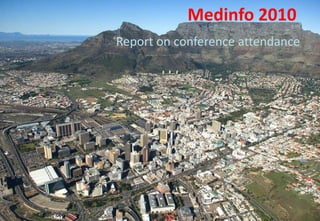
Medinfo 2010Report on conference attendance
IMIA – International Medical Informatics AssociationAssociated with HINZMedinfo2010 organised by the South African Health Informatics AssociationConference theme: Partnerships for effective eHealth solutions - Innovative collaborations promote solutions to health challenges
FormalitiesOpening ceremony with South African Youth Choir
Reception
Poster tours (mine on the Tuesday evening)NetworkingResearchers from Greece, who’re working on smart homes for the elderly
ElskeAmmenwerth from Germany on evaluation of e-health initiatives (GEP-HI and STAIR-HI guidelines)
http://iig.umit.at/efmi/Conference programme (what I attended)MondayAdoption determinantsImplementationCitizen-centric e-healthTelemedicineGuidelines for evaluation of HITuesdayEvaluation methodologySocial networking and virtual realityPanel on ‘Doctors, patients and computers: Evaluating a relationship in evolution’ by C Pearce (Oz GP), S DeLusignan, A Schackak, and A Kushniruk (wrote book chapter with him)Information needs and teleconsultationPresented our posterWednesdayPrimary and home careUser satisfaction
Collaboration in the real world as foundation for health robotics research for aged careKaren Daya, Priyesh Tiwaria, Jim Warrenaa National Institute for Health Innovation, University of Auckland, Auckland, New ZealandA robot can be more than a reminder – it can be used to help clinicians understand what people do when enacting a prescription. AimThe aim of this research was to describe the process, activities and context associated with medication management so that a medication reminder can be developed and deployed on a robot. Abstract In many countries longevity is the norm. Healthcare becomes more complex as people age [1], opening up an opportunity for assistive robotic technology. Developing a healthcare robot requires input from a broad range of disciplines and skills – medical, engineering, management, psychology, computer science and health informatics. Interviews, observation and photographs were used to gain insight into how medicines are managed by residents and care givers in an aged care facility. Multiple perspectives were used to produce a medicines management process and a description of its context. Several worldviews were ‘bridged’ in this research resulting in an alignment of the research project team’s efforts in preparing a robot that supports medication management. Keywords:  Robotics, ehealth, self-help devices, medication therapy management, chronic disease, geriatrics.Method Data were collected by interviewing and observing residents at Selwyn Village, and their relatives. Care givers, managers, and the facility’s doctor and pharmacist were also interviewed. The data were analyzed thematically [2], resulting in process diagrams for system design, and contextual descriptions to gain a shared understanding of the constraints, facilitating factors and perspectives of people managing medicine routines (self or with assistance from others). The easiest way to identify potential contributions of a robot reminder system is to describe and analyse existing processes. We examined how care givers remind residents living independently at Selwyn Village to take their medicines. Results People have different ideas and expectations of what happens and what should happen in medication management. This has implications for support tool design. The medicines process may appear obvious to clinicians – prescribe the medicines, person takes them, represcribe when medicines run out. However, without being able to observe residents all the time, we were unable to collect evidence to assist clinicians in reducing errors and increasing the likelihood of people taking medicines as prescribed.  In contrast to clinicians, residents and care givers emphasise their social context – medicines are part of starting the day. Care givers are concerned about the overall health of the people they care for, interrupting medicines rounds in response to calls for help. In contrast, engineers in the team focus on the technology while relying on input from clinical, psychological and social analyses. The technical, clinical, social, geographical and organizational aspects of this project were at times at odds with one another, despite the sound practice of requirements gathering prior to building the robot prototype. References[1] Sebern, M., Shared care, elder and family member skills used to manage burden. Journal of Advanced Nursing, 2005. 52(2): p. 170-179. [2] Miles, M.B. and A.M. Huberman, Qualitative Data Analysis: An Expanded Sourcebook. 1994, Thousand Oaks: Sage Publications.ConclusionThis research resulted in convergence to a shared understanding of the task at hand – building a robot to support medication management. Collaboration in the conceptualization, design and development of a healthcare robot became the foundation for a practical design that is focused on meeting a specific need, medicines reminding. Contact Karen Dayk.day@auckland.ac.nzwww.hive.org.nzAcknowledgmentsThis work was supported by the R&D program of the Korea Ministry of Knowledge and Economy (MKE) and the Korea Evaluation Institute of Industrial Technology (KEIT). [2008-F039-01, Development of Mediated Interface Technology for HRI]. We also acknowledge FRST funding from New Zealand and the Selwyn Foundation for the context of our research, and the complementary research of our colleagues, Bruce MacDonald, Elizabeth Broadbent (from the University of Auckland) and JoochanSohn (from ETRI).
What was related to robotics?....and aged care?Quite a bit about implementation and evaluation but nothing specific to robotics or aged careWorkshops and some papers on person/citizen-centric healthcare, e.g., patient education,  social mediaWorkshops and papers on technical aspects of HI, e.g., natural language processing, data mining, coding and classification, HL7, interoperability, grid computing, bioinformatics, analysis of data, ontology management, SNOMED CT, Workshops and papers on decision support systems (design, implementation and evaluation)Workshops and papers on telemedicine and other aspects of clinical care, e.g., quality, adverse drug events.
Emerging technologies (got closest to the Healthbots project)
Worth following up....WHO stand on health information management. Plenary by Dr Najeeb Al-Shorbaji of interest in general terms. http://www.who.int/topics/medical_informatics/en/Lots of international interest in telemedicine, collaborative research, and evaluation.
Thank youFull conference programme available at http://www.medinfo2010.org/docs/Full_conference_programme.pdf
MEDINFO 2010Cape Town – South Africa
My PresentationsopenEHR Clinical Modelling TutorialClinical modelling of endoscopyStandardisation in terminologyopenEHR standard for software developmentResults of our studyopenEHR Developers WorkshopDevelopment details; .Net/C#How to create dynamic GUIAssessment of software maintainability
Other Pertinent SessionsEHR systems in Singapore (S. Muttit et al.)Clinical Research Data Repository iof the US NIH (j. Cimino et at.)Interoperability Issues (Amado Espinosa) sessionsCoding and Terminologies (C. Chute) sessionSelected sessions from Data integration and standards (O. Bodenreider) and Data Repositories and Research Infrastructure sessionsNational and international Health IT (B. Leao)STARE Evaluation (J. Talmon et al.)
Thanks for your support!
MEDINFODenise Irvine
Social MediaSocial Networks:  FacebookProfessional networks: LinkedInThematic networks: twitter, blogs and wikis.
Mobile Phones SMS
TIGER Technology Informatics Guiding Educational Reform initiative.
Thank you for your support
Bryan’s MedInfo Report Card510

MedInfo 2010 Report

  • 1.
    Medinfo 2010Report onconference attendance
  • 2.
    IMIA – InternationalMedical Informatics AssociationAssociated with HINZMedinfo2010 organised by the South African Health Informatics AssociationConference theme: Partnerships for effective eHealth solutions - Innovative collaborations promote solutions to health challenges
  • 3.
    FormalitiesOpening ceremony withSouth African Youth Choir
  • 4.
  • 5.
    Poster tours (mineon the Tuesday evening)NetworkingResearchers from Greece, who’re working on smart homes for the elderly
  • 6.
    ElskeAmmenwerth from Germanyon evaluation of e-health initiatives (GEP-HI and STAIR-HI guidelines)
  • 7.
    http://iig.umit.at/efmi/Conference programme (whatI attended)MondayAdoption determinantsImplementationCitizen-centric e-healthTelemedicineGuidelines for evaluation of HITuesdayEvaluation methodologySocial networking and virtual realityPanel on ‘Doctors, patients and computers: Evaluating a relationship in evolution’ by C Pearce (Oz GP), S DeLusignan, A Schackak, and A Kushniruk (wrote book chapter with him)Information needs and teleconsultationPresented our posterWednesdayPrimary and home careUser satisfaction
  • 8.
    Collaboration in thereal world as foundation for health robotics research for aged careKaren Daya, Priyesh Tiwaria, Jim Warrenaa National Institute for Health Innovation, University of Auckland, Auckland, New ZealandA robot can be more than a reminder – it can be used to help clinicians understand what people do when enacting a prescription. AimThe aim of this research was to describe the process, activities and context associated with medication management so that a medication reminder can be developed and deployed on a robot. Abstract In many countries longevity is the norm. Healthcare becomes more complex as people age [1], opening up an opportunity for assistive robotic technology. Developing a healthcare robot requires input from a broad range of disciplines and skills – medical, engineering, management, psychology, computer science and health informatics. Interviews, observation and photographs were used to gain insight into how medicines are managed by residents and care givers in an aged care facility. Multiple perspectives were used to produce a medicines management process and a description of its context. Several worldviews were ‘bridged’ in this research resulting in an alignment of the research project team’s efforts in preparing a robot that supports medication management. Keywords: Robotics, ehealth, self-help devices, medication therapy management, chronic disease, geriatrics.Method Data were collected by interviewing and observing residents at Selwyn Village, and their relatives. Care givers, managers, and the facility’s doctor and pharmacist were also interviewed. The data were analyzed thematically [2], resulting in process diagrams for system design, and contextual descriptions to gain a shared understanding of the constraints, facilitating factors and perspectives of people managing medicine routines (self or with assistance from others). The easiest way to identify potential contributions of a robot reminder system is to describe and analyse existing processes. We examined how care givers remind residents living independently at Selwyn Village to take their medicines. Results People have different ideas and expectations of what happens and what should happen in medication management. This has implications for support tool design. The medicines process may appear obvious to clinicians – prescribe the medicines, person takes them, represcribe when medicines run out. However, without being able to observe residents all the time, we were unable to collect evidence to assist clinicians in reducing errors and increasing the likelihood of people taking medicines as prescribed. In contrast to clinicians, residents and care givers emphasise their social context – medicines are part of starting the day. Care givers are concerned about the overall health of the people they care for, interrupting medicines rounds in response to calls for help. In contrast, engineers in the team focus on the technology while relying on input from clinical, psychological and social analyses. The technical, clinical, social, geographical and organizational aspects of this project were at times at odds with one another, despite the sound practice of requirements gathering prior to building the robot prototype. References[1] Sebern, M., Shared care, elder and family member skills used to manage burden. Journal of Advanced Nursing, 2005. 52(2): p. 170-179. [2] Miles, M.B. and A.M. Huberman, Qualitative Data Analysis: An Expanded Sourcebook. 1994, Thousand Oaks: Sage Publications.ConclusionThis research resulted in convergence to a shared understanding of the task at hand – building a robot to support medication management. Collaboration in the conceptualization, design and development of a healthcare robot became the foundation for a practical design that is focused on meeting a specific need, medicines reminding. Contact Karen Dayk.day@auckland.ac.nzwww.hive.org.nzAcknowledgmentsThis work was supported by the R&D program of the Korea Ministry of Knowledge and Economy (MKE) and the Korea Evaluation Institute of Industrial Technology (KEIT). [2008-F039-01, Development of Mediated Interface Technology for HRI]. We also acknowledge FRST funding from New Zealand and the Selwyn Foundation for the context of our research, and the complementary research of our colleagues, Bruce MacDonald, Elizabeth Broadbent (from the University of Auckland) and JoochanSohn (from ETRI).
  • 9.
    What was relatedto robotics?....and aged care?Quite a bit about implementation and evaluation but nothing specific to robotics or aged careWorkshops and some papers on person/citizen-centric healthcare, e.g., patient education, social mediaWorkshops and papers on technical aspects of HI, e.g., natural language processing, data mining, coding and classification, HL7, interoperability, grid computing, bioinformatics, analysis of data, ontology management, SNOMED CT, Workshops and papers on decision support systems (design, implementation and evaluation)Workshops and papers on telemedicine and other aspects of clinical care, e.g., quality, adverse drug events.
  • 10.
    Emerging technologies (gotclosest to the Healthbots project)
  • 11.
    Worth following up....WHOstand on health information management. Plenary by Dr Najeeb Al-Shorbaji of interest in general terms. http://www.who.int/topics/medical_informatics/en/Lots of international interest in telemedicine, collaborative research, and evaluation.
  • 12.
    Thank youFull conferenceprogramme available at http://www.medinfo2010.org/docs/Full_conference_programme.pdf
  • 13.
    MEDINFO 2010Cape Town– South Africa
  • 14.
    My PresentationsopenEHR ClinicalModelling TutorialClinical modelling of endoscopyStandardisation in terminologyopenEHR standard for software developmentResults of our studyopenEHR Developers WorkshopDevelopment details; .Net/C#How to create dynamic GUIAssessment of software maintainability
  • 16.
    Other Pertinent SessionsEHRsystems in Singapore (S. Muttit et al.)Clinical Research Data Repository iof the US NIH (j. Cimino et at.)Interoperability Issues (Amado Espinosa) sessionsCoding and Terminologies (C. Chute) sessionSelected sessions from Data integration and standards (O. Bodenreider) and Data Repositories and Research Infrastructure sessionsNational and international Health IT (B. Leao)STARE Evaluation (J. Talmon et al.)
  • 18.
  • 19.
  • 20.
    Social MediaSocial Networks: FacebookProfessional networks: LinkedInThematic networks: twitter, blogs and wikis.
  • 21.
  • 22.
    TIGER Technology InformaticsGuiding Educational Reform initiative.
  • 23.
    Thank you foryour support
  • 24.