Nawanan Theera-Ampornpunt, MD, PhD

Healthcare CIO Program
Ramathibodi Hospital Administration School
Aug. 16, 2012   SlideShare.net/Nawanan

                                              Except where 
                                         citing other works
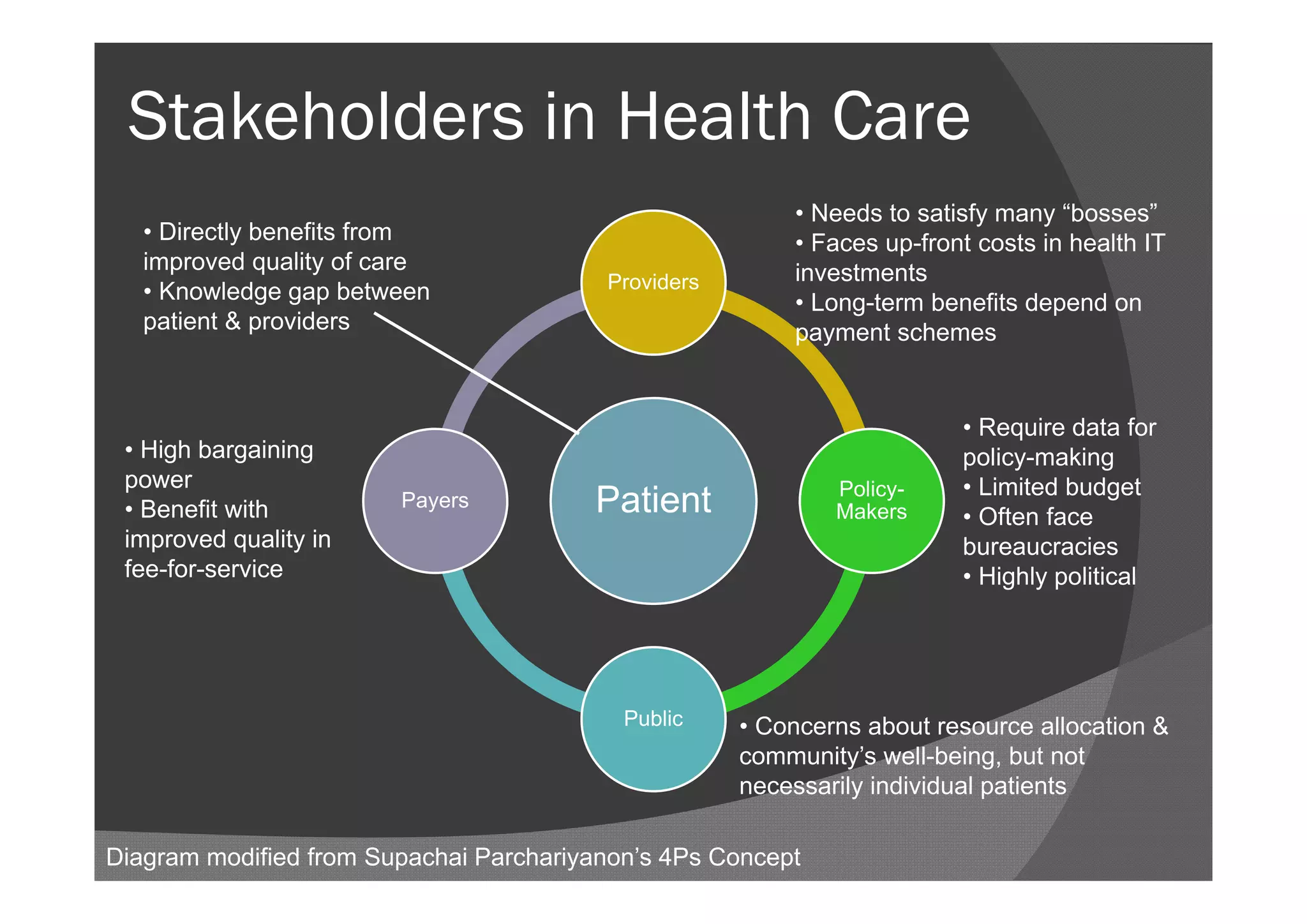
Stakeholders in Health Care
                                                         • Needs to satisfy many “bosses”
   • Directly benefits from                              • Faces up-front costs in health IT
   improved quality of care                              investments
   • Knowledge gap between               Providers
                                                         • Long-term benefits depend on
   patient & providers                                   payment schemes


                                                                        • Require data for
 • High bargaining                                                      policy-making
 power                                                       Policy-    • Limited budget
 • Benefit with         Payers          Patient              Makers     • Often face
 improved quality in                                                    bureaucracies
 fee-for-service                                                        • Highly political


                                           Public    • Concerns about resource allocation &
                                                     community’s well-being, but not
                                                     necessarily individual patients

Diagram modified from Supachai Parchariyanon’s 4Ps Concept
The Intersection
      Providers &
        Patients
                       Clinical
                     Informatics

Patients &
Consumers
             Consumer           Public     Policy-Makers,
                Health          Health     Payers, Public
             Informatics     Informatics   (Also providers)
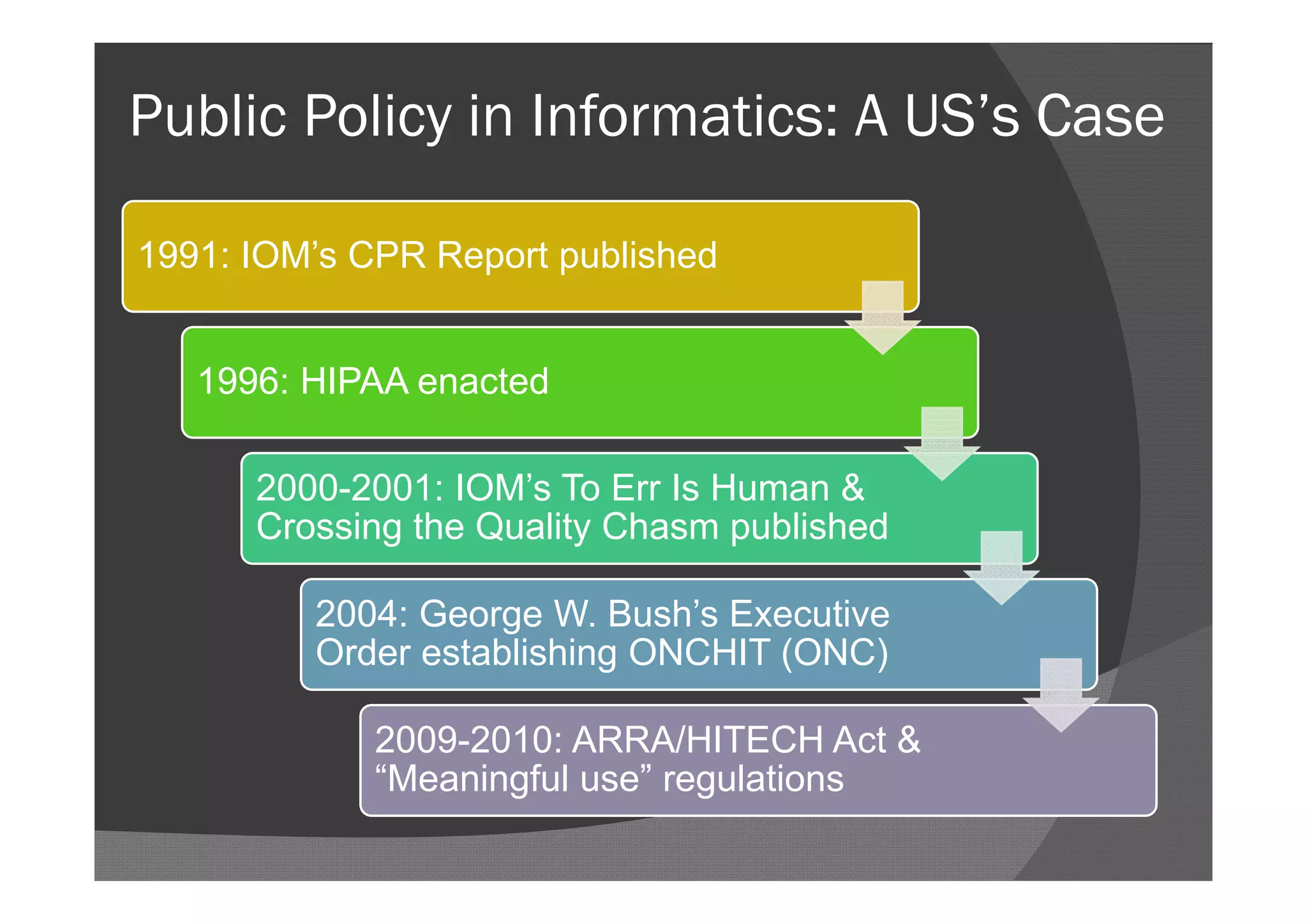
Public Policy in Informatics: A US’s Case

1991: IOM’s CPR Report published


   1996: HIPAA enacted

      2000-2001: IOM’s To Err Is Human &
      Crossing the Quality Chasm published

         2004: George W. Bush’s Executive
         Order establishing ONCHIT (ONC)

             2009-2010: ARRA/HITECH Act &
             “Meaningful use” regulations
Political Support Behind Health IT


                                                ?

       “...We will make wider use of electronic records and other
         health information technology, to help control costs and
                    reduce dangerous medical errors.”
                                                             President George W. Bush
                                                       Sixth State of the Union Address
                                                                       January 31, 2006
Source: Wikisource.org   Image Source: Wikipedia.org
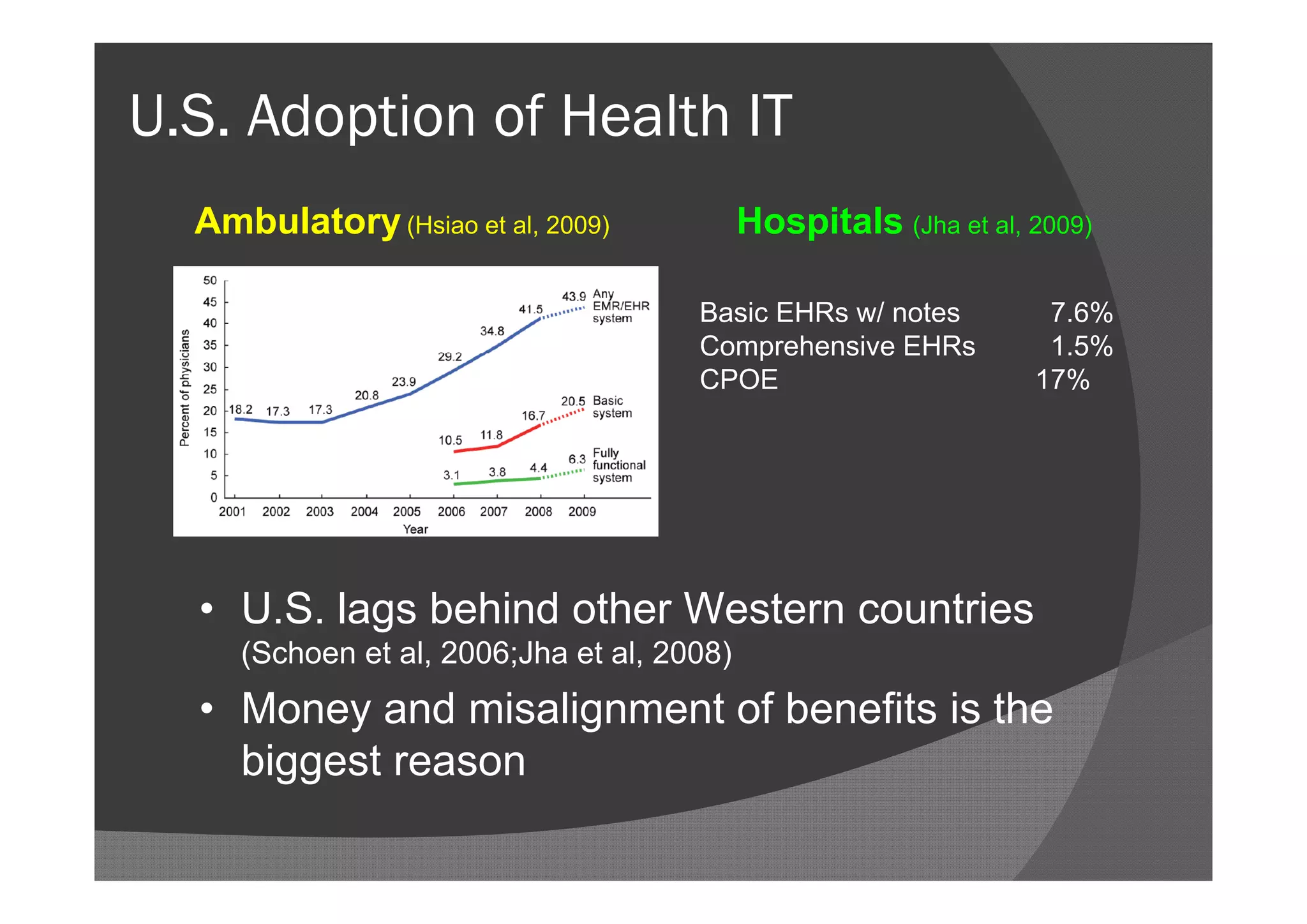
U.S. Adoption of Health IT
  Ambulatory (Hsiao et al, 2009)            Hospitals (Jha et al, 2009)

                                      Basic EHRs w/ notes          7.6%
                                      Comprehensive EHRs           1.5%
                                      CPOE                        17%


  • U.S. lags behind other Western countries
     (Schoen et al, 2006;Jha et al, 2008)
  • Money and misalignment of benefits is the
    biggest reason
President Obama Backs Health IT


                    “...Our recovery plan will invest in
             electronic health records and new technology
                that will reduce errors, bring down costs,
                     ensure privacy, and save lives.”
                                              President Barack Obama
                                  Address to Joint Session of Congress
                                                     February 24, 2009
Source: WhiteHouse.gov
American Recovery & Reinvestment Act

    Contains HITECH Act
     (Health Information Technology for
     Economic and Clinical Health Act)

    ~ 20 billion dollars for Health IT investments

    Incentives & penalties for providers
National Leadership

    Office of the National Coordinator for Health Information
     Technology (ONC -- formerly ONCHIT)


                      David Blumenthal, MD, MPP
                      National Coordinator for
                      Health Information Technology
                      (2009 - Present)


                    Photo courtesy of U.S. Department of Health & Human Services
What is in HITECH Act?


        Blumenthal D. Launching HITECH. N Engl J Med. 2010 Feb 4;362(5):382-5.
“Meaningful Use”


                                       “Meaningful Use”
Pumpkin
                                         of a Pumpkin


           Image Source & Idea Courtesy of Pat Wise at HIMSS, Oct. 2009
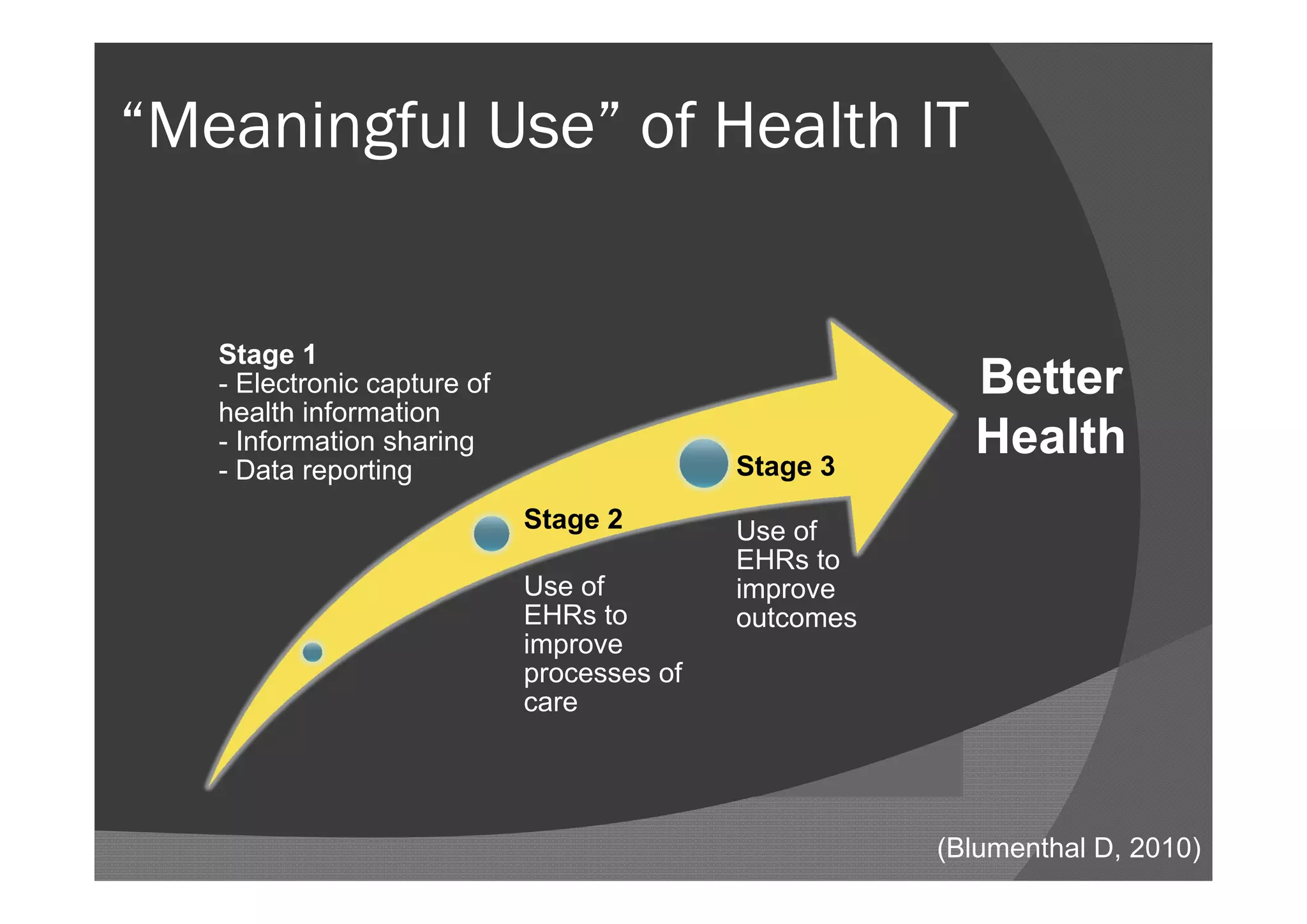
“Meaningful Use” of Health IT


   Stage 1
   - Electronic capture of                               Better
   health information
   - Information sharing
                                            Stage 3
                                                         Health
   - Data reporting
                             Stage 2        Use of
                                            EHRs to
                             Use of         improve
                             EHRs to        outcomes
                             improve
                             processes of
                             care


                                                       (Blumenthal D, 2010)
Health Information Exchange (HIE)


                    Government


    Hospital A                     Hospital B


                                    Clinic C
      Lab        Patient at Home
Health Information Exchange in the U.S.

  Regional Health Information Organizations
   (RHIOs)
  State e-Health initiatives
  Nationwide Health Information Network
   (NHIN)
  Still ongoing efforts, but with significant
   progress
Other Public Health Informatics Applications

    e-Health & m-Health
      m-Health in disaster management: #ThaiFlood
    Data reporting to government agencies
        Claims & reimbursements
        Diseases
        Utilization statistics
        Quality measures
        etc.
    Biosurveillance (case reporting vs. predictive)
    Epidemiologic & health services research
Google Flu Trends


Source: Google.org/FluTrends
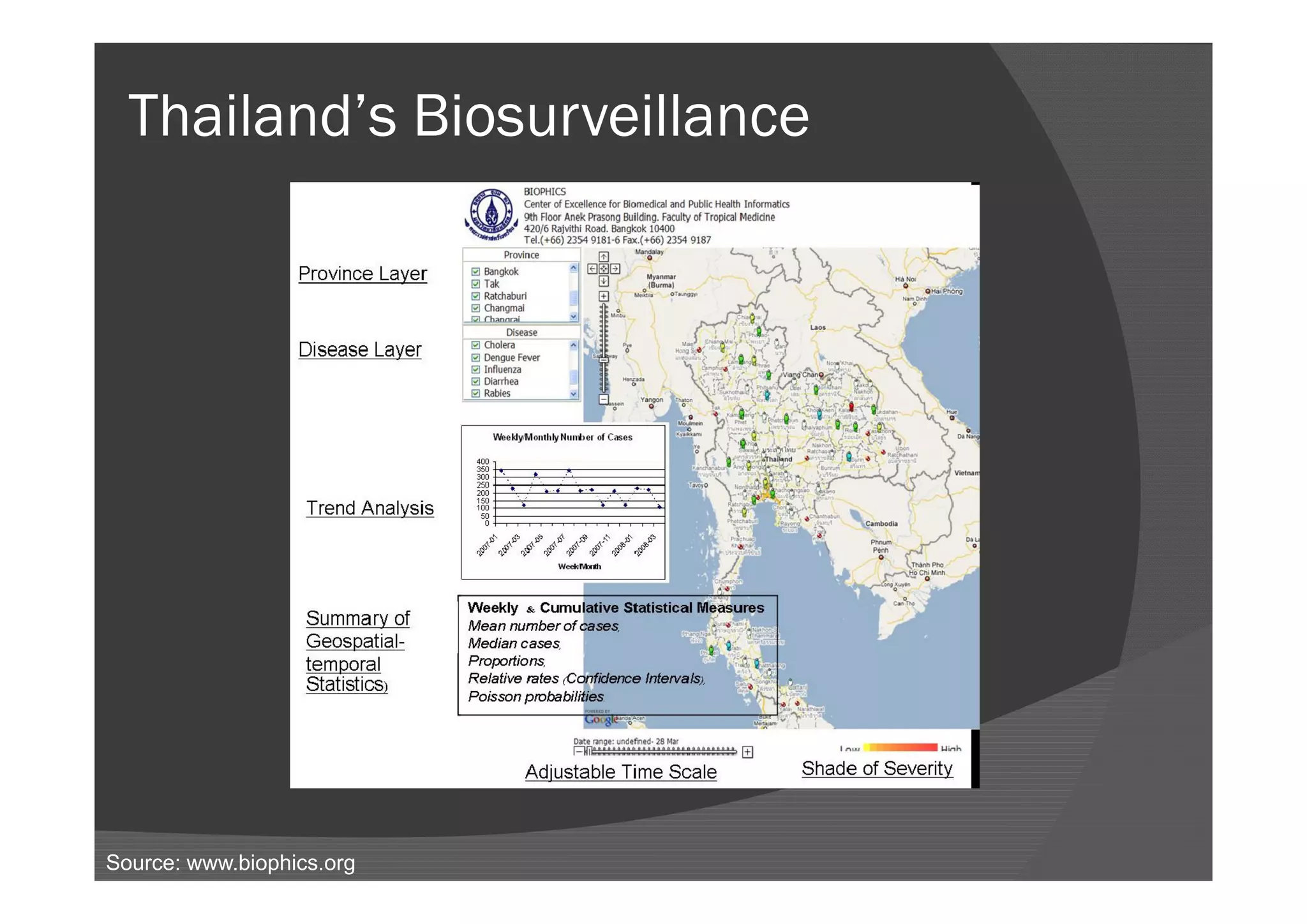
Thailand’s Biosurveillance


Source: www.biophics.org
Consumer Health Informatics (CHI)


    “The field devoted to informatics from a
     consumer view.” (Hersh, 2009)
M/B/H Informatics As A Field


                               (Hersh, 2009)
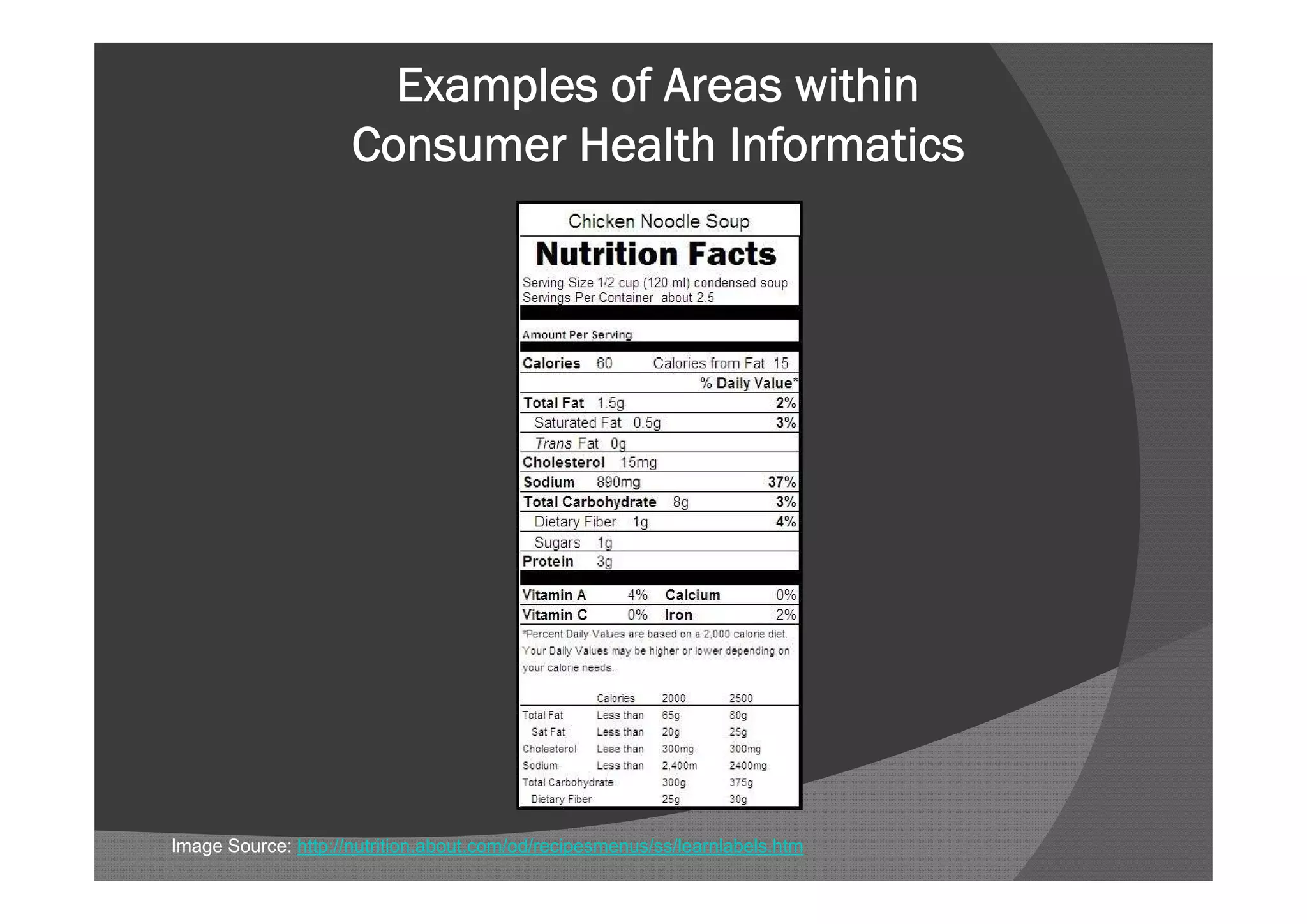
Examples of Areas within
                   Consumer Health Informatics


Image Source: http://www.webmd.com/
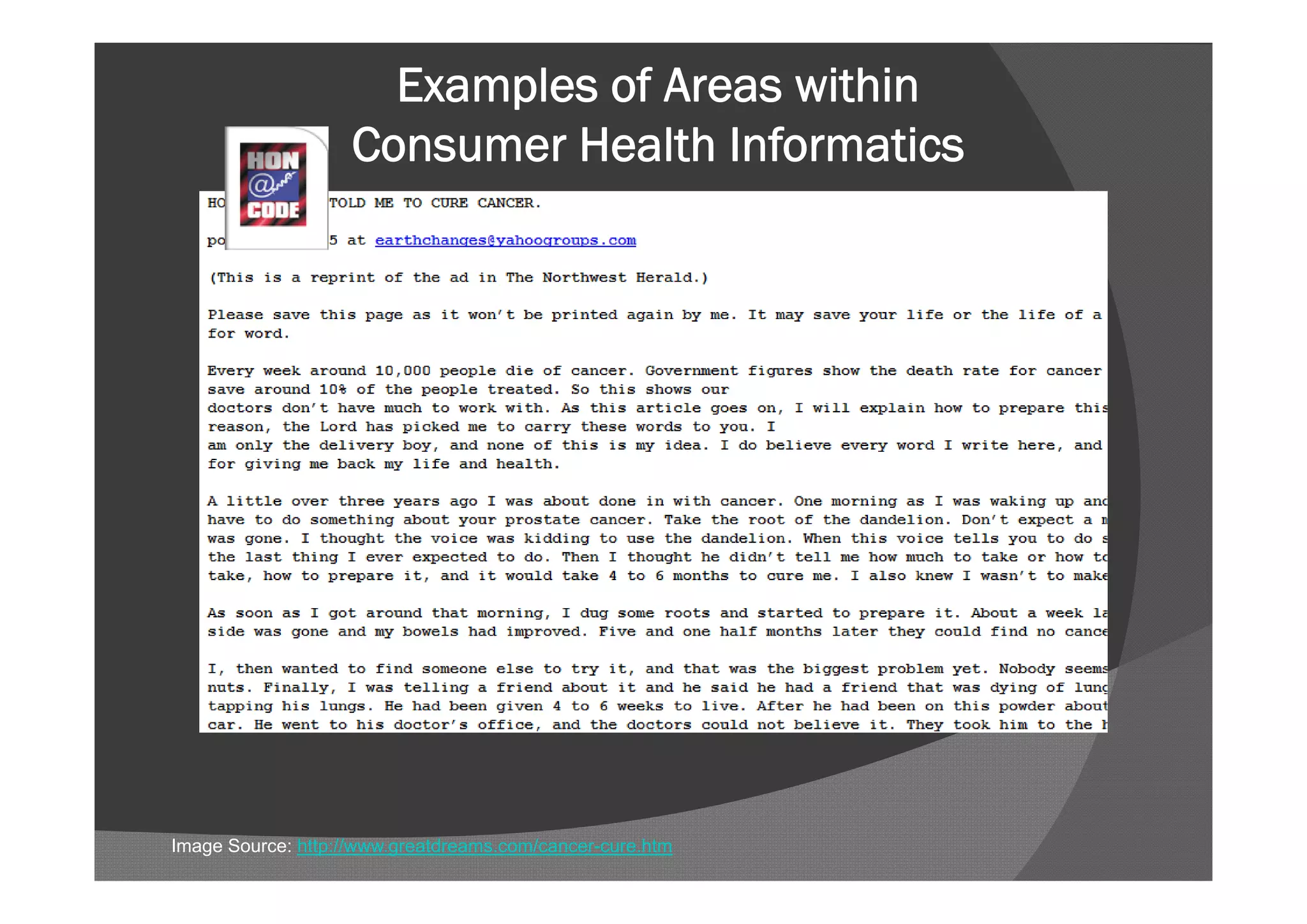
Examples of Areas within
                    Consumer Health Informatics


Image Source: http://www.greatdreams.com/cancer-cure.htm
Examples of Areas within
                     Consumer Health Informatics


Image Source: http://www.hon.ch/, http://socialmarketing.blogs.com/r_craiig_lefebvres_social/2007/02/health_literacy.html
Examples of Areas within
                    Consumer Health Informatics


Image Source: http://michaelcarusi.com/2012/01/01/when-you-should-not-become-a-social-media-manager/
Examples of Areas within
                    Consumer Health Informatics


Image Source: http://ucedtech.wikispaces.com/Welcome
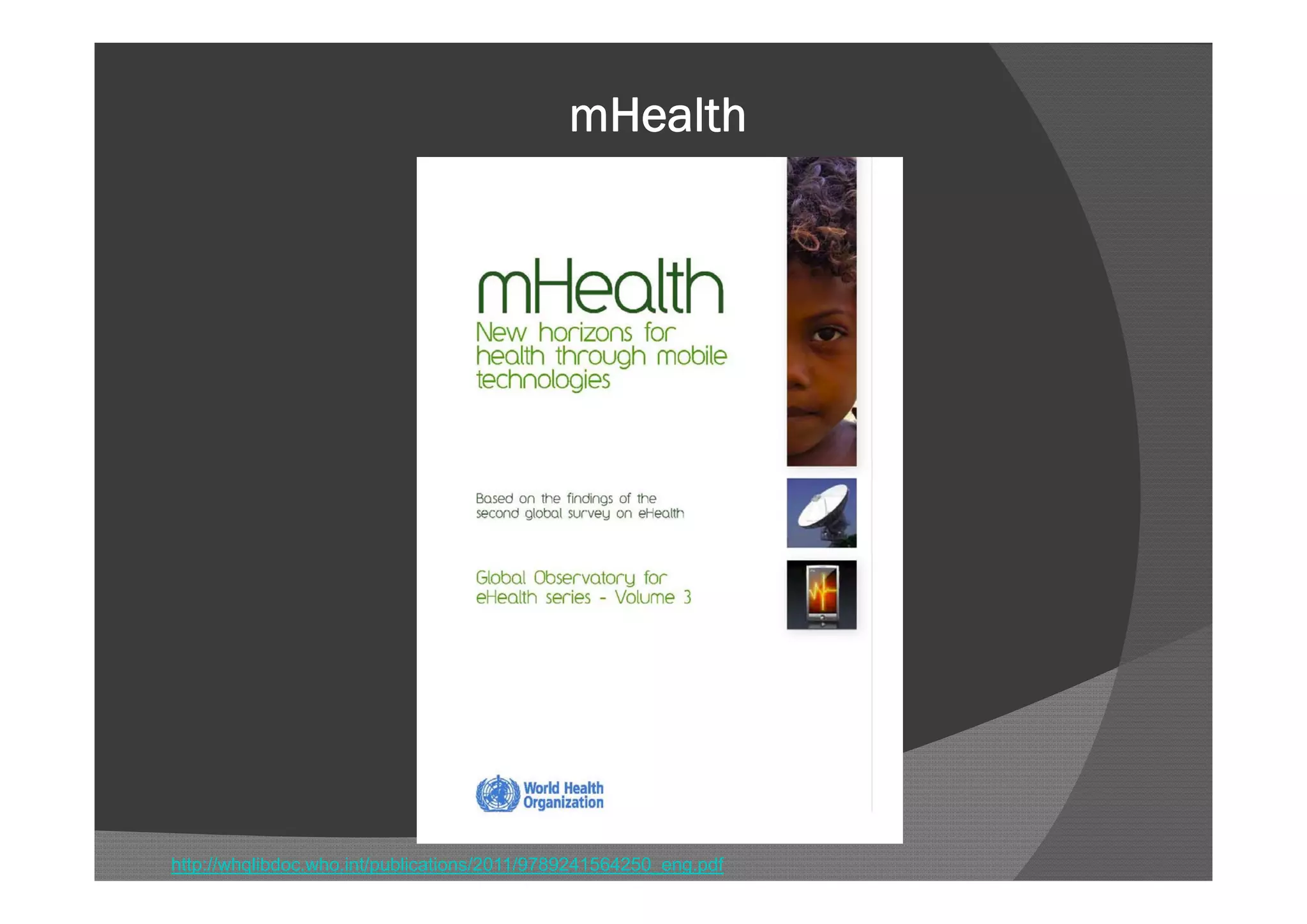
mHealth


http://whqlibdoc.who.int/publications/2011/9789241564250_eng.pdf
Examples of Areas within
                     Consumer Health Informatics


Image Source: http://nutrition.about.com/od/recipesmenus/ss/learnlabels.htm
Class Exercise
Roles of ICT in Consumer Health Informatics

    Access to information
    Networking opportunities
    Education/Self-study
    Personalization
    Effective & efficient communications
    Empowerment
    “User Experience”
Issues in Consumer Health Informatics

    Health literacy & IT literacy
    Cultural diversity & sensitivity
    Usability, information presentation
    Impact of ICT on behavioral modifications

    Integration with provider’s systems
    Information exchange & interoperability
    Business model
    Privacy & security
Personal Health Records (PHRs)

    “An electronic application through which individuals can
     access, manage and share their health information, and that
     of others for whom they are authorized, in a private, secure,
     and confidential environment.” (Markle Foundation, 2003)


    “A PHR includes health information managed by the
     individual... This can be contrasted with the clinician’s record
     of patient encounter–related information [a paperchart or
     EHR], which is managed by the clinician and/or health care
     institution.” (Tang et al., 2006)
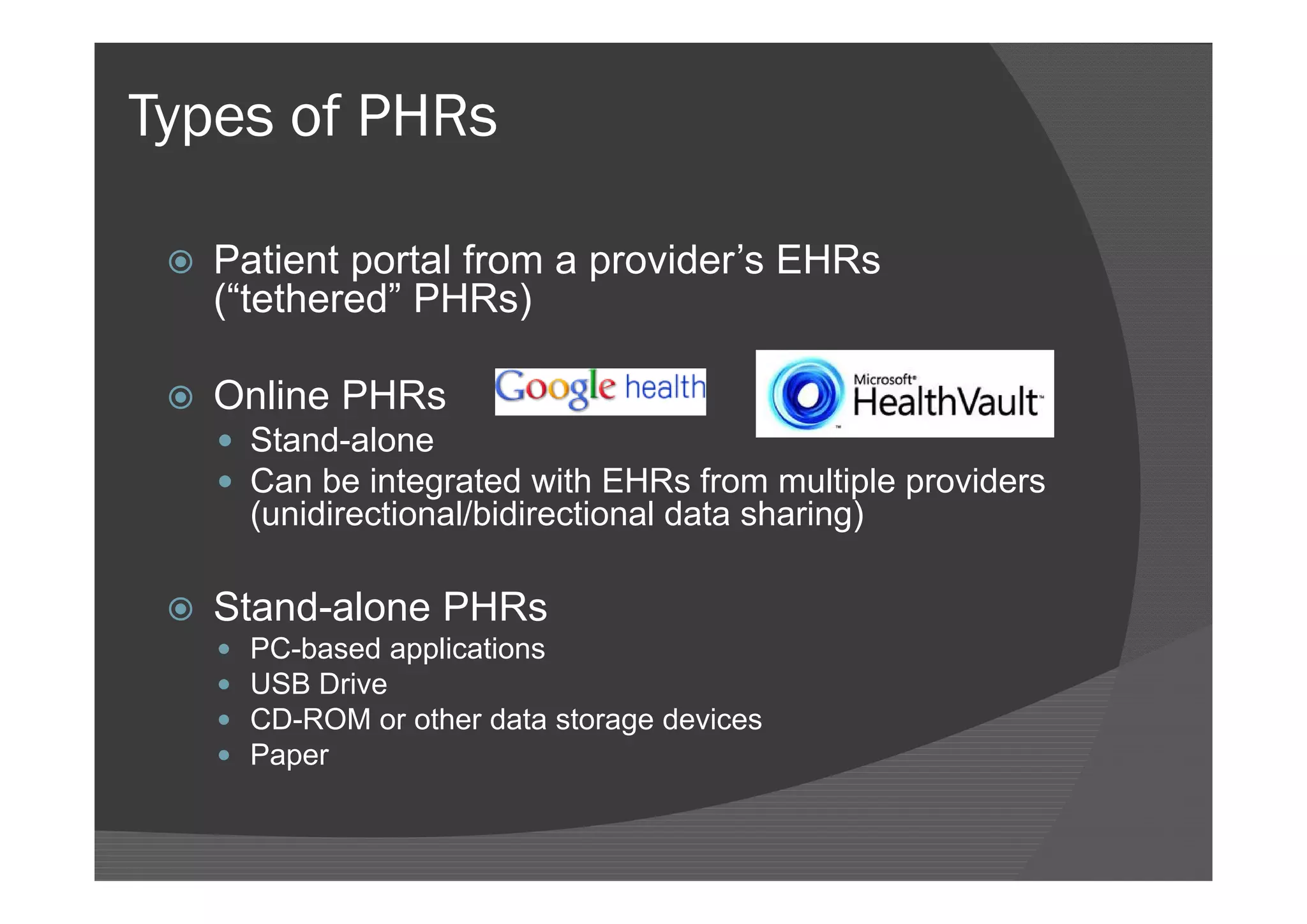
Types of PHRs

    Patient portal from a provider’s EHRs
     (“tethered” PHRs)

    Online PHRs
      Stand-alone
      Can be integrated with EHRs from multiple providers
         (unidirectional/bidirectional data sharing)

    Stand-alone PHRs
        PC-based applications
        USB Drive
        CD-ROM or other data storage devices
        Paper
PHRs and Other Systems


                     (Tang et al., 2006)
Ideal PHRs
    Integrated
    Accessible
    Secure
    Comprehensive
    Accurate & current
    Patient able to
     manage sharing &
     update information
    Engaging &
     educational
    User-friendly,
     culturally & literacy
     appropriate
                             The “Hub and Spoke” Model
                                 (Kaelber et al., 2008)
Use Cases of PHRs

    Data entry/update by patients
    Data retrieval by providers
      With patient’s consent
      “Break-the-glass” emergency access

    Data update from EHRs
    Privacy settings
    Personalized patient education
    Communications with providers
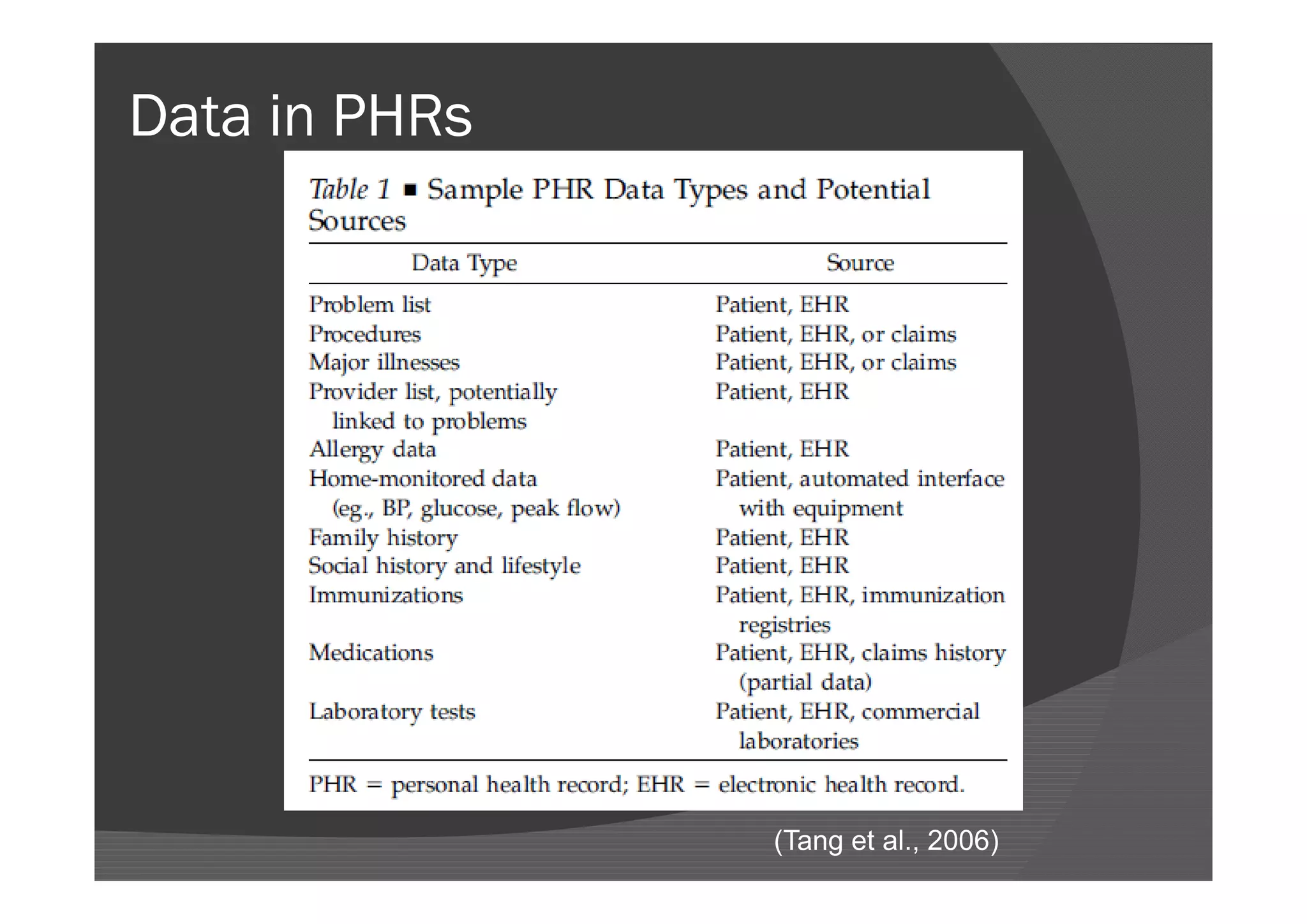
Data in PHRs


               (Tang et al., 2006)

                (Tang et al., 2006)
Other IT for Consumer Health

 Traditional Web
  MedlinePlus
  Other sites
 Social Media
  The Usuals: MySpace, Facebook, Twitter
  Blogs, forums
  PatientsLikeMe
 Telemedicine & Telehealth
  Home monitoring/recording devices
  Tele-consultations, virtual visits
    http://media.nstda.or.th/video/viewVideo.php?video_id=1273
The Future

 Microsoft Health: Future Vision
 http://www.microsoft.com/showcase/en/us/details/b112da1c-c918-
 41ee-bb45-d6a553496168


 NECTEC’s Smart Health
 http://media.nstda.or.th/video/viewVideo.php?video_id=1273
References
   Blumenthal D. Launching HITECH. N Engl J Med. 2010 Feb 4;362(5):382-5.
   Blumenthal D, Tavenner M. The “meaningful use” regulation for electronic health
    records. N Engl J Med. 2010 Aug 5;363(6):501-4.
   Connecting for Health. The personal health working group final report. Markle
    Foundation; 2003 Jul 1.
   Hsiao C, Beatty PC, Hing ES, Woodwell DA. Electronic medical record/electronic health
    record use by office-based physicians: United States, 2008 and preliminary 2009
    [Internet]. 2009 [cited 2010 Apr 12]; Available from:
    http://www.cdc.gov/nchs/data/hestat/emr_ehr/emr_ehr.pdf
   Jha AK, DesRoches CM, Campbell EG, Donelan K, Rao SR, Ferris TG, Shields A,
    Rosenbaum S, Blumenthal D. Use of electronic health records in U.S. hospitals. N Engl
    J Med. 2009;360(16):1628-38.
   Kaelber DC, Jha AK, Johnston D, Middleton B, Bates DW. A research agenda for
    personal health records (PHRs). J Am Med Inform Assoc. 2008 Nov-Dec;15(6):729-36.
   Schoen C, Osborn R, Huynh PT, Doty M, Puegh J, Zapert K. On the front lines of care:
    primary care doctors’ office systems, experiences, and views in seven countries. Health
    Aff (Millwood). 2006;25(6):w555-71.
   Tang PC, Ash JS, Bates DW, Overhage JM, Sands DZ. Personal health records:
    definitions, benefits, and strategies for overcoming barriers to adoption. J Am Med
    Inform Assoc. 2006 Mar-Apr;13(2):121-6.

Health IT Beyond Hospitals

  • 1.
    Nawanan Theera-Ampornpunt, MD,PhD Healthcare CIO Program Ramathibodi Hospital Administration School Aug. 16, 2012 SlideShare.net/Nawanan Except where  citing other works
  • 2.
    Stakeholders in HealthCare • Needs to satisfy many “bosses” • Directly benefits from • Faces up-front costs in health IT improved quality of care investments • Knowledge gap between Providers • Long-term benefits depend on patient & providers payment schemes • Require data for • High bargaining policy-making power Policy- • Limited budget • Benefit with Payers Patient Makers • Often face improved quality in bureaucracies fee-for-service • Highly political Public • Concerns about resource allocation & community’s well-being, but not necessarily individual patients Diagram modified from Supachai Parchariyanon’s 4Ps Concept
  • 3.
    The Intersection Providers & Patients Clinical Informatics Patients & Consumers Consumer Public Policy-Makers, Health Health Payers, Public Informatics Informatics (Also providers)
  • 5.
    Public Policy inInformatics: A US’s Case 1991: IOM’s CPR Report published 1996: HIPAA enacted 2000-2001: IOM’s To Err Is Human & Crossing the Quality Chasm published 2004: George W. Bush’s Executive Order establishing ONCHIT (ONC) 2009-2010: ARRA/HITECH Act & “Meaningful use” regulations
  • 6.
    Political Support BehindHealth IT ? “...We will make wider use of electronic records and other health information technology, to help control costs and reduce dangerous medical errors.” President George W. Bush Sixth State of the Union Address January 31, 2006 Source: Wikisource.org Image Source: Wikipedia.org
  • 7.
    U.S. Adoption ofHealth IT Ambulatory (Hsiao et al, 2009) Hospitals (Jha et al, 2009) Basic EHRs w/ notes 7.6% Comprehensive EHRs 1.5% CPOE 17% • U.S. lags behind other Western countries (Schoen et al, 2006;Jha et al, 2008) • Money and misalignment of benefits is the biggest reason
  • 8.
    President Obama BacksHealth IT “...Our recovery plan will invest in electronic health records and new technology that will reduce errors, bring down costs, ensure privacy, and save lives.” President Barack Obama Address to Joint Session of Congress February 24, 2009 Source: WhiteHouse.gov
  • 9.
    American Recovery &Reinvestment Act  Contains HITECH Act (Health Information Technology for Economic and Clinical Health Act)  ~ 20 billion dollars for Health IT investments  Incentives & penalties for providers
  • 10.
    National Leadership  Office of the National Coordinator for Health Information Technology (ONC -- formerly ONCHIT) David Blumenthal, MD, MPP National Coordinator for Health Information Technology (2009 - Present) Photo courtesy of U.S. Department of Health & Human Services
  • 11.
    What is inHITECH Act? Blumenthal D. Launching HITECH. N Engl J Med. 2010 Feb 4;362(5):382-5.
  • 12.
    “Meaningful Use” “Meaningful Use” Pumpkin of a Pumpkin Image Source & Idea Courtesy of Pat Wise at HIMSS, Oct. 2009
  • 13.
    “Meaningful Use” ofHealth IT Stage 1 - Electronic capture of Better health information - Information sharing Stage 3 Health - Data reporting Stage 2 Use of EHRs to Use of improve EHRs to outcomes improve processes of care (Blumenthal D, 2010)
  • 14.
    Health Information Exchange(HIE) Government Hospital A Hospital B Clinic C Lab Patient at Home
  • 15.
    Health Information Exchangein the U.S.  Regional Health Information Organizations (RHIOs)  State e-Health initiatives  Nationwide Health Information Network (NHIN)  Still ongoing efforts, but with significant progress
  • 16.
    Other Public HealthInformatics Applications  e-Health & m-Health  m-Health in disaster management: #ThaiFlood  Data reporting to government agencies  Claims & reimbursements  Diseases  Utilization statistics  Quality measures  etc.  Biosurveillance (case reporting vs. predictive)  Epidemiologic & health services research
  • 17.
    Google Flu Trends Source:Google.org/FluTrends
  • 18.
  • 20.
    Consumer Health Informatics(CHI)  “The field devoted to informatics from a consumer view.” (Hersh, 2009)
  • 21.
    M/B/H Informatics AsA Field (Hersh, 2009)
  • 22.
    Examples of Areaswithin Consumer Health Informatics Image Source: http://www.webmd.com/
  • 23.
    Examples of Areaswithin Consumer Health Informatics Image Source: http://www.greatdreams.com/cancer-cure.htm
  • 24.
    Examples of Areaswithin Consumer Health Informatics Image Source: http://www.hon.ch/, http://socialmarketing.blogs.com/r_craiig_lefebvres_social/2007/02/health_literacy.html
  • 25.
    Examples of Areaswithin Consumer Health Informatics Image Source: http://michaelcarusi.com/2012/01/01/when-you-should-not-become-a-social-media-manager/
  • 26.
    Examples of Areaswithin Consumer Health Informatics Image Source: http://ucedtech.wikispaces.com/Welcome
  • 27.
  • 28.
    Examples of Areaswithin Consumer Health Informatics Image Source: http://nutrition.about.com/od/recipesmenus/ss/learnlabels.htm
  • 29.
  • 30.
    Roles of ICTin Consumer Health Informatics  Access to information  Networking opportunities  Education/Self-study  Personalization  Effective & efficient communications  Empowerment  “User Experience”
  • 31.
    Issues in ConsumerHealth Informatics  Health literacy & IT literacy  Cultural diversity & sensitivity  Usability, information presentation  Impact of ICT on behavioral modifications  Integration with provider’s systems  Information exchange & interoperability  Business model  Privacy & security
  • 33.
    Personal Health Records(PHRs)  “An electronic application through which individuals can access, manage and share their health information, and that of others for whom they are authorized, in a private, secure, and confidential environment.” (Markle Foundation, 2003)  “A PHR includes health information managed by the individual... This can be contrasted with the clinician’s record of patient encounter–related information [a paperchart or EHR], which is managed by the clinician and/or health care institution.” (Tang et al., 2006)
  • 34.
    Types of PHRs  Patient portal from a provider’s EHRs (“tethered” PHRs)  Online PHRs  Stand-alone  Can be integrated with EHRs from multiple providers (unidirectional/bidirectional data sharing)  Stand-alone PHRs  PC-based applications  USB Drive  CD-ROM or other data storage devices  Paper
  • 35.
    PHRs and OtherSystems (Tang et al., 2006)
  • 36.
    Ideal PHRs  Integrated  Accessible  Secure  Comprehensive  Accurate & current  Patient able to manage sharing & update information  Engaging & educational  User-friendly, culturally & literacy appropriate The “Hub and Spoke” Model (Kaelber et al., 2008)
  • 37.
    Use Cases ofPHRs  Data entry/update by patients  Data retrieval by providers  With patient’s consent  “Break-the-glass” emergency access  Data update from EHRs  Privacy settings  Personalized patient education  Communications with providers
  • 38.
    Data in PHRs (Tang et al., 2006) (Tang et al., 2006)
  • 39.
    Other IT forConsumer Health Traditional Web  MedlinePlus  Other sites Social Media  The Usuals: MySpace, Facebook, Twitter  Blogs, forums  PatientsLikeMe Telemedicine & Telehealth  Home monitoring/recording devices  Tele-consultations, virtual visits  http://media.nstda.or.th/video/viewVideo.php?video_id=1273
  • 40.
    The Future MicrosoftHealth: Future Vision http://www.microsoft.com/showcase/en/us/details/b112da1c-c918- 41ee-bb45-d6a553496168 NECTEC’s Smart Health http://media.nstda.or.th/video/viewVideo.php?video_id=1273
  • 41.
    References  Blumenthal D. Launching HITECH. N Engl J Med. 2010 Feb 4;362(5):382-5.  Blumenthal D, Tavenner M. The “meaningful use” regulation for electronic health records. N Engl J Med. 2010 Aug 5;363(6):501-4.  Connecting for Health. The personal health working group final report. Markle Foundation; 2003 Jul 1.  Hsiao C, Beatty PC, Hing ES, Woodwell DA. Electronic medical record/electronic health record use by office-based physicians: United States, 2008 and preliminary 2009 [Internet]. 2009 [cited 2010 Apr 12]; Available from: http://www.cdc.gov/nchs/data/hestat/emr_ehr/emr_ehr.pdf  Jha AK, DesRoches CM, Campbell EG, Donelan K, Rao SR, Ferris TG, Shields A, Rosenbaum S, Blumenthal D. Use of electronic health records in U.S. hospitals. N Engl J Med. 2009;360(16):1628-38.  Kaelber DC, Jha AK, Johnston D, Middleton B, Bates DW. A research agenda for personal health records (PHRs). J Am Med Inform Assoc. 2008 Nov-Dec;15(6):729-36.  Schoen C, Osborn R, Huynh PT, Doty M, Puegh J, Zapert K. On the front lines of care: primary care doctors’ office systems, experiences, and views in seven countries. Health Aff (Millwood). 2006;25(6):w555-71.  Tang PC, Ash JS, Bates DW, Overhage JM, Sands DZ. Personal health records: definitions, benefits, and strategies for overcoming barriers to adoption. J Am Med Inform Assoc. 2006 Mar-Apr;13(2):121-6.