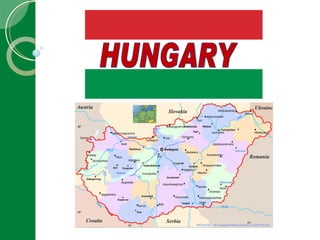
HUNGARY
Location:  Hungary is placed in the centre of Europe, by the Danube.  Frontiers:  Slovakia to the north,  Ukraine  to the northwest, Romania to the east, Slovenia, Croatia and Serbia to the south and Austria to the west. Population:  There are 10 million inhabitants.  Capital:  Budapest. Government:  democracy.
Climate  Life expectancy The climate is continental.  Winters are cold and  summers are warm.                                                                                Life expectancing is 74 years old. For women is 78 years old and for men 70 years old.
Languages  Currency  The oficial language is Hungarian  but 10% also  speak German. The oficial currency is the Forint.  One euro equals 250 forints.
Time zone The same timezone as Spain. 2/3 of the population in Hungary are Catholics but a minority of ¼ is Protestant. Religion
Traditional dresses   and dances Shopping Wood Textiles  Porcelain Ceramics Crystal
Goulach soup  Ingredients for 4 people: 1 kg. beef chuck  1 tsp. salt  2 onions, white or yellow  2 Tbsp. lard or shortening  2 Tbsp sweet paprika  2 bay leaves  1 Qt. water  4 peeled and diced potatoes  1/4 tsp. black pepper  Cut beef into 1 inch squares, add 1/2 tsp. salt. Chop onions and brown in shortening, add beef and paprika. Let beef simmer in its own juice along with salt and paprika for 1 hr. on low heat. Add water, diced potatoes and remaining salt. Cover and simmer until potatoes are done and meat is tender.
Music Frank Liszt,  Béla Bartók and Zoltán Kodály are three  famous composers. Opera is also very important in Hungary. Hungary has made important contributions to folk and classical music.   Our teachers enjoyed the Opera  Aida  in Budapest last November after the Comenius meeting in Tiszafured. Béla Bartók
 
This  is a complex of statues and sculptures on the square.  The Monument was to reflect royal continuity and pride.   The Heroes’ square  It  was planned as part of the Millennium celebrations held in 1896 to commemorate 1000 years of  Hungarian history since the Conquest of the Carpathian Basin by Magyar tribes.
This synagogue seats the largest number of people in the world with its 2840 holding capacity. The external dimensions of the Dohány street Main Synagogue are 26,80 x 74,95 meters, and it measures 44 square meters from the inside. The towers are 44 meters high.  The Synagogue
The main entrance leads to a ceremonial staircase with ceiling frescoes by Károly Lotz. From here opens a 16-sided hall below the dome, used for official receptions and ceremonies. The MP's debating chamber is in the south wing.    Parliament The massive, neo-Gothic Parliament Building is one of the landmark symbols of Budapest. Work on the building began in 1884, and it was completed in 1902.  It has nearly 700 rooms, is 268m long, 118m wide at its maximum and over 90m high at the top of the dome.
Liberty bridge Built in 1894, the bridge spans the Danube and was opened in 1896 by the Emperor Franz Joseph. The bridge is a steel construction and at first site looks like a suspension bridge. However, the construction is a combination of a steel arch with extra strength provided by triangulation.
The first palace was built by Béla IV in 1243. In the 1350s, the Anjou kings began to build a royal court here. The next king was Sigismund of Luxemburg. King Mátyás gave a strong Renaissance accent to the palace. The invading Turks used it as a barracks. The Habsburgs built their Baroque palace   The  Royal Palace
Photographs
                                                                                                                                                     
Curiosity People in Hungary are very kind with tourists.
Comenius  “ A World of Differences”  meeting in Tiszafüred, Hungary 24th November 1st December 2009  Working Session at Kossuth Lajos School
  GROUP MEMBERS Carmen Mª Andrade Muñoz Susana Fernández del Río Marina Gallardo Briega Marta Hidalgo Moreno Estefanía Monzón Aguirre Silvia Mª Muñoz Magdalena IES Blas Infante. Córdoba. Spain. ICT Tourism. For Comenius  A World of Differences  and  School Peace Project  January 2009 Introducing Spain to Kossuth Lajos students

Hungary Ppt

  • 1.
  • 2.
    Location: Hungaryis placed in the centre of Europe, by the Danube. Frontiers: Slovakia to the north, Ukraine to the northwest, Romania to the east, Slovenia, Croatia and Serbia to the south and Austria to the west. Population: There are 10 million inhabitants. Capital: Budapest. Government: democracy.
  • 3.
    Climate Lifeexpectancy The climate is continental. Winters are cold and summers are warm.                                                                              Life expectancing is 74 years old. For women is 78 years old and for men 70 years old.
  • 4.
    Languages Currency The oficial language is Hungarian but 10% also speak German. The oficial currency is the Forint. One euro equals 250 forints.
  • 5.
    Time zone Thesame timezone as Spain. 2/3 of the population in Hungary are Catholics but a minority of ¼ is Protestant. Religion
  • 6.
    Traditional dresses and dances Shopping Wood Textiles Porcelain Ceramics Crystal
  • 7.
    Goulach soup Ingredients for 4 people: 1 kg. beef chuck 1 tsp. salt 2 onions, white or yellow 2 Tbsp. lard or shortening 2 Tbsp sweet paprika 2 bay leaves 1 Qt. water 4 peeled and diced potatoes 1/4 tsp. black pepper Cut beef into 1 inch squares, add 1/2 tsp. salt. Chop onions and brown in shortening, add beef and paprika. Let beef simmer in its own juice along with salt and paprika for 1 hr. on low heat. Add water, diced potatoes and remaining salt. Cover and simmer until potatoes are done and meat is tender.
  • 8.
    Music Frank Liszt, Béla Bartók and Zoltán Kodály are three famous composers. Opera is also very important in Hungary. Hungary has made important contributions to folk and classical music. Our teachers enjoyed the Opera Aida in Budapest last November after the Comenius meeting in Tiszafured. Béla Bartók
  • 9.
  • 10.
    This isa complex of statues and sculptures on the square. The Monument was to reflect royal continuity and pride. The Heroes’ square It was planned as part of the Millennium celebrations held in 1896 to commemorate 1000 years of Hungarian history since the Conquest of the Carpathian Basin by Magyar tribes.
  • 11.
    This synagogue seatsthe largest number of people in the world with its 2840 holding capacity. The external dimensions of the Dohány street Main Synagogue are 26,80 x 74,95 meters, and it measures 44 square meters from the inside. The towers are 44 meters high. The Synagogue
  • 12.
    The main entranceleads to a ceremonial staircase with ceiling frescoes by Károly Lotz. From here opens a 16-sided hall below the dome, used for official receptions and ceremonies. The MP's debating chamber is in the south wing.   Parliament The massive, neo-Gothic Parliament Building is one of the landmark symbols of Budapest. Work on the building began in 1884, and it was completed in 1902. It has nearly 700 rooms, is 268m long, 118m wide at its maximum and over 90m high at the top of the dome.
  • 13.
    Liberty bridge Builtin 1894, the bridge spans the Danube and was opened in 1896 by the Emperor Franz Joseph. The bridge is a steel construction and at first site looks like a suspension bridge. However, the construction is a combination of a steel arch with extra strength provided by triangulation.
  • 14.
    The first palacewas built by Béla IV in 1243. In the 1350s, the Anjou kings began to build a royal court here. The next king was Sigismund of Luxemburg. King Mátyás gave a strong Renaissance accent to the palace. The invading Turks used it as a barracks. The Habsburgs built their Baroque palace The Royal Palace
  • 15.
  • 16.
                                                                                                                                                        
  • 17.
    Curiosity People inHungary are very kind with tourists.
  • 18.
    Comenius “A World of Differences” meeting in Tiszafüred, Hungary 24th November 1st December 2009 Working Session at Kossuth Lajos School
  • 19.
    GROUPMEMBERS Carmen Mª Andrade Muñoz Susana Fernández del Río Marina Gallardo Briega Marta Hidalgo Moreno Estefanía Monzón Aguirre Silvia Mª Muñoz Magdalena IES Blas Infante. Córdoba. Spain. ICT Tourism. For Comenius A World of Differences and School Peace Project January 2009 Introducing Spain to Kossuth Lajos students