













Humanizing Technology
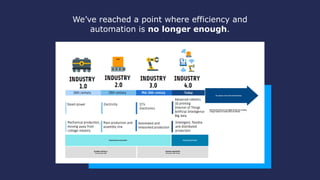
We’ve reached a point where efficiency and
automation is no longer enough.
Empowering Corporation
Scalable efficiency
Doing things right
Scalable adaptability
Doing the right things
Empowering People
10x Impact of the Internet Revolution
Blurring the physical and digital divide and creating
a larger impact on society than on industry
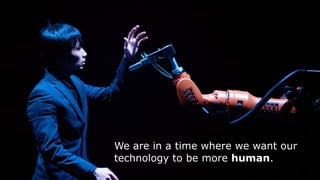
We are in a time where we want our
technology to be more human.
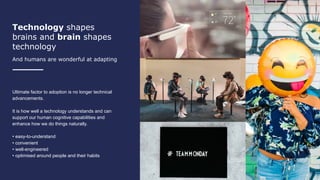
Technology shapes
brains and brain shapes
technology
And humans are wonderful at adapting
Ultimate factor to adoption is no longer technical
advancements.
It is how well a technology understands and can
support our human cognitive capabilities and
enhance how we do things naturally.
• easy-to-understand
• convenient
• well-engineered
• optimised around people and their habits
GPS vs Human
Factors to consider when
designing for humans
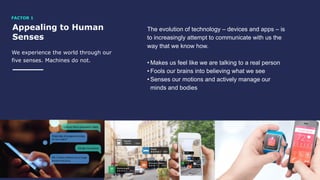
Appealing to Human
Senses
We experience the world through our
five senses. Machines do not.
The evolution of technology – devices and apps – is
to increasingly attempt to communicate with us the
way that we know how.
• Makes us feel like we are talking to a real person
• Fools our brains into believing what we see
• Senses our motions and actively manage our
minds and bodies
FACTOR 1
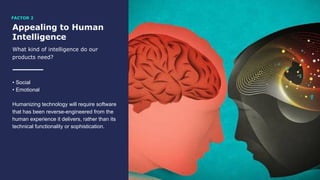
Appealing to Human
Intelligence
What kind of intelligence do our
products need?
• Social
• Emotional
Humanizing technology will require software
that has been reverse-engineered from the
human experience it delivers, rather than its
technical functionality or sophistication.
FACTOR 2
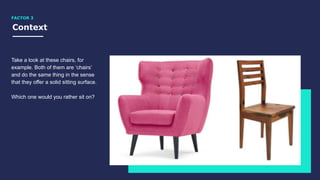
Context
Take a look at these chairs, for
example. Both of them are ‘chairs’
and do the same thing in the sense
that they offer a solid sitting surface.
Which one would you rather sit on?
FACTOR 3
Mindset, habits and
behaviours
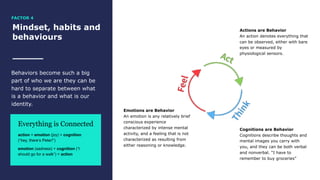
Behaviors become such a big
part of who we are they can be
hard to separate between what
is a behavior and what is our
identity.
Actions are Behavior
An action denotes everything that
can be observed, either with bare
eyes or measured by
physiological sensors.
Cognitions are Behavior
Cognitions describe thoughts and
mental images you carry with
you, and they can be both verbal
and nonverbal. “I have to
remember to buy groceries”
Emotions are Behavior
An emotion is any relatively brief
conscious experience
characterized by intense mental
activity, and a feeling that is not
characterized as resulting from
either reasoning or knowledge.
Everything is Connected
action = emotion (joy) + cognition
(“hey, there‘s Peter!”)
emotion (sadness) + cognition (“I
should go for a walk“) = action
FACTOR 4
Mindset, habits and
behaviours
What you should know
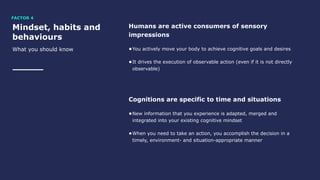
Humans are active consumers of sensory
impressions
•You actively move your body to achieve cognitive goals and desires
•It drives the execution of observable action (even if it is not directly
observable)
Cognitions are specific to time and situations
•New information that you experience is adapted, merged and
integrated into your existing cognitive mindset
•When you need to take an action, you accomplish the decision in a
timely, environment- and situation-appropriate manner
FACTOR 4
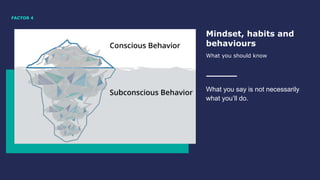
What you say is not necessarily
what you’ll do.
Mindset, habits and
behaviours
What you should know
FACTOR 4
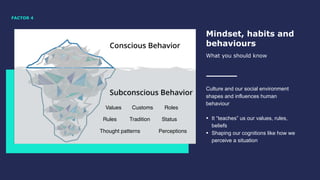
Culture and our social environment
shapes and influences human
behaviour
• It “teaches” us our values, rules,
beliefs
• Shaping our cognitions like how we
perceive a situation
Mindset, habits and
behaviours
What you should know
Values Customs Roles
Rules Tradition Status
Thought patterns Perceptions
FACTOR 4
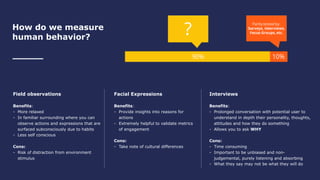
Field observations
Benefits:
- More relaxed
- In familiar surrounding where you can
observe actions and expressions that are
surfaced subconsciously due to habits
- Less self conscious
Cons:
- Risk of distraction from environment
stimulus
Facial Expressions
Benefits:
- Provide insights into reasons for
actions
- Extremely helpful to validate metrics
of engagement
Cons:
- Take note of cultural differences
Interviews
Benefits:
- Prolonged conversation with potential user to
understand in depth their personality, thoughts,
attitudes and how they do something
- Allows you to ask WHY
Cons:
- Time consuming
- Important to be unbiased and non-
judgemental, purely listening and absorbing
- What they say may not be what they will do
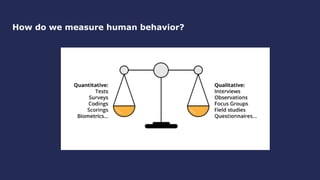
How do we measure
human behavior?
How do we measure human behavior?
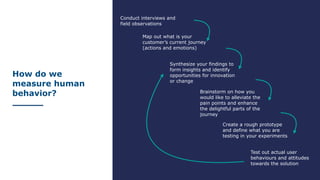
Conduct interviews and
field observations
Synthesize your findings to
form insights and identify
opportunities for innovation
or change
Brainstorm on how you
would like to alleviate the
pain points and enhance
the delightful parts of the
journey
Map out what is your
customer’s current journey
(actions and emotions)
Create a rough prototype
and define what you are
testing in your experiments
Test out actual user
behaviours and attitudes
towards the solution
How do we
measure human
behavior?
Insurance Agent Tool
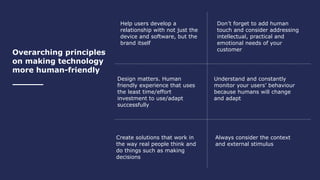
Overarching principles
on making technology
more human-friendly
Help users develop a
relationship with not just the
device and software, but the
brand itself
Don’t forget to add human
touch and consider addressing
intellectual, practical and
emotional needs of your
customer
Design matters. Human
friendly experience that uses
the least time/effort
investment to use/adapt
successfully
Understand and constantly
monitor your users’ behaviour
because humans will change
and adapt
Create solutions that work in
the way real people think and
do things such as making
decisions
Always consider the context
and external stimulus
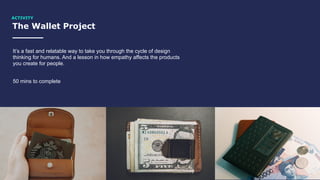
The Wallet Project
ACTIVITY
It’s a fast and relatable way to take you through the cycle of design
thinking for humans. And a lesson in how empathy affects the products
you create for people.
50 mins to complete
The Wallet Project
STEP 1
Please pair up.
Partner A
Walk your partner through the contents of your wallet.
Partner B
make initial observations of verbal and non verbal
communications.
4 mins each
The Wallet Project
STEP 2
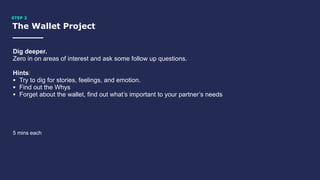
Dig deeper.
Zero in on areas of interest and ask some follow up questions.
Hints:
• Try to dig for stories, feelings, and emotion.
• Find out the Whys
• Forget about the wallet, find out what’s important to your partner’s needs
5 mins each
The Wallet Project
STEP 3
Individually reflect on what you’ve learnt about
your partner
Hints:
• Goals and wishes are objectives that your
partner would like to achieve.
• Insights are discoveries you have made
that you could use when creating
solutions.
5 mins
Goals & Wishes
Insights
The Wallet Project
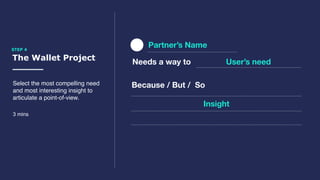
STEP 4
Select the most compelling need
and most interesting insight to
articulate a point-of-view.
3 mins
Partner’s Name
Needs a way to User’s need
Because / But / So
Insight
The Wallet Project
STEP 5
Sketch to Ideate; reframe your
problem statement into a header
and come up with as many ideas
you can think of.
Remember to be visual, draw it out!
7 mins
The Wallet Project
STEP 6
Share your solutions & capture
feedback.
Think about how you can improve
what you have designed based on
the feedback captured.
5 mins each
Recap!
Bridging the gap between
Technology and humans
If there’s anything you must do first
It is to build trust.
Trustworthiness is the first thing your user will judge.
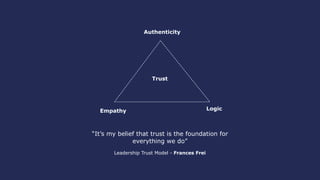
The triangle of trust has three components,
• empathy
• authenticity
• logic
If any one of these three gets shaky, the triangle
becomes unstable.
Trust
Empathy Logic
Authenticity
“It’s my belief that trust is the foundation for
everything we do”
Leadership Trust Model - Frances Frei
How vulnerable are your users?
How did you feel when you shared the contents
of your wallet
Everything you do and say on your service/
product is suspicious until proven innocent.
With data security being a huge topic in recent
years, it is hard for anyone to trust anyone with
their information.
Recall when you had your information for against
your interests.
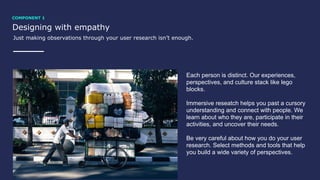
Designing with empathy
Just making observations through your user research isn’t enough.
Each person is distinct. Our experiences,
perspectives, and culture stack like lego
blocks.
Immersive reseatch helps you past a cursory
understanding and connect with people. We
learn about who they are, participate in their
activities, and uncover their needs.
Be very careful about how you do your user
research. Select methods and tools that help
you build a wide variety of perspectives.
COMPONENT 1
Understanding the needs of a
Diverse set of users
HOOQ
COMPONENT 1
Here’s what we know.
From data and prior market research
What we knew at least 60% of our users watched movies on their mobile
Around 75% were android.
Internet speed was sometimes slow and 3g connectivity gets spotty.
Spent on average at least an hour and a half in traffic daily
First language was not English but watched a good mix of English and Bahasa shows
From Customer service feedback
Top complaints was that there were no subtitles or they were incomplete
Loooooong loading times that eventually timed out
Had problems cancelling or pausing their subscriptions
COMPONENT 1
What were important factors driving their entertainment consumption habits
why these were important.
What we wanted to find out
From user interviews
Many users either wanted to learn English or teach their children English.
Users download shows from the internet then load them into their mobiles to watch outside.
Felt uncomfortable committing to a monthly payment
From market immersion
Impractical to stream on the go given loading time is slow and video buffers midway.
Topped up prepaid cards often and in small amounts
These findings helped us understand how we should structure subscriptions, downloads and subtitle
indicators to meet our users needs.
Piecing together the puzzle
COMPONENT 1
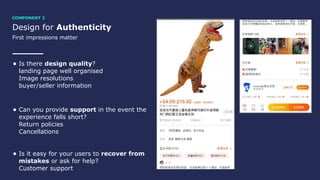
Design for Authenticity
First impressions matter
• Is there design quality?

landing page well organised

Image resolutions

buyer/seller information
• Can you provide support in the event the
experience falls short?

Return policies

Cancellations
• Is it easy for your users to recover from
mistakes or ask for help?

Customer support
COMPONENT 2
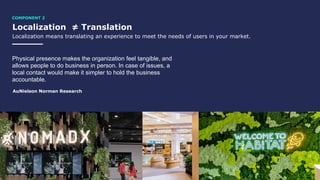
Localization ≠ Translation
Localization means translating an experience to meet the needs of users in your market.
Physical presence makes the organization feel tangible, and
allows people to do business in person. In case of issues, a
local contact would make it simpler to hold the business
accountable.
AuNielson Norman Research
COMPONENT 2
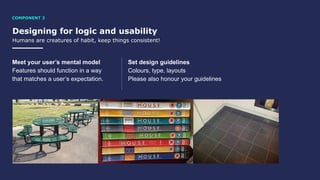
Designing for logic and usability
Humans are creatures of habit, keep things consistent!
Meet your user’s mental model
Features should function in a way
that matches a user’s expectation.
Set design guidelines
Colours, type, layouts
Please also honour your guidelines
COMPONENT 3
Negativity bias has consequences.
Brands that can do no wrong
Brands that can do no right.
The negativity bias is the tendency for humans to
pay more attention, or give more weight to
negative experiences.
Even when negative experiences are
inconsequentail
Once disillusioned, people often exhibit a
confirmation bias and continue to notice
additional elements that strengthen their
negative viewpoint.
Nielson Norman Research
COMPONENT 3
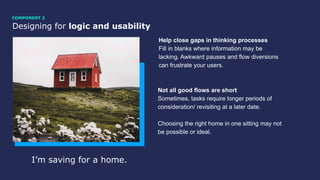
Help close gaps in thinking processes
Fill in blanks where information may be
lacking. Awkward pauses and flow diversions
can frustrate your users.
Not all good flows are short
Sometimes, tasks require longer periods of
consideration/ revisiting at a later date.
Choosing the right home in one sitting may not
be possible or ideal.
Designing for logic and usability
I’m saving for a home.
COMPONENT 2
Trust is a very human concept and a key ingredient in forming
relationships. It will continue to be relevant in time to come as
our relationship with technology develops.
As our lives become increasingly entwined with technology, we’ll
notice a shift. Technology will continue to evolve to meet human
needs. The more seamless the integration, the less we’ll notice it.
The future of technology is coming and
It looks strangely human.

Humanizing Digital Experiences at UXSEA Summit 2018

  • 1.
  • 2.
    We’ve reached apoint where efficiency and automation is no longer enough. Empowering Corporation Scalable efficiency Doing things right Scalable adaptability Doing the right things Empowering People 10x Impact of the Internet Revolution Blurring the physical and digital divide and creating a larger impact on society than on industry
  • 3.
    We are ina time where we want our technology to be more human.
  • 4.
    Technology shapes brains andbrain shapes technology And humans are wonderful at adapting Ultimate factor to adoption is no longer technical advancements. It is how well a technology understands and can support our human cognitive capabilities and enhance how we do things naturally. • easy-to-understand • convenient • well-engineered • optimised around people and their habits
  • 5.
  • 6.
    Factors to considerwhen designing for humans
  • 7.
    Appealing to Human Senses Weexperience the world through our five senses. Machines do not. The evolution of technology – devices and apps – is to increasingly attempt to communicate with us the way that we know how. • Makes us feel like we are talking to a real person • Fools our brains into believing what we see • Senses our motions and actively manage our minds and bodies FACTOR 1
  • 8.
    Appealing to Human Intelligence Whatkind of intelligence do our products need? • Social • Emotional Humanizing technology will require software that has been reverse-engineered from the human experience it delivers, rather than its technical functionality or sophistication. FACTOR 2
  • 9.
    Context Take a lookat these chairs, for example. Both of them are ‘chairs’ and do the same thing in the sense that they offer a solid sitting surface. Which one would you rather sit on? FACTOR 3
  • 10.
    Mindset, habits and behaviours Behaviorsbecome such a big part of who we are they can be hard to separate between what is a behavior and what is our identity. Actions are Behavior An action denotes everything that can be observed, either with bare eyes or measured by physiological sensors. Cognitions are Behavior Cognitions describe thoughts and mental images you carry with you, and they can be both verbal and nonverbal. “I have to remember to buy groceries” Emotions are Behavior An emotion is any relatively brief conscious experience characterized by intense mental activity, and a feeling that is not characterized as resulting from either reasoning or knowledge. Everything is Connected action = emotion (joy) + cognition (“hey, there‘s Peter!”) emotion (sadness) + cognition (“I should go for a walk“) = action FACTOR 4
  • 11.
    Mindset, habits and behaviours Whatyou should know Humans are active consumers of sensory impressions •You actively move your body to achieve cognitive goals and desires •It drives the execution of observable action (even if it is not directly observable) Cognitions are specific to time and situations •New information that you experience is adapted, merged and integrated into your existing cognitive mindset •When you need to take an action, you accomplish the decision in a timely, environment- and situation-appropriate manner FACTOR 4
  • 12.
    What you sayis not necessarily what you’ll do. Mindset, habits and behaviours What you should know FACTOR 4
  • 13.
    Culture and oursocial environment shapes and influences human behaviour • It “teaches” us our values, rules, beliefs • Shaping our cognitions like how we perceive a situation Mindset, habits and behaviours What you should know Values Customs Roles Rules Tradition Status Thought patterns Perceptions FACTOR 4
  • 14.
    Field observations Benefits: - Morerelaxed - In familiar surrounding where you can observe actions and expressions that are surfaced subconsciously due to habits - Less self conscious Cons: - Risk of distraction from environment stimulus Facial Expressions Benefits: - Provide insights into reasons for actions - Extremely helpful to validate metrics of engagement Cons: - Take note of cultural differences Interviews Benefits: - Prolonged conversation with potential user to understand in depth their personality, thoughts, attitudes and how they do something - Allows you to ask WHY Cons: - Time consuming - Important to be unbiased and non- judgemental, purely listening and absorbing - What they say may not be what they will do How do we measure human behavior?
  • 15.
    How do wemeasure human behavior?
  • 16.
    Conduct interviews and fieldobservations Synthesize your findings to form insights and identify opportunities for innovation or change Brainstorm on how you would like to alleviate the pain points and enhance the delightful parts of the journey Map out what is your customer’s current journey (actions and emotions) Create a rough prototype and define what you are testing in your experiments Test out actual user behaviours and attitudes towards the solution How do we measure human behavior?
  • 17.
  • 18.
    Overarching principles on makingtechnology more human-friendly Help users develop a relationship with not just the device and software, but the brand itself Don’t forget to add human touch and consider addressing intellectual, practical and emotional needs of your customer Design matters. Human friendly experience that uses the least time/effort investment to use/adapt successfully Understand and constantly monitor your users’ behaviour because humans will change and adapt Create solutions that work in the way real people think and do things such as making decisions Always consider the context and external stimulus
  • 19.
    The Wallet Project ACTIVITY It’sa fast and relatable way to take you through the cycle of design thinking for humans. And a lesson in how empathy affects the products you create for people. 50 mins to complete
  • 20.
    The Wallet Project STEP1 Please pair up. Partner A Walk your partner through the contents of your wallet. Partner B make initial observations of verbal and non verbal communications. 4 mins each
  • 21.
    The Wallet Project STEP2 Dig deeper. Zero in on areas of interest and ask some follow up questions. Hints: • Try to dig for stories, feelings, and emotion. • Find out the Whys • Forget about the wallet, find out what’s important to your partner’s needs 5 mins each
  • 22.
    The Wallet Project STEP3 Individually reflect on what you’ve learnt about your partner Hints: • Goals and wishes are objectives that your partner would like to achieve. • Insights are discoveries you have made that you could use when creating solutions. 5 mins Goals & Wishes Insights
  • 23.
    The Wallet Project STEP4 Select the most compelling need and most interesting insight to articulate a point-of-view. 3 mins Partner’s Name Needs a way to User’s need Because / But / So Insight
  • 24.
    The Wallet Project STEP5 Sketch to Ideate; reframe your problem statement into a header and come up with as many ideas you can think of. Remember to be visual, draw it out! 7 mins
  • 25.
    The Wallet Project STEP6 Share your solutions & capture feedback. Think about how you can improve what you have designed based on the feedback captured. 5 mins each
  • 26.
  • 27.
    Bridging the gapbetween Technology and humans
  • 28.
    If there’s anythingyou must do first It is to build trust. Trustworthiness is the first thing your user will judge. The triangle of trust has three components, • empathy • authenticity • logic If any one of these three gets shaky, the triangle becomes unstable.
  • 29.
    Trust Empathy Logic Authenticity “It’s mybelief that trust is the foundation for everything we do” Leadership Trust Model - Frances Frei
  • 30.
    How vulnerable areyour users? How did you feel when you shared the contents of your wallet Everything you do and say on your service/ product is suspicious until proven innocent. With data security being a huge topic in recent years, it is hard for anyone to trust anyone with their information. Recall when you had your information for against your interests.
  • 31.
    Designing with empathy Justmaking observations through your user research isn’t enough. Each person is distinct. Our experiences, perspectives, and culture stack like lego blocks. Immersive reseatch helps you past a cursory understanding and connect with people. We learn about who they are, participate in their activities, and uncover their needs. Be very careful about how you do your user research. Select methods and tools that help you build a wide variety of perspectives. COMPONENT 1
  • 32.
    Understanding the needsof a Diverse set of users HOOQ COMPONENT 1
  • 33.
    Here’s what weknow. From data and prior market research What we knew at least 60% of our users watched movies on their mobile Around 75% were android. Internet speed was sometimes slow and 3g connectivity gets spotty. Spent on average at least an hour and a half in traffic daily First language was not English but watched a good mix of English and Bahasa shows From Customer service feedback Top complaints was that there were no subtitles or they were incomplete Loooooong loading times that eventually timed out Had problems cancelling or pausing their subscriptions COMPONENT 1
  • 34.
    What were importantfactors driving their entertainment consumption habits why these were important. What we wanted to find out From user interviews Many users either wanted to learn English or teach their children English. Users download shows from the internet then load them into their mobiles to watch outside. Felt uncomfortable committing to a monthly payment From market immersion Impractical to stream on the go given loading time is slow and video buffers midway. Topped up prepaid cards often and in small amounts These findings helped us understand how we should structure subscriptions, downloads and subtitle indicators to meet our users needs. Piecing together the puzzle COMPONENT 1
  • 35.
    Design for Authenticity Firstimpressions matter • Is there design quality?
 landing page well organised
 Image resolutions
 buyer/seller information • Can you provide support in the event the experience falls short?
 Return policies
 Cancellations • Is it easy for your users to recover from mistakes or ask for help?
 Customer support COMPONENT 2
  • 36.
    Localization ≠ Translation Localizationmeans translating an experience to meet the needs of users in your market. Physical presence makes the organization feel tangible, and allows people to do business in person. In case of issues, a local contact would make it simpler to hold the business accountable. AuNielson Norman Research COMPONENT 2
  • 37.
    Designing for logicand usability Humans are creatures of habit, keep things consistent! Meet your user’s mental model Features should function in a way that matches a user’s expectation. Set design guidelines Colours, type, layouts Please also honour your guidelines COMPONENT 3
  • 38.
    Negativity bias hasconsequences. Brands that can do no wrong Brands that can do no right. The negativity bias is the tendency for humans to pay more attention, or give more weight to negative experiences. Even when negative experiences are inconsequentail Once disillusioned, people often exhibit a confirmation bias and continue to notice additional elements that strengthen their negative viewpoint. Nielson Norman Research COMPONENT 3
  • 39.
    Help close gapsin thinking processes Fill in blanks where information may be lacking. Awkward pauses and flow diversions can frustrate your users. Not all good flows are short Sometimes, tasks require longer periods of consideration/ revisiting at a later date. Choosing the right home in one sitting may not be possible or ideal. Designing for logic and usability I’m saving for a home. COMPONENT 2
  • 40.
    Trust is avery human concept and a key ingredient in forming relationships. It will continue to be relevant in time to come as our relationship with technology develops.
  • 41.
    As our livesbecome increasingly entwined with technology, we’ll notice a shift. Technology will continue to evolve to meet human needs. The more seamless the integration, the less we’ll notice it. The future of technology is coming and It looks strangely human.