Operant & Classical Conditioning
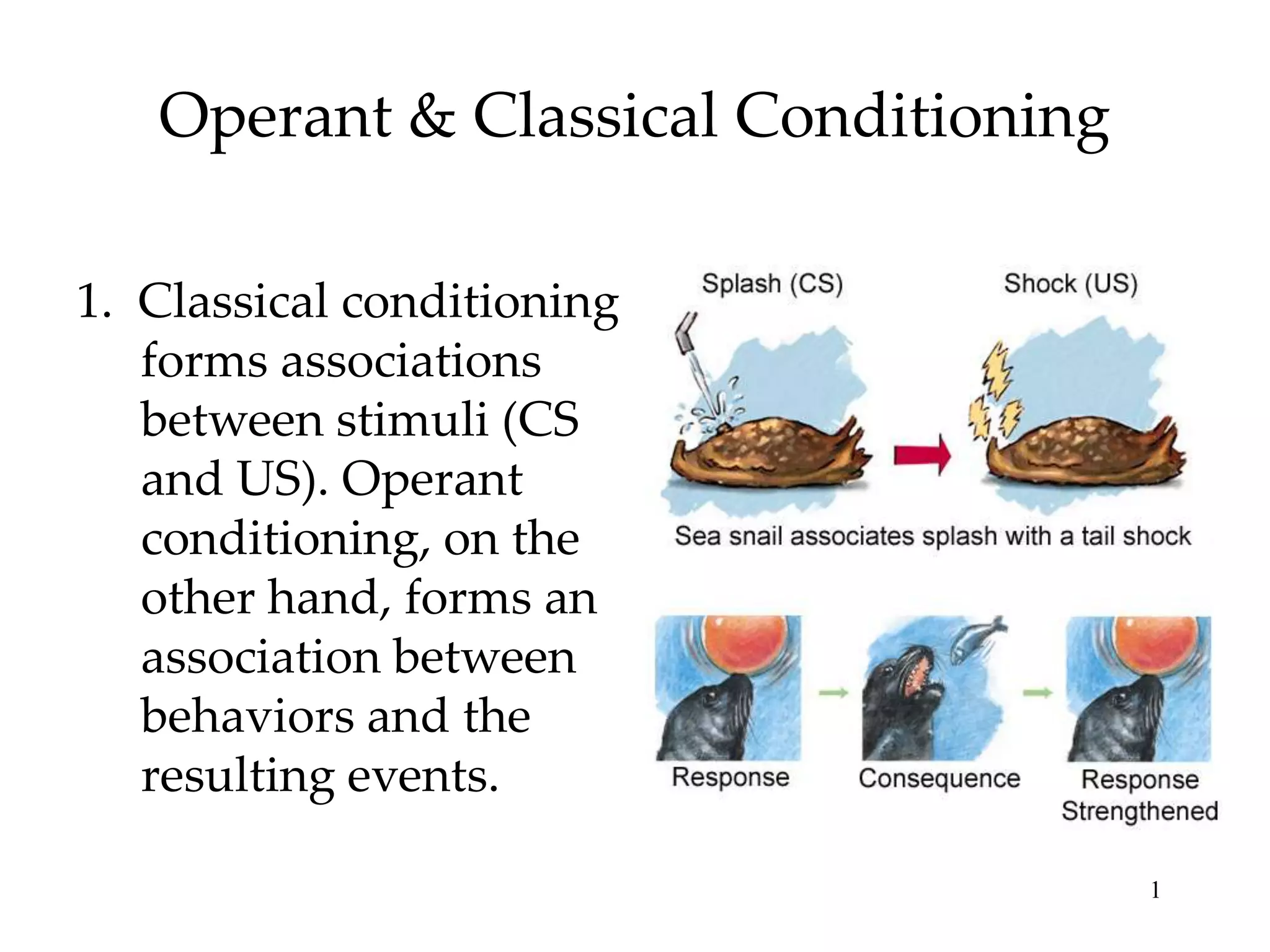
1. Classical conditioning
forms associations
between stimuli (CS
and US). Operant
conditioning, on the
other hand, forms an
association between
behaviors and the
resulting events.
1
Operant & Classical Conditioning
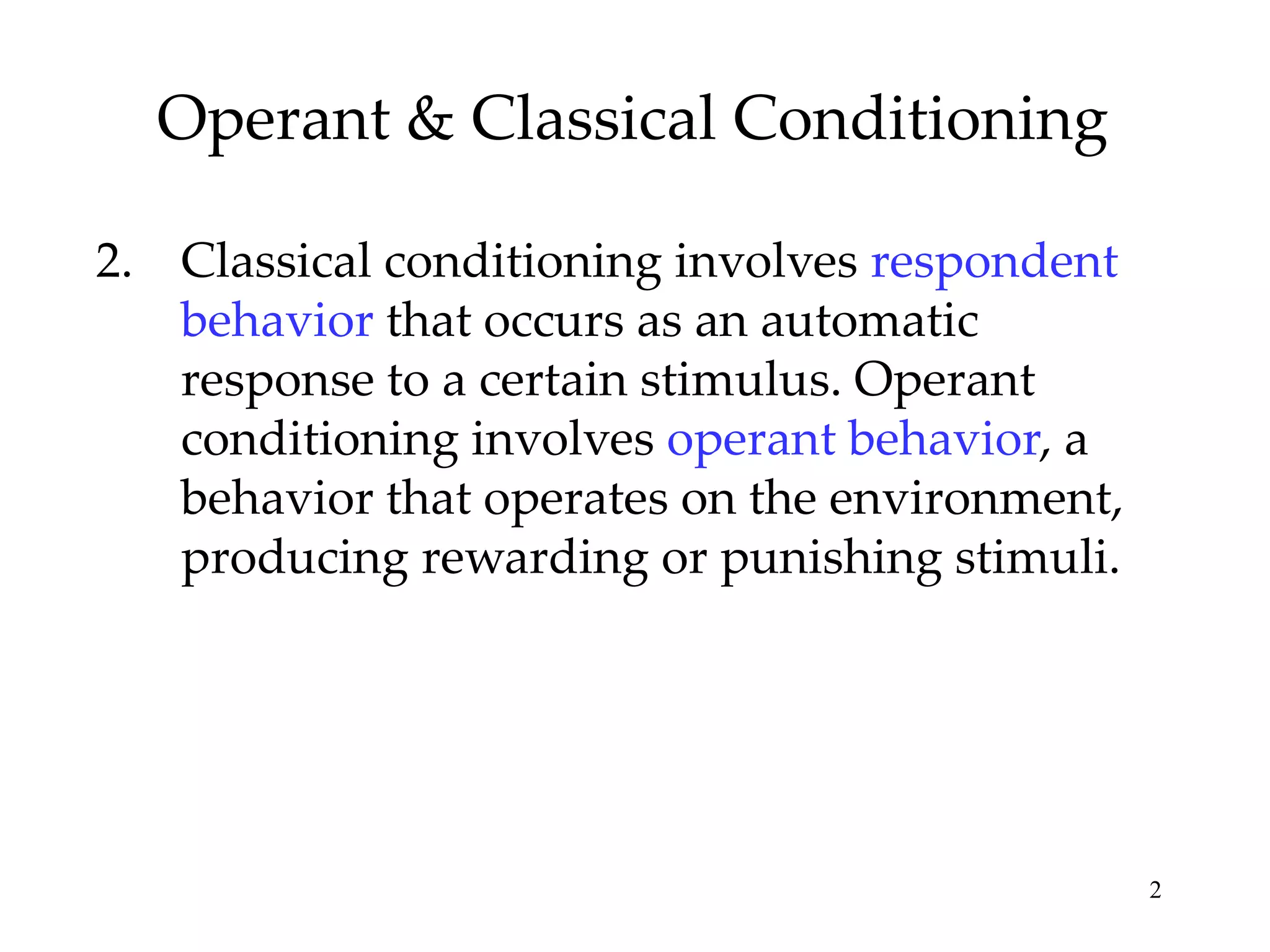
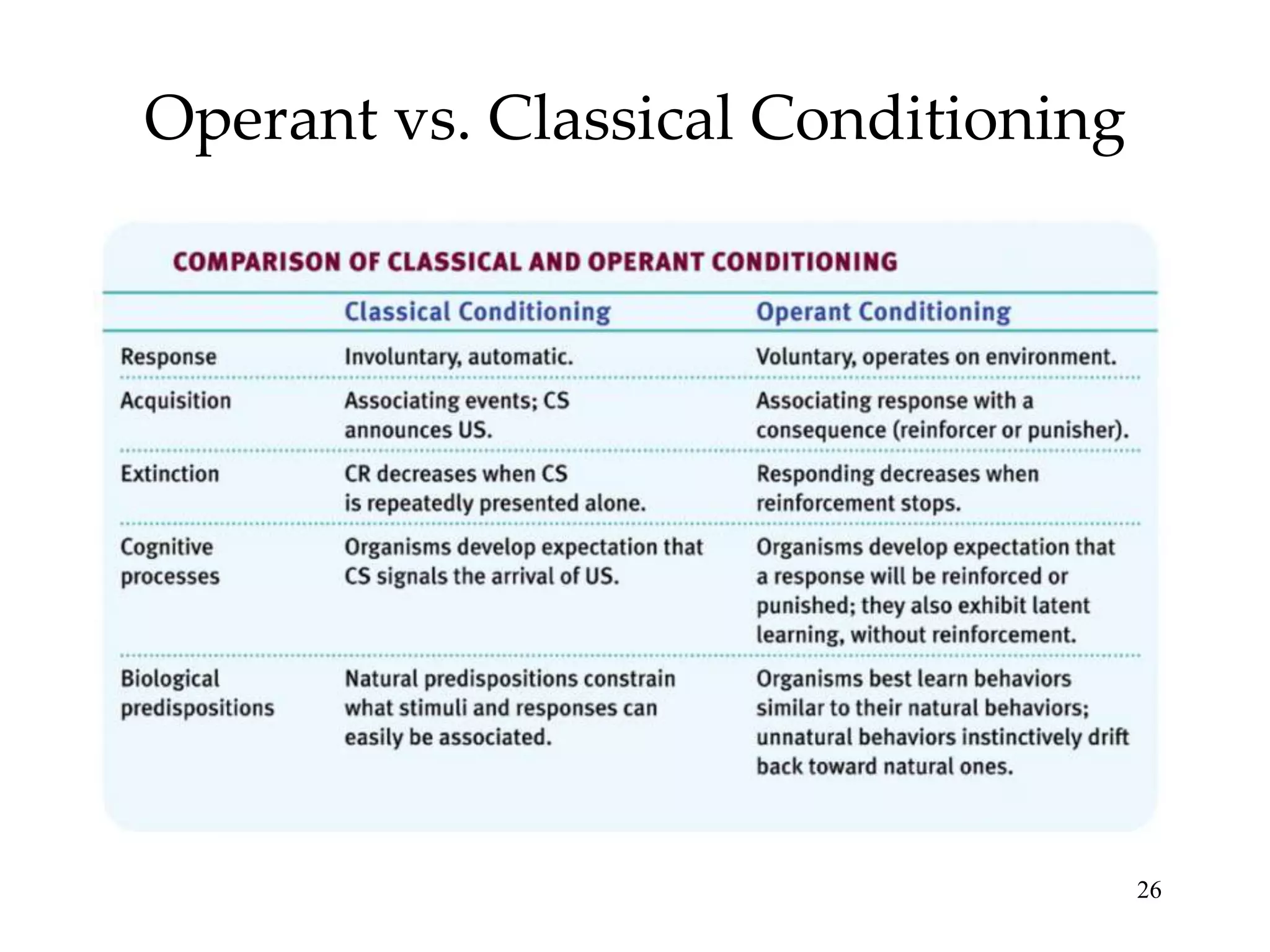
2. Classical conditioning involves respondent
behavior that occurs as an automatic
response to a certain stimulus. Operant
conditioning involves operant behavior, a
behavior that operates on the environment,
producing rewarding or punishing stimuli.

2
Skinner’s Experiments
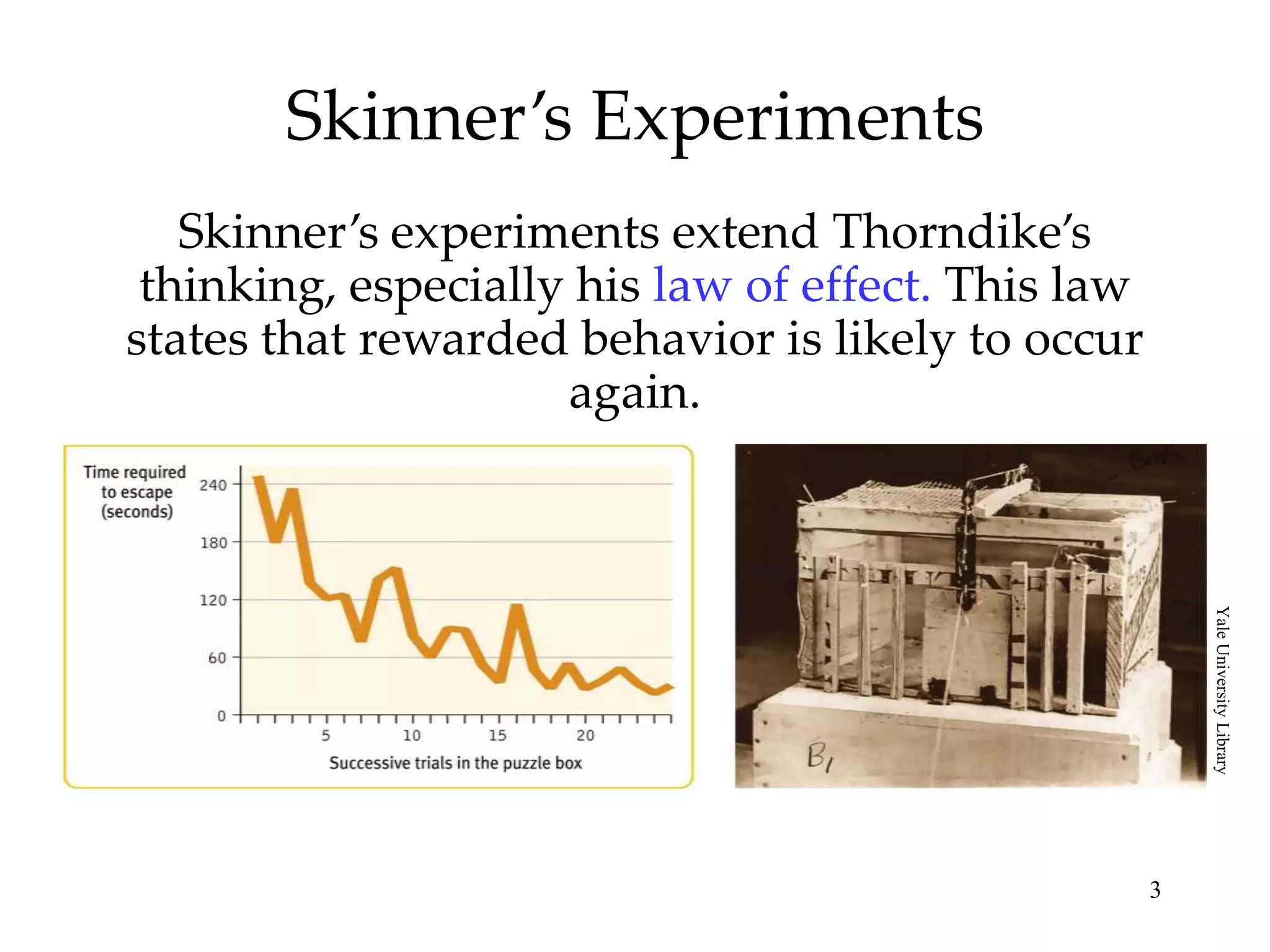
Skinner’s experiments extend Thorndike’s
thinking, especially his law of effect. This law
states that rewarded behavior is likely to occur
again.

Yale University Library

3
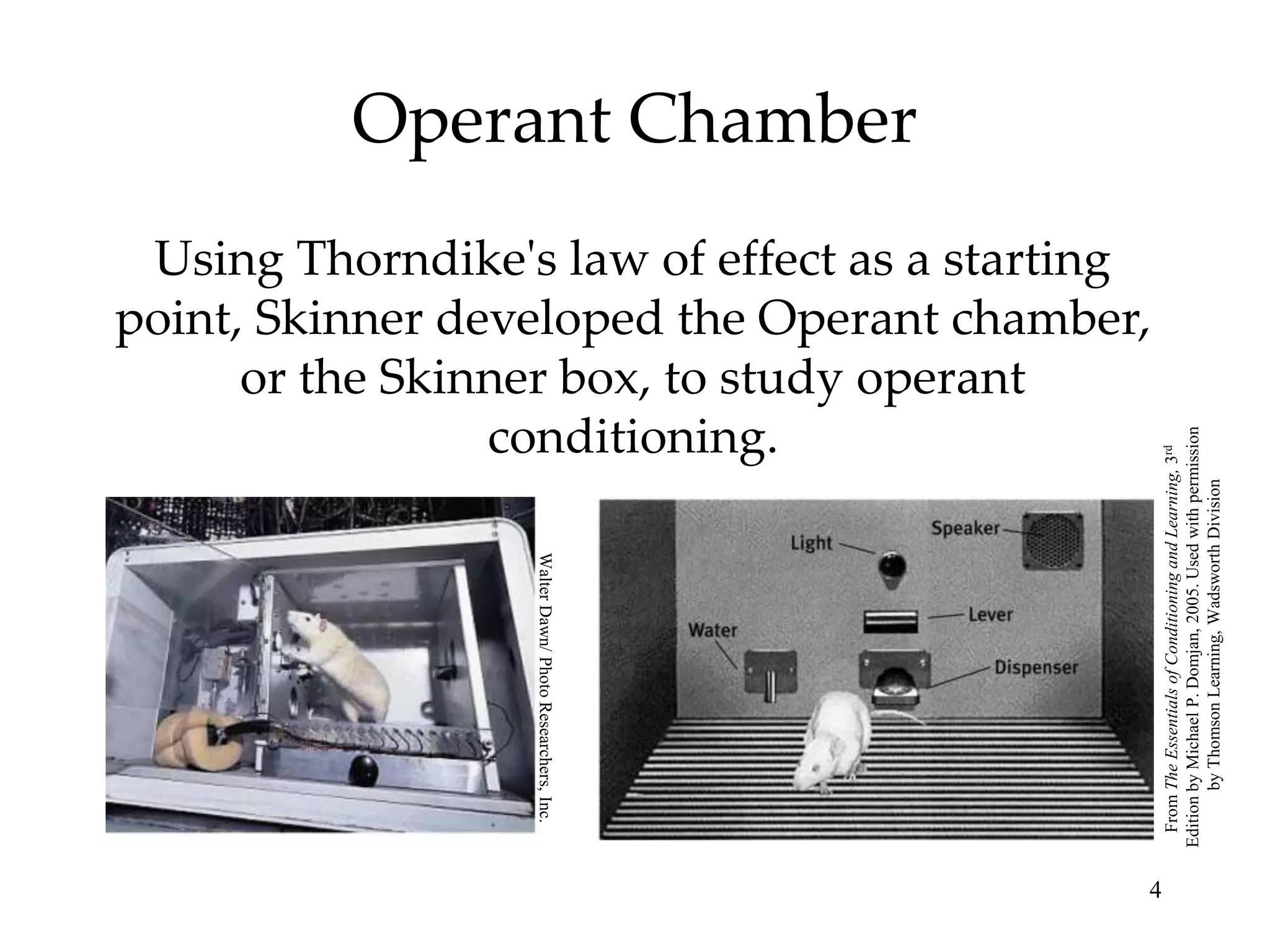
Using Thorndike's law of effect as a starting
point, Skinner developed the Operant chamber,
or the Skinner box, to study operant
conditioning.
Walter Dawn/ Photo Researchers, Inc.

4

From The Essentials of Conditioning and Learning, 3rd
Edition by Michael P. Domjan, 2005. Used with permission
by Thomson Learning, Wadsworth Division

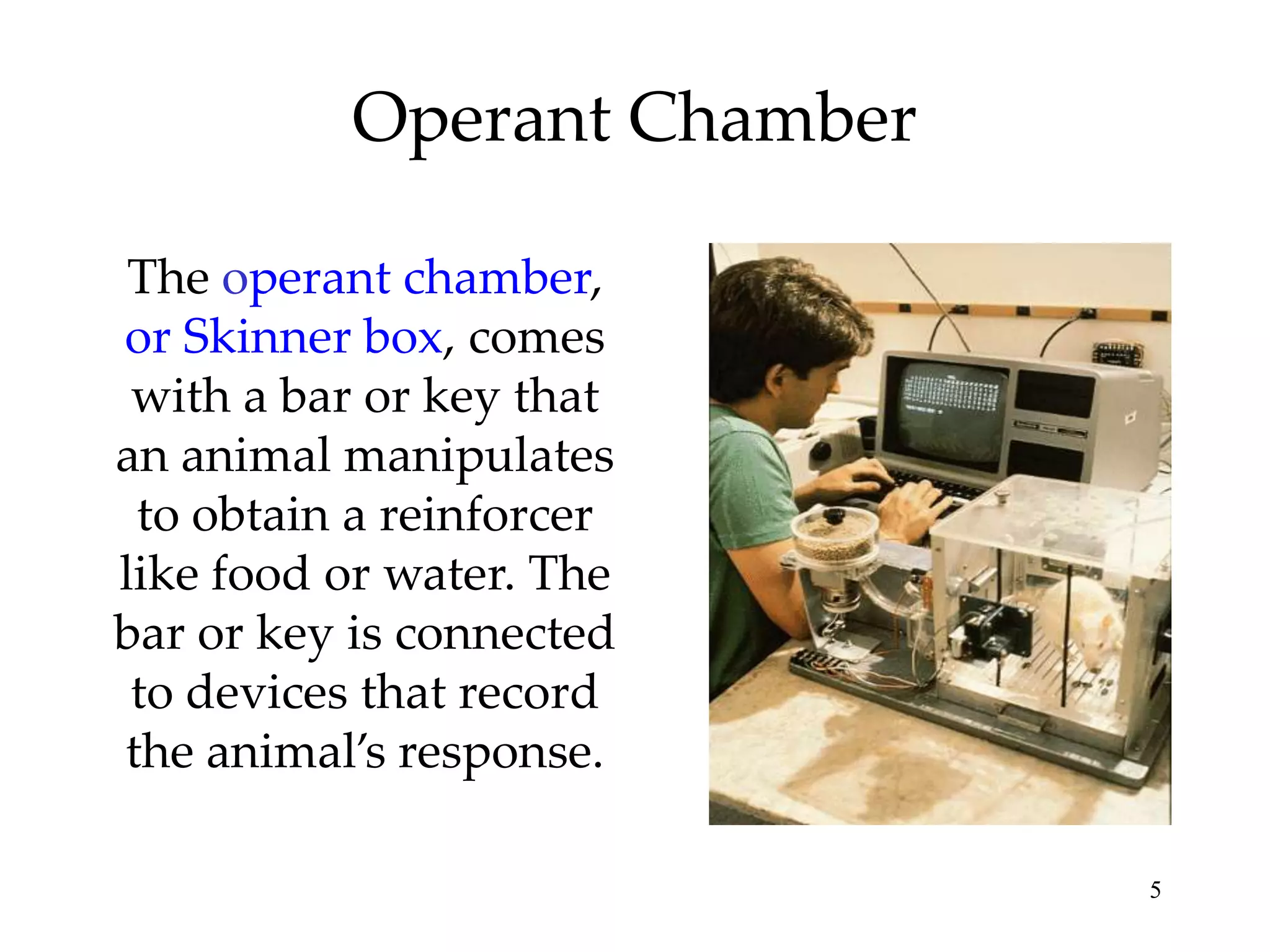
Operant Chamber
Operant Chamber
The operant chamber,
or Skinner box, comes
with a bar or key that
an animal manipulates
to obtain a reinforcer
like food or water. The
bar or key is connected
to devices that record
the animal’s response.
5
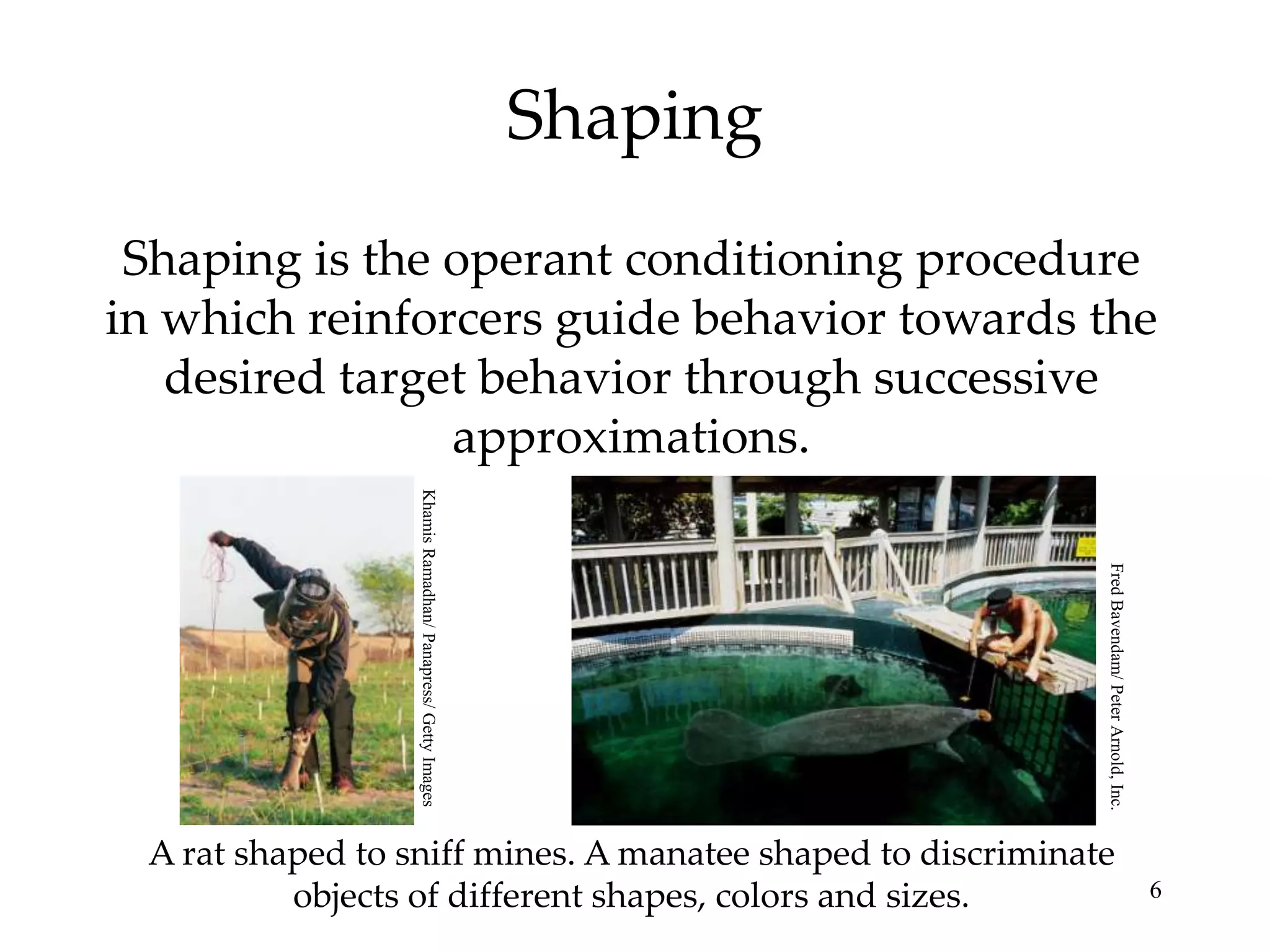
Shaping
Shaping is the operant conditioning procedure
in which reinforcers guide behavior towards the
desired target behavior through successive
approximations.
Fred Bavendam/ Peter Arnold, Inc.

Khamis Ramadhan/ Panapress/ Getty Images

A rat shaped to sniff mines. A manatee shaped to discriminate
objects of different shapes, colors and sizes.

6
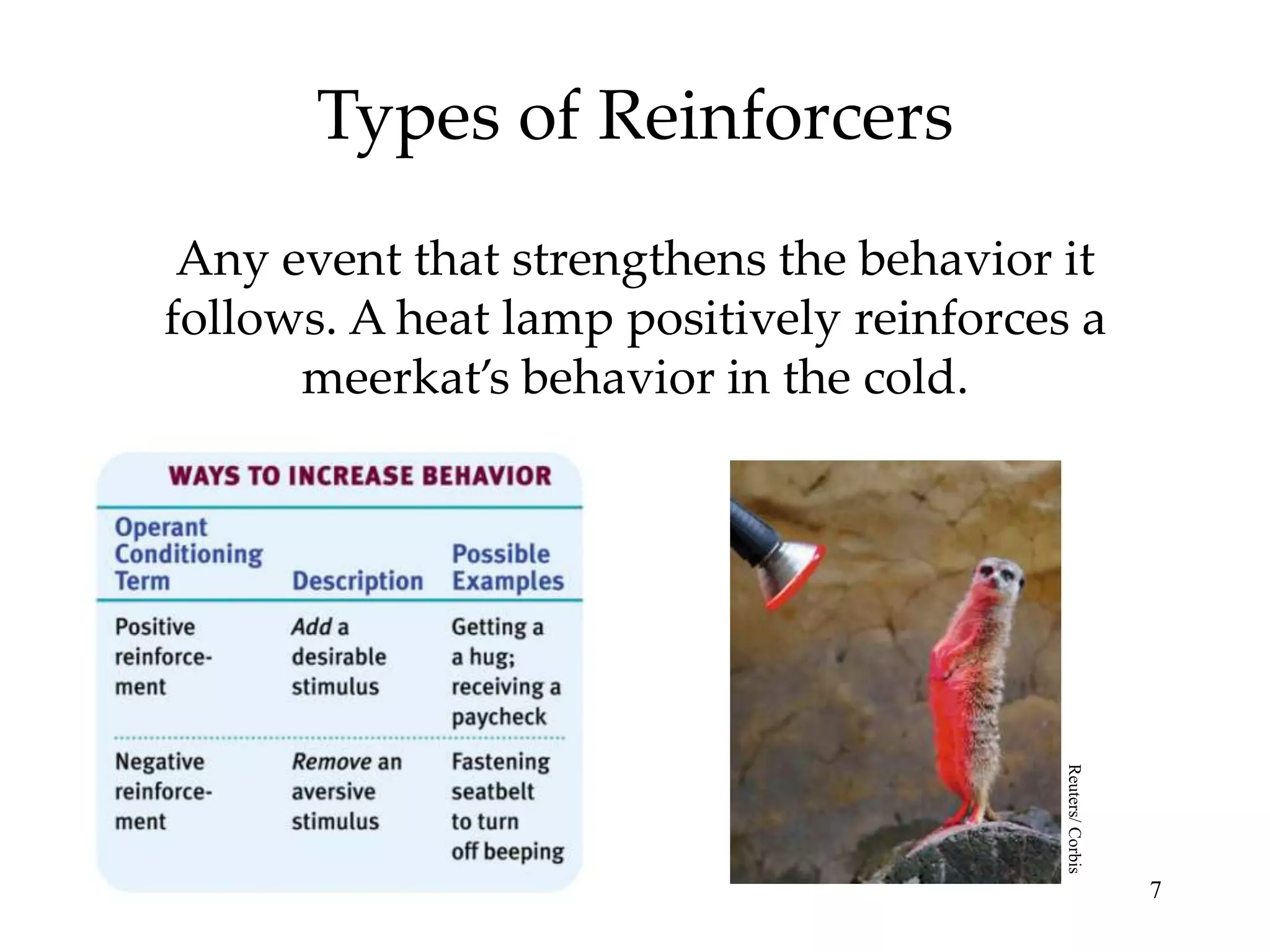
Types of Reinforcers
Any event that strengthens the behavior it
follows. A heat lamp positively reinforces a
meerkat’s behavior in the cold.

Reuters/ Corbis

7
Primary & Secondary Reinforcers
1. Primary Reinforcer: An innately reinforcing
stimulus like food or drink.
2. Conditioned Reinforcer: A learned
reinforcer that gets its reinforcing power
through association with the primary
reinforcer.

8
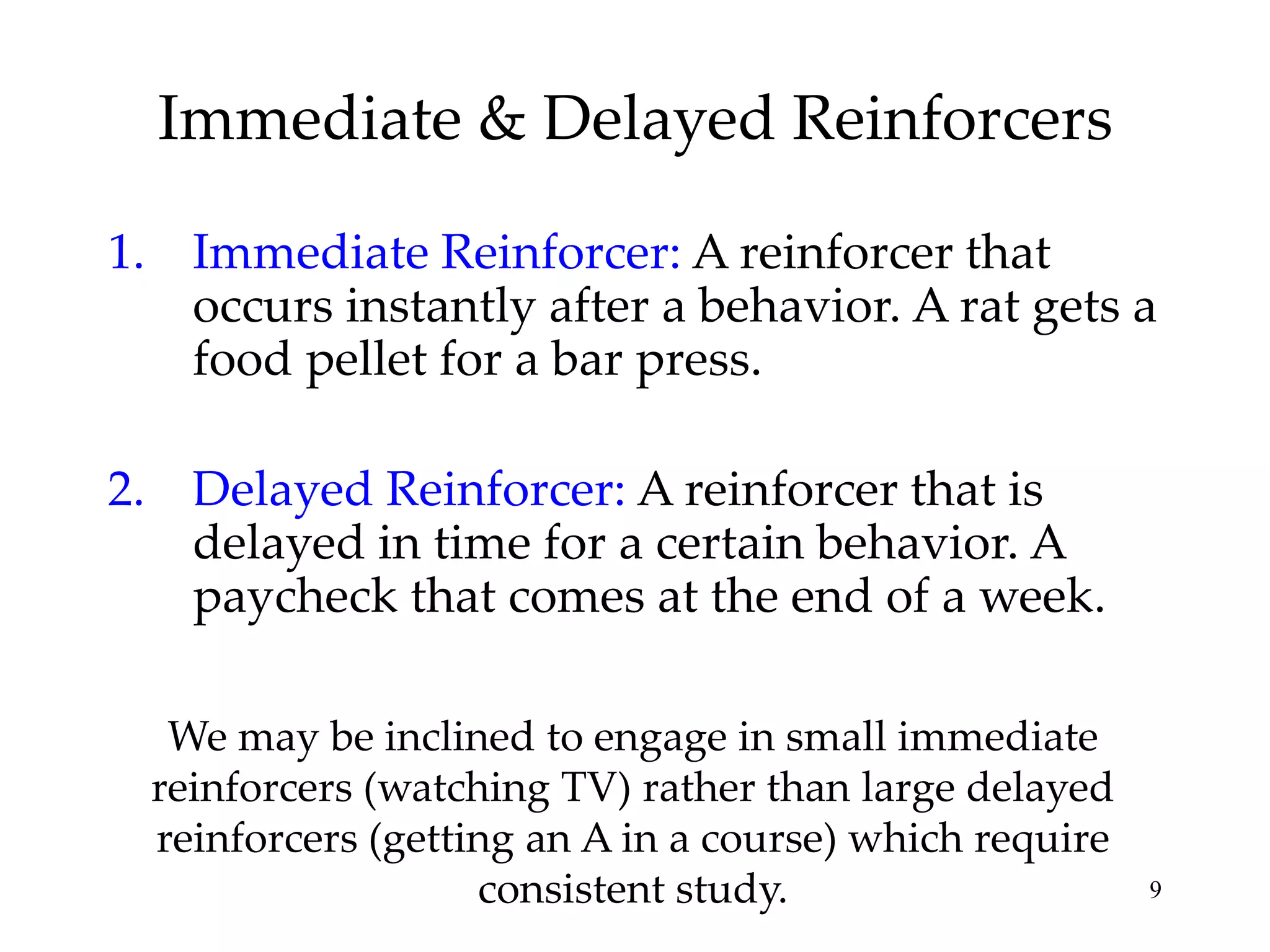
Immediate & Delayed Reinforcers
1. Immediate Reinforcer: A reinforcer that
occurs instantly after a behavior. A rat gets a
food pellet for a bar press.
2. Delayed Reinforcer: A reinforcer that is
delayed in time for a certain behavior. A
paycheck that comes at the end of a week.
We may be inclined to engage in small immediate
reinforcers (watching TV) rather than large delayed
reinforcers (getting an A in a course) which require
consistent study.

9
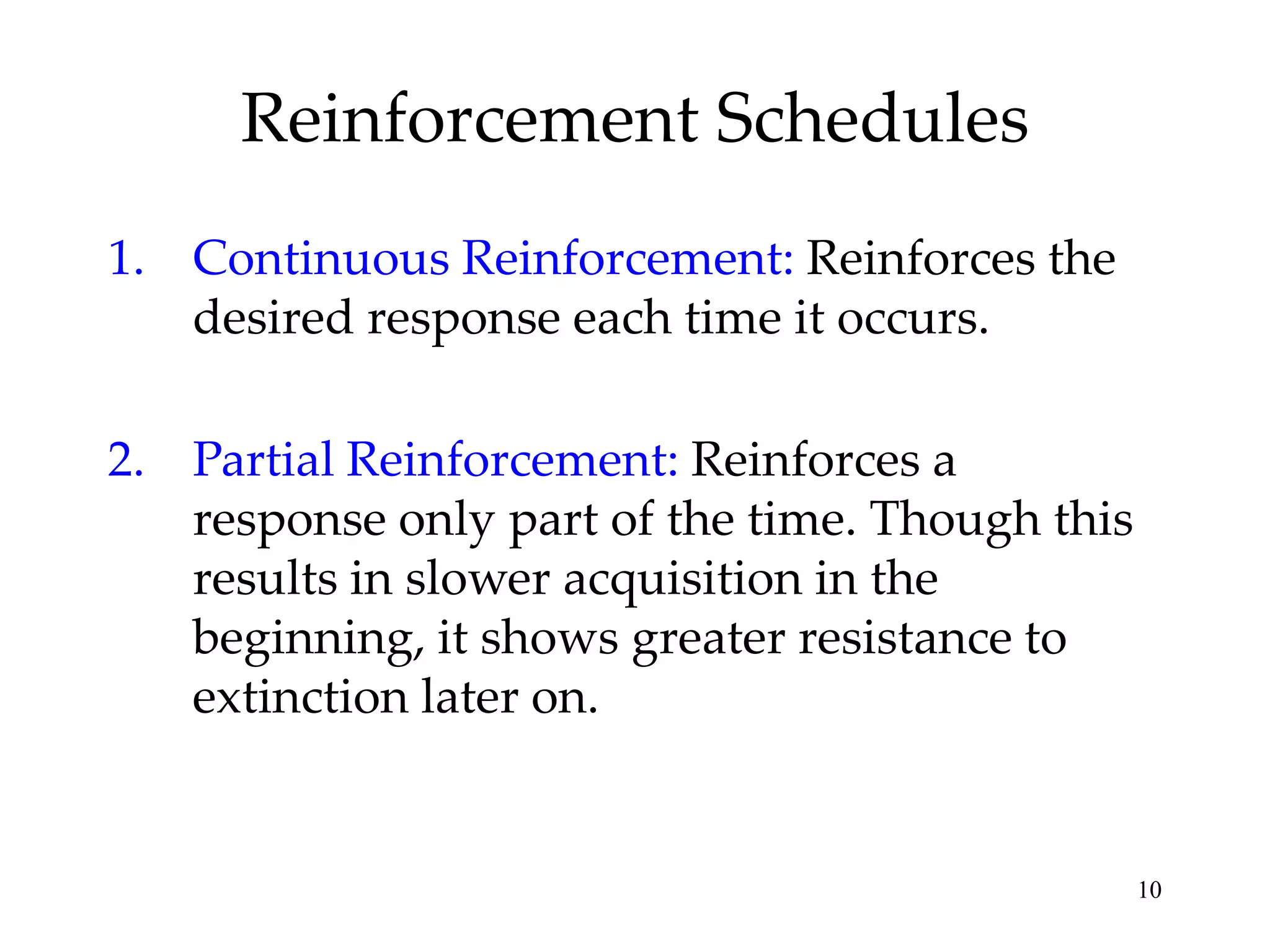
Reinforcement Schedules
1. Continuous Reinforcement: Reinforces the
desired response each time it occurs.
2. Partial Reinforcement: Reinforces a
response only part of the time. Though this
results in slower acquisition in the
beginning, it shows greater resistance to
extinction later on.

10
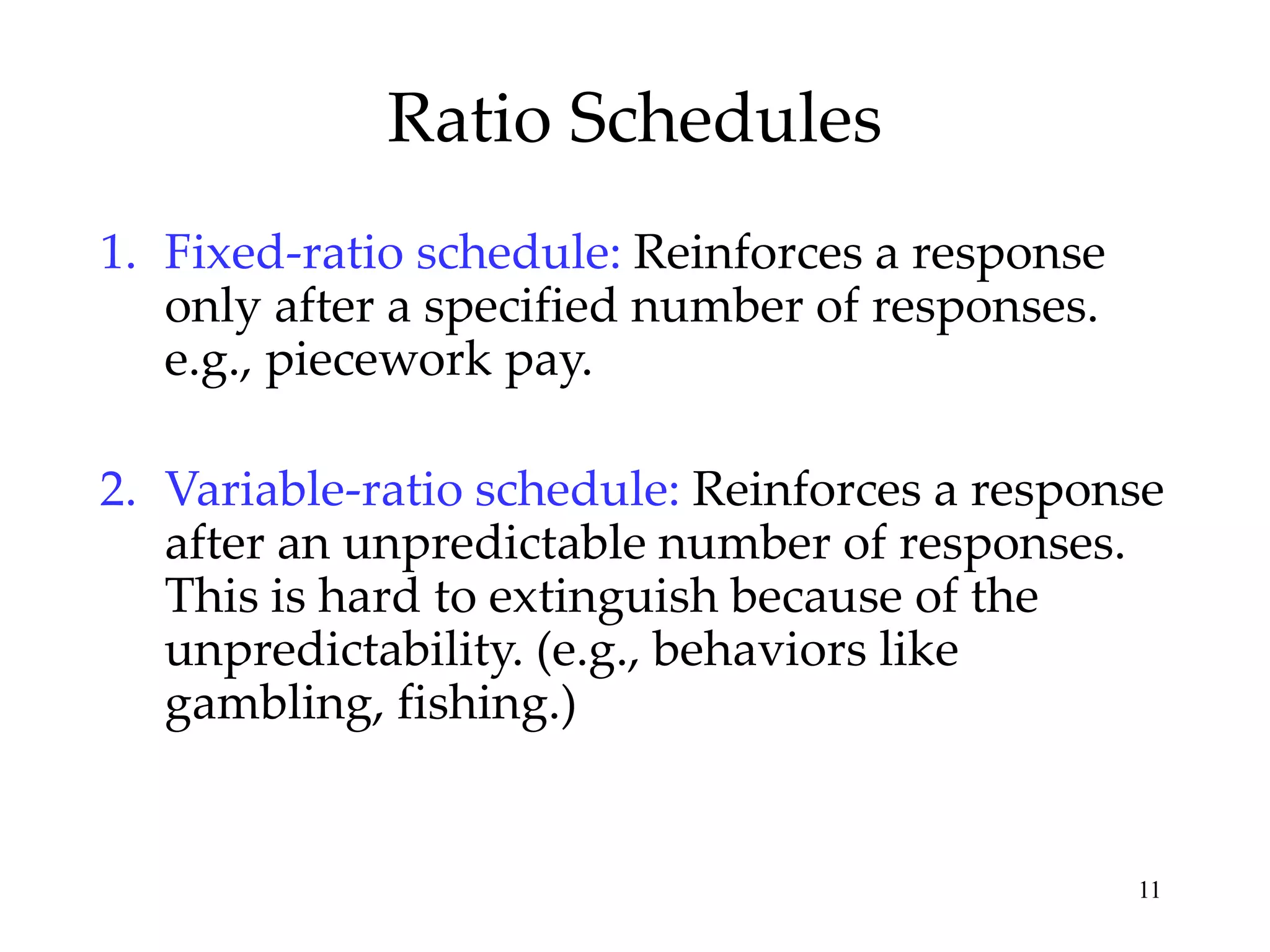
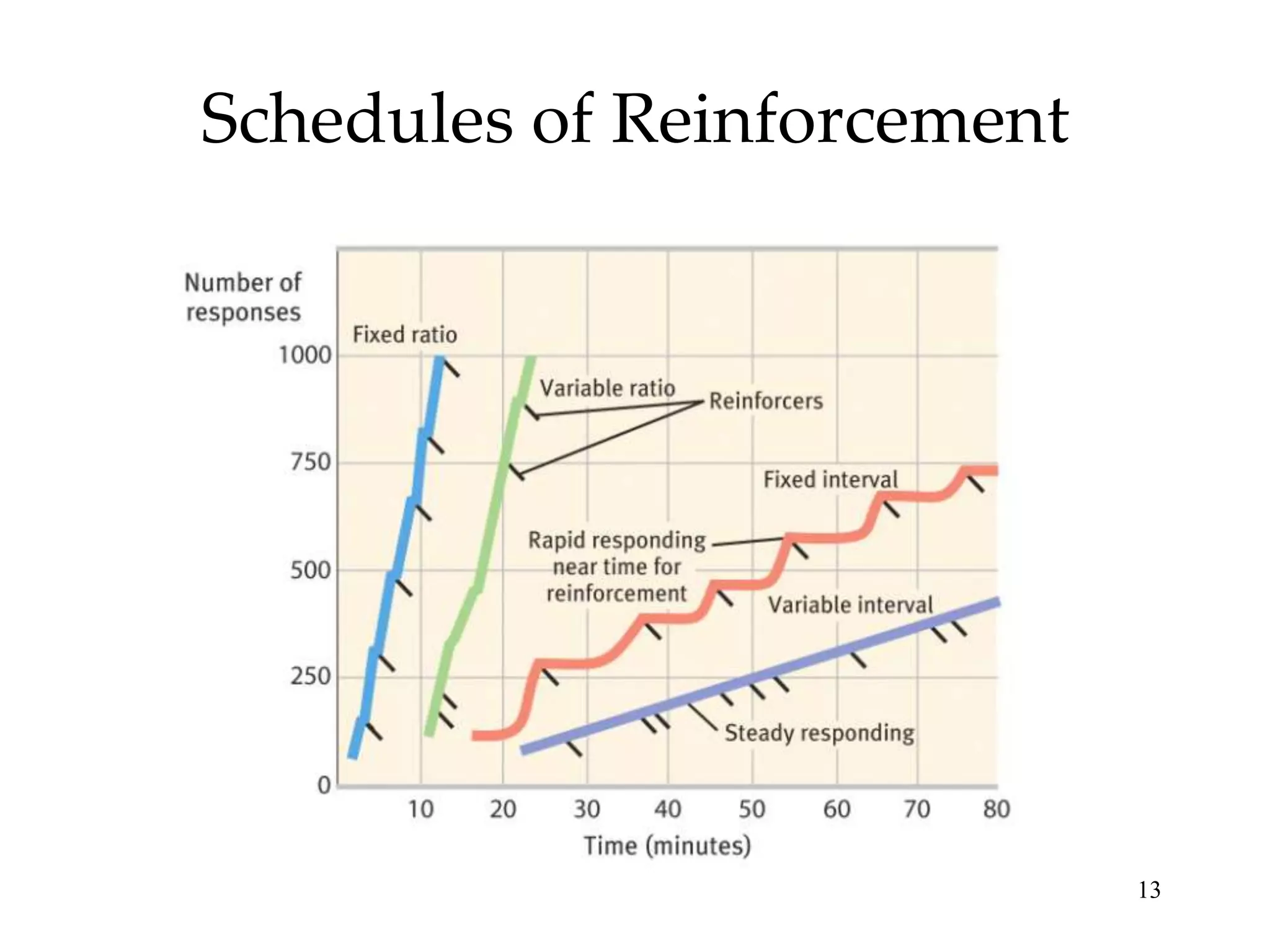
Ratio Schedules
1. Fixed-ratio schedule: Reinforces a response
only after a specified number of responses.
e.g., piecework pay.
2. Variable-ratio schedule: Reinforces a response
after an unpredictable number of responses.
This is hard to extinguish because of the
unpredictability. (e.g., behaviors like
gambling, fishing.)

11
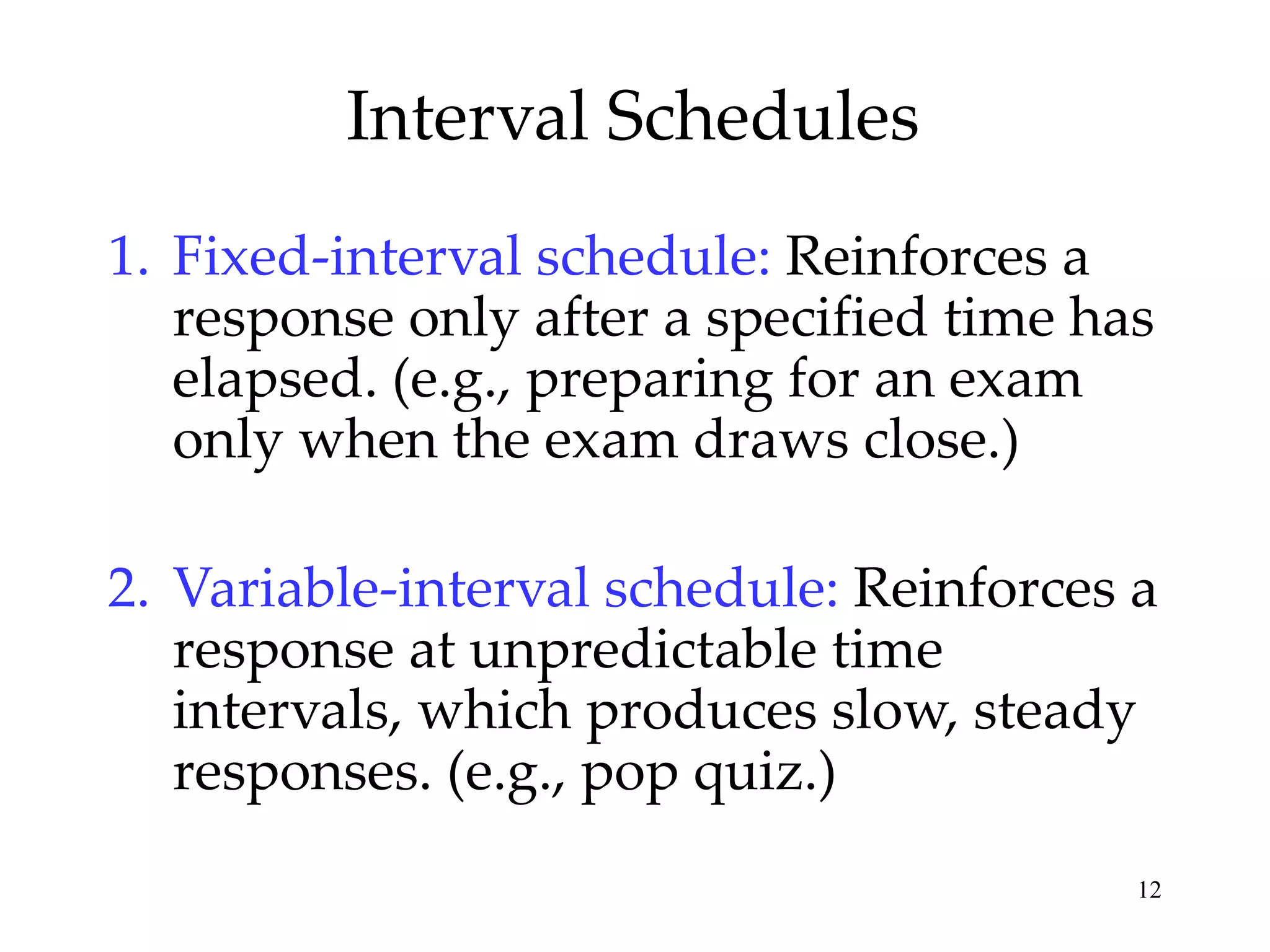
Interval Schedules
1. Fixed-interval schedule: Reinforces a
response only after a specified time has
elapsed. (e.g., preparing for an exam
only when the exam draws close.)
2. Variable-interval schedule: Reinforces a
response at unpredictable time
intervals, which produces slow, steady
responses. (e.g., pop quiz.)
12
Schedules of Reinforcement

13
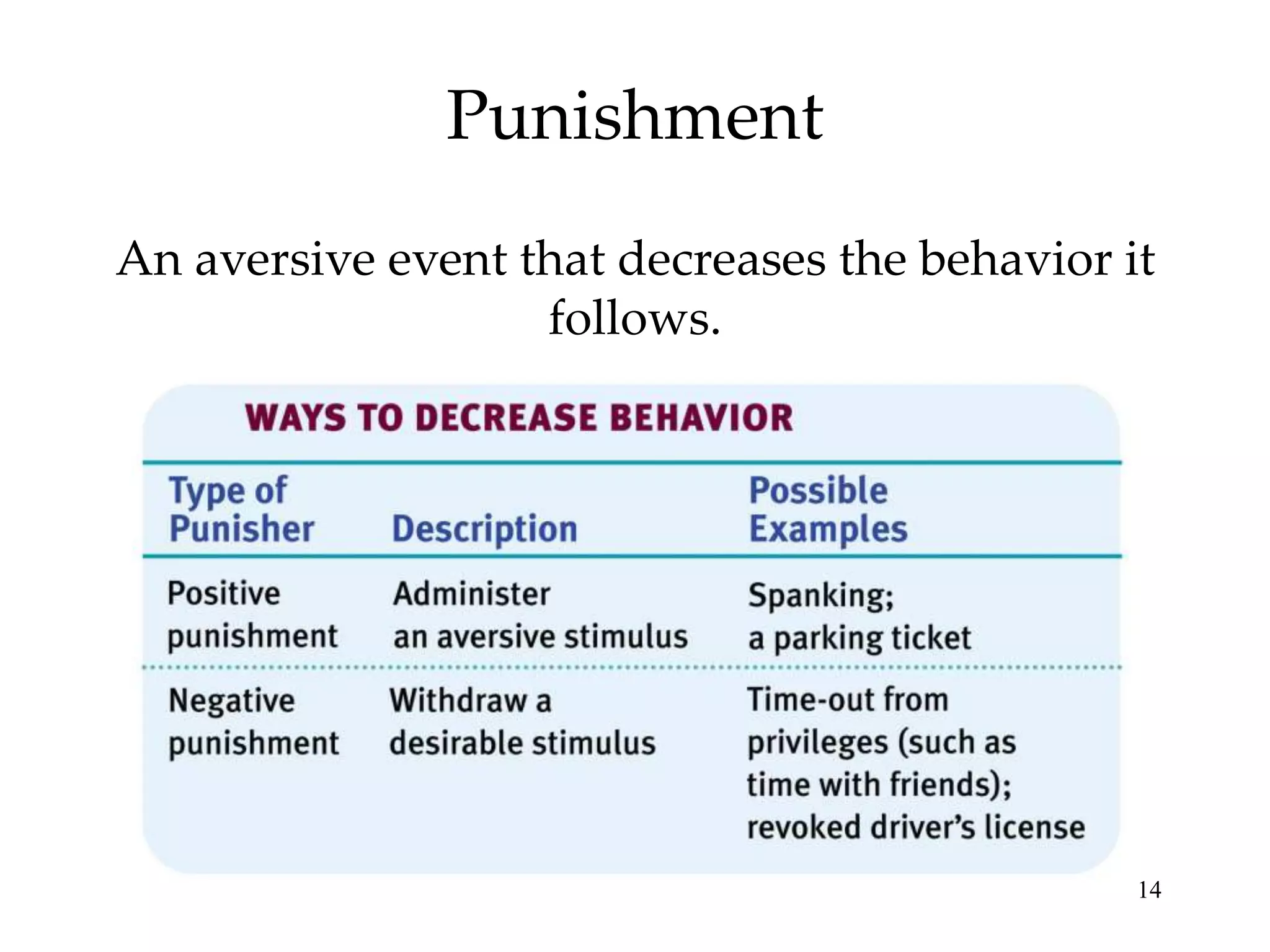
Punishment
An aversive event that decreases the behavior it
follows.

14
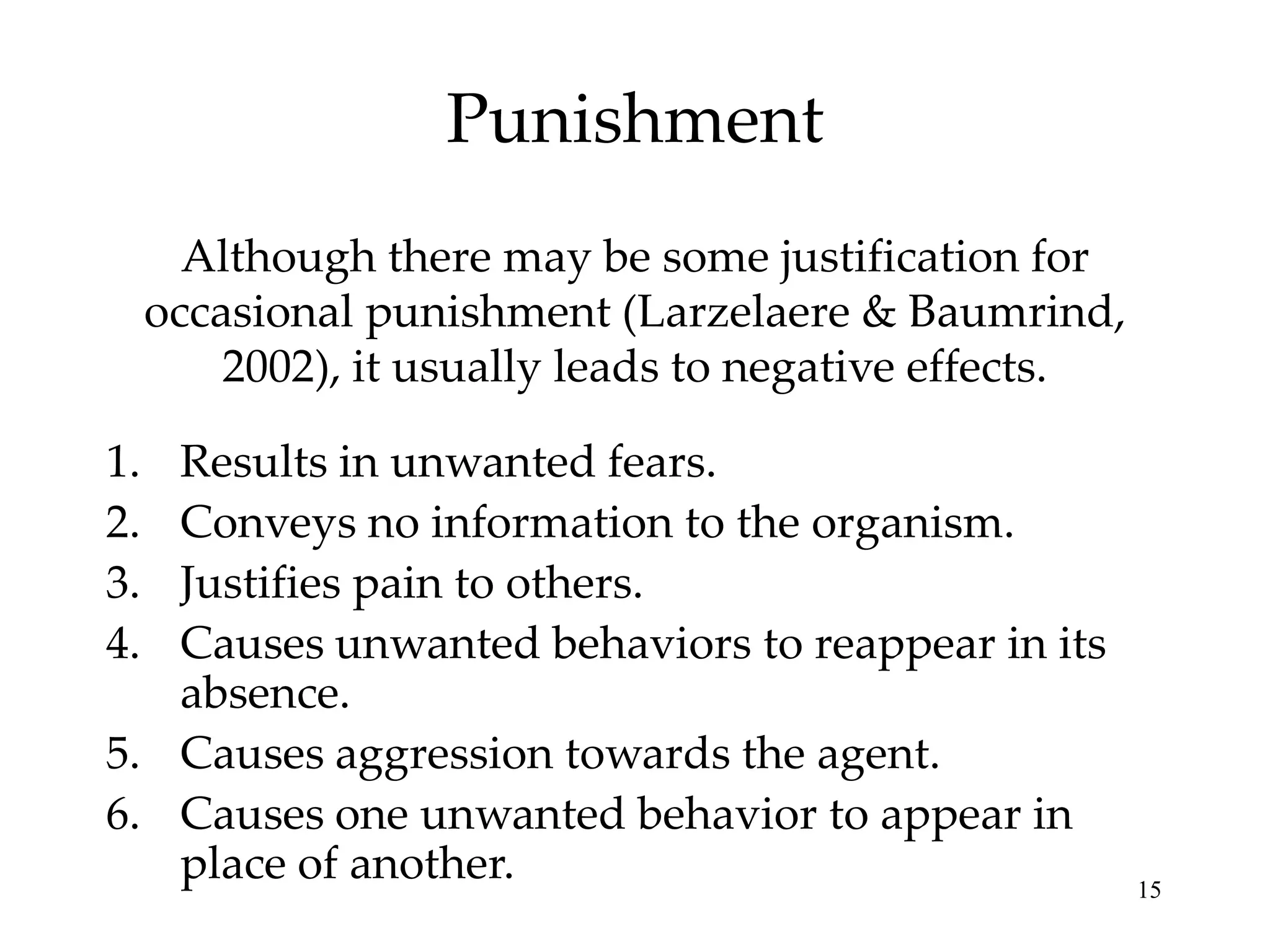
Punishment
Although there may be some justification for
occasional punishment (Larzelaere & Baumrind,
2002), it usually leads to negative effects.
1.
2.
3.
4.

Results in unwanted fears.
Conveys no information to the organism.
Justifies pain to others.
Causes unwanted behaviors to reappear in its
absence.
5. Causes aggression towards the agent.
6. Causes one unwanted behavior to appear in
place of another.

15
Extending Skinner’s Understanding
Skinner believed in inner thought processes and
biological underpinnings, but many
psychologists criticize him for discounting
them.

16
Cognition & Operant Conditioning
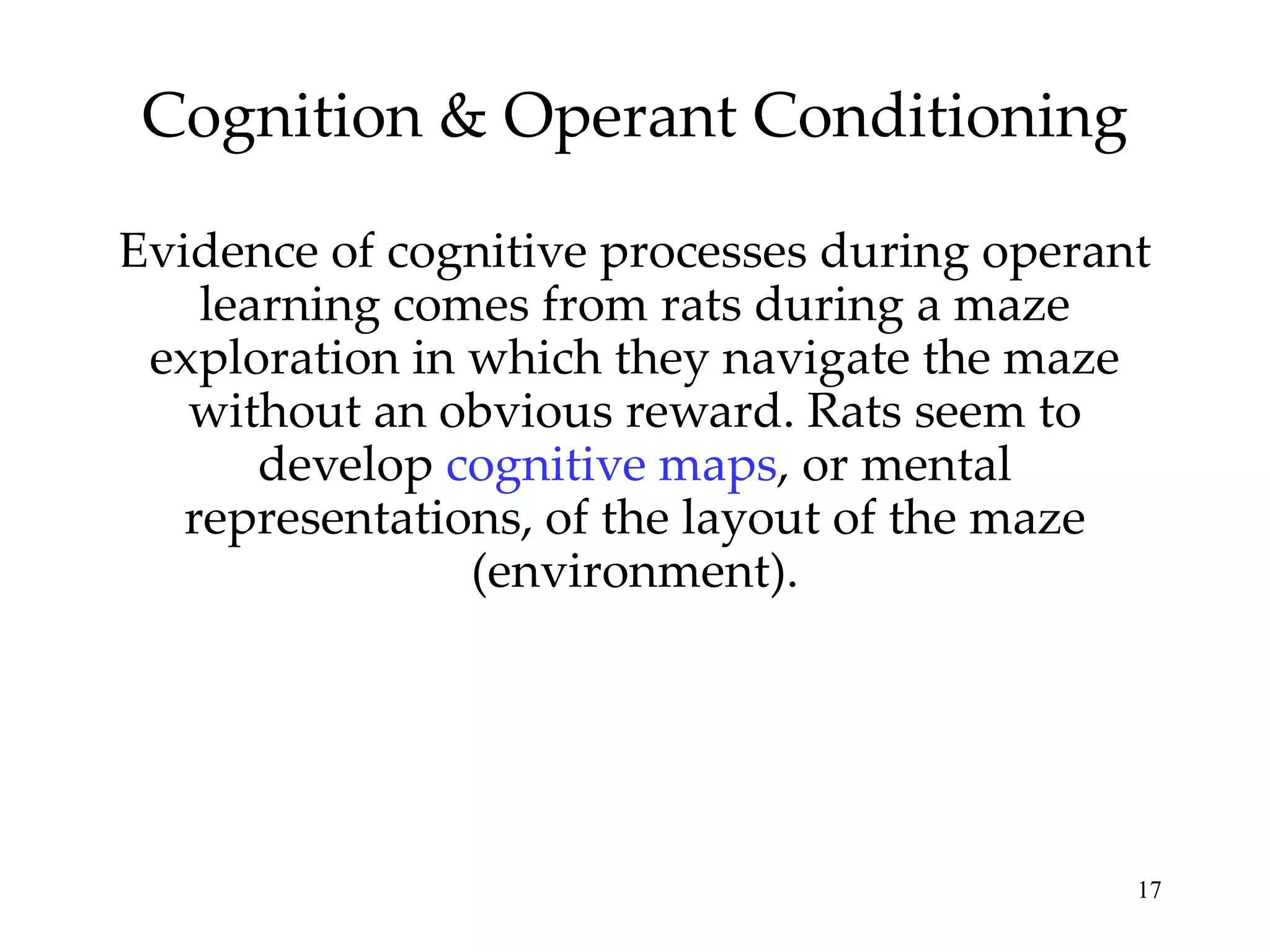
Evidence of cognitive processes during operant
learning comes from rats during a maze
exploration in which they navigate the maze
without an obvious reward. Rats seem to
develop cognitive maps, or mental
representations, of the layout of the maze
(environment).

17
Latent Learning
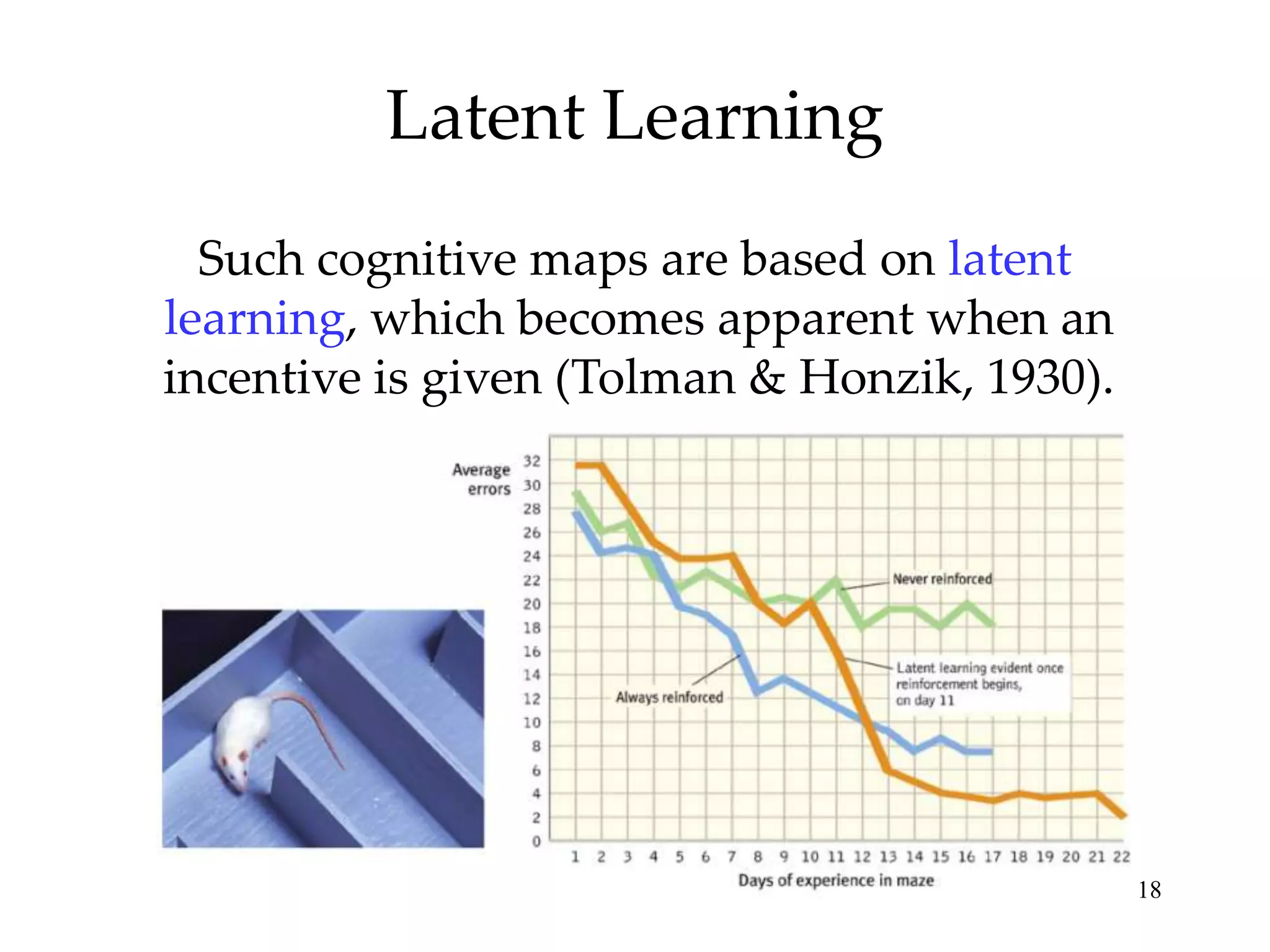
Such cognitive maps are based on latent
learning, which becomes apparent when an
incentive is given (Tolman & Honzik, 1930).

18
Motivation
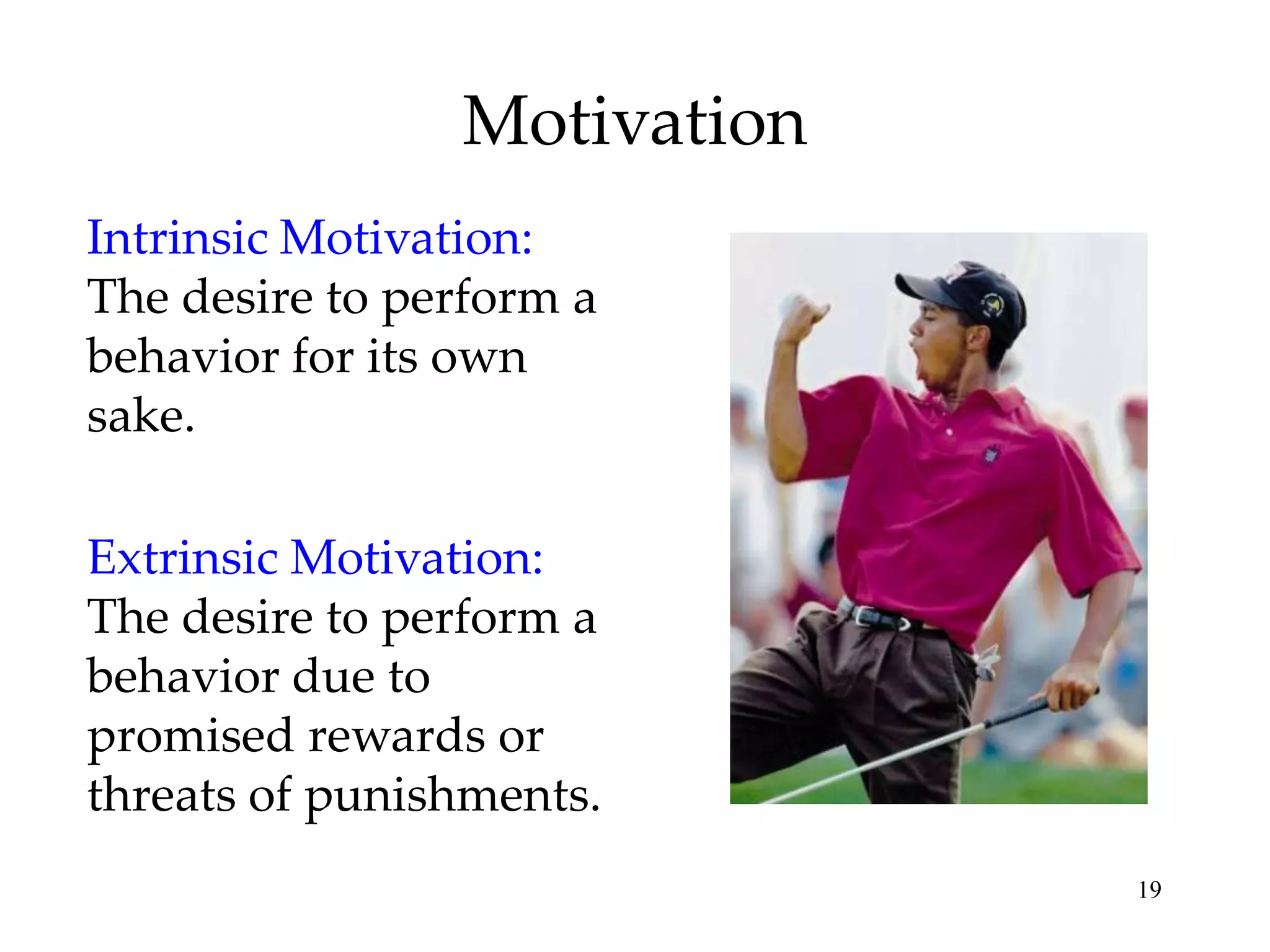
Intrinsic Motivation:
The desire to perform a
behavior for its own
sake.

Extrinsic Motivation:
The desire to perform a
behavior due to
promised rewards or
threats of punishments.
19
Biological Predisposition

Photo: Bob Bailey

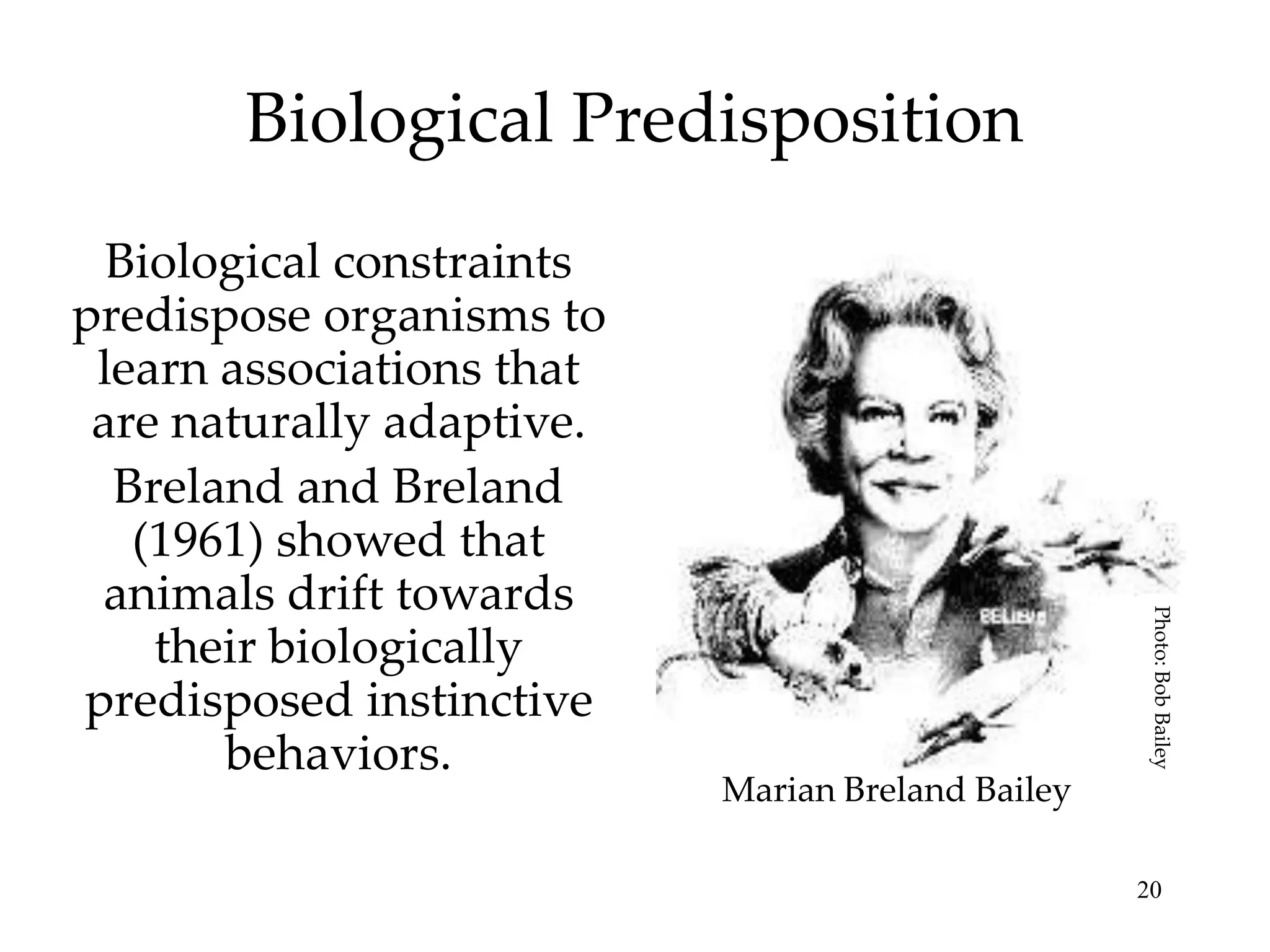
Biological constraints
predispose organisms to
learn associations that
are naturally adaptive.
Breland and Breland
(1961) showed that
animals drift towards
their biologically
predisposed instinctive
behaviors.

Marian Breland Bailey
20
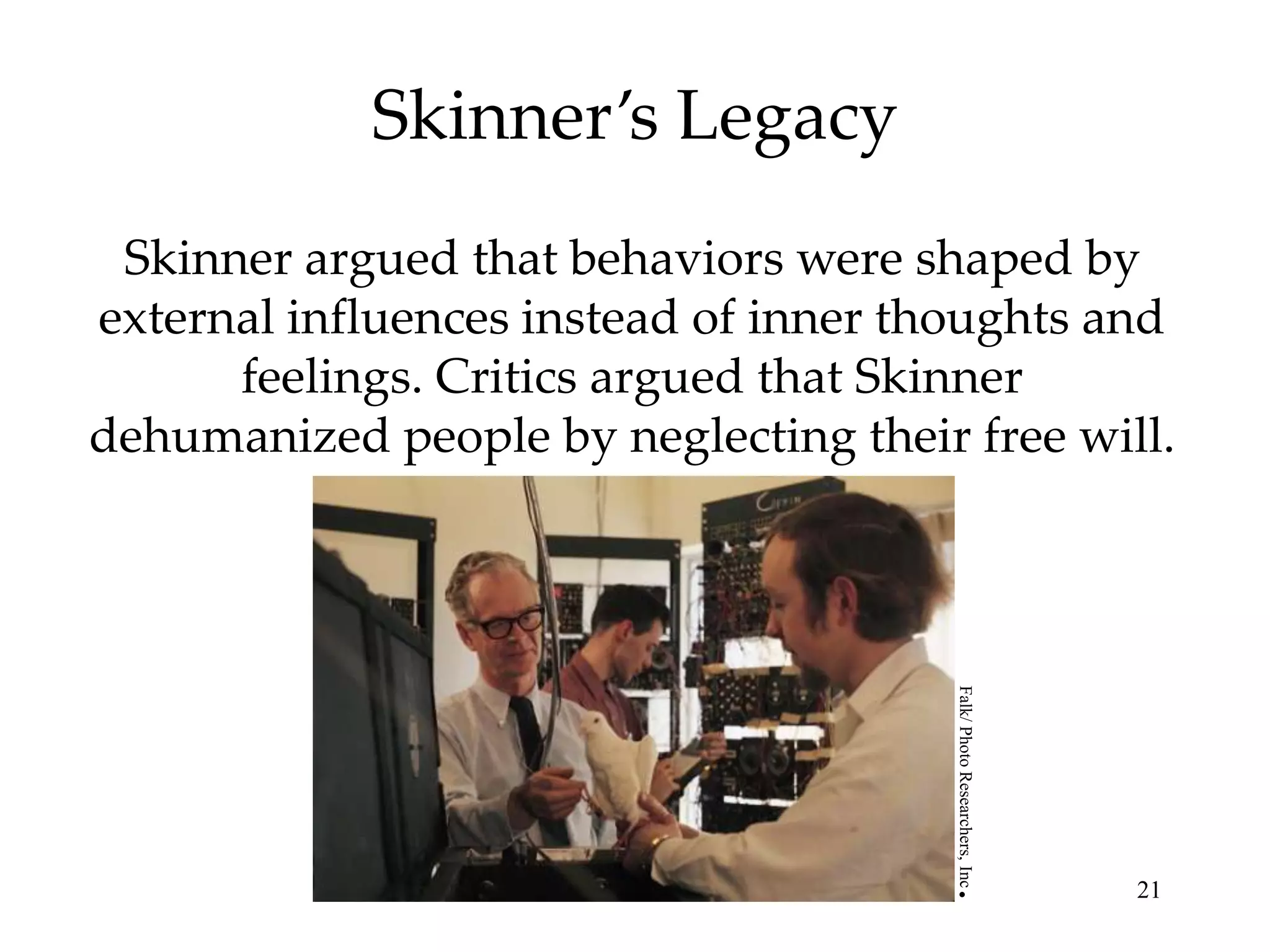
Skinner’s Legacy
Skinner argued that behaviors were shaped by
external influences instead of inner thoughts and
feelings. Critics argued that Skinner
dehumanized people by neglecting their free will.

Falk/ Photo Researchers, Inc

.

21
Applications of Operant
Conditioning
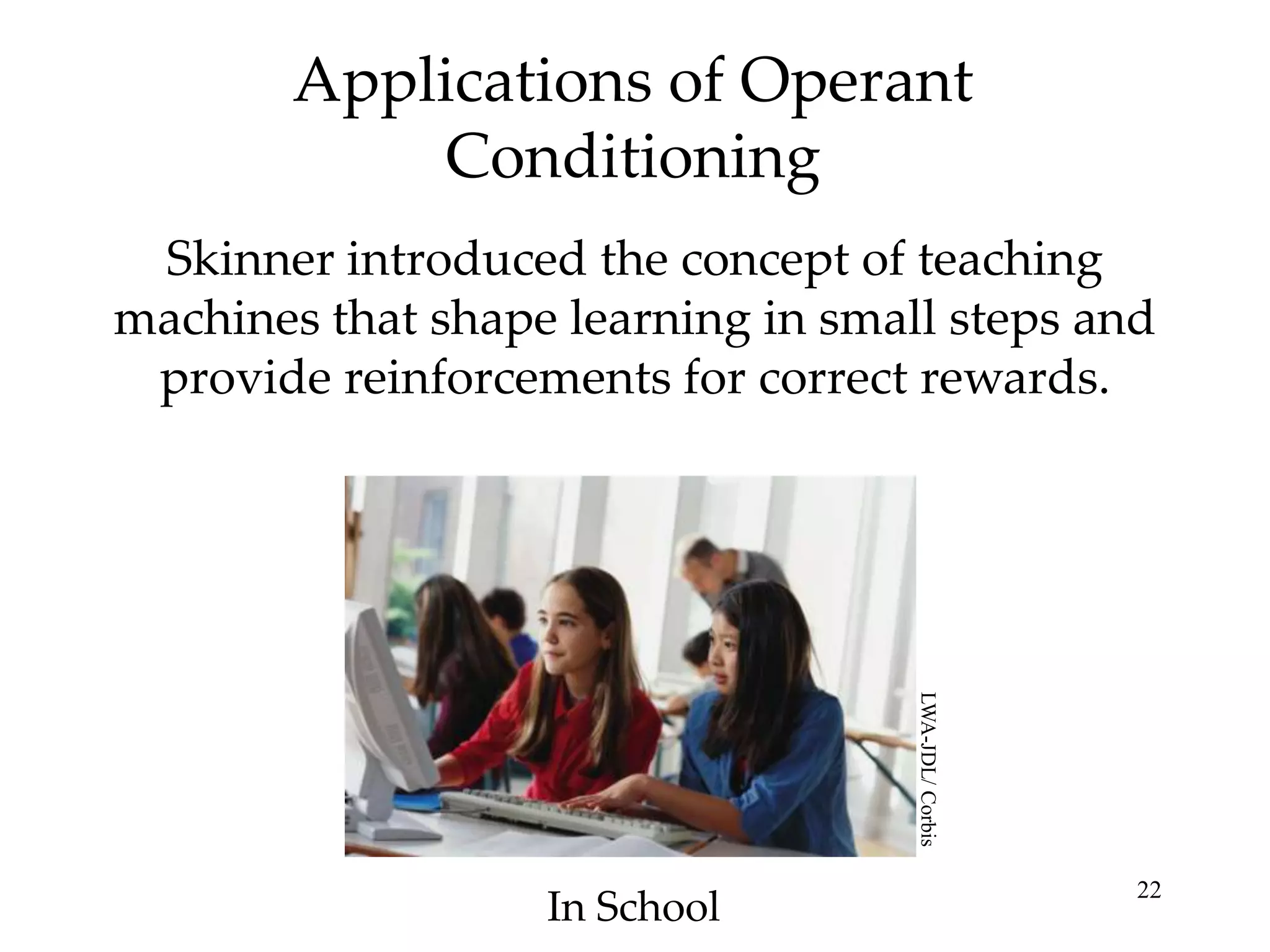
Skinner introduced the concept of teaching
machines that shape learning in small steps and
provide reinforcements for correct rewards.

LWA-JDL/ Corbis

In School

22
Applications of Operant
Conditioning
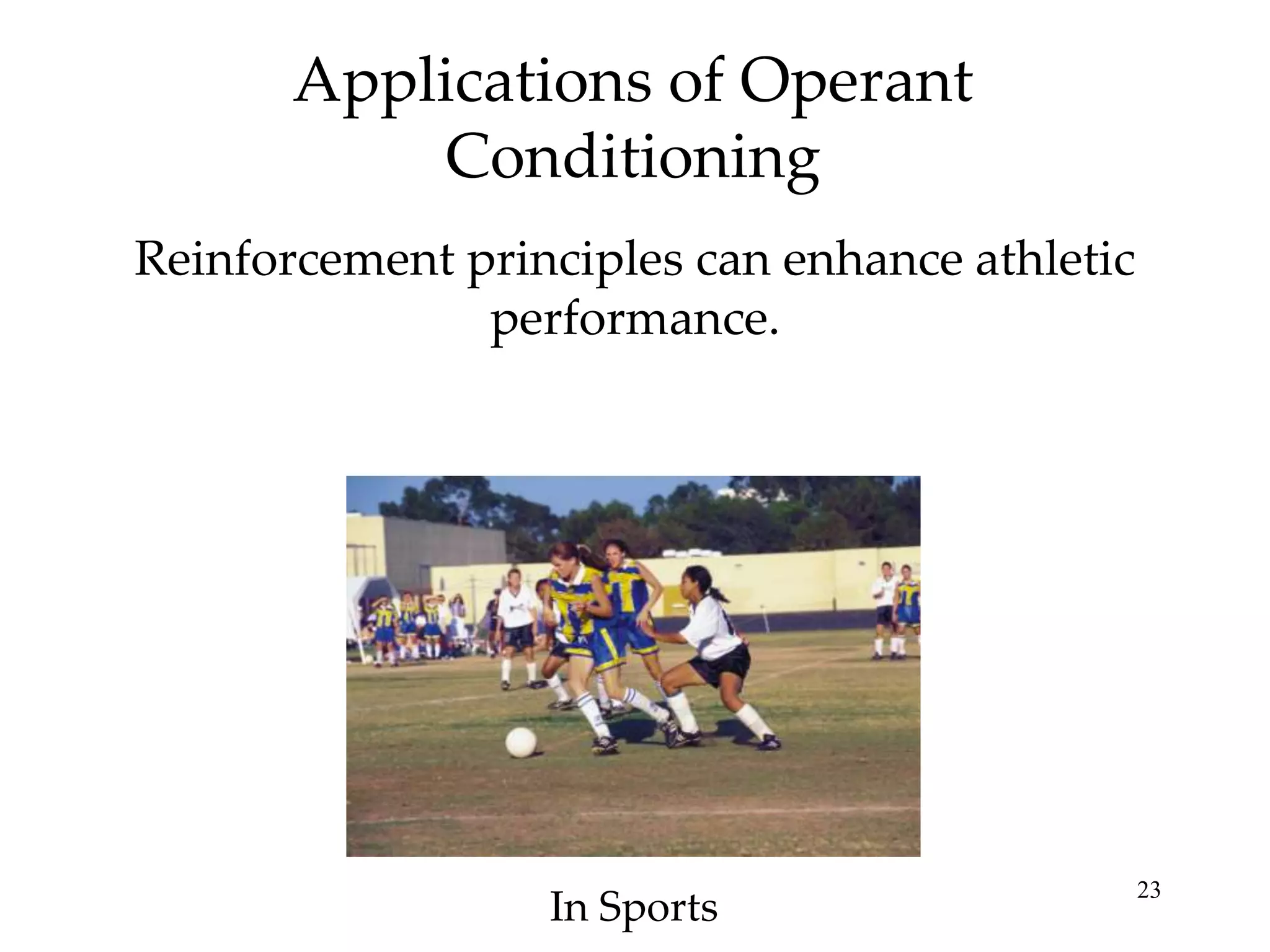
Reinforcement principles can enhance athletic
performance.

In Sports

23
Applications of Operant
Conditioning
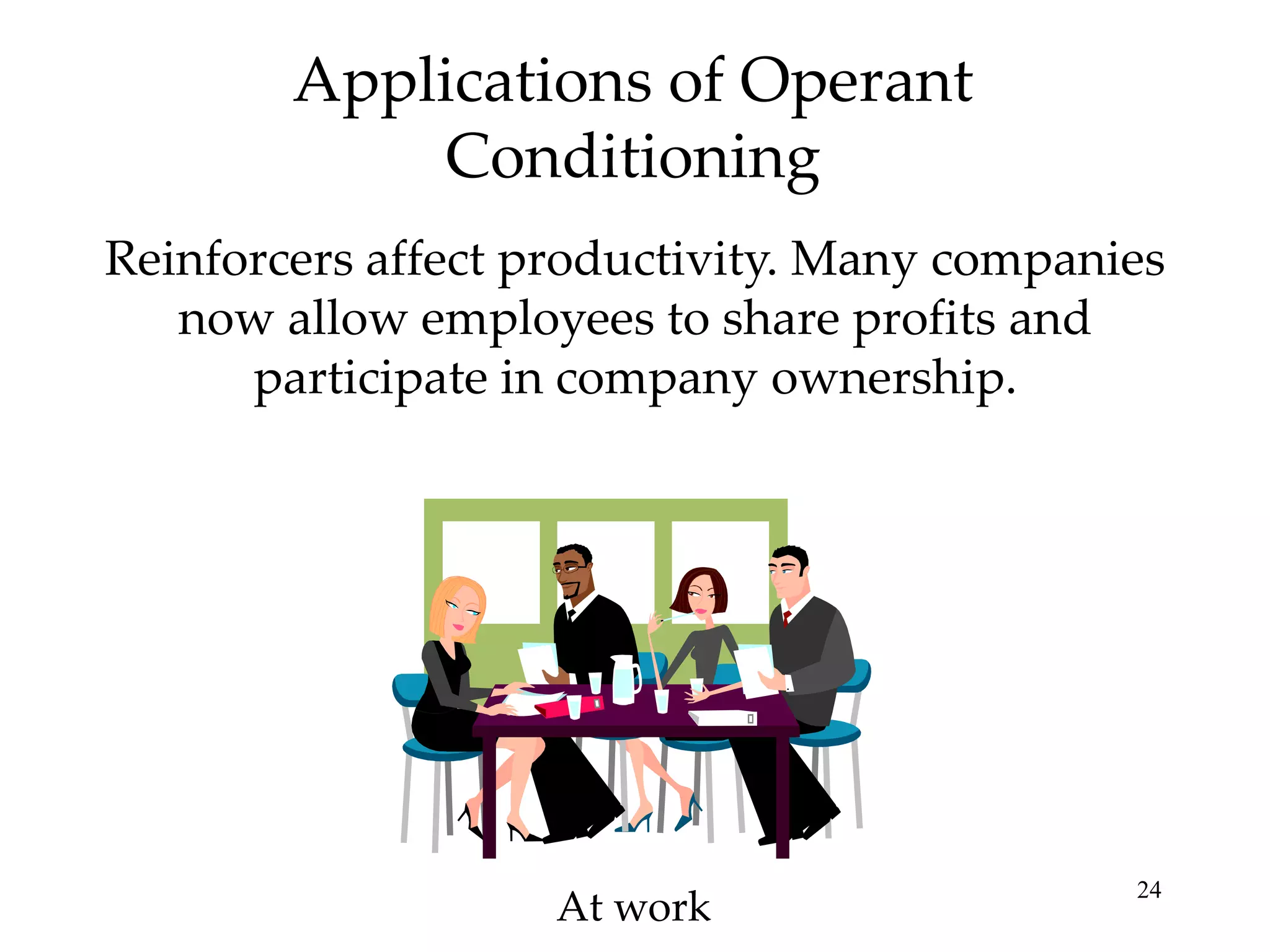
Reinforcers affect productivity. Many companies
now allow employees to share profits and
participate in company ownership.

At work

24
Applications of Operant
Conditioning
In children, reinforcing good behavior increases
the occurrence of these behaviors. Ignoring
unwanted behavior decreases their occurrence.

25
Operant vs. Classical Conditioning

26

Operant conditioning

  • 1.
    Operant & ClassicalConditioning 1. Classical conditioning forms associations between stimuli (CS and US). Operant conditioning, on the other hand, forms an association between behaviors and the resulting events. 1
  • 2.
    Operant & ClassicalConditioning 2. Classical conditioning involves respondent behavior that occurs as an automatic response to a certain stimulus. Operant conditioning involves operant behavior, a behavior that operates on the environment, producing rewarding or punishing stimuli. 2
  • 3.
    Skinner’s Experiments Skinner’s experimentsextend Thorndike’s thinking, especially his law of effect. This law states that rewarded behavior is likely to occur again. Yale University Library 3
  • 4.
    Using Thorndike's lawof effect as a starting point, Skinner developed the Operant chamber, or the Skinner box, to study operant conditioning. Walter Dawn/ Photo Researchers, Inc. 4 From The Essentials of Conditioning and Learning, 3rd Edition by Michael P. Domjan, 2005. Used with permission by Thomson Learning, Wadsworth Division Operant Chamber
  • 5.
    Operant Chamber The operantchamber, or Skinner box, comes with a bar or key that an animal manipulates to obtain a reinforcer like food or water. The bar or key is connected to devices that record the animal’s response. 5
  • 6.
    Shaping Shaping is theoperant conditioning procedure in which reinforcers guide behavior towards the desired target behavior through successive approximations. Fred Bavendam/ Peter Arnold, Inc. Khamis Ramadhan/ Panapress/ Getty Images A rat shaped to sniff mines. A manatee shaped to discriminate objects of different shapes, colors and sizes. 6
  • 7.
    Types of Reinforcers Anyevent that strengthens the behavior it follows. A heat lamp positively reinforces a meerkat’s behavior in the cold. Reuters/ Corbis 7
  • 8.
    Primary & SecondaryReinforcers 1. Primary Reinforcer: An innately reinforcing stimulus like food or drink. 2. Conditioned Reinforcer: A learned reinforcer that gets its reinforcing power through association with the primary reinforcer. 8
  • 9.
    Immediate & DelayedReinforcers 1. Immediate Reinforcer: A reinforcer that occurs instantly after a behavior. A rat gets a food pellet for a bar press. 2. Delayed Reinforcer: A reinforcer that is delayed in time for a certain behavior. A paycheck that comes at the end of a week. We may be inclined to engage in small immediate reinforcers (watching TV) rather than large delayed reinforcers (getting an A in a course) which require consistent study. 9
  • 10.
    Reinforcement Schedules 1. ContinuousReinforcement: Reinforces the desired response each time it occurs. 2. Partial Reinforcement: Reinforces a response only part of the time. Though this results in slower acquisition in the beginning, it shows greater resistance to extinction later on. 10
  • 11.
    Ratio Schedules 1. Fixed-ratioschedule: Reinforces a response only after a specified number of responses. e.g., piecework pay. 2. Variable-ratio schedule: Reinforces a response after an unpredictable number of responses. This is hard to extinguish because of the unpredictability. (e.g., behaviors like gambling, fishing.) 11
  • 12.
    Interval Schedules 1. Fixed-intervalschedule: Reinforces a response only after a specified time has elapsed. (e.g., preparing for an exam only when the exam draws close.) 2. Variable-interval schedule: Reinforces a response at unpredictable time intervals, which produces slow, steady responses. (e.g., pop quiz.) 12
  • 13.
  • 14.
    Punishment An aversive eventthat decreases the behavior it follows. 14
  • 15.
    Punishment Although there maybe some justification for occasional punishment (Larzelaere & Baumrind, 2002), it usually leads to negative effects. 1. 2. 3. 4. Results in unwanted fears. Conveys no information to the organism. Justifies pain to others. Causes unwanted behaviors to reappear in its absence. 5. Causes aggression towards the agent. 6. Causes one unwanted behavior to appear in place of another. 15
  • 16.
    Extending Skinner’s Understanding Skinnerbelieved in inner thought processes and biological underpinnings, but many psychologists criticize him for discounting them. 16
  • 17.
    Cognition & OperantConditioning Evidence of cognitive processes during operant learning comes from rats during a maze exploration in which they navigate the maze without an obvious reward. Rats seem to develop cognitive maps, or mental representations, of the layout of the maze (environment). 17
  • 18.
    Latent Learning Such cognitivemaps are based on latent learning, which becomes apparent when an incentive is given (Tolman & Honzik, 1930). 18
  • 19.
    Motivation Intrinsic Motivation: The desireto perform a behavior for its own sake. Extrinsic Motivation: The desire to perform a behavior due to promised rewards or threats of punishments. 19
  • 20.
    Biological Predisposition Photo: BobBailey Biological constraints predispose organisms to learn associations that are naturally adaptive. Breland and Breland (1961) showed that animals drift towards their biologically predisposed instinctive behaviors. Marian Breland Bailey 20
  • 21.
    Skinner’s Legacy Skinner arguedthat behaviors were shaped by external influences instead of inner thoughts and feelings. Critics argued that Skinner dehumanized people by neglecting their free will. Falk/ Photo Researchers, Inc . 21
  • 22.
    Applications of Operant Conditioning Skinnerintroduced the concept of teaching machines that shape learning in small steps and provide reinforcements for correct rewards. LWA-JDL/ Corbis In School 22
  • 23.
    Applications of Operant Conditioning Reinforcementprinciples can enhance athletic performance. In Sports 23
  • 24.
    Applications of Operant Conditioning Reinforcersaffect productivity. Many companies now allow employees to share profits and participate in company ownership. At work 24
  • 25.
    Applications of Operant Conditioning Inchildren, reinforcing good behavior increases the occurrence of these behaviors. Ignoring unwanted behavior decreases their occurrence. 25
  • 26.
    Operant vs. ClassicalConditioning 26